The tower was supposed to fall at half past nine on the morning of 4 May 1995. Tens of thousands of Latvians had driven out to the fields and forest roads north of Skrunda to watch it happen, parking along the verges, standing on car roofs, waiting in the cold with a national television crew live on air. The countdown ran. Nothing happened. A helicopter had drifted too close to the exclusion zone and the shot was aborted. For thirteen minutes the crowd stood looking at a nineteen-storey concrete slab in the middle of a birch forest, and then at 9:43 the charges fired, an orchestral piece written for the occasion played over the fields, and the largest unfinished radar in the Soviet early-warning network came down in a grey cloud. Latvia’s prime minister, Māris Gailis, told reporters that the Skrunda monster had collapsed.
The building destroyed that morning had never worked. Construction on the Daryal-UM had begun in 1984 and stopped in August 1991, when Latvian authorities halted it as the Soviet Union came apart. It was an empty shell with no equipment inside, on land that already belonged to Latvia, and it could have been dismantled slowly and cheaply by anyone with a crane and a decade. The United States paid seven million dollars to have it blown up in front of a television audience instead.
That figure is the whole story of Skrunda-1. Sovereignty is a legal condition, and legal conditions are invisible. A new state four years out from occupation, still hosting Russian troops on its own territory under a signed lease, needed something a citizen could see from a field. The tower was chosen because it was the biggest thing in the country that nobody would miss.
Why the Soviet Union Built a Secret Radar City in Western Latvia
The Dnepr Radars and the Soviet Missile Early-Warning Line
Skrunda sat at the western edge of the Soviet Union, and that geography was the entire reason the town existed. Two Dnepr radars went up in the forest during the 1960s, long low structures that NATO analysts nicknamed Hen House for their shape. They faced west across the Baltic and swept the airspace over most of Western Europe, tracking objects in orbit and watching for the launch signature of missiles fired from NATO submarines or from the continent. Everything they saw went to Moscow. The station was garrisoned by the 129th Independent Radio-Technical Unit and paired with a receiving station called Daugava.
The arithmetic that made the site matter was brutally simple. A missile launched from the North Atlantic would reach Moscow in under thirty minutes, and every kilometre of westward radar coverage bought the Soviet leadership more time to decide whether to launch in return. Skrunda bought roughly the most of any station in the network. Its counterpart in the Ukrainian SSR, the enormous over-the-horizon antenna at the Duga Radar, tried to detect launches at the moment of ignition by bouncing signals off the ionosphere and never worked reliably enough to be trusted alone. Skrunda’s job was the unglamorous one: confirming what was already in the air, and doing it correctly.
A Closed Town With No Name on Any Soviet Map
The Soviet Union built more than forty settlements of this type, and the naming convention gave them away to anyone paying attention. A closed town took the name of the nearest ordinary town and added a number. Skrunda-1 sat five kilometres north of Skrunda, in Raņķi parish, and did not appear on maps printed in Riga or anywhere else. The bus stop on the road outside was labelled simply as the facility.
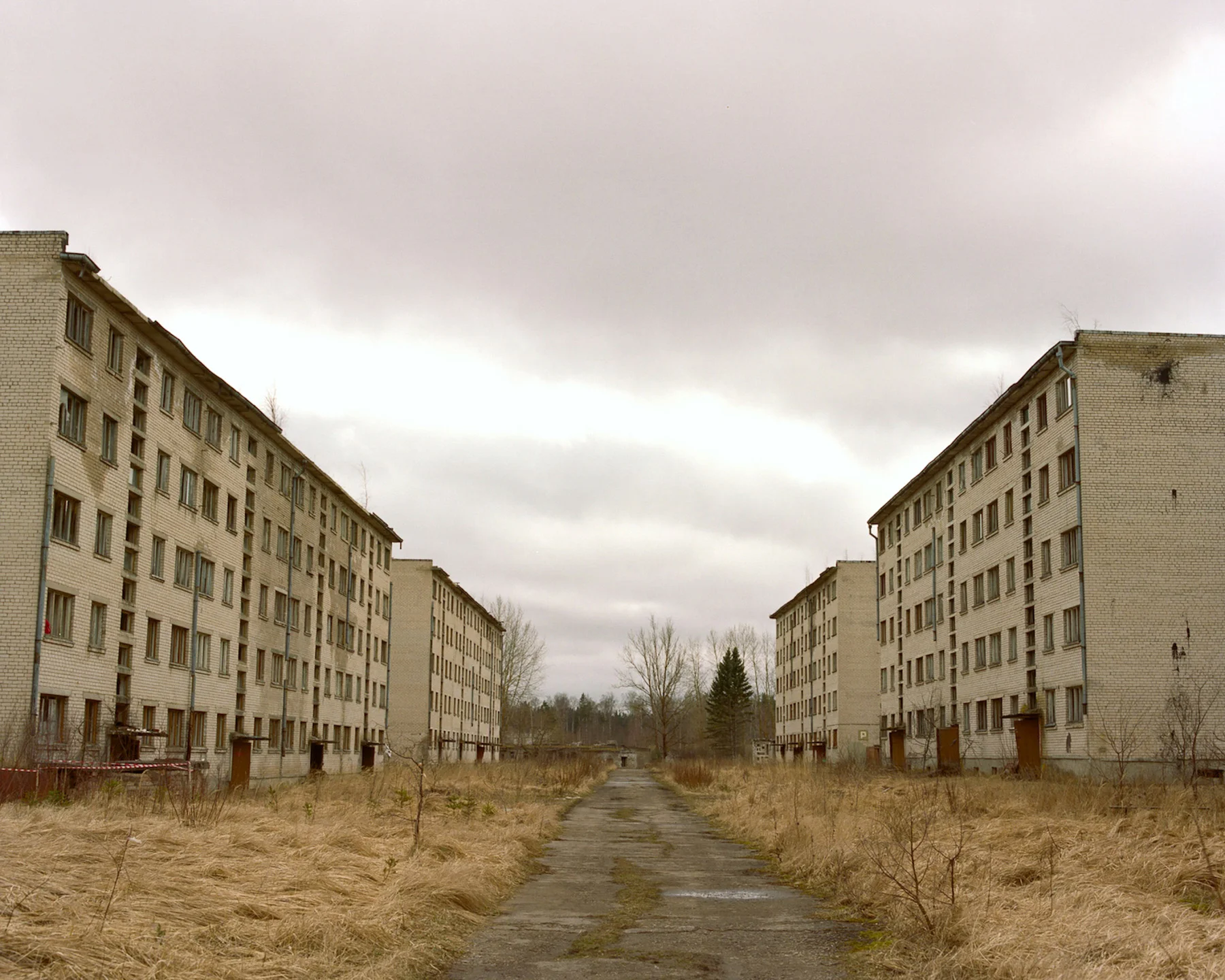
Ten apartment blocks went up in the forest, along with a school, a kindergarten, a hospital, a cultural centre, a gymnasium, shops, a sauna, garages and a water tower that still stands above the treeline. Around 5,000 people lived inside the fence at the town’s peak: officers, radar technicians, engineers, their wives and their children. Latvian citizens from the town four miles down the road could not enter. Most had no clear idea what was inside.
Life Inside Skrunda-1: The Closed Soviet Town of 5,000
Apartments, Schools and Shops Behind the Perimeter Fence
Closed towns were rewarded for their secrecy, and the reward arrived as groceries. Supply to Soviet military installations of strategic rank ran ahead of supply to the civilian economy around them, which produced the defining absurdity of Skrunda-1: a fenced settlement in rural Latvia whose shops carried goods that people in Skrunda proper queued for and often did not get. Officers’ families had a swimming pool, a cinema in the cultural centre and a school with a full staff. The Latvian farming families outside the wire had a shop with empty shelves and a view of a fence.
The children inside grew up in a town that was, in an official sense, nowhere. Their address was a post-box number. They were schooled in Russian, in a curriculum shipped from Moscow, in a country their parents had been posted to and most of them had never chosen. The apartment blocks still hold the residue of that ordinary life — wallpaper, radiators, the tiled stairwells of Soviet mass housing, classrooms with the frames of portraits still hanging where the portraits used to be.
The Radiation Fears That Turned Skrunda Into a Political Weapon
Fear of the radars ran through the surrounding parishes for years and became one of the most effective arguments in Latvian politics. Residents around Skrunda described headaches, sleeplessness, ringing in the ears, electronics failing without cause and strange lights above the forest. Scientific investigation followed independence and produced results that were suggestive at best and never conclusive; no study established that the transmitters were harming the people who lived under them.
The absence of proof changed nothing. The radars were a Soviet installation operating on Latvian soil, aimed at the West, and staffed by a foreign army — a set of facts that made the health question feel like a technicality to almost everyone outside the laboratories. By 1994 the word Skrunda functioned in Latvian public life as a synonym for occupation, and the physics had stopped mattering.
The 1994 Agreement That Let Russia Keep Its Radar in an Independent Latvia
Negotiating the Russian Military Withdrawal from the Baltics
Latvia negotiated the removal of the Russian army from its territory in 1994 and paid for it with Skrunda. The agreement on the legal status of the Skrunda radar station, signed on 30 April 1994, allowed the Russian Federation to keep operating the Dnepr installations for four more years, followed by eighteen months to dismantle them. The final deadline was 29 February 2000. Russian troops left the rest of the country; a Russian military facility remained in the forest of Kurzeme, with Russian soldiers living in it, six years after Latvia declared its independence restored.
The deal was deeply unpopular. On 12 March 1994 the Latvian Popular Front organised a rally against it, arguing that a leased radar station was a foothold and that a country cannot be sovereign in most of its territory. The government’s answer was that the alternative to a dated lease was an undated occupation.
Germany was negotiating the same departure on a far larger scale and finished sooner. The Soviet high command for every unit in East Germany sat at Wünsdorf, a sealed city of some 75,000 people south of Berlin, and the last troops left German soil in the summer of 1994 — four years before a single radar in Kurzeme was switched off.
Moscow’s need was concrete rather than symbolic. The replacement station at Baranovichi in Belarus was years from completion, and until it came online the Russian early-warning network’s western coverage depended on Skrunda, patched with the Balkhash radar in Kazakhstan and the Gabala station in Azerbaijan. The weakness of that network was demonstrated three months before the tower came down: on 25 January 1995 a Norwegian scientific rocket launched from Andøya was read by Russian radar operators as a possible submarine-launched missile, and the nuclear briefcase was opened in front of Boris Yeltsin. The system that Skrunda fed was, at that exact moment, misreading the sky over Scandinavia.
The Unfinished Daryal-UM Radar Left Standing in the Forest
The Daryal-UM was meant to replace the Dnepr radars entirely. Construction started in 1984 on a receiver structure that reached nineteen storeys, a concrete cliff face rising out of flat forest and visible for kilometres. Work stopped in August 1991. The building had never been fitted with its electronics and never emitted a signal.
Latvia took possession of the empty shell and put its removal out to tender. A working group met in the Saeima building on 28 October 1994, chaired by Prime Minister Gailis, to settle the administrative arrangements with the American Department of Defense and the contractor that had won the bid: Controlled Demolition, Inc., a family firm from Phoenix, Maryland, that had spent half a century imploding stadiums and department stores.
The 1995 Demolition of the Skrunda Radar Tower
Controlled Demolition, Inc. and the Cost of Bringing It Down
The Americans paid for the demolition, which is the detail that makes the event legible. Seven million dollars of United States money went into removing a Soviet radar from a country that had been part of the Soviet Union four years earlier, hired out to an American firm that normally worked on car parks in Baltimore. Nothing about the operation was economically rational. The building was worthless, immobile and harmless, and the cost of leaving it standing was zero.
The choreography absorbed the budget. Latvian television carried the event live. Fireworks were prepared. The composer Zigmars Liepiņš, one of the best-known musicians in the country, wrote an orchestral piece called Liberatio to be played across the site as the charges fired. Government ministers and foreign diplomats were assembled with champagne. A national government arranged, in effect, a state funeral for a building.
Watching the Tower Fall on Latvian Independence Day
The date carried the argument. 4 May was the fifth anniversary of the 1990 declaration that restored Latvian independence, and the demolition was scheduled to land on it precisely so that the two events would fuse in the national memory.
The first attempt failed for reasons that no ceremony can control. A helicopter strayed too close to the tower and the firing sequence was halted on safety grounds, leaving a crowd of tens of thousands standing in a field watching a building refuse to die. The charges went off successfully at 9:43. The concrete came down in seconds, the music played, and Russian soldiers — still resident in the town, still operating the two working radars four hundred metres away — watched the destruction of their unfinished replacement from inside the perimeter they were legally entitled to occupy for another three years.
The rubble was cleared by November 1995.
Closure in 1998 and the Last Residents of Skrunda-1
The OSCE Inspection That Verified the Radar Was Dead
Russia asked for an extension in the summer of 1998, requesting two more years on the Dnepr station until Baranovichi was ready. Riga refused. The presidents of Estonia, Latvia and Lithuania had issued a joint statement at New Year pressing Yeltsin to finish the withdrawal he had promised in 1994, and the Baltic position held. Operations at Skrunda ceased on 31 August 1998, and an inspection team from the Organization for Security and Co-operation in Europe verified on 4 September that the radar was closed.
Dismantling took another year. Equipment worth moving went east by rail; the Dnepr structures came down; the housing, the school, the hospital and the cultural centre stayed exactly where they were because nobody had any use for them.
The Last Families Leave the Town
The town emptied through the autumn of 1999. Families packed what they could carry and left the rest — furniture, curtains, crockery, children’s drawings on classroom walls, files in the administrative offices. In one apartment kitchen a tear-off calendar hangs on the wall with its last page torn to Thursday, 4 November 1999. It has not moved since.
The final residents were the third generation of people whose lives had been organised entirely around a machine that scanned the western sky. They were leaving a place that had never officially existed, in a country that had never wanted them, for a Russia most of the younger ones had never lived in. The gates closed behind them in October and the forest began the work it has been doing ever since.
Selling a Ghost Town: The Skrunda-1 Auction and Its Collapse
The 2010 Auction and the Russian Buyer Who Never Paid
Latvia decided to sell the town in 2008 and put the entire site up as a single lot. On 5 February 2010, in an auction room in Riga, roughly 70 buildings across 40 hectares of forest went under the hammer with a starting price of 150,000 lats. The bidding ran for two hours. The winner, at 1.55 million lats — around 3.1 million dollars, more than ten times the opening figure — was Alekseevskoye-Serviss, a Russian company.
The symmetry was too neat for comfort in Latvia: a secret Soviet town, sold back to a Russian buyer at auction by the state that had spent seven million American dollars proving it was free of Russian control. The commentary lasted longer than the deal. The purchase collapsed, the buyer developed nothing, and the property was put up again for less than half the winning price. That sale failed as well.
Looting, Decay, and the Army That Took It Back
Skrunda Municipality bought the town back in 2015 for 12,000 euros. The number is the honest valuation: a fifteen-year-old ghost town, stripped by scrap-metal thieves of every pipe, radiator, cable and window frame worth removing, in a district with no industry to attract.
The municipality began charging four euros for entry in February 2016 as urban explorers arrived in growing numbers, and demolition of the most dangerous buildings started soon after. Roughly half the site went to the Latvian National Armed Forces. The town closed to visitors in 2022 and now operates as Mežaine, a military training area used by the 4th Brigade of the National Guard for urban warfare instruction.
Latvian soldiers now clear Soviet stairwells room by room, in a town built to warn Moscow that the West was coming. The buildings are being used, in the end, for exactly the thing they were designed to prevent.
Visiting Skrunda-1 Today: Access, Tours and the Mežaine Training Area
Access to Skrunda-1 is restricted, and the situation on the ground has changed more than once in the past decade. The open-gate period ran from roughly 2016 to 2022, when the municipality sold tickets and allowed unaccompanied wandering. That arrangement ended when the site was designated a military training area. Anyone planning a visit should confirm current conditions with Skrunda Municipality or the Latvian National Armed Forces before travelling, because the answer given in one year has not reliably applied to the next.
The site lies five kilometres north of the town of Skrunda in Kuldīga Municipality, about 150 kilometres west of Riga along the A9 toward Liepāja. The turning is unmarked and the town is invisible from the main road; the water tower above the birch canopy is the first sign that anything is there.
What remains is a Soviet housing estate with the population removed and twenty-five years of weather let in. Floors are unsound in places, stairwells have no railings, and the ground carries broken glass and asbestos debris. The radar installations themselves are gone entirely — the Daryal-UM shell was cleared in 1995 and the Dnepr structures were dismantled by the Russian army, so the machine that justified the town’s existence leaves almost no trace. The buildings are all that is left, and the buildings were the incidental part.
The most useful thing a visitor can hold in mind here is how ordinary it all was. Karosta, sixty kilometres west on the coast, preserves the harder edge of Soviet military Latvia in the naval prison at Karosta Prison, where the violence was explicit and the architecture was built for it. Skrunda-1 has no cells and no torture rooms. It has a kindergarten. The people who lived here were doing shift work in a forest, raising children, queuing for the cinema, and participating without much reflection in a system designed to give one government a twenty-minute warning before the end of the world.
The wider question the site poses has not gone away. The Russian-speaking populations left behind across the Baltics by the Soviet withdrawal are still a live political fact, most visibly in the Estonian border city of Narva, and the argument about who belongs where in this part of Europe has grown louder rather than quieter since 1999. Skrunda-1 is the version of that argument in which everyone simply left, and the forest took the buildings, and a state that had been erased twice in one century spent seven million borrowed dollars on the pleasure of watching a wall fall down.
Frequently Asked Questions About Skrunda-1
What was Skrunda-1?
Skrunda-1 was a closed Soviet military town in western Latvia, five kilometres north of the town of Skrunda in what is now Kuldīga Municipality. It was built in the 1960s to house the personnel of two Dnepr early-warning radars, known to NATO as Hen House, which scanned the skies over Western Europe for incoming missiles. Around 5,000 people lived there at its peak, including officers, technicians and their families. The settlement appeared on no map and took its name from the nearest ordinary town plus a number, the standard Soviet convention for secret installations.
Why did Latvia blow up the Skrunda radar tower?
The nineteen-storey Daryal-UM tower was an unfinished shell that had never held any equipment, and it was destroyed for political rather than practical reasons. Latvia had signed an agreement in 1994 allowing Russia to keep operating the two working radars until 1998, which was deeply unpopular with a public that saw a leased military facility as a continuation of occupation. Demolishing the tower on 4 May 1995, the fifth anniversary of the declaration restoring Latvian independence, gave the country a visible moment to attach to an invisible legal change. The two functioning radars kept running for another three years.
Who paid for the demolition of the Skrunda radar?
The United States paid roughly seven million dollars for the demolition and the work was carried out by Controlled Demolition, Inc., an American firm based in Maryland. The contract was awarded through a bidding process settled in late 1994, with a Latvian government working group coordinating directly with the US Department of Defense. The event was televised nationally, accompanied by fireworks and an orchestral piece called Liberatio composed for the occasion by Zigmars Liepiņš. The first firing attempt was aborted when a helicopter entered the exclusion zone; the charges went off successfully at 9:43 in the morning.
When did the last residents leave Skrunda-1?
Radar operations ended on 31 August 1998 and an inspection team from the Organization for Security and Co-operation in Europe verified the closure on 4 September. Dismantling and removal of equipment continued for another year, and the last residents left in the autumn of 1999. A tear-off calendar still hanging in one apartment kitchen has its final page torn to 4 November 1999. The town has been empty of permanent residents ever since.
Was Skrunda-1 sold at auction?
The entire 40-hectare site, containing roughly 70 buildings, was auctioned as a single lot in Riga on 5 February 2010. Bidding opened at 150,000 lats and ran for two hours, closing at 1.55 million lats — around 3.1 million dollars — with the winning bid placed by the Russian firm Alekseevskoye-Serviss. The buyer never developed the property and the sale collapsed. A second auction at less than half the price also failed, and Skrunda Municipality bought the town back in 2015 for 12,000 euros.
Can visitors go to Skrunda-1 today?
Access is restricted and has changed repeatedly. The municipality charged a four-euro entry fee and permitted unaccompanied visits between roughly 2016 and 2022, after which the site was designated the Mežaine military training area and closed to the public. Roughly half the town is now used by the 4th Brigade of the Latvian National Guard for urban warfare training. Anyone planning a visit should confirm current conditions with Skrunda Municipality or the Latvian National Armed Forces before travelling.
Sources
Skrunda Radar Building Destroyed; Gailis Comments — Riga Radio, FBIS Daily Report (1995)
Dismantling of Skrunda Base Planned — LETA, FBIS Daily Report (1994)
Agreement on the Legal Status of the Skrunda Radar Station During Its Temporary Operation and Dismantling — Republic of Latvia and Russian Federation (1994)
History and the Current Status of the Russian Early-Warning System — Pavel Podvig, Science and Global Security (2002)
Russian Strategic Nuclear Forces — Pavel Podvig, ed. (2001)
Latvia and the Withdrawal of Russian Troops — Dzintra Bungs, RFE/RL Research Report (1994)
The Baltic States and Their Region: New Europe or Old? — David J. Smith, ed. (2005)
Travel Guide: Traces of the Cold War Period — The Countries Around the Baltic Sea — Johannes Bach Rasmussen, Nordic Council of Ministers (2010)
A Ghost Town Deep in the Baltic Forests: Exploring Skrunda-1 — Darmon Richter, Deep Baltic (2016)
Latvian Ghost Town Auctioned Off for $3.1 Million — Associated Press (2010)
Skrunda-1: Latvia’s Last Ghost City — The Baltic Times (2016)
The History of Skrunda-1 — Volume / Archis (2010)