How Soviet Bombers Destroyed 98% of Narva in 1944
On March 6, 1944, around 100 Soviet bombers appeared in formation over Narva, at that point one of the finest Baroque cities in Northern Europe. The Swedish-era old town — three centuries of merchant houses, a 17th-century Town Hall, cobblestone squares unchanged since the days of Charles XII — sat directly in their path. Over the next two days, 3,600 bombs fell on a nine-kilometre stretch of highway and the city centre. The old town was levelled. Not a single building was left intact. The Wehrmacht had evacuated the civilian population weeks earlier, so the death toll was military rather than civilian. The architecture absorbed the full blow. By the time the Red Army walked into the smoking ruins on July 26, only 200 of Narva's 3,200 pre-war buildings were still standing.
The walls of many structures survived. They could have been rebuilt. Gdańsk was rebuilt. Warsaw was rebuilt — using secret maps to reconstruct entire blocks from memory. Narva's ruins were placed under monument protection in 1947, and Estonian architects prepared restoration plans. The Soviet authorities filed those plans away and never looked at them again. In 1953, the ruins were bulldozed. Identical concrete apartment blocks — khrushchyovkas — went up in their place. The old Narva did not decay. It was demolished by the same state that had bombed it, then overwritten with Soviet concrete.
The destruction was not a side effect. It was a method. Narva is a case study in what happens when a state uses war, demolition, and mass population transfer as instruments of territorial absorption — and when the resulting demographic reality outlasts the regime that created it. The city sits inside the European Union, inside NATO, inside the Schengen Area. Its streets feel like a small Russian industrial town. The shop signs are in Russian. The elderly watch Russian state television. Over a third of the residents hold Russian Federation passports. Estonia's intelligence services have spent years monitoring Russian influence operations targeting the city. And in early 2026, social media channels began promoting the idea of an independent "Narva People's Republic" — complete with flags, coats of arms, and calls for armed resistance — replicating, almost to the letter, the script Russia used in eastern Ukraine in 2014.
The question Narva forces Europe to answer is not a comfortable one: what do you do with a city inside your borders whose population was engineered by an adversary, and which that adversary now actively tries to weaponise?
The History of Narva: From Danish Fortress to Baroque Pearl
Narva's strategic value has never changed. It sits at the narrowest crossing point on the river that now marks the EU's external border with Russia — a natural chokepoint between East and West that every empire in the region has tried to control.
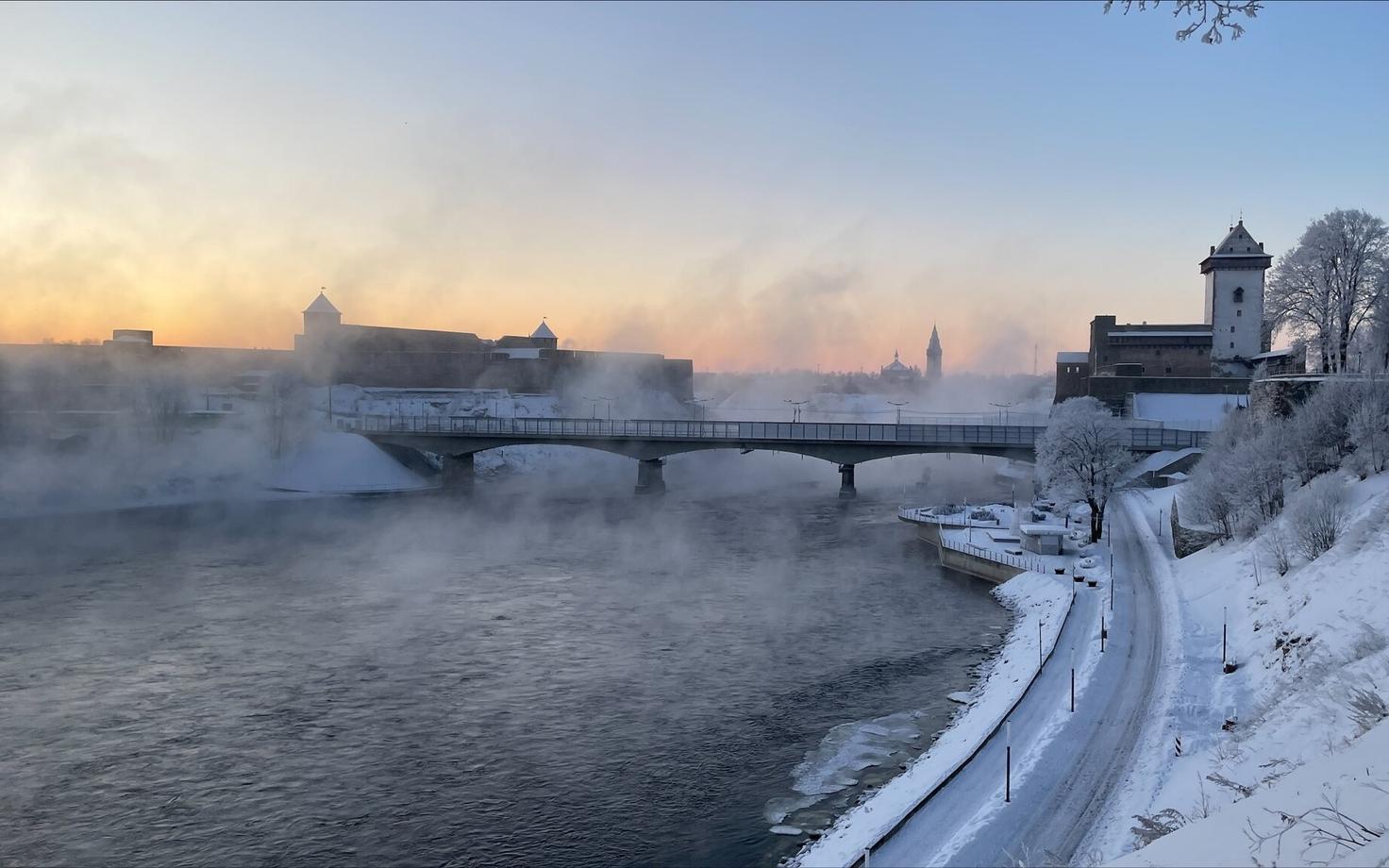
The Danes built the first stone fortress here in the 13th century. The Livonian Order took it over in 1346. In 1492, Ivan III of Moscow constructed Ivangorod Fortress directly across the river — a physical declaration that Russia intended to contest the crossing. The two castles have stared each other down ever since, separated by a strip of water you can throw a stone across.
Sweden captured Narva in 1581 and turned it into something remarkable. A large fire in 1659 destroyed most of the wooden town, and the Swedes mandated that only stone buildings could be erected in the centre. What emerged over the next two decades was one of the most cohesive Baroque cityscapes in Northern Europe — a merchant town of gabled stone houses, churches, and civic buildings that remained essentially unchanged for nearly three centuries. Narva became known as the "Baroque Pearl of the Baltics."
The Swedish period ended in blood. In 1700, Charles XII stunned Europe by defeating a Russian army five times his size at the Battle of Narva — one of the most lopsided victories in military history. Peter the Great did not forget. He returned in 1704 with a larger army and took the city by storm. His troops massacred much of the garrison and the civilian population. Narva entered the Russian Empire, where it stayed for two centuries. After World War I, the city became part of independent Estonia. By 1934, Estonians made up 65% of the population. That number would be erased within a decade.
The Battle of Narva (1944): The WWII Siege That Killed 300,000 Soldiers
The Estonian SS Division and the Tannenberg Line
The Battle of Narva was one of the bloodiest engagements on the Eastern Front in 1944, and one of the least remembered in the West. The Red Army's Leningrad Front reached the Narva River on February 1, 1944, and spent the next six months trying to cross it. The defenders included an unusual coalition: German Wehrmacht divisions, European SS volunteer units from Norway, Denmark, the Netherlands, and Belgium — and, crucially, Estonian conscripts fighting under the German flag.
The Estonian soldiers at Narva were not fighting for National Socialism. They were fighting to prevent a second Soviet occupation — having already lived through the first one in 1940–41, during which thousands of Estonians were deported to Siberia. The 20th Waffen Grenadier Division of the SS (1st Estonian) held the centre of the Tannenberg Line, the defensive position behind Narva. These men were defending their own country against the army that had deported their families. The moral complexity of this fact — Estonians in SS uniforms fighting for survival, not ideology — still divides Estonian memory. Western historians sometimes call the entire campaign the "Battle of the European SS." Estonians call it a war of national survival.
The casualties were staggering. Estonian historian Mart Laar estimates that the Leningrad Front lost approximately 65,000 dead or missing and 235,000 wounded or sick across the Narva campaign. On July 25, 1944, 280,000 Soviet shells hit Estonian positions across the river. The density of artillery was 160 guns per kilometre of front line. The trenches collapsed on both sides. When the Estonian division ran out of ammunition, Soviet infantry crossed on boats and rafts while loudspeakers blasted the Soviet anthem across the river.
The March 1944 Bombing of Narva and the Soviet Cover-Up
The air raids of March 6–8 were not surgical strikes. They were area bombardment. The Baroque old town — which had no significant military value — absorbed the bulk of the damage. The Soviets later photographed the ruins and presented the images at the Nuremberg Trials as evidence of German destruction. The deception was deliberate: an album of photographs in three languages was compiled specifically to blame the Wehrmacht for damage the Red Army had inflicted. Estonian historians have documented this disinformation operation in detail, noting that the damage assessment commission inflated restoration costs by a factor of 118 to make reconstruction appear economically impossible. The Soviets did not want Narva rebuilt. A restored Baroque city would have been a European city. The plan was to build something else entirely.
Soviet Occupation of Narva: How Russia Replaced an Entire City's Population
Why the Soviets Demolished Narva's Old Town Instead of Rebuilding It
The post-war Soviet decision regarding Narva was not neglect. It was policy. The ruins of the old town were still restorable in 1947. Estonian architects and art historians prepared plans. The occupation authorities placed the ruins under conservation. Then, in 1953, the demolition orders came. The restorable ruins were destroyed and Soviet apartment blocks went up on the foundations. The ideological logic was blunt: the old Narva was a Swedish, German, European city. The new Narva would be Soviet. Rebuilding the Baroque old town would have preserved a visual connection to a pre-Russian past. The khrushchyovkas severed it.
Only around 50 pre-war buildings survived or were restored. Of those, about 20 still stand today — including the shell of the Baroque Town Hall, which now serves as a museum piece. The restored Hermann Castle dominates the riverfront, facing Ivangorod Fortress across the border. The rest of the city looks like any Soviet industrial town: five-storey concrete blocks, wide empty boulevards, and a total absence of architectural character.
The Kreenholm Factory and the Russian Population Transfer to Estonia
The mechanism of replacement was industrial. The Kreenholm Manufacturing Company, already one of Europe's largest textile mills — with 10,000 workers at its peak in the 19th century — was expanded into a massive Soviet industrial complex. The city needed labour. That labour would not come from Estonia. The Soviet authorities had formally banned Narva's original Estonian population from returning. A 1950 government statement justified the ban by claiming the returnees would include "spies and exploiters" — the standard Stalinist language for anyone the regime wanted to exclude.
Tens of thousands of Russian-speaking workers were administratively transferred from across the Soviet Union. Ukraine, Belarus, Russia proper — they came from everywhere, and they came to stay. By the 1989 census, Estonians made up less than 5% of Narva's population. A city that had been 65% Estonian in 1934 was now 95% Russian-speaking. The population transfer was, by any measure, a violation of the Fourth Geneva Convention, which prohibits an occupying power from transferring its own civilian population into occupied territory. The Soviet Union had ratified the convention. It simply claimed the Baltic states had joined voluntarily, making the convention inapplicable — a lie Russia continues to repeat.
What Life Was Like in Soviet Narva
The resulting city was a self-contained Russian-speaking universe. Education was in Russian. Commerce was in Russian. Social life was in Russian. Contact with Tallinn, 200 kilometres to the west, was minimal. Contact with Estonian language and culture was essentially zero. Narva's residents watched Soviet television, read Soviet newspapers, and lived in a Soviet city that happened to sit on Estonian territory. The few remaining Estonians were culturally invisible.
The factory defined everything. Kreenholm employed the majority of the city's working population. The factory provided housing, childcare, cultural facilities. When someone moved to Narva, they moved to Kreenholm. The identity of the city and the identity of the factory were functionally inseparable. This would matter enormously after 1991, when the factory — and the Soviet system that sustained it — collapsed.
Estonian Independence and Narva's Grey Passport Crisis
Estonia's Citizenship Law and the Stateless Russians of Narva
Estonia regained independence in 1991. The new government faced an existential question: who counts as a citizen of the restored republic? The answer was legally precise and humanly brutal. The 1992 Citizenship Act granted citizenship only to people who had been citizens of Estonia before the Soviet occupation, and their descendants. Everyone else — including every Russian-speaking worker imported during five decades of occupation — would need to apply for citizenship by passing an Estonian language exam and a civics test.
In Narva, this meant the overwhelming majority of the population woke up stateless. They had not chosen to live in Estonia. They had been sent there by a state that no longer existed. Now the state that did exist required them to learn a language most of them had never needed to speak. Hundreds of thousands received the "grey passport" — an alien's travel document that granted permanent residency but not citizenship. As of 2025, roughly 15% of Narva's population still holds undefined citizenship. Another 36% are citizens of the Russian Federation. Fewer than half are Estonian citizens.
The policy was designed to protect a small nation — 1.3 million people — from being politically overwhelmed by a population that had been implanted by an occupying power. From Tallinn's perspective, granting automatic citizenship to the products of an illegal occupation would have rewarded the coloniser. From Narva's perspective, an entire city had been told it did not belong. Both perspectives contain truth. Neither resolves the problem.
The 2007 Bronze Soldier Crisis and Narva's Divided Loyalties
The fault line cracked open on April 26, 2007, when the Estonian government relocated a Soviet war memorial — the Bronze Soldier of Tallinn — from the city centre to a military cemetery. Estonians saw the statue as a symbol of occupation. Russian-speakers saw it as a memorial to the soldiers who defeated Nazism. Tallinn erupted in two nights of rioting. One person was killed. Over 150 were injured. More than 1,000 were detained.
In Narva, the reaction was revealing. The city did not riot. It seethed. The Bronze Soldier incident was the moment when Estonia's Russian-speaking minority and its Estonian-speaking majority looked at the same object and saw two completely different histories — and when it became clear that this divide was not narrowing. Russia's government exploited the crisis immediately, launching cyberattacks against Estonian government websites in one of the first state-level cyber operations in history. The Berlin Wall divided a city with concrete. Narva's wall is linguistic, psychological, and generational — and it has no physical structure to tear down.
Narva and the Russia-Ukraine War: NATO's Most Vulnerable Border City
Hermann Castle vs. Ivangorod: The T-34 Tank Removal and the New Iron Curtain
When Russia launched its full-scale invasion of Ukraine on February 24, 2022, Narva became the most closely watched city in the Western alliance. NATO began evaluating the "Narva scenario" — a hypothetical in which Russian-backed paramilitaries, mimicking the Donbas playbook of 2014, would attempt to seize control of Estonia's Russian-speaking northeast. In 2023, "dragon's teeth" anti-tank obstacles were installed on the Friendship Bridge connecting Narva and Ivangorod. Russia suspended vehicle traffic across the border in February 2024. The crossing is now open only to pedestrians. Family ties that once spanned the river freely now require passing through one of the most militarised border checkpoints in Europe.
The Estonian government moved fast. Soviet monuments were dismantled across the country. In August 2022, the most emotionally charged removal took place: a Soviet T-34 tank that had stood on a pedestal between Narva and Narva-Jõesuu since 1970, its gun pointed toward Estonia. Narva's mayor, Katri Raik, called the decision "very, very hard" and acknowledged it went against the instincts of the vast majority of the city's residents. Crowds gathered at the tank to protect it. An excavator involved in removing a different Soviet monument nearby was set ablaze. The tank was loaded onto a military truck at dawn and taken to the Estonian War Museum near Tallinn. Russia responded within weeks by erecting an identical T-34 monument in Ivangorod, directly visible from the Narva side of the border — a gesture that said, plainly: we remember, even if they make you forget.
Eleven Narva city council members attempted to force the city government to sue the Estonian state over the removal. Raik said she would resign if the lawsuit went forward. The council backed down. The episode laid bare the city's divided loyalty: a mayor trying to hold Estonia together, a council majority sympathetic to the monument, and a population caught between a country that doesn't fully accept them and a "homeland" across the river that is actively at war with the democratic order.
The "People's Republic of Narva": Russia's Separatist Playbook Comes to NATO
Since 2024, Estonian border guards at Narva have intercepted military-use items worth tens of thousands of euros concealed in travellers' luggage — electronics, microchips, Starlink systems. Everything that feeds a war machine was being walked across the border in backpacks. The smuggling is a symptom. The deeper infection is informational.
In 2023 and 2024, the Narva Museum — housed in Hermann Castle — unfurled a banner reading "Putin: war criminal" with an image of the Russian president's bloodied face, visible from Ivangorod. Museum director Maria Smorževskihh-Smirnova received death threats. Local politicians accused her of deepening divisions. The episode captured Narva's schizophrenia: an institution of the Estonian state, in an Estonian castle, denouncing Russia's president — in a city where the majority of the population consumes Russian-language media and a significant portion still identifies with Russia emotionally, culturally, or politically.
The most alarming development arrived in early 2026. Telegram channels began promoting the concept of a "Narva People's Republic" — complete with a green-black-white flag, a coat of arms featuring a black eagle, military insignia for a fictitious armed force, and maps depicting Narva as a separate territory between Estonia and Russia. The channels used the hashtag #WaitingForRussia. Posts called for leaflet distribution, sabotage, and armed resistance. The Estonian anti-propaganda platform Propastop identified the campaign as using the identical template Russia deployed in Donetsk and Luhansk in 2014: first the "people's republic" branding, then the demand for autonomy, then the Russian military "protection" of the self-declared entity.
The Patarei Prison in Tallinn tells one story of what Soviet occupation did to Estonia's institutions. Narva tells another: what it did to Estonia's people. The prison was a building. Narva was a city filled with human beings who were moved like inventory, stripped of their previous inhabitants, and left as a demographic time bomb on the EU's eastern edge.
Estonia's response has been characteristically firm. In 2025, the Estonian parliament voted nearly unanimously to strip Russian and Belarusian citizens of the right to vote in local elections — one of the few remaining avenues of political expression for Narva's non-citizen population. The Defence Forces announced the construction of a military base in Narva, initially planned for 200–250 troops but since expanded to accommodate up to 1,000 — including units from NATO allies. Construction is scheduled to begin in 2026, with the base operational by 2027. Major General Vahur Karus, Chief of the General Staff, was blunt about the purpose: "We will give the city's residents a clear signal about the presence of the Estonian state. Narva residents will be able to get used to the fact that the military is part of their everyday city life."
The subtext was even blunter: this is Estonia, not Russia, and if that fact is unclear, here are a thousand soldiers to clarify it.
The NATO Military Base in Narva and Estonia's Fight for Integration
Not everyone in Narva fits the fifth-column narrative. Younger Russian-speaking residents — educated at the University of Tartu's Narva College, fluent in Estonian and English, oriented toward Europe — represent a genuine integration success. Denis Larchenko, a Russian-speaking politician who grew up in Narva, left for Canada at 18, returned, and now runs the local branch of Eesti 200, speaks of being "more open to Europe than to Russia." The city took in Ukrainian refugees after 2022. Some residents are finding their own reasons to reject Moscow.
The problem is that these people leave. As the principals of Narva's leading secondary schools have confirmed, none of the best or brightest return to live in Narva after university. The city's population has fallen from 83,000 in 1992 to roughly 52,000 today — a 37% decline. The demographic forecast for Ida-Virumaa county is a further 20% drop by 2085. Narva is simultaneously a security threat and a dying city. The young and the integrated get out. The old and the Russian-oriented stay. The average age rises. The proportion that watches Russian state television holds steady or increases. The city calcifies.
In Carlo Masala's 2025 book If Russia Wins, Narva appears as a thought experiment for Western strategists. His question is as cold as it is necessary: "Do we risk a full-scale conflict against potentially 1.5 million Russian soldiers for the liberation of a city of 50,000 inhabitants — one that would always be on the brink of nuclear escalation?" The question is not rhetorical. It is the question that Article 5 of the NATO treaty was written to answer — and the question that a Russian demographic operation executed 80 years ago was designed, eventually, to make unanswerable.
Visiting Narva: What to See at the EU-Russia Border
Hermann Castle, Kreenholm Factory, and the Narva-Ivangorod Border View
Hermann Castle is the anchor. The 13th-century fortress, rebuilt after the war, houses the Narva Museum and a virtual reality exhibition that reconstructs the destroyed Baroque old town — the only way to see a city that no longer exists. The view from the castle walls is the reason most visitors come: directly across the river, close enough to photograph without a zoom lens, sits Ivangorod Fortress, flying the Russian flag. The two castles form what may be the most visually arresting international border in Europe — medieval twins divided by the boundary between the democratic West and whatever Russia has become.
The river promenade runs south from the castle along the border. Dragon's teeth anti-tank obstacles are visible on the Friendship Bridge. On clear days, you can see the T-34 tank monument that Russia erected in Ivangorod after Estonia removed its own. The Checkpoint Charlie visitor experience in Berlin has been commodified into a tourist attraction. Narva's border is not a museum piece. It is a live front in a hybrid war.
The Kreenholm district — the massive 19th-century textile complex that once employed tens of thousands — is partially accessible and partially derelict. The factory closed in 2010. The buildings are among the most impressive industrial ruins in the Baltic states, a monument to the economic engine that brought the Russian population to Narva and the collapse that left them stranded. The Baroque Town Hall, one of the handful of pre-war survivors, stands on the main square — a fragment of the old city surrounded by Soviet concrete, like a single tooth in an otherwise empty jaw.
Narva is accessible by train from Tallinn in approximately 2.5 hours. No special permits are required. The city is safe for visitors. English is spoken at hotels and the museum. Russian is spoken everywhere else.
Is Narva Safe to Visit? What to Expect at Europe's Eastern Edge
Standing on the castle walls in Narva, looking east across the river, a visitor is looking at more than a foreign country. They are looking at the physical edge of the European project — the line where the rule of law, freedom of movement, and democratic governance stop, and something older and more violent begins. The distance between the EU flag on Hermann Castle and the Russian tricolor on Ivangorod is 100 metres. The distance between the civilisations those flags represent is immeasurable.
Narva is not a war memorial. It is not a ruin. It is not abandoned. It is a living city full of people who did not choose to be born on a geopolitical fault line, and who now live with the consequences of decisions made by empires they never voted for. The Soviet Union put them here. The Estonian Republic does not fully trust them. The Russian Federation would like to use them. And 52,000 people get up every morning and go to work in a city that exists, fundamentally, because one empire decided to erase another empire's architecture and replace it with its own population.
The river is narrow. The history is not.
FAQ
Where is Narva, Estonia, and why is it important?
Narva is Estonia's third-largest city, located on the country's eastern border with Russia. The city sits directly on the Narva River, which marks the boundary between the European Union and the Russian Federation. Its significance stems from its overwhelmingly Russian-speaking population — roughly 96% — which makes it a focal point for European security concerns, particularly since Russia's full-scale invasion of Ukraine in 2022. Two medieval fortresses face each other across the river: Estonia's Hermann Castle and Russia's Ivangorod Fortress, making the border crossing one of the most visually striking in Europe.
Why does Narva have such a large Russian population?
Narva's Russian-speaking majority is the direct result of Soviet demographic engineering after World War II. The city was 65% ethnic Estonian in 1934. After Soviet bombers destroyed 98% of Narva in 1944, the occupation authorities banned the original Estonian population from returning, claiming they would include "spies and exploiters." Tens of thousands of Russian-speaking workers were then transferred from across the Soviet Union to staff the city's expanded industrial complex, primarily the Kreenholm textile factory. By 1989, Estonians made up less than 5% of the population. International legal scholars have noted that this population transfer violated the Fourth Geneva Convention, which prohibits an occupying power from settling its own civilians in occupied territory.
What happened to Narva's Baroque old town?
Narva was renowned as the "Baroque Pearl of the Baltics" for its Swedish-era architecture, dating primarily from the late 17th century. Soviet air raids on March 6–8, 1944, destroyed the old town during the Battle of Narva. After the war, the ruins were still restorable — Estonian architects prepared plans and the site was placed under monument protection in 1947. The Soviet authorities overruled those plans in 1953, ordering the ruins demolished and replaced with standard Soviet apartment blocks. Unlike Warsaw or Gdańsk, which were rebuilt, Narva's architectural heritage was deliberately erased. Only about 20 pre-war buildings survive today.
What is the "grey passport" in Estonia?
The grey passport, formally known as an alien's travel document, was created after Estonia regained independence in 1991. Estonia's citizenship law required Estonian language proficiency and a civics test, which most of Narva's Russian-speaking population could not pass. Those who did not qualify for citizenship and did not take Russian citizenship received these grey passports, granting permanent residency but not full political rights. Grey passport holders could vote in local elections but not national ones. In 2025, the Estonian parliament voted to strip Russian and Belarusian citizens of local voting rights as well, further reducing the political participation of Narva's non-citizen population.
Is Narva safe to visit?
Narva is safe for tourists. The city is fully within the European Union and NATO, and there is no active conflict. Hermann Castle and the Narva Museum are the primary attractions, along with the river promenade offering direct views of Russia's Ivangorod Fortress. The city is accessible by train from Tallinn in approximately 2.5 hours. English is spoken at hotels and the museum, though Russian is the dominant language on the streets. The border area is monitored but open to the public. Dragon's teeth anti-tank obstacles on the Friendship Bridge are visible from the promenade.
What is the "People's Republic of Narva"?
In early 2026, Telegram channels began promoting a fictitious "Narva People's Republic" — a social media campaign featuring separatist imagery, self-designed flags and coats of arms, and calls for autonomy or armed resistance. Estonian intelligence and the anti-propaganda platform Propastop identified the campaign as using the same branding and escalation template that Russia deployed in Donetsk and Luhansk in 2014 before its military intervention in Ukraine. While the channels have limited followings, security analysts describe them as part of a psychological warfare strategy designed to normalize separatist narratives and create a pretext that could be activated when strategically convenient for Moscow.
Sources
- [Bombing of Narva in World War II] - Wikipedia, sourced from Estonian National Archives and Narva Museum (2024 exhibition materials)
- [Battle for Narva Bridgehead] - Mart Laar, Estonian historian, casualty estimates cited in multiple academic sources (2006)
- [Narva bombing 1944: Only the blind cannot see the parallels with Russia today] - ERR News / Estonian Public Broadcasting, interview with Zurab Jänes, Head of Collections, Narva Museum (March 2024)
- [History: Russian disinformation operation about the March bombing of Narva] - Propastop, Estonian anti-propaganda platform (March 2024)
- [The Future of Narva and the Russian-Speaking Population in Estonia] - Population and Security, academic analysis with Europa report and FPRI data (2023)
- [The EU's Citizenship Double Standard: Estonia's Stateless Russians] - Europe Now Journal, with ERR News and Le Monde citations (October 2025)
- [A 'People's Republic' on NATO's Edge: The Narva Narrative Testing Europe's Defences] - Euronews, with Propastop research and Carlo Masala analysis (March 2026)
- [Separatist "Narva People's Republic" idea spreads on social media] - Propastop (March 2026)
- [A New Russian Game on the Borders of the Baltics] - CEPA (Center for European Policy Analysis), analysis of amplification paradox (March 2026)
- [Estonia Plans Military Base in Narva] - Kyiv Post, citing ERR and Major General Vahur Karus (April 2025)
- [Estonia's Robust Security Posture: Dispelling the "Is Narva Next?" Narrative] - ICDS (International Centre for Defence and Security), Tallinn (August 2025)
- [Russians in the Baltic States] - Academic overview with Geneva Convention analysis and demographic data, sourced from Baltic census records (multiple years)