Kibera and the 2007 Post-Election Violence
The results came through on a radio balanced on a corrugated iron roof on the evening of December 30, 2007. Mwai Kibaki, the incumbent president, had been declared the winner of Kenya's presidential election — an outcome that contradicted every exit poll and the count's own trajectory, which had shown opposition leader Raila Odinga leading by 370,000 votes with ninety percent of constituencies reporting. Within hours, the railway line that bisects Kibera became a front line. The Uganda-bound track, a colonial-era artery that slices through the settlement from east to west, separated neighborhoods that were predominantly Luo — Odinga's ethnic base — from those with significant Kikuyu populations aligned with Kibaki. Neighbors who had shared water points that morning were identifying each other by ethnicity by nightfall. Homes burned. Police were ordered to patrol the wider dirt roads and the railway corridor but to avoid the narrow pathways where they could be ambushed. Over the following two months, more than 1,100 Kenyans died nationwide, over 600,000 were displaced, and Kibera — a settlement built on land the British Crown never intended anyone to permanently inhabit — became the most televised slum on Earth.
The violence was predictable — the detonation of a fuse that had been burning since 1912, when the British colonial administration told a group of Sudanese-born soldiers they could live in a forest outside Nairobi but never own the ground beneath their feet. That single decision — permission without title, settlement without tenure — created a legal and political contradiction that every subsequent government inherited, exploited, and refused to resolve. Kibera is not a story about poverty. It is a story about land: who controls it, who profits from it, and who bleeds when the question of ownership is finally forced into the open.
How British Colonial Policy Created Kibera
The Nubian Soldiers of the King's African Rifles
The men who founded Kibera were Sudanese — soldiers from the Nuba Mountains, recruited by the British in the late 1880s and deployed across East Africa to fight imperial wars and guard the construction of the Uganda Railway. By 1902, they had been folded into the King's African Rifles (KAR), the British colonial military force that would serve across the continent for the next six decades. These soldiers, known as Nubians, were the backbone of the early KAR. They fought in German East Africa during World War I, across Tanzania, Mozambique, and Northern Rhodesia. In World War II, they served in Somalia, Abyssinia, Madagascar, and the brutal jungle campaigns in Burma.
Their reward was a patch of forest. Around 1912, the KAR administration permitted approximately 300 Sudanese ex-soldiers and their families to occupy a forested tract near the military exercise grounds along Ngong Road, southwest of Nairobi's center. The Nubians called this place Kibra — a Kinubi word meaning "forest" or "bush land." The Maasai had used the area for limited grazing before signing it over to the British in the 1904 Maasai Agreements. In 1918, the colonial government gazetted 4,197 acres as a military reserve for the settlement. The soldiers were told they could stay. They were not given title deeds.
One of them, Juma Rakuba Abdalla, enlisted in the 3rd Battalion of the KAR on January 20, 1914, at the age of sixteen. He fought across the East African theater of World War I — at Longido, Namanga, Korogwe, Lindi, and into Portuguese East Africa — took a German bullet in the leg, and returned to Nairobi. He settled at Kibra, was awarded the King's Silver Jubilee Medal in 1935, and reportedly died in Nairobi in 1999 at the age of 101. His autobiography, translated from Kinubi, records the geography of his service in meticulous detail — every town, every river crossing, every campaign. What it does not record is a title deed. He never received one.
Colonial Land Laws and the Denial of Land Tenure
The omission was deliberate. British urban planning in Nairobi operated on a foundational assumption: Africans were temporary residents of the city. The colonial capital was built for Europeans. Asians were tolerated as a labor and commercial class. Africans were brought in on short-term contracts — as railway laborers, domestic servants, and low-level administrative staff — and were expected to return to designated "Native Reserves" when their contracts expired. A series of laws enforced this architecture of impermanence: the 1915 Crown Land Ordinance, the 1922 Vagrancy Act, and the kipande pass system, which required Africans to carry identification documents specifying their ethnic group and employer.
The Nubians fell through every category. They were not indigenous to Kenya, so they had no Native Reserve. They could not return to Sudan — the country they had been taken from no longer existed in any meaningful administrative sense for them. The colonial government classified them as "detribalized natives," a bureaucratic designation that meant they belonged nowhere. Kibra was tolerated because the soldiers were useful and their settlement was outside the European residential zone. But tolerance is not ownership. The land remained Crown property. The Nubians had permission, not rights.
By 1955, the Nubian community at Kibra numbered roughly 3,000 people. Photographs from the era show an attractive rural village — houses surrounded by large gardens, mango trees, green grass. A Nubian officer posed for a photograph holding his invitation to a garden party at Government House in honor of Princess Margaret. The image is a study in colonial contradiction: a man decorated for valor in the service of the Crown, invited to tea on the lawns of the Governor, living on land the Crown refused to give him.
From Military Settlement to Nairobi's Largest Informal City
Independence and the Land That Was Never Redistributed
Kenya became independent on December 12, 1963. Section 87 of the new constitution provided that every person born in Kenya with a parent born in Kenya was automatically a Kenyan citizen. The Nubians — born in Kenya, with parents born in Kenya, holders of British colonial passports — should have qualified on multiple grounds. Most were not granted citizenship. Many became stateless. The vetting process imposed on Nubians to prove their right to Kenyan identity was lengthy, humiliating, and disproportionately targeted at Muslim communities. Without identity cards, they could not be formally employed, open bank accounts, acquire title deeds, vote, or leave their homes safely — since being caught without an ID card was a criminal offense.
The land question was worse. At independence, Crown land became government land. President Jomo Kenyatta's administration inherited the colonial land structure intact and showed no interest in dismantling it. The Nubians expected formalization — the fulfilment of what they understood as a promise made by the British that the post-independence government would grant permanent rights. Instead, Kibera was reclassified as an "unauthorised settlement." The government did not evict the Nubians. It simply refused to acknowledge them while simultaneously allowing — and in some cases actively encouraging — migrants from other parts of Kenya to flood into the settlement.
The population began to explode. Rural Kenyans, driven by chronic underdevelopment and overpopulation in the countryside, migrated to Nairobi in search of wage labor. Formal housing was scarce and expensive. Kibera was cheap, close to the city center, and functionally unregulated. By 1974, the Kikuyu had become the largest ethnic group in the settlement. By the 1980s, political patronage under President Daniel arap Moi accelerated the process: land in Kibera was allocated to civil servants and provincial administration officials as informal rewards for loyalty. The population jumped from roughly 20,000 in 1975 to 65,000 in 1980. By the early 2000s, estimates ranged from 170,000 to over a million, depending on who was counting and what political point they were trying to make. The 2019 Kenyan census recorded just over 170,000 — a figure many researchers and residents consider a dramatic undercount.
Kibera's Absentee Landlords and the Informal Rental Economy
The economics of Kibera defy the assumptions most outsiders bring to the word "slum." This is not a place where the poor simply squat on empty land. It is a rental market — one of the most profitable in Kenya — operating entirely on government-owned soil where no one holds legal title.
The landlords are called "structure owners." They have no deed to the ground, but they build corrugated iron and mud-walled rooms — each typically 12 feet by 12 feet — and rent them to tenants. A single room costs around 700 Kenyan shillings per month (roughly $6). The cost of building one is approximately 13,000 shillings. That means a structure owner recoups the investment in under a year. A 2004 UN-Habitat report estimated that landlords in Kibera collectively earned 2.35 billion shillings annually from rent.
The structure owners are not, for the most part, Kibera residents. A 2002 UN survey of 120 landlords found that 41 percent were government officials, 16 percent were politicians, and 42 percent were absentee owners who visited Kibera occasionally and hired agents to collect rent. The majority belonged to the Kikuyu or Nubian communities. The tenants — overwhelmingly Luo, Luhya, and Kamba migrants from western Kenya — had no rights, no leases, and no recourse. They paid rent for structures on land that belonged to the state, to owners who had no legal claim to it, in a settlement that the government officially described as unauthorized. A UN-Habitat analysis called it the most lucrative unauthorized housing investment in Kenya. Everyone profited except the people who actually lived there.
Life Inside Kibera: Density, Sanitation, and the Economics of Survival
Water, Sewage, and the Flying Toilet
The Kenyan government owns all the land in Kibera. It provides almost nothing on it. There are no government hospitals or clinics. No public sewage system. No municipal water supply reaching individual homes. The services that exist — schools, health clinics, water points — are privately run or operated by NGOs and churches.
Water arrives through two main pipes: one from the municipal council, one funded by the World Bank. Residents buy it at communal kiosks for roughly 3 Kenyan shillings per 20 liters — a price that sounds trivial until you calculate that a family of six needs at least 90 liters per day, and many households earn less than 300 shillings. The water vendors who control distribution points have historically operated as cartels, inflating prices and restricting access. In some parts of Kibera, residents collect water from the Nairobi Dam — a reservoir so contaminated with human waste, industrial runoff, and garbage that it is a documented source of cholera and typhoid outbreaks.
Sanitation is the crisis that defines daily life. In much of Kibera, one pit latrine — a hole in the ground covered by a wooden or concrete slab — serves up to 50 households. The latrines fill. Boys are hired to empty them by hand, carrying the waste to the river. When latrines are too far away, too dangerous to reach at night, or too full to use, residents resort to what aid workers have euphemistically named the "flying toilet" — defecation into a plastic bag, tied and thrown as far from the dwelling as possible. The bags land on rooftops, in drainage ditches, in the same waterways where children play. Waterborne diseases — diarrhea, cholera, typhoid — are endemic. The connection between the flying toilet and the cholera ward is a straight line.
Kibera's Informal Economy and Community Innovation
Kibera has a thriving economic life that the word "slum" obscures. Half a million wallets' worth of money walks into Kibera every evening. Some of it circulates internally through a dense ecosystem of small businesses: food stalls, barbershops, tailoring workshops, mobile phone repair shops, changaa breweries (the local moonshine, often dangerously high in methanol), and an intricate network of informal financial services. Matatu routes connect Kibera to the city center and to industrial zones where many residents work.
Kennedy Odede grew up in Kibera from the age of two, after a famine in his family's rural village of Rarieda drove them to Nairobi. By ten, he was a street child — scavenging from garbage bins, stealing food to survive. A mob nearly beat him to death after he took a mango from a market stall; a stranger intervened and saved his life. As a teenager, he worked ten-hour shifts in a factory for one dollar a day. From that dollar, he saved twenty cents and bought a soccer ball. In 2004, he used that ball to start organizing youth in Kibera, founding what would become Shining Hope for Communities (SHOFCO) — now Kenya's largest grassroots organization. By 2016, SHOFCO had built an aerial piping system delivering clean water to 37,000 households, opened free medical clinics, established the Kibera School for Girls, and created an urban community network with over 2.4 million members across the country. In 2018, SHOFCO became the youngest organization ever to receive the Conrad N. Hilton Humanitarian Prize, the world's largest humanitarian award.
Odede's trajectory illustrates a truth about Kibera that the poverty-tourism narrative routinely misses: this is a place with agency, not just suffering. The informal economy is real, the social networks are dense, and the community organizations are sophisticated. The problem is not a lack of human capacity. The problem is that 250,000 people are building lives on land they are not allowed to own.
Political Violence and the Weaponization of Kibera
The 2007–2008 Post-Election Crisis
The post-election violence that erupted on December 30, 2007, reached its most concentrated expression in Kibera. The settlement sits within the Langata parliamentary constituency — the long-term electoral stronghold of Raila Odinga, the Luo opposition leader. For decades, Odinga's political machine had cultivated Kibera as a vote reservoir, encouraging migration from Luo communities in western Kenya and positioning himself as the settlement's patron. The reciprocal arrangement was explicit: Odinga delivered political representation; the Luo community delivered overwhelming turnout.
When Kibaki was declared the winner despite apparent vote rigging, Kibera's Luo majority treated the announcement as a theft — not just of an election, but of the political power that was supposed to translate, eventually, into services, land rights, and recognition. Protests erupted within minutes. Kikuyu-owned shops and homes were targeted first. The violence was initially spontaneous — raw rage at a stolen result — but it organized quickly along ethnic lines. The Luo community, which considered Kibera their political domain, attacked Kikuyu residents. Kikuyu groups retaliated, in some cases with the backing of the Mungiki, a banned Kikuyu criminal organization allegedly mobilized by figures within Kibaki's inner circle.
The railway line became a de facto border. Police, unable or unwilling to enter the narrow pathways, patrolled only the wider dirt roads and the tracks. SMS messages circulated inciting violence, spreading rumors of impending attacks, and identifying targets by ethnicity. A train was looted by residents desperate amid shortages caused by the crisis. The UN High Commissioner for Human Rights later documented that policing in Kibera was conducted with excessive force, with security services using live ammunition against demonstrators. Across Kenya, 1,133 people were killed, 900 experienced sexual violence, and over 600,000 were displaced. Kibera was among the worst-hit areas — a place where the intersection of ethnic geography, political patronage, and landlessness produced a combustion that surprised no one who understood how the settlement worked.
Kibera's Role in Kenyan Elections: Patronage, Demolitions, and Broken Promises
The 2007 violence was extreme, but it followed a pattern Kibera had lived through before. Kibera has been a site of political manipulation and ethnic conflict since independence. In November 2001, a "rent revolt" killed 15 people after President Moi and Raila Odinga were accused of inciting tenants to refuse to pay hiked rents — a move that targeted Nubian and Kikuyu structure owners and mobilized Luo tenants as a political weapon. The 1992 and 1997 elections produced similar, if smaller, episodes of displacement and violence.
The pattern is structural. Every Kenyan election cycle produces the same sequence: politicians promise Kibera residents upgrading, land rights, and services in exchange for votes. The votes are delivered. The promises are not. Demolitions — framed as slum clearance or infrastructure projects — displace residents without compensation. New structures go up on the cleared land, owned by new patrons. The residents who were displaced either return to the same conditions elsewhere in the settlement or are absorbed into other slums. The Nubian community, which has fought for recognition of their land rights for over a century, has watched successive governments carve away the original 4,197 acres of gazetted land — for the Royal Nairobi Golf Club, for the Langata Prison quarry, for European residential estates, for roads — until roughly 1,150 acres remained. They were never compensated.
The Slum Upgrading Programme and Why It Keeps Failing
KENSUP and the Decanting Model
In 2004, the Kenyan government and UN-Habitat launched the Kenya Slum Upgrading Programme (KENSUP), the country's most ambitious attempt to address informal settlements. The pilot project targeted Soweto East, one of Kibera's most densely populated villages, where an estimated 19,000 residents occupied Zone A alone. The plan was straightforward on paper: temporarily relocate residents to a "decanting site" — a set of newly built apartment blocks — while their original area was demolished and replaced with permanent high-rise housing. Residents would then move back into the new units.
The decanting site was completed in 2009, five years after the program launched. The first batch of around 1,500 residents were loaded onto trucks on September 16, 2009, starting at 6:30 a.m., overseen by Prime Minister Odinga, the Housing Minister, armed police, and several dozen cameras. The new apartments offered two rooms and a monthly rent of roughly $10. On paper, it was a transformation.
In practice, it unraveled almost immediately. The decanting site had been originally planned at Athi River — 23 kilometers from Kibera — which would have destroyed residents' social networks, their proximity to jobs, and their children's schooling. After protests, the site was moved closer. But the fundamental problem was economic: residents who had been paying 700 shillings a month for a single room in Kibera could not afford the new rents, even at subsidized rates. Many who moved into the apartments sublet them to middle-class tenants at market rates and moved back into the slum. The government official overseeing the project admitted that at its current pace, completing the upgrade of Kibera would take 1,178 years.
Why Upgrading Without Land Reform Changes Nothing
Sheikh Issa Abdulfaraj, chairman of the Kenya Nubian Council of Elders, watched the KENSUP apartments go up and called them dormitories, not homes. The Nubian community opposed the low-income housing projects not because they objected to better housing, but because the projects represented the permanent settlement of others on land the Nubians considered their heritage. The upgrading program did not address land tenure. It could not — because addressing tenure would mean acknowledging the Nubian claim, or formalizing squatter rights, or confronting the politically connected structure owners who profited from the status quo.
This is the contradiction at the core of every intervention in Kibera. You cannot formalize housing on land with no clear tenure. You cannot provide municipal services to a settlement the government officially considers unauthorized. You cannot break the cycle of political violence when the land itself is the prize that politicians use to mobilize ethnic constituencies. The 822 housing units that KENSUP eventually built in Soweto East — a meaningful achievement in isolation — housed a fraction of the displaced residents and changed nothing about the structural conditions that produced the slum in the first place. The structure owners continued to build. The tenants continued to pay. The government continued to own the land and do nothing with it.
Kibera Today: Current Conditions and Community Resilience
The Nairobi Expressway and Kibera's Ongoing Marginalization
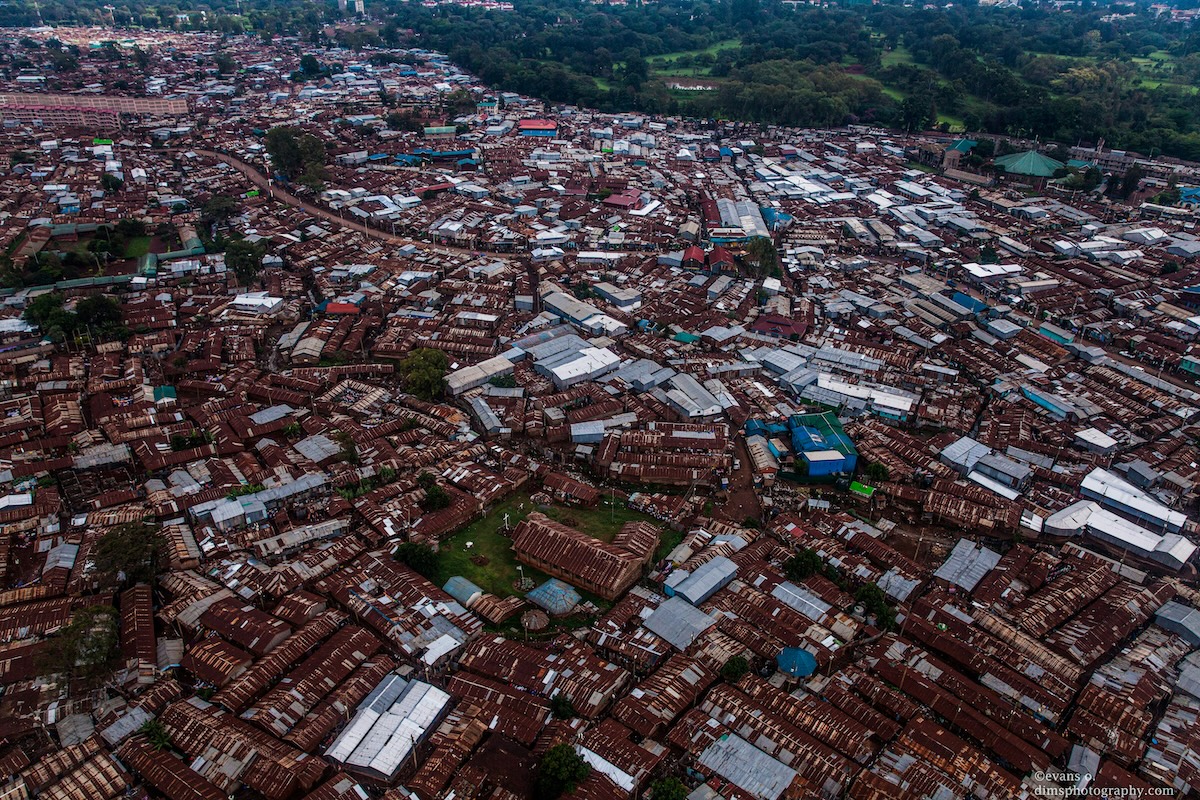
In 2022, Kenya opened the Nairobi Expressway — a $668 million, Chinese-built toll road connecting Jomo Kenyatta International Airport to the western suburbs. The elevated highway passes within sight of Kibera. From the expressway, the settlement is a sea of rust-colored rooftops stretching to the horizon, bisected by the railway line, punctuated by the occasional church steeple or water tower. From Kibera, the expressway is a concrete ribbon in the sky — a piece of infrastructure that cost more than the Kenyan government has spent on Kibera in the entire history of the settlement. The expressway charges tolls that no Kibera resident can afford. It connects places that Kibera residents cannot reach. It is the colonial logic of impermanence rendered in twenty-first-century concrete: the city builds around the slum, through the slum, over the slum — but never for it.
The 2019 Kenyan census recorded Kibera's population at just over 170,000 — a figure dramatically lower than the 500,000-to-one-million estimates that had circulated for decades. The census was controversial. Researchers and community organizations argued that informal settlements are inherently difficult to count, that residents may have been away at work or unwilling to participate, and that the government had political incentives to minimize the number. Whatever the true figure, Kibera remains one of the densest human settlements in Africa, and it remains entirely on government land. No title deeds have been issued. No comprehensive land reform has been implemented. The Nubian Council of Elders continues to claim over 1,100 acres. The government does not accept the claim.
Community Organizations and the Fight for Recognition
The most significant changes in Kibera over the past two decades have come not from the government but from within. SHOFCO's aerial water system — a network of elevated pipes delivering clean water across the settlement — was the first of its kind in Kenya and now operates 24 water kiosks with cashless payment systems designed to undermine the water cartels that had controlled distribution. The Kibera School for Girls, SHOFCO's flagship educational institution, ranked second in its sub-county for national exam scores in 2018. Map Kibera, a community-led digital mapping project launched in 2009, created the first open-source map of the settlement — a tool that gave Kibera residents the ability to document their own infrastructure, report service gaps, and make their community visible to the outside world in their own terms.
The Nubian community, formally recognized as a Kenyan tribe in 2009 after decades of statelessness, continues to press its land claim through legal channels. The African Commission on Human and Peoples' Rights has heard cases on their behalf. The 2010 Kenyan constitution, adopted after the post-election crisis, strengthened protections for community land rights — but implementation has been glacial, and the political will to confront the land question in Kibera remains absent.
Kibera endures because the people in it have no alternative and because the system that created it — colonial land theft, post-independence patronage, the informal rental economy, the weaponization of ethnicity — benefits too many powerful people to be dismantled. The settlement is not a failure of planning. It is the product of planning — a century of deliberate decisions to keep a population visible enough to be useful but invisible enough to be denied. The forest that the Nubian soldiers named is gone. The promise that was never written down remains unbroken and unfulfilled.
The Atlas Entry: Visiting Kibera
What to Expect and How to Visit Ethically
Kibera demands careful ethical consideration from any visitor. The settlement is accessible from central Nairobi — roughly a 20-minute drive from the CBD depending on traffic — and several community-based organizations offer guided tours led by Kibera residents. These tours are the only ethically defensible way to visit: they ensure that revenue goes directly to the community, that residents consent to the presence of visitors, and that the experience is framed by people who actually live there rather than by outsiders projecting narratives of poverty.
Kennedy Odede, who grew up in Kibera, has written forcefully against "slum tourism" that treats poverty as spectacle. The distinction matters. A tour led by a Kibera resident that includes visits to community projects, schools, and small businesses is fundamentally different from a drive-through poverty safari. Visitors should ask who benefits from the tour, whether guides are from the community, and whether photography policies respect residents' dignity. Pointing a camera at someone's home without permission is not journalism. It is extraction.
The physical experience is intense. The pathways are narrow, uneven, and in places slippery with water and waste. The air carries the smell of cooking charcoal, open drainage, and — in some areas — raw sewage. The density is disorienting: corrugated iron walls on both sides, children in school uniforms threading through adult foot traffic, the sound of radios and generators layered over conversation. Kibera is loud, alive, and overwhelming in a way that no photograph captures.
Nearby sites of interest include the Nairobi National Museum, the Karen Blixen Museum in the Langata area, and — for those interested in the colonial-era infrastructure that shaped Kibera's existence — the old Nairobi Railway Station, where the Uganda Railway that brought the Nubian soldiers to Kenya still terminates. Readers interested in how African settlements have been shaped by political upheaval will find Soweto a necessary companion piece — another place where a township's density made it a political weapon. Dharavi in Mumbai shares Kibera's central paradox: a billion-dollar informal economy operating on land its residents cannot legally claim. And Cidade de Deus in Rio illustrates what happens when a state's answer to informal settlement is isolation rather than integration.
Kibera asks a question that no visitor can answer by walking through it: what does a city owe to the people it was built on top of? The Nubian soldiers who named this place were promised a home. Their great-grandchildren are still waiting.
FAQ
Where is Kibera and how big is it?
Kibera is an informal settlement in southwestern Nairobi, Kenya, roughly seven kilometers from the city's central business district. It covers approximately 2.5 square kilometers (around 250 hectares) of government-owned land. The settlement sits within the Langata constituency, bordered by the Ngong Road to the north and bisected by the Uganda Railway line. Despite its proximity to Nairobi's commercial center, Kibera has no formal municipal infrastructure — no government hospitals, no public sewage system, and no piped water to individual homes.
How many people live in Kibera?
The population of Kibera is genuinely contested. For decades, estimates ranged from 500,000 to over one million, figures widely repeated by media and aid organizations. The 2019 Kenyan census recorded just over 170,000 residents, a number that researchers and community organizations have challenged as a significant undercount. The difficulty of accurately surveying a dense informal settlement — where residents may be away at work, distrustful of government enumerators, or living in structures that defy standard census methodology — means that the true figure likely falls somewhere between these extremes. Most credible current estimates place the population between 200,000 and 300,000.
Who owns the land in Kibera?
The Kenyan government owns all the land on which Kibera stands. No individual resident holds a title deed. The settlement originated as an informal grant to Nubian soldiers who served in the King's African Rifles during the colonial era — they were given permission to live on the land but never received legal ownership. At independence in 1963, Crown land became government land, and Kibera was reclassified as an unauthorized settlement. The Nubian Council of Elders claims over 1,100 acres as their ancestral heritage, but the government does not recognize this claim. The absence of legal tenure is the foundational issue behind Kibera's poverty, political violence, and the repeated failure of upgrading programs.
Is Kibera the largest slum in Africa?
Kibera has long been described as the largest slum in Africa, and some sources have called it the largest in the world. This claim is difficult to verify and depends heavily on how "slum" is defined and how populations are counted. The 2019 census figure of 170,000 would make it significantly smaller than settlements like Orangi Town in Karachi or Dharavi in Mumbai. Even within Nairobi, Mathare and Mukuru have comparable populations. What is beyond dispute is that Kibera is one of the most densely populated informal settlements on the African continent and one of the most politically significant urban slums in the world, given its role in Kenyan elections and its century-long history rooted in colonial land policy.
Can you visit Kibera?
Kibera can be visited through community-led tours organized by local organizations such as SHOFCO and other grassroots groups. These tours are led by Kibera residents and typically include visits to community projects, schools, and small businesses. Visitors should avoid independent "poverty tourism" excursions that treat the settlement as a spectacle. Photography should always be done with permission, and tour fees should go directly to community organizations rather than to external operators. Kibera is accessible by road from central Nairobi in roughly 20 minutes, though traffic can extend the journey significantly.
What happened in Kibera during the 2007 Kenyan election violence?
Kibera was one of the worst-affected areas during Kenya's 2007–2008 post-election crisis. When incumbent President Mwai Kibaki was declared the winner of a disputed election on December 30, 2007, violence erupted along ethnic lines within hours. The settlement's Luo majority, aligned with opposition candidate Raila Odinga, clashed with Kikuyu residents. The Uganda Railway line that bisects Kibera became a de facto ethnic boundary. Police used live ammunition against protesters. Homes were burned, and residents were displaced. Nationally, over 1,100 people were killed and 600,000 displaced before a power-sharing agreement brokered by former UN Secretary-General Kofi Annan ended the crisis in February 2008.
Sources
- [The Nubis of Kibera: A Social History of the Nubians and Kibera Slums] - Johan Victor Adriaan de Smedt, PhD dissertation, Leiden University (2011)
- [Ballots to Bullets: Organized Political Violence and Kenya's Crisis of Governance] - Human Rights Watch (2008)
- [UN-HABITAT and the Kenya Slum Upgrading Programme: Strategy Document] - UN-HABITAT (2008)
- [In Search of Order: Property Rights Enforcement in Kibera Settlement, Kenya] - Aron, Kayser & Wiseman, Oxford Scholarship Online (2008)
- [The Kibera Soweto East Project in Nairobi, Kenya] - Les Cahiers d'Afrique de l'Est / The East African Review (2013)
- [Land Tenure Systems in the Slum Settlements of Nairobi] - IGAD Land Governance Report / World Bank (2012)
- [Report on Post-Election Violence in Kenya] - Office of the UN High Commissioner for Human Rights, OHCHR (2008)
- [Find Me Unafraid: Love, Loss and Hope in an African Slum] - Kennedy Odede & Jessica Posner, Ecco/HarperCollins (2015)
- [Kenya's Nubians: Then & Now] - Greg Constantine, Open Society Foundations / Moving Walls Exhibition (2008)
- [The International Criminal Court and the Post-Election Violence in Kenya] - Center for Strategic and International Studies, CSIS (2011)
- [Slum Housing Is Big Business for Nairobi Politicos] - Pambazuka News, citing UN-HABITAT Rental Housing Survey (2004)