The Moonscape the Red Army Found in January 1945
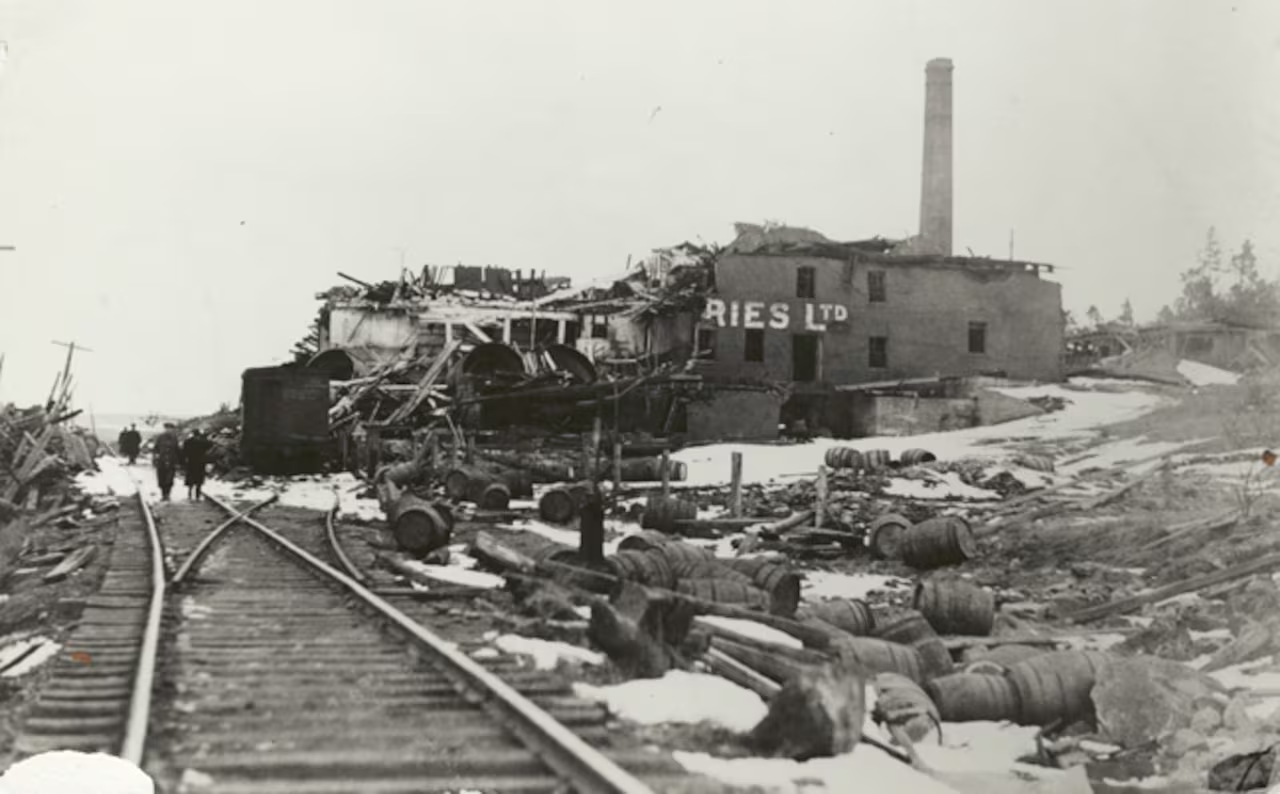
On January 17, 1945, the Red Army crossed the frozen Vistula River and entered Warsaw. They expected to find a capital city — a strategic prize, a home to over a million people. They walked into a moonscape.
The silence was the first thing to strike the soldiers: a heavy, unnatural quiet hanging over a horizon of jagged brick and twisted rebar. No birds. No trams. No crowds. Only wind whistling through the hollowed shells of burnt tenements. According to estimates, 85% of the city's built environment had been annihilated. The Old Town, the Royal Castle, the libraries, the churches, the palaces — not damaged, but pulverised. Twenty million cubic metres of debris covered the ground.
When General Dwight D. Eisenhower later toured the ruins, the veteran of the Western Front was reportedly shaken. He had seen the destruction of cities across Europe, but nothing on this scale. Warsaw was not a city that had been caught in crossfire. It was a city that had been sentenced to death and executed.
A few hundred survivors — later dubbed the "Robinson Crusoes of Warsaw" — crawled from bunkers and cellars into a world that no longer existed. They were the first witnesses to what the Annihilation Order had accomplished. The thesis of modern Warsaw begins here, in this frozen rubble field: the Nazis tried to prove that by destroying every physical trace of a city, they could erase the civilisation that built it. The Poles spent the next decade proving them wrong, using hidden blueprints, oil paintings, and the crushed remains of the old city itself to force it back into existence.
What Warsaw Looked Like Before the War
The "Paris of the North" and Its One Million Jewish Residents
Before September 1939, Warsaw was known across Europe as the "Paris of the North" — a city of baroque spires, Art Nouveau townhouses, crowded cafés, cabaret, and an intelligentsia that punched well above its weight. It was the capital of a nation that had only regained independence in 1918, and it carried itself with the defiant energy of a city that knew its existence was not guaranteed.
A third of Warsaw's population was Jewish. In the 1930s, the city was home to the second-largest Jewish community in the world after New York — roughly 375,000 people living, working, and creating in a dense web of synagogues, theatres, Yiddish-language newspapers, and market streets that made the city culturally unlike anything else in Europe. The destruction of Warsaw was not just the levelling of buildings. It was the erasure of one of the most diverse urban cultures on the continent. When the Nazis looked at the "Paris of the North," they saw a centre of Slavic resistance and Jewish life that they intended to remove from history entirely.
How Warsaw Was Destroyed: From the Uprising to the Annihilation Order
The 1944 Warsaw Uprising and the Soviet Betrayal
The final death of the city began on August 1, 1944. Warsaw had already endured five years of brutal occupation, including the Warsaw Ghetto Uprising of April–May 1943, when Jewish fighters held out for nearly a month against German forces before the ghetto was razed and its surviving population sent to Treblinka and other extermination camps — a catastrophe that Auschwitz-Birkenau would come to symbolise for the world.
In the summer of 1944, with Soviet artillery audible from across the Vistula, the Polish Home Army (Armia Krajowa) launched a desperate bid to liberate the capital before the Red Army arrived. The calculus was political as much as military: if Poland freed its own capital, it could negotiate from a position of strength with Stalin. The gamble failed catastrophically. For 63 days, poorly armed insurgents fought the German war machine in sewers, cellars, and on barricades made of paving stones. The Soviets — whose advance had prompted the timing of the uprising — halted on the east bank of the Vistula and waited. Stalin wanted the Germans to destroy the Home Army for him, eliminating the non-communist Polish resistance before his own forces moved in. The parallel with the Katyn massacre — where the Soviets had already murdered 22,000 Polish officers in 1940 to decapitate a future independent Poland — was not lost on the fighters dying inside the city.
The Home Army capitulated on October 2, 1944. The remaining civilian population — hundreds of thousands of people — was expelled. Warsaw stood empty.
Hitler's Annihilation Order and the Sprengkommando
In most wars, the end of fighting marks the beginning of recovery. In Warsaw, the capitulation marked the beginning of the execution. With the city empty and defenceless, Heinrich Himmler issued the Vernichtungsbefehl — the Annihilation Order — on Hitler's direct instructions. The directive was explicit: "The city must completely disappear from the surface of the earth and serve only as a transport station for the Wehrmacht. No stone can remain standing. Every building must be razed to the foundation."
Special detachments were formed: Sprengkommando (demolition squads) and Brandkommando (arson squads). These were not combat troops. They were technicians of destruction. For three months — October 1944 to January 1945 — the squads moved through the empty city with methodical precision. They divided Warsaw into grid sectors and dismantled it block by block. First, the Brandkommando used flamethrowers to incinerate the interiors: furniture, art, wooden floors, libraries. Then the Sprengkommando drilled into the foundations of historical monuments, palaces, and archives, and detonated dynamite charges to bring the structures down.
The targeting was deliberate. The Krasiński Library, housing priceless manuscripts of Polish history, was set on fire after the uprising had ended — not as collateral damage but as cultural policy. The Royal Castle was drilled and blown up. The Saxon Palace was levelled. Every church in the Old Town was dynamited. The destruction of Warsaw was not a military operation. It was a state-sponsored engineering project of cultural annihilation — the physical equivalent of burning every book in a language to ensure no one could ever read it again. Oradour-sur-Glane in France, where the SS massacred an entire village and left the ruins standing as a frozen crime scene, was a single act of terror. Warsaw was the same impulse applied systematically, over three months, to an entire capital city.
How Warsaw Was Rebuilt After the War
The Debate: Abandon the Ruins or Resurrect the City?
When Polish authorities surveyed the damage in early 1945, a serious debate began. The destruction was so total — no water, no electricity, no bridges, the ground seeded with thousands of unexploded mines — that many planners argued Warsaw should be abandoned as a capital. Proposals circulated to move the seat of government to Łódź, a nearby industrial city that had survived relatively intact, and to leave the Warsaw ruins as a fenced-off memorial landscape.
The returning residents settled the argument before the government could. Despite an official ban on entry, thousands of Varsovians trekked back to the rubble field and began living in caves dug into the debris. They planted Polish flags on the tops of ruined heaps. The psychological need to reclaim the capital was stronger than any logistical calculation. The authorities recognised that Poland could not exist without Warsaw. The decision was made: the city would be rebuilt.
Professor Zachwatowicz and the Secret Architectural Archive
The reconstruction required blueprints for a city whose municipal archives had been deliberately incinerated. The answer came from a secret resistance operation that had been running inside Warsaw's architectural community since the early years of the occupation.
Professor Jan Zachwatowicz, head of architecture at the Warsaw University of Technology, had recognised years before the 1944 destruction that the Nazis intended to erase Poland's built heritage. He organised a covert network of architects and students who spent the occupation years secretly measuring buildings, copying architectural inventories, and producing detailed drawings of Warsaw's historic facades. They smuggled the documents out of the university and hid them in fortified basements, country monasteries, and inside family tombs in local cemeteries.
When the Capital Reconstruction Bureau (Biuro Odbudowy Stolicy — BOS) was established on February 14, 1945, Zachwatowicz became its intellectual engine. His team set up operations in one of the few standing buildings in the Praga district, working in unheated rooms with boarded-up windows. The hidden archives were unearthed and carried to the bureau — a treasure trove of data, but incomplete. There were gaps: entire facades of the Old Town for which no measured drawings existed. To fill them, Zachwatowicz turned to a source that seemed more suited to a museum than a construction site.
How Canaletto's Paintings Were Used as Architectural Blueprints
This is the most extraordinary chapter of the reconstruction. Bernardo Bellotto, an 18th-century Italian painter known in Poland as Canaletto the Younger, had served as court painter to Poland's last king, Stanisław August Poniatowski. Between 1770 and 1780, Bellotto painted 22 detailed vedute — panoramic city views — of Warsaw. He was a master of the camera obscura, a technique that allowed him to capture urban landscapes with near-photographic precision. He painted every brick, every cornice, every chimney pot, and the specific quality of the Warsaw light falling on plaster at different hours of the day.
The paintings survived the war. Zachwatowicz and the BOS architects realised that Bellotto's vedute were accurate enough to serve as elevation drawings. In a move unprecedented in the history of urban planning, 20th-century engineers used 18th-century oil paintings to reconstruct a modern capital. The colour of the plaster on the burgher houses in the Old Town Market Place was matched to the pigments on Bellotto's canvases. Window shapes, ornamental details, rooflines — all lifted from the paintings and translated into architectural specifications.
The result is that walking through Warsaw's Old Town today is, in a precise sense, walking through a three-dimensional projection of a Canaletto painting. Critics at the time called it "creating a fake." Zachwatowicz argued that the architects were restoring the "spiritual truth" of the city. The distinction mattered enough that in 1980, UNESCO added Warsaw's Old Town to the World Heritage List — an unprecedented exception to their policy of excluding reconstructions. The citation states that the value lies not in the original stones but in the "exceptional example of the near-total reconstruction of a sequence of history spanning the 13th to the 20th century."
Rubble Concrete: How Warsaw Was Rebuilt from Its Own Corpse
The intellectual framework came from Zachwatowicz and Bellotto. The physical labour was borne by the nation. "The entire nation builds its capital" (Cały naród buduje swoją stolicę) became the slogan of the reconstruction era, and it was not just propaganda. Contributions poured in from across an impoverished, war-shattered country. Peasants sent food. Miners sent coal. Workers donated wages. Volunteer brigades — men and women, often working with bare hands — cleared millions of tonnes of rubble and formed human chains to pass bricks from the ruins to the masons.
New building materials barely existed in postwar Poland's wrecked economy, so Warsaw was rebuilt from its own remains. Engineers developed a technique called "rubble concrete" — grinding the destroyed bricks into aggregate and mixing them into new blocks. The city was reconstructed from the pulverised dust of the city that had been destroyed. Touching a wall in the Old Town today means touching the physical remains of the pre-war buildings, reconstituted and reassembled by the hands of people who remembered what had stood there. The corpse of the old Warsaw is literally inside the walls of the new one.
Stalin's "Gift" and the Palace of Culture
While the Old Town was being painstakingly reconstructed to resemble its 18th-century self, a different kind of architecture was rising nearby. Poland had fallen under Soviet domination, and Joseph Stalin decided to offer a "gift" to the Polish people: the Palace of Culture and Science (Pałac Kultury i Nauki), completed in 1955. The building is a socialist-realist skyscraper modelled on the Seven Sisters towers in Moscow — 237 metres of concrete and steel that still dominates the Warsaw skyline.
The contrast was devastating. On one side of the city, Poles were gluing together fragments of their own history. On the other, a foreign power was erecting a monument to its dominance over the country it had "liberated" — the same country whose Home Army it had left to die in 1944, whose officers it had murdered at Katyn, and whose independence it had no intention of restoring. The Palace was loathed for decades. Varsovians called it "the best view in Warsaw" — because it was the only place in the city where you couldn't see the Palace itself. The joke carried a real edge: the building was a daily reminder that the Soviet betrayal of 1944 had not been an aberration but a policy. The Berlin Wall would formalise the division of Europe a few years later; the Palace of Culture had already announced it in concrete.
Warsaw's Old Town Today: The Perfect Illusion and Its Deliberate Scars
Is Warsaw's Old Town Original or a Reconstruction?
Walking down the Royal Route toward Castle Square, the pastel-coloured tenement houses gleam in the sun. The cobblestones feel ancient underfoot. The Royal Castle stands with its clock tower keeping time. The Old Town Market Place is ringed by burgher houses with ornate facades in colours that match the light in a Bellotto painting from 1778. It feels like a medieval city that has weathered six centuries of storms.
Almost nothing visible is older than 1950. The Royal Castle itself was not fully reconstructed until the 1980s. The "medieval" cobblestones were laid by volunteer brigades in the 1950s. The facades are Bellotto translations rendered in rubble concrete. The entire Old Town is a reconstruction so complete and so faithful that it earned UNESCO status — not for its age, but for the act of will that brought it back.
Tank Tracks in the Cathedral: Where the Scars Were Left Visible
The architects of the BOS did not intend the reconstruction to be seamless. They deliberately embedded scars — architectural markers for the observant visitor — to ensure the trauma was not entirely erased by the beauty of the rebuilt city.
At the Cathedral of St. John in the Old Town, a segment of a Goliath tracked mine — the remote-controlled demolition vehicle the Germans used to destroy the church — is embedded in the outer brickwork. It sits there permanently, a piece of the weapon fused into the wall of the building it was used to destroy. Throughout the Old Town, fragments of original stone appear in the new walls — darker, rougher, visibly older than the surrounding material, integrated like relics in a reliquary. Some buildings were intentionally left unplastered, exposing the "Warsaw rubble bricks" — a patchwork of red and grey clay that reveals the chaotic, recycled material of the reconstruction beneath the polished surface.
These are the details that make Warsaw a Dark Atlas site rather than simply a beautiful European capital. The Old Town is not a theme park replica. It is a reconstruction that carries the DNA of the destruction inside its walls — literally, in the ground-up remains of the buildings that were dynamited, and symbolically, in the scars the architects chose to leave visible.
Where to See the History of Warsaw's Destruction and Reconstruction
The Warsaw Rising Museum and POLIN
Two museums contextualise the walk through the Old Town. The Warsaw Rising Museum (Muzeum Powstania Warszawskiego), opened in 2004, is an immersive experience rather than a static exhibition. Visitors walk through a replica of the sewers used by insurgents to move beneath the burning city. The sound design reproduces bomber engines and artillery. The museum explains the military and political calculus of the 1944 uprising and documents the systematic destruction that followed — the why behind the rubble field.
The POLIN Museum of the History of Polish Jews stands in the Muranów district, built directly on top of the levelled rubble of the Warsaw Ghetto. The building's architecture creates a canyon-like void through its centre — a rupture in the structure that mirrors the rupture in the city's history. The museum traces a thousand years of Jewish life in Poland, from medieval settlement through the interwar golden age to the annihilation of Warsaw's 375,000 Jewish residents. The neighbourhood around it is quiet and modern, built on a foundation of compacted ghetto debris. The ground level of Muranów is several metres higher than the surrounding streets because the rubble was never removed — it was simply flattened and built over.
Visiting Warsaw: Practical Information
Warsaw's Old Town is compact and walkable. The Royal Route — from the Royal Castle south to Łazienki Park — covers the principal reconstructed landmarks in a two-hour walk. The Warsaw Rising Museum is in the Wola district, a short tram ride west of the centre. POLIN is in Muranów, north of the Old Town. Both require at least two hours each to visit properly.
The city functions as a living argument about what authenticity means. Every pastel facade, every cobblestone, every ornamental detail was placed there by someone who knew what had stood in the same spot before the Sprengkommando arrived. The buildings are new. The intention behind them is not. Warsaw is not a city that survived the war. It is a city that was killed and brought back by people who refused to accept the verdict. The rubble is inside the walls. The scars are in the stone. The paintings that saved the city hang in the National Museum, a fifteen-minute walk from the Old Town they resurrected.
Frequently Asked Questions
Was Warsaw completely destroyed in WWII?
Approximately 85% of Warsaw's built environment was destroyed by the end of the war. The destruction occurred in two phases: significant damage during the 1944 Warsaw Uprising, and systematic demolition by German Sprengkommando and Brandkommando squads in the three months following the uprising's failure, acting on Hitler's explicit Annihilation Order. The Old Town, Royal Castle, major churches, libraries, and archives were deliberately dynamited and burned after the civilian population had been expelled.
Why was Warsaw destroyed after the uprising?
The destruction was not collateral war damage but a deliberate policy of cultural annihilation. After the Warsaw Uprising failed in October 1944, Heinrich Himmler issued the Vernichtungsbefehl (Annihilation Order) on Hitler's instructions, directing that Warsaw be razed to its foundations. The goal was to erase the physical evidence of Polish history and culture, eliminating the capital as a symbol of national identity. Demolition squads spent three months systematically destroying the empty city.
Is Warsaw's Old Town original or rebuilt?
Warsaw's Old Town is almost entirely a reconstruction built in the 1950s. The original was destroyed in 1944. Architects from the Capital Reconstruction Bureau used secretly hidden architectural drawings, measurements taken during the occupation, and 18th-century paintings by Bernardo Bellotto to recreate the historic centre. In 1980, UNESCO added the Old Town to the World Heritage List — the only reconstruction ever granted this status — citing the exceptional nature of the rebuilding effort.
What are the Canaletto paintings of Warsaw?
Bernardo Bellotto, known in Poland as Canaletto the Younger, was an 18th-century Italian painter who served as court painter to Poland's last king. Between 1770 and 1780, he painted 22 detailed panoramic views of Warsaw using a camera obscura technique that captured architectural details with near-photographic accuracy. After the war, these paintings were used as blueprints to reconstruct buildings for which no architectural drawings had survived. The paintings are now in the National Museum in Warsaw.
What museums in Warsaw cover the WWII destruction?
The two principal museums are the Warsaw Rising Museum, which documents the 1944 uprising and subsequent destruction through immersive exhibits including a replica of the insurgent sewer network, and the POLIN Museum of the History of Polish Jews, which covers a thousand years of Jewish life in Poland including the destruction of the Warsaw Ghetto. Both are essential for understanding the context of the city's reconstruction.
How long does it take to walk through Warsaw's Old Town?
The reconstructed Old Town is compact and can be walked in one to two hours. The Royal Route — from the Royal Castle south through Krakowskie Przedmieście and Nowy Świat to Łazienki Park — extends the walk to approximately two hours. The Warsaw Rising Museum and POLIN Museum each require at least two hours for a thorough visit and are located outside the Old Town in the Wola and Muranów districts respectively.
Sources
- [Historic Centre of Warsaw: Inscription Document] - UNESCO World Heritage Centre, List No. 30 (1980)
- [Warsaw 1944: Hitler, Himmler, and the Warsaw Uprising] - Alexandra Richie, Farrar, Straus and Giroux (2013)
- [The Reconstruction of Warsaw's Old Town] - Jan Zachwatowicz, Ochrona Zabytków (Protection of Monuments), Vol. 3 (1950)
- [How Warsaw Came Close to Never Being Rebuilt] - Michał Krasucki, Culture.pl, Adam Mickiewicz Institute (2016)
- [Story of Cities #28: How the Debris of Warsaw's Ruins Was Recycled into New Buildings] - Justin McGuirk, The Guardian (2016)
- [Bernardo Bellotto: The Painter Who Rebuilt Warsaw] - Google Arts & Culture, in partnership with the National Museum in Warsaw (ongoing)
- [History of the 1944 Warsaw Uprising] - Warsaw Rising Museum Archives (ongoing)
- [The Warsaw Ghetto: A Guide to the Perished City] - Israel Gutman, Indiana University Press (2009)
- [POLIN Museum: Core Exhibition Catalogue] - POLIN Museum of the History of Polish Jews (2014)
- [The Royal Castle in Warsaw: History and Reconstruction] - Bożena Wierzbicka, The Royal Castle in Warsaw — Museum (2004)
- [The Sprengkommando and Brandkommando in Warsaw, October 1944–January 1945] - Tomasz Szarota, Okupowanej Warszawy dzień powszedni (Daily Life in Occupied Warsaw), Czytelnik (1978)