The Night the Baltic Took 852 Lives
Around 1:00 AM on 28 September 1994, passengers in the karaoke bar on Deck 5 were still listening to the Swedish singer Pierre Isacsson finish his set when the first metallic bang rolled through the hull. The bridge logged the noise but found nothing wrong on the indicator lights. Down on Deck 1, families were sleeping in the cheap interior cabins. On the higher decks, a Swedish police delegation, a tour group of pensioners from Norrköping, and two Estonian musicians traveling home for a wedding had already gone to bed. Above them, somewhere in the black, wind-driven Baltic, the bow visor was beginning to come apart.
Fifteen minutes later, the visor tore free. It pulled the loading ramp behind it ajar as it fell, and through the four-metre-wide opening that no one on the bridge could see, the sea began pouring directly onto the car deck. By 1:30 the ship had rolled sixty degrees. By 1:50 it was gone. From the first bang to the moment the MS Estonia vanished from the radar of the nearby cruiseferry Mariella, fifty minutes had passed. Of the 989 people on board, 137 would survive.
The Estonia is the deadliest peacetime shipwreck in European waters since the RMS Titanic in 1912. The comparison is not literary. Both ships went down because someone, somewhere, had decided that an obvious vulnerability — watertight subdivision in 1912, bow visor strength in 1980 — was not worth designing for. The Titanic's flaw was hidden by ice. The Estonia's was hidden by the fact that the system functioned perfectly until the night it didn't. The ferry had sailed the Tallinn–Stockholm route hundreds of times. She had been certified by Finnish, Swedish, and Estonian inspectors. Her crew had run every checklist. None of it mattered, because the entire safety architecture rested on the assumption that the door at the front of the ship would hold. It hadn't been built to.
The Soviet-Built Ferry and the Tallinn–Stockholm Lifeline
From Viking Sally to MS Estonia: A 14-Year Identity Shift
The ship that sank as the MS Estonia was already fourteen years old and on her fourth name. She had been built in 1980 at the Meyer Werft shipyard in Papenburg, West Germany, for the Finnish operator Rederi Ab Sally, and entered service that summer as the Viking Sally, running between Turku, Mariehamn and Stockholm. She was the largest ferry on the route. She was also unremarkable. Through the 1980s she grounded once in the Åland Archipelago, suffered a propeller fault, and was lengthened with a "duck tail" in 1985. In 1986 a passenger was murdered on board. In 1987, another murder and an attempted murder occurred — the second still unsolved.
She became Silja Star in 1990, then Wasa King in 1991, running across the Bothnian Sea to Vaasa, where her crews quietly considered her the best-behaved ship on the route in heavy weather. In January 1993 the Swedish company Nordström & Thulin bought her for the new Estline service to the newly independent Republic of Estonia, and she was renamed MS Estonia. Her ownership was structured through Cyprus and Tallinn for financing reasons, which meant she was simultaneously registered under two flags. To Estonians, none of that mattered. She was the largest ship sailing under the Estonian flag, and she was a national symbol of an eighteen-month-old country that had emerged from fifty years of Soviet occupation and was finally, visibly, free.
The Tallinn–Stockholm Route and the New Baltic Economy
The ferry mattered because the route mattered. After 1991, the overnight crossing between Tallinn and Stockholm became the most important commercial artery between the new Baltic republics and the Nordic world. Estonians sailed west to work, to shop, to bring back goods that did not yet exist on Tallinn shelves. Swedes sailed east for cheap vodka, for cheap weekends, for the strange tourist appeal of a city emerging from communism in real time. The MS Estonia ran the route three times a week, and she ran it full. On any given crossing she carried roughly a thousand people and several hundred tonnes of vehicles and cargo — a floating border between two economies still figuring out how to be neighbours.
How Roll-On/Roll-Off Ferries Became Maritime Death Traps
The Estonia was a roll-on/roll-off ferry, a design built for one purpose: to load and unload vehicles as quickly as a parking garage. The economics were beautiful. The physics were not. The car deck was a single, unbroken cavern running almost the entire length of the ship, and the moment any significant amount of water got onto it, the free surface effect took over. Water sloshes. Sloshing water on a wide flat deck has enormous momentum. It travels with the roll of the ship, amplifies the roll, and then keeps going. A RoRo ferry that takes water on the car deck does not slowly fill and settle. It tips, and once it begins to tip it cannot recover.
The maritime industry had been warned about this seven years earlier. In March 1987 the MS Herald of Free Enterprise had capsized off Zeebrugge in less than ninety seconds because someone had failed to close the bow door before sailing. Water flooded the car deck, free surface effect did the rest, and 193 people died. The Herald disaster produced reports, recommendations, and a regulatory conversation. It did not produce stronger bow doors. The visor on the MS Estonia had been engineered using load calculations meant for non-opening bows. Even her attachment locks were built of mild steel. The visor itself was never classified as a critical safety component. It was a door. The water beyond it was the responsibility of the people who closed it properly.
28 September 1994: The Final Crossing of the Baltic
The 989 People on Board
The Estonia was carrying 989 people on her last voyage — 803 passengers and 186 crew. Most of the passengers were Swedish. Among them was a tour group of pensioners from a small Swedish town, traveling home from a few days in Tallinn. A Swedish police delegation was returning from a professional exchange. A Finnish couple was on holiday. Roughly two hundred and eighty-five of the passengers were Estonian — workers, traders, families with relatives in Stockholm, two young Estonian musicians on their way to play at a wedding. The Estonian singer Urmas Alender was on board. So was the Swedish entertainer Pierre Isacsson, hired to host the karaoke night in the Pub Admiral on Deck 5. Neither would survive.
The youngest person on board was an infant. The oldest were in their eighties. There were no minors travelling alone. The total demographic mirrored the route: middle-aged and elderly Swedes who had time to take ferries, Estonian families and workers traveling for economic reasons, and a working crew almost entirely drawn from the new Republic of Estonia. Of the 137 people who survived, 111 would be men, only 26 women. Seven survivors were over the age of 55. None were under 12.
A Force 8 Storm and a Routine Departure from Tallinn
The MS Estonia left Tallinn at 19:15 on the evening of 27 September, slightly behind schedule. The forecast called for a storm — Force 7 to 10 on the Beaufort scale, winds of 15 to 25 metres per second, significant wave heights of four to six metres. None of this was unusual for a Baltic autumn. Esa Mäkelä, the captain of the Silja Europa who would later be appointed on-scene rescue commander, would describe the weather that night as "normally bad." Every other scheduled ferry on the Baltic that night had also sailed. The Estonia's bridge logged a small starboard list from uneven cargo distribution before departure and corrected nothing.
Captain Arvo Andresson had the bridge. The ship's other rotating captain, Avo Piht, was off duty and travelling as a passenger. The ship cleared the Estonian coast and pushed northwest into the open Baltic. By midnight she was making roughly fourteen knots in heavy seas, slower than her usual sixteen or seventeen, but holding course. The ship was fully loaded. Below the passenger decks, on the great open car deck, trucks and cars sat lashed in their usual rows.
The Disco, the Karaoke, and the Last Normal Hours
The Estonia's evening followed the rhythm of every Baltic ferry on every crossing. The duty-free shop did business. The dining rooms served set menus. A live band played on Deck 6. Pierre Isacsson hosted the karaoke in the Pub Admiral on Deck 5. The pool and sauna on Deck 0, two decks below the waterline, stayed open into the late evening. By midnight most passengers had gone to their cabins. The cheap inside staterooms on Deck 1 — windowless, bunk-bedded, four to a room — were full of sleeping families. The pricier cabins on Decks 4, 5, and 6 held the older passengers, the police delegation, the couple celebrating their anniversary. The two musicians on their way to the wedding had stayed up for one last drink.
The 30 Minutes That Sank a Modern Ferry
The Bow Visor Tears Free at 1:00 AM
The first sound came at around 1:00 AM, on the outskirts of the Turku archipelago. A passenger on Deck 1 woke to a metallic bang from the front of the ship. So did the bartender on Deck 5. Several other passengers and crew reported similar noises over the next ten minutes. On the bridge, a crewman was sent to check the indicator lights for the visor and the inner ramp. The lights showed green. He reported back. No one was sent forward to look at the actual door, because the bridge was set too far back on the superstructure to see the bow visor at all. The video monitor that watched the inner ramp was mounted on the bridge but not visible from the captain's conning position.
What the passengers had heard was the visor's lower locking lug failing. Over the next ten minutes the remaining locks tore free in sequence, and the 55-ton visor began to flap against the hull with each wave. At approximately 1:15 it sheared off completely, taking the loading ramp behind it. The ramp swung partly open — a four-metre gap at the front of the ship, just below the waterline at certain wave angles. None of this triggered an alarm. The visor had been torn off at points the warning system was not designed to detect. The bridge still saw green lights. Through the open ramp, the Baltic was now flooding directly onto the car deck.
The Listing: How Free Surface Effect Killed the Ship
The ship's reaction was almost instantaneous. By 1:20 the Estonia was listing fifteen degrees to starboard. By 1:30, sixty degrees. By 1:50, ninety. The free surface effect was doing exactly what the engineers of every RoRo ferry had been warned it would do. The water on the car deck swirled with the rolling of the hull, gathered weight on one side, and pulled the ship over faster than the ship could right itself. Survivors later reported water flowing down through ceiling panels and stairwells from decks that were not yet underwater. The big windows along Deck 6 burst inward as the sea reached them. Anyone still in a cabin on the lower decks was now trapped — stairwells became vertical chutes, doors became ceilings, walking became falling.
A quiet female voice came over the public address system at around 1:20: "Häire, häire, laeval on häire" — "Alarm, alarm, there is alarm on the ship." She spoke in Estonian. Most of the passengers were Swedes who had no idea what she was saying. The internal crew alarm followed immediately, and the general emergency signal one minute after that. By then, the angle of the deck made the alarm largely irrelevant. The roughly 650 people still inside the ship would never reach the open air.
The 1:22 AM Mayday and the Rescue That Arrived to a Sea of Bodies
The Estonia sent her first mayday at 1:22. The transmission did not follow international format. Maritime Rescue Co-ordination Centre Turku failed to acknowledge it directly. The Mariella, the first ferry to receive the signal, relayed it onward — but Helsinki Radio passed it on as the less urgent "pan-pan" message rather than a full mayday. A full-scale emergency was not declared until 2:30 AM, more than an hour after the first distress call and forty minutes after the ship had vanished from radar.
The Mariella reached the position at 2:12 AM and found a scattering of inflatable life rafts in heavy seas. The first Finnish border guard helicopters arrived at 3:05 AM. The pilot of the Super Puma OH-HVG would later describe landing on the rolling deck of a rescue ferry as the most difficult flying he had ever done; that single helicopter would lift forty-four people from the water — more survivors than any of the rescue ferries managed combined. Of the ferries that arrived, most could not safely launch their man-overboard boats in the storm. The Estonian liner MS Isabella saved sixteen people with its rescue slide. By dawn, search aircraft were combing a debris field of bodies, broken life rafts, and cabin fragments stretched across miles of grey Baltic.
The 137 Survivors and the 852 Lost
Hypothermia, Life Rafts, and the Baltic in September
The water temperature on the night of 28 September was 10 to 11 degrees Celsius — cold enough to kill a healthy adult in an hour. The investigation later concluded that perhaps 310 people made it onto the open decks before the ship rolled. Of those, only about 160 boarded a life raft or lifeboat. The rest were swept into the sea wearing whatever they had been sleeping in, or were thrown clear when the ship went under. Roughly a third of the people who reached the outer decks died of hypothermia before any rescuer found them. The wind drove the waves and the rafts in different directions. People who held on to the wrong piece of debris died within sight of the right one.
The life rafts themselves were a brutal exposure of design failure. Many flipped on launching. Others filled with water and stayed half-submerged, leaving survivors clinging to a rim with the sea breaking over their faces. The disaster would push the International Maritime Organization to redesign the standard life raft and to mandate automatic distress beacons on passenger ferries — improvements paid for, like most maritime safety, in lives.
Documented Survivor Accounts: Härstedt, Hedrenius, and the Raft
The most widely told survival story belongs to two strangers. Kent Härstedt, a 29-year-old Swedish entrepreneur in a suit, reached the boat deck just as the ship was rolling. There he met Sara Hedrenius, a 18-year-old Swedish girl trying to free a lifeboat that wouldn't release. Härstedt offered her a deal: they would help each other survive, and if they did, he would take her to dinner in Stockholm. A wave swept them both into the sea before they could finish the conversation. Hedrenius's foot caught on something underwater. She panicked at the thought of her parents at her funeral, the foot came free, and she surfaced. They found each other again in the dark, swam to an overturned life raft, and climbed onto it with about twenty-two other survivors.
They sat in waist-deep water on the raft for hours, telling each other jokes to stay awake, while bodies of fellow passengers bumped against their legs. A man on the raft — survivors only ever knew him as "Mr. Positive" — kept reassuring everyone that rescue would arrive any moment. He died after four hours. When the helicopter finally found them, Härstedt and Hedrenius made sure another half-frozen passenger named Boye was lifted first. Sara had been keeping him conscious by slapping his face. They kept their dinner date a month later. Härstedt later became a member of the Swedish Parliament. Hedrenius became a Swedish Red Cross trauma specialist who would help survivors of the 2004 Indian Ocean tsunami.
The National Wound: Who Died and Where They Came From
The Estonia killed 501 Swedes and 285 Estonians. The remaining 66 dead came from sixteen other countries — Latvia, Russia, Finland, Norway, Denmark, Germany, Lithuania, Morocco, the Netherlands, France, the United Kingdom, Canada, Belarus, Ukraine, Nigeria. In Sweden, with a population of under nine million, the death toll worked out to one in roughly seventeen thousand citizens — proportionally comparable to what the United States lost on 9/11. Survivor Rolf Sörman would say afterwards that "Sweden is so small that basically everyone knew someone who drowned." In Estonia, with a population then of about a million and a half, the proportional loss was even higher. Mart Luik, an Estonian commentator, observed that every Estonian of a certain age remembers exactly where they were when they heard about the Estonia.
The dead included 94 bodies that were eventually recovered — 93 in the first 33 days of the search, the last one not for 18 months. The remaining 758 were never brought up. They are still inside the wreck.
The JAIC Investigation and the Bow Visor Verdict
The Joint Estonian-Finnish-Swedish Commission
The Joint Accident Investigation Commission was formed within twenty-four hours of the sinking. It included representatives from all three countries on the route — Estonia, Finland, Sweden — and worked in parallel with each delegation maintaining technical independence. The Commission held twenty internal meetings over fifty-one days of formal sessions, supplemented by structural simulations, hydrodynamic studies, and a wreck survey conducted by the Norwegian company Rockwater A/S using ROVs and divers in October 1994. The bow visor itself was located on the seabed about a mile from the wreck, recovered, and brought to the Muskö naval base in Sweden for examination.
The Final Report's Conclusions and Their Limits
The Commission's final report, published in December 1997, concluded that the bow visor's locking mechanism had failed under wave loading, the visor had separated and dragged the ramp open, and the resulting flooding of the car deck had capsized the ship through free surface effect. The report identified a cluster of underlying causes: the visor had been built to load standards meant for non-opening bows; its locks were not classified as critical safety items; the inspections required at certification had never been performed; the bridge could not see the visor or the ramp monitor. The report was also openly critical of the crew — for failing to reduce speed when the noises started, for the late and informal mayday, for the absence of clear evacuation guidance.
A final, damning footnote: the Commission concluded that if the inspection had been performed and the certificate had recorded the regulatory exemption granted for the bow ramp's position, the Estonia would not have been allowed on the Tallinn–Stockholm route in the first place, and the accident "would probably not have occurred."
Why the Official Account Was Never Fully Accepted
The report satisfied very few people. The families of the dead noted that it explained the mechanism of the sinking but answered almost none of the human questions. Why did the bridge not slow down after the first bang? Why was the mayday so late and so badly formatted? Why was Captain Andresson's exact decision-making sequence never fully reconstructed? Why was the visor recovered, examined, and then quietly scrapped before independent experts could conduct further forensic work? And, above all, why had the Swedish, Estonian, and Finnish governments decided in December 1994 — barely two months after the disaster — that the ship would not be raised, the bodies would not be recovered, and the wreck would be sealed off as a sanctified grave?
The official answer was ethics and cost. The political answer was easier to suspect than to prove.
The Sealed Wreck and the Conspiracy Theories That Refused to Die
The 1995 Sanctuary Treaty: War Grave or Cover-Up?
In 1995 Sweden, Finland, Estonia, Latvia, Poland, Denmark, Russia and the United Kingdom signed the Estonia Agreement. The treaty designated the wreck site a sanctified grave and prohibited citizens of the signatory states from approaching, diving, or filming the wreck. As a preliminary protective measure, Sweden dropped thousands of tonnes of pebbles onto the site, though the plan to encase the entire wreck in concrete was abandoned after protests from victims' families. The Swedish Navy intercepted at least two unauthorized diving operations. The Finnish Navy continues to monitor the site by radar to this day. To the families, this was protection. To others, it was a lid.
The objection from the families was straightforward. A modern shipwreck in 80 metres of water, in a partially enclosed sea, was technically recoverable. The Swedish government had publicly promised within hours of the disaster to bring up the bodies. Two months later that promise had been quietly reversed. Survivors and relatives' associations have argued ever since that the decision was not about ethics but about preventing anyone from looking too closely at the cargo, the structural damage, or the chain of decisions on the bridge that night.
The Russian Military Cargo Allegations
The most persistent set of allegations concerns what was on the car deck. Beginning in the late 1990s, multiple investigations — by the Swedish journalist Jutta Rabe, by the New Statesman, by the Norwegian researcher Ola Tunander, and by the Swedish television channel SVT in 2004 — alleged that the Estonia had been routinely used to ferry former Soviet military electronics from newly independent Estonia to Sweden, possibly as part of a joint Western intelligence operation. In 2004 a former Swedish customs officer publicly confirmed that military equipment had crossed on the Estonia in September 1994.
Subsequent investigations by the Swedish and Estonian governments admitted that non-explosive military equipment had indeed travelled on the ferry on 14 and 20 September 1994, with the Swedish defence forces eventually conceding in 2022 that the number of such transports had been higher than previously disclosed. Both governments insisted that no military shipment had been on board on the night of the sinking. Estonian investigator Väino Karm's exhaustive 1990s investigation, which interviewed every port worker on duty that night, found no documentary evidence of a military cargo on the final voyage. Estonia's then-president Lennart Meri privately ordered the Estonian Internal Security Service to investigate discrepancies in the cargo manifest — the border guards counted 61 vehicles, customs and the shipping company counted 75, the security service estimated as many as 83 — but the investigation produced nothing conclusive.
The honest summary, three decades later, is that nobody has proven the Estonia was carrying secret cargo on the night she sank, and nobody has proven she wasn't. The official investigations have stated the question is closed. The families do not accept that answer. Neither does a non-trivial fraction of Swedish, Estonian, and Finnish public opinion.
The 2020 Documentary and the 4-Metre Hole
The conspiracy returned to the front pages on 28 September 2020, when the Swedish journalist Henrik Evertsson released a five-part documentary series titled Estonia: The Discovery That Changes Everything. Working from a German-flagged vessel — Germany was the only Baltic state that had not signed the 1995 sanctuary treaty — Evertsson and cameraman Linus Andersson had used a remotely operated underwater vehicle to film the wreck in detail. Their footage showed a previously undocumented hole in the starboard side of the hull, four metres high and roughly 1.2 metres wide. Marine engineering experts interviewed in the film argued that damage of that scale could only have been caused by an external impact.
The documentary forced an immediate political response. The foreign ministers of Estonia, Sweden, and Finland met within days and agreed to formally re-examine the new evidence. Evertsson and Andersson were arrested by Swedish authorities and prosecuted under the 1995 Estonia Agreement for "breaching the peace of the grave." The case bounced through Swedish courts for years; both men were eventually fined in 2022. None of the prosecutions addressed the question their footage had raised.
The 2023 Reinvestigation and the Wreck That Will Never Rise
New Findings on Hull Damage and the Sea Floor
The Swedish Accident Investigation Authority (SHK), working jointly with Estonian and Finnish counterparts, conducted a new survey of the wreck between 2021 and 2023. They produced 45,000 high-resolution 3D images, sawed off a steel sample at the edge of the starboard damage, took drill samples from the bedrock directly beneath the hole, and in July 2023 — in the most ambitious physical operation since the 1990s — recovered the bow ramp itself for laboratory examination in Estonia.
The results, published in 2023 and finalised in 2024, were unambiguous in one direction. The Estonian Forensic Science Institute reported no traces of explosive residue on the steel sample, no chemical signs of an explosion, no signs of contact or collision with another metal object. The bedrock beneath the hole was identified as gneiss — a hard, abrasive rock entirely consistent with the hull tearing open as it settled onto the seabed. Stockholm University concluded that the deposits found on the damaged plating were the product of natural marine processes, not detonation. Swedish prosecutors formally closed the case. The official conclusion, thirty years on, remains the bow visor.
The 2023 investigation did add one significant new detail: the visor's design flaws were even more serious than the 1997 report had concluded, and the chain of certification failures stretched further back into the regulatory practices of the 1980s. The Estonia, on this revised reading, had been a slowly maturing accident from the day she left the Papenburg shipyard.
The Continued Refusal to Raise the Dead
The wreck will not be raised. This has been the consistent position of all three governments since 1994, and there is no political appetite — in Stockholm, in Tallinn, in Helsinki — to revisit it. The 758 bodies still inside the hull will stay there. The relatives' organisations have largely accepted, after thirty years, that this is permanent. What they have not accepted is the secrecy that surrounds it. In October 2025, German broadcasters WDR and NDR, working with Süddeutsche Zeitung, reported NATO intelligence suspicions that Russian military divers — operating from the GUGI deep-sea research directorate — had been using the protected wreck site as a base for underwater espionage operations against NATO submarine traffic in the Baltic. The MS Estonia, on these reports, may be the only war grave on Earth that is also a covert intelligence platform.
Memorials, Memory, and the Two Nations That Still Mourn
The "Broken Line" Memorial in Tallinn
The Estonian memorial sits on the rocky shore beside Linnahall, a few hundred metres from the ferry terminal where the MS Estonia loaded for the final time. It is a bronze sculpture by the Estonian artist Villu Jaanisoo, a fractured arc of metal — the "broken line" of the title — set into the limestone. The site is unmarked by signage from a distance and easy to walk past on the way to the cruise ships. Up close it is intimate, almost private: a single curve of dark metal facing the sea the ship sailed into. Estonian state ceremonies are held here on every 28 September. The president and prime minister attend; church bells ring across Tallinn at 1:00 AM in years that fall on the anniversary.
Stockholm's Memorial Wall and the Swedish Annual Remembrance
The Swedish memorial sits on the south side of Djurgården, beside the historical naval cemetery of Galärvarvskyrkogården. It was designed by the Polish sculptor Mirosław Bałka and inaugurated on 28 September 1997, the third anniversary of the sinking. The structure is a triangular enclosure of bright granite with an entrance from the seaward side. A single tree stands at the centre, with an iron ring around its base inscribed with the coordinates where the ship sank — 59.382°N, 21.682°E. The names of 815 of the 852 dead are engraved on the granite walls. The remaining names were withheld at the request of relatives. The inscription reads, in Swedish: "Their names and their fate we never want to forget."
The Swedish royal family attends the memorial service most years. The 30th anniversary in September 2024 was marked with a speech by King Carl XVI Gustaf and Prime Minister Ulf Kristersson — the king observing that few events in modern history have shaken Sweden as deeply as the loss of the Estonia.
Smaller Markers Across the Baltic
Smaller memorials sit in Turku, Helsinki, and on the Finnish island of Utö, the closest piece of land to the wreck site. The Estonian Maritime Museum in Tallinn maintains a permanent exhibition on the disaster, curated in cooperation with survivors' organisations. The Estline pier where the MS Estonia loaded on her last voyage is no longer used by ferry traffic. The new ferries to Stockholm — operated by Tallink and Viking Line — depart from a different terminal, on a different route, in ships built to the post-Estonia safety standards that her sinking forced into existence.
The Atlas Entry: Visiting the Memorials of MS Estonia
The two memorials sit in the two cities the ship connected, a Baltic crossing apart. Both are open year-round and free. Both reward a quiet visit on a grey day more than they reward summer.
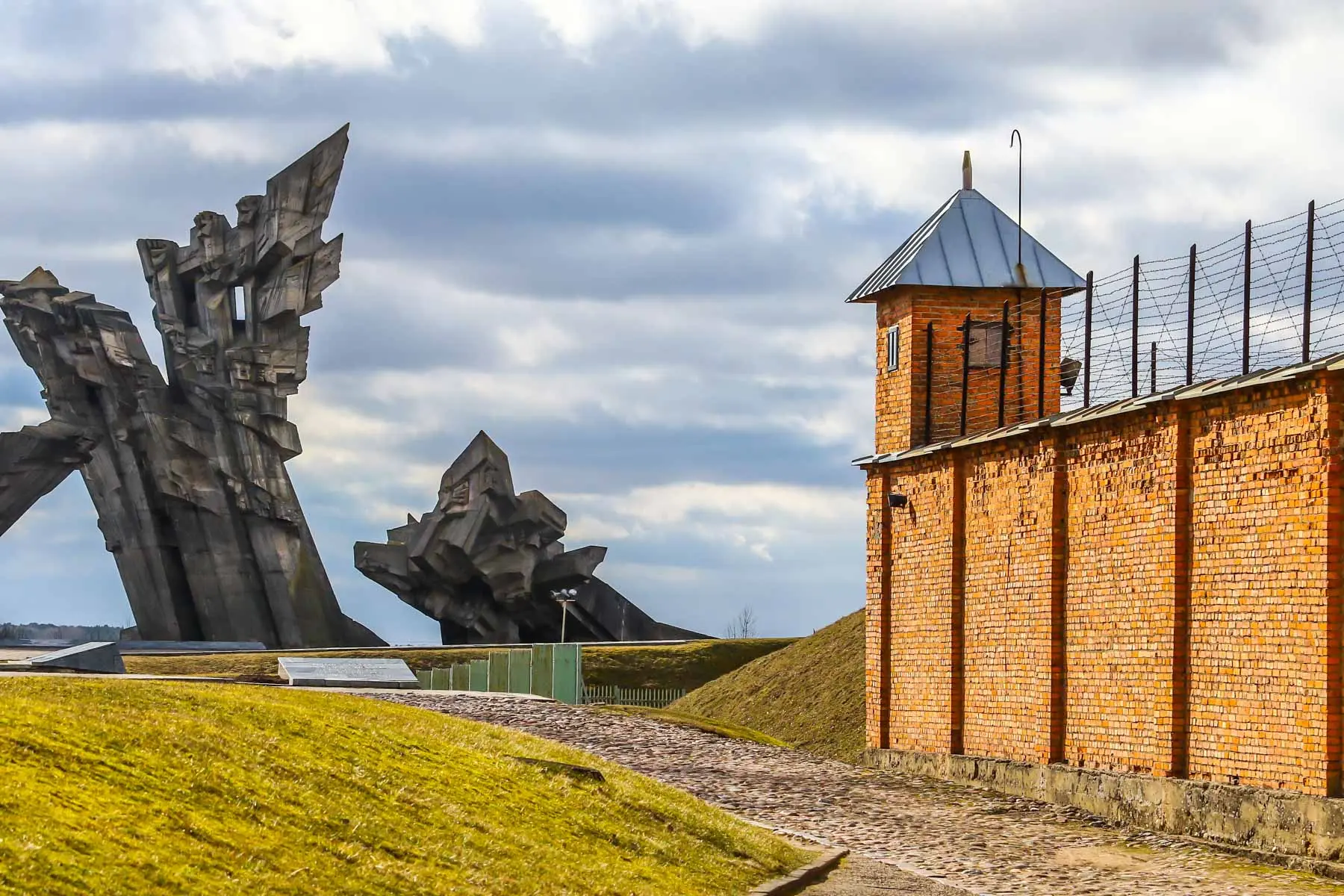
In Tallinn, the Broken Line monument is on the Linnahall waterfront, a fifteen-minute walk north from the medieval Old Town. The path runs past Patarei Prison — Tallinn's three-regime house of horrors and a useful frame for what the Estonia meant in a country that had only just stopped being a Soviet colony when she sank. The Estonian Maritime Museum, housed in the Fat Margaret tower at the edge of the Old Town, is a short walk further south. Plan an hour at the museum, fifteen minutes at the monument, and longer if you want to walk the breakwater out to where the ferries still load.
In Stockholm, the memorial is on Djurgården, a short walk from the Vasa Museum and the Nordic Museum. The Galärvarvskyrkogården naval cemetery is immediately adjacent and worth ten minutes on its own. The 28 September anniversary service is open to the public and draws several thousand attendees in significant years. On any other day, the granite enclosure is almost always empty. Read the names. The inscriptions are in alphabetical order, which means parents and children, husbands and wives, are not always together. That is the point.
The wreck itself is unreachable. It lies in 80 metres of water, 35 kilometres south of the Finnish island of Utö, inside an exclusion zone monitored by the Finnish Navy. No civilian dive operator is licensed to approach it. No memorial cruise stops at the coordinates. The closest anyone is allowed to come is Utö lighthouse, from which on a clear day the horizon is blank Baltic in every direction. The MS Estonia is the only major modern shipwreck in European waters that no living person has stood beside, and the political will to keep it that way has held for thirty years across three governments, multiple investigations, and two generations of grieving families.
The Estonia is a quieter site than the RMS Titanic or the SS Andrea Doria, the two great peacetime sinkings she joined in the maritime record. The Titanic became a film. The Andrea Doria became a recreational dive site. The Estonia became a sealed grave inside a treaty inside a conspiracy theory, and the modern visitor's only access to her is two granite walls inscribed with names. That is more than the dead got. It is less than their families wanted.
Frequently Asked Questions About the MS Estonia Disaster
What caused the MS Estonia to sink?
The MS Estonia sank because the locks on her bow visor — a 55-ton hinged door at the front of the ship — failed under wave loading in a Force 7–10 Baltic storm. When the visor tore free at around 1:15 AM on 28 September 1994, it pulled the loading ramp behind it ajar, and the sea flooded directly onto the wide, open car deck. Water on a roll-on/roll-off ferry's car deck triggers the free surface effect, an unstoppable sloshing motion that capsized the ship in roughly thirty minutes. The 1997 official report concluded that the visor had been under-designed at construction in 1980 and that mandatory inspections, which would have caught the flaw, had never been performed.
How many people died on the MS Estonia?
A total of 852 people died when the ferry sank between Tallinn and Stockholm. Of the 989 people on board — 803 passengers and 186 crew — only 137 survived. Most of the dead were Swedish (501) and Estonian (285), with the remaining 66 victims drawn from sixteen other countries. Only 94 bodies were ever recovered, the last one found 18 months after the sinking. The remaining 758 dead are still inside the wreck on the Baltic seabed.
Where is the MS Estonia wreck located, and can it be visited?
The MS Estonia rests at a depth of approximately 80 metres in international waters about 35 kilometres south of the Finnish island of Utö, at coordinates 59.382°N, 21.682°E. The wreck cannot be visited. Under the 1995 Estonia Agreement signed by Sweden, Finland, Estonia, Latvia, Poland, Denmark, Russia, and the United Kingdom, the site is a sanctified grave and citizens of the signatory states are forbidden from approaching it. The Finnish Navy monitors the location by radar, and the Swedish Navy has intercepted at least two unauthorized diving operations over the years.
Was the MS Estonia carrying secret military cargo?
The Swedish defence forces have admitted that the MS Estonia carried non-explosive military electronics on at least two crossings in September 1994 (on 14 and 20 September), and conceded in 2022 that the total number of such transports was higher than previously disclosed. Both Swedish and Estonian official investigations have stated that no military shipment was on board on the night of the sinking. Independent investigators including Ola Tunander and Jutta Rabe have argued the opposite. Nobody has produced definitive evidence either way, which is why the question has not closed in three decades.
What is the "Broken Line" memorial in Tallinn?
The Broken Line is the Estonian national memorial to the disaster, located on the Linnahall waterfront a short walk from the modern ferry terminal. It is a fractured bronze arc by sculptor Villu Jaanisoo, set into the limestone shore facing the route the Estonia sailed. The memorial is the focal point of Estonia's annual 28 September commemorations, attended by the president and prime minister. The corresponding Swedish memorial sits in Stockholm at Galärvarvskyrkogården on Djurgården, designed by the Polish sculptor Mirosław Bałka and inscribed with 815 of the 852 victims' names.
Why was the wreck never raised and the bodies never recovered?
The Swedish government promised within hours of the disaster to raise the wreck and recover the dead. Two months later, in December 1994, that promise was reversed on the recommendation of the National Maritime Administration and a government ethics committee. The official justification was that the recovery operation would be financially expensive, technically risky for divers, and ethically fraught given how many bodies were trapped inside collapsed cabin spaces. The relatives of the dead have never fully accepted this reasoning. Persistent allegations that the decision was made to prevent close forensic examination of the hull and cargo have driven the disaster's enduring conspiracy debate.
Sources
* [Final Report on the Capsizing on 28 September 1994 in the Baltic Sea of the Ro-Ro Passenger Vessel MV Estonia] - Joint Accident Investigation Commission of Estonia, Finland and Sweden (1997)
* [M/V ESTONIA Preliminary Assessment of New Information] - Swedish Accident Investigation Authority (SHK) (2023)
* [A Sea Story] - William Langewiesche, The Atlantic (2004)
* [Flashes in the Night: The Sinking of the Estonia] - Jack A. Nelson (2011)
* [Estonia: The Discovery That Changes Everything] - Henrik Evertsson, Discovery Networks (2020)
* [Investigation Reports on Steel Sample and Bow Ramp Examinations] - Estonian Forensic Science Institute (2024)
* [Agreement Regarding the M/S Estonia (Estonia Agreement)] - Sweden, Finland, Estonia, Latvia, Poland, Denmark, Russia, United Kingdom (1995)
* [The Sinking of MS Estonia: 30 Years of Unanswered Questions] - Silver Tambur, Estonian World (2024)
* [After the MV Estonia Ferry Disaster: A Swedish Nationwide Survey of the Relatives of the Victims] - Brändänge & Lundin, Dialogues in Clinical Neuroscience (2000)
* [The Swedish Defence Forces: MS Estonia Transported Military Equipment] - Aftonbladet / Estonian World (2022)
* [Russia Suspected of Using MS Estonia Wreck for Baltic Sea Espionage] - WDR / NDR / Süddeutsche Zeitung joint investigation (2025)
* [Salvage of the Bow Ramp] - Statens Haverikommission, Government of Sweden (2023)