The Red Cross Inspection of June 1944: The Day the World Chose Not to See
June 23, 1944. Three visitors — Maurice Rossel of the International Committee of the Red Cross, E. Juel-Henningsen of the Danish Ministry of Health, and Franz Hvass of the Danish Foreign Ministry — entered the gates of the Theresienstadt ghetto for an eight-hour inspection. They were led along a predetermined route. They passed a café. A bank. A children's playground. Freshly planted flower gardens. A soccer match was underway. In a newly built community hall, a children's opera called Brundibár was being performed by young prisoners in clean costumes. The streets had been renamed with civilian-style signs. A bandstand had been erected in the town square.
Paul Eppstein, the head of the Jewish Council of Elders, was driven through the ghetto in a limousine chauffeured by an SS officer posing as his personal driver. He delivered a speech — written by the SS — describing Theresienstadt as "a normal country town" of which he was the "mayor." He presented fabricated statistical data on population health and food supply. He still had a black eye from a beating administered days earlier by camp commandant Karl Rahm. At one point during the tour, Eppstein attempted to warn Rossel that there was "no way out" for Theresienstadt's prisoners. Rossel did not act on the warning.
In the five weeks before the visit, 7,503 of the ghetto's most visibly emaciated, sick, and elderly inhabitants had been loaded onto transports and sent to Auschwitz-Birkenau, where the majority were gassed on arrival. The deportation's purpose was to reduce the ghetto's population from 44,000 to under 30,000 — a number that would make the overcrowding less obvious to visitors. The streets had been swept. The barracks had been painted. The cruelty had been rearranged to be invisible from a guided tour.
Rossel's report declared conditions favorable — even superior, he wrote, to those of ordinary Czech civilians. Rabbi Leo Baeck, the spiritual leader of the ghetto's prisoners, later said of the visit: "The effect on our morale was devastating. We felt forgotten and forsaken." Terezín is the place where the Holocaust dressed itself up and invited guests. The deception required the participation of victims — forced to perform their own contentment — and the cooperation of observers, who chose not to see what was in front of them. The horror of Terezín is not just what happened inside its walls. It is that the world was given a chance to look, and looked away.
Terezín Before the Nazis: The Habsburg Fortress That Became a Ghetto
The 18th-Century Military Fortress and the Small Fortress Prison
Emperor Joseph II of Austria commissioned the construction of Terezín in 1780 as a military fortification against Prussian expansion, naming it after his mother, Empress Maria Theresa. The town was a purpose-built garrison — massive bastion walls, deep moats, a water system capable of flooding the surrounding terrain, and tens of kilometers of underground tunnels. No battle was ever fought there. The fortress's military significance faded within decades of its construction.
The Small Fortress, across the river from the main town, found a second life as a political prison. Its most famous inmate arrived in 1914: Gavrilo Princip, the 19-year-old Bosnian Serb who assassinated Archduke Franz Ferdinand and his wife Sophie in Sarajevo — the act that triggered World War I. Too young for the death penalty by one month, Princip was chained to a wall in solitary confinement at Terezín, where tuberculosis consumed his body. His right arm was amputated. He died on April 28, 1918, weighing roughly 40 kilograms. The man whose single act of violence had collapsed four empires and killed millions ended his life in a cell in a fortress that had never seen combat. His cell can still be visited today.
How the Nazis Chose Terezín for the "Model Ghetto" (1941)
In October 1941, Reinhard Heydrich — the newly appointed Reich Protector of Bohemia and Moravia, and the principal architect of the Final Solution — selected Terezín as the site for a new kind of camp. The walled garrison town could be sealed off from the outside world. It was close to Prague, architecturally presentable, and large enough to hold a significant population. Its purpose would be dual: a transit camp for Czech Jews en route to the extermination camps in the East, and a propaganda tool — a "model Jewish settlement" that could be shown to the international community as evidence that the deportations were humane.
The first transports of Czech Jews arrived on November 24, 1941. By 1942, the Nazis had expelled the town's 7,000 Czech civilian residents and sealed the ghetto. German, Austrian, Dutch, and Danish Jews followed. Elderly Jews, war veterans, prominent cultural figures, and individuals whose disappearance might attract international attention were sent to Terezín rather than directly to the killing centers. The fiction was that they were being "resettled" in a comfortable retirement community. The reality was that they were being held in a walled town designed for 7,000 soldiers, which at its peak on September 18, 1942, held 58,491 people.
Life and Death Inside the Theresienstadt Ghetto (1941–1945)
Overcrowding, Disease, and Starvation Behind the Nazi Propaganda
The mathematics of Terezín were simple and lethal. A town built for a military garrison of 7,000 held nearly 60,000 people at its worst. Men were packed into the Sudetenland Barracks, women into the Hamburg and Dresden Barracks — thirty or more to a room designed for a handful of soldiers. When the rooms overflowed, more than 6,000 prisoners were forced into attics, sleeping on suitcases. Sanitation collapsed under the weight of the population. Tuberculosis, typhus, and dysentery moved through the barracks unchecked. Food rations were calibrated to sustain malnutrition — enough to prevent immediate death, insufficient to prevent slow starvation. At the worst points, the death rate approached 130 per day.
The ghetto was administered internally by a Jewish Council of Elders (Ältestenrat), headed successively by Jacob Edelstein, Paul Eppstein, and Benjamin Murmelstein — each of whom served at the pleasure of the SS and bore the impossible burden of implementing German orders while trying to protect as many prisoners as possible. The council managed housing, food distribution, labor assignments, medical care, and — most agonizingly — the deportation lists. When the SS demanded transports east, the council chose who would go. Edelstein was deported to Auschwitz in December 1943 and murdered with his family in June 1944. Eppstein was shot at Terezín in September 1944.
On November 11, 1943, Commandant Anton Burger ordered the entire camp population — approximately 40,000 people — to stand outside in freezing temperatures for a camp-wide census. Roughly 300 prisoners died of hypothermia before it was over.
Cultural Resistance in the Ghetto: Art, Music, and the Children of Terezín
Against the backdrop of starvation and deportation, Terezín developed a cultural life more vibrant than any other camp or ghetto in the Nazi system. The concentration of artists, musicians, scholars, and intellectuals — many among the most prominent in Central European culture — created conditions for an extraordinary flowering of creative work. The activity was paradoxical from the start: genuine cultural resistance that the Nazis simultaneously tolerated, exploited, and eventually destroyed.
Rafael Schächter, a Czech conductor, organized performances of Verdi's Requiem — a Catholic mass for the dead, sung in Latin by Jewish prisoners for an audience that included Adolf Eichmann. Eichmann reportedly remarked: "Those crazy Jews — singing their own requiem." Schächter was deported to Auschwitz on October 16, 1944, and murdered the following day. Viktor Ullmann composed more than twenty works at Terezín, including the opera Der Kaiser von Atlantis, a thinly veiled allegory in which Death goes on strike because a tyrant has abused his power. The opera was banned before its premiere. Ullmann was murdered at Auschwitz in October 1944. The Ghetto Swingers played jazz — music the Nazis considered degenerate — in performances that became status symbols within the ghetto's social hierarchy.
The children's opera Brundibár, composed in 1938 by Hans Krása, was performed fifty-five times at Terezín after its ghetto premiere on September 23, 1943. Ela Stein, a young prisoner who played the cat, later said: "For those moments, we were not branded with the yellow star, which meant that for this brief moment of time, we were free." The opera was staged for the Red Cross inspection and featured in the Nazi propaganda film. Krása was murdered at Auschwitz on October 17, 1944. Most of the children who performed in Brundibár were gassed at Birkenau in the autumn transports of 1944.
Friedl Dicker-Brandeis, a Bauhaus-trained Austrian artist, was deported to Terezín in December 1942. She used the 50-kilogram luggage allowance to pack art supplies instead of personal possessions. Over the next two years, she gave art lessons to over 600 children — secret classes that became a form of psychological survival. She insisted that each child sign their own name on their work: no one would be allowed to become anonymous. Her former student Helga Kinsky recalled: "She transported us to a different world. She didn't make us draw Terezín." When Dicker-Brandeis's husband was deported to Auschwitz in September 1944, she volunteered for the next transport to follow him. Before leaving, she packed 4,500 children's drawings into two suitcases and hid them in a children's dormitory. She was murdered at Birkenau on October 9, 1944. Her husband survived. The drawings survived. They are now held at the Jewish Museum in Prague — the largest collection of children's art from the Holocaust in the world.
Transports East: The 88,000 Deported to Auschwitz and Treblinka
Terezín was never only a ghetto. It was a transit station — a holding pen where Jews were kept alive long enough to be useful for propaganda before being sent to their deaths. Beginning in 1942, regular transports left Terezín for the extermination camps and killing sites in the East. More than 88,000 people were deported from the ghetto. The overwhelming majority were murdered — at Auschwitz-Birkenau, at Treblinka (where 18,000 Terezín Jews were killed in the autumn of 1942), and at smaller camps and ghettos across occupied Europe.
At Auschwitz, a special section of Birkenau — Camp BIIb, known as the "Theresienstadt Family Camp" — was established in September 1943 to hold Terezín deportees. Unlike other Auschwitz arrivals, these prisoners were not immediately selected for the gas chambers. They were kept alive for six months — a buffer of living evidence that could be shown to Red Cross inspectors as proof that deportees from Terezín had survived their "resettlement." In July 1944, the SS liquidated the first group: 3,792 people gassed in a single night. The remaining family camp prisoners were murdered in October 1944.
The Nazi Propaganda Film: "The Führer Gives a City to the Jews"
The Beautification Campaign and the Film That Was Never Shown
The success of the June 1944 Red Cross inspection encouraged the SS to go further. In August and September 1944, a propaganda film was produced inside the ghetto under the working title Theresienstadt: Ein Dokumentarfilm aus dem jüdischen Siedlungsgebiet — "Terezín: A Documentary Film from the Jewish Settlement Area." It became known informally as "Der Führer schenkt den Juden eine Stadt" — "The Führer Gives a City to the Jews."
The film was directed by Kurt Gerron, a German-Jewish actor and filmmaker who had appeared alongside Marlene Dietrich in The Blue Angel. Gerron was himself a prisoner. He was ordered to direct a film depicting the ghetto as a thriving, self-governed Jewish community — happy residents attending concerts, playing sports, tending gardens, raising children. Filming took eleven days. When it was completed, the cast — including Gerron, most of the Jewish leadership, and the majority of the children featured on screen — were deported to Auschwitz. Gerron was murdered in the gas chambers on October 28, 1944. The film was never distributed as intended; the war was nearly over. Only fragments survive.
Liberation, Typhus, and the Final Reckoning (1945)
The Final Months: Death Marches and the Typhus Epidemic
In the autumn of 1944, the Nazis accelerated the liquidation of Terezín. In a single month, 24,000 prisoners were deported to Auschwitz and other camps. By early 1945, as the Third Reich contracted, Terezín began receiving transports in the opposite direction — thousands of emaciated survivors from death marches and evacuated concentration camps, many carrying typhus. The disease spread through the weakened ghetto population with devastating speed. The Red Cross was transferred control of the camp on May 3, 1945. Soviet troops liberated Terezín five days later, on May 8 — the same day the war in Europe ended. The typhus epidemic continued to kill for weeks after liberation.
Terezín by the Numbers: The Scale of the Nazi Deception
The statistics resist comprehension. Approximately 140,000 to 155,000 Jews were sent to Terezín over three and a half years. Roughly 33,000 died inside the ghetto — one in four. More than 88,000 were deported to extermination camps and killing sites; of those, only 3,586 survived. Of the estimated 15,000 children who passed through Terezín, fewer than 1,500 lived to see liberation. By the war's end, approximately 17,000 to 19,000 Terezín prisoners were still alive. The "model ghetto" killed or facilitated the murder of more than 120,000 people while presenting itself to the world as a retirement community.
The Terezín Memorial and Ghetto Museum Today
The Small Fortress, the Ghetto Museum, and the Children's Drawings
Terezín today is both a memorial complex and a functioning Czech town of roughly 2,500 residents — a dual identity that gives the site an unsettling quality absent from memorial-only locations like Dachau or Treblinka. People live, shop, and raise children in the same streets where 58,000 prisoners were packed into barracks designed for 7,000 soldiers.
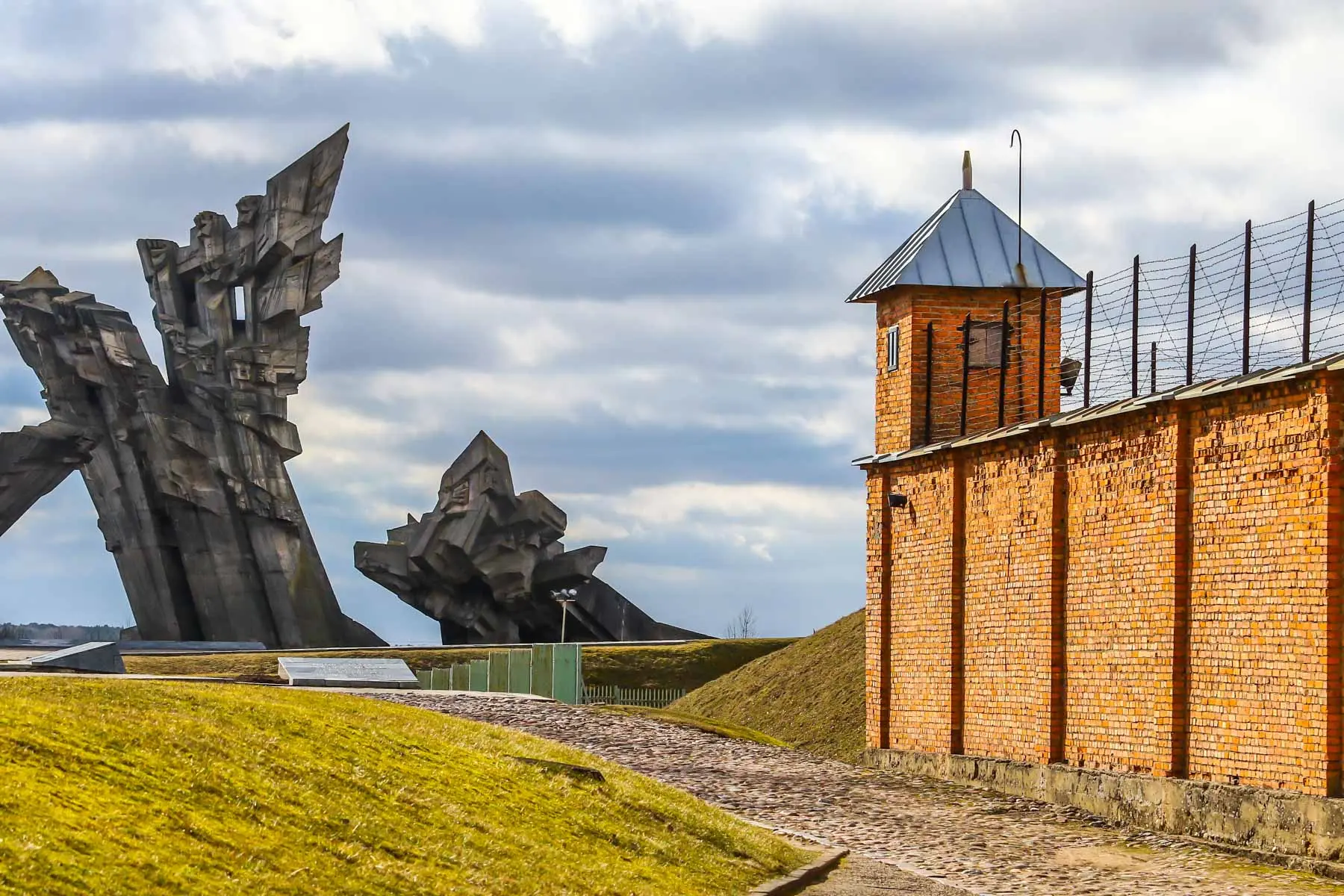
The Small Fortress is the most physically imposing part of the memorial. Visitors can walk through the cells where political prisoners were held — including the cell where Gavrilo Princip died in 1918 — and the courtyards where executions took place during the Gestapo's use of the fortress from 1940 to 1945. The entrance gate, inscribed with the words "Arbeit Macht Frei" (Work Sets You Free), stands intact. The National Cemetery, directly outside the fortress walls, holds the remains of thousands who died in the final typhus epidemic.
The Ghetto Museum, located in the former town school, provides the most comprehensive account of daily life in the ghetto — overcrowding, food rations, the Council of Elders, the cultural life, and the deportation transports. The Magdeburg Barracks house a permanent exhibition on the ghetto's cultural activities, including reproductions of the children's drawings and documentation of the musical and theatrical performances. A crematorium, built by the Nazis when the death rate overwhelmed the ghetto's capacity for burial, stands on the outskirts of town. The original furnaces remain.
The children's drawings — 4,387 works housed at the Jewish Museum in Prague — are the emotional center of Terezín's legacy. They depict flowers, gardens, family dinners, and imagined journeys to Palestine — images of normalcy drawn by children who were living in a concentration camp and would soon be murdered. The drawings are the only memorial many of these children have. Without Friedl Dicker-Brandeis's decision to hide two suitcases of artwork before her deportation, their names would be forgotten entirely.
Visiting Terezín: How to Get There and What to Expect
Terezín is located 60 kilometers northwest of Prague, accessible by bus from Prague's Nádraží Holešovice station (approximately one hour). Several tour operators run half-day and full-day trips from Prague. Independent visitors can cover the Ghetto Museum, the Small Fortress, and the crematorium in a full day; a half-day visit requires prioritizing either the fortress or the ghetto exhibits.
The experience of visiting Terezín is different from other Holocaust sites. There are no gas chambers to confront, no crematorium smokestacks on the horizon, no barbed-wire perimeters stretching to the vanishing point. Terezín looks like a small Czech town — because it is one. The horror is architectural rather than industrial: the knowledge that every street, every barracks, every courtyard was repurposed for imprisonment and deception, and that the town's normalcy was itself the weapon. The Nazis did not build Terezín to look terrifying. They built it to look acceptable. That was the point.
Standing in the community hall where Brundibár was performed for the Red Cross — in the same room where children sang an opera about defeating a bully, while the men who would murder them watched from the audience — the visitor confronts something worse than cruelty. Cruelty is at least honest about what it is. Terezín was cruelty dressed as kindness, genocide presented as a gift. Auschwitz makes no pretense about what it was. Terezín was designed so that pretense was the entire architecture. The walls of the fortress that Joseph II built to defend against foreign armies were used, 160 years later, to hide the murder of the people living inside them. The fortress held. The deception worked. The world that could have intervened chose instead to accept a favorable report and move on.
FAQ
What was Terezín (Theresienstadt) and why is it significant?
Terezín, known in German as Theresienstadt, was a Nazi concentration camp and transit ghetto established in November 1941 in a fortress town 60 kilometers northwest of Prague, Czechoslovakia. It served a dual purpose: as a holding camp for Jews before their deportation to extermination camps, and as a propaganda tool — a "model Jewish settlement" designed to deceive the international community about the reality of the Holocaust. Approximately 140,000 Jews were imprisoned there; roughly 33,000 died in the ghetto and more than 88,000 were deported to their deaths.
What happened during the Red Cross visit to Terezín in 1944?
On June 23, 1944, representatives from the International Red Cross and the Danish government were given a carefully staged eight-hour tour of the ghetto. In preparation, the Nazis deported 7,503 of the most visibly sick prisoners to Auschwitz, planted gardens, built fake shops and cafés, and staged cultural performances including the children's opera Brundibár. The delegation's report declared conditions satisfactory. The visit is considered one of the most successful propaganda deceptions of World War II.
How many children died at Terezín?
An estimated 15,000 children passed through the Terezín ghetto during its operation. Fewer than 1,500 survived the war — roughly ten percent. Most were deported to Auschwitz-Birkenau, where they were murdered in the gas chambers. The children's drawings created during secret art classes led by Friedl Dicker-Brandeis, now held at the Jewish Museum in Prague, remain the most widely known testimony of their brief lives.
What was the cultural life like inside the Terezín ghetto?
Despite appalling conditions, Terezín developed an extraordinarily rich cultural life. Imprisoned artists, musicians, and intellectuals organized orchestras, operas, lectures, theater performances, and art classes. Notable works created there include the children's opera Brundibár by Hans Krása, Viktor Ullmann's opera Der Kaiser von Atlantis, and performances of Verdi's Requiem conducted by Rafael Schächter. The Nazis exploited this cultural output for propaganda while simultaneously deporting the artists to their deaths.
Can you visit Terezín today?
Terezín is a functioning Czech town that also serves as a major Holocaust memorial site. The Terezín Memorial includes the Small Fortress (a former Gestapo prison), the Ghetto Museum, the Magdeburg Barracks, a crematorium, and the National Cemetery. The site is approximately one hour from Prague by bus and can be visited independently or through organized tours. Most visitors spend a half-day to a full day at the site.
What is the connection between Terezín and Auschwitz?
More than 88,000 Jews were deported from Terezín to Auschwitz and other killing sites. A special "Theresienstadt Family Camp" was established at Auschwitz-Birkenau to hold Terezín deportees temporarily — creating living evidence that deportees had survived their "resettlement." The camp was liquidated in two waves in 1944, with thousands gassed in a single night. After the June 1944 Red Cross visit, deportations from Terezín to Auschwitz intensified, with 24,000 sent in a single month.
Sources
* Theresienstadt - United States Holocaust Memorial Museum, Holocaust Encyclopedia
* Theresienstadt: Red Cross Visit - United States Holocaust Memorial Museum
* Theresienstadt Ghetto - Yad Vashem
* Theresienstadt - Encyclopaedia Britannica
* Friedl Dicker-Brandeis - Jewish Women's Archive
* Children's Drawings from the Terezín Ghetto - Jewish Museum in Prague
* Coping Through Art: Friedl Dicker-Brandeis and the Children of Theresienstadt - Yad Vashem
* The History of Terezín - Terezín Memorial / terezin.org
* Into That Darkness: From Mercy Killing to Mass Murder - Gitta Sereny (1974)
* I Never Saw Another Butterfly: Children's Drawings and Poems from Terezín - Hana Volavková, ed. (1993)
* Music in Terezín 1941–1945 - Joža Karas (1985)
* The Last of the Unjust - Claude Lanzmann (2013)