The Kiss at Santa Cruz Church
December 8, 1977. Inside the Santa Cruz Church in the San Cristóbal neighborhood of Buenos Aires, a small group of women is meeting to organize the publication of a paid advertisement in La Nación — a list of names of their disappeared children, an appeal for information. At the center is Azucena Villaflor de De Vincenti, 53 years old, a former factory worker whose son and daughter-in-law had vanished into the regime's secret prisons the year before. She had become the founder of the Madres de Plaza de Mayo, the white-headscarved mothers who circled the obelisk in front of the presidential palace every Thursday demanding to know where their children were.
A tall, blond, blue-eyed man in his late twenties approaches her in the church. The mothers know him as Gustavo Niño, a grieving young man who had attached himself to the group for months, claiming to be searching for his disappeared brother. He had wept with them. He had marched with them. The French nuns Léonie Duquet and Alice Domon, who had been supporting the mothers' work, trusted him completely. He leans in and kisses Azucena Villaflor on the cheek. It is a signal.
Outside, men from the Grupo de Tareas 3.3.2 — the operational task force of the Escuela de Mecánica de la Armada, the Navy Mechanics School known by its Spanish initials, ESMA — are already in position. Within minutes Villaflor, the two French nuns, and ten others associated with the mothers are dragged into unmarked Ford Falcons and driven across the city to a white neoclassical building on the Avenida del Libertador. Ten days later their bodies, still warm and partly dressed, wash up on beaches south of Buenos Aires. They had been drugged with sodium pentothal, loaded into the cargo bay of a Navy aircraft, and thrown alive into the South Atlantic. The autopsies, sealed for decades, would record fractures consistent with falls from great height into water.
"Gustavo Niño" was Lieutenant Alfredo Astiz, a 26-year-old Navy intelligence officer assigned to ESMA. He had not lost a brother. He had volunteered to infiltrate the mothers because he was the right age and looked the part. The mothers called him the Blond Angel of Death.
This is what ESMA was for. The horror of the place is not only the roughly 5,000 people who passed through its doors and the fewer than 200 who walked out alive. The horror is that it ran for seven years inside an active and decorated naval academy on one of the most elegant avenues in Buenos Aires, with cadets studying upstairs, officers eating in the dining room downstairs, and the city walking past on its way to work. The Argentine state did not hide its terror in a remote jungle camp or a desert prison. It built it into the same building where it trained its naval officers. The men who ran the basement torture rooms ran them in full uniform, signed off shifts, and went home for dinner.
What follows is how that machine was built — and how, against every effort of the men who built it, it was eventually pulled into the light.
Argentina Before the Junta: How the 1976 Coup Built a Disappearance Machine
Argentina in the early 1970s was already saturated with political violence. Juan Domingo Perón, exiled for nearly two decades, returned in 1973 to a country tearing itself apart between his left-wing Montoneros — armed revolutionaries who had once revered him — and his right-wing security apparatus, dominated by his social welfare minister and personal astrologer José López Rega. When Perón died in July 1974, his third wife Isabel Martínez de Perón inherited a presidency she could not control. López Rega used her to launch the Alianza Anticomunista Argentina, the Triple A — a death squad that murdered hundreds of leftists, journalists, lawyers, and students in the eighteen months before the coup, sometimes leaving the bodies on the streets of Buenos Aires as warning.
On March 24, 1976, the armed forces moved. A junta of three — General Jorge Rafael Videla, Admiral Emilio Massera, and Brigadier Orlando Agosti — deposed Isabel Perón without firing a shot. They called what followed the Proceso de Reorganización Nacional — the Process of National Reorganization. To the world they presented it as the restoration of order against Marxist guerrillas. Inside the country it was a war of annihilation against anyone the military decided was a "subversive" — and the definition was elastic enough to swallow trade unionists, priests, psychologists, high school activists, students, the relatives of activists, and people whose names appeared in the wrong address book.
The methods were not improvised. Argentine officers had trained for years with French veterans of the Algerian War, who taught the doctrines of clandestine detention and the systematic use of torture; with American instructors at the U.S. Army's School of the Americas in Panama, who taught counterinsurgency in the framework of a hemispheric Cold War. The junta's innovation was scale and bureaucracy. Instead of conventional courts and conventional prisons, it built a network of roughly 340 clandestine detention centers across the country, and at the center of the system it placed a word that became the regime's signature: desaparecido. Disappeared. A person who had not been arrested, because there was no arrest record. A person who had not been killed, because there was no body. A person who simply no longer existed, and whose family, when they asked the authorities, were told nothing had happened to anyone by that name.
Operation Independence and the Doctrine of the Disappeared
The model had been tested before the coup. In February 1975, under Isabel Perón's signature, the army launched Operativo Independencia in the northwestern province of Tucumán — a counterinsurgency campaign against a small rural guerrilla unit that became, in practice, a laboratory for the methodology the entire country would soon experience. Detainees were taken to a sugar mill called La Escuelita, tortured for intelligence, and then either released as informants or killed and buried in unmarked pits. Many of the officers who would later run ESMA cycled through Tucumán first. The lesson they took back to Buenos Aires was that a war could be fought without prisoners, without trials, without records — and that the absence of evidence was itself the weapon.
By the time the junta took power, the doctrine was settled. There would be no Nuremberg, no show trials, no public executions. There would be cars pulling up at night, hoods over heads, basements with cattle prods, and bodies that nobody could prove had ever been bodies. The country would be cleansed quietly. ESMA was where the doctrine became industrial.
Inside ESMA: The Officers' Casino and the Architecture of Terror
The Escuela de Mecánica de la Armada occupies a 17-hectare campus of white colonnaded buildings on the Avenida del Libertador, in one of the wealthiest districts of Buenos Aires. It had trained Argentine naval mechanics since the 1920s. After the coup the academy continued, in every visible respect, to function. Cadets marched on the parade ground. Engines were stripped and rebuilt in the workshops. The Navy band rehearsed. Joggers ran past the perimeter fence along the avenue. The Khmer Rouge would do something comparable two years later with a converted Phnom Penh high school, but ESMA's distinction was that the cover institution kept fully operating — naval cadets were not stopped, only walled off from the basement.
The clandestine detention center occupied a single building: the Casino de Oficiales, the Officers' Casino, a four-story neoclassical block set back behind trees inside the campus. From the avenue it looked like the most respectable building of all. Inside, it was the central node of a kidnapping and killing operation that consumed the lives of approximately 5,000 people over seven years. The men who ran it were Navy officers in uniform. They ate lunch in the officers' dining room on the ground floor, then walked upstairs or down into the basement to work.
The Capucha, the Pecera, and the Basement Torture Rooms
The system inside the Casino de Oficiales had a vocabulary, and survivors who lived to testify spent decades teaching judges and prosecutors what each word meant. The Sótano — the basement — was where new arrivals were taken first. Rooms numbered 12, 13, and 14 contained the torture tables. The standard instrument was the picana eléctrica, a high-voltage cattle prod applied to the gums, genitals, and inside the ears. Sessions lasted hours, sometimes days. The screams were audible throughout the building, which is why the Navy band, witnesses later reported, was occasionally ordered to rehearse in adjoining rooms during heavy interrogation periods.
Prisoners who survived initial interrogation were moved to the upper floors. The Capucha — the Hood — was a low-ceilinged attic on the third floor where detainees lay shackled on thin mattresses, eyes covered with black hoods, for weeks or months. They were not allowed to speak, stand, or remove the hood. They learned to recognize their guards by the sound of boots and the smell of cigarettes. Across the attic was Capuchita — Little Hood — a smaller version for new arrivals or for prisoners being punished. Conditions in both were designed to dissolve identity: no names, only numbers; no daylight; no schedule.
Then there was the Pecera — the Fishbowl — a room of cubicles on the third floor where a small group of selected prisoners, those the regime had decided to use rather than kill immediately, were forced to perform clerical work. They translated foreign press clippings about Argentina, doctored documents, and in some cases ghostwrote articles defending the junta abroad. Admiral Massera, the Navy member of the original junta, had political ambitions and wanted his own intelligence and propaganda operation; the Pecera was where he assembled it, using the labor of people he had personally signed off on kidnapping. Survivors would later describe the surreal violence of being escorted from the torture rooms in the basement to a desk on the third floor and ordered to type.
The Task Force 3.3.2 and the Officers Who Ran It
The operational unit was Grupo de Tareas 3.3.2 — Task Force 3.3.2 — composed of Navy intelligence officers, marines, and Federal Police agents seconded to ESMA. It ran the snatch operations across Buenos Aires in unmarked Ford Falcons, conducted the interrogations, supervised the death flights, and falsified the paperwork that erased the prisoners from existence. The commanders cycled through over the years, but several names became central to the criminal cases that followed.
Captain Jorge "Tigre" Acosta ran intelligence operations and was the dominant figure inside the Casino de Oficiales for much of the regime. Survivors described him as theatrical, vain, given to long ideological speeches between torture sessions, and personally involved in the decision of who lived and who was "transferred." Captain Alfredo Astiz — the Blond Angel of Death — became internationally infamous for the Santa Cruz Church operation and was later sentenced in absentia by a French court for the murders of the two French nuns. Lieutenant Adolfo Scilingo, a young naval officer who participated in the death flights, would in 1995 become the first ESMA officer to publicly confess what the regime had actually done, breaking the silence that had held since the dictatorship's end.
Above them sat Admiral Massera himself, who treated ESMA not only as a torture center but as a personal political project. He cultivated relationships with foreign journalists, courted exiled Peronist leaders, and used selected prisoners as forced collaborators in his own ambitions for power after the junta. The detention center was simultaneously a death camp and a political workshop, run by men in dress uniforms who believed they were saving the nation.
The Death Flights and the Bureaucracy of Disappearance
The defining innovation of ESMA was the solution to what the regime called the "final disposition" of prisoners. Mass graves left evidence. Public executions left witnesses. The Navy's answer was the ocean.
Roughly once a week, on Wednesday nights, selected detainees were told they were being "transferred" to a regular prison in the south of the country. They were given an injection of what the guards called a "vaccine" — sodium pentothal, administered by a Navy doctor — and told it was a precaution against disease at the new facility. Within minutes the prisoners were unconscious but alive. They were loaded onto trucks, driven to the military section of the Aeroparque Jorge Newbery — the city's domestic airport, less than ten minutes from ESMA — and placed in the cargo bays of Navy aircraft, typically Short Skyvans or Lockheed Electras. The aircraft took off, flew out over the Río de la Plata estuary or the open South Atlantic, and at altitude the side door was opened. The prisoners were pushed out, alive and unconscious, into the water.
The system ran on this schedule for years. Estimates of the number of people killed in death flights from ESMA alone reach into the low thousands. The Navy chose the method precisely because it left no body, no grave, and no physical evidence — until the ocean, occasionally and disobediently, returned what had been given to it.
The silence around the flights held until 1995, when Adolfo Scilingo, the former lieutenant, walked into the office of journalist Horacio Verbitsky in Buenos Aires and confessed. He described, in calm and procedural detail, his own participation in two flights in 1977 in which a total of thirty prisoners had been thrown alive into the sea. He named the aircraft, the route, the chaplain who had blessed the officers afterward and explained that the killings were "a Christian form of death." Scilingo's confession, published as the book El Vuelo — The Flight — shattered the wall of denial that had protected the perpetrators for a decade. He was later convicted in Spain and sentenced to 1,084 years in prison.
Azucena Villaflor, the Mothers, and the Bodies on the Beach
The bodies of Azucena Villaflor and the women taken with her from the Santa Cruz Church washed up on the beaches of Santa Teresita and General Lavalle, south of Buenos Aires, in mid-December 1977. The local authorities recorded them as unidentified drownings, photographed the corpses, buried them in unmarked graves in a municipal cemetery, and filed the paperwork. For twenty-eight years the files sat untouched.
In 2003, the Equipo Argentino de Antropología Forense — a team of forensic anthropologists who had been built specifically to identify the remains of disappearance victims — located the cemetery records, exhumed the unmarked graves, and matched DNA. Azucena Villaflor, the founder of the Mothers of Plaza de Mayo, was identified in 2005. Her ashes were buried at the base of the Pirámide de Mayo, the obelisk she had circled every Thursday demanding to know what had happened to her son. She had been thrown into the ocean from a Navy aircraft ten days after Alfredo Astiz kissed her at the church.
The Maternity Ward and the Stolen Babies of ESMA
The most systematic crime committed inside ESMA was reserved for pregnant women. When a captured female detainee was identified as pregnant, she was kept alive — sometimes for months — under conditions of extreme deprivation in a converted room on the upper floor of the Casino de Oficiales that survivors called the Sardá, after a famous Buenos Aires maternity hospital. A Navy obstetrician attended the births. The newborns were taken from their mothers within hours and handed to military or police families considered ideologically reliable, with falsified birth certificates erasing the biological parents. The mothers, once they had given birth, were "transferred." Almost none survived.
The number of children stolen this way during the dictatorship, across ESMA and other detention centers, is estimated at around 500. The children grew up bearing the names of families that had often participated, directly or indirectly, in the murder of their biological parents. The grandmothers of those children — the women whose daughters had vanished pregnant and never returned — organized as the Abuelas de Plaza de Mayo, the Grandmothers of Plaza de Mayo, in 1977. They built a genetic database. They tracked down adoptees. They petitioned courts. As of the mid-2020s they have located and identified more than 130 of the stolen children, most of them now adults in their forties, many of whom learned in middle age that the parents who raised them were not their parents and that their true mothers had been murdered before they could hold them. The Grandmothers' founder, Estela de Carlotto, found her own grandson — born inside a clandestine detention center in 1978 — in 2014, when he was thirty-six years old.
Trial, Memory, and the Long Argentine Reckoning
The dictatorship collapsed in 1983 after the military's catastrophic defeat by Britain in the Falklands War. The newly elected civilian president, Raúl Alfonsín, did something no other Latin American country emerging from military rule had done: he put the junta on trial. The Juicio a las Juntas in 1985, conducted in a civilian court with survivor testimony broadcast nationally, convicted Videla and Massera to life in prison. Survivors of ESMA — many of them appearing publicly for the first time — described the basement rooms, the picana, the Capucha, the flights.
The reckoning then stalled. Under pressure from a still-armed military, Alfonsín signed the Ley de Punto Final in 1986 and the Ley de Obediencia Debida in 1987, halting most prosecutions and shielding lower-ranking officers on the doctrine that they had been following orders. President Carlos Menem went further in 1989 and 1990, pardoning the junta members themselves. By the mid-1990s, the men who had run the death flights were free, and Astiz could be photographed eating in Buenos Aires restaurants.
Scilingo's 1995 confession broke that equilibrium. Public pressure built. In 2003, President Néstor Kirchner pushed Congress to annul the impunity laws, and the Supreme Court declared them unconstitutional in 2005. The ESMA cases reopened. Acosta, Astiz, Cavallo, and dozens of other officers were tried in a series of massive proceedings that ran into the 2010s. Astiz received life imprisonment in 2011. Acosta received multiple life sentences across several trials. As of the mid-2020s, more than one thousand former officials of the dictatorship have been convicted of crimes against humanity in Argentine courts — a record without parallel in any other post-dictatorship transition.
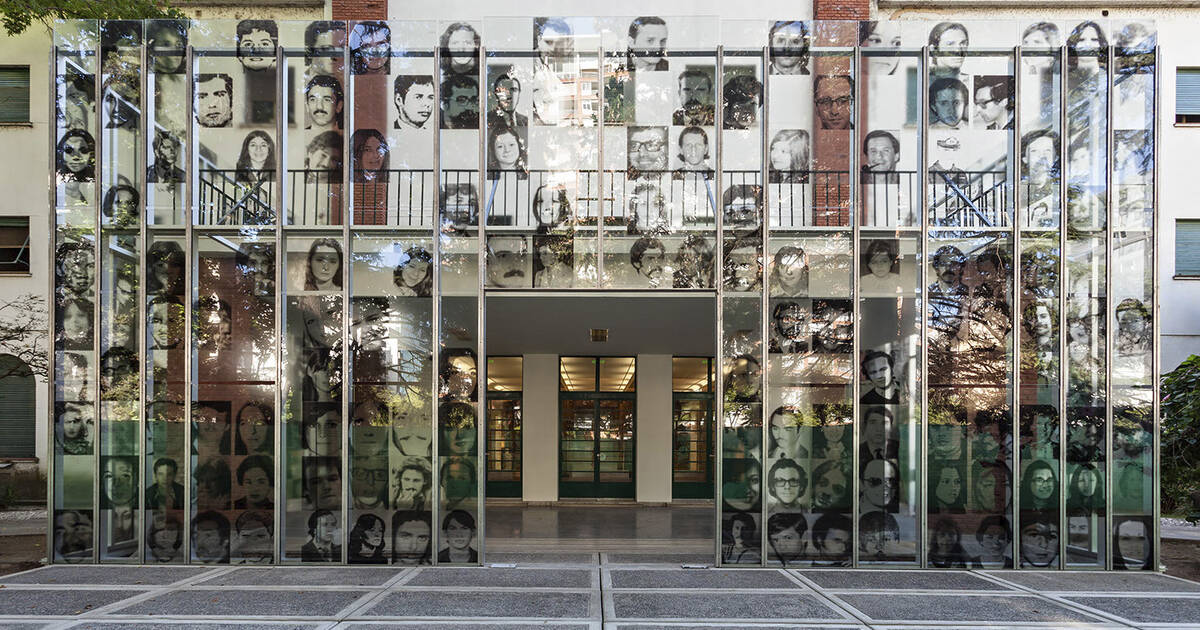
In 2007, the Navy was finally expelled from the ESMA campus. The Casino de Oficiales was preserved as a memorial site, the Espacio Memoria y Derechos Humanos. Survivors walked through it as guides, pointing out the rooms where they had been held. In 2023, UNESCO inscribed ESMA on its World Heritage List, placing it on the same register as Auschwitz-Birkenau — the first such recognition for a Latin American site of state terror.
The Atlas Entry
The Espacio Memoria y Derechos Humanos occupies the original ESMA campus at Avenida del Libertador 8151, in the Núñez neighborhood of northern Buenos Aires. The site is open to the public Tuesday through Sunday; entry is free, and guided tours run multiple times a day in Spanish, with English tours available with advance booking. The visit centers on the Casino de Oficiales, preserved as it was when the Navy left in 2007. Visitors walk through the basement interrogation rooms, the maternity room, and up the narrow staircase to the Capucha attic, where the wooden ceiling beams are still inches above an adult head and the air, even now, feels older than the rest of the building.
The thing to hold onto, standing in the Capucha, is the geography. The Avenida del Libertador outside is still one of the most fashionable streets in Buenos Aires. The buildings around the campus still house schools, government offices, and apartments with views of the river. From the upper windows of the Casino de Oficiales, survivors could see the lights of the city they had been kidnapped from, less than a kilometer away. Their families lived in those lights. Their children walked to school in those streets. None of it knew, and most of it preferred not to know. That is the precise crime ESMA was built to commit — and the precise reason the building has been preserved, intact, with its rooms still named, so that the question of what was allowed to happen in the heart of a great city cannot be turned away from. The men who built the machine counted on the city's silence. The city's silence broke. The building remains.
Frequently Asked Questions About ESMA
What does ESMA stand for and what was the building used for?
ESMA stands for Escuela de Mecánica de la Armada, the Navy Mechanics School of Argentina. From the 1920s until 2007 it functioned as a working naval academy on the Avenida del Libertador in Buenos Aires, training mechanics and officers. Between 1976 and 1983, during the military dictatorship, one building inside the campus — the Casino de Oficiales, or Officers' Casino — was secretly used as a clandestine detention, torture, and extermination center, while the rest of the academy continued its normal operations. Approximately 5,000 people were held there. Fewer than 200 survived.
How many people were killed at ESMA?
The most reliable estimates put the number of detainees who passed through ESMA between 1976 and 1983 at around 5,000, of whom only about 200 survived. The majority were killed through the "death flights" — sedated with sodium pentothal and thrown alive from Navy aircraft into the South Atlantic. ESMA was one of roughly 340 clandestine detention centers operated by the Argentine military regime, which is estimated to have disappeared 30,000 people nationally, though some historians place the figure between 9,000 and 30,000 depending on the methodology used to count.
Who was Alfredo Astiz and what did he do at ESMA?
Alfredo Astiz was a Navy lieutenant who served at ESMA as part of the operational task force known as Grupo de Tareas 3.3.2. In late 1977 he infiltrated the Mothers of Plaza de Mayo, the human rights group founded by women searching for their disappeared children, by posing as the brother of a victim under the false name "Gustavo Niño." On December 8, 1977, he identified the group's founder Azucena Villaflor with a kiss on the cheek inside the Santa Cruz Church, signaling kidnap squads waiting outside. Villaflor and the others taken with her, including two French nuns, were thrown alive into the sea. Astiz was sentenced to life imprisonment in Argentina in 2011 and had earlier been convicted in absentia by a French court.
What were the death flights?
The death flights were the Navy's method for disposing of detainees without leaving evidence. Selected prisoners were told they were being transferred to a regular prison and given an injection of what guards called a "vaccine" — sodium pentothal — that rendered them unconscious. They were then loaded onto Navy aircraft at Aeroparque, the city's domestic airport, flown out over the Río de la Plata or the South Atlantic, and pushed alive from the cargo door at altitude. The flights ran roughly weekly for several years. The system was publicly confirmed in 1995 when former lieutenant Adolfo Scilingo confessed his participation to journalist Horacio Verbitsky, breaking decades of silence.
Can you visit ESMA today?
Yes. The Casino de Oficiales and the surrounding campus are preserved as the Espacio Memoria y Derechos Humanos at Avenida del Libertador 8151 in the Núñez neighborhood of Buenos Aires. Entry is free, and guided tours led by trained staff — and occasionally by survivors — run Tuesday through Sunday, mostly in Spanish, with English tours available by advance arrangement. Visitors walk through the basement interrogation rooms, the upper-floor Capucha attic where detainees were held hooded, and the room where pregnant women were forced to give birth before being killed. The site was inscribed on the UNESCO World Heritage List in 2023.
What happened to the babies born at ESMA?
Pregnant women held at ESMA were kept alive — sometimes for months — until they gave birth in a room on the upper floor of the Casino de Oficiales attended by a Navy obstetrician. The newborns were taken from their mothers within hours and handed to military or police families with falsified birth certificates erasing the biological parents. The mothers were then killed, almost always through the death flights. Roughly 500 children are estimated to have been stolen this way across all detention centers during the dictatorship. The Grandmothers of Plaza de Mayo, organized by women whose pregnant daughters had disappeared, have located and identified more than 130 of these children through DNA matching as of the mid-2020s, most of them now adults who learned in middle age that the parents who raised them were not their biological parents.
Sources
El Vuelo — Horacio Verbitsky (1995)
Nunca Más: Report of the National Commission on the Disappearance of Persons — CONADEP (1984)
A Lexicon of Terror: Argentina and the Legacies of Torture — Marguerite Feitlowitz (1998)
The Disappeared and the Mothers of the Plaza — John Simpson & Jana Bennett (1985)
A Memory of the Devil — Sergio Bufano & Lucrecia Teixidó (2010)
Argentina's "Dirty War": An Intellectual Biography — Donald C. Hodges (1991)
ESMA: Sentencias Comentadas — Ministerio Público Fiscal de la Nación (2017)
The Condor Years: How Pinochet and His Allies Brought Terrorism to Three Continents — John Dinges (2004)
Trial of the Juntas: Final Verdict, Cámara Nacional de Apelaciones en lo Criminal y Correccional Federal — Argentine Federal Court (1985)
Searching for Life: The Grandmothers of the Plaza de Mayo and the Disappeared Children of Argentina — Rita Arditti (1999)
Witness to the Truth: Testimonies of Survivors of ESMA — Memoria Abierta (2011)