A Last Radio Call from the South Summit
At approximately 6:20 PM on May 11, 1996, near the South Summit of Everest at 8,748 meters, Rob Hall keys his radio to speak to his pregnant wife, Jan Arnold, in New Zealand via a satellite patch organized by his base camp manager. He has been stranded in the open above 8,500 meters for almost twenty-four hours, in the lee of a blizzard, with one foot frozen solid, no food, his oxygen regulator iced shut, and a corpse beside him. The corpse is Doug Hansen, a 46-year-old postal worker from Renton, Washington — Hall’s client, on his second attempt at the summit. Hall has been a professional Himalayan guide for fifteen years, the most successful in the industry, and he is going to die on the mountain in the next several hours. He knows it. Jan, seven months pregnant with their first child, knows it. The patch holds long enough for them to talk. He tells her he loves her. He tells her to name the baby Sarah. He says, “Don’t worry about me too much.” The radio cuts out. His body is still there.
Eight climbers died on Everest in approximately thirty-six hours that May. The disaster was the deadliest in the mountain’s history at the time. It has since been surpassed, twice. Everest is a 60-million-year-old geological accident that human bodies cannot survive above 8,000 meters and have not stopped climbing since 1922. The mountain has killed more than 340 people. About 200 of those bodies remain on it. They are landmarks now. The history of Everest is the history of three things at once: the geological reality of the death zone, the bodies left in it, and the commercial industry that keeps putting more bodies into it.
The Death Zone: Why 8,000 Meters Is Where Cells Stop Working
The Geology of a Himalayan Collision
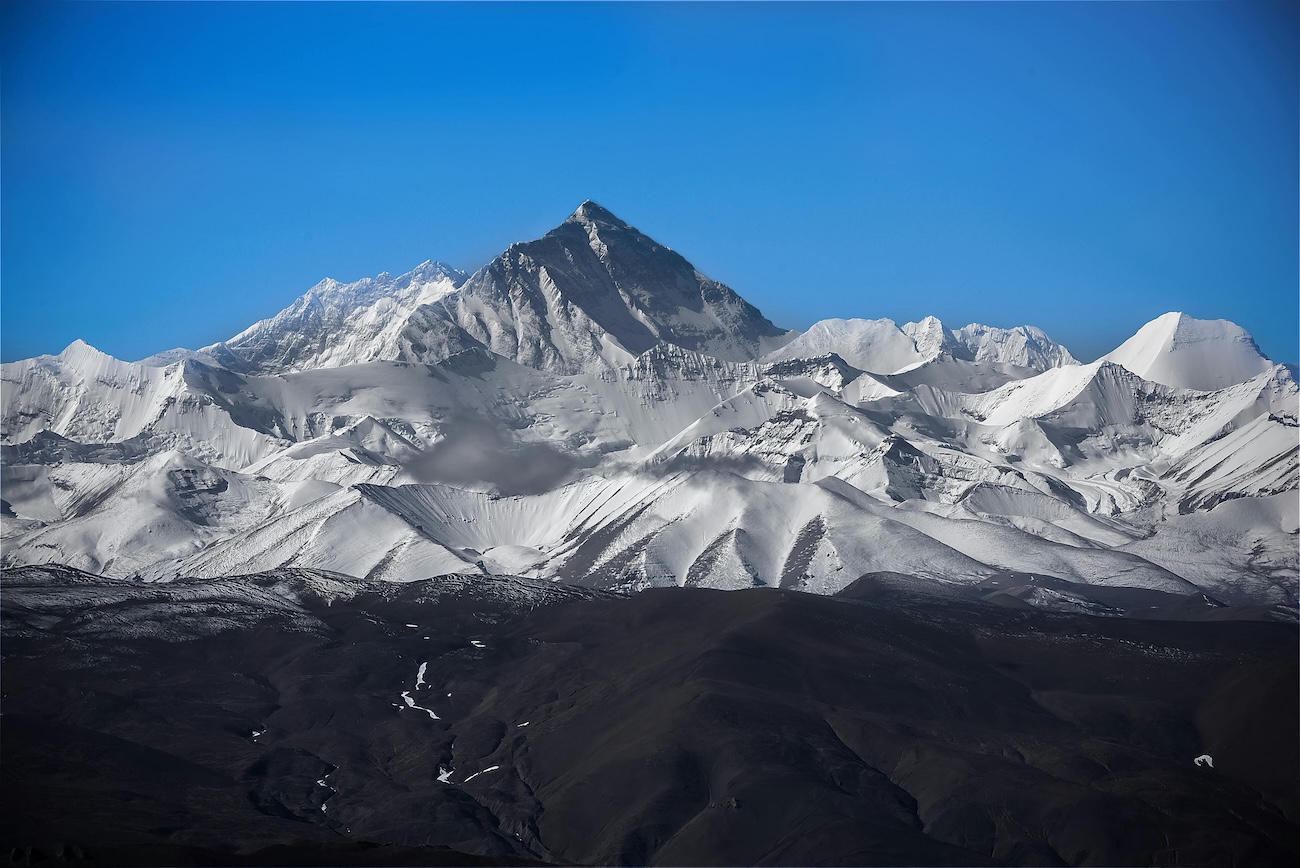
Everest is the youngest of the world’s highest summits. Sixty million years ago, the Indian tectonic plate began driving northward into the Eurasian plate at a rate of roughly five centimeters a year — a collision that has not stopped, and that continues to push the Himalaya upward by approximately four millimeters a year today. The summit of Everest is, geologically, a layer of fossilized seafloor: a marine limestone called the Qomolangma Formation, full of trilobite and crinoid fragments from the bottom of the Tethys Ocean roughly 470 million years ago. The highest point on Earth was once underwater. The dead corals at the top of the world are older than the mountain.
The Tibetans call the peak Chomolungma, “Goddess Mother of the World.” The Nepalis call it Sagarmatha. Both names predate the British survey of India, which renamed the mountain after Sir George Everest, the British Surveyor General of India, in 1865 — over Everest’s own objection that he had nothing to do with the peak and that the local names were perfectly serviceable. The British naming stuck. The mountain straddles the Nepal–China border at 27°59′17″ N, 86°55′31″ E. Its officially recorded height, after a joint Nepal–China remeasurement in 2020, is 8,848.86 meters. Climbers approach it from the south side in Nepal, via the Khumbu Glacier and the South Col, or from the north side in Tibet, via the Rongbuk Glacier and the North Col. The 1996 disaster happened on both sides simultaneously.
How the Human Body Fails Above 8,000 Meters
The death zone is not a metaphor. It is a physiological threshold. Atmospheric pressure at 8,000 meters drops to roughly one-third of sea level; each breath delivers about a third of the oxygen the body expects. Above this altitude, the human body cannot acclimatize. It uses oxygen faster than it can be replenished. The cells of the brain and lungs begin to fail in real time. Climbers who linger above 8,000 meters without supplementary bottled oxygen will, with mathematical certainty, deteriorate to the point of unconsciousness and death within hours to days. Even with oxygen, the deterioration continues; bottled oxygen slows the process, it does not stop it.
The two specific killers are High-Altitude Cerebral Edema (HACE) and High-Altitude Pulmonary Edema (HAPE). HACE is the brain swelling inside the skull as oxygen-starved capillaries leak; victims become confused, lose coordination, hallucinate, and lose the ability to recognize danger. The hallucinations are not minor. Climbers in HACE have removed their gloves at minus forty degrees Celsius because their hands “felt warm,” walked off cliffs they believed were paths, and unclipped from fixed safety lines because the line “was not necessary.” HAPE is the lungs filling with fluid; victims drown internally, coughing pink froth, while remaining technically conscious. Both conditions are reversible at lower altitudes and lethal at altitude. The only treatment is descent. Climbers in the death zone with HACE often refuse to descend because the same condition that is killing them has destroyed their judgment about what is killing them.
The mountain’s other weapons are weather and exhaustion. Summit-day winds at the Hillary Step regularly exceed 100 kilometers per hour. Temperatures with windchill drop below minus sixty degrees Celsius. A standard summit attempt from Camp IV at the South Col — at 7,920 meters, the last camp before the top — takes ten to twelve hours up and another six to eight hours back. Climbers begin moving at midnight after no sleep at altitude, breathing supplementary oxygen at three to four liters per minute, with bottle reserves calculated for a finite window. A delay of three hours on summit day, in unfavorable weather, is enough to run a climber out of oxygen above 8,500 meters with no way back to the bottles cached at the South Col. Several of the people who died in May 1996 died this way. So did several of the people who died in May 2019.
From Mallory to Hillary: A Century of British Death on the Northeast Ridge
1922: The First Seven Men Killed on Everest
The British arrived at Everest because, after climbing parties from the same generation had reached the North and South Poles, the world’s highest mountain was the only remaining “Third Pole” on the imperial trophy list. The first British reconnaissance expedition reached the Tibetan side of the mountain in 1921. The first attempt to climb it followed in 1922. Charles Granville Bruce led a party of British officers and a large contingent of Sherpa porters up the Northeast Ridge. They reached 8,320 meters — at the time, the highest altitude any human had climbed.
On June 7, 1922, an avalanche on the slope above the North Col swept seven Sherpa porters into a crevasse. They were the first seven climbing fatalities on Everest. None of their bodies were recovered. The British survivors of the expedition wrote affecting tributes to the dead; the Royal Geographical Society in London held a memorial service. The fact that all seven dead men were Sherpas — and that no British climber had been killed — passed almost without comment in the official accounts. The pattern of disposable Sherpa labor in service of foreign summit ambitions was established on the first attempt. It has not changed.
1924: George Mallory and Sandy Irvine Vanish 245 Vertical Meters from the Summit
The 1924 expedition produced the most famous disappearance in mountaineering history. George Mallory, a 37-year-old Cambridge-educated schoolmaster and the most accomplished British climber of his generation, made his third attempt on Everest paired with Andrew “Sandy” Irvine, a 22-year-old Oxford rowing blue with a talent for fixing oxygen equipment. On June 8, 1924, expedition geologist Noel Odell glimpsed two figures, briefly, through a break in the clouds at approximately 8,600 meters — moving, he thought, toward the summit. The clouds closed. Mallory and Irvine were never seen alive again.
Whether they reached the summit before they died has been the central unanswered question of Everest history for a century. Mallory’s body was found in 1999 by a search expedition led by Conrad Anker, lying face down on a scree slope at 8,160 meters, his torso intact under the cold, identifiable by a name tag stitched into his clothes. The injuries were consistent with a long fall. The Kodak camera he and Irvine were known to have carried was not on his body. Irvine’s body has never been found, although his ice axe was recovered in 1933, lying alone on the ridge. Without the camera, the question of whether they were on their way up or on their way down at the moment of the fall remains open. Mallory’s last letter to his wife Ruth, written from base camp, ended with the line, “Dear girl, this has been a bad time altogether — I look back on tremendous efforts and exhaustion and dismal looking out of a tent door onto a dismal world of snow.” He carried a photograph of her in his breast pocket, intending to leave it on the summit. The photograph was not on his body when it was found. Some climbers have argued that this means he made it. Others have argued that the wind simply took it.
The British Alpine Club’s response to the disappearance produced the most enduring quotation in the literature of high-altitude climbing. Asked at a public lecture why he wanted to climb Everest, Mallory had given an answer that became his epitaph: “Because it is there.” The response, almost certainly thrown off as a piece of journalist-management, has been used to justify every subsequent attempt on the mountain, almost none of which would have survived more careful interrogation.
1953: Tenzing Norgay and Edmund Hillary on the South Col Route
The route the British had been attempting for thirty years was sealed off in 1950, when the new People’s Republic of China closed Tibet to Western expeditions. Nepal opened its border to foreign climbers the same year. The mountain was suddenly accessible only from the south. The 1953 British expedition under John Hunt chose the South Col as its route — up the Khumbu Icefall, through the Western Cwm, over the Lhotse Face, and across the South Summit to a final rocky obstacle that came to be called the Hillary Step.
On May 29, 1953, Edmund Hillary, a 33-year-old New Zealand beekeeper, and Tenzing Norgay, a 39-year-old Sherpa from the Khumbu Valley with three previous Everest attempts, reached the summit. They spent fifteen minutes there, photographed each other, buried a small offering of food and a Buddhist amulet from Tenzing in the snow, and descended. The news reached London on the morning of Queen Elizabeth II’s coronation. The British press treated the climb as an imperial achievement, an interpretation that ignored the obvious fact that Tenzing was a Sherpa from a Nepalese-Indian background and Hillary was a New Zealander, neither of them English. Tenzing himself, asked decades later who reached the summit first, gave a careful answer that was diplomatic on its surface and unmistakable in its content: “It does not matter. Hillary and I climbed together as a team.” Hillary’s later accounts confirm that he stepped onto the summit a few paces ahead. Tenzing’s accounts confirm the same. The climb was, by any honest reading, a Sherpa-led ascent the British took credit for.
The South Col route Hunt’s expedition pioneered became, over the following half-century, the standard commercial Everest route. By the 1990s it would carry several hundred climbers a season. By the 2010s it would carry more than a thousand. The route Tenzing and Hillary took on a single day in 1953, alone, has become the highway up which the modern Everest industry runs.
May 10, 1996: The Day Everest Killed Eight People
Two Commercial Expeditions on the South Col Route
By May 1996, the South Col route had been transformed by an industry that had not existed twenty years earlier: commercial Everest guiding. The two leading operators on the mountain that season were Adventure Consultants, a New Zealand company run by Rob Hall, and Mountain Madness, a Seattle company run by Scott Fischer. Hall was forty-five, Fischer forty. Both were elite climbers who had transitioned to the more profitable business of taking paying clients up the mountain at $65,000 a head. Hall had a flawless record: thirty-nine clients summited, every one came back. Fischer’s reputation was almost as strong. Their two expeditions reached Camp IV at the South Col on May 9, 1996, alongside several other parties, including a National Geographic IMAX film crew and an Indo-Tibetan Border Police team approaching from the north side. The plan was to summit on the night of May 10 and the morning of May 11.
Among Hall’s eight clients was Jon Krakauer, a 42-year-old American writer commissioned by Outside magazine to report on the commercial Everest industry. Krakauer was a strong amateur climber. He was on the mountain to write about safety. He would write the most influential account of high-altitude disaster ever published — Into Thin Air, released in 1997 — about what happened over the next forty-eight hours. Hall’s other clients included the postal worker Doug Hansen and a Japanese climber, Yasuko Namba, who at forty-seven was attempting to become the oldest woman to summit. Fischer’s clients included Sandy Hill Pittman, a New York socialite who carried a satellite uplink to file daily dispatches from the mountain.
The 2 PM Turnaround Rule That Nobody Enforced
The cardinal rule of summit day on Everest is the turnaround time. Climbers must turn back, regardless of how close to the summit they are, if they have not topped out by a fixed hour — typically 1 PM or 2 PM — because climbing to the summit and descending to the South Col before darkness and exhaustion close in is a logistical equation that does not flex. The 2 PM rule was Hall’s rule. He had enforced it strictly with previous clients. It is the reason his record was perfect.
On May 10, 1996, the rule was violated by both expedition leaders. Several factors converged. The two teams’ Sherpas had not pre-fixed ropes at the Hillary Step as planned, creating an unexpected bottleneck. Climbers backed up below the Step for hours. By 2 PM the lead climbers were just reaching the summit; the slower clients were nowhere close. Hall, instead of turning his team around, kept escorting Hansen up. The two of them reached the summit shortly after 4 PM — two hours past Hall’s own deadline. Fischer, also pushing his team late, was already showing signs of altitude sickness. The storm that had been forecast for late afternoon arrived on schedule.
What followed was the worst command failure in commercial mountaineering history. Hall stayed with Hansen as Hansen’s strength gave out below the South Summit; both men were stranded above 8,500 meters when night fell. Fischer collapsed from HACE at the Balcony, a feature at 8,400 meters, and was abandoned by his Sherpa as the storm closed in; he was found dead the next morning. Yasuko Namba and a young Texan client named Beck Weathers lay together in the snow at the South Col, both unconscious; Namba died, Weathers was left for dead. Andy Harris, one of Hall’s guides, vanished in the storm at the South Col and his body was never found. Five climbers from the two commercial expeditions were dead by the morning of May 11. Three more — the Indo-Tibetan Border Police team on the north side — died simultaneously. Eight deaths in approximately thirty-six hours.
Beck Weathers Walks Back from the Dead
The most extraordinary individual story of the disaster was that of Beck Weathers. A 49-year-old Texan pathologist with a recent eye surgery that had been compromised by altitude — he was effectively blind — Weathers had been left at a high turnaround point earlier in the day. Caught by the storm, he was found unconscious at the South Col with Namba on the morning of May 11. The Sherpas and surviving guides made the agonizing decision that he was beyond help. He was left to die.
Several hours later, in a fact unexplained by any medical or atmospheric authority, Weathers regained consciousness. His right hand was frozen black to the elbow. His face was a frozen mask. He could not see clearly. He stood up, hallucinated his wife and children, and decided, in a moment that he later described as “the most lucid thing I had ever done,” that he would walk himself to camp or die trying. He stumbled into Camp IV under his own power. He was helped down the mountain over the following days, lost his right hand, his nose, and parts of his left hand to amputation, and was eventually evacuated by a Nepalese army helicopter making the highest helicopter rescue in history at the time. He survived. His memoir, Left for Dead, was published in 2000. He never climbed again.
The eight bodies of the 1996 disaster did not all leave the mountain. Yasuko Namba’s body was eventually retrieved at the request of her family. Scott Fischer’s body remains where he died, at the Balcony. Rob Hall’s body remains near the South Summit, exactly where the radio call to his wife ended. Andy Harris was never found. Doug Hansen’s body has not been definitively located. The three Indian climbers killed on the north side — Tsewang Smanla, Dorje Morup, and Tsewang Paljor — would all remain on the mountain. One of them, in particular, would become the most famous corpse in the world.
Rainbow Valley and the Bodies That Became Landmarks
Green Boots: Tsewang Paljor, the ITBP Team, and the 1996 North-Side Tragedy
On the same May 10 that killed Hall, Fischer, Hansen, Harris, and Namba on the south side of Everest, an Indo-Tibetan Border Police expedition was attempting the first Indian ascent of the mountain from the north side. Commandant Mohinder Singh led a six-man team up the Northeast Ridge with no Sherpa support — the team had decided, on grounds of national pride, to fix their own ropes. Three of the six turned back below the summit ridge as the same storm that was killing the south-side climbers rolled in. Three pressed on: Subedar Tsewang Smanla, Lance Naik Dorje Morup, and Head Constable Tsewang Paljor. Paljor was twenty-eight years old. He came from a village called Sakti in Ladakh. He was wearing distinctive bright green Koflach mountaineering boots.
At approximately 3:45 PM Nepal Time on May 10, 1996, the three radioed their base camp to report that they had reached the summit. The team leader Smanla insisted on remaining at the summit to perform Buddhist religious ceremonies, and instructed the other two to begin descending. There was no further radio contact. The next morning, May 11, a Japanese expedition from Fukuoka pushed through to the summit on the same route. They encountered the three Indian climbers, in various states of exhaustion and frostbite, on their way up. The Japanese climbers’ subsequent account — that they continued past the dying men without offering oxygen or assistance — became one of the most contested ethical episodes in the mountain’s history. By the time the Japanese descended, all three Indians were dead.
Paljor died alone in a small limestone alcove at 8,500 meters on the Northeast Ridge. He curled up on his side in the cave, knees toward his chest, and froze in that position. His body was found in the alcove by every subsequent expedition on the north-side route for the next eighteen years. The bright green boots — preserved, fluoroscent against the rock — gave him his name. He became Green Boots. The cave became Green Boots’ Cave. Climbers used it as a navigational landmark on the route to the summit, often resting in it, sometimes brushing past his legs to do so. Paljor’s identity was not officially confirmed; some accounts have suggested the body might be that of his teammate Dorje Morup. The Indo-Tibetan Border Police never released a definitive identification. In 2014, members of a Chinese expedition reportedly moved the body to a less visible location and partially covered it with rocks. In 2017, climbers reported it was visible again. It is most likely still in the cave.
Sleeping Beauty, the German Woman, and the Geography of the Dead
Green Boots is the most famous corpse on Everest. He is not the only one with a name. Francys Arsentiev, a 40-year-old American climber, attempted in 1998 to become the first American woman to summit Everest without supplementary oxygen. She succeeded. On the descent, separated from her husband Sergei Arsentiev in deteriorating weather, she collapsed at approximately 8,650 meters. She was found alive the next day by a passing climbing team — Ian Woodall and Cathy O’Dowd — who attempted to revive her, found her pulse fading and her body too compromised to move, and made the decision Beck Weathers’ rescuers had earlier reversed. They left her. Woodall returned in 2007 and ceremonially covered her body with an American flag. Until that point, climbers on the South Col route had passed her position regularly. Her bright purple climbing suit, vivid against the snow, gave her the unofficial name Sleeping Beauty. Her husband’s body was found later, at the bottom of a face he had apparently fallen down attempting to descend in the dark.
Below the summit on the south side, in a stretch of glacier visible to anyone climbing the final ridge, lies an area informally known as Rainbow Valley. The name does not appear on any official map. Climbers gave it the name because it is the place where the bodies of fallen climbers, in their bright synthetic mountaineering suits — red, yellow, blue, green, purple — accumulate over decades. The bodies do not decompose at altitude. The colors do not fade. The valley is, in literal physical fact, a rainbow of frozen dead climbers on the slope of the mountain. Hannelore Schmatz, a German climber who summited in 1979 and died on her descent at 8,300 meters, sat upright in the snow against her backpack on the south route for years, eyes open, hair frozen. Climbers called her the German Woman. She was eventually displaced by wind. There are at least a dozen other named bodies. There are roughly two hundred unnamed ones.
Why the Bodies Stay
Recovery of a body from above 8,000 meters on Everest is one of the most dangerous operations in mountaineering, and one of the most expensive. The body of a climber, frozen and ice-encrusted, can weigh more than 150 kilograms; lowering it down the technical sections of the route requires teams of Sherpas operating in the same death zone that killed the original climber. Several Sherpas have died attempting recoveries. The cost of a professional body retrieval from the death zone runs to roughly $70,000. Most families of dead climbers, when faced with the cost and the moral weight of asking other men to risk their lives in the same conditions, decline to pay for retrieval.
The Nepalese government has, since the late 2010s, organized cleanup expeditions that combine trash removal with limited body recovery. Bodies have been brought down. Most remain. The mountain has become, by accumulation, the highest-altitude graveyard on Earth — and one of the most accessible, in the bleakest possible sense. Anyone with sufficient money and oxygen can walk past most of its dead. The bodies are part of the route now.
May 22, 2019: Three Hundred and Twenty People in the Queue
Nirmal Purja’s Photograph
The single image that most decisively shifted public understanding of modern Everest was taken on May 22, 2019, by the Nepali climber Nirmal Purja. Purja, a former British Special Boat Service operator turned record-setting mountaineer, was on the summit ridge that morning during a brief weather window. He raised his camera and captured a near-continuous line of climbers, packed shoulder to shoulder, stretching from below the South Summit toward the Hillary Step and the top — what he estimated as roughly 320 people queued in the death zone. The photograph went viral within hours. Newspapers across the world ran it on their front pages. The image of the mountaineering ideal — the lone climber against the sublime peak — collapsed into something much closer to a Black Friday line outside an electronics store, only at 8,700 meters.
Eleven climbers died on Everest in the spring 2019 season. Several of those deaths were directly attributable to the queue. Climbers waited for hours at the Hillary Step in temperatures of minus thirty to minus forty degrees Celsius, exhausting their oxygen supplies and their physical reserves before they could begin the descent. Donald Lynn Cash, a 55-year-old American, collapsed at the summit while taking photographs. Anjali Kulkarni, a 55-year-old Indian businesswoman, died on her descent after her expedition reported that the heavy traffic at the summit had delayed her past the safety window. The Nepali government, which had issued a record 381 climbing permits at $11,000 each that season, denied that overcrowding was a contributing factor. The Department of Tourism’s response was, by climbers’ subsequent accounts, a financial calculation barely disguised as a safety statement. The permits sold. The deaths continued. The number of permits issued in 2023 reached 478. Eighteen people died that season — the deadliest in the mountain’s history.
The Eleven-Thousand-Dollar Permit
Climbing Everest is an industry. Nepal earns roughly $5 million a year in permit fees alone, before counting the broader economic ecosystem of expedition outfitters, equipment, helicopter charters, hotels in Kathmandu, and the trekking-economy of the Khumbu Valley. The permit costs $11,000 per climber for the south side (and somewhat more on the Tibet side). A complete commercial expedition through a guiding company runs between $45,000 and $200,000 per client, depending on the operator and the level of service. The barrier to entry is now financial, not physical. There is no longer a meaningful skill prerequisite imposed by the Nepali government for an Everest permit. A climber who has never used crampons can buy a slot.
The result has been the systematic transformation of the climbing population. The men and women who summited Everest in the 1950s, 1960s, and 1970s were elite mountaineers from elite climbing nations — British, French, Swiss, Japanese, American — who had trained for years in the Alps or the Himalaya. The men and women who summit Everest today are, in many cases, doctors, lawyers, business executives, and influencers from a vastly broader range of backgrounds, with the financial means to purchase a guided ascent. Many are competent. A growing number are not. Sherpa guides routinely report leading clients up the mountain who have never camped above 6,000 meters, never carried a 25-kilogram pack on technical terrain, and have practiced clipping a fixed rope for the first time on the Khumbu Glacier itself. The death rate among inexperienced clients reflects this. So does the death rate among the Sherpas guiding them.
The Sherpa Industry
The dominant unspoken fact of modern Everest is that most of the climbing is done by Sherpas. The Sherpa community of the Khumbu Valley — an ethnic Nepali population of Tibetan origin, numbering roughly 150,000, traditionally Buddhist — has been the labor force of the Everest industry since the 1922 expedition that killed seven of them in an avalanche. Sherpas fix the ropes on summit day. Sherpas carry the oxygen bottles, the tents, the food, and the clients’ personal gear. Sherpas break trail through the deadly Khumbu Icefall, the constantly shifting glacier between Base Camp and Camp I, which they cross several times a season — in some cases more than thirty times — in the course of supplying the higher camps. Foreign clients cross it perhaps four times.
The death rate among Sherpas on Everest is significantly higher than among foreign climbers when measured per ascent. On April 18, 2014, an avalanche on the Khumbu Icefall killed sixteen Sherpas in a single morning — the deadliest day on the mountain until the 2015 earthquake the following year. The Sherpas had been ferrying loads to Camp II for the foreign clients who were just beginning to arrive at Base Camp. The clients themselves, almost without exception, had never seen the icefall the Sherpas were dying in. The Sherpa community, in the immediate aftermath of the 2014 disaster, declared a strike against the Nepali government’s compensation offer — initially $400 per dead Sherpa — and forced a renegotiation. The new compensation reached $15,000 per dead Sherpa. The 2015 earthquake then killed nineteen more people at Base Camp, in a single avalanche, before the renegotiated terms had been fully applied.
The Sherpa community is now wealthier than most of the rest of Nepal. The Sherpa community is also still doing the dying. The relationship is a more complicated piece of moral arithmetic than the foreign climbing public is generally aware of.
The Mountain Now: Climate, Trash, and the 2024 Season
A Melting Khumbu Icefall and the Bodies the Glaciers Are Releasing
Everest’s climbing window has been changing measurably since the 2010s. Climate change in the Himalaya is happening at roughly twice the rate of the global average. The Khumbu Glacier — the icefall climbers must traverse between Base Camp and Camp I — has thinned by approximately fifteen meters since 1990. The glacial structure climbers depend on for stable ladder placements is becoming less stable. The “weather window” on summit day, traditionally a brief period in mid-to-late May before the monsoon, has become harder to predict. Several recent seasons have produced fewer summit days and more concentrated traffic on the days they have produced — a structural cause of overcrowding that the permit policies amplify rather than create.
The melting glaciers have also begun exposing bodies that had been buried for decades. Recent Nepali cleanup expeditions have recovered the remains of climbers whose locations were unknown for thirty or forty years, some of them likely from expeditions in the 1970s and 1980s. Identification is difficult — DNA testing requires family samples, equipment is rarely conclusive — but the mountain’s history is, slowly, being released by its own ice. In 2024 alone, five previously unknown bodies were recovered from the upper mountain. The total number of bodies still on Everest is now an open question that climate change will gradually, and grimly, answer.
Eight Tonnes of Trash a Year
The other accumulated legacy of the commercial era is garbage. Every Everest summit attempt produces, on average, between fifteen and twenty kilograms of waste per climber — oxygen bottles, food packaging, fixed ropes, ladders, human waste, abandoned tents, broken equipment. Multiplied across hundreds of climbers and thousands of support staff per season, the figure approaches eight tonnes a year. Most of it ends up at Camp IV, on the South Col, which has been characterized by veteran climbers as the highest-altitude landfill on Earth. Cleanup expeditions organized by the Nepali Army, the Sagarmatha Pollution Control Committee, and various NGOs have removed several hundred tonnes of material since the early 2010s. They keep finding more. The mountain’s relationship with the industry that climbs it has become, in literal physical terms, an environmental problem with no obvious solution.
The 2024 climbing season produced nine deaths and roughly 600 summits. The 2025 season, by current estimates, produced five deaths and approximately 500 summits. Both seasons were calmer than 2023’s catastrophic eighteen-death record. Industry observers attribute the recent decrease to better weather and modestly tighter permit guidance. Nobody attributes it to a structural change in the system. The system has not changed. The mountain is still 8,848.86 meters high. The death zone is still the death zone.
The Atlas Entry: Approaching the Mountain
Most travelers who go to see Everest never set foot above 6,000 meters. The Atlas Entry for this site is not an Everest summit attempt — that is a multi-month commercial expedition costing tens of thousands of dollars, requiring serious mountaineering experience, and producing the death rates documented in this article. The Atlas Entry is the Everest Base Camp trek, a roughly twelve-to-fourteen-day round trip from Lukla airfield in the Khumbu Valley, at approximately 5,364 meters elevation, that brings trekkers to the foot of the Khumbu Icefall and within direct sight of the south face of the mountain.
The trek is not technical. It is, however, demanding: altitude sickness affects a significant percentage of trekkers, and acclimatization days at intermediate villages — Namche Bazaar, Tengboche, Dingboche — are essential rather than optional. Independent trekking is permitted; guided treks through Nepali outfitters are widely available. The route passes through Sherpa villages whose economy is now substantially built on trekking tourism, and through monasteries — Tengboche the most prominent — that still function as religious centers in the centuries-old Buddhist tradition of the region. The Tibetan-side approach to the north face of the mountain runs through the Rongbuk Valley and is accessible from Lhasa via Chinese-controlled routes; permits are politically constrained and conditions are far harsher.
The walk from Tengboche to Base Camp passes through a landscape of memorial cairns — the Chukhung memorials, near the village of Dughla — that mark the deaths of climbers and Sherpas on the mountain since the 1950s. There are several hundred cairns. Some carry the names of the dead, including some of the climbers in this article. Some carry Tibetan prayer flags weathered to the color of the rock. The visitor at the cairns is approximately one day’s walk from the spot where, in 1996, Beck Weathers stood up from the snow he had been left to die in and walked down the mountain himself.
What the cairns make visible is the same thing the bodies above the South Col make visible. Everest is an enormous, beautiful, geologically extraordinary peak whose history is the history of human beings deciding, with full knowledge of the cost, to climb it anyway. The cost has been documented, exhaustively, since 1922. It continues to be paid, in cash and in lives, every May. The mountain is indifferent to the bargain. The climbers, some of them, are not.
Frequently Asked Questions
How many people have died climbing Mount Everest?
More than 340 climbers have died on Mount Everest since the first British expedition reached the mountain in 1921. The exact figure varies between sources; the Himalayan Database, the most authoritative ongoing record, lists 344 confirmed deaths through the 2024 season. Causes have included avalanches, falls, exposure, altitude sickness, and exhaustion. Approximately 200 of the dead bodies remain on the mountain, most above 8,000 meters in the death zone, where retrieval is too dangerous and expensive to attempt. The deadliest single seasons were 2023 (eighteen deaths) and 2014 (sixteen Sherpas killed in a single avalanche on the Khumbu Icefall). The 1996 disaster, which killed eight climbers in approximately thirty-six hours, was the deadliest at the time and remains the most documented.
What is the death zone on Everest?
The death zone is the altitude band above 8,000 meters, where atmospheric pressure drops to roughly one-third of sea level and the human body cannot acclimatize. Each breath at this altitude delivers about a third of the oxygen the body expects. Brain and lung cells begin to fail in real time. The two specific killers are High-Altitude Cerebral Edema (HACE), where the brain swells inside the skull, and High-Altitude Pulmonary Edema (HAPE), where the lungs fill with fluid. Both conditions are reversible at lower altitudes and lethal at altitude. The only treatment is descent. Climbers in the death zone with HACE often refuse to descend because the same condition that is killing them has compromised their judgment.
Who was Green Boots?
Green Boots is the name climbers gave to a frozen body lying in a small limestone alcove at approximately 8,500 meters on the Northeast Ridge of Everest. The body is most likely that of Tsewang Paljor, a 28-year-old Indian climber from Ladakh and a member of the Indo-Tibetan Border Police expedition that died on the north side of the mountain on May 10–11, 1996 — the same storm that killed the better-known Hall and Fischer parties on the south side. The bright green Koflach mountaineering boots Paljor was wearing remained vivid against the limestone, giving the body its nickname. For nearly two decades, every expedition climbing the north route used Green Boots’ Cave as a navigational landmark. In 2014, members of a Chinese expedition reportedly moved the body to a less visible location. It is most likely still in the cave today.
What happened in the 1996 Mount Everest disaster?
On May 10–11, 1996, a sudden storm caught two commercial expeditions — Rob Hall’s Adventure Consultants and Scott Fischer’s Mountain Madness — and an Indian Indo-Tibetan Border Police team near the summit of Everest. Eight climbers died over approximately thirty-six hours. The dead included expedition leaders Hall and Fischer, climbers Doug Hansen and Yasuko Namba, guide Andy Harris, and the three Indian climbers on the north side. The disaster was caused by a combination of factors: a delayed summit day, violations of the 2 PM turnaround rule, an unforeseen storm, and bottlenecks at the Hillary Step. The journalist Jon Krakauer, who survived as a client on Hall’s expedition, wrote Into Thin Air, the most influential account of the event. Beck Weathers, an American client left for dead at the South Col, regained consciousness and walked himself down to camp in one of the most extraordinary survival stories in mountaineering history.
Why are bodies left on Mount Everest?
Recovery of a body from above 8,000 meters on Everest is one of the most dangerous operations in mountaineering. A frozen, ice-encrusted body can weigh more than 150 kilograms, and lowering it through the technical sections of the route requires teams of Sherpas operating in the same death zone that killed the original climber. Several Sherpas have died attempting recoveries. The cost of a professional retrieval from the death zone runs to approximately $70,000. Most families, weighing the cost against the moral weight of asking other men to risk their lives in the same conditions, decline to pay for recovery. The Nepalese government has organized periodic cleanup expeditions in recent years that include limited body recovery, but most of the estimated 200 bodies on the mountain remain where they fell.
How much does it cost to climb Everest?
The Nepalese government charges $11,000 per climber for a south-side climbing permit, with somewhat higher fees on the Tibet/north side. A complete commercial expedition through a guiding company runs between $45,000 and $200,000 per client, depending on the operator and the level of service. Higher-end services include personal Sherpa guides, oxygen at the summit ridge, helicopter rotation, and professional cooks at Base Camp. Lower-budget Nepali outfitters operate at the $30,000–$45,000 range with significantly reduced support. There is no longer a meaningful skill prerequisite imposed by the Nepali government for an Everest permit. A climber who has never used crampons can purchase a slot, which has contributed to the mortality rate among inexperienced clients in recent seasons.
Why are Sherpas important to Everest expeditions?
The Sherpa community of the Khumbu Valley has been the labor force of the Everest industry since 1922, when seven Sherpa porters were killed in the first avalanche on the mountain. Sherpas fix the ropes on summit day, carry oxygen bottles and supplies between camps, break trail through the deadly Khumbu Icefall, and guide foreign clients up the technical sections of the route. They cross the Icefall multiple times per season — in some cases more than thirty times — while foreign clients cross it perhaps four times. The death rate among Sherpas, measured per ascent, is significantly higher than among foreign climbers. The 2014 Khumbu Icefall avalanche killed sixteen Sherpas in a single morning. The Sherpa community is now wealthier than most of Nepal, but it continues to absorb a disproportionate share of the mortality risk that makes the foreign Everest industry possible.
Sources
Into Thin Air: A Personal Account of the Mt. Everest Disaster — Jon Krakauer, Villard (1997)
The Climb: Tragic Ambitions on Everest — Anatoli Boukreev and G. Weston DeWalt, St. Martin's Press (1997)
Left for Dead: My Journey Home from Everest — Beck Weathers with Stephen G. Michaud, Villard (2000)
Lost on Everest: The Search for Mallory and Irvine — Peter Firstbrook, BBC Worldwide (1999)
The Wildest Dream: The Biography of George Mallory — Peter and Leni Gillman, The Mountaineers Books (2001)
Tigers of the Snow: How One Fateful Climb Made the Sherpas Mountaineering Legends — Jonathan Neale, St. Martin's Press (2002)
The Himalayan Database: The Expedition Archives of Elizabeth Hawley — Richard Salisbury, Elizabeth Hawley, et al., American Alpine Club (ongoing)
Buried in the Sky: The Extraordinary Story of the Sherpa Climbers on K2's Deadliest Day — Peter Zuckerman and Amanda Padoan, W. W. Norton (2012)
The Indian Ascent of Qomolungma by the North Ridge — P. M. Das, Indian Mountaineering Journal (1997)
Mortality on Mount Everest, 1921–2006: A Descriptive Study — Paul G. Firth et al., BMJ (December 2008)
Everest: The First Ascent — Harriet Tuckey, Lyons Press (2013)
The Will to Climb: Obsession and Commitment and the Quest to Climb Annapurna — Ed Viesturs and David Roberts, Three Rivers Press (2011)