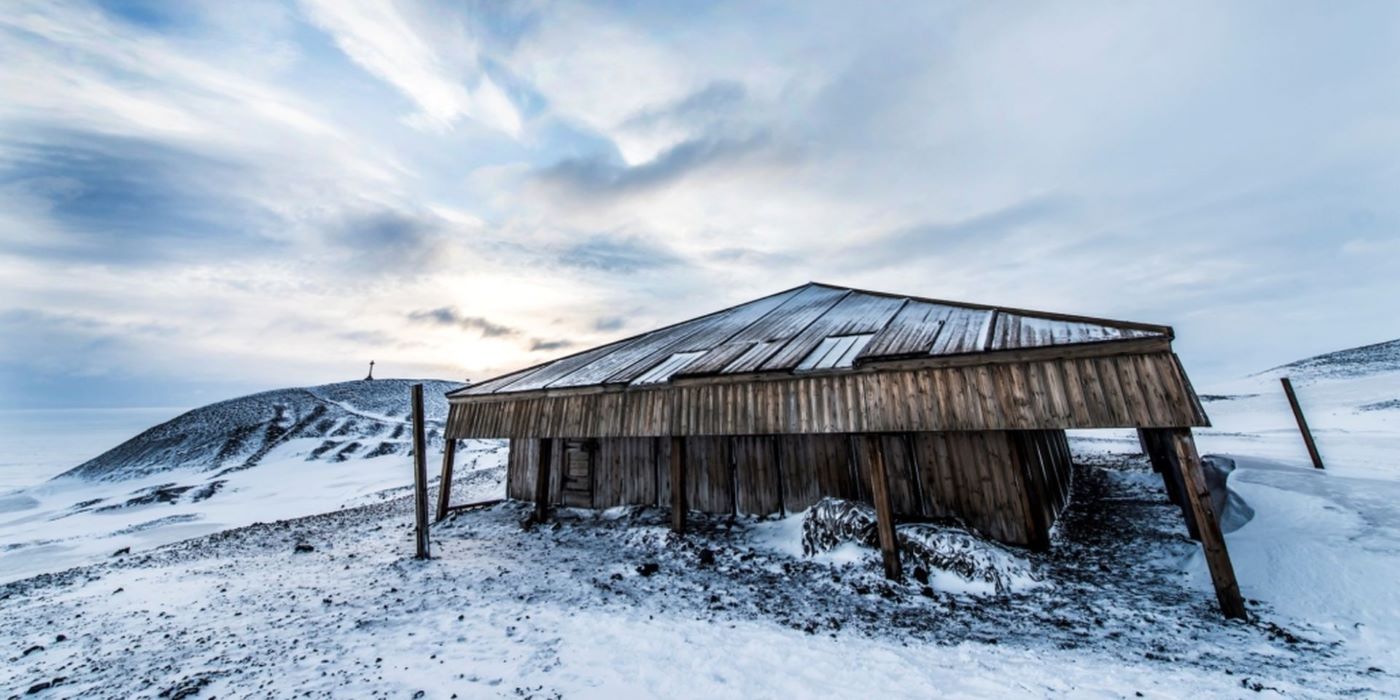
Inside the Frozen House at Cape Evans
The smell hits first. Wool, pipe tobacco, blubber smoke, and the faintly sweet rot of century-old reindeer hide — odors that should have evaporated long ago but cannot, because nothing in this room has been above freezing for more than a hundred years. The hut is dark. Light filters in through small windows half-buried in drift snow. A visitor's eyes adjust slowly to the gloom, and then the room begins to assemble itself: a long wooden table, twenty-five empty chairs, oil lamps suspended from the rafters, shelves stacked with tins of Heinz baked beans and Colman's mustard and Fry's cocoa with the labels still legible.
A bunk on the far wall belongs to Captain Robert Falcon Scott. The reindeer-skin sleeping bag is rolled at the foot of it, exactly as he left it on the morning of 1 November 1911 when he walked out the door to march to the South Pole. He never came back to roll it up differently. On a bench at the rear of the hut sits an emperor penguin, partially dissected, the scalpel placed beside it. The biologist who was performing the autopsy died on the ice shelf nine months later. His instruments still wait for him to return.
The men who lived in this room are dead. Their world is not. Every object is where they put it. Every bunk is made. The kitchen still smells of coal smoke from a stove last lit during the reign of George V.
This is what makes Scott's Hut unlike any other site of catastrophe. The same Antarctic cold that hunted Scott's polar party across the Ross Ice Shelf — that froze Edgar Evans's brain, that locked Lawrence Oates's feet inside his boots, that turned three men in a tent eighteen kilometers from salvation into mummies — is the same force that has held the rest of the expedition in suspended animation for over a century. Antarctica killed Scott. Antarctica preserved his house. The hut is not a memorial to the disaster. It is the disaster, frozen at the moment it happened.
Scott's Hut is the physical record of the entire Heroic Age of polar exploration and the catastrophe at its center: the British Empire confused suffering with virtue, and the men who paid for that confusion were buried by the very landscape they had been sent to conquer. The hut at Cape Evans is the only one of those men's bodies that anyone is allowed to visit.
The Heroic Age of Polar Exploration and the Race for the South Pole
The Polar Fever That Gripped Edwardian Europe
Antarctica was the last empty space on the map. By 1900, the Arctic had been crossed, Africa carved up, and the interiors of Asia and South America largely surveyed. The southern continent remained a white blank, its coastline only partially traced and its interior entirely unknown. No human being had stood at the South Pole. No one even knew for certain whether it was on land, on ice, or in the middle of an ocean.
To Edwardian Europe, this was intolerable. The pole became a national obsession in Britain, Norway, Germany, and Sweden. Geographic societies in London and Christiania funded expeditions on the explicit premise that planting a flag at 90° South was a matter of imperial prestige. The Royal Geographical Society and the Royal Society backed Scott's first expedition in 1901 with the language of pure science, but the subtext was unmistakable: the South Pole belonged to whoever reached it first, and Britain expected that to be a British naval officer.
The cult of polar suffering — the idea that man-hauling sledges across crevassed ice in temperatures of -40°C was a noble exercise of national character — was specifically British. The Royal Navy considered the use of dogs and skis somewhat beneath the dignity of an officer. Scott himself wrote that there was something inherently more virtuous about men dragging their own loads. The Norwegians, who knew dogs and skis the way the British knew horses, took notes and prepared accordingly.
Scott's First Antarctic Expedition and the Discovery Hut at Hut Point
Scott went south for the first time in 1901 aboard the Discovery, a wooden three-masted barque built specifically for ice work. The expedition wintered on the southern tip of Ross Island at a point now called Hut Point, where they erected a prefabricated Australian-style bungalow with a wide veranda and a pyramidal roof — a building designed for the outback, shipped to a continent where the temperature would routinely fall below the boiling point of mercury. The Discovery Hut, as it became known, was so cold and drafty that the men preferred to sleep aboard the ship and used the hut mainly as a storeroom and emergency shelter.
The 1901–1904 expedition produced significant science and a near-fatal southern journey: Scott, Edward Wilson, and Ernest Shackleton sledged to 82° South, the farthest anyone had reached, before scurvy and starvation forced them back. Scott returned to England a national hero. He had also returned with a peculiar set of conclusions: that dogs were unreliable, that skis were of limited use, and that British pluck — the capacity of a fit man to drag a sledge through misery — was the proven method of polar travel.
The Discovery Hut still stands today, twenty-four kilometers from Cape Evans. It is the older, smaller, drearier sister of Scott's Hut — and it is the building that gave Scott a decade of false confidence about how to cross Antarctica. By the time he returned to Ross Island in January 1911, HMS Erebus and HMS Terror had been buried in the Arctic for sixty-three years, killed by exactly the institutional arrogance Scott was about to repeat: a British naval expedition, refusing to learn from indigenous and Scandinavian techniques, marching into a polar landscape with the wrong equipment and a national myth of endurance.
Building Scott's Hut at Cape Evans in January 1911
The Terra Nova Expedition Lands on Ross Island
Scott's second expedition, the British Antarctic Expedition of 1910–1913, sailed south aboard the Terra Nova. The ship reached Ross Island on 4 January 1911 and anchored off a black volcanic beach on the western side of Cape Evans, a low promontory backed by the looming bulk of Mount Erebus, the southernmost active volcano on the planet. The expedition unloaded for ten days. Ponies, dogs, motor sledges, scientific equipment, three years of food, and a flat-pack wooden house all came ashore.
The hut had been prefabricated in England by Ayrton & Co. of Hampstead. It was a single-story rectangular structure measuring fifteen meters by eight, with double-thickness walls insulated with seaweed quilts, a felted roof, and tongue-and-groove floorboards laid over a layer of volcanic gravel for insulation. The carpenters Davies and Keohane led the construction. The whole building went up in two weeks. By 18 January 1911 — three days after Roald Amundsen unloaded his own prefabricated hut at the Bay of Whales, 650 kilometers to the east — twenty-five Britons were sleeping in beds inside a heated wooden house on the coldest continent on Earth.
The two camps were now on the same side of Antarctica, with the same goal. Neither knew exactly where the other was. Scott had not even known until he arrived that Amundsen was racing him at all.
The Wardroom, Mess Deck, and Dark Room: Life Inside the Hut
The interior of Scott's Hut reproduced the social architecture of the Royal Navy with mathematical precision. A wall of stacked food crates ran across the middle of the building, dividing it into two unequal halves. On one side, sixteen officers and scientists slept in private bunk alcoves arranged around a long communal table — the wardroom. On the other side, nine seamen and warrant officers slept in a more crowded bunk arrangement and ate at their own table — the mess deck. The two groups did not eat together, did not socialize freely, and did not cross the wall of crates without reason. They were within six meters of each other for two years.
The wardroom contained a piano, a gramophone, a small library, and Scott's private cubicle at the far end, separated from the rest of the hut by a curtain and a desk on which he wrote his diary every night. Edward Wilson, the chief scientist and Scott's closest friend, had a corner that he turned into a painter's studio. Herbert Ponting, the expedition photographer, set up a darkroom in the corner nearest the door, where he developed the glass-plate negatives that would later become the iconic visual record of the expedition. An acetylene gas plant produced lighting. A coal-fired stove ran continuously through the winter, fed by a coal pile outside that gradually disappeared under drift snow.
The hut was warm. The men complained, in fact, that it was too warm — temperatures inside the wardroom regularly climbed above 10°C while outside the wind chill exceeded -73°C. They wrote letters home, played football on the sea ice, kept up a manuscript newspaper called the South Polar Times, and worked through a research program covering meteorology, geology, biology, glaciology, and magnetism. The science conducted in this hut over two winters produced data that genuinely advanced the understanding of the Antarctic. The men were not just waiting to march on the pole. They were running one of the most ambitious scientific stations ever built.
The Men Who Wintered at Cape Evans
The expedition's roster reads like a cast list for a tragedy. Scott himself, forty-three years old, naval officer and aspiring national hero. Edward Wilson, the doctor-scientist-artist, devout Christian and Scott's spiritual mirror. Henry "Birdie" Bowers, a stocky lieutenant of the Royal Indian Marine, indefatigable, beloved by everyone, and, despite his rank, treated as one of the polar party's intellectual core. Lawrence Oates, a cavalry officer in charge of the ponies, sardonic, aristocratic, contemptuous of much of Scott's planning, and privately convinced the expedition was being mismanaged. Edgar Evans, a Welsh petty officer, the strongest man on the expedition and the only sailor Scott would take to the pole.
And then there was Apsley Cherry-Garrard, twenty-four years old, severely myopic, the son of a wealthy general. Cherry, as everyone called him, had paid £1,000 of his own money to join the expedition. He was the youngest member of the wardroom. In late June 1911, with Scott's blessing, he set out from the hut with Wilson and Bowers on what he would later, in the title of his masterpiece, call The Worst Journey in the World: a five-week sledging trip through the dark of the Antarctic winter, in temperatures that fell to -60.8°C, to collect emperor penguin eggs from a rookery at Cape Crozier 108 kilometers away.
The three men hauled their sledge through total darkness. Their teeth shattered from the cold. Their sleeping bags froze into solid blocks they had to thaw with their own bodies before they could climb in. Cherry's clothes froze around him in the position he had stiffened into. A blizzard tore the roof off their stone shelter at Cape Crozier and they spent thirty-six hours in their bags listening to their tent be carried away across the ice. They came back to the hut after five weeks with three penguin eggs, having proved nothing scientifically that justified the trip. Cherry would later write that it was the worst time anyone had ever had on Earth, and he meant it. He was twenty-four years old and his body never fully recovered. He survived to publish the book in 1922, and he never stopped grieving the men who had not come back from the second journey, the one to the pole.
The March to the Pole and the Norwegian Tent
The Polar Party Departs Cape Evans in November 1911
Scott left the hut on 1 November 1911 with sixteen men, ten ponies, twenty-three dogs, and two motor sledges. The plan was a relay system. Support parties would haul supplies up the Beardmore Glacier and turn back at staged intervals, with a final group of four — to be selected by Scott on the spot — pushing for the pole itself. The motor sledges broke down within days. The ponies, ill-suited to the climate, were shot in stages and fed to the dogs. Scott then dismissed the dogs as well, sending them back to the hut, and the men hauled the sledges themselves the rest of the way. Thirteen hundred kilometers, on foot, dragging their own food.
At the last possible moment, 140 kilometers short of the pole, Scott did something his officers had not anticipated: he announced he was taking five men to the pole instead of four. Bowers, who had been part of a four-man team, was ordered to leave his skis behind and join the polar group. Three men would now ski; two would walk. The tent was sized for four. The food rations were calculated for four. The cooking fuel had been depoted for four-man parties. Scott had just told five men to share supplies meant for four and walk to the pole.
They reached 90° South on 17 January 1912.
January 17, 1912: Amundsen's Black Flag at the South Pole
The five men saw the tent before they reached it. A small dark shape on the white horizon, with a Norwegian flag flapping above it. Amundsen had reached the pole on 14 December 1911, thirty-four days earlier. He had left a tent, a letter to King Haakon, and a note asking Scott — whom he correctly assumed would be the next to arrive — to deliver the letter to Norway in case Amundsen himself did not return.
Scott opened his diary that night and wrote: "The worst has happened... All the day dreams must go... Great God! this is an awful place."
The five men photographed themselves at the pole. Bowers operated the shutter with a string. The image survives. Scott stands in the center, gloved hands at his sides, eyes downcast. Wilson stands at the back with the look of a man who has already calculated the distances and rations for the return journey and reached an answer he is not going to share. Oates is to the left, his frostbitten face barely visible inside his hood. Evans is on the right, squinting, his cracked lip and split fingers already infected. They had walked thirteen hundred kilometers to lose. They now had to walk thirteen hundred kilometers back.
The Death March Back: How Scott's Polar Party Died
Edgar Evans's Collapse at the Beardmore Glacier
Edgar Evans died first. He had been the strongest of them, a thirty-six-year-old Welsh petty officer, the man Scott had picked specifically for his physical power. On the way to the pole he had cut his hand badly while modifying a sledge. The wound did not heal. On the descent of the Beardmore Glacier in mid-February, he fell into a crevasse and struck his head, and from that point his decline was rapid and visible to the others. He stopped speaking coherently. He fell behind. On 17 February 1912 he collapsed in the snow at the foot of the glacier, unable to stand. The other four carried him to the tent. He died that night.
Wilson, the doctor, suspected a brain injury from the fall, possibly compounded by scurvy and the slow starvation that all five men were now experiencing. Scott's diary recorded the death with the clipped grief of a naval officer: a good man, a sad loss, and the expedition must continue. They left Evans's body on the ice and walked north.
Lawrence Oates Walks into the Blizzard
Lawrence Oates's feet had been frostbitten since before the pole. By mid-March 1912, they were gangrenous. The skin had blackened. His toes had begun to come off inside his boots. Each morning it took him longer to force his feet into the frozen leather, and he could no longer keep up with the sledge. He understood, as the others did, that he was killing them by being alive.
On the morning of 17 March 1912 — his thirty-second birthday — Oates spoke to the men in the tent. The blizzard outside was severe. The temperature was approximately -40°C. He said, according to Scott's diary: "I am just going outside and may be some time."
He pushed through the tent flap and walked into the storm. He did not put on his boots. He walked into a -40°C whiteout barefoot, dragging gangrenous feet across the ice, until he was far enough from the tent that the others would not be tempted to look for him. His body was never found.
The Final Camp Eighteen Kilometers from One Ton Depot
Scott, Wilson, and Bowers continued north. They reached a point on the Ross Ice Shelf where they pitched their tent on 19 March 1912. A blizzard came down on them and never lifted. They had food for two days. They had fuel for less. They were eighteen kilometers from a supply cache called One Ton Depot, which had been stocked the previous year. The depot would have saved them.
The depot was eighteen kilometers south of where Scott had originally instructed it be placed. His second-in-command, Edward Evans, had begged him a year earlier to position it further south, where it could actually catch men coming back from the pole on their last legs. Scott had refused. Now, lying in the tent with two starving men, he was eighteen kilometers short of the food that would have allowed them to live.
Scott wrote for nine days. Letters to Wilson's widow, to Bowers's mother, to the wives of dead men, to the British public. "Had we lived," he wrote, "I should have had a tale to tell of the hardihood, endurance, and courage of my companions which would have stirred the heart of every Englishman." He wrote until his hand stopped working. The last entry in the diary is dated 29 March 1912: "It seems a pity but I do not think I can write more. R. Scott. For God's sake look after our people."
The three men lay down in their bags. Scott was found later with his arm thrown over Wilson, the body of his closest friend.
The Hut After Scott: Survivors, Searchers, and the Aurora Castaways
November 1912: The Search Party Finds Scott's Tent
The men at Cape Evans waited through the winter of 1912 in the dark, knowing. By August it was statistically impossible that the polar party was alive. The hut, which had been a place of song and science the previous winter, became a kind of mausoleum-in-waiting. Cherry-Garrard, who had been part of the dog-team support party that had turned back near the pole, blamed himself for not pushing further south. He would blame himself for the rest of his life.
A search party left the hut in late October 1912 and found the tent on 12 November. Tryggve Gran, the Norwegian skier Scott had hired as a ski instructor, was one of the first to reach it. The tent was a low green canvas mound, half-buried in snow. They opened it. The three men were inside, frozen in their sleeping bags, Scott's diary on his chest. The search party read the diary aloud in the snow. Then they collapsed the tent over the bodies, built a snow cairn over the tent, and erected a cross made from a sledge runner. Gran skied back to Cape Evans on Scott's skis — he had wanted, he said, to make sure the skis at least completed the journey.
The hut at Cape Evans was packed up in early 1913. The Terra Nova arrived to collect the survivors. The men carried out the diary, the photographs, the scientific specimens, and Scott's last letters. They left behind everything they did not need. The hut was sealed and abandoned, a wooden box of British Edwardiana on a black volcanic beach at the bottom of the world.
The Forgotten Tragedy of Shackleton's Ross Sea Party (1915–1917)
The story does not end in 1913. The hut has a second tragedy layered on top of the first, and it is the reason the building is not a clean snapshot of Scott's expedition alone.
In 1915, Ernest Shackleton — the same man who had sledged south with Scott in 1902 — launched the Imperial Trans-Antarctic Expedition, a wildly ambitious attempt to cross the entire continent on foot. The plan required two ships. The Endurance would land Shackleton's main party on the Weddell Sea side. A second ship, the Aurora, would land a support party on the Ross Sea side to lay supply depots from Cape Evans inland — the depots Shackleton would consume on his way out of the continent.
The Endurance was crushed by pack ice in the Weddell Sea before Shackleton ever set foot on land. His story of survival — the open-boat journey to South Georgia, the rescue of his men from Elephant Island — became the most famous epic of the Heroic Age. Almost no one remembers what happened to the other half of the expedition.
The Aurora anchored off Cape Evans in early 1915. Ten men went ashore to begin laying depots, expecting the ship to return regularly. A storm broke the Aurora's mooring lines and carried the ship out to sea with most of the supplies still aboard. The ten men were stranded at Cape Evans with the clothes they were wearing, a hut full of three-year-old supplies left by Scott's expedition, and orders to lay depots for a man who was, unknown to them, already shipless on the other side of the continent.
They spent two years at Cape Evans. They wore Scott's old clothes. They ate Scott's old tinned food. They burned Scott's old furniture and floorboards for fuel. They laid the depots Shackleton would never use. Three of them died: Aeneas Mackintosh and Victor Hayward walking out onto unstable sea ice in a blizzard and never coming back, and Arnold Spencer-Smith, a chaplain, dying of scurvy on the ice shelf as his companions dragged him on a sledge. The seven survivors were finally rescued in January 1917 by the repaired Aurora, with Shackleton himself aboard.
When the Ross Sea party left Cape Evans, they left their own layer behind: tins, clothing, sledging gear, and grief. The hut today is not just Scott's hut. It is also Shackleton's. The two tragedies are stacked on top of each other inside the same wooden box.
Preserving the Time Capsule: 8,000 Artifacts at the Bottom of the World
Decades of Frozen Silence and the First Restorations
The hut sat empty for nearly forty years. Drift snow piled against it, then over it. By the 1940s, it had effectively disappeared into a hummock of compacted ice. The continent had digested the building.
In the 1947–48 austral summer, an American expedition rediscovered the hut and dug their way in. What they found was not a ruin. It was a room. Bunks were made. Magazines were open on tables. Cans of food, when opened decades later, were found to be edible. Boxes of biscuits were still crisp. A century-old slab of seal blubber on the kitchen table had not rotted; it had simply frozen and stayed frozen. The interior of the hut had remained at or near the average annual temperature of Cape Evans, which is roughly -28°C. Bacteria do not work at -28°C. Mold does not grow. Wood does not warp. Paper does not yellow. The building had become a domestic-scale cryogenic chamber.
A New Zealand party fully excavated the hut in 1956 and began the first informal conservation work. They documented what they found with growing astonishment. Letters in Scott's handwriting, still legible. Wilson's watercolor paints in their tin. Ponting's photographic chemicals on the darkroom shelf. A reindeer-skin sleeping bag that, when unrolled, looked exactly as it had the morning the man had climbed out of it for the last time.
The Antarctic Heritage Trust and the Race to Save Scott's Hut
The Antarctic Heritage Trust, a New Zealand-based organization, took over formal conservation of Scott's Hut in the early 2000s. The project ran for over a decade and cost millions. Conservators worked in shifts during the brief Antarctic summer, cataloguing every object inside the hut. The final count exceeded eight thousand individual artifacts: tins of food, items of clothing, scientific instruments, photographic negatives, personal letters, books, sledging equipment, harness fittings, medicine bottles, pencils, pipes.
Each object was stabilized, photographed, sometimes removed for off-site treatment, and returned to its exact original position. The roof was repaired without altering the building's external appearance. Drainage channels were cut to prevent meltwater intrusion. The volcanic gravel under the floorboards was found to be saturated with seal blubber that had soaked down from a century of cooking, and the conservators had to extract the contaminated gravel and replace it without disturbing the hut above.
Cape Evans is no longer reliably below freezing year-round. Antarctic Peninsula temperatures have risen significantly over the past fifty years, and the McMurdo Sound region — where the hut sits — has begun seeing more frequent above-freezing days in summer. The same cold that preserved the hut for a century is no longer guaranteed. The Antarctic Heritage Trust now monitors the building's interior microclimate with the urgency of an intensive care unit. A different fate awaits sites further north: Pyramiden, the abandoned Soviet mining town in Svalbard, has decayed visibly over only forty years of partial freeze. Cape Evans has held for over a century. It will not hold forever.
Visiting Scott's Hut and the Ethics of Antarctic Pilgrimage
Scott's Hut is one of the most difficult historical sites to visit on Earth. It cannot be reached overland from any inhabited place. There is no road, no airstrip beside it, no tourist infrastructure. Access is controlled jointly by the Antarctic Heritage Trust and the New Zealand and U.S. Antarctic programs that operate the nearby Scott Base and McMurdo Station. The only practical visitor route is via an Antarctic cruise operated by a member of the International Association of Antarctica Tour Operators (IAATO), which lands passengers at Cape Evans by Zodiac during the brief austral summer window between November and February.
Visitor numbers are strictly capped. No more than eight people may be inside the hut at once. Total annual visitation is limited to a few thousand at most. Visitors are required to remove outer layers, brush snow from their boots, and walk on designated paths. Nothing inside the hut may be touched. Photographs are permitted but flash is generally discouraged. A guide accompanies every group. The visit itself usually lasts under an hour.
The interior is darker than visitors expect. Colder, too, even relative to outside — the hut shades the volcanic gravel floor and traps deep cold. The air smells, faintly, of all the things it has been smelling for a hundred years. People speak in whispers without being told to. Many cry without knowing why.
Standing in the wardroom is the closest a living human being can get to standing inside the British Empire's most consequential failure. Scott's bunk is a meter away. The chair where he wrote his diary entries about Amundsen's tent is in the corner. The kitchen table where he ate his last meal at Cape Evans before walking out to die is still set. The hut is not a museum about the expedition. It is the expedition, paused. The men are not here. Everything else is.
The ethics of such a visit are not casual. Scott's body remains on the Ross Ice Shelf, encased in a moving glacier that will, in a few centuries, deliver his remains to the Southern Ocean. Wilson and Bowers are with him. Oates is somewhere out there alone. Edgar Evans is at the foot of the Beardmore. The hut is the only fragment of these men a visitor will ever be able to stand inside, and it is not a battlefield to be conquered or a curiosity to be ticked off. It is a house where five men shaved and ate and slept and laughed at terrible jokes, and then walked out the door to a death they had not earned but had, in some sense, chosen. To stand inside it is to stand inside the last warm place they ever knew.
Frequently Asked Questions
Where is Scott's Hut located?
Scott's Hut sits at Cape Evans on Ross Island, Antarctica, on the western shore of McMurdo Sound. It is approximately twenty-four kilometers north of the modern American McMurdo Station and the New Zealand Scott Base. The hut is positioned on a black volcanic gravel beach beneath the southern flank of Mount Erebus, the southernmost active volcano on Earth. Its coordinates are 77.6383° S, 166.4172° E, which places it roughly 1,360 kilometers from the South Pole.
Who built Scott's Hut and when?
The hut was built by the men of Robert Falcon Scott's British Antarctic Expedition (the Terra Nova Expedition) in January 1911. The structure itself was prefabricated in England by Ayrton & Co. of Hampstead and shipped to Antarctica aboard the expedition ship Terra Nova. Carpenters Davies and Keohane led the construction, which took approximately two weeks to complete on site. Twenty-five men used the hut as their base for two Antarctic winters between 1911 and 1913.
Is the hut from the famous expedition where Scott died at the South Pole?
Yes. Scott and four companions left this hut on 1 November 1911 to march to the South Pole. They reached the pole on 17 January 1912, only to find that Roald Amundsen's Norwegian team had arrived thirty-four days earlier. All five men died on the return journey. The hut was used by the surviving expedition members through 1912 and 1913, and then again, layered with a second tragedy, by the stranded Ross Sea Party of Shackleton's Imperial Trans-Antarctic Expedition between 1915 and 1917.
Why is Scott's Hut so well preserved after more than a century?
The Antarctic climate at Cape Evans has historically maintained interior temperatures at or below -28°C year-round, which is well below the threshold at which most biological decay processes operate. Bacteria, mold, and fungi cannot function in those conditions, and organic materials such as paper, wood, leather, food, and textiles have remained essentially stable since 1913. The Antarctic Heritage Trust has run a major conservation program since the early 2000s to address roof leaks, water intrusion, and the slow rise in regional temperatures that now threatens the cold-based preservation that kept the hut intact.
Can tourists visit Scott's Hut today?
Yes, but access is heavily restricted. Visits are only possible via cruises operated by members of the International Association of Antarctica Tour Operators (IAATO) during the austral summer between November and February. Annual visitor numbers are capped, no more than eight people may be inside the hut at any time, and nothing inside may be touched. The hut is co-managed by the Antarctic Heritage Trust along with the New Zealand and United States Antarctic programs. Independent travel to Cape Evans is not permitted.
Are Scott's body and the bodies of his polar party still on the ice?
Yes. Scott, Edward Wilson, and Henry Bowers were found in their tent on 12 November 1912, eighteen kilometers from the One Ton Depot that would have saved them. The search party collapsed the tent over the bodies and built a snow cairn above it. The cairn was on the moving Ross Ice Shelf, which has carried the remains slowly northward for over a century. The bodies are believed to be encased deep within the ice and will eventually be carried out to sea as the shelf calves into the Southern Ocean. Lawrence Oates's body was never found, and Edgar Evans's remains are at the foot of the Beardmore Glacier.
Sources
* [The Worst Journey in the World] - Apsley Cherry-Garrard (1922)
* [Scott's Last Expedition: The Journals] - Robert Falcon Scott, ed. Leonard Huxley (1913)
* [Scott of the Antarctic: A Life of Courage and Tragedy] - David Crane (2005)
* [Captain Scott] - Ranulph Fiennes (2003)
* [The Last Place on Earth: Scott and Amundsen's Race to the South Pole] - Roland Huntford (1979)
* [Shackleton's Forgotten Men: The Untold Tragedy of the Endurance Epic] - Lennard Bickel (2000)
* [Conserving the Hut of Captain Scott] - Antarctic Heritage Trust, conservation reports (2004–2017)
* [The Heart of the Great Alone: Scott, Shackleton, and Antarctic Photography] - David Hempleman-Adams, Sophie Gordon, Emma Stuart (2009)
* [The Coldest March: Scott's Fatal Antarctic Expedition] - Susan Solomon (2001)
* [Birdie Bowers: Captain Scott's Marvel] - Anne Strathie (2012)
* [With Scott: The Silver Lining] - Tryggve Gran (1984, English edition of his expedition diary)
* [Antarctic Treaty Historic Sites and Monuments documentation, HSM No. 16] - Antarctic Treaty Consultative Meeting records