Inside Pyramiden: The Soviet Ghost Town Frozen in Time
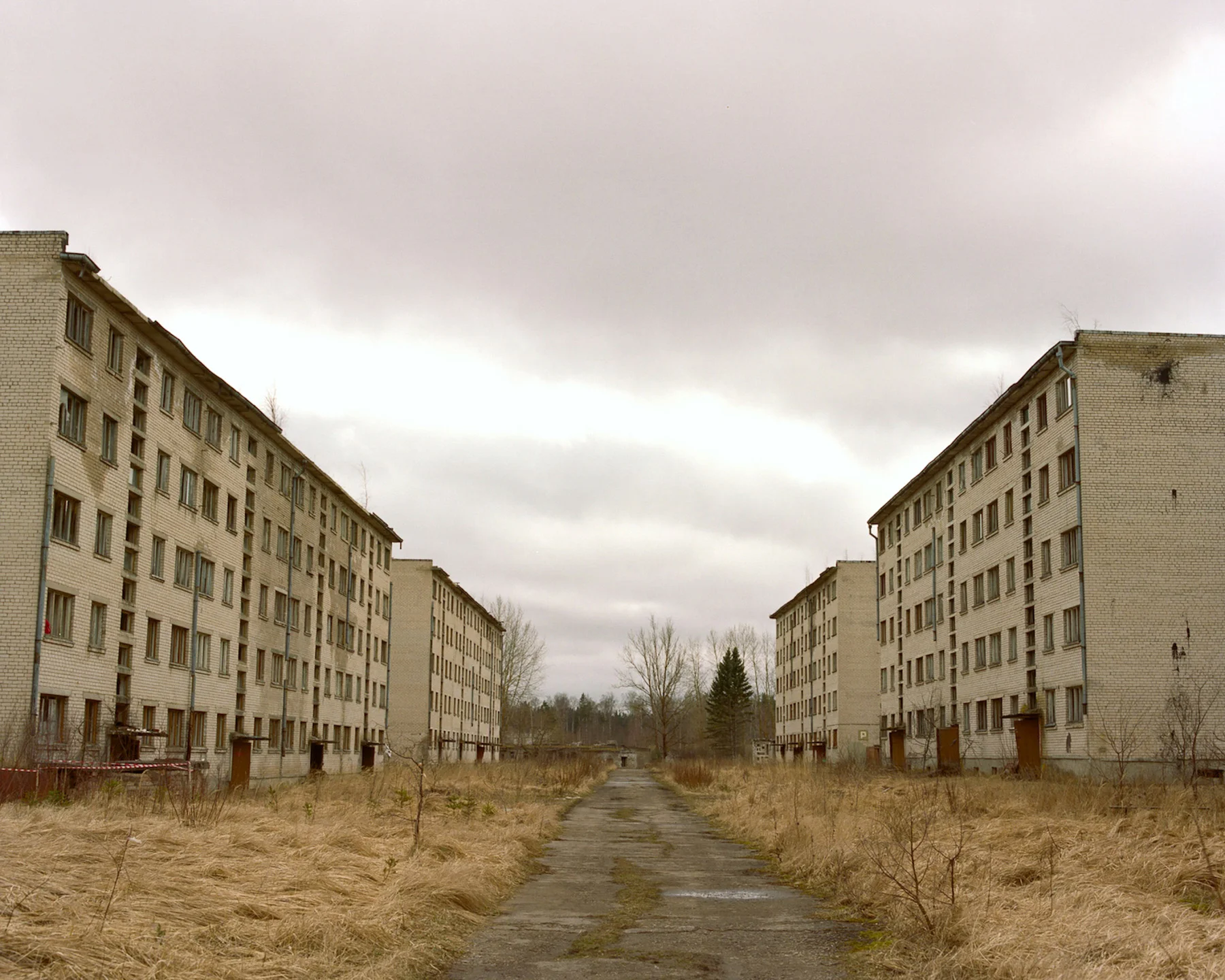
The boat from Longyearbyen rounds the bend of Billefjorden and the settlement appears all at once — a row of pale Soviet apartment blocks pressed against the base of a pyramid-shaped mountain, perfectly silent, perfectly still. A rusted portal crane hangs over the harbour like a skeletal limb, motionless against the grey sky. Above the town, a red star crowns the headframe of the coal mine. Below it, a bronze Lenin stands on a granite pedestal at the end of a gravel boulevard — the world's northernmost Lenin statue — his gaze fixed not on Moscow but on the cracked face of the Nordenskiöld glacier across the fjord. The grand piano in the cultural palace is reportedly still in tune. Plates and cutlery sit on canteen tables where no one has eaten for more than a quarter century.
Pyramiden is not a ruin in the conventional sense. It is a ghost town that was never cleared — a stage set that was never struck. The lights went out, the actors left, and everything remained in place — as though a director might call the cast back at any moment. The extreme cold of Svalbard's High Arctic has slowed decay, preserving wallpaper, furniture, and propaganda murals with an efficiency no museum could match.
The deeper story is one of performance. For nearly seventy years, the Soviet Union maintained Pyramiden not because the coal justified the cost — it almost never did — but because the settlement served a strategic and ideological function that had nothing to do with energy. Pyramiden was proof of concept: a model Soviet community planted on NATO-adjacent soil, operated under the legal cover of an obscure international treaty, designed to demonstrate that the socialist system could build a better life even at the edge of the habitable world. The swimming pool was not for the miners. It was for the visitors.
The Svalbard Treaty and the Loophole That Let Moscow In
The 1920 Spitsbergen Treaty and Its Open-Door Clause
The Spitsbergen Treaty, signed in Paris on 9 February 1920, resolved a problem that had nagged European diplomats for centuries: who owned the remote Arctic archipelago that Norwegian, Russian, Swedish, and Dutch whalers and trappers had used for generations without any single nation claiming sovereignty? The treaty gave Norway full sovereignty over Svalbard — the modern name for the island group — but attached a unique condition. All signatory nations retained equal rights to engage in commercial activity on the islands, including mining, fishing, and hunting. No military installations were permitted. No discrimination against foreign nationals was allowed.
The clause was an anomaly of interwar diplomacy, a compromise that satisfied Norway's territorial claim while leaving the door open to any country willing to invest. Most signatories never exercised the right. The Soviet Union walked straight through it.
How the Soviet Union Acquired Pyramiden
A Swedish mining company, Svensk Grufaktiebolaget Spetsbergen (SGSS), had operated a small coal-extraction operation at the base of Pyramiden mountain since 1910, naming the settlement after the peak's distinctive triangular shape. The operation was modest and intermittent — Arctic coal mining in the early twentieth century was brutally inefficient, and the site changed hands more than once.
In 1927, the Soviet state trust Arktikugol (literally "Arctic Coal") purchased the Swedish concession outright. The transaction was legal under the Spitsbergen Treaty. Moscow now had a permanent foothold on a Norwegian archipelago located roughly midway between mainland Norway and the North Pole — an outpost inside the Western sphere that no diplomatic protest could dislodge.
Mining began in earnest in the 1930s, paused during the Second World War when German forces shelled Svalbard's settlements, and resumed with new intensity after 1945. The Cold War had begun, and Pyramiden's value was no longer measured in tonnes of coal.
How Pyramiden Became the Soviet Union's Model Arctic City
Pyramiden's Swimming Pool, Concert Hall, and the Soviet Showcase
The settlement that emerged in the 1950s and 1960s bore no resemblance to a rough mining camp. Moscow invested heavily in infrastructure that was, by any measure, extraordinary for a community of fewer than a thousand people above the 78th parallel. The centerpiece was the Kulturhuset — the cultural palace, officially the Gagarin Sports and Culture Complex — a substantial building housing a theatre with a full stage and cinema screen, a music room containing the "Red October" grand piano (reputedly the northernmost grand piano in the world), a gymnasium, a basketball court, and a library stocked with several thousand Russian-language volumes. The shelves reportedly still hold their books.
A heated indoor swimming pool occupied its own building — a genuinely remarkable amenity at a latitude where the sea freezes and outdoor temperatures drop below minus 30°C in winter. A canteen provided centralized meals for the entire population. A hospital staffed with doctors and dentists served the community. The apartment blocks, while unmistakably Soviet in their prefabricated concrete construction, were well-heated and fully furnished.
The most famous detail was the grass. Pyramiden's central boulevard was lined with a carefully maintained lawn — real grass, growing on topsoil shipped from Ukraine, tended through the brief Arctic summer by residents who understood that this thin strip of green was not gardening but statecraft. It was, by most accounts, the northernmost cultivated lawn in the world. Visitors from Longyearbyen, the Norwegian administrative capital 50 nautical miles to the southwest, could see it from the harbour: green grass in the Arctic, courtesy of the Soviet Union.
The terraforming went further. A large greenhouse complex, heated by the settlement's coal power plant, produced cucumbers, tomatoes, parsley, and onions through the polar night. A small farm kept pigs, chickens, and dairy cows — ensuring fresh milk and meat for the community's children in a landscape where no food should naturally exist. Elsewhere on the settlement's periphery, residents built the so-called Bottle House — a small structure whose walls were constructed from thousands of empty glass bottles (vodka, mineral water) laid horizontally and cemented in place like bricks. When the low Arctic sun hit the glass, the walls glowed green and white. It was folk art born of isolation, a whimsical counterpoint to the rigid state-planned architecture surrounding it.
Daily Life in the Soviet Arctic: Miners, Families, and Polar Nights
At its peak in the 1980s, Pyramiden's population reached approximately 1,000 — miners, engineers, support staff, teachers, doctors, and their families. The demographic was overwhelmingly Ukrainian and Russian, recruited through Arktikugol's offices on the mainland with contracts that typically lasted two years. The incentives were substantial: salaries well above the Soviet average, and every year of Arctic service counted double toward retirement pensions. The company store stocked goods that were impossible to find in Moscow — fresh fruit, quality meats, imported luxuries. For many Soviet citizens, a transfer to Pyramiden was a step up, not a hardship posting.
Daily life was regimented and communal. Meals were served in the central canteen. Entertainment was organized through the Kulturhuset — film screenings, concerts, amateur theatrical productions. A football pitch and the swimming pool provided recreation during the brief summer. In winter, when the polar night swallowed the settlement for four continuous months, the community turned inward. Viktor Burlakov, a former electrician who worked at Pyramiden in the late 1980s, later described the winter months to Norwegian journalists as a test of psychological endurance — the darkness was total, the isolation was absolute, and the only relief was the social calendar organized by the settlement's cultural committee.
Children attended a small school. Families lived in designated apartment blocks separate from the single workers' dormitories. Alcohol was available but regulated. The settlement had its own post office, and mail arrived by supply ship during the navigable months. A helicopter pad connected Pyramiden to the rest of Svalbard when weather permitted.
The work itself was grinding. The coal seams inside Pyramiden mountain were accessed through tunnels that extended deep into the permafrost. Miners worked shifts in near-total darkness for much of the year, extracting coal that was loaded onto ships bound for Murmansk. Production figures were never impressive by mainland standards — the entire operation was subsidized by the Soviet state, the costs of Arctic extraction far exceeding the market value of the coal produced. The miners knew this. The administrators knew this. The coal was the pretext, not the purpose.
Cold War Propaganda on Norwegian Soil
Pyramiden's real function became most visible when visitors arrived. Norwegian officials, Western journalists, and foreign delegations were periodically invited to tour the settlement — a practice that intensified during the 1960s and 1970s, when Cold War propaganda operated on every available front. The tours followed a predictable script. Guests were shown the swimming pool, the cultural palace, the gymnasium, and the Ukrainian lawn. They ate in the canteen. They were told about the free healthcare, the free housing, the cultural programmes.
What they were not shown was the reality of the mining operation, the restrictions on workers' movements, or the fact that residents could not leave Svalbard without state permission. The settlement was a Potemkin village engineered for a specific audience — a three-dimensional argument that socialism could outperform capitalism even at the frozen edge of civilization. The Norwegians in Longyearbyen, working their own coal mines under considerably less impressive conditions, were meant to notice. Many did.
The parallel to Pripyat is instructive. Both were Soviet showcase communities — purpose-built settlements where the quality of life was artificially elevated to serve a narrative larger than the residents' welfare. Pripyat was meant to demonstrate that nuclear power could anchor a modern utopia. Pyramiden was meant to demonstrate that the socialist system could conquer even the Arctic. Both stories ended the same way: with empty buildings and an ideology that could no longer afford to maintain the illusion.
Why Pyramiden Was Abandoned: The Collapse of 1998
The 1996 Svalbard Plane Crash That Killed 141 Miners
The Soviet Union dissolved in December 1991, and the economic logic that had sustained Pyramiden dissolved with it. Arktikugol, now a Russian state enterprise rather than a Soviet one, continued operations at both Pyramiden and Barentsburg — the other Russian settlement on Svalbard, 55 kilometres to the southwest — but funding dried up. Maintenance was deferred. Equipment aged. The population dwindled as contracts expired and were not renewed.
The catastrophe that accelerated the end came on 29 August 1996. Vnukovo Airlines Flight 2801, a Tupolev Tu-154 charter carrying 129 passengers and 12 crew from Moscow, crashed into Operafjellet mountain during its approach to Svalbard Airport near Longyearbyen. All 141 people on board were killed. The passengers were overwhelmingly Ukrainian coal miners and their families — men, women, and children en route to begin or resume work at Barentsburg. It was the deadliest aviation disaster in Norwegian history.
The crash devastated the Russian mining community on Svalbard. Barentsburg lost friends, colleagues, and entire families in a single afternoon. Pyramiden, already weakened by years of declining investment, felt the shockwave. Recruitment became nearly impossible. The disaster made viscerally clear what the economics had been signalling for years: the Russian government could no longer justify the cost — financial or human — of maintaining coal mines in the High Arctic for the sake of a geopolitical posture that belonged to a dissolved empire.
Why Pyramiden Was Abandoned Overnight in March 1998
The final evacuation of Pyramiden took place in March 1998. The process was abrupt. The last residents — a skeleton crew of maintenance workers and administrators — packed personal belongings and boarded a ship. Almost everything else stayed. The furniture in the apartments was left in place. The kitchen equipment remained in the canteen. Books stayed on the library shelves. The piano stayed in the music room. The Lenin statue remained on its pedestal.
The speed of the departure has fuelled speculation and mythology — stories of half-eaten meals on tables, of clocks still ticking, of a settlement frozen in mid-sentence. The reality, according to former residents and Arktikugol officials, was less cinematic but no less striking. The decision to abandon had been made months earlier. The departure was orderly. Items of value — heavy machinery, certain records — were removed. Everything else was simply not worth the cost of shipping south. The Arctic would preserve it or destroy it. Either way, the performance was over.
What remained was a complete Soviet settlement, intact and uninhabited, in one of the most remote locations on Earth. The permafrost and the dry Arctic air became inadvertent conservators. In the school, maps of the USSR still hung on classroom walls. In the cafeteria, cups sat on tables. In the apartment blocks, clothes hung in wardrobes and potted plants stood in windowsills, long since withered to brown dust. The year 1998 was frozen into the architecture — not as a ruin but as an interruption, a sentence stopped mid-word.
Pyramiden Today: The Arctic Ghost Town Tourists Pay to Visit
Pyramiden's Abandoned Buildings: What Still Stands
More than twenty-five years after the evacuation, Pyramiden exists in a state of suspended decomposition. The extreme climate has preserved the settlement's built environment far better than equivalent abandonment would in a temperate zone — but decay is not absent. Roofs have begun to collapse under accumulated snow loads. Windows have shattered. Water infiltration has damaged interiors where insulation has failed. The swimming pool, long emptied, is cracked and stained. The iconic Ukrainian lawn has reverted to Arctic scrub.
The wildlife, meanwhile, has filled the human vacuum with its own agenda. The most dramatic reclamation belongs to the kittiwakes. Thousands of these seabirds have colonised the abandoned worker dormitories — a building known locally as the "Crazy House" — turning the window ledges into a massive vertical nesting ground. The noise is deafening, a chaotic screeching wall of sound that stands in jarring contrast to the dead silence of the cultural palace a few hundred metres away. The ground beneath the windows is white with guano, the smell acrid and overpowering. Arctic foxes den in the infrastructure. Polar bears pass through with enough regularity that armed guides are mandatory for any visitor venturing beyond the harbour. Pyramiden has joined the long list of places — Kolmanskop in the Namibian desert, Hashima Island off the coast of Japan — where nature's indifference has become the final editorial comment on human ambition.
The Lenin statue endures. Cleaned periodically by Arktikugol staff, it remains the most photographed object in Pyramiden — a bronze revolutionary staring down the Nordenskiöld glacier from the centre of a ghost town, the last man standing in a settlement built to prove a point no one is making anymore.
Pyramiden Tourism and the Tulpan Hotel
Around 2013, Arktikugol reopened a small section of Pyramiden for tourism. The Tulpan Hotel — originally a workers' hostel — was refurbished to a basic but functional standard, offering overnight accommodation in a settlement that otherwise has no permanent residents. A small bar serves drinks. A handful of seasonal staff — typically young Russians on short contracts — maintain the hotel and lead guided tours of the settlement.
The tours have become one of Svalbard's most popular excursions. Boat operators from Longyearbyen run regular summer trips to Pyramiden, and the settlement receives several thousand visitors annually. The experience is tightly controlled — guests are not permitted to enter most buildings, both for safety reasons (structural instability) and because Arktikugol considers the settlement's contents Russian state property. Guides lead visitors past the cultural palace, the canteen, the apartment blocks, and the Lenin statue, narrating the settlement's history with a mix of Soviet nostalgia and dark humour.
The tourism raises uncomfortable questions. Arktikugol's continued presence on Svalbard — it also operates Barentsburg, which remains an active Russian settlement with roughly 400 residents — is a sensitive geopolitical issue, particularly since Russia's 2022 invasion of Ukraine. Norway has tightened regulations on Russian activity in the archipelago without revoking the treaty rights that underpin it. Pyramiden, the abandoned propaganda stage, has become a live diplomatic irritant — a Soviet ghost town on NATO's northern flank that Russia refuses to fully relinquish.
The settlement sits in the same strange category as Forest City in Malaysia or Ocean Flower Island in China — vast built environments that were never fully inhabited, or were inhabited and then emptied, monuments to a logic that evaporated before the concrete could cure. The difference is that Pyramiden was never meant to be profitable. It was always a performance. The audience left, and the set remains, frozen under the Arctic sky, waiting for a curtain call that will never come.
Visiting Pyramiden, Svalbard
How to Visit Pyramiden From Longyearbyen
Pyramiden is accessible only by boat or, in winter, by snowmobile from Longyearbyen — Svalbard's administrative capital and the only settlement with commercial air service (flights from Oslo and Tromsø). The boat trip takes approximately 2.5 hours each way through Isfjorden and Billefjorden, passing glaciers and frequently accompanied by seabirds and, in summer, the occasional beluga whale.
Several Longyearbyen-based tour operators offer day trips to Pyramiden between May and September, when the fjord is navigable. Overnight stays at the Tulpan Hotel can be booked directly through Arktikugol or via local operators, though availability is limited and the experience is basic — expect dormitory-style rooms, a small bar, and no mobile phone reception. Bring layers, waterproof clothing, and binoculars.
Polar bear safety is not optional. All visitors must be accompanied by an armed guide outside the immediate harbour area. Svalbard's polar bear population is healthy and active, and bears use Pyramiden's abandoned buildings for shelter — there have been instances of tourists confined to the hotel or restricted to the boat because a bear was sleeping in the town square. The guides carry rifles and flare guns as standard protocol. The danger is not theatrical.
The emotional register of a visit to Pyramiden is distinct from most dark tourism sites. There is no memorial, no interpretive centre, no narrative of redemption. The settlement simply exists, increasingly fragile, increasingly inhabited by kittiwakes and weather. The propaganda murals are peeling. The Red October piano may or may not still hold its tune. The Lenin statue stares down the glacier, indifferent to the tourists photographing his back. The experience is less grief than vertigo — the disorientation of standing in a place that was built to prove something to the world and is now proving only that the world moved on.
Pyramiden asks no questions and offers no lessons. It is simply what remains on the shores of Svalbard when the performance ends and no one comes to clear the stage.
FAQ
Where is Pyramiden and how do you get there?
Pyramiden is located on the Norwegian archipelago of Svalbard, at approximately 78°39'N latitude in the High Arctic. The settlement sits at the base of Pyramiden mountain on the shore of Billefjorden, roughly 50 nautical miles northeast of Longyearbyen — Svalbard's capital and the only settlement with a commercial airport. Access is by boat (approximately 2.5 hours from Longyearbyen) during summer months or by snowmobile in winter. There are no roads connecting the settlements on Svalbard.
Why did the Soviet Union build Pyramiden on Norwegian territory?
The 1920 Spitsbergen Treaty granted Norway sovereignty over Svalbard but gave all signatory nations equal rights to engage in commercial activities on the islands. The Soviet Union purchased an existing Swedish mining concession in 1927 through the state trust Arktikugol, establishing a legal and permanent presence on the archipelago. While the stated purpose was coal mining, the settlement's lavish amenities — a heated swimming pool, concert hall, library, and imported Ukrainian topsoil — indicate that Pyramiden functioned primarily as a Cold War propaganda showcase on NATO-adjacent territory.
Can you stay overnight in Pyramiden?
Yes. Arktikugol, the Russian state mining company that still holds the concession, reopened the Tulpan Hotel around 2013 for seasonal tourism. The hotel offers basic dormitory-style accommodation, a small bar, and guided tours of the settlement. Availability is limited, and the experience is spartan — there is no mobile phone coverage and limited electricity. Bookings can be made through Arktikugol or local Longyearbyen tour operators.
When was Pyramiden abandoned and why?
Pyramiden was abandoned in March 1998. The primary cause was economic — the Soviet Union's dissolution in 1991 removed the ideological justification and state funding that had sustained the unprofitable mining operation. The 1996 Vnukovo Airlines Flight 2801 crash near Longyearbyen, which killed 141 people (mostly miners and families), further devastated the Russian mining community on Svalbard and made recruitment nearly impossible. The final residents departed in an orderly evacuation, leaving most of the settlement's contents in place.
Is it safe to visit Pyramiden?
Visitors must be accompanied by an armed guide at all times due to the presence of polar bears in the area. Svalbard has a healthy polar bear population, and bears have been spotted in and around Pyramiden's abandoned buildings. Structural instability in many buildings means that entry is restricted to designated areas. The guided tours are well-organised and safe, provided visitors follow the guide's instructions and dress appropriately for Arctic conditions.
What is the current status of Pyramiden?
Pyramiden remains the property of Trust Arktikugol, the Russian state mining enterprise. The settlement has no permanent residents but hosts a small seasonal staff to operate the Tulpan Hotel and manage the guided tours. Most buildings are closed and deteriorating, though the extreme Arctic cold has slowed decay considerably. The settlement receives several thousand tourists annually during the summer season. Russia's continued presence on Svalbard — including the active settlement of Barentsburg — remains a sensitive geopolitical issue, particularly following Russia's 2022 invasion of Ukraine.
Sources
- [The Spitsbergen Treaty: Multilateral Governance in the Arctic] - Torbjørn Pedersen, Polar Record, Cambridge University Press (2009)
- [Ghost Towns of the World: Pyramiden] - Chris McNab, Amber Books (2019)
- [Arktikugol: Soviet Mining in Svalbard] - Thor B. Arlov, Tapir Academic Press (1996)
- [Svalbard: Norway's Arctic Outpost] - Norwegian Polar Institute Publications (2016)
- [Vnukovo Airlines Flight 2801 Accident Report] - Accident Investigation Board Norway (AIBN), Report SL 1997/34 (1997)
- [Cold War on Ice: Soviet and Norwegian Relations on Svalbard] - Sven G. Holtsmark, Institut for Forsvarsstudier (1999)
- [Pyramiden: A Soviet Ghost Town in the Norwegian Arctic] - The Guardian, Long Read (2016)
- [Russia's Arctic Ambitions and the Future of Svalbard] - High North News / The Arctic Institute (2023)
- [Dark Tourism and the Soviet Legacy in Svalbard] - Journal of Heritage Tourism, Routledge (2020)
- [Life and Death in the Arctic Coal Mines] - Aftenposten, investigative series (1997)