The Dead Zone at the Edge of the South China Sea
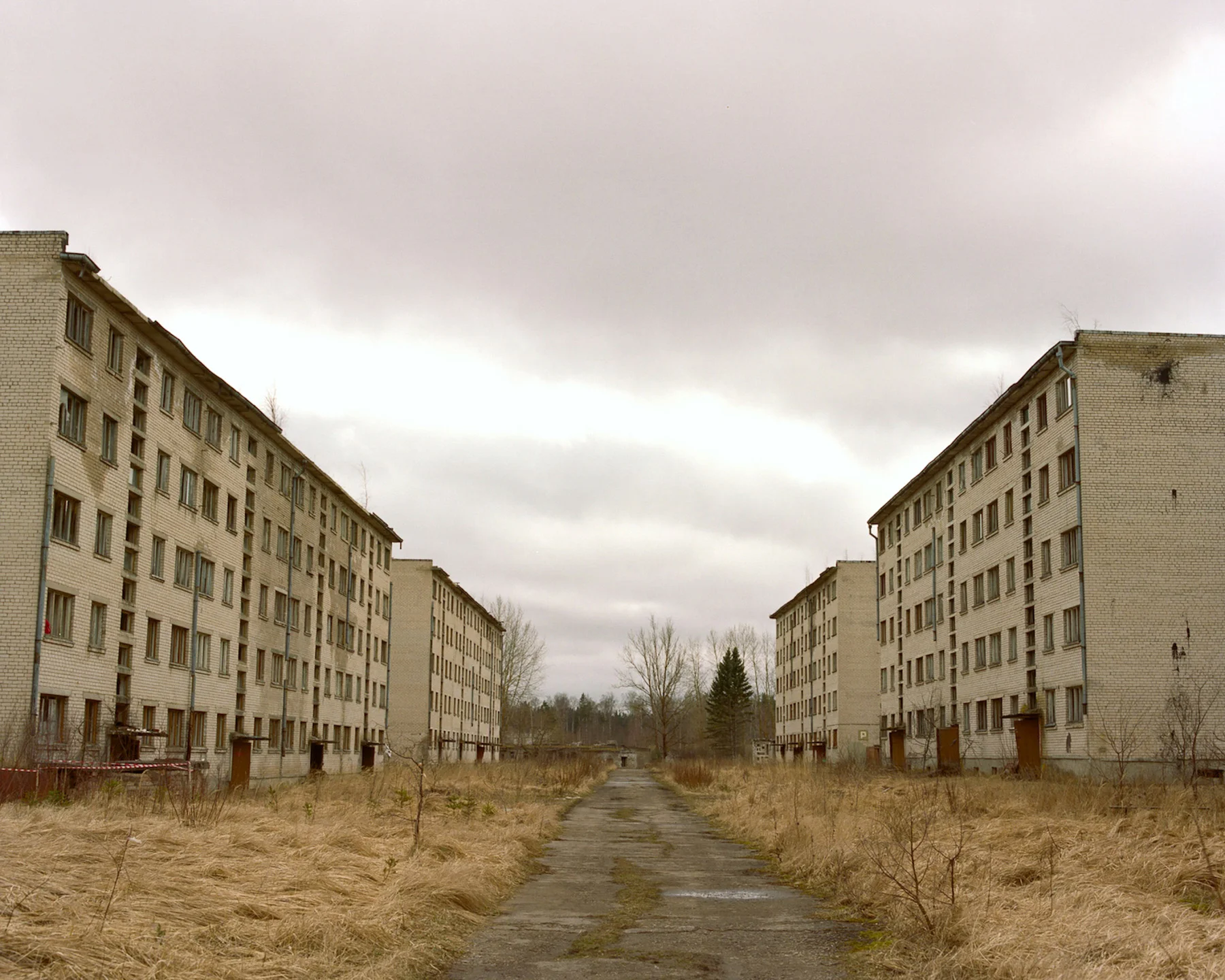
In January 2026, a man named Zhou Qingbin — a local from the nearby coastal city of Danzhou, no connection to the project, just curious about what $12 billion buys you — drove out to see Ocean Flower Island for himself. He parked near the entrance of Ocean Island Fairyland, a fantasy-themed amusement park that had never opened, and walked into an empty plaza the size of several football pitches. Behind him, thirty-nine high-rise apartment towers stood marooned on a wasteland of rubble and flooded concrete foundations. Local fishermen had started casting lines into the rainwater pools that collected where luxury swimming complexes were supposed to be. Hard hats, paint barrels, and construction tools lay scattered across half-finished villas where workers had walked off the job years ago and never returned. "This place is a dead zone," Zhou told the New York Times.
Ocean Flower Island is the physical monument to a collision between limitless ambition, corrupt governance, and the conviction — held like a religious faith across China's property sector for three decades — that if you build it, they will come. The archipelago cost approximately $12 billion to construct, most of it borrowed. It was supposed to be China's Dubai: a self-contained paradise of Michelin-starred restaurants, a convention center, an opera house, a marine aquarium, and a snow-themed water park, all rising from a seabed that had been home to coral reefs and oyster beds. The coral is dead. The oysters are gone. The man who conceived it all — Xu Jiayin, once the richest person in China — is sitting in a Shenzhen detention center, accused of orchestrating the largest financial fraud in the history of Chinese securities markets. The politician who signed the construction permits is serving a life sentence for bribery, after investigators reportedly found 13.5 tons of gold hidden in his basement.
The story of Ocean Flower Island is not simply a story about a failed resort. It is the story of an entire economic model consuming itself — debt posing as ambition, corruption posing as development, construction posing as creation. Every empty tower on this artificial archipelago is a headstone for the belief that the numbers would keep going up forever.
The Richest Man in China and His Sketch on a Napkin
Xu Jiayin's Rise from Steel Technician to Asia's Wealthiest Man
Xu Jiayin — known as Hui Ka Yan in Cantonese — was born in 1958 in rural Henan province, one of the poorest regions in China. His mother died when he was an infant. He grew up during the Cultural Revolution, trained as a metallurgist, and spent years working at a state-run steel factory in Wuhan. When Deng Xiaoping's economic reforms opened the floodgates of private enterprise in the early 1990s, Xu quit his job, traveled south to Shenzhen, and eventually started developing property in Guangzhou. He founded the Evergrande Group in 1996 with a simple formula: borrow aggressively, build fast, sell cheap, repeat.
The formula worked spectacularly. Evergrande became the engine of China's urbanization boom, riding a wave of demand from hundreds of millions of people migrating from the countryside into cities that barely existed a generation earlier. By 2017, Xu Jiayin's personal fortune peaked at an estimated $45.3 billion, making him Asia's richest man. Evergrande owned over 1,300 projects in 280 cities. Its annual sales topped 450 billion yuan. Xu attended the centenary celebration of the Chinese Communist Party in 2021, mingling with Beijing's power brokers on a stage draped in red. The company he built owed more than $300 billion to creditors around the world, but the music hadn't stopped yet.
Ocean Flower Island was Xu's most ambitious vision. According to Reuters, he personally sketched the design for the island — a flower-shaped archipelago in the South China Sea — and received weekly drone footage from the construction site to monitor progress. The project was announced in 2015 with an initial investment target of 160 billion yuan (approximately $24 billion). Xu wanted to build nothing less than the world's largest artificial tourism island. He succeeded. What came next, he didn't plan for.
Hainan's First Property Crash and the Island That Never Learns
Hainan province, the tropical island off China's southern coast, had been here before. In the early 1990s, the island experienced China's first modern property bubble. Speculators poured money into a construction frenzy, building apartments and hotels for an influx of residents and tourists that never materialized at the expected scale. When Beijing raised interest rates in 1993, the bubble collapsed violently. Ninety-five percent of developers in Haikou, the provincial capital, went bankrupt. Unfinished high-rises stood empty for a decade. The crisis became a cautionary tale — and then, as cautionary tales so often do, it became a forgotten one.
By the 2010s, Hainan was being repositioned as China's answer to Hawaii. The central government designated it a free trade port, dangling tax incentives and duty-free shopping to lure tourists and investors. The island's tropical climate, sandy beaches, and strategic location made it irresistible to developers. And nobody developed with more ferocity than Xu Jiayin. The place he chose for his masterpiece was Yangpu Bay, a stretch of coastline on Hainan's northwest shore, near the small city of Danzhou — far from the tourist hubs of Haikou and Sanya, far from international airports, far from almost everything. This remoteness was supposed to be the point. Xu wasn't building on a coastline. He was building the coastline itself.
Building an Island from Nothing: The Construction of Ocean Flower Island
Dredging a Peony from the Seabed
Construction began around 2013. Chinese dredgers gathered sand and gravel from the surrounding seabed and deposited it onto the shallow waters of Yangpu Bay, slowly raising three artificial islands from beneath the South China Sea. The islands were shaped to resemble the petals of a Chinese peony — five petal-like zones radiating from a central core on the main island, with curved facades and organic architectural forms meant to evoke a flower blooming on the ocean surface. The total reclaimed area reached 381 hectares (940 acres) across the three islets, covering roughly eight square kilometers — larger than Dubai's famous Palm Jumeirah.
The vision was staggering in its scope. Island No. 1, the central hub, would house 21 commercial and entertainment venues: an international conference center, an opera house, a marine aquarium, a botanical garden, a wedding manor, a film and television production base, a sports complex, hot springs, and a snow-themed water park called "Snow Mountain." A fantasy-themed amusement park called "Fairyland" would compete with the world's best. Twelve Michelin-starred restaurants would cater to China's expanding middle class. Duty-free shopping malls would capitalize on Hainan's tax-free status. A Hilton and a 5,000-room Castel Hotel would anchor the hospitality. Islands No. 2 and No. 3 were designated for residential development — luxury villas, townhouses, and apartment towers for up to 200,000 residents. The official promotional video declared, with no trace of irony: "There is no other entertainment venue on this planet that can top the Ocean Flower Island."
Evergrande ultimately invested approximately 81 billion yuan ($12.75 billion) into the project. Most of it was borrowed.
The Politician Who Signed the Permit
Building an artificial island the size of a small city in a bay that was home to protected marine habitats required more than engineering. It required political cover. Zhang Qi, the Communist Party secretary of Danzhou who held power during the project's critical early approvals, provided it.
Zhang had worked his way through Hainan's political machinery for decades — posts in Sanya, stints running the provincial tourism bureau, eventually the top party job in Danzhou and later Haikou, the provincial capital. He approved land reclamation permits for Ocean Flower Island in direct violation of Hainan's environmental protection laws. The boundaries of protected marine areas around Yangpu Bay were redrawn to accommodate the project. Environmental impact assessments were either inadequate or ignored. The approvals greased by Zhang's office allowed Evergrande to begin construction on a scale that would have been impossible under legitimate regulatory review.
In September 2019, the Central Commission for Discipline Inspection — the CCP's feared anti-corruption body — placed Zhang under investigation. The probe revealed a career of systematic corruption spanning 14 years and multiple government positions. A court in Guangzhou found that Zhang had accepted bribes totaling over 107 million yuan ($16 million) in exchange for favorable decisions on land development and construction contracts. He was sentenced to life in prison in December 2020, stripped of all political rights, and his personal assets were confiscated. Reports later surfaced — widely circulated in Chinese media and difficult to independently verify in full — that investigators had discovered extraordinary quantities of gold and cash concealed in Zhang's properties. The former governor of Hainan province, Luo Baoming, was separately convicted and jailed for 15 years for accepting approximately $16 million in bribes. Ocean Flower Island had been approved, from top to bottom, by men on the take.
The Coral Reefs That Died for a Theme Park
The environmental cost of dredging a peony from the seabed was immediate and irreversible. The construction of Ocean Flower Island destroyed coral reefs and oyster populations in Yangpu Bay. Dredging operations blanketed the surrounding seafloor with sediment, smothering marine organisms and permanently altering the bay's ecology. Coral reefs, which can take centuries to grow, were buried under tonnes of sand and gravel to create the foundations of shopping malls and apartment towers.
In April 2019, Hainan province investigated the environmental violations and imposed administrative fines of approximately 215 million yuan on the project. Evergrande paid the fines and kept building. The boundaries of the environmental protection area around the island were eventually restored on paper, but the damage was done. The coral would not grow back — not under the concrete foundations of a theme park, not in a bay whose ecology had been fundamentally rewritten.
Ocean Flower Island was far from the only artificial island project ravaging China's coastal and maritime ecosystems. Across the South China Sea, Chinese dredging operations have buried over 4,600 acres of coral reef since 2013, according to the Asia Maritime Transparency Initiative. But Ocean Flower Island's destruction was uniquely pointless. The military islands in the Spratlys, however controversial, served a strategic purpose. Ocean Flower Island destroyed a marine ecosystem to build a vacation resort that its developer couldn't afford to finish.
The Grand Opening and the Immediate Collapse
5.5 Million Visitors and the "Ugliest Building in China" Award
Construction was largely complete by the end of 2020, and the first trial tours launched on January 1, 2021. Visitors streamed in. Over 200,000 people arrived for National Day celebrations on October 1, 2021. By the end of its first year, Evergrande claimed 5.5 million tourists had visited Island No. 1. The numbers were impressive on paper. The reality was more complicated.
The architecture reviewers arrived too. In 2021, Ocean Flower Island was awarded first place in China's "Top 10 Ugliest Buildings" ranking — a widely followed annual list that serves as a barometer of public taste and civic embarrassment. The judges cited reckless capital investment, destruction of the marine ecosystem, bizarre and chaotic architectural forms, and the project's status as a "typical example of ostentatious and vulgar cultural tourism." Futuristic buildings sat beside reproductions of historic cityscapes in a jumble that resembled a theme park designed by committee — or by a billionaire reviewing drone footage and sending notes from a thousand kilometers away.
The island's remoteness compounded its problems. Danzhou had no international airport. Reaching Ocean Flower Island from Haikou's Meilan Airport required a 150-kilometer journey, most of it by high-speed train followed by a 20-minute taxi ride. From Sanya, the journey was nearly two hours. The island was designed as a self-contained world, but it was a self-contained world accessible only through considerable effort — a flaw it shared with Forest City in Johor, Malaysia, another Chinese-developer-built artificial paradise on reclaimed land that became one of the world's most expensive ghost towns, with barely 9,000 residents occupying a development designed for 700,000.
The $300 Billion Collapse of China's Largest Developer
The opening of Ocean Flower Island in early 2021 coincided almost exactly with the beginning of the end for Evergrande. In August 2020, the Chinese government had introduced the "three red lines" policy — financial thresholds that property developers had to meet before taking on new debt. The policy was aimed at curbing the reckless borrowing that had inflated China's property sector into the largest asset class on Earth. For Evergrande, which had built its empire almost entirely on leverage, the three red lines were a death sentence.
The dominoes fell with sickening speed. Evergrande began missing bond payments in late 2021. Its stock price, which had already been declining, collapsed — eventually losing 99% of its peak value and wiping out nearly $47 billion in market capitalization. The company's total liabilities stood at 1.97 trillion yuan ($309 billion), making it the most indebted property developer in history. Xu Jiayin, who had been worth $45 billion four years earlier, watched his fortune evaporate. He sold his $227-million London mansion and other personal assets to inject liquidity into the company. It wasn't enough. Nothing would have been.
The crisis was not Evergrande's alone. The company's implosion triggered a cascading loss of confidence across China's entire property sector. Developer after developer — Fantasia, Kaisa, Shimao, Country Garden — began defaulting on debts or teetering on the edge. New home sales fell to their lowest level in over 15 years. Property prices in 25 major Chinese cities declined by 25 to 30 percent from their July 2021 peak. Economists at Nomura estimated that roughly 20 million pre-sold housing units across China had not been delivered on schedule, creating a funding gap of approximately 3 trillion yuan. The Chinese real estate miracle, which had powered the country's economic growth for two decades, was unraveling. Ocean Flower Island — half-built, heavily indebted, sitting on dead coral in a remote bay — was its most photogenic casualty.
The Demolition Order That Came Ten Days Before New Year
On December 30, 2021 — ten days before the end of the year — the Danzhou Municipal People's Government issued a demolition order targeting 39 buildings on Island No. 2 of Ocean Flower Island. The buildings, covering 434,941 square meters of floor space, had been constructed under permits that were later found to have been obtained illegally. The company was given ten days to comply.
Evergrande responded that the demolition applied only to buildings on a single plot of Island No. 2 and did not affect the rest of the development, where it claimed 60,567 apartments had already been delivered to buyers, with another 628 units pending delivery. Workers erected blue metal sheeting around the condemned towers. As of January 31, 2022, when Reuters journalists visited the site, all 39 buildings were still standing. In April 2022, the demolition order was changed to confiscation — the city of Danzhou would seize the buildings rather than tear them down. The towers remain today: thirty-nine concrete skeletons, nearly finished but never sold, standing on a rubble-strewn artificial island in the South China Sea.
The Richest Man in China Goes to Prison
Xu Jiayin's $78 Billion Fraud and the Shenzhen Detention Center
On September 28, 2023, Xu Jiayin was detained by Chinese police and placed under residential surveillance — a legal mechanism that restricts a suspect's movement and communication, falling short of formal arrest but leaving no ambiguity about the direction of events. Several top executives from Evergrande's wealth management unit had already been taken into custody. Trading in Evergrande shares was suspended.
The investigation revealed a fraud of almost incomprehensible scale. China's Securities Regulatory Commission found that Evergrande's subsidiary, Hengda Real Estate, had fabricated 214 billion yuan ($30 billion) in sales revenue for 2019 — accounting for half of that year's reported revenue. For 2020, the fabricated figure rose to 350 billion yuan ($48.6 billion) — 78% of reported revenue. The combined overstatement of 564.1 billion yuan ($78 billion) over two years represented the largest financial fraud case in the history of mainland China's securities markets. Xu had used these inflated numbers to raise billions in bond financing from investors around the world.
In March 2024, Xu was fined 47 million yuan ($6.5 million) and permanently banned from China's securities markets. His former vice chairman and CEO, Xia Haijun, received the same lifetime ban. A Hong Kong court ordered Evergrande into liquidation on January 29, 2024. By October 2025, the Hong Kong High Court appointed receivers to take control of Xu's worldwide personal assets — including offshore trusts and shell companies — in an effort to recover billions for creditors. His ex-wife, Ding Yumei, was separately subjected to a global asset freeze covering approximately HKD 60 billion, including bank deposits in the UK and a luxury apartment in London. As of early 2026, Xu Jiayin — once a man who reviewed weekly drone footage of his island being built, who personally sketched the shape of a peony on paper and watched it rise from the ocean — was reported to be held in a special detention center in Shenzhen.
The Homeowners Trapped on an Artificial Island
The human cost extends far beyond the boardroom. Over 60,000 families purchased apartments on Ocean Flower Island before the collapse. Many were middle-class Chinese buyers who sank their life savings into what was marketed as a tropical paradise — an investment in China's future, in Hainan's free trade ambitions, in the promise that property values only go up.
Those who received their apartments discovered problems that went beyond the developer's financial collapse. In 2024, residents reported cracked basement columns, crumbling cement, and severe corrosion of reinforcing steel in newly built structures. The suspected cause: illegal use of sea sand in the concrete mix. Sea sand contains salt that corrodes rebar from the inside out, a structural time bomb. The buildings were not just unfinished — the ones that were finished may have been built to fail.
The municipal government of Danzhou now controls much of Ocean Flower Island and is struggling to determine what to do with it. The 60,000-plus apartment owners find themselves in a peculiar limbo: holding titles to units on an artificial island built by a liquidated company, approved by convicted criminals, and maintained by a local government that never planned for any of this. Some buildings sit empty. Others are occupied by families who have nowhere else to go and no one to sell to.
What Remains of China's Dubai
A Shopping Mall Without Shops, a Beach Too Dangerous to Swim
The current state of Ocean Flower Island is a study in surreal contrasts. Parts of the archipelago still function. The Hilton Hainan Ocean Flower Island, a 405-room resort overlooking the island's Central Park and the sea, continues to accept bookings. A handful of attractions on Island No. 1 remain operational — the Fairyland Water Kingdom, some conference facilities, fragments of the marine park. The Danzhou government has organized events — a "Never Ending Carnival" in August 2025, the ADEX Bluewave Festival — to draw visitors and maintain the fiction of viability. Chinese state media, including CGTN, has aired promotional segments portraying the island as a thriving tourism destination.
The rest of the island tells a different story. A gigantic shopping mall stands without shops. Dormant movie studios and unfinished fairytale-themed attractions sit behind locked gates. The artificial beaches — engineered from imported sand — are too dangerous to swim. Roads are blocked or underdeveloped. Dust accumulates on key structures. Across Island No. 2, entire blocks of luxury villas were abandoned so abruptly that hard hats and paint barrels remain where workers dropped them. The 39 confiscated apartment towers stand in rows like the tombstones of a civilization that overbuilt and underdelivered. Flooded concrete foundations, never completed, have become improvised fishing ponds.
Visitor accounts from 2024 and 2025 describe an eerie emptiness despite the presence of minimal staff. Low occupancy and underutilization characterize even the partially operational zones. The architecture — those parametric curves, those peony-petal facades — looks less like the future of tourism and more like the set of a science fiction film about a society that collapsed mid-construction. Similar ruins dot the landscape of Hainan itself: scattered across the province are unfinished construction projects from developers who, like Evergrande, borrowed and built on the assumption that tomorrow would always be richer than today.
Ocean Flower Island and the End of China's Property Miracle
Ocean Flower Island is not an anomaly. It is an emblem. The Chinese property sector, which at its peak accounted for roughly 30% of GDP when related industries are included, has entered a contraction that reshapes the landscape of entire provinces. Home prices in 25 major Chinese cities have declined 25 to 30 percent since their 2021 peak. An estimated 20 million pre-sold housing units remain undelivered. The Chinese authorities, in a measure that says more about the depth of the crisis than any statistic, have begun censoring pessimistic online posts about the property market.
The parallels between Ocean Flower Island and Ordos Kangbashi — the ghost city in Inner Mongolia built for a million residents who never arrived — are impossible to ignore. Both were products of the same faith: that China's urbanization rate would climb indefinitely, that demand would materialize to fill any supply, that the sheer act of construction was itself a form of economic growth. Fordlândia, Henry Ford's failed American utopia in the Amazon, shared the same DNA — a tycoon's personal vision imposed on a landscape that wanted no part of it. But Ocean Flower Island is something more specific, more modern. It is not the ruin of industrial ambition or colonial overreach. It is the ruin of financial engineering — of an economy that confused building with creating, that measured progress in square meters of concrete poured rather than in lives improved.
The island's theme parks echo Pripyat — another city abandoned mid-stride, its amusement park frozen in time, a monument to the hubris that precedes every catastrophe. And like the abandoned concrete battleship of Hashima Island, Ocean Flower Island may eventually become a destination for a different kind of tourism entirely: the kind that draws people not to paradise, but to the wreckage of paradise.
The Atlas Entry: Visiting Ocean Flower Island
How to Get There and What to Expect
Ocean Flower Island is located off the northwest coast of Hainan, approximately 150 kilometers from Haikou Meilan International Airport. The most practical route is to take Hainan's high-speed loop train from Haikou to Baimajin station (白马井), a journey of roughly 90 minutes costing around CNY 60 per person. From Baimajin, a taxi covers the remaining 12 kilometers to the island in about 20 minutes. From Sanya, the train journey takes approximately two hours at a cost of around CNY 99. Private car transfers from Haikou can be arranged for approximately CNY 1,200.
Visitors should expect a profoundly disorienting experience. Parts of the island are genuinely operational — the Hilton hotel functions normally, the water park receives guests, and some restaurants serve food. Other parts resemble a post-apocalyptic film set: empty plazas, shuttered attractions, abandoned construction sites, and rows of uninhabited apartment towers. The contrast between the two realities — the thin veneer of tourist normalcy and the vast, silent evidence of collapse — is what makes Ocean Flower Island unlike almost any other site in Asia. There are no admission fees for the island itself, though individual attractions may charge entry.
The ethics of visiting are worth considering. Over 60,000 families invested their savings in this place. Many are still living in apartments they cannot sell, in buildings that may have been constructed with substandard materials. For some, the island is not a curiosity or a cautionary tale — it is their home, or what remains of it. A visitor walking through the abandoned villas of Island No. 2 is walking through someone's broken promise. The island demands the same respect that any place of loss deserves: not reverence, but honesty. See what it is. Understand what made it. Do not look away from the human beings caught inside the numbers.
Frequently Asked Questions
What is Ocean Flower Island and where is it located?
Ocean Flower Island is an artificial archipelago built by China's Evergrande Group in Yangpu Bay, off the northwest coast of Danzhou in Hainan province, China. It consists of three man-made islands shaped like a peony flower, with a total area of 381 hectares (940 acres). The project was designed as a massive tourism, entertainment, and residential complex — the world's largest artificial tourism island — but has been left largely incomplete following Evergrande's financial collapse and subsequent liquidation.
Why was Ocean Flower Island built?
The project was conceived by Evergrande founder Xu Jiayin (Hui Ka Yan) as China's answer to Dubai's Palm Jumeirah. It was intended to be a self-contained luxury destination featuring theme parks, hotels, duty-free shopping, conference facilities, restaurants, and residential apartments for up to 200,000 people. The project was part of broader efforts to develop Hainan province as a world-class tourism hub and free trade port. Evergrande invested approximately $12 billion in the project, most of it borrowed.
What happened to Ocean Flower Island?
The project was hit by a series of cascading crises. The local politician who approved its construction, Zhang Qi, was convicted of corruption and sentenced to life in prison. Evergrande itself collapsed under more than $300 billion in debt in 2021, leading to a liquidity crisis that halted construction. In December 2021, authorities ordered the demolition of 39 illegally built apartment towers. Evergrande's founder, Xu Jiayin, was detained in 2023 and found to have overseen $78 billion in financial fraud. A Hong Kong court ordered Evergrande into liquidation in January 2024. Much of the island now sits abandoned or incomplete.
Can you still visit Ocean Flower Island?
Parts of Ocean Flower Island remain operational. The Hilton Hainan Ocean Flower Island hotel accepts bookings, and some attractions on Island No. 1 — including a water park and conference facilities — continue to operate. The Danzhou government has organized periodic events and carnivals to attract visitors. However, large portions of the island, particularly Islands No. 2 and No. 3, are abandoned or inaccessible, with unfinished buildings, blocked roads, and construction debris visible throughout.
What environmental damage did Ocean Flower Island cause?
The construction of Ocean Flower Island caused significant and irreversible damage to the marine ecosystem of Yangpu Bay. Dredging operations destroyed coral reefs and oyster populations. The land reclamation violated Hainan's environmental protection laws, which were overridden by corrupt local officials. Hainan province fined the project approximately 215 million yuan for environmental violations in 2019, but construction continued. The boundaries of the protected marine area were eventually restored on paper, but the physical damage to the reefs and seafloor habitats is permanent.
Is Ocean Flower Island a ghost town?
Large sections of Ocean Flower Island fit the definition of a ghost town. Over 60,000 apartments were delivered to buyers, but occupancy is extremely low. Entire blocks of luxury villas and apartment towers were never completed. A New York Times report in January 2026 described the project as featuring "a gigantic shopping mall without shops, a theme park without visitors, dozens of abandoned high-rise housing blocks and artificial beaches too dangerous to swim." Some residents remain, but the island functions at a fraction of its intended capacity.
Sources
- ["The Chinese Island Where Real Estate Dreams Never Die"] - Alexandra Stevenson, The New York Times (January 2026)
- ["Dashed Dreams for China Evergrande's Showpiece Resort Island"] - Reuters (January 2022)
- ["Why Ocean Flower Island — dubbed 'Dubai of China' — is important to China Evergrande Group and Hainan Province"] - South China Morning Post (January 2022)
- ["Rise and Fall of China's Ocean Flower Island"] - Caliber.az, sourcing Financial Times reporting (January 2026)
- ["Ocean Flower Island: What is China's answer to Dubai — and will it ever be finished?"] - The National (January 2022)
- ["Update: Part of Evergrande's Plush Sea Resort Project in Hainan Island Ordered to Shut Down"] - Global Times (January 2022)
- ["China Evergrande Cash Crunch Is Deepened by Hainan Demolition Order"] - The Washington Post (January 2022)
- ["China Accuses Troubled Property Developer of Committing Financial Fraud in $78 Billion Case"] - CNN Business (March 2024)
- ["Detention of China Evergrande Founder Hui Ka-yan 'a Signal Beijing Won't Let Super-rich Off the Hook'"] - South China Morning Post (October 2023)
- ["Hong Kong Court Puts Evergrande Liquidators in Charge of Founder Hui's Fortune"] - Caixin Global (October 2025)
- ["Former Haikou Party Chief Given Life Sentence for Bribery"] - China Daily (December 2020)
- ["Haikou Party Boss Falls Under Graft Investigation"] - Caixin Global (September 2019)