The Industrial Hallucination
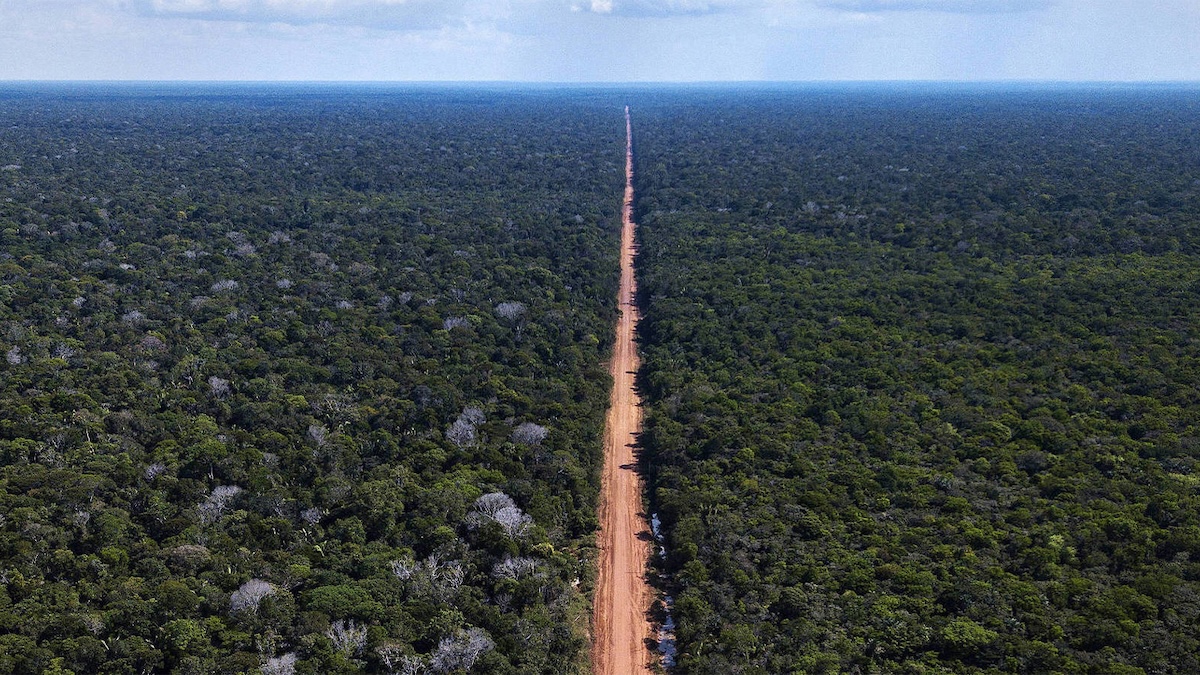
The Tapajós River does not simply flow; it pulses. It is a massive, dark artery of the Amazon basin, miles wide, moving with a deceptive, muscular sluggishness. To travel up this river is to move backward in time, away from the digital noise of the 21st century and into a primordial silence that feels heavy, wet, and indifferent to human ambition.
After hours of navigating the featureless green walls of the jungle, the hallucination appears. It rises above the canopy not like a tree, but like a tombstone. It is a 100-foot-tall steel water tower, painted with the distinct, utilitarian aesthetic of 1920s Michigan. It stands rusting in the equatorial sun, a piercing obelisk of American industrialism stabbed into the heart of the Brazilian rainforest.
This is the first glimpse of Fordlandia. It induces a specific kind of intellectual vertigo—a disorientation born from the sheer impossibility of what you are seeing. Here, deep in the "Green Hell" of the Amazon, sits a spectral Midwestern suburb. There are rows of white clapboard bungalows with pitched roofs designed for shedding snow, not deflecting tropical monsoons. There are fire hydrants waiting for fires that never come, and sidewalks cracked by roots that refuse to be paved over.
This is not merely the site of a failed business venture. It is the architectural carcass of Henry Ford’s most colossal hubris. It is a place where the assembly line met the ecosystem, and the ecosystem won. The silence that hangs over the rusting machinery today is the sound of the jungle digesting the 20th century.
The Rubber Monopoly and the Thirst for Control
To understand the madness of Fordlandia, one must first understand the paranoia of Henry Ford. By the late 1920s, Ford was the richest man in the world, the titan of Dearborn who had put America on wheels. But the Model T relied on rubber—tires, gaskets, hoses—and the rubber market was controlled by a cartel. The British and Dutch empires held a stranglehold on the rubber plantations of Southeast Asia.
Ford, a man who viewed dependence as a sin, sought "vertical integration" on a planetary scale. He wanted to own every step of the process, from the iron mine to the showroom floor. He didn't just want to buy rubber; he wanted to grow it. He wanted to break the European monopoly and create a supply chain that was purely American, even if it had to be carved out of the Brazilian wilderness.
In 1927, Ford negotiated a deal with the Brazilian government. In exchange for a promise of revenue and development, he was granted a concession of 2.5 million acres on the banks of the Tapajós. It was a tract of land the size of Connecticut, sight unseen. It was rugged, hilly, and rocky—entirely unsuitable for large-scale agriculture. But Ford did not send botanists to scout the land; he sent engineers. To him, the Amazon was just another factory floor waiting to be organized.
Constructing the Dream: Michigan in the Mud
The construction of Fordlandia was a logistical feat that bordered on the miraculous. Ford shipped an entire town from the United States to the Amazon. Ships loaded with prefabricated houses, power generators, hospital equipment, sawmills, and even ice cream makers sailed down the Atlantic and up the Amazon river system.
The result was a jarring juxtaposition that remains visible today, creating a fierce "Industrial Gothic" aesthetic. The town was laid out with the rigid geometry of a delicious American suburb:
- "Villa Americana": A street of stately homes for the American managers, complete with bathtubs, screens, and manicured lawns.
- The Hospital: Designed by Albert Kahn (the famous industrial architect of Detroit), arguably the most advanced medical facility in South America at the time.
- Infrastructure: A powerhouse, a sawmill, a schoolhouse, and a golf course.
Walking through these ruins today, the decay is palpable. The white paint peels in thick, scab-like strips, revealing the grey, rot-resistant wood beneath. The windows are gone, leaving the houses staring blankly into the dense foliage. Vines curl around the porch railings like green snakes, and the humidity acts as a slow-motion fire, rusting the metal roofs into jagged sheets of orange oxide. It is a ghostly vision of Anytown, USA, captured in the amber of the jungle.
The Absent Deity
Perhaps the most telling detail of the entire Fordlandia saga is the physical absence of its creator. Henry Ford never set foot in Fordlandia.
He never felt the humidity that clung to the skin like oil; he never swatted the mosquitoes that carried malaria and yellow fever; he never smelled the rot of the jungle floor. Instead, Ford directed the disaster via telegram from his office in Dearborn. He managed the Amazon as an abstraction. He demanded updates, issued decrees, and fired managers based on reports that took weeks to arrive.
This detachment fueled the tragedy. To Ford, the jungle was a problem of engineering—a chaotic system that simply needed the discipline of the time clock and the assembly line to be tamed. He believed that the same principles that built the Model A could mandate the growth cycles of Hevea brasiliensis (the rubber tree). He was wrong.
The Sociological Experiment
Fordlandia was never just about rubber. For Ford, it was a "work of civilization." He viewed the project as an opportunity to export the American way of life—specifically, his own puritanical, Midwestern version of it—to the "uncivilized" tropics.
The cultural imperialism was swift and absurd:
- Alcohol: Ford enforced a strict prohibition, banning cachaça (sugarcane rum), a cultural staple.
- Time: He installed punch clocks, forcing workers accustomed to solar rhythms to strictly punch in and out.
- Poetry: He promoted gardening and poetry readings.
Most surreal of all were the mandatory dances. Ford despised jazz, viewing it as morally corrupt. He loved square dancing. Consequently, exhausted rubber tappers, after spending twelve hours hacking through the jungle in sweltering heat, were frequently corralled into the community hall to learn the do-si-do and the waltz, stepping awkwardly to fiddle music while American managers looked on approvingly. It was a forced performance of joy, a grim pantomime of Detroit society played out in the rainforest.
The Culinary Conflict: Oatmeal vs. The Amazon
The tension between the American management and the Brazilian workforce simmered for months, but the spark that ignited the powder keg wasn’t wages or working hours—it was the cafeteria food.
Ford believed that a healthy worker was an efficient worker, and to him, "healthy" meant a diet of oatmeal, canned peaches, brown rice, and whole wheat bread. The company built a modern cafeteria and insisted that the workers eat there, abandoning their traditional diet of fish, manioc flour, and beans. The workers were forced to sit at tables and eat unfamiliar, bland sludge imported from the United States.
It was a nutritional imposition that ignored the caloric needs of men working in 90-degree heat. The managers, blinded by the dogma of "scientific management," refused to bend. To them, the cafeteria was an extension of the factory; the fuel put into the human machines had to be standardized.
The Riot of the Broken Plates
On December 20, 1930, the tension snapped. It began in the cafeteria. A worker, fed up with the gray paste on his tray, argued with a supervisor. The argument escalated. A plate was thrown. Then another. Within minutes, the "Riot of the Broken Plates" (Quebra-Panelas) was in full fury.
The scene was chaotic and violent. Hundreds of workers, armed with machetes and rocks, destroyed the cafeteria. They smashed the windows, overturned the trucks, and cut the telegraph wires, severing the town’s connection to the outside world. They proceeded to trash the housing of the American staff.
The American managers and their families fled their white bungalows, commandeering boats or hiding deep in the jungle. For a few days, the workers controlled Fordlandia. They drank the forbidden alcohol, smashed the time clocks, and danced to their own music. The Brazilian army eventually arrived to restore order, but the illusion of the "civilizing mission" was shattered.
The War on Nature: The Assembly Line vs. The Fungus
While the social experiment was failing, an even greater catastrophe was brewing in the fields. This is the thematic anchor of the Fordlandia tragedy: The War on Nature.
Henry Ford’s engineers treated the rubber trees like car parts. In a factory, efficiency dictates that you place machines close together to minimize travel time and maximize space. Applying this logic to agriculture, they planted the rubber trees in tight, neat, geometric rows, acre after acre.
They ignored the warnings of local botanists who explained that in the Amazon, rubber trees grow wild and widely separated—often only one or two per acre. This isolation is an evolutionary defense mechanism. It prevents pests and diseases from spreading easily from host to host. By planting the trees in dense monocultures, Ford created a buffet for the Amazon’s predators. The result was a biological massacre.
The Invisible Enemy: South American Leaf Blight
The executioner of Fordlandia was not a revolutionary or a rival corporation; it was a microscopic fungus called Microcyclus ulei, known as South American Leaf Blight.
The blight attacks the leaves of the rubber tree, covering them in velvety grey spores. The leaves wither and fall off. The tree tries to regenerate them, depleting its energy reserves, until it eventually dies of exhaustion. In the wild, the fungus has difficulty finding the next tree. In Fordlandia, the wind simply blew the spores from one row to the next.
Compounding the disaster were lace bugs and caterpillars, which descended in clouds, devouring the saplings. The American managers fought back with the brute force of industry. They sprayed gallons of pesticides; they burned infected groves; they tried to engineer the problem away. But the biology was relentless. The more they planted, the more they fed the plague.
Belterra: The Forgotten Sequel
Refusing to admit defeat, the Ford Motor Company doubled down. In 1934, they secured a new tract of land some 30 miles downriver, a place called Belterra. The land there was flatter and less prone to damp fog, which they hoped would inhibit the blight.
Belterra was a more functional town than Fordlandia—it had better roads, a more established hospital, and better housing—but it was a sequel that followed the same tragic script. The blight eventually found Belterra. The lace bugs returned. The "Ford Way" of agriculture simply could not survive the biodiversity of the Amazon. By 1945, with the invention of synthetic rubber during World War II, the demand for natural latex plummeted. The project was not only a biological failure; it was now economically obsolete.
The Final Surrender
In 1945, Henry Ford died. His grandson, Henry Ford II, took over the company. Known as "The Deuce," he was a pragmatist with no patience for his grandfather’s sentimental or utopian follies. He looked at the books, saw that the Amazon venture had cost the company over $20 million (hundreds of millions in today’s currency) and had not produced enough rubber to make a significant contribution to tire production.
He sold the entirety of Fordlandia and Belterra back to the Brazilian government for a paltry $244,200. The Americans left almost overnight. They packed their suitcases and boarded the boats, leaving behind the silverware in the drawers, the machinery in the powerhouse, and the dream rotting in the mud.
The Living Ruins: Life in a Ghost Town
Today, Fordlandia is often described as a ghost town, but that is a misnomer. It is a zombie town—dead in purpose, but still animated by the living.
Squatters, former workers, and their descendants still inhabit the American bungalows. The population has fluctuated over the decades, but a community remains. There is an uncanny, surreal quality to domestic life here. You will see a satellite dish bolted onto 1920s Michigan siding. You will see a motorcycle parked on what used to be the ninth hole of the golf course. Families cook Brazilian stews in kitchens designed for baking apple pies.
The hospital, once the jewel of the Amazon, is a shell. Its windows are shattered, and bats roost in the operating theaters. But the water tower still stands, and the water system, incredibly, still functions in parts of the town—a testament to the over-engineered quality of 1920s American steel.
Artifacts of Ambition: The Informal Museums
There is no official Smithsonian outpost here. The history of Fordlandia is preserved in the living rooms of the locals. If you show interest, a resident might invite you in to see their personal collection of artifacts.
On dusty shelves, you will find punch-clocks frozen in time. You will see rusted medical clamps, fragments of American glass bottles, and heavy iron tools stamped with the cursive "Ford" logo. These are the relics of a lost civilization, treated with a mix of reverence and bewilderment. They are physical proof that the giants once walked here, tried to tame the land, and failed.
Travel Guide: The Journey to the Heart of Darkness
Visiting Fordlandia is not a casual excursion; it is a pilgrimage for the dedicated dark tourist. There are no luxury hotels, no air-conditioned tour buses, and no gift shops.
- The Logistics: The journey begins in Santarém, a bustling city at the confluence of the Amazon and Tapajós rivers. From there, you must book passage on a local boat. The trip takes approximately six to seven hours upstream. The boats are often crowded with locals sleeping in hammocks.
- The Experience: There is little infrastructure for tourism. You may need to negotiate a ride on the back of a motorcycle to get from the dock to the ruins. Accommodation is basic—usually a room in a local’s house or a very simple pousada.
This lack of polish is exactly why one should visit. It preserves the atmosphere of isolation. Standing in the silent, rusted powerhouse, with the sound of the jungle screaming outside, you feel the weight of history in a way that a sanitized museum can never convey.
Modern Reflections: From Fordlandia to Silicon Valley
The story of Fordlandia is not ancient history; it is a warning for the present. Today, we see the same hubris in the "smart cities" proposed by Silicon Valley billionaires—utopian zones where technology promises to solve the messy inefficiencies of human interaction and biological reality.
Like Ford, modern technocrats often believe that culture, society, and nature are merely code that can be debugged and optimized. Fordlandia stands as a rusting monument to the fallacy of this thinking. You cannot code a community into existence, and you cannot engineer a forest like a machine. When we try to impose rigid, linear systems onto chaotic, organic worlds, the result is usually disaster.
The Jungle Always Wins
As you leave Fordlandia, the boat drifts back down the Tapajós, and the water tower slowly recedes into the green wall of the canopy. It looks small now, insignificant against the vastness of the rainforest.
The poet Percy Bysshe Shelley wrote of Ozymandias, the king whose shattered statue lay in the desert, a testament to the fleeting nature of power. Fordlandia is the Ozymandias of the Industrial Age. It reminds us that nature is patient. It does not argue; it waits. The vines will continue to climb the water tower. The rust will continue to eat the steel. The jungle will eventually swallow the last remnants of Henry Ford’s American dream, leaving nothing but the silence that was there before the first steam whistle ever blew.
Sources & References
- Grandin, Greg. Fordlandia: The Rise and Fall of Henry Ford's Forgotten Jungle City. Metropolitan Books, 2009. (The definitive history of the settlement).
- The Henry Ford Museum. "Fordlandia: The Amazon Rubber Plantation." Archives and historical photos.
- Dempsey, J. "Fordlandia: The Failure of the American Dream in the Amazon." Journal of Historical Geography.
- Gawande, Atul. "The Checklist Manifesto." (References Ford's failure to utilize local knowledge).
- Rough Guides. "Travel Guide to the Brazilian Amazon & Santarém."
- Atlas Obscura. "Fordlandia: The Abandoned Company Town."
- BBC News. "The ruins of Henry Ford's Amazon dream." (Travelogue and photo essay).
- New York Times. "Deep in Brazil’s Amazon, Exploring the Ruins of Ford’s Fantasy."
- Scientific American. "The Biology of the Rubber Tree and the Leaf Blight Failure."
- NPR. "Fordlandia: Henry Ford's Amazon Utopia." (Interview with Greg Grandin).