The Signal: The Cold War Pulse That Haunted the Airwaves
In July 1976, shortwave radio bands across the planet were hijacked by a sharp, rhythmic tapping. It was a 10 Hz pulse—ten beats per second—that drifted across the spectrum, drowning out commercial broadcasts, aviation signals, and maritime distress frequencies. To global operators, it sounded like a frantic wooden bird. They called it the "Russian Woodpecker." This was not just a nuisance; it was a loud, arrogant assertion of Soviet presence in the ionosphere.
10 Hertz: The Sound of the Woodpecker
The Woodpecker was a high-power pulse that carried an estimated 10 megawatts of energy. Unlike the subtle, encrypted signals sent from the US through facilities like Pine Gap in Australia, the Duga was a brute-force hammer. It didn't care about signal-to-noise ratios; it simply overwhelmed the bands. The interference was so massive that it could be heard on unshielded telephone lines in Europe and through home television sets.
The sound was a symptom of the radar’s operational cycle. Every pulse sent out was an attempt to bounce a signal off the top of the atmosphere to peer into the American heartland. For years, the Soviets issued blatant denials of the signal’s existence, even as international telecommunications unions filed thousands of complaints. To the Soviet military, the disruption of a Norwegian fisherman’s radio was a small price to pay for the ability to monitor a potential launch from a Minuteman silo in North Dakota.
Paranoia and Propaganda: The Mystery of the Pulse
Because the Kremlin remained silent, the Western imagination filled the void with nightmares. During the height of the Cold War, the mystery of the Duga signal led to congressional inquiries and scientific panic. Some researchers suggested the signal was an experiment in psychotropic warfare, claiming the 10 Hz frequency matched the alpha waves of the human brain. The fear was that the USSR was attempting to broadcast a "mass mood-alteration" signal into the West.
Others looked at the weather. There were theories that the Duga was part of a climate-modification program, designed to steer the jet stream and trigger droughts or floods across the United States. While these theories were largely unfounded, they reflected the genuine fear of a technology that could pulse through every home in America without an invitation. The reality—a massive early-warning radar—was less supernatural, but it was far more dangerous because it meant the Soviet Union was actively preparing for the first stage of a global nuclear exchange.
Over-the-Horizon: The Failed Physics of Early Warning
The Duga was the Soviet Union’s answer to the challenge of the Earth’s curvature. Standard radar travels in a straight line, meaning it cannot "see" anything below the horizon. If the United States launched a missile, Soviet standard radar wouldn't detect it until it was high in its arc, leaving only minutes to react. The Duga used Over-the-Horizon (OTH) technology to extend that warning time to nearly thirty minutes.
Detecting the Unseen: The Ionospheric Mirror
The physics of the Duga relied on the ionosphere, a layer of the Earth’s atmosphere charged by solar radiation. By firing high-frequency radio waves at a specific angle, the Duga would "skip" its signal off the ionosphere and back down to the ground thousands of miles away. If those waves hit a solid object—like the plume of a rocket—they would scatter, and a tiny fraction of that energy would skip back to the receiver in the Exclusion Zone.
This was a radical departure from the approach taken by NORAD (North American Aerospace Defense Command). While the Soviets built massive, exposed steel grids in the forest, the Americans were hollowing out granite mountains. At the Cheyenne Mountain Complex in Colorado, NORAD created a self-sustaining fortress shielded by 2,000 feet of rock. While Cheyenne Mountain focused on receiving data from a sophisticated web of global sensors and early satellites, the Duga was a solitary, exposed giant. It was the Soviet philosophy of "quantity and scale" versus the American philosophy of "protection and precision."
A Billion-Ruble Failure: The Mechanical Decline
Despite the colossal engineering effort, the Duga was a fundamental failure. The ionosphere is a temperamental medium; it changes its height and density based on sunspots, the time of day, and the seasons. This meant the radar was often "blind" or produced "ghost" images. The Duga-1 installation near Chernobyl was the most advanced of three sites, yet it was never fully integrated into the official Soviet combat alert system.
The cost was staggering. The construction of the Chernobyl-2 site cost twice as much as the construction of the Chernobyl Nuclear Power Plant itself. It was a billion-ruble gamble that was losing its relevance even as the concrete was drying. By the time the antenna was operational, both the US and the USSR were shifting toward satellite systems that provided more reliable data without the need for a 14,000-ton steel lattice. The Woodpecker was a giant that arrived too late to the war.
Chernobyl-2: The Secret Military Town in the Woods
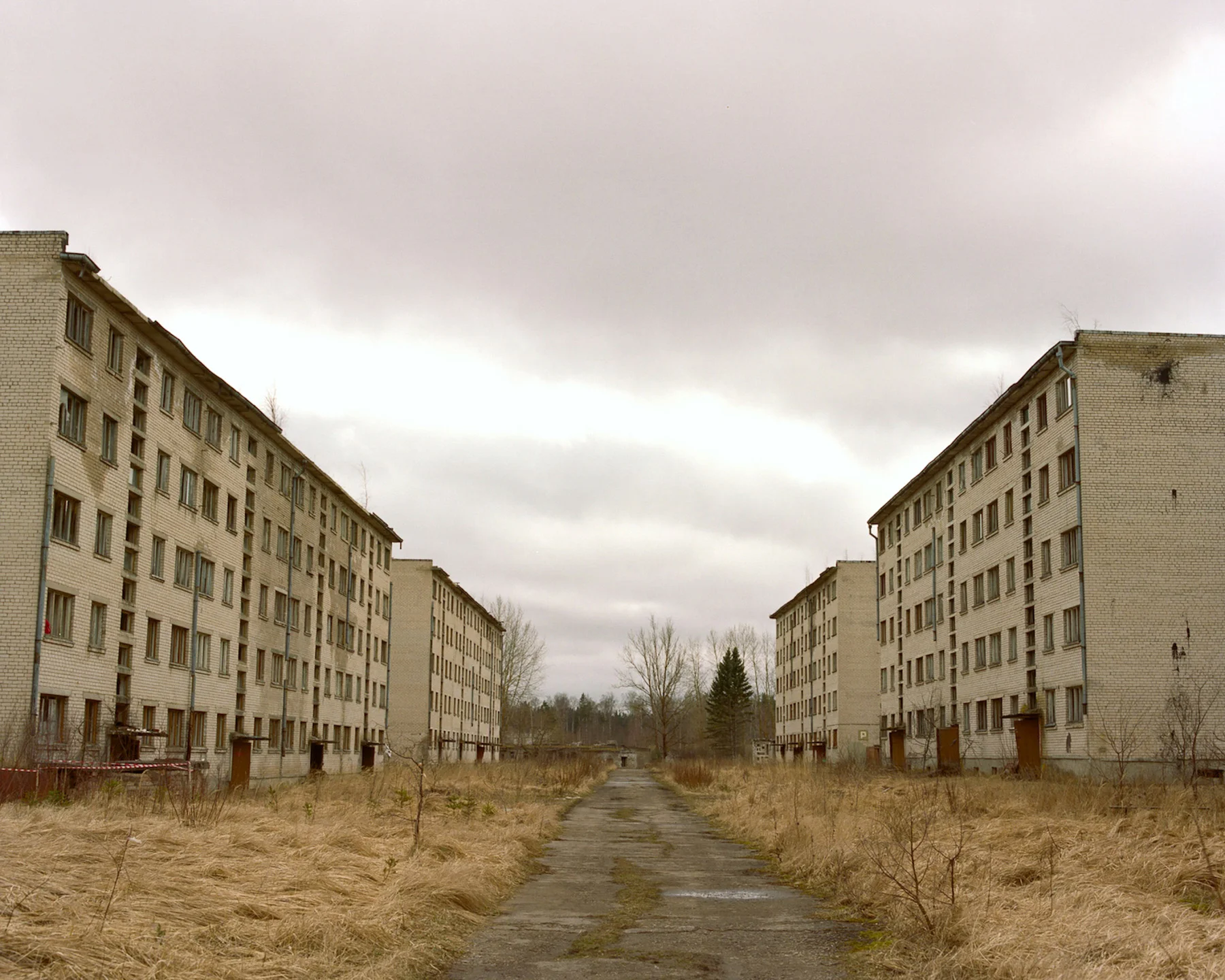
Hidden behind a dense curtain of pine trees, the Duga was the center of a "closed city" known as Chernobyl-2. On civilian maps, the site was marked as an innocent summer camp for children. In reality, it was an elite military garrison housing the scientists, engineers, and soldiers tasked with operating the radar 24 hours a day.
Life Behind the Iron Fence
Chernobyl-2 was a microcosm of Soviet privilege. While the residents of Pripyat lived in a modern industrial city, the inhabitants of the radar town lived in a high-security military bubble. The town featured its own school, a cinema, an indoor sports hall, and a shop that was stocked with luxury goods—oranges, chocolate, and fine meats—that were rarely seen in the rest of the USSR.
The proximity to Reactor 4 was the town's primary reason for being. A radar site of this magnitude required an unimaginable amount of electricity. Tapping into the Chernobyl grid provided the Duga with the steady megawattage needed to pulse its signal across the Atlantic. This created a symbiotic relationship of disaster: the power plant provided the energy for the radar, and the radar provided the "shield" for the state that built the plant.
The Panic of April 1986
When the reactor exploded, the soldiers at Chernobyl-2 were among the first to witness the blue glow of the ionizing air. Because of their high-level radiation detection equipment, they knew the scale of the catastrophe within minutes. However, because they were part of a secret military unit, they were forbidden from communicating with the civilians in Pripyat.
The evacuation of Chernobyl-2 was conducted with cold, military efficiency. While the public was left in the dark for 36 hours, the families of the radar technicians were quietly removed, and the station was placed on a skeleton crew. The air filters of the sophisticated computer rooms were quickly clogged with radioactive dust, and the high-voltage equipment began to malfunction as the isotopes settled on the metal. The giant was slowly poisoned by the very energy source it depended on.
The Steel Lattice: Engineering on a Titan Scale
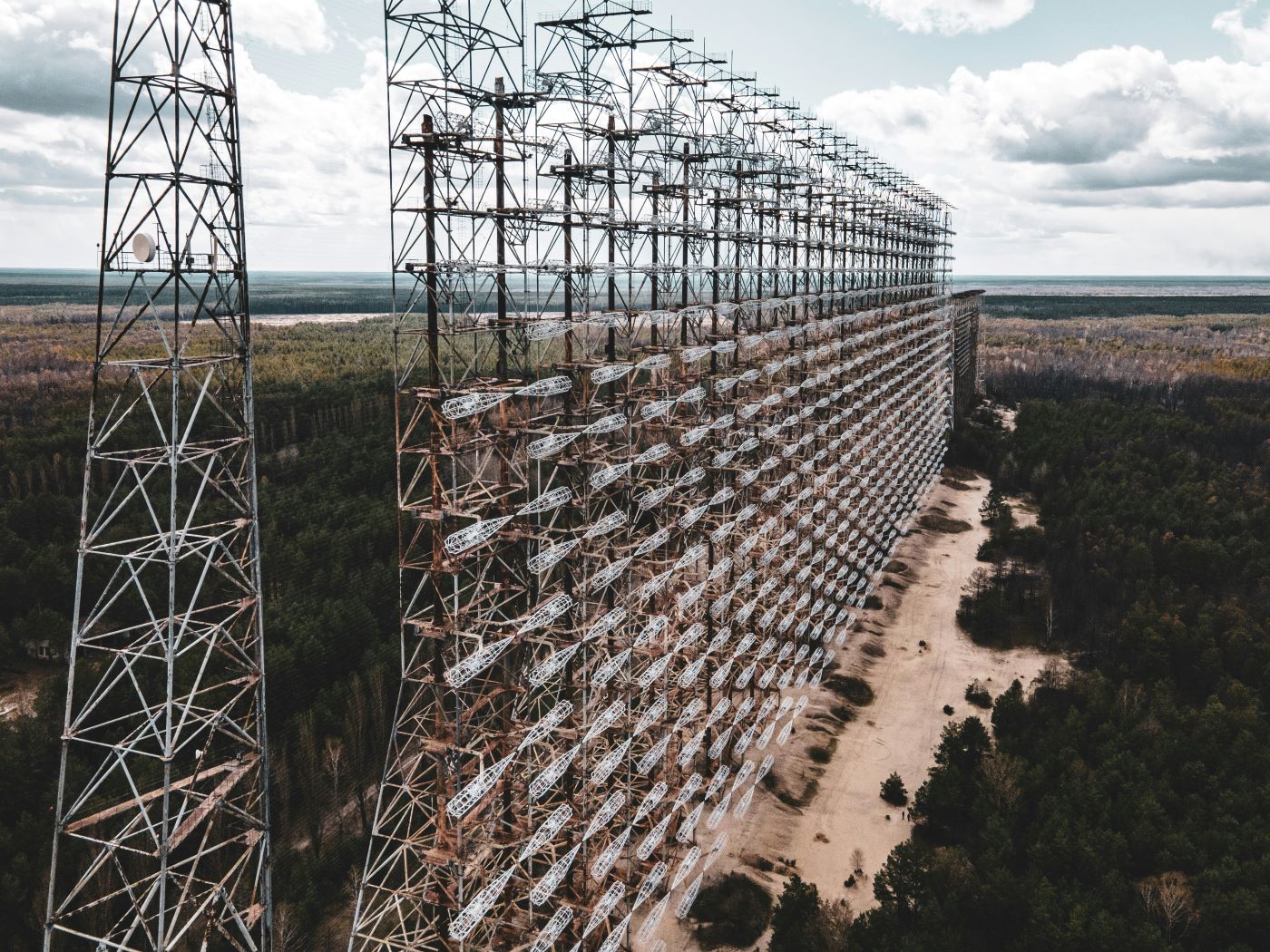
Standing at the base of the Duga today is a lesson in the architecture of paranoia. The structure is so large that it is impossible to capture in a single photograph from the ground. It is composed of two massive arrays—the "Main" and the "Auxiliary"—designed to handle different frequency ranges.
14,000 Tons of Geometry
The larger of the two antennas stands 150 meters high and 450 meters long. It is a dense forest of steel pipes and cylindrical dipoles. The design is based on a "phased array," allowing the operators to electronically "steer" the radar beam without moving the antenna itself. It is a 14,000-ton net designed to catch a missile.
The sheer volume of steel creates its own physical sensations. In high winds, the antenna does not just sway; it vibrates with a low-frequency hum that resonates in the human chest cavity. The thousands of steel cables act like the strings of a giant, discordant instrument. It is a physical manifestation of the Cold War: cold, heavy, and imposing, built with a disregard for human scale or aesthetic beauty.
The Decay of the Control Center
Below the antenna lies the "heart" of the Woodpecker—the command and control center. This two-story bunker was once filled with the most advanced Soviet computers, row after row of magnetic tape drives and cathode-ray tube monitors. Today, it is a ruin. The floors are ankle-deep in discarded gas masks, manuals, and punch-cards.
The abandonment was so hurried that many of the consoles still have the operators' personal touches—decals, small photos, or handwritten notes on the margins of the logbooks. It is here that the failure of the Duga becomes personal. You can see the chairs where young men sat, staring at screens, waiting for a signal from the American Midwest that would indicate the end of the world. The silence in these rooms is a heavy contrast to the 10 Hz tapping that once emanated from them.
Visiting the Giant of the Exclusion Zone
Visiting the Duga is the most physically overwhelming experience in the Exclusion Zone. It lacks the tragic domesticity of Pripyat, replacing it with the sheer, crushing weight of military industrialism.
The Ethics of the Ascent
For many, the ultimate goal is to climb the Duga. The rusted ladders and exposed walkways offer a terrifying climb to the 150-meter summit. From the top, the curve of the Earth becomes visible, and you can see the Reactor 4 sarcophagus sitting like a silver thimble in the distance. However, the climb is officially prohibited for a reason.
The structure has not been maintained since 1989. The welds are forty years old, and the steel has been exposed to four decades of radioactive rain and harsh Ukrainian winters. To climb the Duga is to trust your life to the fading integrity of a failed Soviet experiment. It is a risk that many "Stalkers" take to feel the pulse of the Zone, but for the Dark Atlas traveler, the view from the base is often enough to understand the scale of the hubris involved.
What to Expect: The Sound and the Scale
When you walk the 500-meter length of the antenna, you should pay attention to the acoustics. The site is often eerily quiet, save for the metallic groans of the structure. It is a place of "hollow silence"—a term used to describe sites where the human activity was once deafening but has been replaced by a total absence.
The Duga is a reminder that the Chernobyl disaster was not just a nuclear accident; it was a failure of an entire system of secrecy and competition. The antenna stands as a skeletal remains of the Cold War, a giant that was built to look for a war that never came, only to be blinded by a disaster in its own backyard. It is the only place in the Zone where you can look up and truly feel the weight of the twentieth century.
FAQ: Common Questions Regarding the Soviet Woodpecker
What was the purpose of the Duga Radar?
The Duga was an Over-the-Horizon (OTH) radar system designed for early warning against intercontinental ballistic missile (ICBM) launches. By bouncing radio waves off the ionosphere, it could detect the exhaust plumes of missiles launched from thousands of miles away, theoretically providing the Soviet Union with 25 to 30 minutes of warning time before impact. Unlike the Cheyenne Mountain Complex, which relied on a global network of satellite and land sensors, the Duga was a massive, ground-based attempt to achieve the same goal through high-power radio physics.
Why was it called the "Russian Woodpecker"?
The nickname came from the distinct 10 Hz tapping sound the radar produced on shortwave radio bands. Because of its massive 10-megawatt power output, the signal was strong enough to interfere with civilian radio, television, and even telephone communications worldwide. The repetitive "tapping" noise sounded exactly like a woodpecker to radio operators in the West, who spent years trying to identify the source of the interference.
Can you still climb the Duga Radar today?
Officially, climbing the antenna is strictly prohibited. The structure has not undergone any significant maintenance since the late 1980s, and the metal is heavily corroded from decades of exposure to the elements and radiation. However, the site is a major destination for illegal "Stalkers" who climb the 150-meter lattice for views of the Exclusion Zone. While the stairs and ladders are technically still standing, the structural integrity is unverified and extremely hazardous.
Is the Duga Radar still radioactive?
The antenna itself is made of steel and does not emit radiation. However, because it is located within the 10km inner rim of the Exclusion Zone, the ground around it and the interior of the military buildings contain radioactive dust from the 1986 disaster. The isotopes have settled into the moss, the soil, and the rusted electronics. While a short visit is considered safe under the guidance of a licensed tour operator, the site remains a contaminated area where safety protocols must be followed.
Why didn't the Soviets just use satellites like NORAD?
The Soviet Union did eventually develop satellite early-warning systems, but their ground-based radar technology was a more established and cost-effective (in their view) method at the time. The R&D for reliable infrared satellite sensors was lagging behind the United States, leading the USSR to build massive physical structures like the Duga as a primary line of defense. It was a massive industrial solution to a high-tech problem.
Sources and Citations
- The Duga-1 Radar Station: Technical Specifications - GlobalSecurity.org (2024)
- The Woodpecker: Radio Interference and the Cold War - Signal Identification Wiki (2025)
- Chernobyl-2: The Secret Military City - Chernobyl Adventure (2025)
- NORAD and Cheyenne Mountain: A Comparison of Early Warning Systems - NORAD Official Site (2023)
- Over-the-Horizon Radar Physics and the Ionosphere - ScienceDirect Technical Archive (2022)
- The History of the Soviet Early Warning Program - Russian Strategic Nuclear Forces Project (2024)
- Pine Gap: Australia's Role in Global Surveillance - Nautilus Institute (2021)
- Radiation Levels at Chernobyl-2 Military Site - SSE Chernobyl NPP (2026)