Babi Yar is a ravine on the northwestern edge of Kyiv where, on September 29–30, 1941, Nazi SS units and local auxiliaries shot 33,771 Jewish men, women, and children — the largest single mass shooting of the Holocaust. Over the following two years, as many as 150,000 people were murdered at the same site: Roma, psychiatric patients, Soviet prisoners of war, Ukrainian nationalists. The Soviet government spent decades trying to erase what happened there — filling the ravine with industrial waste, refusing to name the Jewish dead, censoring anyone who spoke the truth. In March 2022, a Russian missile struck the site while Moscow claimed to be “denazifying” Ukraine.
The Walk to Babi Yar — September 29, 1941
On the morning of September 29, 1941, Dina Pronicheva — a 30-year-old actress at the Kyiv Puppet Theatre — walked toward the edge of the city with her elderly mother. Thousands of Jewish families streamed along the same road. An old man in a prayer shawl murmured beside her. A woman ahead carried two infants in her arms while a third child clung to her skirt. Small children cried. The elderly shuffled forward in silence, bags and suitcases piled onto carts behind them. Russian husbands accompanied their Jewish wives. Jewish fathers walked beside their Ukrainian children.
They had all read the same poster, nailed to walls across Kyiv two days earlier. It ordered every Jew in the city to report to the intersection of Melnikova and Dorohozhytska Streets at 7:00 a.m. on September 29, carrying documents, money, valuables, and warm clothing. Failure to appear was punishable by death. Most believed they were being resettled — the railway station was nearby, and deportation seemed logical. Nobody assumed a mass execution.
As Pronicheva neared the ravine, the sounds ahead changed. Machine-gun fire. Screaming. The unmistakable acoustics of industrial killing. Her mother turned to her and said: “Dinochka — you are Pronicheva, a Russian.” It was the last thing she would ever say to her daughter.
Babi Yar is a place where erasure compounds murder. The act of killing — 33,771 human beings shot in 36 hours — was followed by two years of continuous execution, then by a deliberate campaign to destroy the evidence, fill the ravine with concrete and industrial sludge, and pretend that those 33,771 people simply never existed. The bullets were the beginning. The silence that followed was the second killing.
The Fall of Kyiv and the Jews Who Couldn’t Escape
German Occupation and the Trapped Population
The German Wehrmacht captured Kyiv on September 19, 1941, three months into Operation Barbarossa. The city had been the third-largest in the Soviet Union, home to roughly 900,000 people, including a Jewish community of approximately 160,000 — around 20 percent of the prewar population. Jews had lived in Kyiv for centuries, enduring waves of discrimination and pogroms stretching back to the Russian Empire.
By the time German forces entered the city, about 100,000 Jews had already fled eastward or joined the Soviet military. The 60,000 who remained were overwhelmingly those least able to move: women with young children, the elderly, the sick, people who lacked transportation or simply could not believe that what was coming could actually happen. Entire four-generation families — grandparents, parents, children, infants — stayed because leaving felt impossible or because the threat still seemed abstract.
The Explosions That Triggered the Order
Five days after the Germans took Kyiv, demolition charges planted by retreating Soviet sappers detonated across the city center. On September 24, a massive explosion ripped through the German military headquarters at the Continental Hotel on Khreshchatyk Street. Fires burned for days. Over 200 German soldiers and officials died. Buildings collapsed. The city center was gutted.
The Germans blamed the Jews.
The decision to annihilate every remaining Jew in Kyiv was made within 48 hours by three men: Generalmajor Kurt Eberhard, the German military governor of the city; SS-Obergruppenführer Friedrich Jeckeln, the senior SS and police commander for Army Group South; and Otto Rasch, commander of Einsatzgruppe C. The operational unit assigned to carry out the killing was Sonderkommando 4a, led by SS-Standartenführer Paul Blobel. On September 28, the posters went up. They gave the Jews of Kyiv less than twelve hours to comply.
33,771 in 36 Hours — The Mechanics of Mass Murder at Babi Yar
The Gauntlet at the Ravine’s Edge
The Jews who arrived at the assembly point on the morning of September 29 found themselves funneled through a series of increasingly terrifying checkpoints. First, their documents were seized and burned — the clearest possible signal that no one was expected to survive. Then they were driven through a gauntlet of German soldiers armed with rubber clubs and sticks, beaten as they stumbled forward. Their valuables were confiscated. Their clothing was taken. Mothers were separated from their children. Infants were ripped from arms.
The ravine itself was a natural sand quarry — steep walls dropping away into a narrow gorge. The victims were pushed in groups along a ledge that ran along the upper rim of the ravine. Below them, the previous groups lay in a rising mass of bodies. On the opposite rim, machine guns pointed down. Sonderkommando 4a and the 45th Battalion of the German Order Police did the shooting. The 303rd Battalion guarded the outer perimeter. Ukrainian auxiliary police managed the crowd.
The killing ran from early morning until five or six in the evening on September 29. The executioners stopped for the night — not out of mercy, but out of fatigue. Those who had not yet been killed were locked in garages overnight. The shooting resumed the following morning, September 30, and continued until the last group had been marched to the edge.
Bulldozers covered the bodies with thin layers of earth. Some of the wounded were still alive beneath the soil.
Dina Pronicheva’s Escape from the Killing Pit
Pronicheva survived because she lied. When her group was ordered to strip, she discarded her identity card and presented her trade union booklet to a Ukrainian policeman — a document that did not list her Jewish nationality. She told him she was Ukrainian. He pulled her aside and told her to wait.
From the edge, she watched. Group after group was forced through the gap in the sandbank, onto the ledge, and into the ravine. In her postwar testimony, Pronicheva described seeing people’s hair turn white in the minutes before they were shot. She heard the voices of children calling for their mothers. She saw infants thrown over the sand wall into the pit.
At twilight, as the light failed, Pronicheva’s group was pushed through the gap. She saw the sea of bodies below. The machine guns fired. She jumped before the bullets reached her, falling among the dead. She lay still, face down, eyes closed. Around her, the mass of bodies shifted and settled. People who were still alive groaned and moved beneath the weight of those who had fallen on top of them.
A German officer walked among the bodies, firing a pistol into anyone who showed signs of life. Pronicheva felt a boot step on her. She did not move. The officer moved on. Later, soldiers shoveled sand over the bodies. She breathed through the thin layer of earth and waited. When darkness fell, she clawed her way out.
Climbing from the pit, she encountered a boy — Motya, a child with wide eyes who looked at her as if she were his salvation. She took his hand. They hid together. She thought of adopting him, of somehow getting them both to safety. German soldiers found them. Motya was shot. Pronicheva ran.
She was one of no more than 29 known survivors.
The Massacre That Changed the Shape of the Holocaust
The number 33,771 comes from the Einsatzgruppen’s own operational report, filed to Berlin with bureaucratic precision. Historian Karel Berkhoff has described Babi Yar as the first time a major European city lost virtually its entire remaining Jewish population to premeditated murder. The massacre demonstrated that the systematic extermination of Jews could be carried out not only in remote forests or purpose-built camps, but in broad daylight, on the outskirts of a major metropolitan center, in less than two days.
Babi Yar was the apex of what historians now call the “Holocaust by bullets” — the wave of mass shootings carried out by the Einsatzgruppen across the occupied Soviet Union beginning in the summer of 1941. The scale of killing in a single location over 36 hours had few precedents in modern warfare — the Nanjing Massacre of 1937 was one of the rare prior events that approached it in concentrated savagery. The death camps at Treblinka, Auschwitz, and elsewhere industrialized the killing process with gas chambers and crematoria. Babi Yar predated that infrastructure. Here, the murder was carried out face-to-face, with rifles and machine guns, at a pace that even the perpetrators found difficult to sustain.
Rabbi Yisrael Meir Lau, speaking at the 65th anniversary commemoration in 2006, posed a question that has haunted Holocaust scholarship ever since: if the world had reacted to Babi Yar, would the death camps have followed? The massacre occurred ten weeks before the Wannsee Conference formalized the Final Solution. The world’s silence may have functioned as permission.
The Ravine That Never Stopped Killing — Babi Yar 1941–1943
Two Years of Continuous Execution
The September massacre was not the end. Babi Yar remained an active killing site for two years. Jews who had evaded the initial roundup and were later discovered were brought to the ravine and shot. Roma from five encampments around Kyiv were executed there. Patients from the Ivan Pavlov Psychiatric Hospital were gassed in mobile killing vans and their bodies dumped into the ravine — among the first victims, killed on September 27, two days before the Jewish massacre began.
On January 10, 1942, approximately 100 captured Soviet sailors were executed at Babi Yar after first being forced to exhume and cremate earlier victims. Soviet prisoners of war were shot in groups throughout 1942 and 1943. Ukrainian poet and nationalist activist Olena Teliha and her husband were murdered at the ravine on February 21, 1942. Writer Ivan Rohach, his sister, and his staff were killed there the same year.
By the time the Germans evacuated Kyiv in late 1943, the estimated total death toll at Babi Yar stood between 100,000 and 150,000 people.
The Syrets Concentration Camp in the Shadow of the Ravine
In May 1942, the Germans established a labor camp a few hundred meters from Babi Yar — the Syrets concentration camp, built on the grounds of a former military training facility. Intended as a satellite of Sachsenhausen, Syrets held approximately 3,000 prisoners at any given time, guarded by Ukrainian police and German SS under commandant Paul Otto Radomski. Conditions were savage. Prisoners were starved, beaten, and executed for minor infractions.
An estimated 25,000 people died at Syrets over its roughly 18 months of operation. Among them were three players from Dynamo Kyiv who had participated in the so-called Match of Death — a propaganda football game against a German Luftwaffe team. They were shot on February 18, 1943. The match has since become part of Ukrainian national mythology, though the full circumstances remain debated by historians.
Burning the Evidence — Aktion 1005 and the Prisoner Escape
The Chained Men Who Dug Up 100,000 Bodies
By the summer of 1943, the Red Army was advancing toward Kyiv. The Germans understood what Soviet investigators would find in the ravine. Paul Blobel — the same SS officer who had commanded the original massacre — was assigned to lead Sonderaktion 1005, a top-secret operation to exhume and destroy the evidence of mass killing across the occupied East.
Around August 18, 1943, approximately 327 prisoners from the Syrets camp — roughly 100 of them Jewish — were marched to the ravine and shackled. Each man had chains fastened to both legs, connected by a length of two to four meters that allowed them to work but not run. For six weeks, these prisoners dug into the earth with shovels and hooks, pulling decomposed bodies from mass graves that had been accumulating for two years.
The cremation pyres were constructed on a foundation of marble headstones stolen from a nearby Jewish cemetery. Bodies were stacked in layers, alternating with firewood soaked in gasoline and oil. Each pyre held between 2,000 and 3,000 corpses. After burning, specialized crews searched the ashes for gold teeth and rings. Remaining bones were crushed with pestles, sieved, and the powder scattered across surrounding farmland. For decades afterward, Kyivans refused to eat cabbage grown on those fields.
The prisoners worked 12 to 15 hours a day. Those who slowed down were shot on the spot.
The Escape on the Second Anniversary
The shackled men of Sonderaktion 1005 knew what would happen when their work was finished. The Germans had no intention of leaving witnesses. A group of prisoners began secretly collecting tools, scraps of metal, and keys found on the bodies of the dead. They picked the locks on their chains with keys pulled from the pockets of corpses.
On the night of September 29, 1943 — exactly two years after the massacre — the prisoners revolted. They overpowered their guards using hammers, screwdrivers, and bare hands. In the chaos, they broke through the perimeter into the surrounding woods. Martin Gilbert, quoting historian Reuben Ainsztein, described what drove them: in men who reeked of putrefying flesh, whose bodies were ravaged by scabies and encrusted with soot, there survived a determination that at least one of them must live to tell the world what happened in Babi Yar.
Of the 327 prisoners, the vast majority were hunted down and killed in the hours and days that followed, many shot in minefields surrounding the camp. Between 15 and 18 escaped. Several survived the war and gave testimony: Vladimir Davydov, Ziama Trubakov, David Budnik, Leonid Ostrovsky, among others. When Soviet forces retook Kyiv on November 6, 1943, Western correspondents Bill Downs of CBS and Bill Lawrence of the New York Times were taken to the site, where they interviewed three surviving prisoners.
The Soviet Erasure of Babi Yar — Concrete Over Bones
Filling a Mass Grave with Factory Waste
The Soviet government’s response to Babi Yar was not to memorialize it but to destroy it. The pattern was familiar — Moscow had spent years denying its own massacre of Polish officers at Katyn and would apply the same playbook of suppression to the Jewish dead of Kyiv. A 1945 decree ordered a monument, but the plan was shelved during Stalin’s late-1940s antisemitic campaign against “rootless cosmopolitans.” Through the 1950s, the ravine was partially filled with earth and bisected by two new highways. In 1950, the Kyiv city council authorized the Petriv Brickworks to pump liquid industrial waste — a slurry of clay, sand, and water — into the ravine’s remaining spurs through pipelines.
Nikita Khrushchev personally approved the project. The plan was straightforward: the solid matter would settle and harden, the water would drain to the Dnieper River, and the ravine would eventually be level ground suitable for a park or a sports stadium. The project that writer Viktor Nekrasov publicly protested in 1959 — the construction of a soccer stadium on top of a mass grave — was not metaphorical. It was an actual municipal proposal.
For a decade, more than four million cubic meters of industrial pulp were pumped into the spurs of Babi Yar, accumulating at heights of 40 to 60 meters above the neighboring Kurenivka district. The dam holding it in place was made of compacted earth rather than concrete. Engineers warned that it was inadequate. Their warnings were filed and ignored.
The Kurenivka Mudslide of 1961 — The Revenge of the Dead
On the evening of March 12, 1961, after days of heavy rain, the pumping station at the dam failed. At approximately 8:30 a.m. on March 13, the earthen dam collapsed.
Four million cubic meters of slurry — clay, sand, water, and human remains — broke through the embankment and cascaded down the steep hillside onto the Kurenivka neighborhood below. The wall of mud, several stories high, moved through the streets for nearly two hours. It swallowed houses whole. It uprooted trees. It buried the Krasin tram depot, killing 52 workers at their stations. A tram car full of passengers was engulfed. A bus caught fire after a collapsing electrical pole struck it, burning most of the people inside alive. A kindergarten was buried with children and their teacher still inside.
The official Soviet death toll was 145. Modern Ukrainian historians estimate the true number at closer to 1,500. The KGB cut Kyiv’s long-distance communications within hours of the disaster. Soviet troops sealed the perimeter. No official acknowledgment was permitted. Construction engineers were tried for criminal negligence in a closed court. The broader cause — the political decision to bury a mass grave under industrial waste — was never addressed.
Kyivans had their own word for what happened. They called it “the revenge of those shot.” Six months after the mudslide, human bones from the wartime massacres were still visible, protruding from the hardened mud.
In 1962, the ravine was leveled and converted into a public park. The dead beneath it received no marker.
Yevtushenko, Shostakovich, and the Fight to Break the Silence
The Soviet state’s position on Babi Yar was consistent for decades: the victims were “Soviet citizens,” not Jews. The specific ethnic identity of two-thirds of the dead was politically inconvenient. Acknowledging a genocide against Jews would have undermined the official narrative of the Great Patriotic War as a conflict between Soviet communism and German fascism — a framing that left no room for racial extermination as a motive.
In September 1961, the same year as the mudslide, the Russian poet Yevgeny Yevtushenko published “Babi Yar,” a poem that opened with the line “No monument stands over Babi Yar” and forced the Soviet reading public to confront what had been buried — literally and figuratively. The poem was an act of political courage. It named the Jewish dead. It connected their murder to centuries of antisemitism. It accused the Soviet state of complicity through silence.
The following year, composer Dmitri Shostakovich set the poem as the opening movement of his Symphony No. 13, premiered in Moscow in December 1962. Soviet authorities pressured performers to withdraw. The bass soloist received threats. Shostakovich refused to alter the work. The premiere went ahead, and the audience sat in stunned silence before erupting into applause that lasted through dozens of curtain calls.
In 1966, Ukrainian writer Anatoly Kuznetsov published Babi Yar: A Document in the Form of a Novel, incorporating Pronicheva’s testimony and his own childhood memories of the occupation. The Soviet edition was heavily censored. After Kuznetsov defected to Britain in 1969, the uncensored version was published in 1970, restoring passages the Soviet censors had cut — including details about Ukrainian collaboration and the full scale of Soviet suppression.
The first official monument at Babi Yar was not erected until 1976 — 35 years after the massacre. Its inscription memorialized “Soviet citizens and prisoners of war” shot by the Nazis. The word “Jew” did not appear.
The Babi Yar Holocaust Memorial — From Independence to Invasion
Independence and the Slow Work of Remembrance After 1991
Ukraine’s declaration of independence in August 1991 broke the Soviet stranglehold on Babi Yar’s memory. On September 29 of that year — the 50th anniversary of the massacre — a Menorah-shaped monument to the Jewish victims was erected at the site. It was the first official public acknowledgment in the history of the site that the people murdered there were overwhelmingly Jewish.
In the years that followed, a constellation of memorials appeared across the park: markers for the Roma victims, for murdered children, for the patients of the Pavlov psychiatric hospital, for members of the Organization of Ukrainian Nationalists executed at the ravine, for the victims of the Kurenivka mudslide. Each monument represented a constituency that had been silenced by the Soviet state. Together, they formed a fractured landscape of competing memories — a site that could not settle on a single narrative because the Soviet Union had spent 50 years ensuring that no narrative existed at all.
The Babyn Yar Holocaust Memorial Center, an international nonprofit chaired by former Soviet dissident and Jewish Agency head Natan Sharansky, was established to transform the site into a comprehensive museum and research complex. The project drew controversy — its artistic director, Ilya Khrzhanovsky, proposed a high-tech immersive museum that some critics found inappropriate for a site of mass murder — but it represented the most ambitious effort yet to give Babi Yar the institutional memorial it had been denied for 80 years.
In October 2021, a ceremony marked the 80th anniversary of the massacre. Ukrainian President Volodymyr Zelenskyy — himself the grandson of a Holocaust survivor — stood alongside Israeli President Isaac Herzog and German President Frank-Walter Steinmeier. They vowed to remember. They recommitted to the principle of “never again.”
Five months later, Russia invaded Ukraine.
March 1, 2022 — A Russian Missile Strikes the Site of the Holocaust
On March 1, 2022, exactly five days into Russia’s full-scale invasion, a Russian missile struck Kyiv’s main television tower. The tower stands directly adjacent to the Babi Yar memorial complex. Five people were killed. Buildings in the Jewish cemetery within the memorial grounds caught fire. Ukrainian firefighters worked beneath the damaged tower as smoke rose over the park where 33,771 people lay beneath the earth.
Zelenskyy responded with a message that condensed 80 years of moral failure into two sentences: “To the world: what is the point of saying ‘never again’ for 80 years, if the world stays silent when a bomb drops on the same site of Babyn Yar? At least 5 killed. History repeating.”
The strike occurred while Russian President Vladimir Putin was publicly justifying the invasion as an effort to “denazify” Ukraine — a country led by a Jewish president whose family had survived the Holocaust. Sharansky called the juxtaposition “utterly abhorrent” and described it as symbolic that Putin began his assault on Kyiv by bombing the site of the Nazis’ largest massacre.
The memorial itself largely survived. The Menorah monument was undamaged. The planned museum complex, still under construction, escaped significant structural harm. The damage was concentrated in the cemetery buildings — structures belonging to the dead.
The irony was not subtle. At a site where the Soviet state had spent decades erasing the memory of Jewish suffering, a missile from Moscow had struck again. The pattern — violence followed by denial, destruction presented as liberation — was older than anyone alive.
Visiting Babi Yar — The Atlas Entry
What Remains at the Ravine Today
Babi Yar today is a public park in Kyiv’s Syrets district, located at the junction of Kurenivka, Lukianivka, and Syrets between Kyrylivska, Melnykov, and Olena Teliha streets. The ravine that once defined the landscape has been largely filled and flattened. Trees grow where bodies were stacked. Paths wind through grass that covers the largest mass grave in Europe.
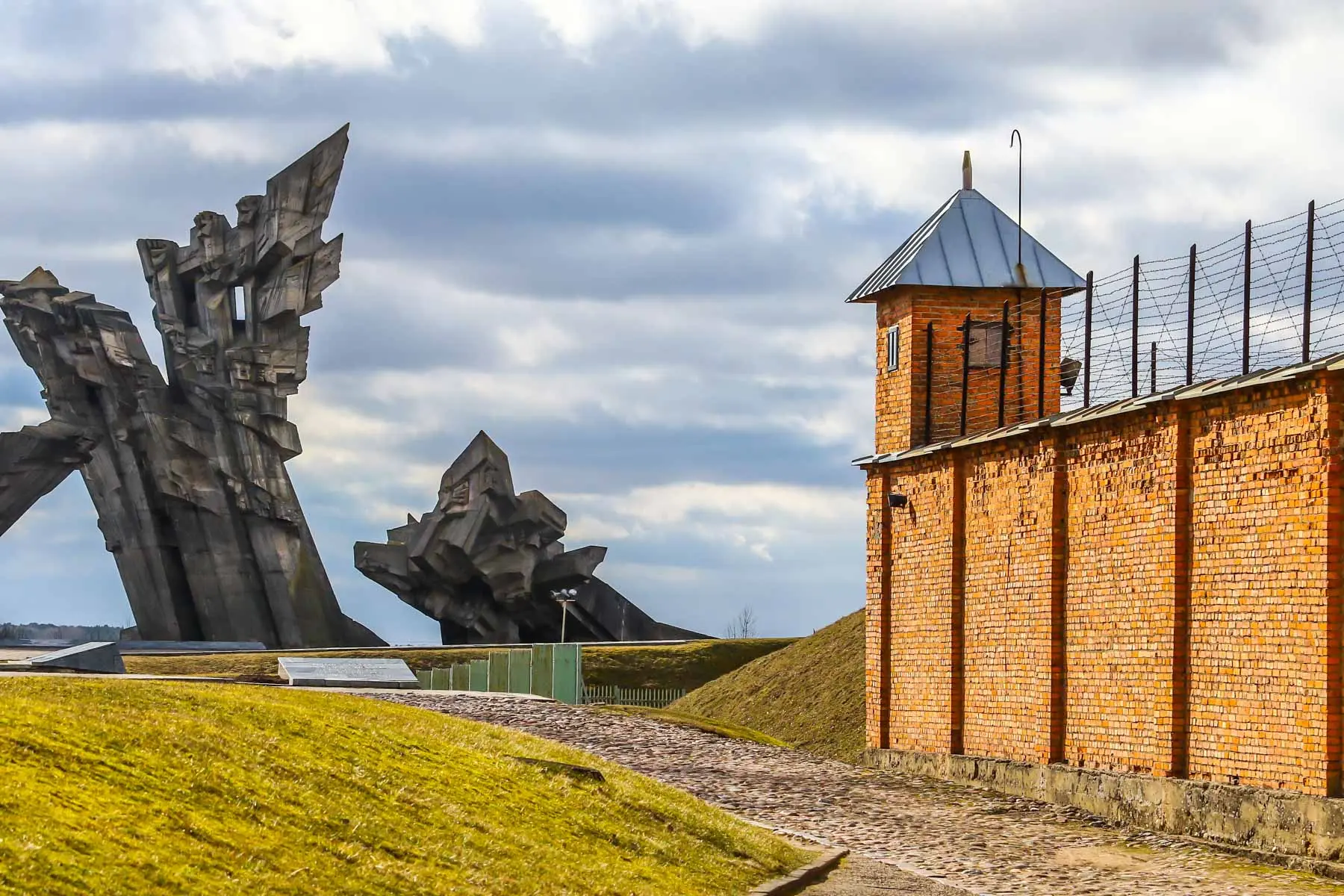
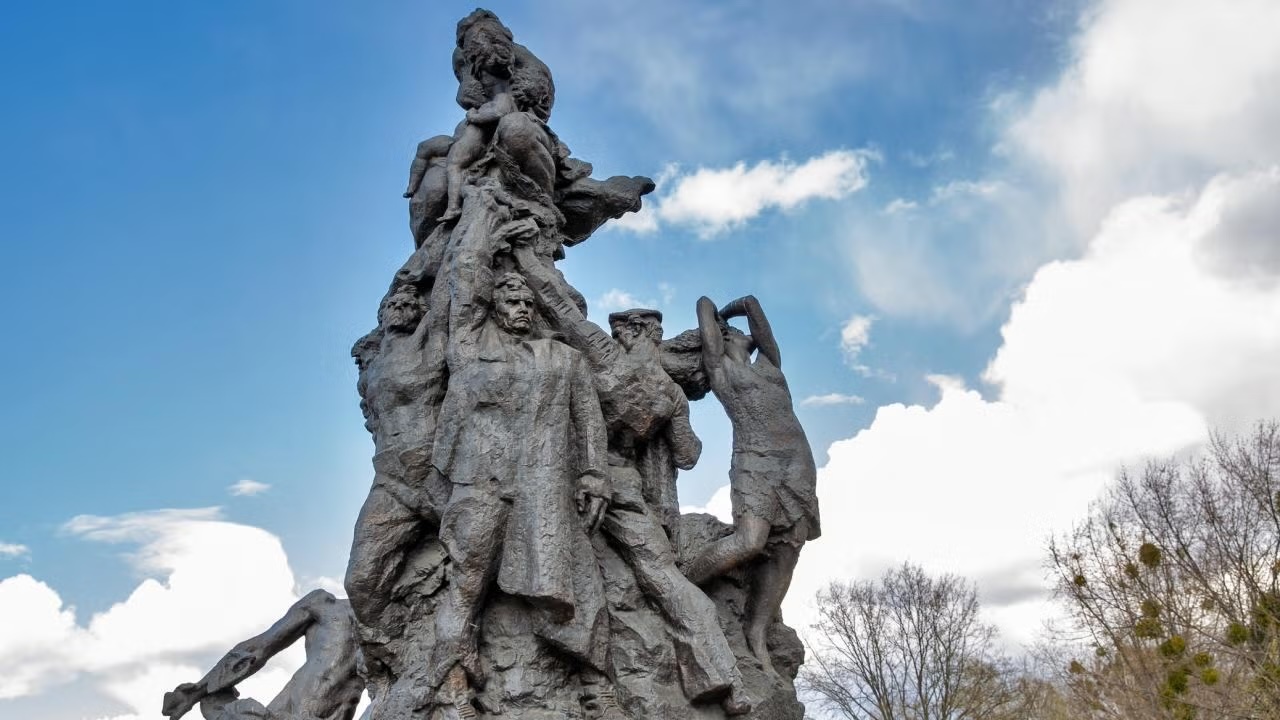
The site contains multiple memorials. The 1976 Soviet-era Monument to Soviet Citizens stands on the southern portion — a monumental bronze sculpture that still does not specify the Jewish identity of the majority of victims. The 1991 Menorah monument marks the approximate location of the September 1941 massacre. A monument to murdered children, depicting a cluster of broken toys, was erected nearby. Separate markers commemorate the Roma victims, the psychiatric hospital patients, Ukrainian nationalists, and the Kurenivka mudslide. The overall effect is not of a single, coherent memorial but of a landscape layered with grief — each monument addressing an absence that the previous one left unspoken.
The Babyn Yar Holocaust Memorial Center continues developing plans for a permanent museum complex on the site. Accessibility is straightforward: the park is reachable by public transit from central Kyiv, with the Dorohozhychi metro station located nearby. There are no entry fees and no formal visitor infrastructure — no museum building, no guided tours, no interpretive center. The site’s ongoing status as a public park means that on any given day, residents walk their dogs and children play on paths laid over the remains of 100,000 human beings.
Visitors traveling through Warsaw — another city where the Nazis attempted total destruction — or to Holocaust sites in Poland such as Auschwitz or Treblinka will find that Babi Yar offers something those sites cannot: the experience of standing at a place of industrial killing that has been deliberately disguised as ordinary urban space. At Oradour-sur-Glane, the ruins are preserved exactly as the SS left them. At Auschwitz, the architecture of death is preserved and labeled. At Babi Yar, there is grass and silence and the knowledge that the ground beneath the visitor’s feet is not what it appears to be.
Standing Where 33,771 People Fell
The deepest shock of Babi Yar is how normal it looks. Suburban apartment blocks rise on every side. Traffic moves along the streets where thousands once walked to their deaths. The park is pleasant, green, and quiet. Nothing in the landscape announces what happened. That normalcy is not accidental — it is the final product of an 80-year campaign to make the site look like nothing at all.
The massacre at Babi Yar was not an aberration of war. It was a test — a proof of concept that a city’s entire Jewish population could be annihilated in less than two days with rifles, manpower, and sufficient will. The world did not react. The death camps followed. And for decades after the killers were defeated, the state that liberated the site worked harder to erase its memory than to honor it.
Dina Pronicheva returned to Babi Yar every year until her death in 1977. She stood at the edge of the ravine that no longer existed — filled with clay, paved with concrete, planted with trees — and remembered. The ravine was gone. The dead were still there. They always will be.
Frequently Asked Questions About Babi Yar
How many people were killed at Babi Yar?
On September 29–30, 1941, Nazi SS units and their auxiliaries shot 33,771 Jewish men, women, and children at the Babi Yar ravine — the largest single mass shooting of the Holocaust. The killing did not stop there. Over the following two years, the Germans continued to execute Jews, Roma, Soviet prisoners of war, psychiatric patients, and Ukrainian civilians at the site. The total death toll at Babi Yar during the German occupation of Kyiv is estimated at between 100,000 and 150,000 people.
Who ordered the Babi Yar massacre?
The decision to murder all remaining Jews in Kyiv was made jointly by three German officials: Generalmajor Kurt Eberhard (military governor of Kyiv), SS-Obergruppenführer Friedrich Jeckeln (senior SS and police commander for Army Group South), and Otto Rasch (commander of Einsatzgruppe C). The operational unit that carried out the killings was Sonderkommando 4a, commanded by SS-Standartenführer Paul Blobel. Ukrainian auxiliary police also participated in managing the victims and guarding the perimeter.
Did anyone survive the Babi Yar massacre?
At least 29 people are known to have survived the September 1941 massacre. The most well-documented survivor is Dina Pronicheva, an actress at the Kyiv Puppet Theatre who escaped by claiming Ukrainian identity and later jumping into the pit among the dead. She crawled out after dark and eventually reached safety. Pronicheva became the only survivor to testify at the 1946 war crimes trial in Kyiv and provided testimony to multiple investigators over the following decades.
Why was there no memorial at Babi Yar for so long?
The Soviet government deliberately suppressed the memory of the massacre for decades. A 1945 decree ordering a monument was shelved during Stalin’s antisemitic campaigns of the late 1940s. Through the 1950s and 1960s, the ravine was filled with industrial waste and eventually leveled into a public park. The first official Soviet monument, erected in 1976, referred only to “Soviet citizens” without acknowledging the Jewish identity of the majority of victims. A Menorah monument specifically honoring the Jewish dead was not erected until 1991, following Ukraine’s independence.
What is the Kurenivka mudslide and how is it connected to Babi Yar?
On March 13, 1961, an earthen dam holding back millions of cubic meters of industrial waste that had been pumped into the Babi Yar ravine collapsed after heavy rain. The resulting mudslide — containing clay, water, and human remains from the wartime massacres — engulfed the Kurenivka neighborhood of Kyiv. The official Soviet death toll was 145, though modern Ukrainian historians estimate the true number at closer to 1,500. Soviet authorities suppressed all news of the disaster and cut Kyiv’s long-distance communications.
Can you visit Babi Yar today?
Babi Yar is now a public park in Kyiv’s Syrets district, accessible by public transportation from central Kyiv. The Dorohozhychi metro station is located nearby. The site contains multiple memorials including the 1976 Soviet monument, the 1991 Menorah monument to Jewish victims, and markers for Roma victims, murdered children, and other groups. There are no entry fees or formal visitor infrastructure. The Babyn Yar Holocaust Memorial Center is developing plans for a permanent museum complex, though the project has been disrupted by the ongoing conflict.
Sources
* Harvest of Despair: Life and Death in Ukraine Under Nazi Rule - Karel C. Berkhoff (2004)
* Dina Pronicheva’s Story of Surviving the Babi Yar Massacre - Karel C. Berkhoff, in The Shoah in Ukraine: History, Testimony, and Memorialization, edited by Ray Brandon and Wendy Lower (2008)
* Babi Yar: A Document in the Form of a Novel - Anatoly Kuznetsov (1966/1970)
* Mass Shootings at Babyn Yar (Babi Yar) - United States Holocaust Memorial Museum, Holocaust Encyclopedia (2024)
* The Syrets Labor Education Camp - United States Holocaust Memorial Museum, Holocaust Encyclopedia (2024)
* Drunk on Genocide: Alcohol and Mass Murder in Nazi Germany - Edward B. Westermann (2021)
* In the Midst of Civilized Europe: The Pogroms of 1918–1921 and the Onset of the Holocaust - Jeffrey Veidlinger (2021)
* Babyn Yar’s ‘Revenge’: The Deadly Mudslide the KGB Tried to Cover Up - Radio Free Europe/Radio Liberty (2021)
* Jews from Kiev and the Surrounding Areas Murdered at Babi Yar - Yad Vashem (2024)
* Babi Yar: Reliability of Witnesses - Holocaust Denial on Trial, Emory University (2019)
* Babi Yar, 1941: An Exceptional Account of the Massacre of Jews in Kyiv - CNRS News, interview with Christian Ingrao (2022)