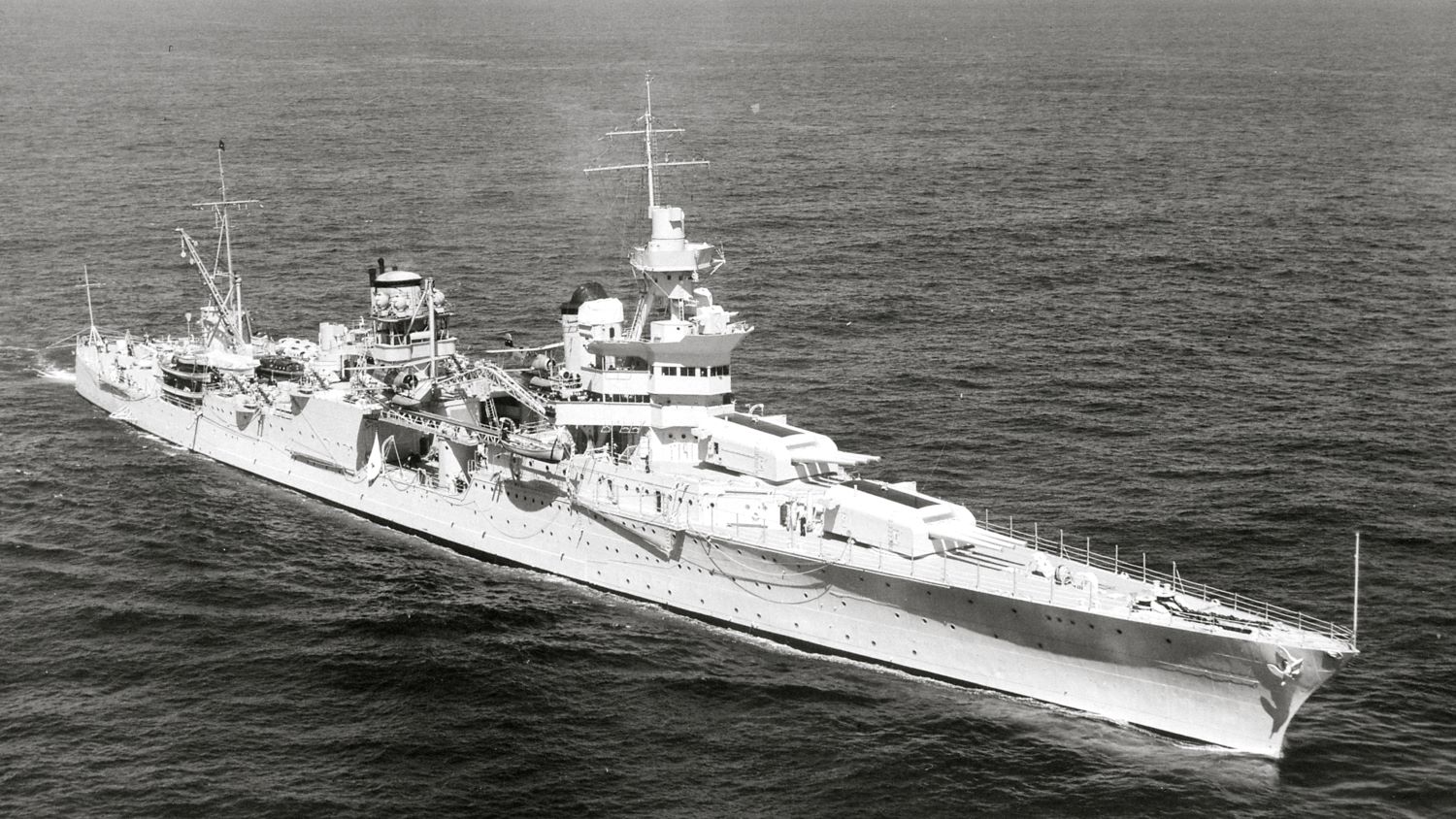
Twelve Minutes After Midnight in the Philippine Sea
Ensign Harlan Twible had been aboard the USS Indianapolis for barely a month. A fresh graduate of the Naval Academy, he had wanted a newer ship — something sleek, something with a future. The Indianapolis, a fifteen-year-old heavy cruiser her crew called “the Indy,” was not his idea of a career-making assignment. Fate corrected him on that point at 00:15 on July 30, 1945.
Two torpedoes from the Japanese submarine I-58 struck the starboard side within seconds of each other. The first blew the bow off the ship. The second hit near the powder magazine amidships, splitting the hull nearly to the keel and killing the electrical grid instantly. The Indianapolis was dark, listing hard, and taking on water faster than any damage-control party could answer. Twible looked around for a senior officer to take charge of the pandemonium. He found none. He was twenty-four years old. He started giving orders.
Twelve minutes. That is all the Indianapolis gave her crew — from torpedo impact to the moment her stern rose into the air and she slid beneath the surface of the Philippine Sea. Roughly 300 of the 1,195 men aboard went down with her. The remaining 890, many of them burned, bleeding, concussed, or blinded by fuel oil, went into the black Pacific water with kapok life jackets and almost nothing else. No functioning radio beacon. No confirmed distress signal received by the Navy. No escort ship watching from the horizon.
The Indianapolis had just completed the most important delivery of World War II. She had carried the core of the atomic bomb that would destroy Hiroshima. And now nearly 900 of her men were floating in the open ocean, and nobody in the United States Navy knew they were gone.
The disaster that followed — four and a half days of shark attacks, saltwater psychosis, and institutional silence — would become the worst loss of life from a single ship in U.S. Navy history. The Navy’s answer would not be a reckoning with its own cascading failures. It would be the court-martial of a captain who had done everything right, and whose guilt was manufactured to shield the institution that abandoned his crew. The story of the Indianapolis is the definitive study in what happens when bureaucracies choose a scapegoat over the truth.
The Secret Cargo That Changed the Course of the War
From Hunters Point to Tinian: The Fastest Crossing in Navy History
On July 15, 1945, a convoy of Army trucks pulled up alongside the USS Indianapolis at Hunters Point Naval Shipyard in San Francisco. Dockworkers loaded a large wooden crate into the cruiser’s port hangar. A lead-lined steel canister was welded to the deck of the cabin normally reserved for Admiral Raymond Spruance, commander of the Fifth Fleet, whose flagship the Indianapolis had been for two years across the Central Pacific.
Two Army officers boarded with the cargo. They introduced themselves as artillery specialists. They were not. Major Robert Furman was an engineer, and Dr. James Nolan was a radiologist — both men from the Manhattan Project. The canister bolted to the cabin floor contained 38.5 kilograms of enriched uranium-235, the fissile heart of the weapon that would be designated Little Boy. Nolan spent much of the voyage feigning seasickness to disguise the fact that he was monitoring the uranium’s radioactivity.
Captain Charles Butler McVay III received his sailing orders from Rear Admiral William Purnell with a briefing remarkable for its bluntness: if the ship sinks, the canister is to be saved before any member of the crew. The Indianapolis departed the following morning, July 16 — the same day the Trinity test detonated the world’s first nuclear device in the New Mexico desert. Furman and Nolan had waited for confirmation of Trinity’s success before allowing the ship to leave port.
The Indianapolis set a speed record on the leg from San Francisco to Pearl Harbor — approximately seventy-four and a half hours at an average of twenty-nine knots. She continued unescorted to Tinian, arriving on July 26. The crew watched from the rails as an unusual concentration of admirals and high-ranking officers clustered on the pier to supervise the offloading of the mysterious crate and canister. None of the sailors understood what they had carried. They would not find out until the bomb fell on Hiroshima eleven days later. One of the ground crew who loaded Little Boy onto the B-29 Enola Gay scratched a piece of graffiti onto the weapon’s casing: “Greetings to the Emperor from the men of the Indianapolis.”
A Decorated Warship Sent Into Submarine Waters Without Escort
The Indianapolis was no ordinary cruiser. Commissioned in 1932, she had served as President Roosevelt’s transport on diplomatic voyages, as the flagship of Scouting Force 1, and — from 1943 onward — as Spruance’s command platform through the bloodiest campaigns in the Pacific. She had earned ten battle stars. She had provided fire support at Iwo Jima, and at Okinawa a kamikaze pilot had driven a bomb clean through her decks, killing nine men and sending her back to California for months of repair.
After delivering the bomb components at Tinian, Indianapolis sailed to Guam, where McVay received new orders: proceed to Leyte Gulf in the Philippines to join a task force preparing for the invasion of Japan. The route was straightforward, the sea calm, the war nearly over. McVay requested a destroyer escort. The request was denied. He asked for intelligence on submarine activity along the route. The Navy’s routing officer, Lieutenant Joseph Waldron, did not inform McVay that a Japanese submarine had recently sunk the destroyer escort USS Underhill along the same corridor. Intelligence on the I-58’s presence in the area existed. It was not passed to McVay.
The Indianapolis sailed alone from Guam on July 28, traveling at seventeen knots — standard cruising speed — on a straight heading through the Philippine Sea. McVay’s orders authorized him to zigzag at his discretion based on weather and visibility. On the night of July 29, visibility was poor: intermittent cloud cover, no moon, moderate swells. McVay ceased zigzagging. It was the last routine decision he would ever make.
Four Days and Five Nights in the Water
The First Dawn: 890 Men and No Rescue Coming
The two torpedoes that struck the Indianapolis at 00:15 on July 30 transformed a functioning warship into a sinking wreck in under a minute. The first explosion severed the bow. The second ignited fuel and ammunition stores amidships. Men who had been sleeping in their bunks were thrown into bulkheads, scalded by ruptured steam lines, or trapped behind jammed hatches in compartments already flooding. The ship lost all electrical power immediately. In total darkness, with the deck tilting beneath their feet, men scrambled topside by feel and memory.
Some crewmen managed to launch a handful of life rafts. Most did not. The majority of the 890 men who made it off the ship went into the water wearing only their kapok life jackets — jackets designed to keep a man afloat for roughly forty-eight hours before becoming waterlogged. They would be in the water for more than four days.
As the first tropical dawn broke on July 30, the survivors took stock. They had scattered into several groups across miles of open ocean, separated by current and darkness. Some groups had rafts and water breakers. Most had nothing. Twible conducted a headcount and discovered he was the only officer among 325 men. He was also discovering the arithmetic of survival at sea: the injured were dying first, and the kapok jackets kept the dead floating among the living.
Father Thomas Conway, the ship’s Catholic chaplain, moved from man to man in the water, administering last rites to the dying and keeping morale alive among the conscious. He continued this work for days, treading water alongside his sailors, until exhaustion pulled him under. He did not survive.
Oceanic Whitetips and the Worst Shark Attack in Recorded History
The sharks arrived with the sunrise. Oceanic whitetip sharks — open-water predators that grow to ten feet and hunt by sensing vibration through pressure receptors along their bodies — were drawn to the oil slick, the debris field, and the irregular movements of hundreds of wounded men. At first, the sharks fed on the floating dead. Then they began taking the living.
Survivor Loel Dean Cox described the attacks decades later: a shark would come from below, strike like a bolt, and drag a man straight down. The screaming was the worst part — the sound of a man being taken right beside you, close enough to touch, and then silence. The larger groups learned that thrashing and kicking could drive the sharks away temporarily, but the animals circled back. Smaller groups and isolated swimmers were the most vulnerable.
Estimates of how many men died from shark attack range from a few dozen to 150 — the precise number is unknowable because the cause of death for hundreds of men in the water was never determined. The sharks loom over the Indianapolis story in public memory, amplified by the famous monologue in the 1975 film Jaws, but the reality is grimmer and more mundane. The sharks were one killer among many. Dehydration, saltwater poisoning, exposure, and drowning killed far more men than any predator.
Saltwater Madness and the Breaking Point
By the second day, the men who had swallowed seawater — deliberately or accidentally — began to deteriorate. Sodium poisoning triggers a cascade of neurological symptoms: confusion, hallucination, paranoia, violent delirium. Men began seeing things that were not there. Some hallucinated islands on the horizon, freshwater springs just below the surface, rescue ships that vanished when they swam toward them. Others became convinced that the Indianapolis was still intact just below them, her galley serving fresh water and hot food to anyone who could dive deep enough to reach her.
Some men drank more seawater to quench the thirst that the seawater itself was intensifying — a feedback loop that led to seizure, coma, and death. Others attacked their shipmates in paranoid rages, convinced they were hoarding water or conspiring to steal life jackets. Drownings multiplied as men slipped out of waterlogged kapok jackets they no longer had the strength to hold onto.
Twible made a decision that required a particular kind of cold-blooded compassion: he ordered the dead cut free from the debris and rafts they had tied themselves to and pushed away from the group. The living could not spend their diminishing strength staring at the bodies of men who had been talking to them hours earlier. The dead drifted outward, feeding the circle of sharks that never left.
By the fourth day, many of the surviving men had stopped believing rescue would come. Twible later admitted he shared their despair but could not say so. His job, as he understood it, was not to survive. It was to keep the men around him surviving.
Rescue by Accident: The Navy’s Cascading Bureaucratic Failure
The Ship Nobody Reported Missing
The most damning element of the Indianapolis disaster is not the torpedo. It is the silence that followed. The Navy had the information, the infrastructure, and the obligation to realize the Indianapolis was gone — and failed at every level.
Three radio stations reportedly received fragments of a distress signal from the Indianapolis in the minutes after the torpedoes struck. At one station, the officer on duty was drunk. At another, the duty officer had left orders not to be disturbed. At the third, the signal was dismissed as a Japanese ruse — a common enough occurrence in the Pacific, but one that did not justify ignoring a distress call without investigation.
More critically, the Indianapolis was expected at Leyte Gulf on July 31. She did not arrive. Under normal naval protocol, a non-arrival of a combatant vessel should trigger an immediate inquiry. But a standing directive — born of wartime paranoia about radio traffic — stated that the non-arrival of combatant ships need not be reported. The port director at Leyte assumed the Indianapolis had been diverted. Nobody checked.
For four days, nearly 900 American sailors were dying in the open ocean while the Navy that was responsible for them simply failed to notice. The failure was not sabotage. It was not conspiracy. It was the accumulated weight of bureaucratic indifference, poorly written standing orders, and the diffusion of responsibility across a system that assumed someone else was watching.
Lieutenant Wilbur Gwinn and the Accidental Rescue
On the morning of August 2 — four and a half days after the sinking — Lieutenant Wilbur Gwinn, piloting a PV-1 Ventura patrol bomber on a routine antisubmarine sweep, noticed his plane’s antenna was malfunctioning. He dropped altitude to investigate, and through a break in the clouds saw a long oil slick on the water below. He descended further. The oil slick was dotted with dark shapes. Some of them were moving.
Gwinn radioed a report: “Many men in the water.” The message reached Lieutenant Adrian Marks, piloting a PBY Catalina flying boat. Marks flew to the coordinates and saw a scene that stopped him: men scattered across miles of ocean, many motionless, some waving weakly, and sharks circling among them. Marks made a decision that violated standing orders — he landed his seaplane in the open ocean, in twelve-foot swells, to begin pulling men from the water. He hauled survivors onto the wings and fuselage until the plane was too overloaded to take off again. He sat on the water through the night, a beacon for the rescue ships that followed.
The destroyer USS Cecil Doyle arrived after dark, its captain, Commander W. Graham Claytor Jr., making his own unauthorized decision: he turned on his searchlights — a violation of blackout protocol in a combat zone — to signal the survivors that help had arrived. Claytor later said the risk of attracting Japanese submarines was secondary to the certainty that men were dying every hour he delayed.
By the time the rescue operation ended on August 3, 316 men had been pulled from the water alive. Two of them — Robert Lee Shipman and Frederick Harrison — died in hospital within weeks. Of the 1,195 men who had sailed from Guam, 879 were dead. The U.S. government delayed reporting the disaster to the public until August 15, 1945 — the same day Japan announced its surrender. The end of the war buried the Indianapolis story beneath the jubilation of victory.
The Court-Martial of Captain Charles McVay III
The Only Captain in U.S. Navy History Court-Martialed for Losing a Ship to Enemy Action
The Navy’s investigation into the sinking began almost immediately — not as an inquiry into the systemic failures that had left 890 men unreported and unrescued for four days, but as a prosecution of the man who had been in command when the torpedoes struck. A Navy Court of Inquiry recommended court-martial for Captain McVay. Admiral Chester Nimitz, the Pacific Fleet commander, disagreed and recommended only a letter of reprimand. Admiral Ernest King, Chief of Naval Operations, overruled Nimitz and ordered the court-martial to proceed.
McVay was charged on two counts: failure to order abandon ship in a timely manner, and hazarding his vessel by failing to zigzag. He was acquitted on the first charge. On the second, the prosecution made a decision that backfired spectacularly — they flew Commander Mochitsura Hashimoto, captain of the Japanese submarine I-58, from Japan to Washington to testify. The Navy’s intent was to establish that the Indianapolis had been an easy target because she was not zigzagging. Hashimoto, under oath, said the opposite: zigzagging would have made no difference. He had a clear firing solution regardless of the ship’s course. The man who sank the Indianapolis effectively told the court that McVay was not responsible for the sinking.
The court convicted McVay anyway. His sentence — a loss of seniority numbers in rank — was later remitted by Secretary of the Navy James Forrestal at Nimitz’s urging, and McVay was restored to active duty. He retired in 1949 as a rear admiral. But the conviction stayed on his record, and the public narrative of blame never released its grip.
The Christmas Cards and the Weight That Broke a Man
The families of the dead needed someone to hold accountable. The Navy had handed them McVay. For years after the war, he received letters from parents and widows of the men who had not survived. Some were grief. Some were venom. One Christmas card read: “Merry Christmas! Our family’s holiday would be a lot merrier if you hadn’t killed my son.”
McVay’s surviving crew — the men who had floated beside him in the water for four days — overwhelmingly defended their captain. They knew he had done everything within his power during the sinking, that he had been among the last to leave the ship, and that the failures that had killed their shipmates were institutional, not personal. Their voices were not enough to counter the official record.
On November 6, 1968, Charles Butler McVay III took his own life at his home in Litchfield, Connecticut. He was seventy years old. He had carried the weight of 879 men for twenty-three years, in a silence that the Navy had engineered and the public had enforced.
A Twelve-Year-Old, 150 Interviews, and a Congressional Exoneration
The Indianapolis might have remained a story of uncorrected injustice if not for an eleven-year-old boy in Pensacola, Florida, named Hunter Scott. In 1996, after watching the USS Indianapolis monologue in Jaws, Scott chose the sinking as his National History Day project. What began as a school assignment became an obsessive investigation: Scott interviewed nearly 150 Indianapolis survivors, reviewed more than 800 documents, and assembled a case that McVay had been wrongly convicted.
Scott testified before the United States Congress in 1998. He was twelve years old. His evidence was detailed, his presentation serious, and his conclusion unambiguous: the court-martial had been a miscarriage of justice driven by the Navy’s need to deflect blame from its own systemic failures. His testimony, combined with decades of lobbying by the survivors’ organization and the work of Captain William Toti, the final commanding officer of the submarine USS Indianapolis (SSN-697), produced results.
On October 30, 2000, Congress passed a resolution exonerating McVay for the loss of the Indianapolis. President Bill Clinton signed it. Hashimoto, the Japanese commander who had tried to exonerate McVay at trial fifty-five years earlier, died five days before the resolution passed. He never learned that the American government had finally agreed with his testimony. Hunter Scott went on to attend the University of North Carolina on a Navy ROTC scholarship and became a naval aviator — a career born from a sixth-grade history project and a debt to 879 men.
The Wreck Found: 18,000 Feet Below the Philippine Sea
Seventy-Two Years on the Floor of the Pacific
The Indianapolis lay somewhere on the floor of the Philippine Sea for more than seven decades, her exact position unknown. Two major search expeditions — in 2001 and 2005 — failed to locate the wreck, stymied by the immense depth and uncertainty about where exactly the ship had gone down. The Navy’s 1945 sinking coordinates, derived from survivor testimony rather than instrument data, were best estimates at most.
The breakthrough came in 2016, when Dr. Richard Hulver, a historian at the Naval History and Heritage Command, discovered a long-overlooked entry in the logbook of the tank landing ship LST-779. The log recorded a visual sighting of the Indianapolis eleven hours before she was torpedoed — proof that the cruiser was further west and traveling faster than anyone had previously calculated. Hulver’s finding shifted the search area thirty-five nautical miles to the southeast and reduced the target zone from three thousand square miles to six hundred.
On August 19, 2017, the research vessel R/V Petrel — funded by Microsoft co-founder Paul Allen — located the wreck at a depth of 5,500 meters, approximately 18,000 feet below the surface. The remotely operated vehicle’s cameras revealed a ship in extraordinary condition: hull number “35” still clearly painted on the side, ammunition boxes still stenciled with “Indianapolis,” anchor markings still legible. The main hull rests in an enormous impact crater on the ocean floor. The bow, which had been blown off by the first torpedo, lies 1.5 miles to the east. The ship’s paint, her gun turrets, and even victory markings — silhouettes of Japanese aircraft and red rising suns — survived seventy-two years in the lightless cold.
The wreck of the Indianapolis is the deepest confirmed U.S. Navy shipwreck ever found. It is legally protected as a war grave. Its coordinates are classified. No human diver can reach it. It will never be raised. Three and a half miles below the surface, the ship that delivered the weapon that ended the war rests in permanent darkness, her crew of the missing entombed in steel and coral.
Congressional Gold Medal and the Last Survivor
In December 2018, the crew of the Indianapolis was collectively awarded the Congressional Gold Medal — the highest civilian honor bestowed by the United States Congress. The ceremony was virtual, timed to coincide with the crew’s annual reunion.
Those reunions had begun in 1960, when a small group of survivors gathered in Indianapolis for the first time since the war. The suggestion of a memorial emerged that year, simmered for decades, and finally materialized in 1995 when 107 survivors attended the dedication of a granite monument along the Canal Walk in downtown Indianapolis. By 2017, only nineteen survivors remained. By the time Allen’s team found the wreck, many of them could no longer travel.
The losses from Truk Lagoon to the Montevideo Maru to the Britannic chart the Pacific and Atlantic alike with wartime maritime catastrophe, but the Indianapolis stands apart — not for the sinking itself, which was an act of war, but for the four days of silence that followed. The dead of those other ships were mourned promptly. The dead of the Indianapolis were not even noticed.
As of 2026, one survivor of the Indianapolis is confirmed alive: Harold Bray, born in 1927, who became a police officer in Benicia, California, after the war and served for thirty years. He is the last living witness to what happened in the Philippine Sea — the last man who can say he was in the water, and no one came.
Visiting the USS Indianapolis Memorial
The Canal Walk Memorial in Indianapolis, Indiana
The USS Indianapolis (CA-35) Memorial sits on the east bank of the Central Canal in downtown Indianapolis, at the north end of the Canal Walk between Senate Avenue and Walnut Street. Dedicated on July 30, 1995 — the fiftieth anniversary of the sinking — the 21-ton memorial was designed by Indiana architect Joseph Fischer in the shape of a naval cruiser, constructed from black and gray granite quarried in California and set on an Indiana limestone base.
On one face, a detailed silhouette of the Indianapolis is etched into the granite alongside the narrative of the ship’s final mission and sinking. On the reverse, 1,197 names are engraved in one-inch letters — the full complement of the final crew. Stars mark the names of the 316 who survived. The bow of the memorial points west, toward the Pacific Ocean and the Philippine Sea where the ship lies.
The memorial is an outdoor site, open twenty-four hours, free to the public. The Indiana War Memorial Museum, a short walk south along the canal, holds the ship’s bell and additional artifacts. The canal itself, with its quiet water and pedestrian walkways, makes for a contemplative setting — an oddly appropriate frame for a story defined by water, silence, and the failure of institutions to hear what was happening on the surface.
A War Grave Beyond All Reach
The wreck of the Indianapolis will never become a dive site. At 5,500 meters, it is beyond any human capacity to visit — deeper than the Titanic, deeper than any recreational or technical dive profile, accessible only to remotely operated vehicles launched from purpose-built research ships. The U.S. Navy classifies the wreck as a protected military gravesite. Its coordinates are sealed. The remotely operated cameras that surveyed the site in 2017 revealed a ship still bearing the marks of her identity and her service, but they did not enter the hull. The dead inside are undisturbed.
Some memorials are places you can stand. Others exist only in the record — in the names etched on a granite cruiser beside a canal in Indiana, in the transcripts of a twelve-year-old boy testifying before Congress, in the testimony of a Japanese submarine commander who traveled halfway around the world to tell the truth about a man the Navy wanted to blame. The Indianapolis is both. Her memorial is granite and water and names. Her grave is darkness and pressure and silence, 18,000 feet below the surface of the sea, in a place no human hand will ever touch.
Frequently Asked Questions
How many sailors died in the USS Indianapolis disaster?
Of the 1,195 crew members aboard the Indianapolis when she was torpedoed on July 30, 1945, approximately 300 went down with the ship. The remaining 890 survivors entered the water and spent four and a half days without rescue. By the time they were found on August 2, only 316 were pulled from the sea alive. Two of those rescued died shortly afterward in hospital, bringing the total death toll to 879. The causes of death among the men in the water included drowning, dehydration, saltwater poisoning, exposure, hallucination-driven violence, and shark attacks.
How many men were killed by sharks after the USS Indianapolis sank?
The precise number of men killed by sharks is unknown and likely unknowable, since hundreds of bodies were never recovered and the cause of death for most men in the water was never determined. Estimates range from a few dozen to as many as 150. Oceanic whitetip sharks were the primary species involved, initially feeding on the floating dead before attacking living survivors. The Indianapolis sinking is widely recognized as the worst shark attack in recorded history, though historians emphasize that dehydration, saltwater poisoning, and exposure killed far more men than sharks did.
Why was Captain McVay court-martialed after the sinking?
Captain Charles Butler McVay III was court-martialed in December 1945 on two charges: failure to order abandon ship in a timely manner, and hazarding his vessel by failing to zigzag in submarine-infested waters. He was acquitted on the first charge and convicted on the second. The conviction was controversial from the outset. Admiral Chester Nimitz had recommended only a letter of reprimand, but Admiral Ernest King overruled him and ordered the court-martial. The Japanese submarine commander who sank the Indianapolis, Mochitsura Hashimoto, testified at trial that zigzagging would not have prevented the attack. McVay was the only captain in U.S. Navy history to be court-martialed for losing a ship to enemy action. He was posthumously exonerated by Congress in 2000.
When and where was the wreck of the USS Indianapolis found?
The wreck was located on August 19, 2017, by a civilian research team aboard the R/V Petrel, funded by Microsoft co-founder Paul Allen. The ship was found in the Philippine Sea at a depth of approximately 5,500 meters (18,000 feet), making it the deepest confirmed U.S. Navy shipwreck ever discovered. The breakthrough that led to the discovery came in 2016 when Naval History and Heritage Command historian Richard Hulver found a logbook entry from the tank landing ship LST-779 that placed the Indianapolis further west than previously estimated. The wreck is remarkably well preserved, with hull markings and paint still visible. Its exact coordinates are classified by the Navy, and the site is legally protected as a war grave.
What secret mission did the USS Indianapolis complete before she was sunk?
The Indianapolis was selected in July 1945 to transport critical components of the Little Boy atomic bomb from San Francisco to the island of Tinian in the Northern Mariana Islands. The cargo included enriched uranium-235 in a lead-lined steel canister welded to the floor of the captain’s quarters, along with non-nuclear bomb components in a wooden crate. Two Manhattan Project personnel traveled with the shipment under cover as Army artillery officers. The Indianapolis completed the delivery on July 26, setting a speed record on the San Francisco-to-Pearl Harbor leg. Eleven days later, Little Boy was dropped on Hiroshima. The ship was torpedoed four days after completing the delivery, during a routine transit to the Philippines.
Is anyone from the USS Indianapolis still alive?
As of 2026, one survivor of the USS Indianapolis is confirmed alive: Harold Bray, born in 1927. After the war, Bray became a police officer in Benicia, California, and served for approximately thirty years. The crew held annual reunions beginning in the 1960s, with attendance declining as survivors aged. The crew was collectively awarded the Congressional Gold Medal in December 2018.
Sources
* [Indianapolis: The True Story of the Worst Sea Disaster in U.S. Naval History and the Fifty-Year Fight to Exonerate an Innocent Man] - Lynn Vincent and Sara Vladic (2018)
* [In Harm’s Way: The Sinking of the USS Indianapolis and the Extraordinary Story of Its Survivors] - Doug Stanton (2001)
* [Abandon Ship! The Saga of the U.S.S. Indianapolis, the Navy’s Greatest Sea Disaster] - Richard F. Newcomb (1958; revised 2001)
* [Fatal Voyage: The Sinking of the USS Indianapolis] - Dan Kurzman (1990)
* [Dispelling the Myths of the Indianapolis] - Dr. Richard Hulver, Naval History Magazine, U.S. Naval Institute (December 2017)
* [USS Indianapolis Discovered: Analysis of a Shipwreck Site] - Blair Atcheson and Dr. Richard Hulver, Naval History and Heritage Command / National Park Service (2024)
* [Surviving the Sinking of the USS Indianapolis] - The National WWII Museum, New Orleans (oral histories of Harlan Twible and Richard Thelen)
* [The Sinking of the USS Indianapolis Triggered the Worst Shark Attack in History] - Smithsonian Magazine (2024)
* [USS Indianapolis (CA-35): The Legacy of a Disaster] - Naval History and Heritage Command, U.S. Department of the Navy
* [Senate Joint Resolution 26: Sense of Congress Regarding the Exoneration of Captain Charles B. McVay III] - 106th United States Congress (October 2000)
* [The USS Indianapolis and the Famous Shark Attack] - Professor Buzzkill History Podcast (2024)
* [USS Indianapolis] - Atomic Heritage Foundation / Nuclear Museum