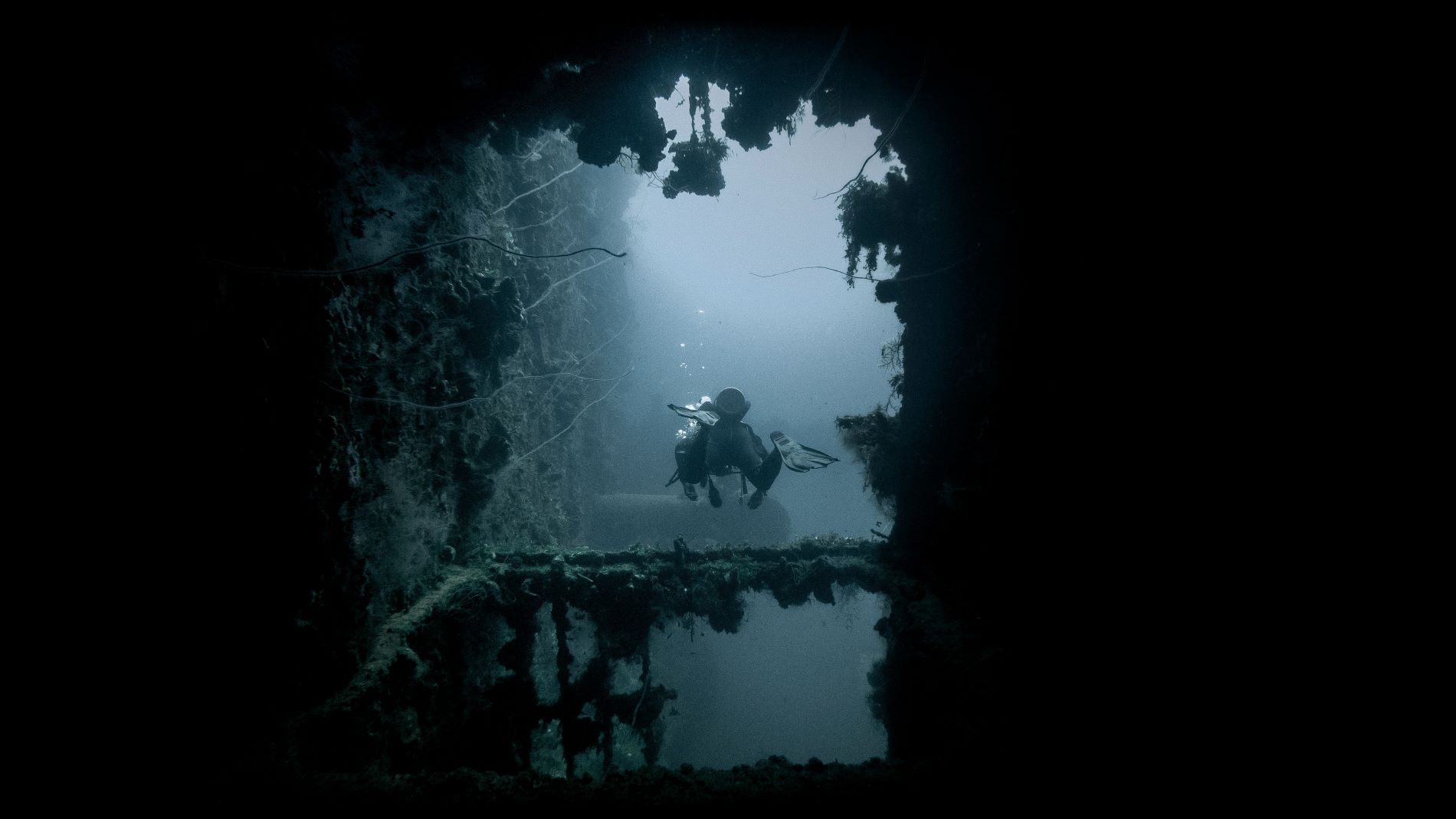
The Blue Descent
The first thing you notice is the silence. It is not an empty silence, but a heavy, pressurized quiet that presses against your eardrums, signaling that you have left the world of air and sunlight behind. As you vent the air from your buoyancy compensator and slip beneath the turquoise surface of Micronesia, the warmth of the tropical sun vanishes, replaced by the cooling embrace of the Pacific.
You are descending into a liquid twilight. At ten meters, the reef fish are colorful distractions. At twenty meters, the light begins to filter out the reds and oranges, turning the world into a monochromatic landscape of indigo and cobalt. It is here, suspended in the blue gloom, that the sense of intellectual vertigo begins to set in.
You are not merely diving into the ocean; you are diving into 1944.
Slowly, a shadow materializes out of the haze. It is too straight, too angular to be a coral head. It looms larger, a dark leviathan sleeping in the silt. First, a mast appears, encrusted in sponges but unmistakably industrial. Then, the jagged tear of a bomb blast. Finally, the massive silhouette of a freighter, upright and intact, stretches out to the limits of visibility. This is not a recreational site; it is a crime scene, a time capsule, and a mass grave, preserved in the high-definition stasis of the deep ocean.
Welcome to Chuuk Lagoon (formerly Truk Lagoon), the final resting place of the "Ghost Fleet" of the Japanese Imperial Navy.
The Gibraltar of the Pacific
To understand the gravity of what lies on the seabed, one must understand the formidable reputation this atoll once held. Before the devastation, Truk Lagoon was known as the "Gibraltar of the Pacific." It was the Empire of Japan’s main forward base in the South Pacific theater, a fortress ringed by protective reefs and fortified islands.
Inside this natural harbor, the Imperial Navy anchored its battleships, aircraft carriers, cruisers, and a massive support fleet of merchant vessels (Marus). It was the logistical heart of the Japanese war machine, pumping fuel, ammunition, and soldiers to the front lines of New Guinea and the Solomon Islands. For years, it was considered impregnable, a terrifying mystery to Allied intelligence.
But by early 1944, the tide of war had turned. The fortress had become a cage.
Operation Hailstone: The Day the Sky Fell
The history of the lagoon is bisected by a single date: February 17, 1944.
Under the codename Operation Hailstone, the U.S. Navy launched a devastating surprise air and surface attack. For two days and nights, Carrier Task Force 58 rained destruction upon the lagoon. The geography that had once protected the Japanese fleet now trapped it.
The statistics of the cataclysm are staggering:
- Duration: Less than 48 hours.
- Losses: More than 50 ships and 250 aircraft sent to the bottom.
- Result: The "Gibraltar of the Pacific" was neutralized.
The sky above the lagoon was thick with smoke and anti-aircraft fire; the water below was slick with burning oil and debris. When the smoke cleared, thousands of sailors had perished. After the war, the lagoon was largely forgotten, sealed off by military and political isolation. The wrecks were left to settle into the silt, undisturbed by salvage operations or commercial traffic. They simply waited, preserving the exact moment of their destruction for decades.
The Fujikawa Maru: An Aviation Tomb
Among the most iconic of the Truk Lagoon wrecks is the Fujikawa Maru. Resting on an even keel at a manageable depth, it serves as a haunting introduction to the tragedy of the fleet.
As you swim along the deck, you encounter the ship’s defensive teeth: a six-inch bow gun, now encrusted with soft corals that bloom in currents like underwater cherry blossoms. But the true ghost story lies within the cargo holds.
Penetrating the gloom of Hold No. 2, your dive light cuts through the darkness to reveal a chaotic jumble of metal. These are not ship parts; they are aircraft. The Fujikawa was a ferry for aircraft, and she went down carrying a load of Mitsubishi A6M "Zero" fighters and spare parts.
Here, in the suffocating silence of the hold, you can hover over the fuselage of a Zero. The cockpit is open, the instruments gone, but the shape of the most feared fighter plane of the early war is unmistakable. Wings are stacked against bulkheads; propeller blades poke out from the sediment. The juxtaposition is jarring: instruments of high-velocity aerial death, now grounded forever in the slow-motion world of the abyss, draped in delicate sea fans.
The Million Dollar Wreck: The San Francisco Maru
For the technical diver, the San Francisco Maru represents the holy grail of Chuuk Lagoon diving. It is often called the "Million Dollar Wreck" due to the immense value of the military cargo it took to the bottom.
This dive requires discipline. The wreck rests deep, with the deck at 50 meters (165 feet). At this depth, nitrogen narcosis—the "martini effect"—clouds the mind. You must move with deliberate slowness, checking your gauges, fighting the urge to succumb to the rapture of the deep.
The descent to the San Francisco Maru feels like falling down a mineshaft. The water is darker here, the shadows longer. When you finally reach the deck, the sight that greets you is enough to stop your breath.
Resting on the forward deck, covered in a fine layer of silt, are three Japanese Type 95 Ha-Go light tanks. They are not scattered; they are parked. They sit on their tracks, their 37mm main guns still trained on a horizon that no longer exists. They look as if they could start their engines and roll off the deck at any moment.
Seeing a tank underwater induces a specific type of cognitive dissonance. These are heavy, terrestrial beasts designed for mud and jungle, now parked in a realm where gravity is optional. The sheer weight of the iron, contrasted with the weightlessness of the diver, emphasizes the permanence of their tomb.
The Shinkoku Maru: The Human Element
While the San Francisco Maru impresses with military might, the Shinkoku Maru disturbs with intimacy. This was a naval tanker, but its modern infamy comes from the exploration of its medical bay.
Swimming through the corridors of the Shinkoku is a lesson in claustrophobia. The passageways are silted, requiring perfect buoyancy control to avoid "silting out" the room and blinding yourself. Inside the infirmary, the atmosphere shifts from historical curiosity to forensic somberness.
The operating table is still there. Medical bottles, scattered by the violent listing of the sinking ship, lie in the mud. On the tiled floor, amidst the debris, divers occasionally encounter the most confronting reality of Operation Hailstone: human remains underwater.
It is a stark reminder that you are not in a museum. You are inside a grave. The silence here feels louder, the water colder. The urge to leave, to return to the light, tugs at the back of your mind.
The Nippo Maru: Secrets in the Helm
The Nippo Maru offers a glimpse into the command structure of the doomed fleet. This wreck was discovered relatively recently compared to the others, protecting it from early souvenir hunters.
The bridge of the Nippo Maru is a ghostly stage. The ship’s wheel stands upright, defying the corrosion that has eaten away the surrounding bulkheads. Nearby, the ship’s telegraph—the device used to signal "Full Ahead" or "Stop" to the engine room—stands frozen. One can imagine the frantic signals sent through this device as the American dive bombers began their dive, orders that would ultimately be futile.
On the deck, a small arsenal of anti-tank guns and howitzers lies scattered. They look like toys tipped out of a box, tossed aside by the ocean's fury.
The Rio de Janeiro Maru: The Leviathan
Once a luxurious passenger liner that traveled the world, the Rio de Janeiro Maru was converted into a submarine tender and transport for the war effort. It is a massive vessel, resting on its starboard side in relatively shallow water.
The sheer scale of the Rio is disorienting. You can swim along its hull for minutes without seeing the end. But the true marvel is the engine room. Entering through a blast hole, you find yourself in a cathedral of engineering.
Massive catwalks hang suspended in the darkness. Giant pistons and cylinders, which once drove this leviathan across the oceans, are now silent monoliths. The room is vast, echoing with the sound of your own regulator. It is an industrial cavern where light rarely penetrates, a testament to the industrial might that fueled the conflict.
The Betty Bomber: An Aluminum Skeleton
Not all the victims of Operation Hailstone were ships. The lagoon floor is littered with the carcasses of hundreds of aircraft. The most famous is the wreck of a Mitsubishi G4M "Betty" bomber.
Unlike the sturdy steel of the ships, the aluminum skin of the aircraft has corroded and crumbled. The Betty bomber lies on the sand like a broken bird. The nose cone is shattered, separated from the fuselage. The engines, heavy iron radials, have torn loose from the lightweight wings and sit heavily in the sand.
Inside the fuselage, radio equipment is still visible, wires hanging like cobwebs. It is a fragile wreck, vulnerable to the currents and the touch of careless divers, a fleeting memory of the air war that raged overhead.
The Interrupted Moment: Artifacts of the Lost
What lingers longest in the mind of the diver is not the guns or the tanks, but the mundane debris of daily life. The silt of Chuuk Lagoon acts as a preservative, holding the "interrupted moment" of 1944 in suspension.
Scattered across the decks and inside the mess halls are the artifacts of the lost:
- Sake bottles, some still corked and containing liquid, standing in rows.
- Porcelain rice bowls, etched with the insignia of the Navy or family crests, lying half-buried.
- Shoes, leather soles that once marched on drills, now dissolving into the mud.
- Bicycles, intended for soldiers on island patrols, hanging from the bulkheads.
- Phonograph records, their grooves holding music that will never be played again.
These objects scream of the suddenness of the end. A meal was being prepared; a drink was being poured; a letter was being written. And then, the bombs fell. These artifacts bridge the gap of eighty years, transforming the "enemy" into human beings who lived, feared, and died in these metal boxes.
Nature’s Reclamation: The Coral Shroud
There is a profound irony in Chuuk Lagoon: the instruments of death have become the cradle of life.
Over the last eight decades, the ocean has claimed the fleet. The iron hulls have become artificial reefs of unparalleled biodiversity. The Fujikawa Maru and the Shinkoku Maru are draped in curtains of soft coral in brilliant hues of violet, yellow, and crimson. Sponges encrust the gun barrels; anemones nestle in the torpedo tubes.
This is the "Forensic Ecology" of the lagoon. The metal is being eaten by the ocean—oxidizing, thinning, returning to the elemental soup. The wrecks are alive. Schools of trevally hunt around the bridges, and sharks patrol the decks. It is a visual battle between the grey geometry of war and the chaotic, neon explosion of nature. Nature is winning.
Logistics of the Abyss: Technical Challenges
Exploring this necropolis is not a casual endeavor. While some wrecks like the Fujikawa are accessible to advanced recreational divers, the true scope of the lagoon requires "tech diving" protocols.
- Gas Management: The depth and duration mean standard air is often insufficient. Divers use Enriched Air Nitrox or Trimix (adding helium) to manage physiological risks.
- Decompression: Deeper wrecks, like the San Francisco, demand decompression stops—hanging in the blue water for nearly an hour after the dive to allow nitrogen to leave the body safely.
- Accessibility: Most serious exploration is done via liveaboard vessels, floating dive bases that move from wreck to wreck. It is a pilgrimage for the serious diver, a journey to the edge of the map.
The Ticking Time Bomb: Environmental Threats
Beneath the coral beauty lies a toxic reality. These ships were fully fueled when they sank. For eighty years, that heavy fuel oil has sat in corroding tanks.
Researchers and environmentalists call this the "ticking time bomb" of the Pacific. As the saltwater eats through the steel plating, the structural integrity of the fuel tanks weakens. Small leaks are already common—divers often smell the acrid tang of hydrocarbons in their regulators or see black globules rising to the surface.
If the hulls collapse entirely, thousands of tons of oil could be released into the pristine lagoon, devastating the marine ecosystem that has grown over the graves. It is a grim race against time: can the oil be pumped out before the iron gives way?
The Ethics of Intrusion: War Graves
Diving Chuuk Lagoon involves navigating a complex ethical landscape. These are not just shipwrecks; they are recognized by the Japanese government as war graves. The souls of the crew are considered to be still on duty.
In the 1970s and 80s, the lagoon was plundered. "Dynamite fishing" for souvenirs was common, and many artifacts disappeared into private collections. Today, the ethos has shifted to strict preservation. "Take only pictures, leave only bubbles" is not just a slogan; it is the law.
Touching human remains or removing artifacts is strictly forbidden. The local guides are fierce protectors of their heritage. Divers must approach these sites with the reverence of a visitor in a mausoleum. You are an intruder in a house of grief.
The Yamagiri Maru: The Killer's Skull
Perhaps the most visceral symbol of this ethical weight is found on the Yamagiri Maru. Deep in the engine room, fused by the heat of the explosion and the pressure of time into the steel bulkhead, is a human skull.
It is known to dive guides and historians, a macabre landmark in the dark. It is a confrontation that no amount of briefing can prepare you for. It stares out from the metal, a permanent fusion of man and machine. It serves as the ultimate warning: this is what war does. It reduces humanity to calcium and carbon, merged with the machinery of its own destruction.
Conclusion: The Silence That Speaks
As you ascend from your final dive, watching the wreck of the San Francisco Maru or the Betty bomber fade back into the deep blue haze, you are left with a feeling of profound heaviness.
Chuuk Lagoon is a place of contradictions. It is terrifying yet beautiful. It is a scene of violent industrial slaughter that has become a garden of peace. It is a "Warning in Steel."
The ocean is slowly dissolving the memory of 1944. Salt and time are erasing the names on the hulls and the shape of the guns. One day, the iron will be gone, leaving only the coral reef in the shape of a ship. But for now, the Ghost Fleet remains. It sits in the silence of the lagoon, a submerged monument to the impermanence of human ambition and the enduring power of the natural world to heal, cover, and reclaim.
Sources & References
- U.S. Naval History and Heritage Command: Operation Hailstone: The Battle of Truk Lagoon. [history.navy.mil]
- National Geographic: Ghost Fleet of the Pacific.
- Pacific Wrecks: Comprehensive Database of WWII Pacific Theater Wrecks. [pacificwrecks.com]
- DAN (Divers Alert Network): Physiology of Deep Diving and Nitrogen Narcosis.
- SPREP (Secretariat of the Pacific Regional Environment Programme): Assessment of Oil Leaks from WWII Wrecks in Chuuk Lagoon.
- The Cousteau Society: Lagoon of Lost Ships (1971 Expedition).
- Truk Lagoon Dive Center: Site specific depth and condition reports.
- CombinedFleet.com: Tabular Records of Movement (TROM) for IJN Vessels.
- Journal of Maritime Archaeology: Ethical Management of Underwater Cultural Heritage in Micronesia.
- NOAA Office of National Marine Sanctuaries: Potentially Polluting Wrecks in U.S. Waters (Comparative Study).