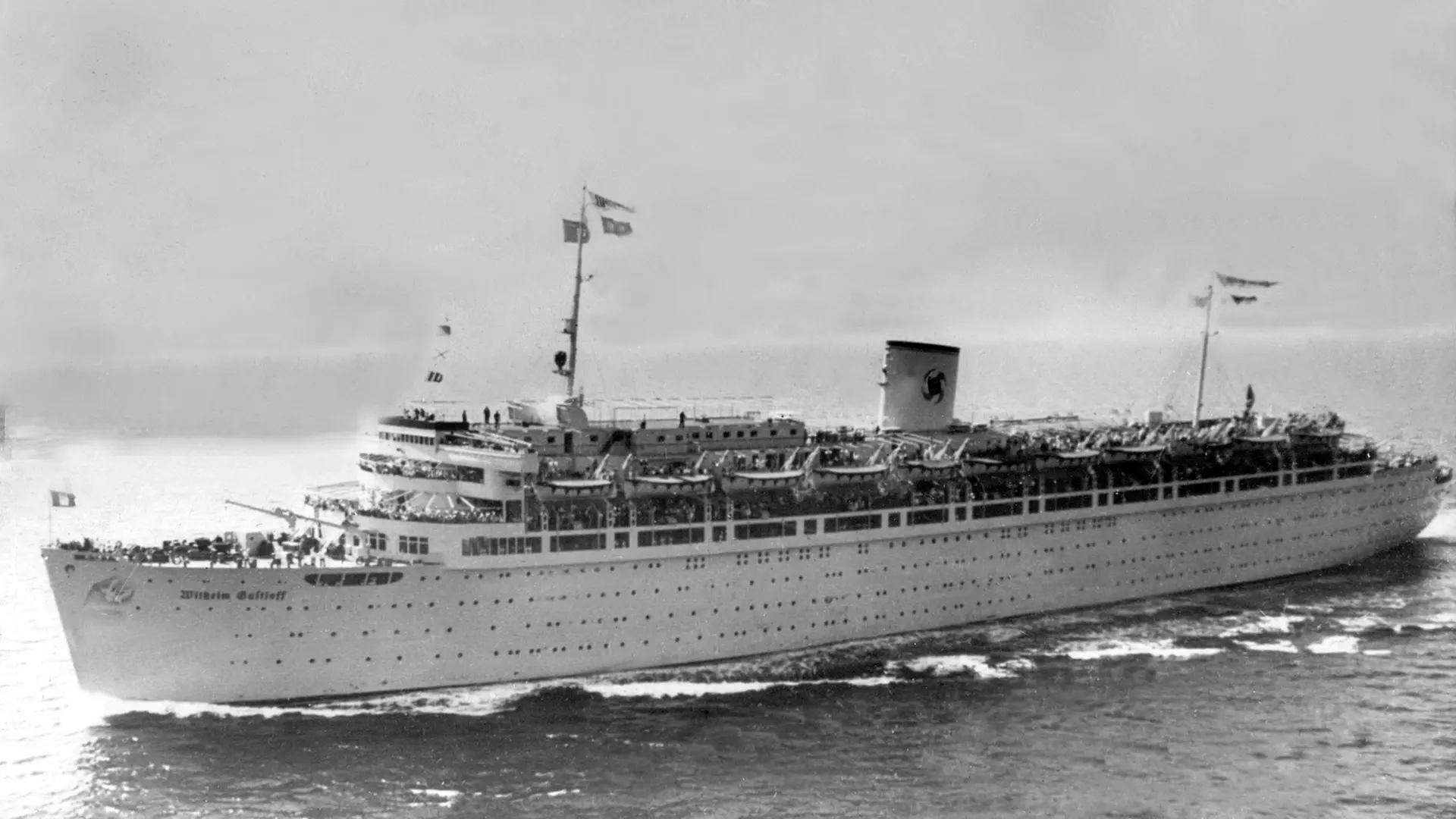
The Soviet Submarine Attack That Sank the Wilhelm Gustloff
Captain Alexander Marinesko had four torpedoes loaded in the bow tubes of Soviet submarine S-13, and each one carried a hand-painted dedication. For the Motherland. For the Soviet People. For Leningrad. The fourth read For Stalin.
At 9:16 PM on January 30, 1945, Marinesko fired all four at an unescorted silhouette running with its navigation lights on — a fat, slow target off the Pomeranian coast. Three torpedoes left the tubes and ran true. The fourth, the one dedicated to Stalin, jammed in its tube, armed and live, and the crew of S-13 spent the next minutes doing the most delicate work of their lives while the other three closed the distance in the dark.
The ship they struck was carrying more than 10,000 people.
The Wilhelm Gustloff is the deadliest shipwreck in history, and its story is a study in erasure. Six times more people died in the Baltic that night than on the RMS Titanic, yet the disaster produced no films, no memorial culture, no household name. The victims were German civilians in the final months of a war Germany started, which meant no one could claim them. The Germans forfeited the right to public grief. The Soviets buried the story along with the reputation of the submarine captain who pulled the trigger. The largest loss of life ever recorded at sea fell into a silence that lasted fifty years — because it happened to the wrong people, at the wrong moment, on the wrong side.
Hitler's Cruise Ship: The History of the Wilhelm Gustloff Before the War
Wilhelm Gustloff: The Nazi Assassination Behind the Ship's Name
Wilhelm Gustloff was a Swiss-based Nazi — the founder and leader of the NSDAP's foreign organization in Switzerland — until February 4, 1936, when a 26-year-old Jewish medical student named David Frankfurter knocked on the door of his apartment in Davos, waited in the study, and shot him five times. Frankfurter walked to the nearest police station and turned himself in. A Swiss court sentenced him to eighteen years; he was pardoned in 1945 and emigrated to Palestine. Switzerland, wary of German pressure, had kept the trial deliberately quiet — the Nazis wanted a show trial and got a footnote.
Hitler wanted a martyr instead. The regime staged a state funeral, and when its new flagship cruise liner — set to be christened Adolf Hitler — launched in Hamburg in May 1937, it slid into the water bearing the dead man's name. Gustloff's widow smashed the champagne. Hitler watched from the platform.
The ship would sink exactly nine years, on the day, after its namesake's birthday: January 30.
Strength Through Joy: Nazi Propaganda Cruises for the German Working Class
The Gustloff was the crown jewel of Kraft durch Freude — Strength Through Joy — the Nazi leisure organization that sold the working class subsidized cruises to Madeira and the Norwegian fjords. The ship was built classless by design: one category of cabin, every one with a sea view, so that a Ruhr factory worker and his foreman shared the same deck. It was floating propaganda, and it worked. For two years the Gustloff carried tens of thousands of ordinary Germans on the first sea holidays of their lives, photographed endlessly, proof that National Socialism delivered.
The regime got other uses out of her. In April 1938 she served as a floating polling station for Austrians voting on the Anschluss. In May 1939 she brought the Condor Legion home from the Spanish Civil War to a hero's welcome.
Then the war came, and the dream ship's holiday ended after 50 voyages.
The Wilhelm Gustloff in World War II: Hospital Ship and U-Boat Barracks
The Gustloff spent the war standing still. She served as a hospital ship for the first year — white paint, green stripe, red crosses — taking wounded from the Polish and Norwegian campaigns. In November 1940 the Kriegsmarine stripped her medical fittings, painted her naval grey, and moored her at Gotenhafen, the occupied Polish port of Gdynia, as a barracks ship for the 2nd Submarine Training Division. U-boat trainees slept in cabins built for tourists.
The grey paint mattered. Under international law, a hospital ship is untouchable; a grey-painted naval barracks ship housing submarine trainees, fitted with anti-aircraft guns, is a legitimate target of war. The Gustloff's final voyage would mix that military role with thousands of civilians — a combination that made her sinking legal and catastrophic at the same time.
She did not move for four years. Her engines sat idle, her hull went unmaintained, and her lifeboat complement was quietly cannibalized — some boats removed for harbor duty, davits rusting. When she was finally ordered back to sea in January 1945, she was a 25,000-ton hotel that had forgotten how to be a ship.
Operation Hannibal: The Largest Sea Evacuation in History
East Prussia 1945: German Refugees Fleeing the Red Army
The people who would drown on the Gustloff came from the oldest edge of the German world. East Prussia had been German-speaking since the Teutonic Knights conquered it in the 1200s; Königsberg, its capital, was where Prussian kings were crowned. By 1944 roughly 2.4 million Germans lived there — farmers, fishermen, small-town families — in a province that Versailles had severed from the rest of Germany, leaving it an island of the Reich wedged against Poland and the Baltic. Most of the refugees who crowded aboard the Gustloff were these people, along with Danzigers and West Prussians: civilians fleeing land their families had held for centuries, though almost none of them understood yet that the flight was permanent. East Prussia would be erased from the map in 1945, divided between Poland and the Soviet Union, its entire German population killed, deported, or expelled. The Gustloff's passengers were the leading edge of some twelve million Germans driven from the east — the largest forced migration in European history, attached to the largest maritime disaster in history, and both nearly forgotten.
The Red Army broke into East Prussia in January 1945 and cut it off from the Reich within two weeks. What followed was one of the largest panicked migrations in European history. Somewhere near two million people fled west in the dead of the coldest winter in years — on foot, in horse carts, across the frozen Vistula Lagoon, where Soviet aircraft strafed the columns and the ice gave way under overloaded wagons. Refugees arriving in the port cities carried stories of what the Red Army did in the villages it overran — the massacre at Nemmersdorf in October 1944 had been broadcast by Goebbels's propaganda machine precisely to harden resistance, and it emptied whole regions ahead of the front line instead. The land routes closed one by one.
The sea was the only way out.
On January 23, Grand Admiral Karl Dönitz ordered Operation Hannibal: every hull the Kriegsmarine could find — liners, freighters, trawlers, barges — would carry refugees and troops west across the Baltic. Over the following fifteen weeks, Hannibal moved somewhere between 800,000 and two million people, the largest seaborne evacuation ever conducted, dwarfing Dunkirk several times over. Its safety record was remarkable — over 99 percent of evacuees survived. The Gustloff belongs to the other fraction of one percent, along with two ships whose names are even less known: the Steuben and the Goya.
The Wilhelm Gustloff, motionless since 1940, was ordered to sail.
Boarding the Gustloff: Over 10,000 Refugees on a Ship Built for 1,900
Gotenhafen's piers in late January 1945 were a compression chamber of human desperation. Tens of thousands of refugees camped in the port in −18°C cold, and the Gustloff — enormous, famous, safe-looking — was the ship everyone wanted. Boarding passes were issued, then forged, then abandoned. Families were separated in the crush. Mothers passed infants over the railings to strangers already aboard, gambling that a child on the ship without them was better than a child on the pier with them. Some of those children sailed alone.
The ship was certified for 1,885 people. The final count, reconstructed decades later by survivor and archivist Heinz Schön, was around 10,582: nearly 9,000 refugees, 918 naval officers and trainees, 162 wounded soldiers, 173 crew — and 373 young women of the Women's Naval Auxiliary, teenagers and twenty-somethings in uniform, who were quartered in the one open space left on board.
The drained swimming pool, on B deck, below the waterline.
The Sinking of the Wilhelm Gustloff: January 30, 1945
Four Captains, One Escort, and the Fatal Decision to Turn On the Lights
The Gustloff sailed at midday on January 30 with four captains on her bridge and no agreement between them. Friedrich Petersen, 63, was the civilian master, brought out of semi-retirement; two merchant marine captains assisted; and Lieutenant Commander Wilhelm Zahn, a U-boat officer, represented the navy. They argued about everything — speed, route, lights. Zahn wanted to zigzag; Petersen refused, arguing the worn-out engines couldn't sustain it. The deep-water channel was chosen over the shallow coastal route, on the theory that mines were a greater threat than submarines. The escort amounted to a single aging torpedo boat, the Löwe, after the second escort turned back with a leak.
Then came the message that killed the ship. A radio signal warned of a German minesweeper convoy approaching head-on in the darkness. To avoid collision, Petersen ordered the navigation lights switched on.
The convoy never appeared. It may never have existed. But the Gustloff was now the only illuminated object on the Baltic Sea, and Alexander Marinesko had been trailing her for two hours.
That same evening, in Berlin, Hitler gave his final radio address, marking twelve years to the day since he took power. It was also Wilhelm Gustloff's birthday. Passengers heard the speech piped through the ship's loudspeakers minutes before the torpedoes struck.
How the Wilhelm Gustloff Sank: Three Torpedo Strikes and 62 Minutes
The first torpedo hit the bow. The second hit amidships — directly into the drained swimming pool where the Women's Naval Auxiliary slept. The blast and the tiled shrapnel killed nearly all of them in seconds; only a handful of the 373 survived. The third struck the engine room, killing the power, the lights, and the radio in one blow.
Watertight doors sealed automatically — locking below decks the off-duty crewmen who knew how to launch lifeboats.
What happened in the next hour is the reason survivors gave interviews sparingly for the rest of their lives. Ten thousand people moved toward lifeboats that could hold a fraction of them, up stairwells slick with blood and seawater, in a ship listing hard to port. Crowds crushed the fallen against bulkheads. Shots were fired — some officers killing their own families before themselves, some men shooting their way toward boats. Lifeboats had frozen to their davits in the −18°C air; crew chipped at the ice while the deck tilted away beneath them. One loaded boat dropped when a davit failed, spilling its passengers onto the ice-covered promenade deck and into the sea.
The water was 4°C, thick with ice floes. Children wearing adult life jackets floated head-down within minutes — the jackets rode up their small bodies and flipped them. Survivors in boats described the sound over the water afterward: thousands of voices, then hundreds, then none.
The Gustloff went down bow-first sixty-two minutes after the first strike. As the stern rose, her lights — dead since the third torpedo — suddenly flickered back on, blazing across the water for a few seconds before the sea took them.
The Rescue of Wilhelm Gustloff Survivors in the Frozen Baltic
The torpedo boat Löwe turned back immediately and began hauling people from the water, joined through the night by torpedo boat T-36 and a handful of smaller vessels — several of which had to keep moving during rescue because S-13 was still out there. T-36 dodged two more torpedoes with survivors clinging to her nets.
About 1,250 people were saved. Roughly 9,400 were not — the deadliest loss of life in the history of seafaring, before or since. More people died on the Gustloff than on the Titanic and the RMS Lusitania combined, several times over.
Seven hours after the sinking, patrol boat VP-1703 swept the debris field one last time and found a lifeboat, apparently empty. Petty Officer Werner Fick climbed in to check and found, wrapped tight in blankets, a months-old infant — alive, the youngest and last survivor of the Wilhelm Gustloff, his parents unknown and unfindable.
Fick adopted him and raised him as his son.
How Many People Died on the Wilhelm Gustloff?
No passenger manifest survived the chaos of Gotenhafen, and for decades the accepted death toll — around 5,300 — came from early postwar estimates. The true figure emerged from one man's obsession. Heinz Schön, an 18-year-old purser's assistant who survived the sinking, spent the next sixty years collecting boarding records, survivor testimony, and naval documents, revising the count upward with each decade of work. His final reconstruction: roughly 10,600 aboard, about 9,400 dead. A 2000s forensic analysis using maritime simulation software tested Schön's figures against the ship's spaces and the boarding chaos and found them credible. Half the dead, by most reconstructions, were children.
The Gustloff was not alone. Eleven days later, Marinesko's S-13 sank the General von Steuben — another Hannibal evacuation ship — killing roughly 4,000. In April, Soviet submarine L-3 sank the Goya, killing about 7,000 in under seven minutes. Three of the five deadliest shipwrecks in history happened in the same sea, in the same operation, in the same ten weeks. All three are obscure.
Why the Wilhelm Gustloff Disaster Was Forgotten
German Guilt, Soviet Silence, and the Politics of Mourning
The Gustloff sank into two silences at once. In Germany, the dead were unmournable: they were casualties of a catastrophe Germany had unleashed on the world, and any public grief risked sounding like a claim to victimhood — an accounting the postwar Federal Republic could not touch. In the Soviet bloc, the sinking was a legitimate act of war against a military target — the ship carried submarine trainees and anti-aircraft guns, which under the rules of war it did — and the ten thousand civilians aboard were a detail with no place in the victory narrative. East Germany, where many survivors lived, could not commemorate people killed by the liberators.
So the largest maritime disaster in history survived only in living rooms — survivors' families, expellee associations, Schön's decades of private documentation. The public taboo held until 2002, when Nobel laureate Günter Grass — himself a refugee from Danzig — built his novel Crabwalk around the sinking and argued that the German left's refusal to touch the story had abandoned it to the far right. The book was a bestseller, and the Gustloff finally entered public memory sixty years late, still trailing the question it had always posed: who is allowed to be a victim? The Montevideo Maru, sunk by an American submarine with over a thousand Allied prisoners aboard, spent decades in a similar silence for a similar reason — the dead were inconvenient to every side's story.
Alexander Marinesko: The Disgraced Soviet Submarine Captain
Marinesko fired the most lethal torpedo salvo in history while under threat of court-martial. Weeks earlier he had vanished for two days in the Finnish port of Turku on a drinking binge with a local woman — a security breach that had NKVD investigators circling. The patrol that found the Gustloff was his chance at redemption, and he took it twice: the Steuben, eleven days later, made him responsible for more deaths at sea in a single patrol than any commander who ever lived.
The Soviet Navy gave him a medal — a lesser one — and denied him the Hero of the Soviet Union, citing his discipline record. Within a year he was demoted and discharged. In 1949 he was convicted on petty theft charges at the institute where he worked and sent to a labor camp in Kolyma. He died of cancer in 1963, poor and mostly forgotten, in Leningrad — the city one of his torpedoes had been dedicated to.
In 1990, in the Soviet Union's final year, Gorbachev posthumously made him a Hero of the Soviet Union. There are statues of him now in Kaliningrad and St. Petersburg. The man who sank the Gustloff was rehabilitated before the people who drowned on her were publicly mourned.
The Wilhelm Gustloff Wreck Site Today: Salvage, Looting, and War Grave
The Amber Room Hunt: How Salvage Crews Blasted the Wreck in the 1950s
The wreck lies about 30 kilometers off the Polish coast near Łeba, in roughly 45 meters of water, listed on Polish navigation charts under the flattest possible name: Obstacle No. 73. The Baltic is barely deep enough to hide her. A ship that once stood over 20 meters from keel to upper deck sank in water only twice that depth — shallow enough that divers can reach the wreck with ease, which shaped everything that happened to her after the war.
To the postwar authorities on that coast, the Gustloff was not a grave. She was enemy scrap in the waters of a Soviet-dominated Poland, five years after a war in which Germany had murdered six million Polish citizens — and salvaging German wrecks for steel was routine business across the Baltic. The Gustloff got special attention because of a rumor. The Amber Room — the amber-and-gold chamber of the Catherine Palace, looted by the Wehrmacht outside Leningrad in 1941 — had last been seen crated in Königsberg Castle in January 1945, in the same collapsing province the Gustloff's refugees were fleeing, in the same weeks the ship sailed. The timing was enough. The theory that the century's most famous missing treasure had gone down with the century's deadliest shipwreck attached itself to the hull and never fully let go.
Salvage crews went into the wreck repeatedly through the 1950s, cutting and blasting their way through the hull. The men working those compartments were moving through a ship that still held thousands of the dead — the cold, dark, low-oxygen Baltic preserves what it takes, and no recovery of the victims had ever been attempted. No account of what those divers saw was ever published; Soviet-bloc salvage operations did not keep public diaries, and this was not work anyone described willingly. They found no amber. The Amber Room has never been found anywhere.
The blasting, decades of decay, and years of unauthorized souvenir diving left the superstructure collapsed and the three hull sections crushed nearly flat against the seabed, rising perhaps 15 meters at their highest points. Human remains are still present throughout. In 2006 Poland classified the site as a war grave — the largest at sea anywhere on Earth — with diving prohibited inside a 500-meter exclusion zone. The designation arrived half a century after the demolition crews: the dead of the Gustloff were not grievable in 1955, and were in 2006, and the wreck's broken condition records both verdicts.
Visiting the Wilhelm Gustloff Wreck Site and Memorials Today
There is no site to visit, which is fitting for a disaster defined by absence. Commemoration exists in fragments: a memorial at Gustloff's namesake grave in Schwerin, exhibitions in the Baltic port museums, a small monument in the resort town of Ustka. The Polish coast at Łeba is a holiday beach — dunes, pines, summer crowds — with nine thousand people lying an hour's sail offshore, most of them children and women whose names were never recorded. The same sea holds the MS Estonia, the deadliest European peacetime wreck, a few hundred kilometers north; the Baltic keeps its dead cold and close.
Stand on the beach at Łeba on a clear January evening and the horizon is empty. That emptiness is the memorial. Nothing marks the spot where the largest number of human beings ever lost at sea went into the water — and for fifty years, nothing was ever supposed to.
FAQ
What was the Wilhelm Gustloff?
The Wilhelm Gustloff was a German cruise liner launched in 1937 as the flagship of the Nazi leisure organization Strength Through Joy, offering subsidized holiday cruises to German workers. During World War II she served briefly as a hospital ship, then spent four years as a floating barracks for U-boat trainees in occupied Gdynia. In January 1945 she was pressed into Operation Hannibal, the German evacuation of East Prussia, and was sunk by a Soviet submarine on her first voyage in over four years.
How many people died on the Wilhelm Gustloff?
Roughly 9,400 people died when the Wilhelm Gustloff sank on January 30, 1945, out of approximately 10,600 aboard — making it the deadliest shipwreck in history. The figures come from decades of research by survivor Heinz Schön, later supported by forensic maritime analysis. By most reconstructions, about half of the dead were children. Only around 1,250 people were rescued from the freezing Baltic.
Why did the Wilhelm Gustloff sink?
The ship was hit by three torpedoes fired by the Soviet submarine S-13 under Captain Alexander Marinesko. The Gustloff was sailing nearly unescorted through a deep-water channel with her navigation lights switched on — a decision made to avoid a reported oncoming German convoy that never appeared. The lights made her visible to S-13, which had been trailing her for two hours. She sank in 62 minutes in ice-filled water of about 4°C.
Was the sinking of the Wilhelm Gustloff a war crime?
No. The Gustloff was painted naval grey, armed with anti-aircraft guns, and carried over 900 military personnel including U-boat trainees, which made her a legitimate military target under the laws of war. She was not marked or registered as a hospital ship at the time of the sinking. The catastrophic civilian death toll was a consequence of Germany loading a military vessel with thousands of refugees, not of an unlawful attack.
Why is the Wilhelm Gustloff disaster so little known?
The victims were German civilians in the final months of a war Germany started, which made public mourning politically impossible on all sides. West Germany avoided anything resembling a claim to victimhood, East Germany could not commemorate people killed by the Soviets, and the USSR treated the sinking as a legitimate victory. The taboo largely held until Günter Grass's 2002 novel Crabwalk brought the disaster into mainstream German memory.
Was the Amber Room on the Wilhelm Gustloff?
No amber was ever found on the wreck, despite repeated salvage operations in the 1950s driven partly by that theory. The Amber Room was last seen crated in Königsberg Castle in January 1945, the same month and region from which the Gustloff sailed, which is how the rumor attached itself to the ship. Salvage crews blasted into the hull searching for it and recovered nothing. The Amber Room has never been found, and most historians believe it was destroyed when Königsberg burned in 1945.
Where is the wreck of the Wilhelm Gustloff?
The wreck lies about 30 kilometers off the Polish coast near Łeba, at a depth of roughly 45 meters, broken into three sections. It appears on Polish navigation charts as "Obstacle No. 73." Poland has classified the site as a war grave, and diving is prohibited within a 500-meter exclusion zone.
Sources
Die Gustloff-Katastrophe: Bericht eines Überlebenden — Heinz Schön (1984)
Crabwalk (Im Krebsgang) — Günter Grass (2002)
Death in the Baltic: The World War II Sinking of the Wilhelm Gustloff — Cathryn J. Prince (2013)
The Cruelest Night: The Untold Story of One of the Greatest Maritime Tragedies of World War II — Christopher Dobson, John Miller, Ronald Payne (1979)
Ship of Fate: The Story of the MV Wilhelm Gustloff — Roger Moorhouse, BBC History Magazine (2015)
Sea of Death: The Baltic, 1945 — Claes-Göran Wetterholm (2002)
Operation Hannibal: The Baltic Evacuation, 1945 — U.S. Naval Institute Proceedings (1995)
The Wilhelm Gustloff Museum Archive — Edward Petruskevich, wilhelmgustloffmuseum.com (ongoing)
Germany 1945: From War to Peace — Richard Bessel (2009)
The German Expellees: Victims in War and Peace — Alfred-Maurice de Zayas (1993)