The Great Action: The Day 9,200 Jews Were Marched to the Ninth Fort
Helmut Rauca stood on a small mound of earth in Democrats Square on the morning of 28 October 1941 and ate while he worked. The entire population of the Kaunas ghetto had been ordered out of their houses before dawn and assembled in front of him — roughly 27,000 people, arranged in columns by family, standing in the cold since six in the morning. Rauca was an SS master sergeant, the Gestapo’s specialist for Jewish affairs in Kaunas, thirty-two years old. He held a swagger stick. He pointed it left or right.
Right meant back into the ghetto. Left meant a column that formed slowly through the day and then walked four kilometres uphill along the Žemaičiai road, past ordinary houses with ordinary curtains, to the Ninth Fort. The pits behind the fort had been dug in advance by Soviet prisoners of war. The selection took most of the day. The ghetto’s inmates had a name for Rauca: Ruakh, a Yiddish pun on his surname, meaning demon.
The following morning, 29 October, the shooting began at the trenches and continued until the light went. Karl Jäger’s office recorded the day in a column of figures: 2,007 men, 2,920 women, 4,273 children. Nine thousand two hundred people in a single day, filed under the heading of an operational report, with the totals ruled off neatly at the bottom of the page.
The Ninth Fort was designed to stop an invading army and never managed it. Built at enormous expense by an empire that abandoned it within days, it spent the twentieth century being repurposed by whoever held Kaunas that year — a prison for the Lithuanian republic, a transit cell for the NKVD, a killing ground for the SS. Its final German function was not murder at all. It was amnesia: an industrial attempt to unmake the evidence of what had happened in its own fields. That attempt failed for one reason. The men ordered to erase the dead survived to describe the process. The Ninth Fort is where the machinery of forgetting broke, and the people it was supposed to destroy became the record.
Kaunas Fortress: The Russian Fort That Never Fought a War
Nine Forts, Eight Batteries and Six Days of Resistance
Russia began fortifying Kaunas in 1882 because the city sat on the shortest road from East Prussia to the empire’s interior. Over three decades the fortress grew into nine forts and a ring of gun batteries, and Kaunas was classified a first-class fortress — the highest designation the empire awarded. The Ninth Fort was the last and most modern of them, built between 1902 and 1913: reinforced concrete casemates, a dry ditch, counterscarp galleries for flanking fire, and a warren of underground corridors linking it all together. It was completed one year before the war it had been built for.
The war took six days. On 12 August 1915 the German Tenth Army under Karl Litzmann opened the assault, having laid a purpose-built railway to bring up a 42-centimetre Gamma-Gerät siege howitzer that threw one-ton shells fourteen kilometres. The German guns concentrated on the oldest forts in the ring. The Russian garrison of 66,629 men lost roughly 45,000 killed, wounded and captured. On 18 August the fortress fell, leaving the Germans 1,300 guns and 810,000 shells. The Ninth Fort, the newest and strongest position in the entire system, barely fired a round in its own defence.
From Imperial Fort to Prison: The Ninth Fort Under Lithuania and the NKVD
The Hard-Labour Prison That Grew Its Own Food, 1924–1940
Independent Lithuania inherited a hilltop full of empty concrete and did the obvious thing with it. From 1924 the Ninth Fort operated as a branch of the Kaunas Hard Labour Prison, and the inmates worked the fields around the walls — the same fields that would be dug into pits seventeen years later. For sixteen years the fort’s history is agricultural and dull. Men served sentences, planted potatoes, and left. It was a provincial prison in a small country, no more notable than Lukiškės Prison in Vilnius and considerably less crowded.
The Soviet Waiting Room for the Gulag, 1940–1941
The Soviet Union occupied Lithuania in June 1940, and the NKVD understood immediately what the fort was actually good for. Its value was not the concrete but the isolation: a secure site outside the city where people could be held without anyone noticing how long they stayed or where they went next. The Ninth Fort became a transit point. Political prisoners, officers, officials, priests and farmers passed through its cells on the way to the cattle wagons and the camps in the east — the same administrative pattern that produced Katyn in the forests of Russia the previous spring. The great deportation wave of June 1941 emptied whole streets of Kaunas. Then, days later, the Germans crossed the border and the fort changed hands again.
June 1941: How the Ninth Fort Became a Nazi Killing Site
The Lietūkis Garage and the Ghetto in Vilijampolė
Kaunas fell on 24 June 1941, and the killing started before the German administration had properly arrived. On 27 June, in the forecourt of the Lietūkis cooperative garage in the city centre, a group of Jewish men were beaten to death with iron bars in front of a standing crowd that included women holding children up for a better view. German soldiers photographed it. The photographs survive. Whatever restraint anyone in Kaunas had expected from the transition, that morning removed it.
By 15 August the city’s Jews — around 29,000 people — had been moved across the river into Vilijampolė, the old Slobodka quarter, and the ghetto was sealed. Slobodka had been one of the great centres of Jewish learning in Eastern Europe, home to a yeshiva that drew students from across the world. It was now a holding pen with a wire fence, four kilometres downhill from a fortress with very deep ditches.
Einsatzkommando 3 and the Ledger That Counted Its Own Victims
Karl Jäger commanded Einsatzkommando 3, the unit responsible for Lithuania, and he did something that most of his colleagues had the sense not to do: he kept a full account. The Jäger Report, compiled on 1 December 1941, lists every operation his men carried out with dates, locations, and victims broken down into men, women and children. It is the most complete surviving self-audit of the Holocaust by bullets, and it exists because Jäger was proud of it.
The killing in Lithuania was done in the open, at pits, by squads with rifles and submachine guns, in the same weeks that the same method was being used at Babi Yar outside Kyiv. There were no gas chambers here, no sealed trains to Poland, no euphemism of a shower block. The distance between the ghetto and the grave was a walk. A roving squad under SS-Obersturmführer Joachim Hamann moved between Lithuanian towns clearing them one by one, working with local auxiliary units, and the Ninth Fort served as the fixed installation at the centre of the system.
Jäger’s ledger records the fort’s tempo through the autumn of 1941. On 4 October, during the liquidation of the ghetto’s “small” section, 315 men, 712 women and 818 children. On 29 October, the Great Action. By the time he signed his report at the start of December, he was able to state that the Jewish problem in Lithuania was essentially solved.
The Pits Behind the Fort
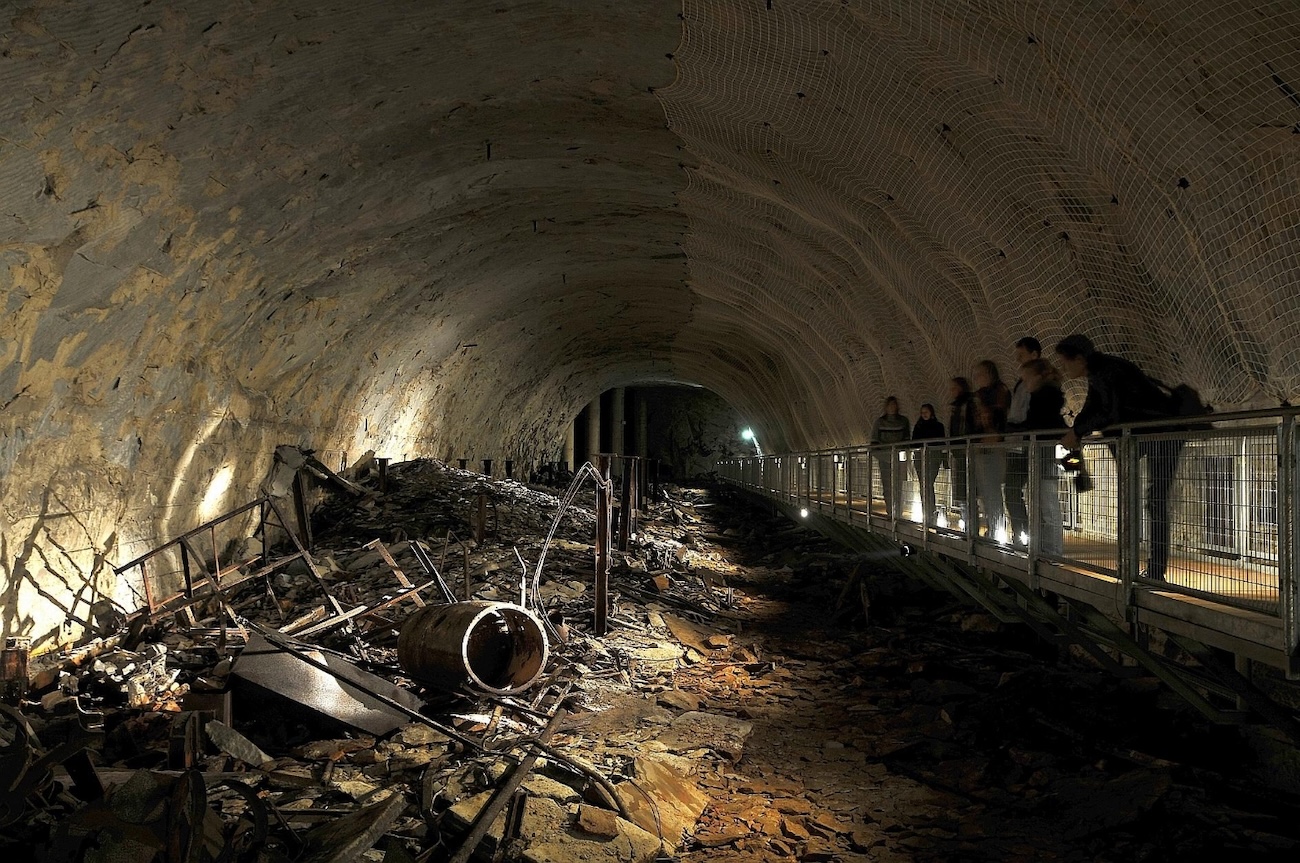
The geography of the killing is the least discussed and most disturbing thing about the site. The Germans did not need to build anything. The fort came with a dry defensive ditch, an earthwork glacis, and a field system already enclosed by walls, all of it screened from the road by the slope of the hill. Groups were held in the casemates, brought out in batches, walked to the edge of the trenches, and shot. Then the next batch. The fort’s defensive architecture — designed to channel an attacking enemy into confined ground covered by flanking fire — worked perfectly well for moving unarmed civilians in controlled numbers toward a fixed point.
People in the nearest houses could hear it. That is not an inference; it appears in testimony from residents of the surrounding district throughout the occupation. The shooting was audible in Kaunas on still days.
The Fort of Death: German, Austrian and French Jews Deported to Kaunas
November 1941 and the First Mass Murder of German Jews
Two trains reached Kaunas in late November 1941 carrying people who had packed suitcases. They came from Berlin, Munich, Frankfurt, Vienna and Breslau: middle-class German and Austrian Jews, some of them decorated veterans of the previous war, who had been told they were being resettled in the east and had paid for their own tickets. They were taken to the Ninth Fort and shot — 2,934 people on 25 November, 2,000 more on 29 November. Jäger recorded the totals in the usual columns, including 327 children.
Those two days were the first systematic mass killings of German Jews in the Holocaust. The murder of Germany’s own Jewish population had, until that November, been a matter of deportation and starvation elsewhere; here it became a matter of pits. Weeks earlier the Nazis had opened the ghetto at Terezín and were still building the fiction of a model settlement for elderly German Jews, complete with a coffee house for the Red Cross to photograph. The reality of what the transports east actually meant was already lying in a trench outside Kaunas.
Convoy 73 and the Words “Nous Sommes 900 Français”
Convoy 73 left Drancy on 15 May 1944 with 878 Jewish men aboard, including thirty-seven boys between thirteen and eighteen. Every other convoy from Drancy that spring went to Auschwitz-Birkenau. This one went north-east instead, and nobody has ever established why. The train was split at the Baltic: around 600 men were unloaded at Kaunas, the rest continued to Reval — Tallinn — and the cells of Patarei Prison. Twenty-two of the 878 were alive in 1945.
For fifty years the families in Paris did not know where their fathers and brothers had been taken. The convoy simply vanished from the record between Drancy and nothing. Then, in the 1990s, researchers examining the cells of the Ninth Fort found the walls covered in writing — names, dates, drawings, addresses, scratched into the plaster by men who knew they were about to disappear and wanted to leave a mark that would outlast them. One line, cut into the wall of a cell, read: Nous sommes 900 Français. We are 900 Frenchmen.
The number was wrong. There were 878, and the man who carved it was rounding up from a rumour. It became the title of the seven-volume memorial work their descendants eventually published, and it is inscribed today on a monument in Père Lachaise. A miscount, scratched by hand into a wall by someone with an hour to live, is the reason those men have a grave marker at all.
Aktion 1005: The Prisoners Ordered to Burn the Bodies
Seventy-Two Men, Leg Irons and the Order to Erase Kaunas
The Germans began losing in the east in 1943, and the Reich Security Main Office started thinking about what the Red Army would find. The programme was called Aktion 1005: open the mass graves across occupied Europe, burn the contents, destroy the ash, and leave a field. It was carried out at Treblinka and dozens of pits across Ukraine and the Baltics, and in the autumn of 1943 it came to Kaunas.
The Gestapo assembled seventy-two prisoners at the Ninth Fort at the end of October and beginning of November — Jews from the ghetto, Soviet prisoners of war, a few political prisoners. They worked in leg irons. Their job was to reopen the trenches that had been filled between 1941 and 1943, remove the bodies, stack them with wood and fuel in layers, burn them, break up whatever bone survived, and scatter the residue across the fields. The pits held people who had been dead for two years and people who had been dead for two months. Several of the men found members of their own families in the ground.
The brigade understood the arithmetic of their situation from the first day. Nobody who had done this work was going to be released to describe it.
The Protocol They Wrote Themselves
The single most important document produced at the Ninth Fort was written by prisoners, days after they got out, in their own names. It opens as a formal protocol — we, the undersigned, a group of prisoners from the Ninth Fort, who escaped from there during the night from the 25th to the 26th of December — and then sets out, in numbered points, exactly what the Germans had ordered and exactly how it was done. Eleven men signed it: Vasilenko, Diskant, Faitelson, Gelbtrunk, Krakinovsky, Deitz, Vilenczuk, Pilownik, Gempel, Idelson, Menaiski.
They had been selected precisely because they were supposed to be unable to testify. They testified in writing within a week.
The Christmas Escape of 1943: How 64 Prisoners Broke Out of the Ninth Fort
314 Holes in a Steel Door
The obstacle was a steel door. Everything else about the escape plan — the tunnels of the old fort, the ditch, the darkness, the snow — was solvable, and the door was not, so Pinia Krakinovsky drilled it. Working at night over a period of weeks, using tools stolen and improvised from the burning detail, he made 314 holes in the metal in the outline of an opening, then cut through the strips of steel between them with a hand file. Every session had to end with the door looking untouched.
They went on the night of 25 December 1943, on the reasonable assumption that a German garrison would be drunk on Christmas. There was snow on the ground and cloud cover. Sixty-four men went through the hole in the door, crossed the ditch, and got clear of a fortress that had been designed by military engineers specifically to make that impossible. Behind them, the pits they had been emptying were still smoking.
Four Directions, Few Survivors
Once outside the walls the group broke into four streams: some toward the city, some toward the forests to find partisans, some to the homes of gentile acquaintances, and some back down the hill toward the Kaunas ghetto in Vilijampolė. The forests were the logical choice for men who had just escaped a killing site. They were also full of German patrols, informers, and hunger.
By mid-January roughly half the escapees had been recaptured, and five were shot during the pursuit. The men who survived in the largest numbers were the ones who did the least logical thing available — they went back into the ghetto, the one place in Lithuania where the Gestapo would not think to look for escaped prisoners, and hid among the people who were themselves waiting to be killed. The Kaunas ghetto was liquidated seven months later as the Soviets approached, and its remaining inhabitants were dispersed to camps in Germany and Poland. A handful of the Ninth Fort’s corpse-burners were still alive at the end of the war. Alex Faitelson spent the rest of his life writing down the names.
The Ninth Fort Memorial: Soviet Monument, Contested Memory
The Museum That Would Not Say the Word “Jew”
The Soviets used the Ninth Fort as a prison again until 1948, handed it to agricultural organisations for a decade, and then, in 1958, opened a museum. The first exhibition occupied four cells and was dedicated to the crimes of fascism in Lithuania. What it did not do, in any consistent way, was identify who had been killed. Soviet commemorative language across the entire western USSR referred to the dead of the pits as peaceful Soviet citizens, and the specific fact that the overwhelming majority of the people shot at the Ninth Fort were murdered for being Jewish was flattened out of the story for thirty years.
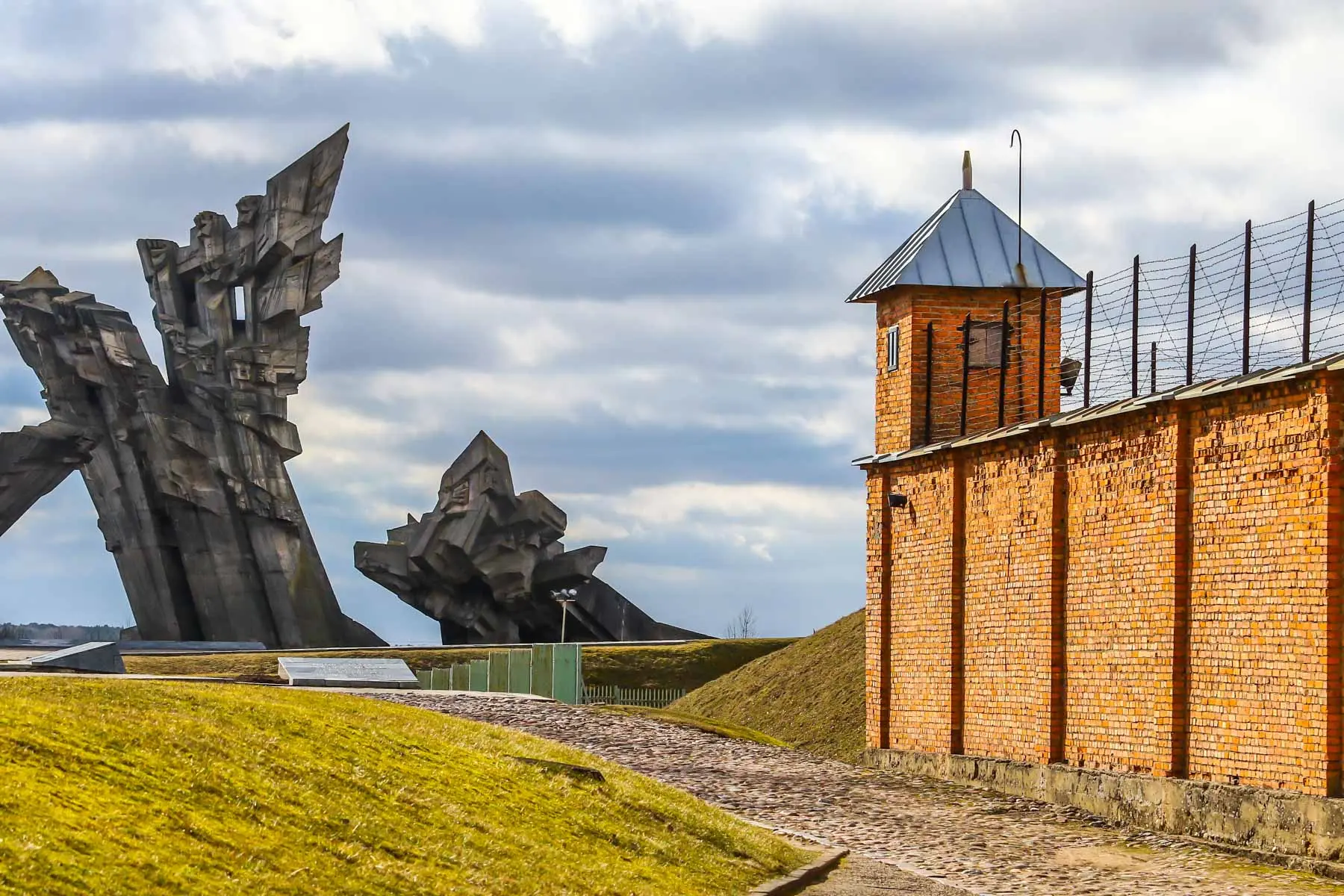
The monument arrived in 1984: three vast concrete forms by the sculptor Alfonsas Vincentas Ambraziūnas, thirty-two metres high, visible from the motorway. It is a genuinely powerful piece of brutalist sculpture and it was built by a state that would not name the victims it commemorated.
The Numbers, the Swastikas, and the Man Who Died in Kassel
The figures have been argued over since the war and the argument is part of the site’s history rather than a footnote to it. The memorial stone in the field states that more than 30,000 Jews from Lithuania and other European countries were killed here. Recent Lithuanian research puts the total number of people murdered at the fort at around 50,000, a figure that includes Soviet prisoners of war and non-Jewish Lithuanians alongside the Jewish majority. Both numbers are defensible; the range exists because the Germans burned the evidence, which was the point.
Independence changed the plaques and did not settle the harder question. Lithuania’s role in its own Holocaust — the auxiliary battalions, the men who staffed the perimeter and pulled triggers at the trenches — remains the most divisive argument in the country’s public life. In April 2011 the memorial was vandalised: tombstones knocked over, white swastikas sprayed across the concrete, Juden raus written on the pavement below.
Helmut Rauca went to Canada in 1950 under his own name, became a citizen in 1956, and lived openly in Toronto for three decades while running a business. A Kaunas ghetto survivor named Elly Gotz, who had settled in the same city, learned that the man who had sorted his family with a swagger stick was living nearby; the RCMP asked Gotz’s mother to confirm the face. Rauca was arrested in 1982 and extradited to West Germany in May 1983, the first Nazi war criminal Canada ever surrendered. He died in a prison hospital in Kassel before his trial could open, on 29 October 1983 — forty-two years to the day after the morning at the Ninth Fort that he was finally going to have to explain.
Visiting the Ninth Fort Museum in Kaunas: What to Expect
The Ninth Fort Museum sits at Žemaičių plentas 73, on the northwestern edge of Kaunas where the motorway to Klaipėda runs past the hill. City buses from the centre take around half an hour and cost about a euro. The museum is closed on Mondays, opens at nine on weekdays and ten at weekends, and everything is captioned in Lithuanian and English. Two hours is the minimum; most people take longer than they planned to.
The site divides into three experiences. The 1984 museum building holds the main exhibition, including material on the Soviet deportations and a section on Chiune Sugihara, the Japanese vice-consul in Kaunas who wrote transit visas against his government’s orders and saved thousands of people before the killing started. The old fort itself is the difficult part: bare casemates, cold stone, the cells with the prisoners’ writing still on the walls, and the steel door with the drilled outline of the opening cut through it. Then you walk outside, past the monument, onto a wide expanse of mown grass with a low memorial stone in the middle of it.
That field is the reason to come, and it is completely unremarkable to look at. There is no trench, no marked pit, no architecture of atrocity to photograph — the Germans took that away in 1943 and the grass has had eighty years to finish the job. Tens of thousands of people are in the ground under it, unnamed and unsorted, mixed with ash. Standing on it feels like standing on nothing at all, which is precisely what the Aktion 1005 brigade was ordered to produce.
They failed by a margin of eleven signatures on a piece of paper and a line scratched into a cell wall by a Frenchman who got the number wrong.
Frequently Asked Questions
What happened at the Ninth Fort in Kaunas?
The Ninth Fort was a Russian imperial fortification on the outskirts of Kaunas that became the main mass killing site in the city during the Nazi occupation of Lithuania. Between 1941 and 1944, victims were held in its casemates and shot at pits dug in the fields behind the walls. Most were Jews from the Kaunas ghetto, but the dead also included Soviet prisoners of war, non-Jewish Lithuanians, and Jews deported from Germany, Austria and France. In 1943 the Germans forced a prisoner brigade to exhume and burn the bodies in an attempt to destroy the evidence.
How many people were killed at the Ninth Fort?
Recent Lithuanian research puts the total at around 50,000 people. The memorial stone in the burial field states that more than 30,000 Jews from Lithuania and other European countries were murdered at the site, and other estimates run between those two figures. The range exists because the Germans burned the bodies and scattered the ash in 1943 under Aktion 1005, deliberately destroying the physical basis for an accurate count. The largest single day was 29 October 1941, when 9,200 people were shot.
What was the Great Action of October 1941?
The Great Action was the largest single massacre of Lithuanian Jews. On 28 October 1941, the entire population of the Kaunas ghetto — roughly 27,000 people — was ordered to assemble at Democrats Square, where SS master sergeant Helmut Rauca sorted them with a swagger stick into those who would live and those who would not. The following day, 2,007 men, 2,920 women and 4,273 children were marched to the Ninth Fort and shot at the trenches. The figures come from the Jäger Report, the German unit’s own operational record.
Why were French Jews sent to the Ninth Fort in Kaunas?
Convoy 73 left the Drancy internment camp near Paris on 15 May 1944 carrying 878 Jewish men, and it was the only French deportation of the war sent to the Baltics rather than Auschwitz. Around 600 men were unloaded at Kaunas and the remainder continued to Tallinn in Estonia. No document has ever been found explaining the decision. Twenty-two of the 878 were still alive in 1945, and their families did not learn where they had been taken until the 1990s, when researchers found their names and the line Nous sommes 900 Français scratched into a cell wall at the fort.
How did 64 prisoners escape from the Ninth Fort?
The escapees were members of the Aktion 1005 brigade forced to dig up and burn the bodies in the fort’s mass graves. Over several weeks, working at night, Pinia Krakinovsky drilled 314 holes in the outline of an opening in a steel door and cut the metal between them with a hand file, disguising the work each morning. On the night of 25 December 1943 — chosen on the assumption that the garrison would be drunk for Christmas — 64 men went through the door and crossed the ditch. Roughly half were recaptured within three weeks; those who survived in the greatest numbers were the ones who hid inside the Kaunas ghetto.
Can you visit the Ninth Fort in Kaunas today?
The Ninth Fort Museum is open to the public at Žemaičių plentas 73, about four kilometres northwest of central Kaunas and reachable by city bus in around half an hour. It is closed on Mondays, and everything is captioned in Lithuanian and English. Visitors can tour the 1984 exhibition building, walk through the original fort with its prisoner inscriptions and the drilled escape door, and cross the burial field beneath Ambraziūnas’s thirty-two-metre concrete monument. Two hours is the practical minimum.
Sources
The Jäger Report: Complete Tally of Executions Carried Out in the Area of Einsatzkommando 3 — Karl Jäger, Yad Vashem Archives (1941)
Evidence of Jewish Escapees from the Ninth Fort in Kovno on the Burning of the Bodies — Yad Vashem Archives (1943)
The Holocaust in the Soviet Union — Yitzhak Arad, University of Nebraska Press (2009)
The Truth and Nothing But the Truth: Jewish Resistance in Lithuania — Aleks Faitelson, Gefen Publishing (2006)
Heroism and Bravery in Lithuania 1941–1945 — Alex Faitelson, Gefen Publishing (1996)
The Shadow of Death: The Holocaust in Lithuania — Harry Gordon, University Press of Kentucky (1992)
The Holocaust in Lithuania 1941–1944 — Arūnas Bubnys, Genocide and Resistance Research Centre of Lithuania (2005)
Encyclopedia of Camps and Ghettos 1933–1945, Volume II: Ghettos in German-Occupied Eastern Europe — United States Holocaust Memorial Museum (2012)
Hidden History of the Kovno Ghetto — United States Holocaust Memorial Museum (1997)
Nous sommes 900 Français: à la mémoire des déportés du convoi n° 73 — Ève Line Blum-Cherchevsky (1999)
War Criminal on Trial: Rauca of Kaunas — Sol Littman, Key Porter Books (1998)
Collaboration and Resistance: The Ninth Fort as a Test Case — Aya Ben-Naftali, Yad Vashem Studies (1999)