On 21 March 1945, an electric crane in the main tunnel of the Mittelwerk lifted a steel beam a few feet off the concrete floor. Thirty men hung from it. Each had a length of wood wired into his mouth so he could not call out to the prisoners below. The bodies stayed up through the shift change. Underneath them, the assembly line kept running — rocket fuselages rolling south on the rails toward the loading bay, past the feet of the men accused of sabotaging them.
The V-2 rocket killed more people in its manufacture than in its use. Every rocket fired at London, Antwerp, Paris and Liège killed somewhere in the region of 9,000 people in total. The programme that produced them killed more than twice that number in the tunnels, the barracks, the subcamps and the evacuation marches. It remains the only weapon in history with that ratio, and the ratio was not an accident of scale. It followed directly from a decision made in the late summer of 1943 to move the entire enterprise underground, where the factory itself had to be dug out by hand before a single rocket could be built.
That decision converted a weapons programme into an excavation programme, and excavation was the one industrial task for which the SS held a limitless supply of labour. Germany in 1943 was short of steel, aluminium, liquid oxygen and skilled machinists. It was not short of prisoners. The Manhattan Project, running at the same moment on the other side of the Atlantic, built the atomic bomb in a purpose-built town of salaried physicists and killed almost nobody in the process — Los Alamos lost one man to a criticality accident before Hiroshima. The Reich built its rocket the other way, and the difference is buried in the hillside above Nordhausen.
Why Germany Moved V-2 Rocket Production Underground in 1943
The RAF Raid on Peenemünde That Forced the Move
The V-2 had a home before it had a tunnel. Peenemünde, on the Baltic island of Usedom, was the army research centre where Wernher von Braun’s team had spent seven years turning a liquid-fuelled rocket into a weapon. On 7 July 1943, von Braun and Walter Dornberger flew to Hitler’s East Prussian headquarters at the Wolf’s Lair and screened colour film of a successful launch. Hitler gave the programme the highest production priority in the Reich and asked whether the rocket could carry a warhead ten times larger.
Six weeks later the RAF answered the question of where it would be built. On the night of 17–18 August 1943, nearly 600 bombers hit Peenemünde in Operation Hydra. The raid killed around 730 people. Most of them were Polish and Russian forced labourers in the Trassenheide camp, whose wooden barracks burned; among the German dead was Walter Thiel, the propulsion engineer who had designed the V-2’s combustion chamber. The bombing set the programme back by a matter of weeks. Its real effect was psychological. Within days, Heinrich Himmler proposed to Hitler that rocket production be moved into caves where no bomber could reach it, and that the workforce be drawn from concentration camps, where secrecy could be enforced by the simple method of never releasing anyone.
Kohnstein Mountain and the Mittelwerk Tunnel Complex
Kohnstein was chosen because most of the digging had already been done. The hill is a mass of anhydrite, a hard gypsum rock stable enough to hold an unlined tunnel, and since 1936 a state fuel agency had been mining it and using the voids to store petroleum reserves. Two parallel galleries, Tunnel A and Tunnel B, ran nearly two kilometres through the hill, linked at intervals by cross-galleries numbered 1 to 46. The layout resembled a ladder, and it happened to be an excellent shape for an assembly line.
The first transport of prisoners arrived from Buchenwald on 28 August 1943, ten days after the Peenemünde raid. There were 107 of them. Within four months there were 10,000. The camp had no name of its own at first — it was Arbeitslager Dora, a subcamp of Dachau’s far larger successor system, administered from Buchenwald sixty kilometres to the south, and it existed on paper as a construction detail. The men who arrived that autumn were not sent to build rockets. They were sent to finish the hole.
Life Inside the Dora Tunnels: The Deadliest Winter of 1943–1944
Sleeping in the Tunnels Without Daylight
Prisoners at Dora lived underground for the first six months. The SS built no barracks, because barracks would have been visible from the air and would have cost time. Instead, cross-galleries 43 to 46 at the northern end of the complex were fitted with wooden bunks stacked four tiers high, and roughly 6,000 men slept there in the dust and noise of a construction site that never stopped. Blasting continued while they slept. The air carried anhydrite dust fine enough to coat the lungs, along with ammonia from the explosives and exhaust from the diesel locomotives that hauled rock out of the galleries.
There was no water for washing. Sanitation was barrels cut in half, set at the ends of the sleeping galleries, emptied when they overflowed. Men who worked twelve-hour shifts in the tunnels went weeks without seeing daylight; those on the night shift sometimes went months. The French survivor Yves Béon, who arrived in 1944, described the sound of the place as continuous — drilling, the crash of rock, the shouting of Kapos amplified by stone walls that returned every noise.
Tuberculosis moved through the sleeping galleries first, then dysentery, then pneumonia. The most common cause of death recorded at Dora in that winter was simply exhaustion, entered on the paperwork as heart failure. Men who could no longer stand were beaten until they stood or until they stopped.
The Death Rate at Dora and the Transports Back to Buchenwald
Roughly 3,000 prisoners died at Dora between October 1943 and March 1944. Dora had no crematorium in that period, so the bodies were stacked at the tunnel mouth and trucked to Buchenwald, sometimes several hundred at a time. The camp administration also ran the traffic in the other direction: prisoners too sick to work were loaded onto transports and sent to Bergen-Belsen, Mauthausen and Majdanek to die elsewhere, keeping the mortality figures in the Dora ledgers artificially low. Around 6,000 men were shipped out this way in the first year.
Albert Speer visited the tunnels on 10 December 1943. He recorded afterwards that the conditions were barbaric, that prisoners were dying of nothing more complicated than filth and airlessness, and that something had to be done. He then wrote to Hans Kammler praising the speed of the construction as an achievement that surpassed anything in America, and authorised the building of an above-ground barracks camp. The barracks went up through the spring of 1944. The death rate fell sharply once men could sleep in wooden huts with windows, which is the clearest possible measure of what the tunnels had been doing to them.
Who Ran Mittelbau-Dora: The SS and the V-2 Rocket Engineers
Hans Kammler and the SS Construction Empire
Hans Kammler was a civil engineer with a doctorate and a talent for delivering impossible schedules. He had overseen the construction planning for the extermination facilities at Auschwitz-Birkenau before Himmler handed him the underground dispersal programme, and he approached rocket production with the same instrument: a labour force that did not need to be housed, fed or preserved. Kammler’s method at Dora was to set a completion date, allocate prisoners against it, and treat their deaths as a consumable input rather than a problem to be solved.
By August 1944 he had been given command of the entire V-2 programme, including its operational firing units, displacing the army officers who had developed it. Kammler moved constantly between sites in an armoured train and left almost no paper trail with his signature on it. He vanished in the first week of May 1945 in Czechoslovakia, and no body was ever identified.
Wernher von Braun’s Visits to the Mittelwerk Factory
Wernher von Braun visited the Mittelwerk at least fifteen times. He was the technical director of the rocket programme, and the tunnels were where his design was being turned into hardware; his presence there was routine, professional and documented in company records. He later described the conditions in the tunnels as hellish and said that his own reaction to seeing them was one of horror.
A letter he wrote on 15 August 1944 sits harder against that account. Writing to Albin Sawatzki, the production chief at the Mittelwerk, von Braun described travelling to Buchenwald in order to select skilled prisoners for transfer to the rocket plant, and arranging their allocation. The letter is administrative in tone. It is the single clearest surviving piece of evidence that the men who designed the V-2 understood exactly where their workforce came from and participated in acquiring it.
Arthur Rudolph, the operations director of the Mittelwerk, attended the meeting in April 1943 at which the decision to use concentration camp labour in rocket production was formally taken. He ran the assembly line for the next two years. Both men would be building rockets for the United States within thirty months of the camp’s liberation.
Sabotage and Public Hangings in the V-2 Assembly Tunnels
How Prisoners Sabotaged V-2 Rockets on the Assembly Line
The V-2 was the most complex machine ever mass-produced up to that point, with more than 20,000 components, and it was assembled almost entirely by men who wanted it to fail. Sabotage at the Mittelwerk was methodical and nearly invisible. Solder joints were made cold, so that they held on the bench and cracked under launch vibration. Wiring was crimped just short of a break. Prisoners urinated into electrical assemblies, knowing that corrosion would take weeks to appear and could not be traced back to a shift. Gyroscope housings were assembled a fraction out of tolerance.
The rockets failed constantly. Of the roughly 3,000 V-2s fired in combat, a large proportion broke up in flight, went off course or exploded on the pad, and the SS could never satisfactorily separate deliberate sabotage from the genuine immaturity of the technology. That ambiguity was fatal for the prisoners. Any failure could be attributed to any worker who had touched the assembly, and the standard of proof was whatever the camp Gestapo decided it was.
The Mass Executions of March 1945
Executions at Dora were staged for maximum visibility. Prisoners were hanged inside the tunnels, in the roll-call area beside the assembly line, and the entire shift was marched past the bodies on the way to work. The first mass hanging took place in November 1944. The largest came in March 1945, when the front was collapsing and production discipline was disintegrating: thirty men on 8 March, thirty more on 21 March, lifted together on a beam slung from an overhead crane.
The wooden gags were an innovation of that final period. Earlier executions had been disrupted by condemned men shouting to the assembled prisoners, so the SS began wiring a stick into the mouth and securing it behind the head. Around 200 prisoners were hanged at Dora in total. Most of them were Russian and Polish, and most were accused of nothing more specific than being near a component that later failed.
The Mittelbau Camp System and the Final Months of the War
Boelcke-Kaserne: The Dying Camp in Nordhausen
Mittelbau grew into a network of around forty subcamps scattered across the Harz mountains, digging further tunnel complexes for aircraft and fuel production. It became an independent camp in October 1944, no longer answering to Buchenwald. In January 1945 the SS took over a former Luftwaffe barracks in Nordhausen, the Boelcke-Kaserne, and turned it into something for which the camp system had no official category: a place to put prisoners who were too ill to work and not yet dead.
Men were laid on concrete floors in unheated garages with no medical care and almost no food. Transports from the east arrived through that winter — thousands of prisoners evacuated from Auschwitz as the Red Army approached, walked and shipped west into a camp already collapsing under its own mortality. Roughly 3,000 people died in the Boelcke-Kaserne in ten weeks. On 3 and 4 April 1945, RAF bombers attacked Nordhausen and destroyed most of the town along with the barracks. Around 1,500 prisoners were killed by British bombs in a building they were not permitted to leave.
Death Marches and the Gardelegen Barn Massacre
The SS emptied Mittelbau-Dora in the first week of April 1945 as American units approached from the west. Roughly 40,000 prisoners were loaded onto open freight cars or marched north and east in columns. Guards shot those who fell behind, and the roadside dead were left where they lay across a hundred kilometres of Thuringia and Saxony-Anhalt.
One column reached the town of Gardelegen on 13 April. The local SS and Luftwaffe men, unable to move the prisoners further and unwilling to release them, herded more than a thousand into a large brick barn on the Isenschnibbe estate, spread petrol-soaked straw across the floor and set it alight. Men who reached the doors were shot. Soldiers of the US 102nd Infantry Division arrived the following day and found 1,016 bodies, some of them still in the doorways where they had died trying to dig out under the walls. The division commander ordered the citizens of Gardelegen to bury each man in an individual marked grave and maintain the cemetery in perpetuity. They still do.
Liberation, Operation Paperclip, and the Dora War Crimes Trial
What American Troops Found at Nordhausen in April 1945
The 3rd Armored and 104th Infantry Divisions reached Nordhausen on 11 April 1945. They were not looking for a camp. They found the bombed Boelcke-Kaserne with around 3,000 corpses lying in and around the buildings and roughly 700 survivors among them, many too weak to indicate which of the two categories they belonged to. Combat soldiers spent three days carrying bodies out. Army photographers recorded the site, and the Nordhausen images became some of the most widely published evidence of the camp system in the American press that spring.
Ordnance officers entered the tunnels within days and understood immediately what they were standing in. Under Special Mission V-2, Major James Hamill stripped the Mittelwerk of enough components to assemble around 100 rockets and moved them out on 341 railway wagons, finishing in late May. Thuringia had already been assigned to the Soviet occupation zone under the Yalta agreements. The Americans were removing the hardware ahead of a handover they knew was coming, and they completed it with weeks to spare.
From the Mittelwerk to the Saturn V: Operation Paperclip
Von Braun and around 120 of his engineers surrendered deliberately to American troops in Bavaria in May 1945 and were brought to the United States under Operation Paperclip. Their security files were rewritten to remove the political and moral obstacles to their employment. Arthur Rudolph, who had run the Mittelwerk assembly line, became project manager for the Saturn V — the launch vehicle that carried Apollo 11 to the Moon in July 1969. Von Braun ran the Marshall Space Flight Center in Huntsville, Alabama, and became the most recognisable public face of American spaceflight.
The bargain was standard practice rather than an aberration. American authorities were making the same calculation across two theatres in the same period, granting immunity to the staff of Japan’s Unit 731 in exchange for their human experimentation data. Technical knowledge was treated as an asset that could be separated from the circumstances of its production, and in both cases the men who held it walked into postwar careers.
The Dora Trial and the Deportation of Arthur Rudolph
Nineteen men stood trial for crimes at Mittelbau-Dora before an American military court at Dachau between August and December 1947. Hans Möser, the SS officer who had personally supervised executions in the tunnels, was sentenced to death and hanged in November 1948. Fifteen others received prison terms, most of which were substantially reduced within a few years. Georg Rickhey, the general director of the Mittelwerk, had been brought to the United States under Paperclip, was returned to Germany to stand trial, was acquitted, and went home.
Arthur Rudolph’s reckoning arrived thirty-seven years late. The US Justice Department’s Office of Special Investigations opened a file on him in 1982, and in 1984 he agreed to renounce his American citizenship and leave the country rather than face denaturalisation proceedings. He died in Hamburg in 1996, still insisting he had done nothing but manage a factory. West Germany investigated him and declined to prosecute. The retired NASA engineers who had worked under him on the Saturn V campaigned for years to have his name cleared.
Visiting the Mittelbau-Dora Memorial and Tunnels in Thuringia
The memorial sits five kilometres north of Nordhausen, reachable by tram from the town centre and about an hour by train from Erfurt. Admission is free. The permanent exhibition opened in 2006 in a low building at the edge of the former roll-call square, and the ground beyond it is largely empty — the SS burned the barracks camp during the evacuation, and only foundations, the fire pond and the crematorium remain above ground.
The crematorium is the hardest part of the site. It stands uphill from the camp, a small brick building with two ovens, and the path to it climbs the same slope that prisoners were made to climb carrying the dead.
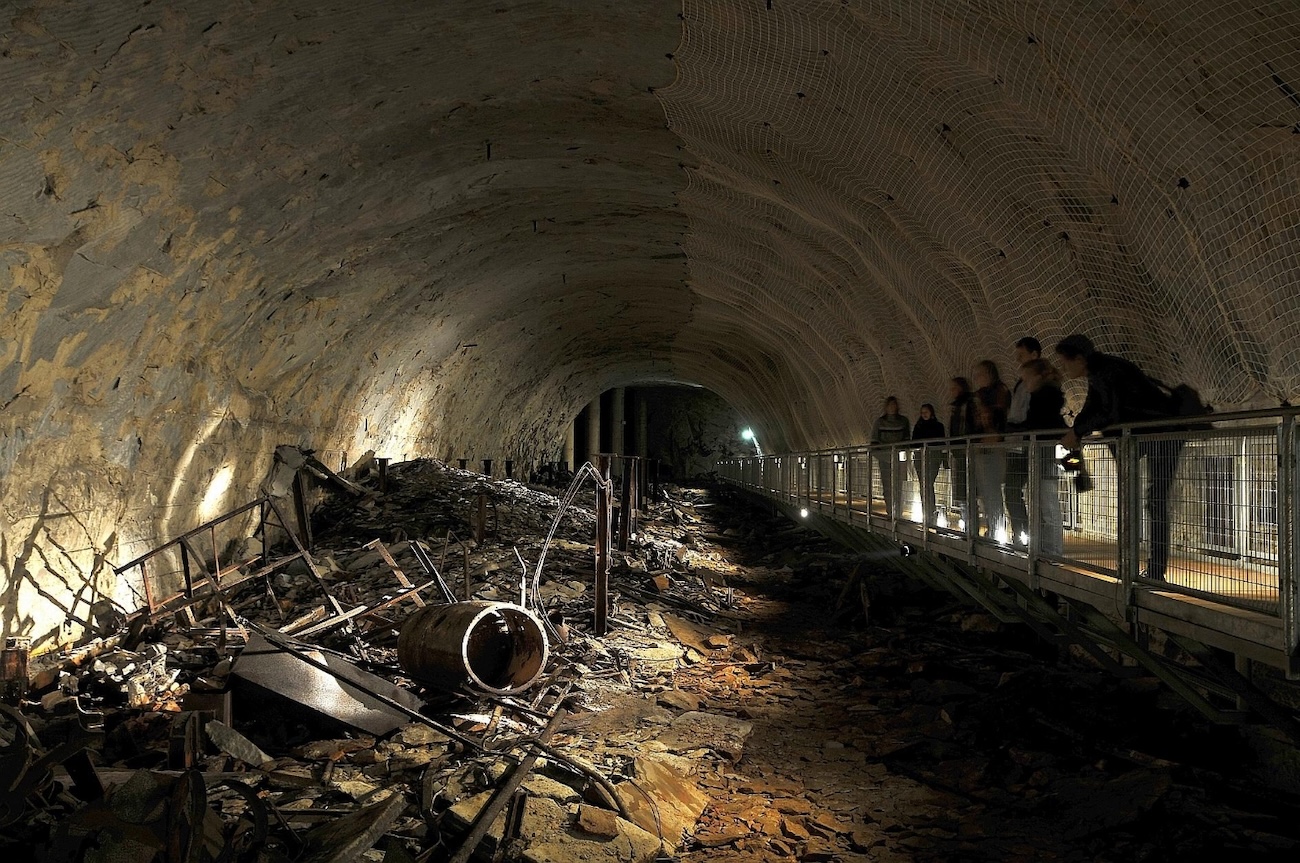
Access to the tunnels is by guided tour only, and the tours fill in advance during summer. The Soviets blew the entrances in 1948; a section of Tunnel B was reopened in 1995 and can be walked. The temperature inside holds at around 8°C year-round regardless of the season outside, and the air is damp and completely still. Rocket components lie where they were left — sections of fuselage, a combustion chamber, twisted rail. The tour route is well lit and level, though the cold is severe enough that a coat matters in August.
What the site does not offer is a rocket. There is no restored V-2 standing on a plinth, and the omission is deliberate. The memorial’s argument, made consistently across its exhibition and its tours, is that the V-2 was never primarily a triumph of engineering that happened to have been built by prisoners. It was a project in which the engineering and the killing were the same undertaking, carried out by the same organisation, at the same address. The Saturn V that left Florida in 1969 traces a direct line of design and personnel back to this hill, and the memorial asks visitors to hold both facts at once rather than choosing between them.
Twenty thousand people died here so that a machine could exist. The machine worked. That is the whole of it, and the tunnels are still there under the trees.
Frequently Asked Questions About Mittelbau-Dora
What was Mittelbau-Dora?
Mittelbau-Dora was a Nazi concentration camp near Nordhausen in central Germany, established in August 1943 to supply forced labour for an underground V-2 rocket factory called the Mittelwerk. The factory occupied a tunnel system inside Kohnstein mountain, roughly 20 kilometres of galleries originally dug as a fuel store. Around 60,000 prisoners passed through the camp and its forty subcamps in twenty months. It began as a subcamp of Buchenwald and became an independent camp in October 1944.
How many people died at Mittelbau-Dora?
Roughly 20,000 prisoners died in the Mittelbau-Dora system. Around 3,000 of those deaths occurred in the first six months, when prisoners slept inside the tunnels with no daylight, no washing water and continuous blasting dust. Thousands more died in the Boelcke-Kaserne dying camp in Nordhausen, in the subcamps of the Harz mountains, and during the evacuation marches of April 1945. The death toll exceeds the number of people killed by every V-2 rocket ever fired, which stands at roughly 9,000.
Did Wernher von Braun know about the concentration camp at the Mittelwerk?
Wernher von Braun visited the Mittelwerk at least fifteen times as technical director of the rocket programme and later described the conditions there as hellish. A letter he wrote on 15 August 1944 records him travelling to Buchenwald to select skilled prisoners for transfer to the rocket plant and arranging their allocation. He was never prosecuted. He was brought to the United States under Operation Paperclip in 1945 and became director of NASA’s Marshall Space Flight Center.
Why were the V-2 rockets built underground?
The RAF bombed the rocket development centre at Peenemünde on the night of 17–18 August 1943, killing around 730 people and demonstrating that the programme was within reach of British bombers. Heinrich Himmler proposed moving production into caves beyond the reach of air attack, staffed by concentration camp prisoners so that secrecy could be enforced absolutely. Kohnstein mountain was selected because a state fuel agency had already excavated two parallel tunnels through it. Prisoners were sent to enlarge those tunnels by hand before rocket assembly could begin.
What happened to the Mittelwerk tunnels after the war?
American ordnance officers stripped the factory in May 1945 under Special Mission V-2, removing enough components for around 100 rockets on 341 railway wagons before Thuringia was handed to the Soviet occupation zone. Soviet forces demolished the tunnel entrances in 1948. A section of Tunnel B was reopened in 1995 and now forms part of the memorial’s guided tour. Rocket components remain inside where they were abandoned.
Can visitors enter the Mittelbau-Dora tunnels today?
Access to the tunnels is by guided tour only, booked in advance, and tours fill quickly in summer. Admission to the memorial and its permanent exhibition is free. The site lies five kilometres north of Nordhausen and is reachable by tram from the town centre. The tunnel interior holds a constant temperature of around 8°C regardless of the season, so warm clothing is necessary even in August.
Sources
The Rocket and the Reich: Peenemünde and the Coming of the Ballistic Missile Era — Michael J. Neufeld (1995)
Von Braun: Dreamer of Space, Engineer of War — Michael J. Neufeld (2007)
Produktion des Todes: Das KZ Mittelbau-Dora — Jens-Christian Wagner (2001)
Mittelbau-Dora Concentration Camp 1943–1945: Guide to the Permanent Exhibition — KZ-Gedenkstätte Mittelbau-Dora (2010)
Planet Dora: A Memoir of the Holocaust and the Birth of the Space Age — Yves Béon (1997)
Dora — Jean Michel (1979)
United States of America v. Kurt Andrae et al. (Case 000-50-37), Dachau Military Tribunal Records — United States Army (1947)
Secret Agenda: The United States Government, Nazi Scientists, and Project Paperclip — Linda Hunt (1991)
Operation Paperclip: The Secret Intelligence Program That Brought Nazi Scientists to America — Annie Jacobsen (2014)
V-2: A Combat History of the First Ballistic Missile — T.D. Dungan (2005)
Inside the Third Reich — Albert Speer (1970)
Concentration Camps in Nazi Germany: The New Histories — Jane Caplan and Nikolaus Wachsmann (2010)