Origins of the First Nazi Concentration Camp
The history of the Holocaust and the Nazi carceral system begins geographically in Upper Bavaria, on the swampy, fog-laden industrial grounds of a defunct Royal Bavarian powder and munitions factory. Located just ten miles northwest of Munich, the Dachau Concentration Camp was not an anomaly of the late war years but a foundational pillar of the Third Reich, opened merely weeks after Adolf Hitler became Chancellor.
On March 22, 1933, Heinrich Himmler, then the Police President of Munich, officially announced the opening of the camp in a press conference. His statement, published in the Münchner Neueste Nachrichten, was chillingly bureaucratic: it was to be a facility for "the concentration of all Communist and Social Democratic functionaries who endanger the security of the state."
This announcement marked a critical turning point in the history of the twentieth century. Unlike the wild, unauthorized torture cellars initially run by the SA (Stormtroopers) in the early days of the regime—often located in basements or pubs—Dachau was a state institution. It was designed for durability, capacity, and legalistic terror. It operated for the entirety of the Nazi regime, from 1933 until liberation in 1945, serving as the longest-running concentration camp. This longevity meant that Dachau evolved alongside the regime itself, transforming from a detention center for political dissidents into a massive hub of slave labor and, eventually, a dumping ground for the dying remnants of the camp system as the Allies closed in.
The significance of Dachau lies in its role as the "Position Zero" of the Nazi carceral state. It was here that the SS consolidated its power, wresting control of the camps away from the SA and the judiciary. It was here that the legal frameworks of "protective custody" (Schutzhaft) were tested and perfected, allowing the state to imprison individuals indefinitely without trial or judicial review. Dachau was the laboratory where the Nazis learned how to run a concentration camp, establishing the administrative blueprints that would later be replicated at Buchenwald, Sachsenhausen, and eventually, the extermination complexes like Auschwitz.
The camp's location was strategic; Munich was the "Capital of the Movement," and having the camp nearby served as a constant, silent threat to the population of the city. The phrase "Lieber Gott, mach mich stumm, dass ich nicht nach Dachau kumm" (Dear God, make me mute, that I may not go to Dachau) became a grim whisper among the Bavarian populace.
The Anatomy of the Landscape: Architecture of Control
The Geometry of Submission and the Appellplatz
The physical layout of Dachau was a carefully engineered mechanism of psychological domination. When the camp was rebuilt and expanded in 1937–38 by prisoner labor, the architects eschewed organic design for a rigid, rectangular grid designed to strip prisoners of their individuality and enforce total surveillance. The camp was bisected by the Lagerstrasse (camp road), lined by poplars, which separated the administrative areas from the prisoner compound. This road was the spine of the camp, a threshold that divided the world of the perpetrators from the world of the victims.
At the heart of this grid lay the Appellplatz (roll call square), a vast, exposed expanse of gravel capable of holding tens of thousands of men. This square was the theater of the camp's daily terror. Twice a day, morning and evening, prisoners were forced to assemble here for roll call (Zählappell). This was not merely a logistical head count; it was a ritual of submission. Prisoners were forced to stand at rigid attention for hours, sometimes continuously for an entire day and night, regardless of rain, snow, or sub-zero temperatures. If a prisoner had escaped or a discrepancy in numbers occurred, the entire camp population suffered. The architecture of the square—wide, open, and surrounded by machine gun nests on the rooftops of the maintenance buildings—ensured that every prisoner felt small, exposed, and utterly powerless against the wall of SS authority.
The Jourhaus and the Threshold of Terror
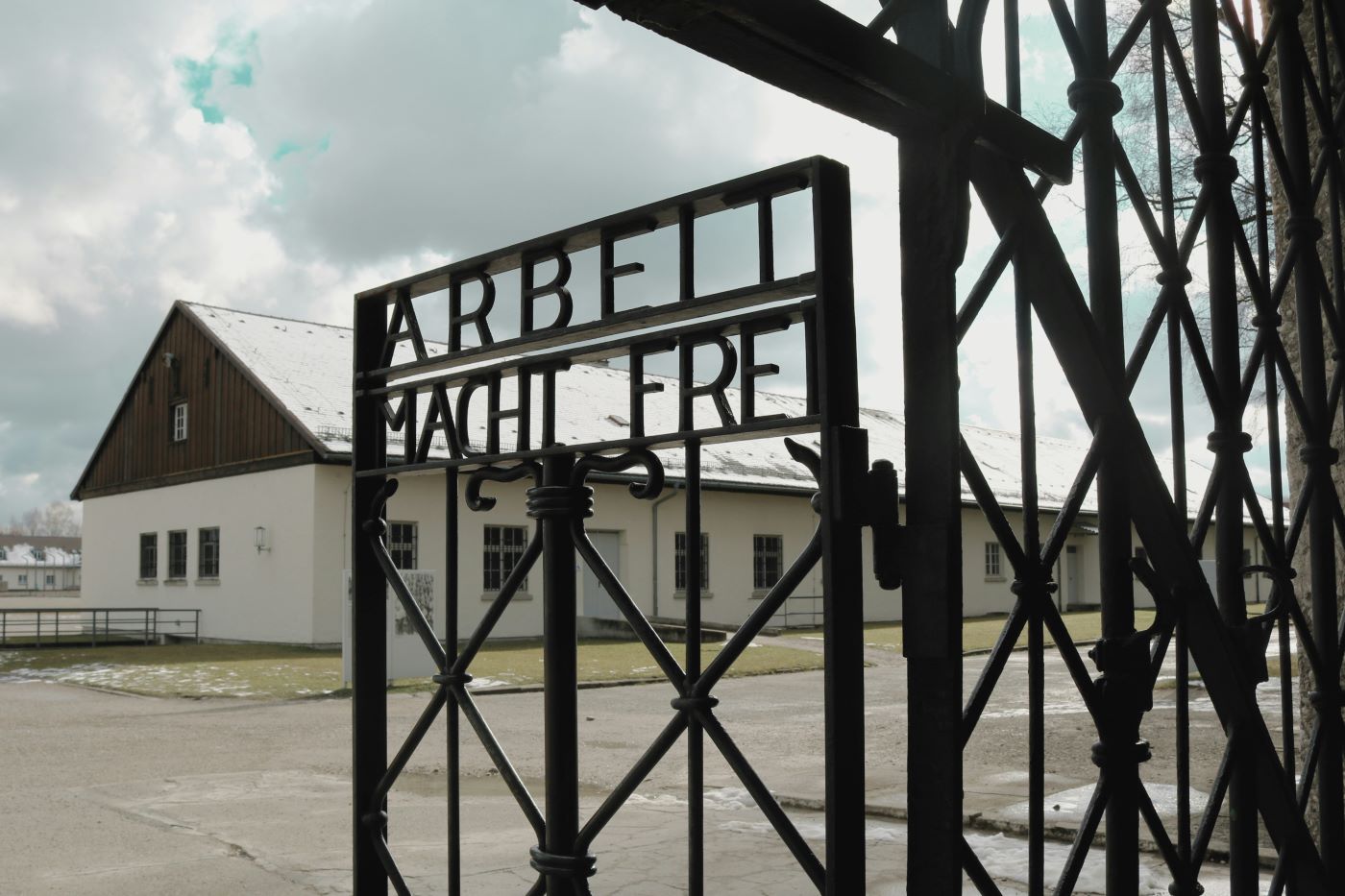
Entry into this world of organized brutality was strictly channeled through the Jourhaus, the main gatehouse that served as the administrative command center and the only entrance to the prisoner compound. It is here that the infamous wrought-iron gate bears the inscription "Arbeit Macht Frei" (Work Sets You Free). While this slogan later appeared at Auschwitz and other camps, it was popularized here. In the context of 1933, it was a cynical psychological weapon, suggesting a false promise of "re-education" and rehabilitation through hard labor. For the incoming political dissidents, and later the Jewish prisoners and clergy, passing through this gate meant crossing a threshold from civil society into a state of total rightlessness.
The building itself looms over the entrance, embodying the unchecked authority of the SS. Upstairs sat the offices of the Schutzhaftlagerführer (protective custody camp leader), while the windows looked down directly onto the Appellplatz, reinforcing the Panopticon-like surveillance of the site. The gatehouse was the dividing line between life and death; once inside, the laws of the outside world no longer applied. The SS guards at the gate were the gatekeepers of a separate reality, one where murder was not a crime but an administrative procedure.
The Bunker and the Neutral Zone
Within the camp perimeter lay a prison within the prison: the "Bunker," or the camp arrest building. This T-shaped structure was where the SS conducted enhanced interrogations and carried out specific punishments. It housed tiny standing cells and darkened cells where prisoners were kept in total isolation for weeks or months. The Bunker was a place of silence and terror, where the screams of tortured prisoners were muffled by thick walls. It was here that Georg Elser, the carpenter who attempted to assassinate Hitler in 1939, was held in special isolation for years before being executed weeks before the liberation.
Behind the Bunker was the execution range and the "neutral zone"—a strip of grass before the electrified barbed wire fence and the moat. Prisoners were forbidden to step onto this grass; doing so authorized the guards in the watchtowers to shoot to kill immediately. This "neutral zone" became a common method of suicide for prisoners pushed beyond their breaking point, who would run toward the wire to induce a guard's bullet. The SS referred to this cynically as "suicide by guard," a final act of desperation for those who could no longer endure the suffering.
The Academy of Violence: Theodor Eicke and the SS
The Eicke System and the School of Violence
Dachau’s historical weight is heavily defined by the tenure of its second commandant, Theodor Eicke. Appointed in June 1933, Eicke was a fanatical Nazi who viewed the early, somewhat disorganized administration of the camp as inefficient. He quickly reorganized the camp to establish what became known historically as the "Dachau Model." Eicke drafted the "Disciplinary and Penal Code" (Lagerordnung), a rigid set of regulations that standardized punishment and institutionalized brutality.
Under Eicke, the whim of individual guards was replaced by a systematized terror. The regulations prescribed specific punishments for specific infractions—25 lashes for sabotage, solitary confinement for insubordination, death for incitement. This bureaucratic veneer gave the violence a semblance of legality and order. Eicke’s philosophy was simple and devastating: pity was a weakness, and the prisoners were to be treated as "agitators" and "enemies of the state." He famously told his SS men, "There is only one thing that counts: orders!" Eicke succeeded in isolating the camp from the outside legal world, creating a "state within a state" where the SS was the police, the judge, and the executioner.
Desensitization and the Creation of the Totenkopfverbände
Perhaps the most sinister function of Dachau was its role as a training academy. The camp served as the primary recruitment and training center for the SS-Totenkopfverbände (Death’s Head Units), the paramilitary branch of the SS responsible for administering the entire concentration camp system. Young SS recruits were rotated through Dachau specifically to be hardened. They were subjected to intense ideological indoctrination that portrayed prisoners not as humans, but as "sub-human" threats to the German blood and soil.
This desensitization was achieved through participation in violence. Recruits were forced to watch and eventually participate in corporal punishment, such as the public floggings carried out on the Bock (whipping block) in the roll call square. They learned to execute summary justice without hesitation. The men who learned their trade at Dachau—men like Rudolf Höss (who would go on to command Auschwitz), Adolf Eichmann, and Josef Kramer—exported the "Dachau spirit" to the extermination camps in the East. In this sense, Dachau was the university of the Holocaust; the methods of dehumanization refined here were the prerequisite for the industrial genocide that followed. The brutalization of the guards was as systematic as the brutalization of the prisoners; Eicke created a cadre of men for whom violence was a professional qualification.
The Historical Reality: Demographics, Labor, and Death
The Prisoner Population and the Hierarchy of Suffering
While Dachau was initially established for German communists, social democrats, and trade unionists, the demographic composition of the camp expanded rapidly to mirror the regime's widening circle of enemies. By the late 1930s, the camp held "asocials," Romani people, homosexuals, and Jehovah’s Witnesses. Following Kristallnacht in November 1938, more than 10,000 Jewish men were interned in Dachau, marking a shift toward the racial persecution that would define the later years of the Holocaust.
A unique feature of Dachau was the "Priest Barracks" (Priesterblock). Over 2,700 clergy members, the vast majority of them Catholic priests from Poland, were incarcerated here. This specific concentration of religious figures turned the camp into a center of ecclesiastical resistance and suffering. The Vatican eventually negotiated for all clergy held in the camp system to be centralized at Dachau, though this did little to alleviate their suffering. They were subjected to the same starvation and forced labor as other inmates, often singled out for humiliation by the SS guards who viewed Christianity as a rival ideology to Nazism.
Within the prisoner population, the SS instituted a hierarchy of control using the Kapo system. Prisoner functionaries (Kapos) were inmates appointed to supervise other prisoners. Often selected from the "criminal" class of prisoners (marked with green triangles), these men were given special privileges—better food, better clothing—in exchange for maintaining ruthless order in the barracks and work details. This system turned victim against victim, shattering solidarity and ensuring the SS could control thousands of men with a minimal number of guards. The political prisoners (red triangles) constantly vied for these positions to protect their own networks, creating a complex and deadly internal politics within the camp.
The Economics of Slavery and Sub-Camps
Dachau was not just a prison; it was a business. The SS monetized prisoner labor through SS-owned enterprises. Initially, prisoners worked in the camp workshops, a bakery, a slaughterhouse, and a large plantation (Die Plantage) used for growing medicinal herbs. This plantation work was notoriously brutal, involving long hours of exposure to the elements with minimal food. The SS profited immensely from this slave labor, charging private companies and the state for the use of the prisoners.
As the war turned against Germany, the demand for armaments transformed Dachau into the center of a sprawling network of sub-camps (Außenlager). By 1944, there were nearly 140 sub-camps surrounding Dachau, supplying slave labor to companies like BMW and Messerschmitt. The most notorious of these were the Kaufering and Mühldorf complexes, where prisoners were forced to build underground aircraft factories. The conditions in these sub-camps were often worse than in the main camp; at Kaufering, prisoners lived in earthen pits and were worked to death in a process the Nazis termed "extermination through labor." The average life expectancy in these sub-camps was measured in weeks. The bodies were often transported back to the main camp for cremation, overwhelming the facilities.
Medical Experiments and Action 14f13
The camp was also a site of pseudo-scientific atrocities conducted under the guise of medical research. Dr. Claus Schilling, a tropical medicine specialist, infected over 1,000 prisoners with malaria to test various immunizations and treatments. Many died from the disease or the toxic doses of drugs. Simultaneously, doctors from the Luftwaffe used prisoners as involuntary test subjects for high-altitude and hypothermia experiments. To simulate pilots ejected at high altitudes, prisoners were locked in decompression chambers where the air pressure was drastically lowered, causing agonizing death or permanent injury. Others were submerged in tanks of freezing water for hours to study the limits of human survival and methods of rewarming.
Furthermore, Dachau played a key role in "Action 14f13," the extension of the T4 Euthanasia program into the concentration camps. SS doctors screened prisoners for illness, disability, or exhaustion. Those deemed unfit for work were not treated but were transported to Hartheim Castle near Linz, Austria, where they were gassed. This bureaucratic murder was disguised as a "transfer for convalescence," but the prisoners knew that a selection for Hartheim was a death sentence.
Baracke X and the Machinery of Death
Beyond the infirmary, the infrastructure of death was formalized in Baracke X, the new crematorium built in 1942. The original crematorium had become insufficient for the rising mortality rate caused by typhus, malnutrition, and execution. Baracke X was a brick building housing four large ovens and a gas chamber disguised as a shower room. While historical consensus indicates that the gas chamber at Dachau was never used for mass gassing operations on the scale of Auschwitz or Treblinka, it was fully functional and used for testing. The ovens, however, ran continuously. By the end of the war, even these ovens could not keep up with the dying. When coal supplies ran out in April 1945, the bodies simply piled up outside the building, creating the horrific scenes later captured by American liberation forces.
Visiting the Site: The Memorial Experience
The Journey from Munich and the Modern Site
Today, the journey to the Dachau Concentration Camp Memorial Site begins with a mundane suburban commute. Visitors typically take the S2 train from Munich to the town of Dachau, a twenty-minute ride that feels jarringly normal. From the station, the 726 bus ferries tourists to the visitor center. The path leads visitors along the same route prisoners once marched, transitioning from the quiet, leafy streets of a Bavarian town to the stark, gravel expanse of the camp. The contrast is the first thing that strikes you; the proximity of ordinary residential houses to the camp walls serves as a physical reminder of how close the terror was to everyday life. The town of Dachau did not exist in a vacuum; the smoke from the crematorium was visible, and the smell was undeniable.
The Memorial Landscape and Religious Remembrance
Entering the site through the Jourhaus, visitors are confronted with the immense emptiness of the Appellplatz. The barracks were torn down after the war, but their foundations have been reconstructed in concrete, stretching out in endless rows that emphasize the scale of mass imprisonment. Two barracks have been reconstructed to demonstrate the living conditions—from the early period, where conditions were harsh but livable, to the late war period, where hundreds of men were packed into wooden bunks designed for dozens, sleeping on top of one another in filth.
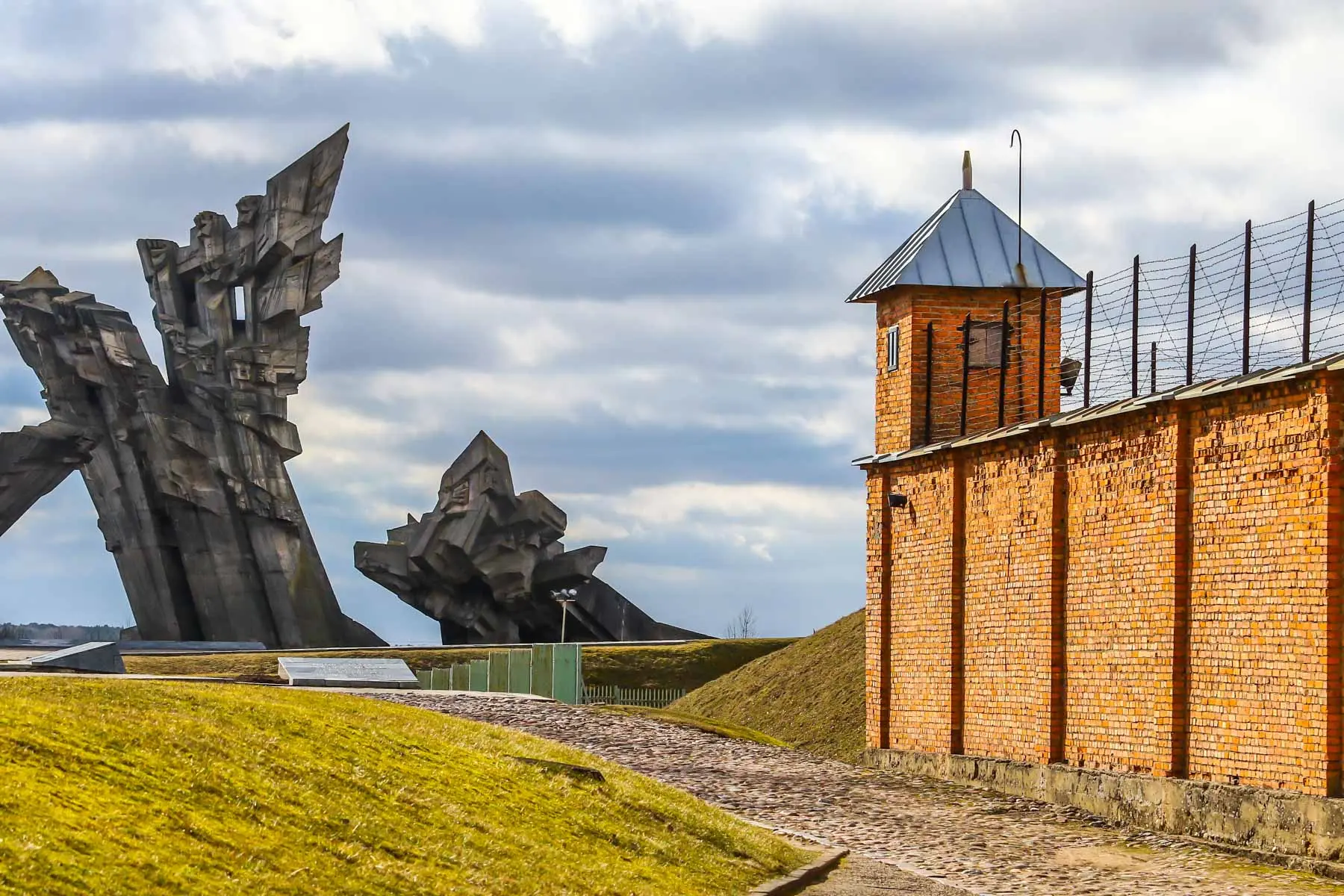
The central axis of the camp is now dominated by the International Monument, designed by Nandor Glid. It features a haunting sculpture of emaciated figures entangled in barbed wire, a jagged, dark mass that captures the agony of the victims. At the northern end of the camp, passed the rows of barrack foundations, stands the religious memorial area. Here, the Catholic Mortal Agony of Christ Chapel, the Protestant Church of Reconciliation, and the Jewish Memorial stand in a semicircle. There is also a Russian Orthodox chapel built of timber on a bed of soil brought from the Soviet Union. These structures offer spaces for silence and contemplation, breaking the sterile geometry of the SS architecture.
The most harrowing section of the site remains Baracke X. To reach it, visitors must cross the Würm river bridge, moving away from the main prisoner compound. The building is preserved largely as it was in 1945. Visitors can walk through the disinfection chambers, the waiting rooms where prisoners were told to undress, and the gas chamber itself—a low-ceilinged room with fake showerheads. Beyond lies the crematorium room, where the brick ovens still stand, their metal stretchers waiting. It is a place of heavy, suffocating silence, where the industrial scale of the Holocaust becomes tangible.
Conclusion: The Legacy of Liberation and the "Dachau Trials"
When the 42nd ("Rainbow") and 45th ("Thunderbird") Infantry Divisions of the US Army liberated Dachau on April 29, 1945, they uncovered horrors that hardened combat soldiers could barely comprehend. Upon approaching the camp, they discovered the infamous "death train" from Buchenwald parked on a siding—dozens of cattle cars filled with over 2,000 corpses of prisoners who had died of starvation and exposure during the transfer. The smell of death permeated the air for miles. Inside the camp, they found 30,000 survivors, emaciated and riddled with typhus, living amongst the dead.
The liberation was chaotic and violent. Overwhelmed by the atrocity, some American soldiers summarily executed SS guards found at the camp, an event known as the Dachau liberation reprisals. The most well-known incident occurred at the coal yard, where machine gun fire cut down SS personnel. In the days that followed, the US Army struggled to contain the typhus epidemic, quarantining the camp and setting up emergency hospitals.
In the aftermath of the war, Dachau became the site of the American military tribunals, known as the "Dachau Trials." Between 1945 and 1948, nearly 1,700 defendants were prosecuted here for crimes committed at Dachau and its sub-camps, establishing legal precedents for the Nuremberg trials. Interestingly, before becoming a memorial, the site served as a refugee camp for "ethnic Germans" expelled from Eastern Europe, adding another layer of complex history to the grounds.
Today, the Dachau Memorial Site operates not just as a museum, but as a warning. It is a site of "Substantive Awe," demanding a confrontation with the darkest capabilities of human nature. The slogan "Never Again" resonates with particular force here, in the place where the system began. As visitors leave the camp and return to the comfortable streets of Dachau town, the enduring lesson is the terrifying ease with which a civilized society can construct an academy of terror in its own backyard, normalizing the unthinkable until it becomes routine.
FAQ
Is the gas chamber at Dachau original?
The gas chamber located in Baracke X is the original structure built in 1942; it is not a reconstruction. Unlike the wooden barracks which were torn down and later rebuilt as concrete outlines or museum exhibits, the crematorium complex remained largely intact after the war. While the gas chamber was fully functional and equipped with fake showerheads to deceive victims, historical evidence suggests it was never used for mass gassing operations on the scale of camps like Auschwitz. It was, however, used for testing and training by SS doctors and commanders.
How many people died at Dachau?
Between 1933 and 1945, there were more than 200,000 prisoners registered at Dachau and its sub-camps. Of those, at least 41,500 are documented to have died from starvation, disease, torture, and execution. This figure does not include the thousands of unregistered prisoners, particularly Soviet POWs and Jews sent for immediate execution, nor does it fully account for the death marches that occurred in the final weeks of the war.
Can visitors enter the Bunker prison?
Yes, the "Bunker" (the camp prison) is accessible to visitors. It has been converted into a museum exhibition space detailing the history of the SS and the specific torture methods used on high-profile prisoners. Visitors can walk through the corridor and see the cell doors, as well as the courtyard where corporal punishment was administered. The exhibition provides a focused look at the individual stories of "special prisoners" like Georg Elser.
What happened to the SS guards after liberation?
Following the liberation, American forces detained the surviving SS personnel. Between 1945 and 1948, the US military held the Dachau Trials on the camp grounds. These tribunals tried 1,672 individuals for war crimes committed at Dachau and other camps. Of these, 426 were sentenced to death, though many sentences were later commuted. Commandant Martin Weiss was among those executed.
Sources & References
- Dachau Concentration Camp 1933–1945 - KZ-Gedenkstätte Dachau (2023)
- Dachau: The First Concentration Camp - United States Holocaust Memorial Museum (2024)
- The Dachau Gas Chamber - Jewish Virtual Library (2024)
- Timeline of Dachau - PBS Frontline (2023)
- Dachau Concentration Camp - Encyclopedia Britannica (2024)
- The Liberation of Dachau - The National WWII Museum (2022)
- Dachau: Prototype of the Nazi Concentration Camps - Yad Vashem (2023)
- Legacies of Dachau: The Uses and Abuses of a Concentration Camp - Harold Marcuse (2001)