Ghulam Dastagir was the deputy stationmaster at Bhopal Junction on the night of 2 December 1984, and the gas reached his platform some time after midnight. Passengers waiting for the Gorakhpur Express began coughing, then choking, then falling where they stood. Dastagir stayed at his post. He sent the message down the line that held incoming trains outside the city, so that no more passengers would be delivered into a cloud nobody could yet name, and he went on working the platform while people died around him. He survived that shift. He died years later of what it had done to his lungs.
The release itself took roughly two hours. Everything else has taken forty-one years and is not finished. The chairman of Union Carbide was arrested in Bhopal five days later and flown out of the country the same afternoon, never to return. The company settled in 1989 for $470 million, a sum that worked out to a few hundred dollars per death. The factory was never remediated, its poisons went into the aquifer, and the communities around it drew drinking water from that aquifer for roughly three decades. The 337 tonnes of packaged waste stacked inside the plant did not leave the gates until 1 January 2025.
That asymmetry is the subject. A disaster that takes two hours to cause can take four decades to not clean up, when the cost of the cleanup sits in one country and the power to compel it sits in another.
Why Union Carbide Built a Pesticide Plant in the Middle of Bhopal
Sevin, the Green Revolution and the Promise of 1969
India in the late 1960s was building its way out of famine. The Green Revolution required fertiliser, irrigation and pesticide, and Union Carbide India Limited — majority-owned from Danbury, Connecticut — proposed a plant in Bhopal to manufacture Sevin, a carbamate insecticide, close to the cotton and grain belts that would buy it. The state offered land at a favourable rate. The plant opened in 1969 as a symbol of exactly what a newly industrialising country wanted to be seen doing.
Sevin’s manufacture runs through methyl isocyanate, a compound that reacts violently with water and attacks any moist tissue it touches. Bhopal stored it in bulk: three partly buried tanks, each holding tens of thousands of litres. Bayer’s equivalent operation in Germany kept its inventory minimal and made the compound as it was consumed. Bhopal kept a reservoir.
The Bastis That Grew Against the Factory Wall
Land in Indian cities is allocated by the market at the centre and by improvisation at the edges, and the strip beside a factory wall is cheap because nobody with options wants it. Settlements called JP Nagar, Kazi Camp and Chhola Kenchi grew directly against the Union Carbide perimeter over the 1970s, housing people who worked in the old city and had nowhere nearer to live. The same economics produce the same result across the country, most visibly in Mumbai’s Dharavi, where an entire industrial district assembled itself on marginal ground because that ground was available.
The state of Madhya Pradesh granted those settlers thirty-year leases in 1984, formalising their tenure a few months before the gas came over the wall. The people who died first were the people the government had just given legal title to live there.
The Safety Systems That Were Switched Off Before December 1984
A Loss-Making Plant and the Cuts That Followed
Sevin sold badly. Indian farmers facing drought bought less pesticide than the plant’s business case assumed, and by the early 1980s the Bhopal operation was losing money and running far below capacity. Union Carbide considered dismantling the plant and shipping it elsewhere.
The response in the meantime was reduction. The workforce fell by hundreds. The crew on the MIC unit was cut roughly in half. The maintenance supervisor post on the night shift was eliminated entirely. Training periods were shortened, experienced operators left for jobs at plants that were not visibly dying, and the manuals stayed in English at a site where much of the workforce did not read it comfortably.
A safety audit conducted by Union Carbide’s own American engineers in 1982 identified dozens of hazards at Bhopal, including the risk of a runaway reaction in the MIC storage tanks. The findings were transmitted. Most were not acted on.
Refrigeration, Flare Tower and Scrubber: Three Defences, None Working
MIC is supposed to be kept cold. The Bhopal tanks had a refrigeration unit designed to hold the contents near freezing, which slows any reaction enough to give operators time. In June 1984 the refrigeration was shut down to save money and its coolant drained for use elsewhere on the site. The high-temperature alarm was reset upward so that it would not sound constantly against the new normal.
The flare tower, meant to burn escaping gas before it reached the air, was out of service with a corroded connecting pipe removed for repair. It was in any case sized for routine venting rather than for a tank emptying itself.
The vent gas scrubber, meant to neutralise MIC with caustic soda, was on standby and rated for a fraction of the flow that arrived.
The last line was a water curtain intended to knock down anything that got past the rest. It threw water about thirteen metres. The gas left the stack at around thirty-three.
Every one of those four systems failed on the same night, which is the detail that makes Bhopal something other than an accident. Four independent defences do not fail simultaneously by chance. They fail simultaneously because the same decision degraded all of them.
The Night of 2–3 December 1984: How the Gas Escaped Tank 610
Water in the Tank and the Runaway Reaction
Around 500 kilograms of water entered Tank 610 during a pipe-washing operation on the evening of 2 December. Water and methyl isocyanate react exothermically, and the reaction accelerates as it heats.
Workers in the MIC unit noticed their eyes stinging at about eleven that night, which was not in itself unusual at Bhopal. A pressure reading was logged as rising and treated as an instrument problem, because the instruments at the plant were frequently wrong. The operator Suman Dey went to check the tank gauges and found the temperature past the maximum the dial could display.
Inside the tank the contents had gone past 200°C. The concrete casing cracked. At around half past midnight the safety valve lifted and the tank emptied itself into the night air over about two hours — somewhere between 27 and 40 tonnes of methyl isocyanate and its reaction products, at speed, from a stack three storeys up, into a light wind blowing south-east toward the densest part of the old city.
What Methyl Isocyanate Does to the Human Body
Methyl isocyanate finds water, and the human body is mostly water at every exposed surface. The gas reacted on contact with the moisture in eyes, throats and lungs.
People woke to a burning sensation and the sense that they could not draw breath. Corneas clouded. Airways swelled shut. In the lungs the reaction destroyed tissue and flooded the alveoli, so that the immediate cause of death for thousands was drowning in their own fluid, on dry ground, in their own homes.
The gas was heavier than air and stayed low, which put its highest concentration at the height of a child.
The City That Woke Up Running
Bhopal emptied into the streets in the dark. Nobody knew what the gas was, which way it was moving, or that running — which raises the breathing rate — was close to the worst possible response. Families ran into it as often as away. The roads out of the affected quarters filled with people, then with people who had fallen, then with the bodies of those who did not get up.
Union Carbide’s plant siren, which might have communicated something, was silenced early in the release and restarted later. No public warning system existed, because none had been planned for. The city’s doctors had never been told what the plant made. When they telephoned the factory that night to ask what they were treating, they were told the gas was not poisonous and that water would be sufficient.
By first light the streets held bodies, dead livestock and leaves stripped from the trees. Hospitals had been overrun for hours. The dead were cremated and buried in groups, at a rate that made individual counting impossible, which is the reason the death toll has been arguable ever since.
Counting the Dead: The Contested Toll of the Bhopal Gas Tragedy
The Madhya Pradesh government’s official figure for deaths attributable to the disaster is 5,479. Union Carbide maintained a figure closer to 3,800. Independent estimates of deaths within the first three days run to around 8,000, and estimates of the total including those who died over subsequent years from lung, eye and immune damage reach 25,000 and beyond. More than half a million people were exposed.
The spread between those numbers is not a technical disagreement. It follows from three facts: bodies were disposed of collectively in the first days without registration, no baseline health data existed for the affected population, and the compensation framework created a strong incentive for the responsible party to argue the number downward and for claimants to argue it upward. India’s own compensation registry eventually recognised over 500,000 claimants.
What is not in dispute is that Bhopal killed more people in a single night than any industrial accident before or since.
Warren Anderson, the $470 Million Settlement and the Trial That Took 26 Years
The Arrest and Departure of Union Carbide’s Chairman
Warren Anderson, chairman of Union Carbide Corporation, flew to India on 7 December 1984 and was arrested on arrival in Bhopal on charges including culpable homicide. He was held for several hours, released on bail of ₹25,000, and taken to the airport on a state government aircraft the same afternoon. He left the country and never came back.
An Indian court declared him a proclaimed absconder in 1992. Extradition requests went to Washington and were not granted. He lived quietly in Florida and Connecticut for another three decades and died in 2014, aged 92, having never returned to face the charge.
The 1989 Settlement and What It Paid Per Victim
The Indian government, acting as sole legal representative of the victims under a 1985 statute, settled with Union Carbide in February 1989 for $470 million. The Supreme Court approved it. The settlement extinguished all civil and criminal liability in one instrument, and it was reached without the affected population being consulted.
Distributed against the recognised claims, the money amounted to roughly ₹25,000 for a death — around $500 at the time — and less for injury. Payment took years to reach people, routed through a claims bureaucracy that required survivors with damaged lungs to establish, document by document, that the gas was the reason.
The contrast with later industrial catastrophes is stark and specific. TEPCO’s compensation programme following Fukushima has run into the tens of billions of dollars for a disaster whose direct death toll was a tiny fraction of Bhopal’s. The difference is not the scale of harm. It is where the harm happened and who was liable under whose courts.
The 2010 Convictions and Dow Chemical’s Position
Criminal proceedings against the Indian executives of UCIL ground on for twenty-six years. In 1996 the Supreme Court reduced the charge from culpable homicide to causing death by negligence, which carries a maximum of two years.
Judgment came on 7 June 2010. Seven former UCIL officials, including the company’s then chairman Keshub Mahindra, were convicted and sentenced to two years each and a fine of ₹1 lakh. All were granted bail the same day. None served the sentence.
Dow Chemical acquired Union Carbide in 2001 and has consistently held that the 1989 settlement resolved all claims and that it has no responsibility for the site. Union Carbide has never appeared before an Indian criminal court. In March 2023 the Supreme Court dismissed the Indian government’s curative petition seeking an additional ₹7,844 crore in compensation, closing the last legal route to enlarging the 1989 figure.
The Poison That Stayed: Groundwater, Birth Defects and the Second Generation
The Solar Evaporation Ponds and the Contaminated Aquifer
Union Carbide’s liquid effluent went into three solar evaporation ponds north of the plant, lined with plastic sheeting and in use from 1977. The liners failed. Testing since the 1990s has found mercury, lead, chromium, nickel, hexachlorobenzene, hexachlorocyclohexane, carbon tetrachloride and chloroform in the soil and in the groundwater, spreading outward from the site over the decades.
Around 700,000 tonnes of contaminated soil and material are estimated to remain in and around the factory grounds. The 337 tonnes removed in 2025 was the packaged, catalogued portion — the part that had been swept up and stacked. The rest is the ground itself.
Communities around the plant drew their water from hand pumps sunk into that aquifer, for cooking and drinking, for roughly thirty years after the disaster. The Supreme Court ordered a piped clean water supply in 2012, and delivery to every affected neighbourhood took years longer.
The comparison that clarifies the scale of the omission is the Chernobyl Exclusion Zone, where a 30-kilometre perimeter was established within days, the population was moved out permanently, and an international consortium eventually spent around €1.5 billion on a containment structure over the reactor. Bhopal’s plant was fenced and left. Nobody was moved. The water was not tested for years, and when it was tested, people kept drinking it because there was nothing else to drink.
Chingari, Sambhavna and the Children Born Afterward
Clinics in Bhopal have documented elevated rates of congenital disability among children born to gas-exposed parents and to families using contaminated water, in the decades since 1984. The mechanisms are contested in the literature; the pattern is visible in the caseload.
The Chingari Rehabilitation Centre, founded by the survivors Rashida Bee and Champa Devi Shukla with the proceeds of an international environmental prize, treats children with cerebral palsy, hearing loss, developmental delay and physical deformity — children born long after the night the gas came over the wall. The Sambhavna Trust Clinic, running since 1996, provides free treatment to survivors and to the water-affected. Both are funded by donations rather than by anyone responsible.
January 2025: Moving 337 Tonnes and the Protests at Pithampur
The Madhya Pradesh High Court lost patience in December 2024. Hearing a petition that had been filed in 2004, the bench said the authorities’ inertia risked producing a second tragedy and gave the state four weeks to remove the waste, with contempt proceedings if it failed.
The convoy left on the night of 1 January 2025. Twelve sealed containers, 337 tonnes, a police green corridor cleared through three districts, and a seven-hour run to the Pithampur industrial area 250 kilometres away. Around a hundred workers had packed and loaded it over the preceding days, rotating in thirty-minute shifts, with medical checks before and after and mandatory rest between rotations.
That is the sentence to sit with. The people handling the residue in 2025 were given thirty-minute exposure limits, protective equipment and doctors. The people it fell on in 1984 were given nothing, told the gas was not poisonous, and advised to rinse with water.
Pithampur refused it. The town shut down under a bandh call, a crowd of several hundred marched on the incineration plant, and on 3 January two men in their forties poured flammable liquid over themselves in the middle of a protest and were set alight. Both were hospitalised and survived. A mob threw stones at the facility gates the following day. Prohibitory orders were imposed around the plant, and the state government sent officials to explain to residents that the waste was safe — the Chief Minister stating publicly that it was not poisonous at all, which is close to the phrasing Bhopal’s doctors were given on the telephone in 1984.
Trial incineration of ten-tonne batches began at the end of February 2025. The main burn of the remaining 307 tonnes started in May at a maximum rate of 270 kilograms an hour under pollution board supervision.
The activists who have worked with survivors for decades made the obvious point throughout. Union Carbide made the waste. Dow owns Union Carbide. The Indian taxpayer paid ₹126 crore to move 337 tonnes of it 250 kilometres so that it could be burned in somebody else’s town.
Visiting Bhopal: The Union Carbide Site, the Memorial and the Ethics of Standing There
The factory stands where it stood, on the northern edge of the old city, roughly two kilometres from Bhopal Junction railway station. The state of Madhya Pradesh has owned the site since 1998. It is fenced and formally closed, though access has been permitted intermittently for journalists, researchers and organised groups, and the position changes with the litigation. Anyone intending to enter should arrange it in advance rather than turning up at the gate.
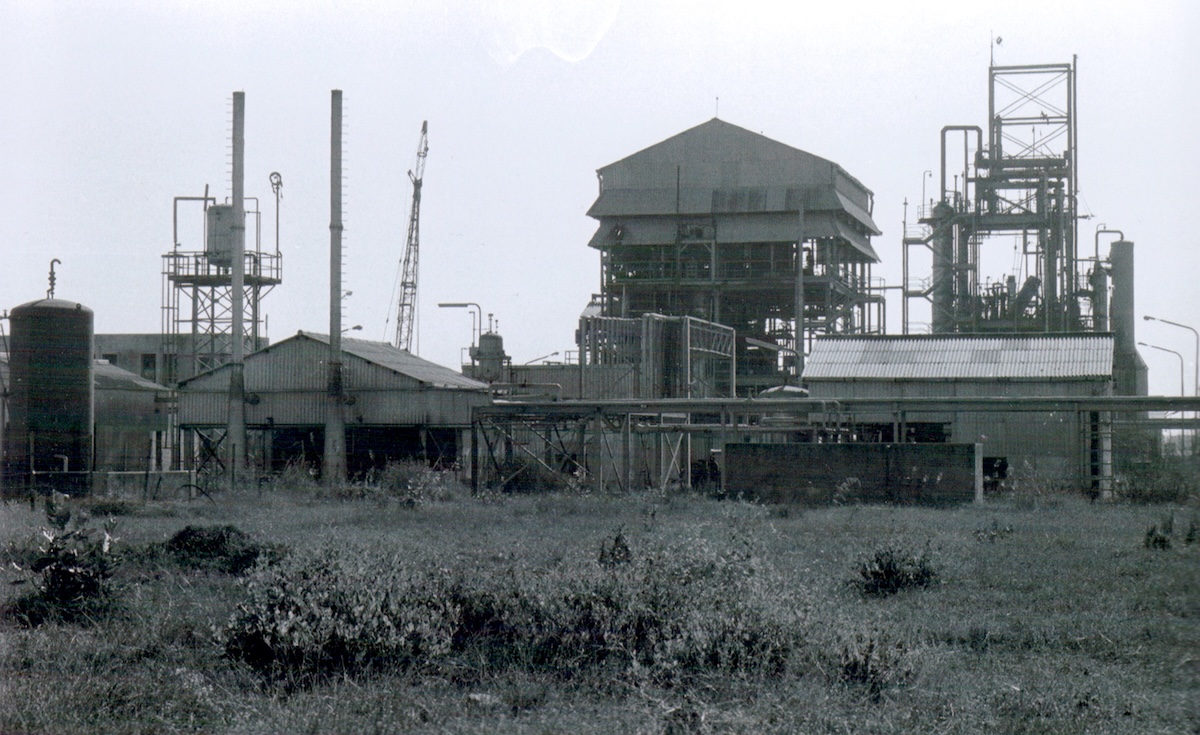
The structures are still recognisable: the control room, the pipework, the tank bays, all of it rusted through and thick with vegetation. Tank 610 is on the ground where it was thrown. The scale of the plant surprises people — it is small, an ordinary chemical works, nothing about it suggesting the reach of what left it.
The memorial that matters most is outside the gates. The statue of a woman covering a child, made in 1985 by the Dutch artist Ruth Waterman, stands opposite the entrance, and it has been the gathering point for the anniversary procession every 2 December for forty-one years. Survivors’ organisations march to it. The photographs of the missing are carried there.
Visitors should understand that Bhopal is not a memorial city that has processed its disaster. The bastis remain where they were, with the same families, and the plant is at the end of their street. The Sambhavna and Chingari clinics operate a short distance away and treat people every day for injuries sustained in 1984 and for conditions in children born in the 2010s. Photographing residents, their homes or their children without asking is intrusive to a degree that should not need explaining in a neighbourhood that has been photographed by the world’s press for four decades and compensated at roughly $500 a death.
The single most useful thing to grasp on the ground is the geography. The wall is right there. The settlements are on the other side of it, close enough that the distance is a matter of metres. The gas did not travel far to find the people it killed, and the aquifer beneath both did not travel at all.
Forty-one years on, the packaged waste has been burned in Pithampur over local objection, the soil and the groundwater have not been touched, the company that made both is a subsidiary of a firm that denies it owes anything, and the annual procession still walks to a statue of a woman shielding a child from something in the air.
Frequently Asked Questions About the Bhopal Gas Tragedy
What happened in the Bhopal gas tragedy?
Water entered a methyl isocyanate storage tank at Union Carbide’s pesticide plant in Bhopal, Madhya Pradesh, on the evening of 2 December 1984, triggering a runaway exothermic reaction. At around half past midnight the tank’s safety valve lifted and released somewhere between 27 and 40 tonnes of methyl isocyanate and its reaction products over roughly two hours. The gas was heavier than air, stayed low, and drifted south-east over the densest part of the old city while people slept. It reacted with moisture in eyes, throats and lungs, and thousands died within days.
How many people died in the Bhopal disaster?
The Madhya Pradesh government’s official figure is 5,479 deaths. Union Carbide maintained a figure closer to 3,800, while independent estimates put deaths within the first three days at around 8,000 and total deaths including later years at 25,000 or more. More than half a million people were exposed, and India’s compensation registry eventually recognised over 500,000 claimants. The spread exists because bodies were cremated and buried collectively in the first days without registration, no baseline health data existed for the affected population, and the compensation framework gave each side an incentive to argue the number in opposite directions.
What caused the Union Carbide gas leak in Bhopal?
Four independent safety systems were degraded or inoperative on the night of the release. The refrigeration unit that kept the methyl isocyanate cold had been shut down in June 1984 to save money and its coolant drained for use elsewhere. The flare tower was out of service with a corroded pipe removed for repair. The vent gas scrubber was on standby and rated for a small fraction of the flow that arrived. The water curtain reached about thirteen metres against a stack of roughly thirty-three. A Union Carbide safety audit in 1982 had identified the risk of a runaway reaction in the storage tanks, and most of its findings were not acted on.
Was anyone held responsible for the Bhopal disaster?
Warren Anderson, chairman of Union Carbide Corporation, was arrested in Bhopal on 7 December 1984, released on bail the same day, flown out on a state government aircraft, and never returned; an Indian court declared him a proclaimed absconder in 1992 and he died in Florida in 2014. The Indian government settled with the company in 1989 for $470 million, extinguishing civil and criminal liability without consulting the affected population. In June 2010, seven former Indian executives of UCIL were convicted of causing death by negligence and sentenced to two years each; all were bailed the same day. Dow Chemical, which acquired Union Carbide in 2001, holds that the 1989 settlement resolved all claims.
Is the Bhopal factory site still contaminated?
Union Carbide’s liquid effluent went into three solar evaporation ponds whose plastic liners failed, and testing since the 1990s has found mercury, lead, chromium, nickel, hexachlorobenzene, hexachlorocyclohexane, carbon tetrachloride and chloroform in the soil and groundwater. An estimated 700,000 tonnes of contaminated material remains in and around the factory grounds. Surrounding communities drew drinking water from the affected aquifer for roughly thirty years until the Supreme Court ordered a piped supply in 2012. The 337 tonnes of packaged waste removed in January 2025 was the catalogued portion only.
Can visitors go to the Union Carbide factory in Bhopal?
The site sits on the northern edge of the old city, about two kilometres from Bhopal Junction railway station, and has been owned by the state of Madhya Pradesh since 1998. It is fenced and formally closed, though access has been permitted intermittently for journalists, researchers and organised groups, and the position shifts with ongoing litigation. Anyone intending to enter should arrange it in advance. The memorial statue of a woman shielding a child stands outside the gates and is the gathering point for the survivors’ procession every 2 December.
Sources
Five Past Midnight in Bhopal — Dominique Lapierre and Javier Moro (2001)
The Bhopal Saga: Causes and Consequences of the World’s Largest Industrial Disaster — Ingrid Eckerman (2005)
Bhopal: Anatomy of a Crisis — Paul Shrivastava (1987)
Bhopal: The Inside Story — Carbide Workers Speak Out on the World’s Worst Industrial Disaster — T.R. Chouhan and others (1994)
Union Carbide Corporation v. Union of India: Judgment and Settlement Order — Supreme Court of India (1989)
The Bhopal Gas Disaster: Report of the International Medical Commission on Bhopal — International Medical Commission on Bhopal (1994)
Health Effects of the Toxic Gas Leak from the Union Carbide Methyl Isocyanate Plant in Bhopal — Indian Council of Medical Research (2004)
The Bhopal Legacy: Toxic Contaminants at the Former Union Carbide Factory Site — Greenpeace Research Laboratories (1999)
Contamination of Soil and Water Inside and Outside the Union Carbide India Limited, Bhopal — Centre for Science and Environment (2009)
Why Bhopal Remains Toxic 40 Years On — Aniqah Majid, The Chemical Engineer (2024)
Toxic Waste from India’s 1984 Bhopal Gas Tragedy Site Moved for Disposal After 40 Years — Reuters (2025)
Bhopal Gas Tragedy: What It Took to Relocate Toxic Waste from the World’s Worst Industrial Disaster — Down To Earth (2025)