The Morning the Halifax Explosion Erased the North End
The ship burned for nearly twenty minutes before it killed them.
At 8:45 on a clear, cold Thursday morning, two vessels scraped hulls in the Narrows, the tight strait where Halifax Harbour funnels into Bedford Basin. One of them, the French freighter Mont-Blanc, was carrying a cargo the entire city had no idea existed: more than 2,900 tonnes of TNT, picric acid, guncotton, and barrels of high-octane benzol stacked on her open deck. The scrape opened a spark. The benzol caught. And the burning ship, abandoned by her terrified crew, drifted on the tide until she came to rest against Pier 6, in the heart of the working-class district of Richmond.
Fire in the harbour was a spectacle. Along the north-end waterfront, dockworkers stopped to watch. In the sugar refinery and the cotton factory, men pressed to the windows. In the classrooms of Richmond School, children turned from their lessons to look out at the black smoke and the flames dancing on the water. Nobody ran, because nobody knew. The word explosion meant nothing to a crowd that could not read the ship's manifest.
At 9:04:35, the Mont-Blanc ceased to exist. Everything within a kilometre of Pier 6 — the piers, the factories, the school, the streets of Richmond, the people at the windows — went with it. This is a story about a city that armed its own destruction, a wartime port so vital to the fighting in Europe that it filled its own harbour with the machinery of death, and then watched that machinery turn inward on a Thursday morning.
Halifax Harbour: The Wartime Port That Armed Its Own Destruction
Why Halifax Became the Atlantic's Busiest War Port
Halifax existed because of its harbour. The deep, ice-free anchorage of Bedford Basin could hold entire fleets, and by 1917 the Royal Navy used it as the mustering point for the transatlantic convoys carrying troops, horses, grain, and munitions to the Western Front. The war had transformed a quiet Nova Scotian port of some 50,000 people into one of the most strategically important cities in the British Empire. Ships waited in the basin by the dozen. Steel nets and gun batteries guarded the harbour mouth against German submarines.
All of that traffic squeezed through the Narrows — a channel barely half a kilometre wide at its tightest. On the morning of December 6, two ships were about to meet in it, moving in opposite directions.
The Two Ships on a Collision Course in Halifax Harbour
The Mont-Blanc had crossed from New York the day before and arrived too late to enter the submarine-netted basin, so she anchored outside overnight. Her holds were a chemist's nightmare of wartime demand: roughly 2,300 tonnes of picric acid, the yellow explosive that filled Allied artillery shells; around 250 tonnes of TNT; some 60 tonnes of guncotton; and, lashed to her decks in metal drums, close to 250 tonnes of benzol fuel. She flew no special flag to signal her cargo. Regulations advising munitions carriers to warn other ships were routinely ignored, on the theory that advertising a floating bomb only invited attack.
Coming the other way was the Imo, a Norwegian steamer chartered to carry relief supplies to occupied Belgium. She was running empty, riding high in the water, bound out for New York to load. She was behind schedule, impatient, and travelling faster than the harbour rules allowed. Two ships, one narrow channel, one loaded past capacity with explosives and one racing to make up lost time.
How the Halifax Explosion Began: Collision in the Narrows
Nine Minutes in the Narrows: How the Mont-Blanc Caught Fire
The two ships saw each other and got it catastrophically wrong.
Maritime rule required each to pass port-to-port, keeping to its own side. The Imo, forced wide by other traffic, had drifted into the Mont-Blanc's lane. A sequence of whistle signals turned into an argument conducted in steam — one ship insisting it would hold course, the other insisting the same. At the last moment both captains tried to avoid the crash, and the maneuvers cancelled each other out. The Imo's bow drove into the Mont-Blanc's forward hull.
The wound itself was shallow. What mattered was what happened as the Imo reversed engines to pull free. Steel grinding against steel threw a shower of sparks into the punctured hold and across the deck, where the benzol drums had ruptured. Vapour ignited. Within seconds a column of oily black smoke and orange flame was climbing off the Mont-Blanc's bow, and the crew understood exactly what was sitting beneath their feet.
The Warning Halifax Could Not Hear
The French sailors did the only rational thing. They abandoned ship.
They lowered the lifeboats and rowed for the Dartmouth shore with everything they had, shouting warnings across the water as they went. The warnings were in French. The crowd gathering along the Halifax waterfront was almost entirely English-speaking, and to them the frantic men in the boats looked like cowards fleeing a manageable fire. The abandoned Mont-Blanc, meanwhile, drifted with the current until she nudged against the wooden Pier 6 and set it alight. The fire brigade responded. Onlookers gathered. The countdown continued, invisible.
One man understood. Vince Coleman, a railway dispatcher in the Richmond yards, was warned by a sailor that the burning ship was a munitions carrier. He and a colleague ran. Then Coleman remembered the incoming passenger train — the overnight express from Saint John, carrying some 300 people, due at the Richmond station within minutes. He turned back to his telegraph key and hammered out a message to stop it: an ammunition ship was afire in the harbour, it would explode, and this would be his last message. He kept sending until the blast reached him. Coleman died at his post. The train stopped. His warning is credited with saving hundreds of lives, and it remains the single most documented act of the morning — one man choosing to stay in the path of the largest explosion in human history so that strangers on a train would not arrive at the pier.
The Halifax Explosion: Twenty Minutes to Detonation
The Blast That Matched 2.9 Kilotons of TNT
At 9:04:35 the Mont-Blanc's cargo went off all at once.
The explosion released energy equivalent to roughly 2.9 kilotons of TNT — a fifth of the yield that would flatten Hiroshima twenty-eight years later, and the most powerful man-made blast that had ever occurred anywhere on Earth. For a fraction of a second, the temperature at the ship's core reached several thousand degrees, hotter than the surface of anything the city's residents could have imagined. The Mont-Blanc vaporised. Her hull, weighing thousands of tonnes, was converted into shrapnel and thrown across the sky.
Fragments of the ship rained down over an area kilometres wide. The Mont-Blanc's anchor shaft, a half-tonne piece of iron, cleared the entire peninsula and buried itself in the ground on the far side of the Northwest Arm, nearly four kilometres away, where it still sits today. A cannon barrel came down on the Dartmouth side, over five kilometres distant. The shockwave punched outward through the city, then over the surrounding hills, and was felt more than 200 kilometres away; people heard the sound in Cape Breton, some 360 kilometres off.
The blast also shoved the harbour aside. Water displaced by the explosion surged up the shoreline in a wave that reached as high as eighteen metres above the normal waterline, dragging debris and bodies back into the sea as it withdrew. A greasy black rain of unburnt carbon and oily residue fell over the ruins for ten minutes afterward, coating the survivors in soot.
How the Halifax Explosion Flattened a City in an Instant
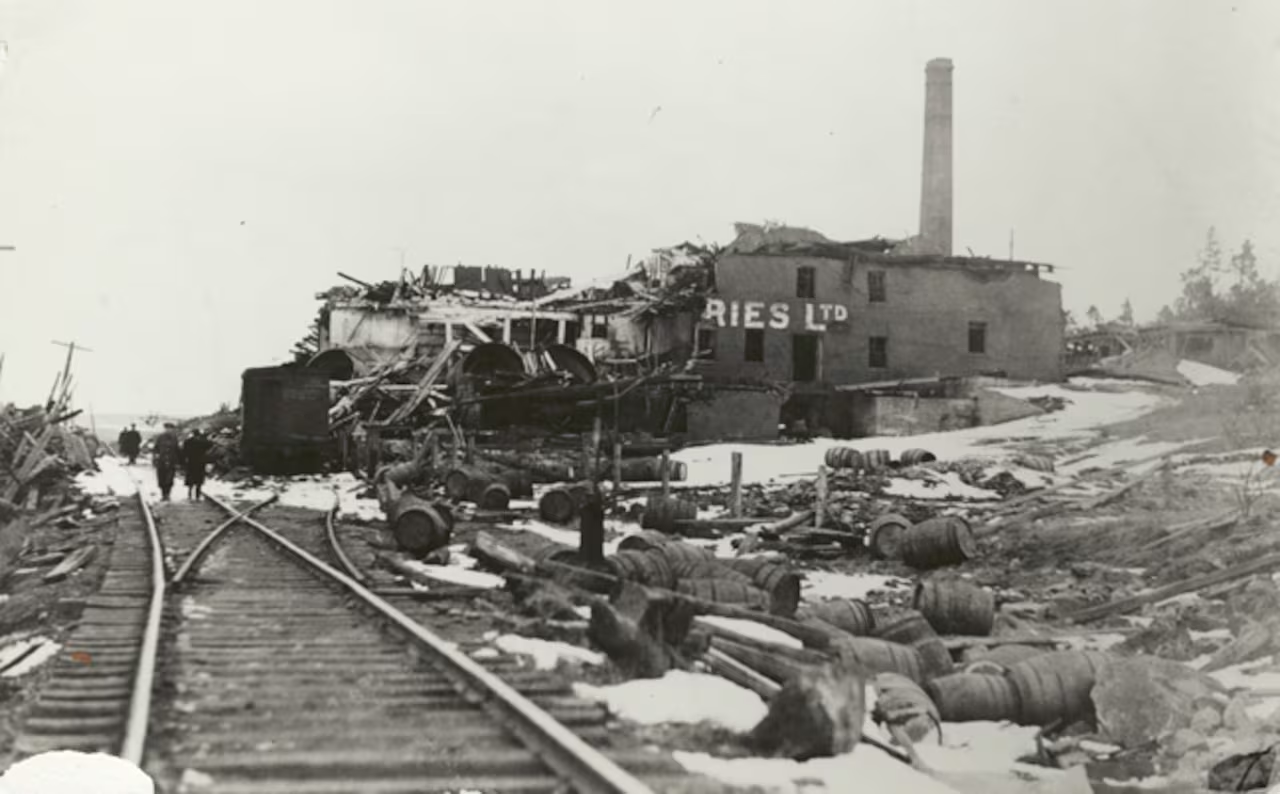
Richmond ceased to be a neighbourhood. The district nearest the pier — homes, churches, the school, the factories where people had gone to work an hour earlier — was swept flat, then set on fire by the coal and wood stoves that shattered inside every collapsing house. Roughly 1,600 buildings were destroyed outright and another 12,000 damaged. In a city of about 50,000, some 25,000 people were left without adequate shelter, in December, hours before a blizzard.
The death toll settled at close to 2,000, with about 9,000 injured. Entire families died in their homes. Whole rooms of children died in their schools; of the hundreds enrolled at Richmond School, only a handful survived. And because the fire had drawn people to their windows to watch, the injuries followed a horrifying pattern. When the shockwave hit, it turned every pane of glass in the north end into a burst of flying blades aimed at the faces of the people looking through them. Roughly 5,900 eye injuries were recorded. Around 40 people lost their sight entirely, and hundreds more were partially blinded. It was one of the largest mass blinding events in history, and it happened to people who had done nothing but look out a window.
Across the water, the tsunami erased Turtle Grove, the Mi'kmaq community at Tuft's Cove on the Dartmouth shore. The settlement, home to families who had fished and lived on that ground for generations, was scoured away by the wave. It was never rebuilt. The people who survived were scattered, and one of the oldest continuous communities in the harbour vanished from the map in a single morning, a loss folded almost silently into the larger count of the dead.
Rescue After the Halifax Explosion and the Blizzard That Followed
Digging Through the Ruins as the Snow Fell
The survivors dug with their hands.
Those who could still walk pulled at the wreckage for the people trapped and burning beneath it, working against the fires that were spreading house to house. Soldiers, sailors, and dockworkers who had survived the outer edge of the blast came into the ruins to help. Then, the next morning, the weather turned. A blizzard dropped roughly 40 centimetres of snow on the shattered city, collapsing rescue tents, freezing the injured who lay in the open, and burying the dead and the living together under the same white silence.
The rescue produced stories that Halifax has never let go of. A baby girl, later known as "Ashpan Annie," was found alive in the wreckage of a Dartmouth home 26 hours after the blast, sheltered from the fire and the cold by the iron ashpan of a stove that had fallen over her. She lived into the twenty-first century. Barbara Orr, a teenage girl, was picked up by the blast wave and thrown across a stretch of ground onto the slope of Fort Needham hill; she survived, and learned that she was the only member of her immediate family left alive. Decades later she would give the memorial bells that now stand on that same hill.
How Boston Saved Halifax
Help arrived first from the United States.
Within hours of the news reaching Boston, the Massachusetts Halifax Relief Committee organised a train loaded with doctors, nurses, and medical supplies and sent it north into the storm. It fought through the blizzard and reached the city inside two days, and the Massachusetts medical teams took over care of the wounded when Halifax's own hospitals had been overwhelmed and half-destroyed. The Halifax Relief Commission was established to manage the recovery, distribute aid, and eventually rebuild the north end. The gratitude outlasted the crisis by a century: every year since, Nova Scotia has cut and shipped a giant Christmas tree to the city of Boston, where it stands lit on Boston Common as a thank-you that has never stopped being paid.
The Legacy of the Halifax Explosion
How the Halifax Explosion Helped Measure the Atomic Bomb
The blast that destroyed Halifax became a scientific instrument.
For nearly three decades, the Halifax Explosion held the grim distinction of being the largest man-made detonation ever recorded, and it was studied as such. When the physicists of the atomic age needed to understand what a multi-kiloton blast does to a real city — how far the shockwave travels, how buildings fail, how a fireball behaves over an urban grid — Halifax was the closest thing to a full-scale experiment that had ever occurred. The 1917 disaster became a reference point in the effort to model the destructive reach of the bombs that would fall on Japan.
The suffering also produced medicine. The mass blinding forced doctors to advance the treatment and rehabilitation of eye injuries at a scale never seen before, and the crisis of caring for hundreds of newly blind people directly shaped the founding of the national institution that would serve the blind across Canada. And a young Halifax clergyman and scholar named Samuel Henry Prince did something no one had done before: he studied the disaster itself — not the ship or the chemistry, but the way a human community breaks down and reorganises under catastrophe. His 1920 work is regarded as the founding text of disaster sociology, the first systematic attempt to understand how societies respond when the worst happens. The field that now studies every earthquake, flood, and terrorist attack was born from the ashes of Richmond.
Remembering the Halifax Explosion Today
Halifax carries the explosion in its ground.
The rebuilt north end includes the Hydrostone, a district of solid concrete-block homes laid out on garden-city lines to rehouse the survivors, now a quiet heritage neighbourhood that exists only because the old one was destroyed. On the hill above it stands the Fort Needham Memorial Bell Tower, with its carillon of bells, dedicated on the site where Barbara Orr came down alive. The Mont-Blanc's anchor shaft still rests where it fell across the harbour, a rusting half-tonne of iron marked with a plaque in a residential neighbourhood four kilometres from where the ship blew apart.
The city's memory of the disaster is inseparable from another one. In 1912, Halifax had been the port that recovered the bodies of the RMS Titanic; its undertakers had embalmed the dead and its cemeteries had buried them in long neat rows. Five years later, the same city, the same cemeteries, and in some cases the same undertakers received the dead of its own catastrophe — an order of magnitude larger, and made of its own people. No one was ever held criminally responsible for the collision. The courts eventually ruled that both ships shared the blame, and the case dissolved into legal ambiguity, leaving the 2,000 dead without a single name to hold accountable.
Standing at the Site of the Halifax Explosion
The blast site is not a ruin. It is a working part of a living city, which is what makes standing there strange.
The place to begin is the Fort Needham Memorial Park in the north end, where the bell tower overlooks the ground that was ground zero. From the hill, the harbour and the Narrows lie open below, and the distances become real: the pier where the Mont-Blanc burned, the water the tsunami climbed, the flat land where Richmond stood. The Maritime Museum of the Atlantic, on the downtown waterfront, holds the most complete account of the disaster, including recovered fragments of the ship and the human objects pulled from the wreckage. The Mont-Blanc's anchor shaft can be visited on the far side of the peninsula near the Northwest Arm, and the cannon barrel that flew across the harbour is marked on the Dartmouth side. The city's north-end cemeteries hold the mass graves, and nearby lie the rows of Titanic dead from five years before.
Every December 6, at 9:04 in the morning, Halifax holds a memorial service at the bell tower, and for a moment the modern city stops on the exact minute the old one ended. The site asks for no drama and offers none. What it offers is scale — the plain, physical fact of how far the iron flew, how wide the wave reached, how ordinary the morning was until it was not. The people who died here were watching a fire. That is the whole of it, and it is enough.
Frequently Asked Questions
What caused the Halifax Explosion?
The Halifax Explosion was caused by a collision between two ships in the Narrows of Halifax Harbour on the morning of December 6, 1917. The French freighter Mont-Blanc, loaded with nearly 3,000 tonnes of wartime explosives, was struck by the Norwegian relief ship Imo. Sparks from the grinding hulls ignited barrels of benzol fuel stacked on the Mont-Blanc's deck, and the resulting fire burned for about twenty minutes before it reached the main cargo and detonated. Neither ship was travelling correctly through the narrow channel, and the courts eventually ruled that both shared the blame.
How many people died in the Halifax Explosion?
Roughly 2,000 people were killed and about 9,000 were injured, out of a city population of around 50,000. The dead included entire families and nearly all of the children at Richmond School, closest to the pier. The toll made it the deadliest man-made explosion in history up to that point. A blizzard the following day added to the death count by burying and freezing survivors trapped in the ruins.
Was the Halifax Explosion the biggest explosion before the atomic bomb?
The Halifax Explosion was the largest man-made blast the world had ever seen, and it held that distinction until the first nuclear detonation in 1945. Its energy release was equivalent to roughly 2.9 kilotons of TNT, about a fifth of the yield of the bomb dropped on Hiroshima. Because it was the closest thing to a full-scale urban blast on record, scientists later used it as a reference point when modelling the destructive effects of atomic weapons.
Why did so many people go blind in the Halifax Explosion?
The ship burned for nearly twenty minutes before it exploded, which drew crowds to their windows to watch the spectacle. When the shockwave hit, it shattered every pane of glass in the north end and drove the fragments into the faces of the people looking through them. Around 5,900 eye injuries were recorded, roughly 40 people were permanently blinded, and hundreds more lost part of their sight. The disaster drove major advances in the treatment of eye trauma and in the organised care of the blind in Canada.
Why does Nova Scotia send a Christmas tree to Boston every year?
The tradition began as gratitude for the help Boston sent after the explosion. The Massachusetts Halifax Relief Committee dispatched a train of doctors, nurses, and supplies within hours of the news, and it fought through the blizzard to reach the shattered city. In thanks, Nova Scotia sends a giant Christmas tree to Boston each year, where it is lit on Boston Common. The gift has continued for over a century.
Can you visit the site of the Halifax Explosion?
The blast site is now part of the living city of Halifax rather than a preserved ruin. The best starting point is Fort Needham Memorial Park, where a bell tower overlooks the ground that was ground zero, and where a memorial service is held every December 6 at 9:04 in the morning. The Maritime Museum of the Atlantic on the downtown waterfront holds the most complete exhibit, including recovered fragments of the ship. The Mont-Blanc's anchor shaft, thrown nearly four kilometres by the blast, still rests where it landed near the Northwest Arm.
Sources
- [Curse of the Narrows: The Halifax Explosion of 1917] - Laura M. MacDonald (2005)
- [Shattered City: The Halifax Explosion and the Road to Recovery] - Janet F. Kitz (1989)
- [The Town That Died: A Chronicle of the Halifax Disaster] - Michael J. Bird (1962)
- [Catastrophe and Social Change: Based Upon a Sociological Study of the Halifax Disaster] - Samuel Henry Prince (1920)
- [Ground Zero: A Reassessment of the 1917 Explosion in Halifax Harbour] - Alan Ruffman & Colin D. Howell, eds. (1994)
- [Explosion in Halifax Harbour, 1917] - Graham Metson (1978)
- [The Halifax Explosion] - The Canadian Encyclopedia / Historica Canada (2013)
- [Halifax Relief Commission Fonds] - Nova Scotia Archives
- [The Halifax Explosion Remembrance Book] - Nova Scotia Archives / Maritime Museum of the Atlantic