The fog that night was not merely weather; it was a blindfold wrapped tightly across the eyes of the Atlantic.
On July 25, 1956, the ocean off Nantucket was a void of sensory deprivation. The air was heavy, damp, and opaque, swallowing the navigation lights of any vessel foolish enough to cut through it at speed. Inside the bridge of the Italian liner SS Andrea Doria, the atmosphere was tense but controlled. It was 11:10 PM. The smell of expensive tobacco smoke mixed with the distinct, metallic scent of salt spray. Below decks, 1,134 passengers were winding down a voyage that had been a week-long celebration of la dolce vita. In the First Class Lounge, the orchestra was playing "Arrivederci Roma." The champagne was cold; the air conditioning hummed a lullaby of modern engineering.
They were floating in a bubble of light, unaware that a knife-edge of steel was rushing toward them through the dark.
Miles away, the SS Stockholm, a smaller, ice-strengthened Swedish liner, was cutting a sharp wake through the gloom. Both ships were relying on radar—a technology still in its adolescence, trusted with a fatal, religious fervor. On the green, sweeping screens, they were blips in a monochromatic video game. But in the reality of the North Atlantic, they were thousands of tons of steel hurtling toward a mathematical impossibility.
The collision, when it came, did not sound like a crash. Survivors would later describe it as a sickening thud followed by the visceral shriek of tearing steel—a sound like the earth itself splitting open. The Stockholm’s reinforced bow, designed to crush polar ice, sliced into the starboard side of the Andrea Doria like a chisel into soft marble. It penetrated thirty feet deep, directly under the bridge, severing fuel tanks, generators, and lives.
In that instant, the sinking of the Andrea Doria began. The era of the unsinkable ocean liner died, not with an iceberg, but with a radar blip and a wrong turn in the fog.
The Floating Masterpiece: Italian Line History and Post-War Ambition
To understand the tragedy, one must first understand the height from which the victim fell. The SS Andrea Doria was not just a conveyance for moving people from Genoa to New York; she was a floating statement of national resurrection.
Following the devastation of World War II, Italy lay in ruins. Its merchant fleet had been decimated. The Italian Line history is one of resilience, and the Andrea Doria, launched in 1951, was the crown jewel of this comeback. She was proof that Italy had returned to the world stage, not as a conquered nation, but as a purveyor of art, style, and mechanics.
A Gallery at Sea: Murals, Bronze, and The Arts
Stepping aboard the Andrea Doria was akin to entering a curator’s fever dream. The interior design rejected the stuffy, wood-paneled Edwardian aesthetics of British liners in favor of sleek, modernist lines and surrealist art. She was a gallery at sea.
In the First Class lounge, a massive bronze statue of the Genoese admiral Andrea Doria stood guard—a symbol of protection that would ironically end up lying in the silt of the Atlantic floor. The walls were adorned with commissioned murals by Salvatore Fiume, depicting imaginary Italian cities, blurring the lines between the ship’s interior and a Renaissance fantasy. Every surface whispered luxury: rare woods, ceramics from the kilns of Faenza, and tapestries that absorbed the hum of the engines.
The ship was commanded in her early days by the legendary Guido Notari (Captain), a man who embodied the dignity of the Italian merchant marine. Under his and his successors' command, the ship became a byword for punctuality and grace. However, beneath the velvet and the bronze, the ship’s beauty masked a fatal flaw. The designers had prioritized the expansive, open spaces required for luxury over the rigid, watertight compartmentalization that ensures survival. She was built to heel, but she was not built to survive the wound she was about to receive.
Life on Board: The Stratification of 1950s Luxury
The social architecture of the Andrea Doria was as rigid as her steel hull. The ship was divided into three classes: First, Cabin, and Tourist.
In First Class, the air smelled of heavy fuel oil mixed with salt air and expensive perfume—Joy by Jean Patou or Chanel No. 5. Hollywood royalty like Cary Grant and Tyrone Power had walked these decks. Dinner was a theatrical event involving silver tureens, white-gloved waiters, and endless courses of pasta and veal.
Down in Tourist class, the experience was less opulent but no less hopeful. These were immigrants and families returning home, sleeping in bunk beds, their suitcases packed with the physical manifestation of the American Dream or the longing for the Old Country. Regardless of the deck, every passenger shared the same vibration of the turbines, the same fog, and, ultimately, the same terror when the floor beneath them tilted irrevocably into the sea.
The Fog of Nantucket: Anatomy of the Andrea Doria Collision
The transition from floating palace to sinking tomb occurred in seconds. The Andrea Doria collision is studied today as a masterclass in the "radar-assisted collision"—a phenomenon where technology emboldens captains to maintain speed in conditions that demand caution.
The Radar Trap: Technology and Human Error
The night of July 25, 1956, was a perfect storm of misinterpretation. Captain Piero Calamai of the Andrea Doria and the officers of the SS Stockholm were both looking at their radar screens, but they were seeing two different realities.
The Andrea Doria, approaching the lightship off Nantucket, spotted the Stockholm on radar and determined a starboard-to-starboard passing was safe. This was unorthodox but not illegal. Meanwhile, the Stockholm, believing the Doria was to its left, initiated a standard port-to-port passing.
Blind to each other visually, the ships executed a slow-motion dance of death. The Andrea Doria turned hard to port to open the distance; the Stockholm turned hard to starboard to do the same. In doing so, they turned directly into one another. It was a geometry of doom, orchestrated by the very instruments designed to prevent it.
The Mechanics of Doom: Why She Capsized
The impact was catastrophic, but it should not have been fatal. Modern liners are designed to withstand collisions. The Andrea Doria’s death sentence was written in her fuel tanks.
Nearing the end of her voyage, the ship’s fuel tanks were nearly empty. Standard procedure dictated that as fuel was consumed, the tanks should be filled with seawater to maintain the ship’s weight and stability (ballast). However, filling tanks with saltwater required expensive cleaning before refueling. To save money and time, the tanks were left empty.
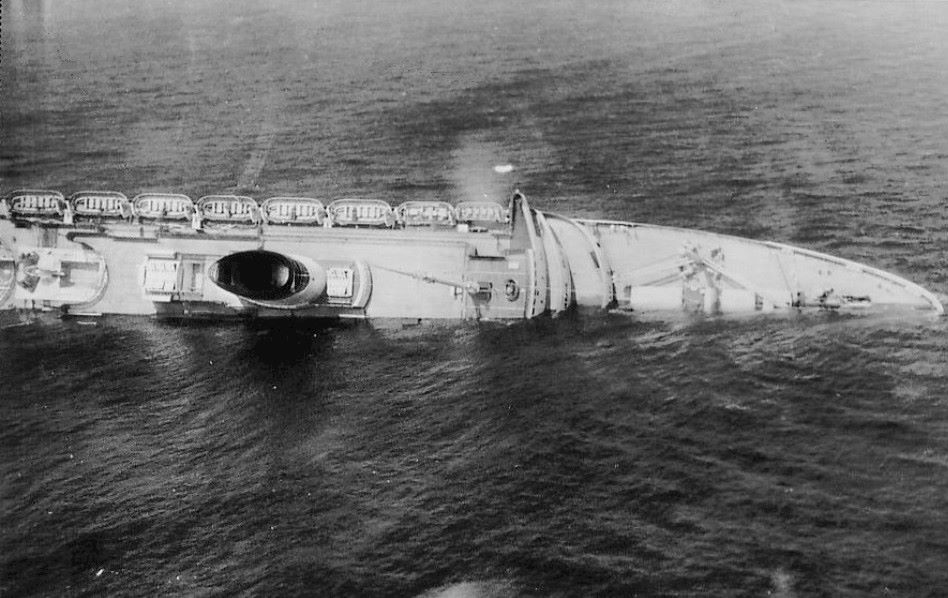
When the Stockholm struck, the Andrea Doria took on thousands of tons of water on her starboard side. Because the fuel tanks were empty, she had no low weight to counterbalance the flood. She immediately listed 20 degrees to starboard.
This list was the true killer. The severe tilt rendered the port-side lifeboats useless—they swung inboard, banging uselessly against the glass of the promenade deck, unable to be lowered. Half the lifeboats were instantly negated. In the engineering room, the angle was so steep that oil intakes rose out of the fuel, starving the generators. The lights flickered, dimmed, and switched to emergency red, bathing the terrified passengers in the color of blood.
The Greatest Rescue: Miracles Amidst Nautical Disasters of 1956
In the pantheon of nautical disasters 1956, the Andrea Doria stands apart from the Titanic for one crucial reason: the rescue worked.
Despite the loss of half the lifeboats, the proximity to busy shipping lanes saved the day. The distress signal—SOS... Collision... Need Assistance—was picked up by several ships, including a freighter and the massive French liner Ile de France.
The Arrival of the Ile de France
The captain of the Ile de France, Baron Raoul de Beaudéan, made a decision that enshrined him in maritime history. He turned his massive ship around and steamed at full speed through the fog toward the dying Italian liner.
When the Ile de France arrived, the fog miraculously lifted, illuminated by the French ship's massive floodlights. It was a surreal scene: the pristine, gargantuan Ile de France glowing like a savior next to the crippled, listing silhouette of the Andrea Doria. The French liner formed a breakwater, calming the seas, and launched its own lifeboats. It was the greatest sea rescue in peacetime history. 1,660 people were saved. 46 people died on the Doria, and 5 on the Stockholm, almost all killed by the initial impact.
The Girl on the Stockholm: A Miracle of Physics
Amidst the carnage, a story of impossible survival emerged. Linda Morgan, a 14-year-old girl, had been sleeping in her cabin on the Andrea Doria in the direct path of the collision.
When the Stockholm’s bow smashed into the cabin, it disintegrated the room. In a freak occurrence of physics, the force of the impact scooped Linda up from her bed and deposited her safely onto the crushed bow of the Stockholm. She woke up confused, hearing sailors speaking Swedish, with no memory of how she had flown from one ship to the other. She became known as the "Miracle Girl," a living testament to the chaos of the collision.
The Mount Everest of Wreck Diving: Descent into the Abyss
As the Andrea Doria slipped beneath the surface at 10:09 AM the next morning, she ceased to be a ship and became a destination. Today, she is known by a moniker that commands both respect and fear: the Mount Everest of wreck diving.
This is not a recreational site. It is a frontier. Lying on her starboard side at a depth of approximately 240 feet (73 meters), the wreck is enveloped in perpetual twilight and strong, erratic currents.
Conditions of the Deep: Currents, Cold, and Narcosis
To dive the Andrea Doria is to enter a hostile alien environment. The water temperature hovers in the 40s (Fahrenheit). The depth requires the use of Trimix (a breathing gas blend of oxygen, helium, and nitrogen) to combat nitrogen narcosis—the "rapture of the deep" that can cause divers to feel drunk and make fatal errors.
The currents at the site are notorious. They can sweep a diver miles off course in minutes. Visibility is often reduced to a few feet by silt and plankton, often described by divers as "diving in milk." It is a place where panic is a death sentence.
Peter Gimbel and the Opening of the Safe
The allure of the wreck attracted high-profile explorers. Filmmaker and department store heir Peter Gimbel became obsessed with the ship. He led multiple expeditions, treating the wreck with a mix of reverence and forensic curiosity.
In 1981, Gimbel launched a massive salvage operation to recover the First Class safe. The media frenzy was comparable to the opening of Al Capone’s vault. When the safe was finally opened on live television in 1984, dreams of diamonds and gold bars evaporated. It contained mostly sodden bundles of US silver certificates and Italian banknotes—wealth rendered worthless by the sea. Yet, Gimbel’s expeditions proved that the Doria was accessible, igniting a fever that would claim lives.
The Deadly Price of Porcelain: Technical Diving Fatalities and "China Fever"
The Andrea Doria is a siren. Her song is not sung in notes, but in artifacts. For decades, the wreck was the ultimate trophy hunt for technical divers. The prize? The ship’s exquisite Ginori china.
The Lure of the First Class Dining Room
This obsession became known as "China Fever." Divers, weighed down with double tanks and decompression stages, would penetrate deep into the labyrinthine interior of the ship, squeezing through collapsing corridors to reach the First Class Dining Room.
They risked their lives for plates. To recover a piece of Andrea Doria china was to hold a piece of history, a tangible connection to the lost glamour of 1956. But the cost of this porcelain was often paid in blood.
A Labyrinth of Nets and Cables: How the Wreck Kills
The interior of the Andrea Doria is a death trap. Over the decades, the wreck has become draped in abandoned fishing nets, known as "ghost nets." These invisible webs wait to snag a tank valve or a fin.
Inside, the ship is a disorienting maze. Because she lies on her side, walls have become floors, and floors have become walls. Debris falls constantly. Technical diving fatalities at the site now number over 16. Experienced divers, some with thousands of logged dives, have entered the Doria and never returned, victims of disorientation, equipment failure, or simply the unforgiving physics of the deep. They died seeking a souvenir from a grave.
Entropy and Erasure: The Rapid Deterioration of the SS Andrea Doria
Time is the one enemy the Andrea Doria cannot list away from. For decades, the ship remained remarkably intact, a sleeping giant on the sand. But in the last fifteen years, the ocean has accelerated its consumption.
The Andrea Doria salvage era is ending, not because of regulation, but because of geometry. The wreck is collapsing. The upper superstructure, once a proud tower of white steel, has crumbled. The famous "Gym," a popular penetration point for divers, has collapsed. The hull is pancaking, folding in on itself.
Current reports from expeditions describe a wreck that is unrecognizable compared to the photos from the 1980s. The currents are ripping the steel apart, rivet by rivet. The interior spaces are becoming inaccessible, sealed off by falling bulkheads. The ship is undergoing a slow, violent erasure. She is returning to the elemental components from which she was forged.
Conclusion
The SS Andrea Doria exists today in a state of duality. In the grainy black-and-white newsreels of 1956, she is forever beautiful, forever dying—a sharp prow slipping beneath the waves, taking the ambitions of post-war Italy with her. On the ocean floor, she is a disintegrating pile of rust, a dangerous playground that demands the ultimate price from those who disrespect her.
The tragedy of the Andrea Doria is not just in the lives lost or the steel ruined. It is in the confrontation between human hubris and the indifferent, crushing weight of the sea. We built a palace of art and radar, thinking we had conquered the fog. The Atlantic proved us wrong.
As the wreck dissolves into the seabed, the physical artifacts—the china, the bronze statue, the safe—will be all that remain. But the true legacy of the Andrea Doria is the silence of the fog off Nantucket, a reminder that no matter how luxurious the vessel, we are all just guests on the water.
Sources & References
- Woods Hole Oceanographic Institution - "Imaging the Andrea Doria." Detailed sonar and imaging reports on the wreck's condition.
- PBS/NOVA - "Descent on the Doria." Transcript and production notes regarding the history of diving the wreck.
- The New York Times Archives - "Doria and Stockholm Collide; 1,134 Passengers Aboard." (July 26, 1956). Contemporary reporting on the collision and rescue.
- Goldstein, Richard. Desperate Hours: The Epic Rescue of the Andrea Doria. A forensic accounting of the collision and the "radar-assisted" errors.
- Kohler, Richie. Mystery of the Last Days of the Andrea Doria. Technical analysis of the ship's structural failure and diving conditions.
- United States Naval Institute. "The Collision of the Andrea Doria and Stockholm." Analysis of the maritime law and navigation errors involved.
- Diver Magazine. "The Andrea Doria: The Deepest Dive." Logistics of technical diving operations at the site.