Nuclear Weapons Testing History: Why the Nevada Desert Had to Burn
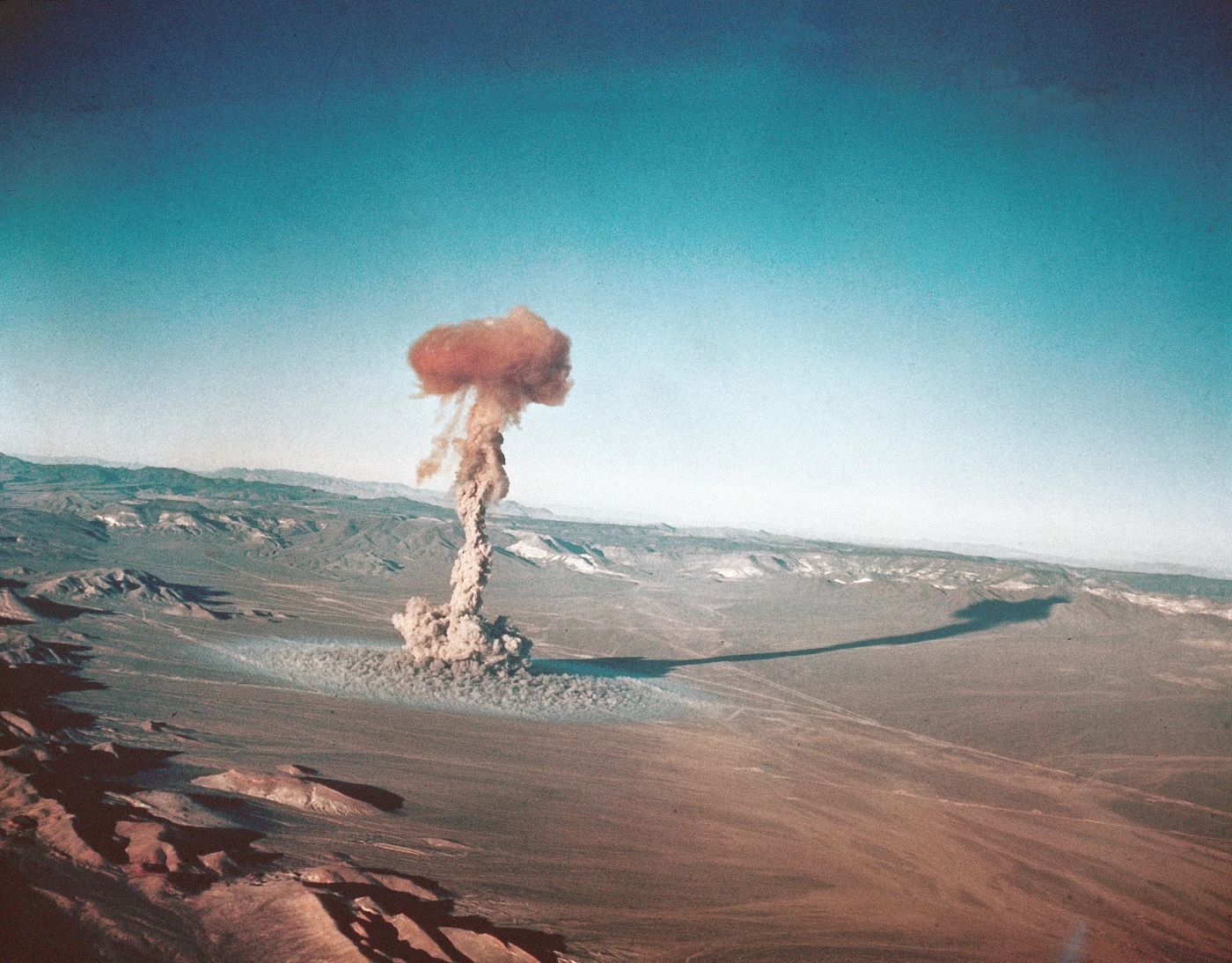
The Nevada Test Site is the physical manifestation of the 20th century’s greatest ambition—the mastery of the atom. Between 1951 and the 1992 moratorium, the United States government detonated 928 nuclear devices across this 1,360-square-mile patch of high desert.
This landscape was chosen specifically for its perceived emptiness, a clinical void where the most violent forces in the universe could be unleashed without immediate political consequence. The result is a geography of trauma, a place where the earth itself has been repeatedly broken, melted, and poisoned in the name of a peace maintained through the threat of total annihilation.
Standing at the edge of the Yucca Flat, the sheer scale of the engineering effort reveals a chilling bureaucracy of destruction. This was a workplace. Men in short-sleeved shirts and horn-rimmed glasses clocked in to calculate the exact yield of a fireball that would briefly exceed the temperature of the sun. They treated the apocalypse as a series of data points, measuring blast pressure, thermal radiation, and initial nuclear yield with the same cold detachment one might apply to a bridge stress test.
Strategic Selection of the Continental Test Site
The decision to bring nuclear testing to the American mainland was a logistical pivot born of Cold War desperation. Following the 1945 Trinity test in New Mexico and the subsequent tests in the Pacific Proving Grounds at Bikini and Eniwetok Atolls, the Department of Defense realized that testing in the Marshall Islands was too expensive and too slow. Each Pacific test required a massive naval armada and months of preparation. In 1950, with the Korean War escalating and the Soviet Union having successfully tested their first atomic bomb, the "Continental Test Site" became a national security priority.
The Nevada Proving Grounds, as it was then known, offered the perfect intersection of isolation and accessibility. It was located within the Nellis Air Force Range, ensuring existing restricted airspace. More importantly, the prevailing winds generally blew toward the east, over sparsely populated desert regions of Utah and Arizona, rather than toward the political and economic hubs of California.
The federal government viewed the inhabitants of these "downwind" areas as a "low-use" population. This cold-blooded demographic calculation allowed the Atomic Energy Commission (AEC) to proceed with atmospheric testing on a scale that would have been impossible anywhere else on the continent.
This vast buffer zone didn’t just protect the public from radiation; it protected the government's other secrets. Directly bordering the Yucca Flat—the site of most nuclear tests—lies 'Area 51.' While the NTS was being pulverized by nuclear fire, its neighbor at Groom Lake was using the same impenetrable restricted airspace to develop the U-2 and SR-71 Blackbird spy planes in total anonymity.
Geography and Environmental Impact of Nuclear Radiation
The physical characteristics of the Nevada Test Site are defined by "The Void." The site is situated within the Basin and Range Province, characterized by north-south mountain ranges separated by broad, flat valleys. These valleys—Frenchman Flat and Yucca Flat—provided the ideal canvas for the AEC. The flat, alkaline soil was stable enough to support massive steel towers for atmospheric tests and deep enough to swallow the massive drill holes required for later underground detonations. This is a landscape where the primary geological feature is no longer the result of tectonic plates or erosion, but of man-made explosions.
Every square inch of the site has been mapped according to its radioactive potential. The soil is not just dirt; it is a repository for isotopes like Plutonium-239, which has a half-life of 24,100 years. The geography here is permanent. While the wooden houses of "Doom Town" were vaporized or splintered, the glassified sand—trinitite—and the massive subsidence craters like Sedan remain as indelible marks. This is a geography of erasure, where the original desert scrub and Joshua trees were burned away to make room for a grid system of ground zeros. It is the only place on Earth where the topography can be accurately described as "post-human."
Pre-Atomic History: The Nevada Desert Before the Flash
Before the first flash of Operation Ranger in 1951, the area now known as the Nevada Test Site was a quiet expanse of the Great Basin Desert. It was a region of extreme temperatures and minimal water, inhabited by a resilient ecosystem of creosote bush, sagebrush, and bighorn sheep. To the casual observer in Washington D.C., it was a "wasteland," a term used to justify its subsequent destruction. However, the pre-atomic history of the site reveals a complex human and natural history that was systematically dismantled to make way for the nuclear age.
The world before the site existed was one of ranching, mining, and indigenous survival. The Western Shoshone and Southern Paiute peoples had lived on this land for millennia, navigating its hidden springs and seasonal migrations. For them, the land was not a laboratory; it was a sacred home. The subsequent federal seizure of the land in the 1940s and 50s was not just a military maneuver, but a final act of colonial displacement.
Native American Ancestry and Federal Eminent Domain
The legal mechanism used to create the Nevada Test Site was as violent as the tests themselves. Under the 1863 Treaty of Ruby Valley, the Western Shoshone never ceded their rights to the land that encompasses the NTS. Despite this, the federal government utilized the doctrine of eminent domain and military necessity to claim the territory. The Shoshone's ancestral hunting grounds and spiritual sites were reclassified as "Target Areas." This was an erasure of identity; the land was stripped of its cultural names and given alphanumeric designations like "Area 5," "Area 12," and "Area 25."
This process of federalization created a closed-loop system where the AEC was the sole landlord, judge, and jury of the land’s health. By the time the first bomb was detonated, the indigenous presence had been reduced to a security concern. The site wasn't "empty"—it was emptied. The history of the Nevada Test Site is the history of the American West distilled into its most aggressive form: the total subjugation of the landscape to the needs of the military-industrial complex.
Ranching History of the Frenchman Flat Basin
Frenchman Flat, the site of the first Nevada tests, was once a dry lake bed used by local ranchers for grazing livestock during the winter months. The alkaline crust of the playa was a natural landing strip and a highway for those moving through the rugged interior of Nye County. There was no electricity, no running water, and no hint that this basin would soon host the most intense heat ever generated on the planet. The ranchers who moved their cattle through these flats operated on a timeline of seasons and survival, unaware that the federal government was already surveying the soil for its ability to withstand a kiloton-range blast.
The transition from pastoral to planetary threat happened with clinical speed. In late 1950, President Harry S. Truman approved the establishment of the site, and within weeks, the first structures were being erected. The silence of the playa was replaced by the grinding of heavy machinery and the arrival of thousands of military personnel. The cattle were moved out, the ranchers were compensated with pennies on the dollar, and the dry lake bed was prepared for its new role as a stage for the theater of nuclear war. The ghost of this pastoral era remains only in the archival photos of early 20th-century surveys, now buried under layers of radioactive dust.
Atmospheric Nuclear Testing: The Era of the Fireball (1951-1962)
Between 1951 and the signing of the Limited Test Ban Treaty in 1963, the Nevada Test Site was the world’s most spectacular and terrifying show. This was the era of atmospheric testing, where nuclear mushrooms were visible from the balconies of Las Vegas hotels, sixty-five miles to the south. The AEC marketed these events as "shots," a term that minimized the gravity of the detonations. During this decade, 100 atmospheric tests were conducted, sending radioactive plumes across the United States. This was the "Golden Age" of the atom, a period of reckless scientific curiosity and propaganda where the American public was encouraged to watch the end of the world as a form of patriotic entertainment.
Huge steel towers, some 500 feet tall, were constructed to hold the "gadgets." Thousands of miles of coaxial cable were laid to transmit data in the microseconds before the sensors themselves were vaporized. The site became a bizarre experimental city, populated by mannequins, tanks, and domestic structures designed to see exactly what a nuclear bomb does to a suburban kitchen. This era was defined by the fireball—a blinding, expanding sphere of plasma that turned night into day and silicon into glass.
Operation Ranger: The First Nuclear Explosion in Nevada
Operation Ranger was the opening salvo of the Nevada era. On January 27, 1951, a B-50 bomber dropped a 1-kiloton nuclear device over Frenchman Flat. Code-named "Able," it was the first nuclear explosion on the American mainland since Trinity. The blast broke windows in Las Vegas and was felt as far away as Los Angeles. For the AEC, the test was a success; it proved that testing could be done domestically without immediate catastrophe. For the world, it marked the beginning of a period where the atmosphere itself was treated as a disposal site for radioactive fission products.
The Ranger series consisted of five detonations in total, all dropped from aircraft. The goal was simple: calibrate the instruments and establish the "safety" of the site. However, the data gathered was purely physical. The biological consequences were largely ignored. The AEC issued press releases telling the public not to worry about the "beautiful" clouds drifting eastward. They even distributed pamphlets to schools in nearby St. George, Utah, telling children that the radiation was no more dangerous than a dental X-ray. It was a period of calculated clinical optimism that masked a burgeoning public health disaster.
Doom Town: The Science of Survival City
The most haunting relics of the atmospheric era are the remains of "Survival City," more popularly known as Doom Town. In 1953 and 1955, the AEC constructed entire suburban neighborhoods in the middle of the Yucca Flat. They built two-story colonial houses, stocked them with JC Penney furniture, and populated them with mannequins dressed in typical mid-century attire. They even put food in the refrigerators. The goal of the "Apple II" shot (part of Operation Teapot) was to measure the effects of a 29-kiloton blast on civil infrastructure and human (mannequin) bodies.
The results were recorded by high-speed cameras housed in lead-lined bunkers. The footage shows the paint blistering off the houses milliseconds before the shockwave arrives to strip the siding and collapse the roofs. The "macabre science" of Doom Town was meant to provide data for the Federal Civil Defense Administration, but it primarily served as a psychological experiment. It demonstrated that in the event of a nuclear strike, the "modern" American life was as fragile as tissue paper. Today, the concrete foundations of these houses still sit in Area 1, charred and lonely, a testament to the fact that we once built cities just to see them burn.
Civil Defense Propaganda and Atomic Tourism
During the 1950s, the Nevada Test Site was integrated into the American cultural fabric through the "Duck and Cover" campaign. The AEC invited journalists, "civilian observers," and even high-ranking politicians to witness the tests from "News Nob," a rocky outcropping with a clear view of the flats. They turned the apocalypse into a press junket. The narrative was one of control; the government wanted the public to believe that nuclear war was survivable through simple precautions and trust in federal expertise.
This marketing campaign was essential to keep the tests running. By framing the mushroom clouds as symbols of American strength and technological prowess, the AEC suppressed dissent regarding the environmental and health impacts. They used "Atomic Cocktails" in Vegas lounges and "Miss Atomic Bomb" pageants to normalize the presence of nuclear weapons. However, the raw facts were different. Behind the PR, the site was becoming a zone of permanent contamination, and the "marketing" was a thin veil over the reality that every atmospheric test was a gamble with the genetic future of the American population.
Underground Nuclear Testing: The Hidden Violence of the Subsidence Crater
In 1963, the Limited Test Ban Treaty forced the nuclear program underground. The violence of the Nevada Test Site did not end; it simply became invisible. For the next three decades, the site was subjected to 828 underground detonations. This shift required a massive technological leap. Scientists had to figure out how to contain a nuclear explosion within the earth, a process that involved drilling holes up to 5,000 feet deep and "stemming" them with specific mixtures of gravel, sand, and epoxy. The goal was keep the radioactive gases trapped below the surface, but the earth is rarely a perfect container.
Underground testing changed the topography of the site in a way atmospheric testing never did. When a nuclear device is detonated deep underground, it creates a massive cavity of vaporized rock. Within seconds, the roof of this cavity collapses, creating a "subsidence crater" on the surface. The Yucca Flat is now a lunar landscape, pockmarked with hundreds of these craters, some nearly a mile wide. This is the "hidden violence"—the structural failure of the crust itself, creating a permanent geological record of every secret test.
The Baneberry Incident: Radioactive Gas and Containment Failure
On December 18, 1970, the "Baneberry" test proved that the earth could not always hold the atom. Baneberry was a 10-kiloton device detonated 900 feet below the surface of Yucca Flat. Moments after the explosion, a massive fissure opened in the ground, and a plume of radioactive dust and steam shot 8,000 feet into the air. The containment had failed. The radioactive cloud drifted over the site, contaminating hundreds of workers and eventually crossing the state line.
The Baneberry incident exposed the limits of geological engineering. The fissure was caused by an unrecognized geological fault and high water content in the surrounding rock, which turned to steam and forced its way out. Two workers eventually died from leukemia linked to the exposure. This failure forced a total overhaul of containment protocols, but it also highlighted a fundamental truth: you cannot detonate a nuclear bomb in the earth without consequence. The "venting" of Baneberry remains the most visible reminder of the inherent unpredictability of the underground program.
Sedan Crater: Engineering the Man-Made Canyon
A subsidence crater is the mechanical signature of a successful underground test. The process is a brutal sequence of physics. First, the blast creates a room of molten glass. Second, the pressure drops as the heat dissipates. Third, the thousands of tons of rock above the cavity collapse under their own weight. This collapse ripples upward until the desert floor drops, sometimes hundreds of feet, in a matter of seconds.
The most famous of these is the Sedan Crater, created in 1962 as part of Operation Plowshare—a program designed to see if nuclear bombs could be used for "peaceful" purposes like digging canals or harbors. The Sedan blast moved 12 million tons of earth and created a hole 320 feet deep and 1,280 feet across. It is a man-made canyon, a clinical demonstration of the power to reshape the planet. While Plowshare was eventually abandoned as a radioactive folly, the craters remain, serving as permanent radioactive basins where nothing grows and the silence is absolute.
The Human Toll: Iodine-131, Radiation Sickness, and the Downwinders
The Nevada Test Site is responsible for a biological legacy that is still being calculated in cancer wards across the American West. While the AEC was busy measuring blast radii, the "Downwinders"—citizens living in Nevada, Utah, and Arizona—were being dusted with Iodine-131, Cesium-137, and Strontium-90. These isotopes do not simply vanish; they enter the food chain. Iodine-131, in particular, mimics natural iodine and is absorbed by the thyroid gland, especially in children. The human toll of the site is not found in the craters, but in the medical records of thousands of families who lived in the path of the "beautiful" clouds.
Pathology of Nuclear Fallout: Thyroid Cancer and Leukemia
When an atmospheric test occurred, the heat would draw up tons of irradiated soil, creating the iconic mushroom cloud. This debris would then cool and fall back to earth as "fallout." For those in the path, it looked like snow or gray dust. Children played in it; housewives wiped it off their laundry. Once inhaled or ingested—often through milk from cows grazing on contaminated grass—the isotopes began their internal work. Iodine-131 has a short half-life (8 days), but its impact is immediate and concentrated in the thyroid, leading to nodules and carcinomas.
Strontium-90 is more insidious. It mimics calcium and is absorbed into the bone marrow and teeth, where it remains for years, emitting beta particles that cause leukemia and bone cancer. The National Cancer Institute later estimated that the atmospheric tests at NTS released enough Iodine-131 to cause up to 212,000 cases of thyroid cancer across the continental United States. This was not an accident; it was a known statistical probability that was accepted as a "cost of doing business."
The Radiation Exposure Compensation Act (RECA) of 1990
For nearly forty years, the U.S. government fought every legal claim brought by the Downwinders. In the landmark 1984 case Allen v. United States, a judge initially ruled that the government had been negligent in failing to warn citizens of the known dangers. However, an appeals court overturned the decision, citing "sovereign immunity"—the idea that the government cannot be sued for discretionary policy decisions, even if those decisions result in the death of its citizens.
It wasn't until the Radiation Exposure Compensation Act (RECA) of 1990 that the government finally offered a formal apology and a program of financial "compassion payments." The act was a tacit admission of guilt, though it capped payments at $50,000 for Downwinders—a fraction of the cost of the medical treatments many required. The irony of RECA is that it required victims to prove they had one of a specific list of cancers and had lived in a specific geographic zone during the tests. It was a final, bureaucratic indignity: even in death, the victims had to fit into the government's clinical data sets.
Modern Legacy: Plutonium-239 and the Nuclear Sanctuary
Today, the Nevada Test Site is a place of eerie, static silence. It is one of the most heavily monitored pieces of land on earth, yet it is fundamentally abandoned. The 828 subsidence craters of Yucca Flat look like a microscopic view of a diseased bone, a literal structural failure of the American landscape. The site is now used for "subcritical" experiments—tests that involve nuclear materials but do not result in a self-sustaining chain reaction (a "boom"). This allows the U.S. to maintain its nuclear stockpile without violating the 1992 moratorium.
Environmental Stewardship and Groundwater Contamination
The "Red Zones" of the Nevada Test Site will not be safe for human habitation for roughly 240,000 years—ten half-lives of Plutonium-239. The soil in areas like the "Plutonium Valley" contains "hot particles" that, if inhaled, are almost certain to cause lung cancer. There is no plan to "clean up" the Nevada Test Site in the traditional sense; it is too large and the contamination is too deep. Instead, the strategy is "stewardship"—monitoring the site to ensure the radiation doesn't move.
This persistence means the NTS is a permanent monument. Unlike the ruins of Rome or Egypt, which are made of stone and subject to erosion, the ruins of the NTS are atomic. They are encoded into the very isotopes of the dirt. Future civilizations, should they exist, will find the Nevada Test Site not through its architecture, but through their Geiger counters. It is the most enduring legacy of the American Century: a thousand square miles of land that we have effectively removed from the Earth's usable surface.
Atlas Entry: How to Visit the Nevada National Security Site
The Nevada Test Site is not a tourist attraction, but it is accessible to those with patience. The Nevada National Security Site (NNSS) runs a monthly public tour program that is notoriously difficult to join. These tours are strictly controlled; there are no cameras, no cell phones, and no wandering off the bus. You are a guest in a high-security military zone that just happens to be a graveyard of the Cold War.
Tour Logistics and Security Clearances
The tours depart from the National Atomic Testing Museum in Las Vegas. To get a seat, you must apply months in advance when the registration window opens. It is a first-come, first-served lottery that fills up in minutes. Security clearance is required, and foreign nationals must undergo additional screening that can take up to 90 days.
The tour takes you through Mercury, the "base camp" of the site, which looks like a 1960s college campus frozen in time. From there, you visit the highlights: Frenchman Flat, the Sedan Crater, and the "BEE" site. It is a grueling, 10-hour day spent mostly on a bus, but it provides the only legal way to see the scale of the destruction.
Ethical Considerations of Atomic Tourism
There is a tension in visiting the Nevada Test Site. For some, it is a site of technological pride; for others, it is a crime scene. When standing at the "Downwinders" memorial or looking into a crater, one must weigh the "security" gained against the lives lost. The ethics of atomic tourism require a recognition of the suffering it caused. You are not there to see a show; you are there to witness a scar.
FAQ
Is the Nevada Test Site still radioactive?
Yes. While atmospheric radiation dissipated decades ago, the soil and groundwater in specific areas remain heavily contaminated with isotopes like Plutonium-239 and Americium-241. Certain "hot zones" are permanently closed even to site workers.
Can you see the NTS craters from space?
Yes. The subsidence craters in Yucca Flat are clearly visible on satellite imagery and appear as a dense pockmarking of the desert floor, similar to the surface of the moon.
Was anyone killed during the Nevada nuclear tests?
Direct fatalities during testing were rare but did occur, most notably during the Baneberry venting and various construction accidents. However, the vast majority of deaths linked to the site occurred years later in the form of radiation-induced cancers among workers and Downwinders.
Are nuclear tests still happening in Nevada?
Full-scale nuclear detonations have not occurred since 1992. However, the site remains active for "subcritical" experiments and tests involving conventional explosives to ensure the reliability of the existing nuclear stockpile.
Sources
- The Nevada National Security Site Official History - Department of Energy (2024)
- Under the Cloud: The Decades of Nuclear Testing - Richard L. Miller (1986)
- National Cancer Institute: Estimated Exposures and Thyroid Doses Received by the American People from Iodine-131 in Fallout Following Nevada Atmospheric Nuclear Bomb Tests - NCI (1997)
- Atomic Audit: The Costs and Consequences of U.S. Nuclear Weapons Since 1940 - Stephen I. Schwartz (1998)
- The Radiation Exposure Compensation Act (RECA) Overview - U.S. Department of Justice (2023)
- Proving Grounds: The Nevada Test Site in the Cold War - Gerald H. Clarfield (1984)