The Rooftop on Hawlwadag Road
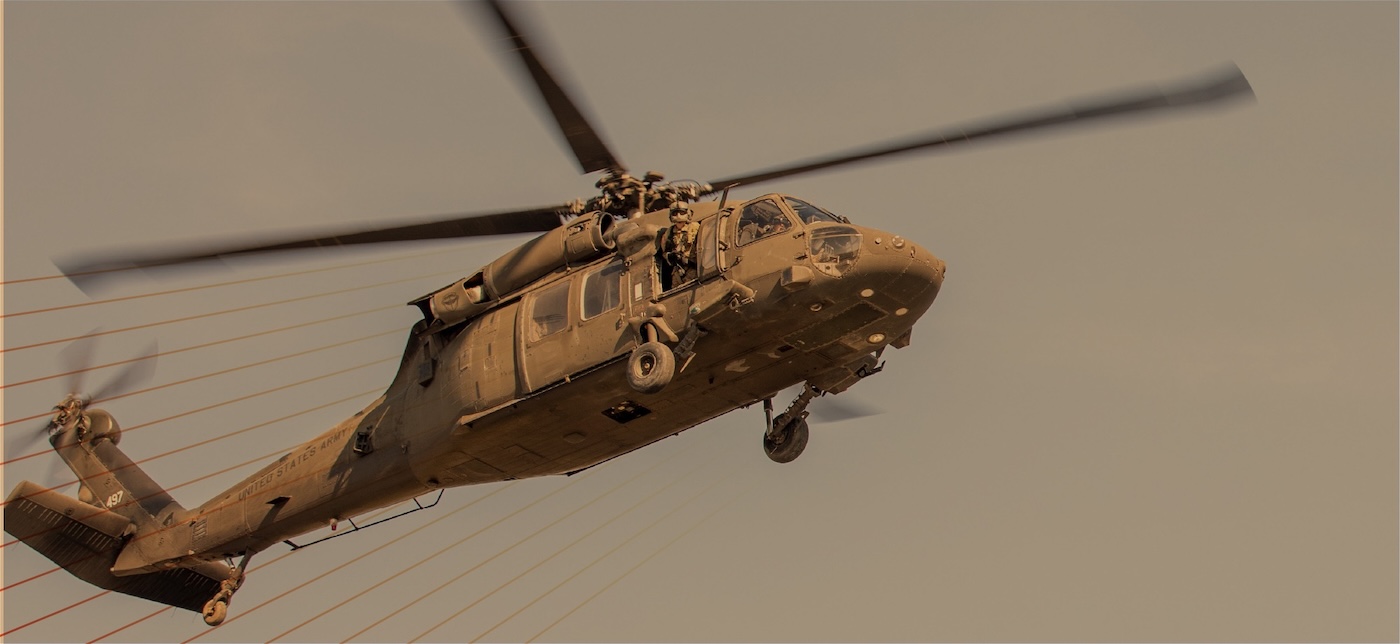
At 16:20 local time on 3 October 1993, an MH-60L Black Hawk helicopter call-signed Super Six-One was hovering above an intersection in central Mogadishu when a rocket-propelled grenade struck its tail rotor.
The pilot, Chief Warrant Officer 3 Cliff Wolcott, was killed instantly. The aircraft yawed violently, inverted, and cartwheeled into a narrow alley off Hawlwadag Road, two blocks south of the Bakaara Market. The fuselage came to rest on its side against a stone wall. The five men trapped inside the wreckage were all American special operations soldiers. Three of them were already dead.
Within ninety seconds, the news of the crash reached every operator on the ground and every commander at the joint operations center at Mogadishu Airport. Within fifteen minutes, the entire mission, which had been planned to take thirty minutes, began to disintegrate. Within an hour, a second Black Hawk would be down half a mile away. By midnight, a force of fewer than 200 American Rangers and Delta Force operators would be pinned in narrow streets they could not navigate, fighting a city they did not understand, with no plan for getting out.
It would take fifteen hours, a Pakistani tank column, and 18 American lives to end the night.
This was the Battle of Mogadishu, the operation the soldiers called the Day of the Rangers and the rest of the world came to know by the title of a book and a film: Black Hawk Down. It lasted eighteen hours. Its consequences ran for thirty years.
The battle was the moment the Cold War's victory narrative collided with the post-Cold War world and lost. A snatch raid that was supposed to capture two of warlord Mohamed Farrah Aidid's lieutenants instead produced the deadliest day for American combat troops since Vietnam, and the photographs that followed killed humanitarian military intervention as a serious political project in Washington for a decade. Six months later, when the genocide began in Rwanda, the Clinton administration's first instinct would be to remember Mogadishu. The bullets stopped on 4 October 1993. The shadow has not.
The UNOSOM Mission and the Hunt for Aidid
The American soldiers who fast-roped onto Hawlwadag Road that afternoon were the third stage of a humanitarian operation that had begun fifteen months earlier with no combat intent whatsoever.
By the summer of 1992, Somalia had ceased to function as a state. The fall of the dictator Siad Barre in January 1991 had been followed by a civil war between rival clan militias that destroyed Mogadishu and produced a famine of catastrophic proportions in the country's southern agricultural belt. By August 1992, an estimated 1.5 million Somalis faced imminent starvation. Aid convoys from international NGOs were being looted at gunpoint by clan militias before they could reach the famine zone. The United Nations Operation in Somalia, UNOSOM I, was authorized to escort the convoys. It failed almost immediately, outgunned and outnumbered.
In December 1992, President George H. W. Bush ordered American troops into Somalia under Operation Restore Hope. Within weeks, 28,000 U.S. Marines and soldiers were on the ground. The famine zone was secured. The convoys reached the camps. By the spring of 1993, the mission was being publicly celebrated in Washington as the model for a new kind of post-Cold War American intervention: armed humanitarianism, brief and clean.
From Operation Restore Hope to the June 5 Ambush
The handover from American command to a renewed UN mission, UNOSOM II, took place on 4 May 1993. Within a month, the political situation had collapsed.
The most powerful warlord in Mogadishu was General Mohamed Farrah Aidid, leader of the Habr Gidr sub-clan and chairman of the Somali National Alliance. Aidid had read the new UN mandate carefully. He had concluded, correctly, that UNOSOM II's stated intention to disarm the militias and rebuild a central Somali government would mean the end of his political power. He decided to fight.
On 5 June 1993, Aidid's militia ambushed a Pakistani UN peacekeeping patrol that had been ordered to inspect one of his weapons caches near Radio Mogadishu. Twenty-four Pakistani soldiers were killed. Some of the bodies were mutilated. The next day, the UN Security Council passed Resolution 837, authorizing the arrest and prosecution of those responsible for the ambush. By name, that meant Aidid.
The hunt began. Through July and August, UNOSOM II and supporting American forces conducted a series of escalating operations against the Habr Gidr leadership in southern Mogadishu. The most notorious, on 12 July 1993, was a Cobra helicopter strike on a meeting of Habr Gidr clan elders at the Abdi House, which killed dozens of unarmed Somalis and produced the first widespread anti-American sentiment among Mogadishu's civilian population. The four Western journalists who arrived after the strike were beaten to death by a crowd of mourners.
In Washington, the response was to send a more specialized tool.
Task Force Ranger and the Olympic Hotel
Task Force Ranger arrived in Mogadishu on 22 August 1993 under the command of Major General William F. Garrison. The force was a small, elite, secret-by-design unit drawn from three of the most selective formations in the U.S. military: B Company of the 3rd Battalion, 75th Ranger Regiment, providing the perimeter and assault infantry; C Squadron of the 1st Special Forces Operational Detachment-Delta, providing the entry team; and the 160th Special Operations Aviation Regiment, the Night Stalkers, providing the helicopter lift. Their joint operations center was set up in a partially demolished hangar at Mogadishu Airport.
Their mission was narrow: find and capture General Aidid. Over the course of August and September, Task Force Ranger conducted seven operations into the warren of streets north of the airport. None of them captured Aidid. Some captured his lieutenants. Some captured the wrong people entirely. The operations took place in daylight, a deliberate decision Garrison would later defend as the only way to get reliable confirmation of targets in a city where the population was largely hostile and the intelligence shaky. Every raid taught the militias a little more about how the Americans operated.
On the afternoon of Sunday, 3 October 1993, a Somali informant code-named "Lincoln" delivered intelligence to the Task Force Ranger operations center that two of Aidid's most senior lieutenants, Omar Salad Elmi and Mohamed Hassan Awale, would be meeting that afternoon at a building near the Bakaara Market, two blocks from the Olympic Hotel landmark. The meeting was to begin at approximately 15:30.
The Task Force Ranger team had been planning for exactly this opportunity for six weeks. The mission was launched at 15:42.
The Bakaara Market Raid of 3 October 1993
The 15:42 Insertion and the Two Targets
Nineteen aircraft lifted off from Mogadishu Airport at 15:42: twelve helicopters and seven ground vehicles staged for the extraction. The plan was a textbook Task Force Ranger operation, refined over six weeks of practice and seven previous raids.
Four Delta Force assault teams would fast-rope from MH-60L Black Hawks onto the target building, secure the two Aidid lieutenants, and bring them to the roof. Four Ranger chalks would fast-rope onto the four street corners of the block to establish a perimeter. The ground convoy of nine Humvees and three five-ton trucks, commanded by Lieutenant Colonel Danny McKnight, would arrive at the target building, the prisoners would be loaded, and the entire force would extract back to the airport. Total time on the ground: an estimated thirty minutes.
The first phase went almost perfectly. The Delta operators were on the roof within minutes. The two targets were inside the building, secured and zip-tied within twenty minutes of the insertion. The convoy arrived at the target building at approximately 16:03. The prisoners were loaded. The Rangers on the perimeter were already taking fire, heavier than on any previous mission, but the volume of return fire from the helicopters was managing it.
At 16:20, the situation changed completely.
Super Six-One: The First Helicopter Down
CW3 Cliff Wolcott had been flying Black Hawks for the Night Stalkers for eight years. He was thirty-six years old. He had a wife and two children in Tennessee. On the afternoon of 3 October he was at the controls of Super Six-One, an MH-60L providing aerial fire support over the target building, flying a low orbit at roughly 75 feet over the rooftops south of the Bakaara Market.
A young Somali militiaman fired a Soviet-pattern RPG-7 grenade upward from a side street. The warhead struck Super Six-One's tail rotor assembly. The aircraft lost yaw control, spun violently, and went down in an alley off Hawlwadag Road, approximately three blocks from the target building.
Wolcott and his co-pilot Donovan Briley were killed in the impact. Two of the four crew chiefs in the back were killed. One Delta sniper, SSG Daniel Busch, survived the crash but died of his wounds an hour later defending the wreckage. One crew chief, SSG Ray Dowdy, survived. A small Combat Search and Rescue team fast-roped down from another helicopter, Super Six-Eight, to secure the site. Within minutes, every armed Somali within a kilometer of the crash was moving toward it.
The mission's center of gravity shifted instantly. The two prisoners and the ground convoy were now secondary. Every American on the ground was being redirected to crash site one. The Ranger chalks broke perimeter and moved on foot through the alleys toward Wolcott's helicopter. McKnight's convoy turned around to do the same. The narrow streets, the dust kicked up by the rotors, and the radio confusion meant that within ten minutes the convoy was lost.
Super Six-Four and the Decision of Shughart and Gordon
At approximately 16:40, twenty minutes after Super Six-One went down, a second MH-60L took an RPG hit while orbiting in support of the rescue effort. Super Six-Four, piloted by CW3 Mike Durant, autorotated into a crash landing on a street roughly a mile southwest of crash site one. Durant survived the impact with a broken leg and a crushed back. His co-pilot, CW3 Ray Frank, also survived. Two crew chiefs were trapped in the wreckage, one dead, one mortally wounded.
There was no rescue force available. Every ground unit was already committed to crash site one. From the air, the operations center could see armed Somalis converging on Durant's helicopter from multiple directions.
In an orbit overhead, two Delta Force snipers were watching the scene from their helicopter, Super Six-Two. Master Sergeant Gary Gordon and Sergeant First Class Randy Shughart asked their command three times by radio for permission to be inserted at the crash site to defend the survivors. The first two requests were denied. The third was approved.
Gordon and Shughart fast-roped onto a street corner approximately a hundred meters from Durant's helicopter, fought their way to the wreckage, and pulled Durant out of the cockpit and into a defensive position behind the airframe. With the rifles and ammunition they could carry, they held the position for an estimated thirty-five minutes against an enemy force that grew throughout the engagement from dozens to several hundred men.
Shughart was killed first, his body found later still holding his weapon. Gordon was killed after running out of ammunition; one account, drawn from Durant's debriefing, has him handing his sidearm to Durant with the words "good luck" before turning to face the crowd. Durant was beaten, dragged from the wreckage, and taken hostage. He would be held in captivity for eleven days.
In 1994, Gary Gordon and Randy Shughart were posthumously awarded the Medal of Honor for the action at crash site two. They were the first American soldiers to receive the medal since the Vietnam War.
The Long Night at Crash Site One
The Lost Convoy and the Pinned Defenders
By 17:00 on the afternoon of 3 October, the Task Force Ranger operation had ceased to resemble its plan in any particular. The two captured prisoners were still in the ground convoy, but the convoy itself was lost in the maze of streets between the target building and crash site one, taking sustained fire from every intersection it passed through.
The convoy made multiple attempts to reach crash site one. Each one ended at a street block, or under heavy fire from rooftops, or with another vehicle disabled by RPG hits. By 17:30, Lieutenant Colonel McKnight, wounded and with most of his Humvees burning or disabled, was ordered to break off and return to the airport with the prisoners and his casualties, which by that point already exceeded his ability to evacuate them. He arrived at the joint operations center after dark, having lost contact with the men still moving on foot toward crash site one.
Those men, approximately ninety Rangers and Delta operators, reached Wolcott's wreckage at separate points and consolidated a perimeter of two-story buildings around the alley where the helicopter had fallen. They held that perimeter through the night. They could not move Wolcott's body out of the airframe; he was pinned inside, and removing him would require cutting tools they did not have. They could not abandon him.
The fighting through the night ranged from sporadic RPG and small-arms fire to coordinated militia assaults at every hour. American air support, AH-6 Little Bird gunships and the surviving Black Hawks, ran continuous orbits overhead, expending most of the ammunition the task force had brought into Somalia. The men on the ground watched their wounded die in doorways for lack of evacuation. They ran out of intravenous fluid before midnight. They ran out of morphine before dawn. They radioed for help.
The Pakistani-Malaysian Armored Rescue at Dawn
The rescue convoy that finally extracted the men at crash site one at first light on 4 October was not American.
The Task Force Ranger had been operating in deliberate political and operational isolation from UNOSOM II. The American command had not coordinated with the UN coalition. It had not requested armor support, which the Americans did not have in Mogadishu and the UN did. When the situation at crash site one became unsustainable, the Pakistani contingent of UNOSOM II was asked to lend its tanks, and the Malaysian contingent was asked to lend its armored personnel carriers. Both said yes.
The relief column that assembled at the New Port stadium on the night of 3 October included four Pakistani M48 tanks, twenty-four Malaysian Condor armored personnel carriers, and a company of the U.S. Army's 10th Mountain Division as escort infantry. It rolled out at approximately 02:00 on 4 October. It took five and a half hours to fight its way through three kilometers of streets to crash site one. One Malaysian soldier, Corporal Mat Aznan Awang, was killed in the advance when his Condor was hit by an RPG. One Pakistani soldier was killed in supporting operations. By the time the column reached crash site one, the American defenders had been on the ground for nearly fifteen hours.
The extraction was disorganized. There was not enough room in the Condors for all of the survivors. A column of Rangers and Delta operators jogged alongside the vehicles for several kilometers under fire on the way back to the Pakistani stadium, an episode that would be remembered in the unit as the Mogadishu Mile. They reached the stadium at approximately 06:30 on 4 October. They had been in continuous combat for fifteen hours.
The body of Cliff Wolcott had been cut out of his helicopter with a hydraulic spreader, the kind used by fire departments to extract motorists from car wrecks. It was the last American body to leave crash site one.
The Cost on Both Sides
The Eighteen American Dead and the Body in the Street
Eighteen American soldiers were killed in the eighteen hours between the start of the mission and the return to the stadium. Seventy-three were wounded. Two helicopters had been destroyed. One pilot, Mike Durant, was in the hands of Aidid's militia.
The dead were Wolcott and Briley of Super Six-One; Gordon and Shughart at crash site two; Busch, Smith, Joyce, Fillmore, Pilla, Kowalewski, Cavaco, Alphabet, Field, Anderson, Martin, Cleveland, Stebbins, and Ruiz of the Rangers and Delta on the ground. Most were in their twenties. The youngest, Specialist James Cavaco, was twenty-six. The oldest, Sergeant First Class Earl Fillmore, was thirty-eight.
The image that did the most political damage in the United States was not, in the end, the casualty figures. It was a photograph.
Paul Watson, a Canadian photographer for the Toronto Star, was in Mogadishu on the morning of 4 October. He photographed the body of Staff Sergeant William David Cleveland, a Black Hawk crew chief killed at crash site two, being dragged through a street by a jubilant Somali crowd. The photograph ran in newspapers across the United States within forty-eight hours. It would win Watson the Pulitzer Prize for Spot News Photography in 1994. It would also, more than any combat report or casualty list, define the American political memory of the battle. The image became the proof point in every subsequent argument against committing American ground troops to humanitarian intervention.
Three days later, on 7 October, President Bill Clinton appeared on television and announced that the American mission in Somalia would be ended. He gave a deadline: 31 March 1994. After that date, no American combat troops would remain in the country. The withdrawal began the next week.
The Somali Casualties
The Somali dead from the battle were never counted accurately. The figure is genuinely unknown.
The most conservative estimate, from the International Committee of the Red Cross, was 500 Somalis killed in the eighteen hours of fighting. Aidid's own information ministry claimed 315 killed and 812 wounded, a figure most analysts consider deflated to obscure the scale of his militia's losses. Some American post-battle assessments, drawn from intelligence intercepts and detainee interviews, estimated total Somali casualties at 1,000 to 1,500 killed and several thousand wounded. The U.S. Department of Defense, in 2003, used a working figure of "over 500 Somali militia and civilian casualties."
The reason for the disagreement is straightforward. The fighting took place in a densely populated urban area where civilians and militiamen were indistinguishable, where most of the wounded were never brought to functioning hospitals, where the dead were buried by families rather than counted by authorities, and where the political incentive on every side, the Habr Gidr, the UN, the Americans, was to make the figure either lower or higher than the truth.
What is not in dispute is that the ratio of dead was extreme. For every American killed in the Battle of Mogadishu, at least thirty Somalis died, and possibly closer to eighty. The asymmetry was the predictable consequence of fielding a small force of elite light infantry against a city's worth of militia in territory the militia knew and the soldiers did not.
The Political Earthquake
Clinton's Withdrawal and the End of the Powell Doctrine
Mike Durant was released by Aidid's militia on 14 October 1993, after eleven days in captivity, following back-channel negotiations conducted by ambassador Robert Oakley. American combat troops had already begun withdrawing by that point. By 31 March 1994, the deadline President Clinton had announced six days after the battle, every American soldier was out of Somalia.
The Secretary of Defense at the time of the battle was Les Aspin. He had, two weeks before the operation, formally denied a request from the commander of American forces in Somalia, Major General Thomas Montgomery, for the deployment of M1 Abrams tanks and Bradley Fighting Vehicles to support the Task Force Ranger operations. The reasoning had been political: armor would be visible to the press, would signal escalation, and would contradict the administration's public framing of the mission as a transitional handover to the UN. Aspin's denial became the central political fact of the post-battle inquiry. He resigned on 15 December 1993. He died of a stroke fifteen months later, at the age of fifty-six.
The doctrine that died at Mogadishu was the Powell Doctrine, the post-Vietnam strategic framework articulated by Chairman of the Joint Chiefs General Colin Powell. The doctrine held that American military force should be used only with overwhelming superiority, clear political objectives, exit strategies, and broad domestic support. The Somalia mission had violated almost every component of it. Task Force Ranger was not overwhelmingly superior. Its political objective, the capture of one man in a city of a million, was nebulous. Its exit strategy did not exist. After 4 October, its domestic support collapsed.
The Powell Doctrine survived in textbooks. As an operating principle of American foreign policy, it never again commanded the kind of bipartisan deference it had enjoyed before Mogadishu.
Rwanda Six Months Later
In May 1994, seven months after the battle and five weeks after the start of the Rwandan genocide, the Clinton administration issued Presidential Decision Directive 25.
PDD-25 set out the new American policy on multilateral peace operations. It established a series of strict tests that any proposed UN peacekeeping mission, or American participation in such a mission, would have to pass before receiving U.S. support: a clear threat to international peace, defined objectives, available resources, broad domestic and international support, an acceptable command structure, and a defined endpoint. By the time the directive was issued, the genocide in Rwanda had been ongoing for five weeks. An estimated 500,000 Tutsi and moderate Hutu had already been killed.
The directive was not written specifically to prevent intervention in Rwanda. It was written to prevent another Mogadishu. The effect, in the Rwandan context, was the same. Throughout April and May 1994, as the death toll mounted, the U.S. State Department instructed its diplomats to avoid the word "genocide" in their public statements, on the grounds that using it might create a legal obligation to act under the 1948 Genocide Convention. American support for an expanded UNAMIR peacekeeping force was withheld. By the time the genocide ended in mid-July 1994, an estimated 800,000 to 1,000,000 Rwandans had been killed, the vast majority of them with machetes, in approximately one hundred days.
President Clinton, who toured the Kigali Genocide Memorial on 25 March 1998, called the American failure to intervene the greatest regret of his presidency. The Battle of Mogadishu was the closest thing to a cause of that failure that historians have been able to identify. Eighteen dead Americans on Hawlwadag Road bought a policy that allowed nearly a million Rwandans to die five months later.
The contrast with Entebbe Airport, the Israeli hostage-rescue operation of July 1976 that remains the textbook for how a long-distance special operations raid into an African capital is supposed to end, is the contrast that every American military planner has studied since. Entebbe took ninety minutes, freed 102 hostages, and lost one Israeli soldier. Mogadishu took fifteen hours, freed no one, and lost eighteen.
The Atlas Entry: Visiting Mogadishu
The Battle of Mogadishu was fought across a roughly two-square-kilometer area in the Hawl-Wadag and Wardhigley districts of central Mogadishu. The principal landmarks remain identifiable on the ground: the Bakaara Market is still the largest open-air market in the country; the building called the Olympic Hotel, then a partially functional landmark, was destroyed in subsequent fighting and has not been rebuilt; the intersection where Super Six-One went down is now a residential neighborhood with no commemoration; the location of crash site two is similarly unmarked. There is no battlefield memorial. There is no museum.
Mogadishu in 2026 is not a destination that ordinary tourism reaches. The city has been the front line of the war against al-Shabaab, the Somali al-Qaeda affiliate that grew out of the Islamic Courts Union in the late 2000s, for nearly two decades. Bombings of hotels, government buildings, and restaurants in the central districts have been a regular feature of the city since 2009. The most recent major attack on a Mogadishu hotel killed thirty-two people in early 2024. The Somali Federal Government controls Mogadishu in daylight; the situation at night is more contested. Western foreign offices uniformly advise against all travel.
A small number of conflict journalists, NGO workers, and Somali-diaspora visitors do travel to Mogadishu under armed escort. The standard arrangement involves an armored vehicle from Aden Adde International Airport to a fortified compound hotel on the airport peninsula, then organized excursions into the city with private security. The Bakaara Market remains the area most often visited as a symbolic destination by Western visitors with an interest in the battle. The market is busy, dense, hot, and almost entirely uninterested in the events of October 1993. The Somalis who fought in the battle are now in their fifties and sixties. The militiamen who dragged the bodies through the streets are aging men with grandchildren. The young men who fill the alleys today were born after the battle and are mostly preoccupied with the war against al-Shabaab.
What this place asks of a visitor is not nostalgia for a battle. It asks attention to a sequence: famine, intervention, mission creep, miscalculation, withdrawal, and the long consequences of the lesson that gets drawn. The American soldiers who died on Hawlwadag Road were not the only people whose lives ended because of what happened in Mogadishu. Several hundred Somalis died in the same eighteen hours. Several hundred thousand Rwandans died over the next hundred days in part because of how Washington remembered it. Standing at the edge of the Bakaara Market with that knowledge is the closest a visitor can come to understanding why Mogadishu matters.
Frequently Asked Questions
What was the Battle of Mogadishu?
The Battle of Mogadishu, also called Black Hawk Down or the Day of the Rangers, was an eighteen-hour urban combat operation on 3 and 4 October 1993 in central Mogadishu, Somalia. An elite American force of about 160 Rangers and Delta Force operators, supported by 19 aircraft, attempted to capture two senior lieutenants of Somali warlord Mohamed Farrah Aidid. The raid succeeded in capturing the targets but spiraled into a full-scale urban siege when two MH-60L Black Hawk helicopters were shot down by rocket-propelled grenades. Eighteen American soldiers were killed and 73 wounded. Estimates of Somali dead range from 500 to over 1,000.
Who shot down the Black Hawks in Mogadishu?
The two Black Hawks, Super Six-One and Super Six-Four, were brought down by Soviet-pattern RPG-7 rocket-propelled grenades fired by Somali militiamen loyal to General Mohamed Farrah Aidid's Habr Gidr clan. The militias had been instructed by veterans of the Soviet-Afghan war, including reportedly some Afghan and Arab advisors, on the technique of firing RPGs upward at low-flying helicopters. The first Black Hawk, piloted by CW3 Cliff Wolcott, was hit in the tail rotor at approximately 16:20. The second, piloted by CW3 Mike Durant, was hit roughly twenty minutes later.
How many Americans died in the Battle of Mogadishu?
Eighteen American soldiers were killed in the battle itself, with 73 wounded. The dead included 12 Rangers, 4 Delta Force operators (including Master Sergeant Gary Gordon and Sergeant First Class Randy Shughart, both later awarded the Medal of Honor), and 4 Night Stalkers helicopter crew members. One additional American, Sergeant Matt Rierson, was killed by a mortar attack at the airport joint operations center two days later, on 6 October 1993, bringing the total to 19. One Pakistani and one Malaysian UN peacekeeper were also killed in the rescue operation.
What happened to Mike Durant?
Chief Warrant Officer 3 Michael Durant, the pilot of Super Six-Four, survived his helicopter's crash with a broken leg and a crushed back. He was pulled from the wreckage by Master Sergeant Gary Gordon and Sergeant First Class Randy Shughart, who held off Aidid's militia until both were killed. Durant was then beaten, dragged from the wreckage, and held hostage by elements of the Habr Gidr clan for eleven days. He was released on 14 October 1993 following back-channel diplomatic negotiations conducted by U.S. ambassador Robert Oakley. He retired from the U.S. Army as a Chief Warrant Officer 4 in 2001.
What is the connection between the Battle of Mogadishu and the Rwandan genocide?
The connection runs through Presidential Decision Directive 25, issued by the Clinton administration in May 1994. PDD-25 imposed strict new conditions on American support for UN peacekeeping operations, conditions explicitly designed to prevent a repeat of the Mogadishu disaster. When the Rwandan genocide began on 6 April 1994, the directive's framework, combined with the lingering political impact of Mogadishu, contributed to the administration's decision not to support an expanded UNAMIR peacekeeping force. Approximately 800,000 to 1,000,000 Rwandans were killed over the following hundred days. President Clinton later identified the failure to intervene as the greatest regret of his presidency.
Can you visit the Battle of Mogadishu sites today?
Travel to Mogadishu remains restricted by every major Western foreign office, and there are no marked memorials at the battle sites. The Bakaara Market, near the original target building, is still operational and is the area most often visited by foreign journalists or Somali-diaspora travelers with an interest in the battle. Visits require armored transport, private security, and coordination with the Somali Federal Government's security services. The Olympic Hotel landmark was destroyed in later fighting. The two helicopter crash sites are unmarked residential streets in the Hawl-Wadag district.
Sources
Black Hawk Down: A Story of Modern War — Mark Bowden (1999)
In the Company of Heroes — Michael J. Durant with Steven Hartov (2003)
The Mission, the Men, and Me: Lessons from a Former Delta Force Commander — Pete Blaber (2008)
Somalia After Operation Restore Hope: Lessons Learned — U.S. Army War College Strategic Studies Institute (1994)
Report on the Investigation of the Battle of Mogadishu (Department of Defense After-Action Report) — U.S. Department of Defense (1994)
My Clan Against the World: U.S. and Coalition Forces in Somalia 1992-1994 — Robert F. Baumann and Lawrence A. Yates (2003)
Senate Armed Services Committee Hearing on the Situation in Somalia — United States Senate (October 1993)
Mogadishu Photograph (Paul Watson, Toronto Star, 1993) — Pulitzer Prize Archives, Spot News Photography (1994)
Presidential Decision Directive 25: Reforming Multilateral Peace Operations — The White House (1994)
A Problem from Hell: America and the Age of Genocide — Samantha Power (2002)
Shake Hands with the Devil: The Failure of Humanity in Rwanda — Lt. Gen. Roméo Dallaire (2003)
UN Security Council Resolution 837 — United Nations Security Council (1993)