The Degüello at Dawn
It was still dark when the music started.
Around five in the morning on March 6, 1836, the buglers in Santa Anna’s army lifted their instruments and played the Degüello — an old Spanish military call whose name comes from the verb degollar, to slit the throat. It meant exactly what it sounded like. No prisoners. No quarter. No mercy for anyone inside the walls. The notes carried across the cold open ground toward a battered mission compound where fewer than two hundred exhausted men were sleeping at their posts, some of them collapsing from thirteen days without real rest.
By the time most of them woke, roughly 1,800 Mexican soldiers were already running at the walls in the dark.
The whole thing was over in about ninety minutes.
This is the part everyone gets wrong about the Alamo: it was not a heroic victory. It was a catastrophe. Every defender who took up arms inside that compound was killed. The fort was taken. The man who ordered the assault, Antonio López de Santa Anna, walked through the smoke a few hours later having won decisively. By any military accounting, the Alamo is a story about losing.
And that is precisely what makes it the most important place in this story — because losing turned out to be the most powerful thing those men could have done. The cry that came out of those walls, Remember the Alamo, did not commemorate a triumph. It commemorated a massacre, and it weaponized grief so effectively that it founded a republic. For nearly two centuries that war cry has done something else, too: it has flattened a tangled, uncomfortable, deeply human story — about land, money, slavery, and divided loyalties — into a clean little parable about heroes and a fort. The real Alamo is far stranger and far more interesting than the legend that swallowed it.
A Spanish Mission Becomes a Texan Fortress
The Alamo was never built to be a fort. It was built to save souls.
Spanish missionaries founded Mission San Antonio de Valero in 1718 as a frontier outpost meant to convert the Indigenous peoples of the region to Catholicism and bind them to the Spanish crown. For decades it functioned as a working mission — chapel, living quarters, workshops, fields. By the early 1800s the mission system had collapsed, the place was secularized, and a Spanish cavalry unit moved in. Their hometown back in Mexico was a place called Álamo de Parras, and the nickname stuck to the old mission like a burr. El Álamo. The cottonwood.
That’s the entire origin of the name. A unit of soldiers, homesick for a town full of cottonwood trees.
By 1836 the compound was a wreck — a roofless church, a long low barracks, and a sprawling plaza ringed by walls that had never been designed to stop an artillery assault. It enclosed about three acres, which sounds defensible until you realize that fewer than two hundred men were being asked to cover a perimeter that needed close to a thousand. The defenders spent their thirteen days frantically shoring up gaps with dirt and timber. It was, in the brutal assessment of more than one officer present, the wrong place to make a stand.
So why were they there at all? Because of a revolution.
In 1835 the Anglo-American settlers who had poured into the Mexican state of Texas — invited there, originally, by a Mexican government that wanted the frontier populated — turned against that same government. The reasons were a knot. Santa Anna had torn up Mexico’s federalist constitution and made himself a centralist strongman, which enraged the colonists. But many of those colonists were also American slaveholders, and Mexico had moved to restrict and abolish slavery, which enraged them just as much. The Texas Revolution was both a fight for self-government and a fight to keep human beings in bondage, and the people who tell you it was only one of those things are selling you a flag instead of a history.
By early 1836 the rebels had actually captured San Antonio and its mission in a previous battle. The Alamo wasn’t a fortress they were besieged in by surprise. It was a prize they had taken — and then chosen to hold, against the advice of nearly everyone, including the man who would soon win the whole war by doing the opposite.
The Defenders: Bowie, Travis, and Crockett Inside the Walls
The Alamo’s garrison was a collection of men who, in any other circumstance, might never have agreed on anything.
William Barret Travis and the “Victory or Death” Letter
William Barret Travis was twenty-six years old and not, by most accounts, an easy man to like. He was a lawyer who had abandoned a wife and child in Alabama, fled to Texas under a cloud of debt and possibly worse, and arrived with an enormous chip on his shoulder and an even larger sense of destiny. He was vain, dramatic, ambitious — and, it turned out, exactly the kind of man you want writing your last words.
On February 24, with Santa Anna’s army already in San Antonio and the bombardment underway, Travis sat down inside the walls and wrote a letter addressed “To the People of Texas & all Americans in the world.” He described his situation plainly: surrounded, outnumbered, under a flag of no quarter. Then he refused to surrender or retreat, and signed off with three words that would outlive him by centuries — Victory or Death.
The letter was smuggled out by a courier who rode through the enemy lines in the dark. It is, by any measure, one of the great pieces of writing produced under fire in American history — and Travis wrote it knowing, almost certainly, that no help was coming. He was a self-mythologizer composing his own legend in real time, and the terrible thing is that he was right. The legend was earned.
Jim Bowie’s Sickbed and Davy Crockett’s Last Stand
Jim Bowie should have been the most dangerous man inside the Alamo. He was already a living legend before he ever got there — a brawler, a land speculator, a slave smuggler, and the namesake of the enormous fighting knife he’d made famous in a Mississippi sandbar duel where he’d been shot and stabbed and still killed his man. He arrived at the Alamo as a co-commander, locked in an ugly authority struggle with the much younger Travis.
And then his body betrayed him. Sometime during the siege Bowie collapsed with a violent illness — possibly typhoid, possibly pneumonia, the record isn’t sure — and spent the final days flat on a cot, fading in and out, unable to stand. The most feared knife-fighter in North America met his end in bed, too weak to lift the weapon that bore his name. Mexican accounts say he was killed where he lay, firing pistols from his cot until the soldiers reached him. It is the kind of detail the legend usually edits out, because there is nothing clean about it.
Then there was the most famous man of all. David Crockett — “Davy” to the legend, “David” to himself — was a former U.S. Congressman from Tennessee, a national celebrity, a frontier humorist whose tall tales had already made him a brand while he was still alive. He’d lost his seat in Congress and reportedly told his constituents they could go to hell, and he would go to Texas. He did. He showed up at the Alamo with a small band of Tennessee volunteers, a fiddle, and a reputation, and by all accounts kept the demoralized garrison’s spirits up during the long siege.
How exactly Crockett died is one of the most fiercely contested questions in American history. The legend has him swinging his empty rifle “Old Betsy” like a club, surrounded by a ring of dead Mexican soldiers. Some accounts — including a disputed diary by a Mexican officer — claim he was among a handful of men captured alive and executed on Santa Anna’s orders shortly after the battle. Texans have come close to fistfights over which version is true. What is not in dispute is that he came, he stayed when he could have left, and he died there. The rest is the kind of argument people only have about men who matter.
The 13-Day Siege of the Alamo, February–March 1836
Santa Anna arrived in San Antonio on February 23, and the first thing he did was send a message everyone inside the Alamo could see.
Santa Anna’s Army and the Red Flag of No Quarter
He ran a blood-red flag up the tower of the San Fernando church in the center of town. In the military language of the era, a red flag meant one thing: no quarter. Surrender will not be accepted. Everyone inside dies.
Santa Anna fancied himself the “Napoleon of the West,” and he had the ego to match — he had crushed earlier rebellions with deliberate brutality precisely because he believed that overwhelming terror ended wars faster than mercy ever could. The flag was not a bluff. It was a statement of policy. When the defenders answered it with a defiant cannon shot, the lines were drawn with total clarity. There would be no negotiated ending here.
For twelve days the Mexican artillery pounded the walls while the army’s full strength assembled. Inside, the defenders dug in, patched holes, rationed what little they had, and waited for the reinforcements Travis kept promising in letter after letter carried out by couriers slipping through the dark.
The Couriers and the Reinforcements That Never Came
The most heartbreaking thread of the siege is the help that almost came and didn’t.
Travis sent rider after rider out through the encircling army, each carrying pleas for reinforcement to the scattered Texan forces and provisional government. A few men actually made it in — most famously a group of about thirty-two volunteers from the nearby town of Gonzales who deliberately rode toward the doomed fort in the early hours of March 1, slipping through the Mexican lines to join a garrison they had every reason to believe was already lost. They were farmers and townsmen. They went anyway. Almost none of them would survive the week.
The larger relief force never came. The Texan commander Sam Houston, who understood that the revolution could not be won by feeding men into a trap, was already convinced the Alamo should be abandoned entirely. The government was in chaos. The promised hundreds of reinforcements remained a fiction. By the night of March 5, Travis is said to have gathered the garrison and told them plainly that no help was coming and that the choice ahead was death — the famous “line in the sand” he supposedly drew with his sword, inviting any man who would stay and die to step across it.
That scene is almost certainly a later invention; the only man who could have witnessed it and survived left no such account. But like much of the Alamo, the legend grew because it captured something true even when the specific facts were fiction. These men were not trapped by accident. By the final night, most of them understood exactly what dawn would bring. And they stayed.
The Final Assault and the Fall of the Alamo
The attack came in the dark of March 6 because Santa Anna wanted it to.
He pulled his artillery silent for two days to lull the exhausted garrison, then launched four columns of infantry against the walls before sunrise, when the defenders would be hardest to rally and the killing could be done up close. The first waves were cut down by cannon and rifle fire — the Texans were superb marksmen, and the open ground in front of the walls turned briefly into a slaughter of attackers. For a few minutes it looked as if the assault might break.
It didn’t. There were simply too many. The columns reformed, found a weak point at the north wall, and poured over and through it. Once the Mexican soldiers were inside the plaza, the defenders’ greatest weakness became fatal: there were not enough of them to hold three acres of wall, and once the perimeter was breached, the battle collapsed into a chaos of room-to-room killing in the dark.
The fighting moved into the long barracks and the church, where the defenders had cut firing holes and barricaded the doors. Men fought with rifles until there was no time to reload, then with knives, then with bare hands and clubbed weapons. Travis died early, reportedly shot through the head at the north wall he was defending. Bowie was killed on his cot. The last organized resistance is thought to have been made inside the chapel — the roofless stone church that still stands today and that most people now picture when they hear the word “Alamo.”
By daylight it was finished. Every defender who had taken up arms — somewhere between 180 and 250 men, the exact number still debated — was dead. Santa Anna ordered the bodies stacked and burned. The smoke from the pyres hung over San Antonio for days.
He thought he had ended the rebellion. He had just guaranteed it.
The Survivors and “Remember the Alamo”
Santa Anna spared a few people on purpose, and it was the worst tactical decision of his life.
He let the noncombatants live — most notably Susanna Dickinson, the young wife of one of the defenders, and her infant daughter, along with Joe, a man enslaved by Travis who had been forced into the fort alongside his enslaver. Santa Anna’s logic was cold and deliberate: he sent the survivors east to spread the news of the Alamo’s annihilation, believing that terror would shatter the rebels’ will to fight. He wanted them to carry the horror outward like a contagion.
Susanna Dickinson rode out of the smoking ruin with her baby and told every Texan she met exactly what had happened inside those walls. So did Joe. The story did spread, just as Santa Anna intended — but instead of terror, it produced rage.
Six weeks later, on April 21, 1836, Sam Houston’s army caught Santa Anna’s forces resting and unprepared on the banks of the San Jacinto River. The Texans attacked in the late afternoon screaming two things at once: Remember the Alamo! and Remember Goliad! — the latter for a separate mass execution of Texan prisoners Santa Anna had ordered weeks before. The Battle of San Jacinto lasted about eighteen minutes. It was less a battle than a reckoning. Santa Anna himself was captured the next day, hiding in the grass in a borrowed uniform, and signed away Texas to save his own neck.
The men who died at the Alamo did not win their battle. But their deaths won the war — not through the fort they failed to hold, but through the fury their massacre unleashed. Santa Anna had wanted to make an example of them. He succeeded far better than he knew, and entirely against himself.
The thread of his story doesn’t end there, either. He would return to power again and again in Mexico, lose a leg to a French cannonball, stage that leg an elaborate state funeral, and eventually face the United States once more — including at the fortress of Chapultepec Castle, where another doomed garrison of young defenders would enter Mexican legend the way the Alamo’s dead had entered the Texan one.
Standing at the Alamo Today
The Alamo is not where you’d expect to find it.
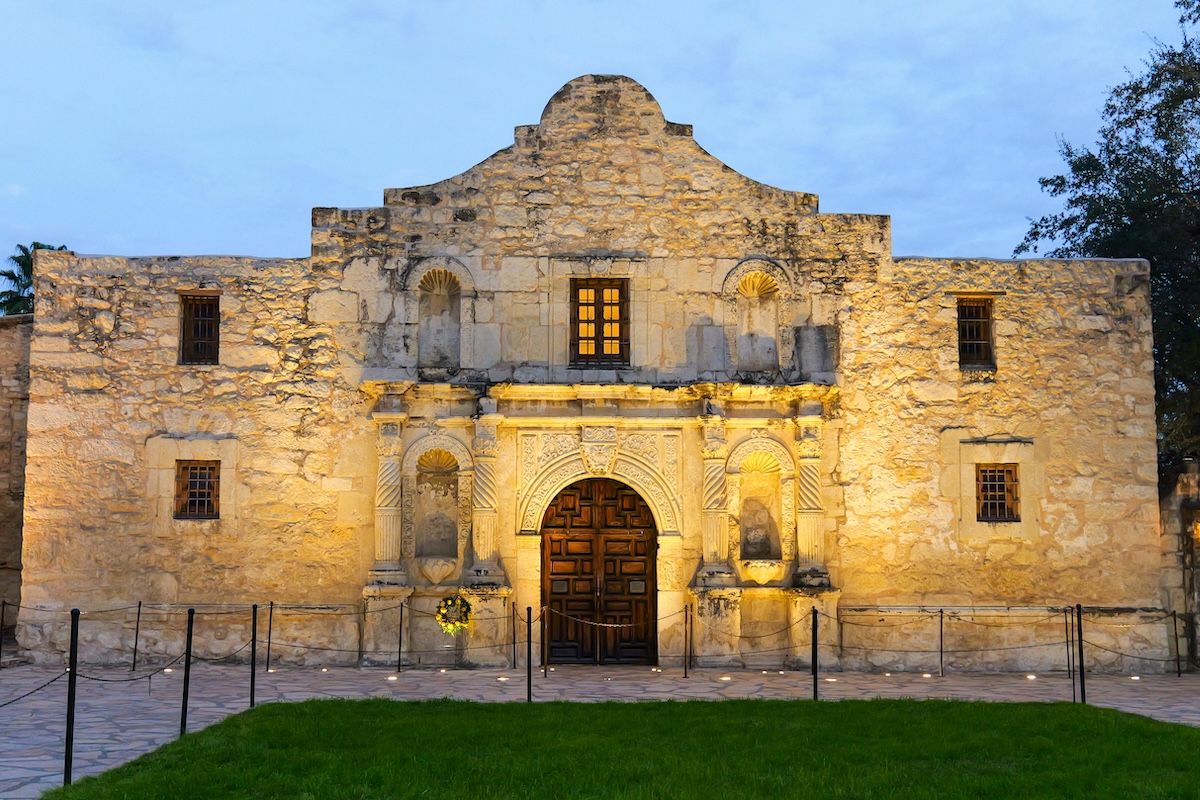
There is no remote battlefield, no preserved wilderness. The mission sits in the dead center of downtown San Antonio, surrounded by hotels, a river walk, and decades of commercial sprawl that crept right up to its walls. The famous chapel facade — the one with the distinctive humped gable — is smaller than almost everyone imagines, and the three acres that the defenders died trying to hold have largely been swallowed by the modern city. Visitors routinely stand on the actual ground of the battle without realizing it, because a department store or a street now covers it.
Inside the chapel, the management asks for silence and for hats to be removed. It is treated, explicitly, as a shrine — for over a century it was maintained by the Daughters of the Republic of Texas as a near-sacred site, and the reverence is real and palpable. Millions of people visit every year. Many of them weep.
What they are weeping for has become the subject of a genuine and sometimes bitter fight. For most of the twentieth century the Alamo was presented as a pure parable: noble freedom fighters, evil tyrant, glorious sacrifice. That version left out a great deal — that many of the defenders were fighting in part to preserve slavery, that the Tejanos (Texans of Mexican descent) who died inside the walls were largely written out of the Anglo legend, that the land itself had belonged to Indigenous and Mexican peoples whom the story conveniently forgot. A major reinterpretation and redevelopment of the site, underway in recent years, has tried to tell a fuller version of events, and it has provoked exactly the kind of public anger you’d expect from a place where memory and identity are fused. People do not argue this fiercely about facts. They argue this fiercely about myths — about what a place is allowed to mean.
That argument is, in the end, the truest thing about the Alamo. Like other American shrines where the official story and the buried one fight for the same ground — the contested granite of Stone Mountain comes to mind — the Alamo has always been less a record of what happened than a battleground over how to remember it. The men who died here fought for thirteen days. The fight over what their deaths meant has lasted nearly two hundred years, and it is nowhere near finished.
Stand in the chapel, in the cool dim quiet, and you are standing inside the gap between the two — between the catastrophe that actually happened and the victory the world decided to remember instead. Few places make that gap so visible. Fewer still ask you to choose a side.
Frequently Asked Questions
Who died at the Alamo?
Every defender who took up arms inside the Alamo was killed — somewhere between 180 and 250 men, with the exact figure still debated by historians. The most famous among them were William Barret Travis, the 26-year-old commander; Jim Bowie, the legendary knife-fighter who died bedridden with illness; and David “Davy” Crockett, the former U.S. Congressman from Tennessee. The dead also included roughly thirty-two volunteers from Gonzales who deliberately rode into the doomed fort, and a number of Tejanos — Texans of Mexican descent — who were long left out of the popular legend. Santa Anna ordered the bodies burned in pyres after the battle.
How long did the Battle of the Alamo last?
The siege lasted thirteen days, from February 23 to March 6, 1836, but the final assault itself was over in roughly ninety minutes. Santa Anna’s army bombarded the walls for nearly two weeks while assembling its full strength, then launched four infantry columns against the compound before dawn on March 6. Once the Mexican soldiers breached the north wall and poured into the plaza, the outnumbered defenders could not hold the three-acre perimeter, and the battle collapsed into close-quarters fighting that ended by daylight.
Did Davy Crockett die fighting or was he executed?
This is one of the most fiercely contested questions in American history, and there is no settled answer. The popular legend has Crockett dying in combat, swinging his empty rifle while surrounded by fallen Mexican soldiers. Other accounts — including a disputed diary attributed to a Mexican officer named José Enrique de la Peña — claim he was among a small group captured alive and executed shortly after the battle on Santa Anna’s orders. What is not disputed is that Crockett came to the Alamo, stayed when he could have left, and died there.
What does “Remember the Alamo” mean?
“Remember the Alamo” became the rallying cry of the Texan army after the fort fell, used to channel grief and rage into the wider fight for independence. Six weeks after the massacre, Sam Houston’s forces shouted it — alongside “Remember Goliad,” for a separate execution of Texan prisoners — as they overwhelmed Santa Anna’s army at the Battle of San Jacinto in roughly eighteen minutes. The cry transformed a total military defeat into a moral victory and helped secure Texan independence. It remains one of the most recognizable phrases in American history.
Why is the Alamo so controversial today?
The Alamo sits at the center of a genuine fight over memory. For most of the twentieth century it was presented as a clean parable of heroism against tyranny, a version that omitted uncomfortable facts — that many defenders were fighting in part to preserve slavery, which Mexico had moved to abolish; that the Tejanos who died inside were largely erased from the Anglo legend; and that the land had belonged to Indigenous and Mexican peoples. A major recent reinterpretation and redevelopment of the site has tried to tell a fuller story, provoking sharp public anger from those attached to the traditional myth.
Where is the Alamo located?
The Alamo is in the center of downtown San Antonio, Texas, surrounded by hotels, the River Walk, and modern commercial development. Originally founded in 1718 as Mission San Antonio de Valero, it is no remote battlefield — much of the original three-acre compound has been absorbed by the city, and visitors often stand on the actual ground of the battle without realizing it. The surviving stone chapel, with its distinctive humped gable, is the structure most people picture when they hear the name.
Sources
A Time to Stand — Walter Lord (1961)
Three Roads to the Alamo: The Lives and Fortunes of David Crockett, James Bowie, and William Barret Travis — William C. Davis (1998)
The Blood of Heroes: The 13-Day Struggle for the Alamo — James Donovan (2012)
Texian Iliad: A Military History of the Texas Revolution — Stephen L. Hardin (1994)
The Alamo Reader: A Study in History — Todd Hansen (2003)
With Santa Anna in Texas: A Personal Narrative of the Revolution — José Enrique de la Peña, trans. Carmen Perry (1975)
Forget the Alamo: The Rise and Fall of an American Myth — Bryan Burrough, Chris Tomlinson & Jason Stanford (2021)
Sam Houston and the American Southwest — Randolph B. Campbell (1993)
Eyewitness to the Alamo — Bill Groneman (1996)
Handbook of Texas: Battle of the Alamo — Texas State Historical Association