The Monument That Was Never a Monument — How Landscape Becomes Ideology
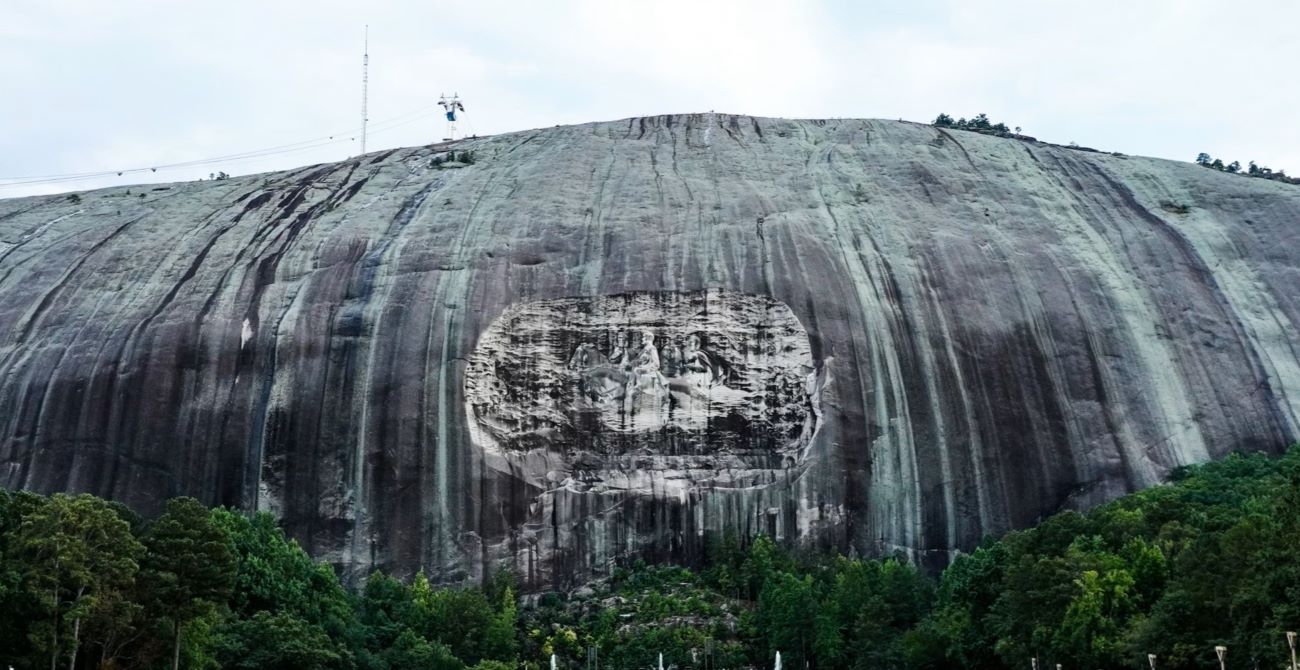
Stone Mountain is a lie carved in granite. Not because the three men on its face didn't exist — they did, and they led armies in defense of chattel slavery — but because the mountain has nothing to do with them. No regiment ever camped at its base. No shell ever scarred its surface. No Confederate soldier bled on its slopes. The granite dome sat in the Georgia countryside for 300 million years before anyone decided it should mean something about the Civil War, and when that decision came, it was made not by veterans mourning their dead but by ideologues building a mythology.
The carving on Stone Mountain is the physical manifestation of the Lost Cause — the revisionist narrative that reframed the Confederacy as a noble defense of states' rights rather than a war fought to preserve human slavery. Every yard of that sculpture, every chisel strike across its three-acre surface, was an act of deliberate historical fabrication. The mountain didn't ask for it. The mountain was already sacred to the Creek and Cherokee nations who had gathered at its base for thousands of years before a single white settler arrived. What makes Stone Mountain one of the most important and uncomfortable sites in America is not the carving itself but the question it forces: what happens when a landscape is hijacked, when stone older than complex life on Earth is conscripted into a political project barely a century old — and when the law says it must stay that way forever?
The Sacred Mountain Before the Carving — 9,000 Years of Indigenous Life at Stone Mountain
The Monadnock and the First Peoples of the Georgia Piedmont
The dome of Stone Mountain formed between 300 and 350 million years ago during the Carboniferous period, when magma welled up from the Earth's crust and cooled into a massive pluton of quartz monzonite — a granite variant laced with quartz, feldspar, and mica. Erosion stripped the softer surrounding rock over geological time, leaving the dome exposed: an inselberg, or monadnock, rising abruptly from the flat Piedmont plain. The pluton extends underground for nine miles into neighboring Gwinnett County. What visitors see is just the tip.
Archaeological evidence places the first human visitors at Stone Mountain roughly 9,000 years ago, during the Early Archaic period. These Indigenous peoples quarried quartz from outcrops on the mountain's surface for toolmaking and left behind soapstone bowls, dishes, and lithic debris that have been recovered from the surrounding area. The summit once bore a low stone wall, constructed by Native Americans for purposes — ceremonial, defensive, or both — that remain undetermined, because the wall was dismantled before any systematic excavation could record it. By the late prehistoric period, the mountain sat in a buffer zone between Muskogean-speaking Creek peoples to the south and Cherokee territories to the north. Its commanding visibility from great distances — and its position at the junction of two major trails — made it a neutral meeting ground where rival nations could convene without trespassing on each other's land.
Colonial Contact, the Creek Confederation, and the Theft of the Land
European contact arrived in the late seventeenth century, most likely through English traders and slave raiders pushing into central Georgia. Disease followed. Thousands of Native Americans died, and the survivors formed defensive alliances that became the Creek Confederation. Stone Mountain sat at the heart of this shifting world. In 1790, President George Washington sent Colonel Marinus Willet to meet Creek leaders near the mountain to negotiate the cession of their lands — one of the earliest federal attempts to formalize the theft already underway. The 1821 Treaty of Indian Springs expelled the remaining Creek peoples from the land east of the Flint River and opened the Stone Mountain region to white settlement.
The town at the mountain's base incorporated as New Gibraltar in 1839, was renamed Stone Mountain in 1847, and by 1849 supported a population of roughly 300 residents with four hotels and eight stores. The real draw was the granite. Quarrying operations expanded rapidly after a railroad spur reached the site, and Stone Mountain granite proved extraordinarily desirable: it was used in the steps of the U.S. Capitol's East Wing, the locks of the Panama Canal, and the Imperial Hotel in Tokyo. The Venable family purchased the mountain in 1887 for $45,000 and ran quarrying operations for decades. The quarries destroyed several geological features, including a formation called the Devil's Crossroads at the summit. The mountain that Indigenous peoples had treated as sacred ground for millennia was being carved up and shipped around the world as building material — a prelude to the far more ambitious carving that was coming.
The Night the Klan Was Reborn — Thanksgiving Eve, 1915
William Joseph Simmons, the Leo Frank Lynching, and The Birth of a Nation
Three events converged in Georgia in 1915 to produce one of the most consequential acts of domestic terrorism in American history. The first was the Leo Frank case. Leo Frank, a Jewish superintendent of an Atlanta pencil factory, had been convicted in 1913 of the murder of 13-year-old Mary Phagan in a trial saturated with anti-Semitic and anti-Northern sentiment. After Georgia's governor commuted Frank's death sentence to life imprisonment, a group of armed men calling themselves the Knights of Mary Phagan abducted Frank from prison on August 17, 1915, drove him to Phagan's hometown of Marietta, and hanged him from an oak tree. The guards did nothing to stop it.
The second event was the premiere of D.W. Griffith's The Birth of a Nation in Atlanta that same year — the first American 12-reel film, the first screened at the White House, and a white supremacist fantasy that depicted the Reconstruction-era Klan as heroic defenders of civilization. President Woodrow Wilson reportedly called it "like writing history with lightning." The NAACP organized massive protests in cities like Boston, and Chicago shut the film down entirely. None of it mattered. The film became Hollywood's first blockbuster, earning the equivalent of $2.4 billion in today's dollars, and it planted a burning cross in the American imagination that had never actually been part of the original Klan's repertoire — Griffith had borrowed the image from Thomas Dixon's novels, who had borrowed it from the signal fires of Scottish clans.
The third event happened on a mountaintop.
Sixteen Men, a Burning Cross, and a New Era of Domestic Terror
William Joseph Simmons was a failed Methodist preacher — suspended by the church in 1912 for "inefficiency and moral impairment" — and a compulsive joiner of fraternal organizations. He had dreamed of resurrecting the Ku Klux Klan for years, and in 1915, the Frank lynching and Griffith's film handed him the cultural moment he needed. On Thanksgiving Eve, November 25, 1915, Simmons led fifteen men — several of them members of the Frank lynching mob — up the granite slopes of Stone Mountain. At the summit, they set up a flag-draped altar, opened a Bible, and set fire to a 16-foot cross soaked in kerosene. Simmons declared himself Imperial Wizard of the Invisible Empire of the Knights of the Ku Klux Klan. The second Klan was born.
Simmons later embellished the evening with claims of "temperatures far below freezing," a romantic touch for the founding myth. Weather records showed it never dropped below 45°F that night. The fabrication was characteristic: the second Klan, like the monument that would follow, was built on mythology rather than fact. Within a month, the new organization had ninety members. By 1920, professional marketers Edward Young Clarke and Elizabeth Tyler had been brought in to recruit nationally, charging a ten-dollar initiation fee and keeping 80 percent. The Klan's membership exploded. By the mid-1920s, it claimed as many as five million supporters — not fringe extremists hiding in the hills, but preachers, mayors, police officers, and state legislators. The 1924 Democratic National Convention became a battleground between Klan supporters and northeastern liberals. An Oklahoma mayor told reporters the KKK "made our best citizens their best friends."
The Venable Family and the Mountain's Klan Covenant
The summit where Simmons lit his cross belonged to Samuel Venable, whose family had owned the mountain since 1887. Venable was himself a Klansman. He granted the Ku Klux Klan the right to hold meetings on Stone Mountain in perpetuity — a covenant that would outlast his ownership. Cross burnings continued on the summit until 1962. Annual Klan rallies marched through the streets of the town of Stone Mountain as late as 1978. Horace O'Kelly, who grew up in Shermantown — a Black community at the mountain's base named for Union General William T. Sherman — was a freshman in high school in the late 1970s when the Klan marched past his mother's house. He could see them from the front yard. He could hear them all night, chanting "White power!" He could smell the remnants of burning wood for weeks afterward. In 1956, the Knights of the Ku Klux Klan staged another rally atop Stone Mountain with an estimated 3,500 attendees. The mountain was not a relic of the past. It was an active staging ground for white supremacist violence well into the lifetimes of people alive today.
Carving a Mythology in Stone — The 57-Year Saga of the Confederate Memorial
Helen Plane, the United Daughters of the Confederacy, and the Original Vision
The idea of carving Stone Mountain into a Confederate memorial predates the Klan's rebirth by only a year. In 1912, Caroline Helen Jemison Plane, a charter member of the United Daughters of the Confederacy's Atlanta chapter, first conceived the project. By 1914, the Atlanta UDC had formally advocated for a memorial on the mountain's north face. The Venable family deeded the carving rights to the UDC in 1916, granting them twelve years to complete a "sizable Civil War monument." Plane's initial concept was modest — a bust of Robert E. Lee — but the sculptor she recruited had grander ambitions. In a letter to that sculptor, Plane made her own ambitions explicit: "I feel it is due to the Klan which saved us from Negro domination and carpetbag rule, that it be immortalized on Stone Mountain." She wanted Klansmen included in the carving. The final design omitted them — not out of moral objection, but because the sculptor's ego demanded something larger.
Gutzon Borglum — The Sculptor Who Joined the Klan and Then Built Mount Rushmore
Gutzon Borglum was the son of Danish Mormon polygamists from Idaho, a man of outsized ambition and a talent for monumental self-promotion. His 1908 marble bust of Abraham Lincoln had earned him a national reputation — ironically, it was this Lincoln portrait that brought him to Helen Plane's attention. Borglum arrived at Stone Mountain in 1915 and saw, in his own words, "the thing I had been dreaming of all my life." He proposed a precipitously larger vision than Plane's bust: a sweeping bas-relief of Confederate generals leading an army across the mountain's face.
Borglum became deeply enmeshed in Klan politics. He attended rallies, served on Klan committees, and maintained correspondence with D.C. Stephenson, the Indiana Grand Dragon who would later be convicted of the rape and murder of Madge Oberholtzer. A signed portrait from Stephenson to Borglum, inscribed "To my good friend Gutzon Borglum, with the greatest respect," is still displayed at the Mount Rushmore museum. Borglum publicly denied formal membership — "I am not a member of the Kloncilium, nor a knight of the KKK" — but his biographers Howard and Audrey Shaff concluded that this was "for public consumption." His private letters to Stephenson detailed a conviction in Nordic moral superiority and strict immigration restriction. Whether Borglum joined the Klan out of genuine belief or calculated fundraising — "the KKK was offering to help raise the money," his biographers noted — the practical result was the same: America's most famous sculptor was building a Confederate monument with Klan money on Klan ground.
By 1925, after eight years on the project, Borglum had completed only the head of Robert E. Lee. Clashes with the Stone Mountain Confederate Memorial Association over artistic control and finances — Borglum had allegedly embezzled project funds — led to his dismissal. He fled Georgia one step ahead of a warrant for the destruction of his studio models. The Association blasted his carving of Lee's head off the mountain entirely. Borglum went to South Dakota, where South Dakota's state historian had read about Stone Mountain and invited him to carve something into the Black Hills. The techniques Borglum developed on Georgia granite — dynamiting rock faces, working with pneumatic drills at impossible scales — became the foundation for Mount Rushmore. The man who carved America's most beloved national monument learned how to do it while working for the Klan.
Augustus Lukeman, the Great Depression, and 36 Years of Silence
Augustus Lukeman replaced Borglum in 1925 and retained the basic three-figure design — Davis, Lee, and Jackson on horseback — but at a smaller scale. He blasted away Borglum's incomplete work and started fresh with pneumatic drills. By 1928, when the twelve-year deed from the Venable family expired, Lukeman had completed only the head of Lee (again) and roughed in the three generals and the upper portions of their horses. Funds were gone. The Venables reclaimed their property. The mountain fell silent.
For 36 years, the half-carved granite face stared north with an unfinished Lee and the ghosts of two abandoned attempts. The Great Depression made funding impossible. World War II diverted national attention. Governor Eugene Talmadge formed the Stone Mountain Memorial Association in 1941 to revive the project, but the war intervened again. The National Park Service, when approached about recognizing the site, rejected it — the quarry scars and abandoned carvings, they said, had destroyed the mountain's natural value. Stone Mountain sat in limbo: too damaged to be a natural wonder, too incomplete to be a monument, too entangled with the Klan to be easily celebrated. It took a new political crisis — the civil rights movement — to resurrect it.
Segregation's Monument — How the Civil Rights Movement Revived the Carving
Brown v. Board of Education, Marvin Griffin, and the State Purchase of the Mountain
The 1954 Supreme Court ruling in Brown v. Board of Education — declaring segregated schools unconstitutional — detonated a campaign of "massive resistance" across the white South. In Georgia, the response was led by Governor Marvin Griffin, a segregationist who told his constituents during his 1955 inaugural address: "So long as Marvin Griffin is your governor, there will be no mixing of the races in the classrooms of our schools and colleges of Georgia." Griffin and the Georgia General Assembly purchased Stone Mountain in 1958 for $1,125,000 in public funds and established the Stone Mountain Memorial Association as a state authority. The timing was not coincidental. Historian Grace Elizabeth Hale described the motivation plainly: state politicians formed Stone Mountain Park "as part of an effort to ground the white southern present in images of the southern past, a sort of neo-Confederatism, and halt nationally mandated change."
The purchase transformed Stone Mountain from a private failure into a state-sponsored project. The governor would appoint the SMMA board, but the association would receive no tax dollars — a structure that gave the state ideological control while maintaining financial distance. The message was clear: Georgia would answer the Supreme Court with 90 feet of Confederate generals carved into granite.
Walker Hancock, Roy Faulkner, and the Completion of the World's Largest Bas-Relief
In 1963, the SMMA chose Walker Kirkland Hancock of Gloucester, Massachusetts — selected from a competition among nine internationally known sculptors — to complete the carving. Work began in 1964. The dedication ceremony took place on May 9, 1970, with an expected 100,000 attendees. President Nixon was invited but sent Vice President Spiro Agnew in his place. Roy Faulkner, a worker on the project, applied the finishing touches, and the carving was officially completed on March 3, 1972. The final sculpture depicts Davis, Lee, and Jackson astride their horses — Blackjack, Traveller, and Little Sorrel — across a carved surface of three acres, larger than a football field and larger than Mount Rushmore. The deepest point, at Lee's elbow, sits twelve feet from the mountain's surface. Workers could stand inside a horse's mouth to shelter from rain.
The carving took 57 years, three head sculptors, two world wars, a depression, and a civil rights revolution to complete. It was finished four years after Martin Luther King Jr.'s assassination, seven years after the Voting Rights Act, and in the same year that the Watergate burglars broke into the Democratic National Committee headquarters. The Confederacy it memorializes lasted four years.
The Plantation, the Laser Show, and the Theme Park That Wrapped the Monument in Entertainment
Stone Mountain Park officially opened on April 14, 1965 — a date whose significance as the centennial of Lincoln's assassination was either a breathtaking coincidence or a deliberate provocation, depending on whom you ask. In 1963, the park opened a replica antebellum plantation beneath the sculpture. Promotional materials described the slave quarters as "neat" and "well-furnished." The enslaved people were called "hands" or "workers." Butterfly McQueen, the Black actress who played Prissy in Gone with the Wind, was hired to guide visitors through the exhibit. The park stated that the plantation was "inspired by" Gone with the Wind — a fiction built to contextualize a monument built to perpetuate a fiction.
Over the following decades, Stone Mountain transformed into a family theme park with a 4-D movie theater, miniature golf, a dinosaur-themed playground, and a farmyard. The nightly laser show, projected onto the carved face of the mountain, became the park's signature attraction. For the 1996 Atlanta Olympics, the show briefly illuminated the faces of Martin Luther King Jr. and Rosa Parks over the Confederate generals — a gesture of reconciliation that made no mention of the Klan's founding on the same summit. Today, the park draws more than four million visitors annually, most of them families with children who come for the hiking trails, the scenic railroad, and the Skyride aerial tram. The carving looms over all of it, inescapable and unexplained.
"Let Freedom Ring from Stone Mountain of Georgia" — Martin Luther King Jr. and the Counter-Narrative
The 1963 March on Washington and the Mountain's Symbolic Reclamation
On August 28, 1963, standing before 250,000 people at the Lincoln Memorial in Washington, D.C., Martin Luther King Jr. named Stone Mountain by name. "Let freedom ring from Stone Mountain of Georgia," he declared — a deliberate, radical act of rhetorical reclamation. King did not choose the phrase casually. He chose the single most potent symbol of white supremacist mythology in the American South — the mountain where the Klan was reborn, the mountain where three Confederate slaveholders were being carved into eternal granite at that very moment — and claimed it for the dream of freedom. The Lorraine Motel in Memphis, where King would be assassinated five years later, memorializes the death of that dream. Stone Mountain memorializes its defiance.
Shermantown, the Freedom Bell, and the Black Community That Endured
The town of Stone Mountain was not exclusively white. At its base, a Black community called Shermantown — named by Freed People of Color for Union General William T. Sherman, whose March to the Sea had been the nation's largest emancipation event — persisted through decades of Klan rallies, cross burnings, and institutional hostility. The community's residents watched the Klan march past their homes. They smelled the burning crosses. They raised their children in the literal shadow of the world's largest Confederate memorial. The Tulsa Race Massacre of 1921, which destroyed a thriving Black community barely six years after the Klan's rebirth on Stone Mountain, illustrated what happened when Black prosperity became visible in the Jim Crow South. Shermantown's survival was its own form of resistance.
In 2000, Charles Burris became the village of Stone Mountain's first African-American mayor. He dedicated the Freedom Bell on Main Street in King's honor. Each Martin Luther King Jr. Day, the bell rings out across the village — its sound carrying toward the granite face that still bears the images of three men who fought to keep Black Americans in chains. The mountain has not changed. The community around it has.
The Monument That Georgia Law Will Not Let Go
Georgia Code 50-3-1 and the Legal Fortress Around the Carving
The legal architecture protecting Stone Mountain's Confederate carving is as deliberate as the carving itself. In 2001, Governor Roy Barnes brokered a compromise to remove the Confederate battle emblem from Georgia's state flag — a flag that had featured the emblem since the height of massive resistance in 1956. The price of that compromise was Georgia Code 50-3-1(c), which mandates that "the memorial to the heroes of the Confederate States of America, graven upon the face of Stone Mountain, shall never be altered, removed, concealed, or obscured in any fashion." A separate statute, Georgia Code 12-3-192.1, requires the Stone Mountain Memorial Association to "maintain an appropriate and suitable memorial for the Confederacy." The code's definition of the park's "project" explicitly identifies its purpose as "a Confederate memorial and public recreation area." The Lost Cause is not subtext at Stone Mountain. It is the law.
Charlottesville, Stacey Abrams, and the Ongoing Battle Over Stone Mountain's Future
The 2017 Unite the Right rally in Charlottesville, Virginia — a white nationalist protest against the removal of a Robert E. Lee statue that turned deadly — reignited the national debate over Confederate monuments and sent it hurtling toward Stone Mountain. Stacey Abrams, then a Democratic gubernatorial candidate and minority leader of the Georgia House, called the carving "a blight upon our state" and advocated for its removal by sandblasting. The Stone Mountain Action Coalition, formed in 2020 after the police killing of George Floyd prompted the removal of Confederate monuments across the country, began lobbying for legislative change. The SMMA itself took steps to de-emphasize Confederate symbolism: relocating Confederate flags from walking trails, dismissing calls to glorify the carving, and removing Confederate imagery from its official logo.
In 2023, Georgia's General Assembly allocated $11 million for a "Truth Telling" center — an interpretive exhibit within the park's Memorial Hall designed to confront the mountain's ties to slavery, segregation, and white supremacy. The exhibit, designed by Birmingham-based Warner Museums, would include a section called "Monuments and Mythmaking" and tell the stories of the Black community that lived near the mountain after the Civil War. The Georgia Division of the Sons of Confederate Veterans filed a lawsuit in 2025 to block the exhibit, arguing it violated state law by "completely repurposing" the park. Georgia's attorney general moved to dismiss the suit. A burst water pipe in Memorial Hall on November 14, 2025, flooded all three floors and damaged the interactive exhibits, delaying the planned December opening until spring 2026. House Bill 243, introduced in February 2025 by six Democratic state senators, would repeal the Confederate mandate entirely — but as of early 2026, the bill remains stalled in a Republican-controlled legislature. The carving endures.
Visiting Stone Mountain — The Dark Tourism Ethics of America's Most Contested Landscape
What to See and How to Navigate the Park
Stone Mountain Park occupies 3,200 acres of preserved land in DeKalb County, 15 miles east of Atlanta. The mountain's summit, at 1,686 feet above sea level, is reachable via the one-mile Walk-Up Trail on the west face — a moderately strenuous hike over bare granite — or by the Skyride aerial tram. The five-mile Cherokee Trail circles the mountain's base through oak-hickory forest. Memorial Hall, at the foot of the carving, houses the park's historical and geological exhibits and is slated to become the home of the new interpretive center. Historic Square (formerly the Antebellum Plantation) is an open-air museum of 19 relocated 19th-century buildings. The park's Quarry Exhibit documents the industrial history of granite extraction. Confederate Hall offers a geology museum and a small theater screening a documentary on the Civil War in Georgia.
The park charges a daily parking fee rather than individual admission. Most attractions — the laser show, the scenic railroad, the 4-D theater — require separate tickets or an all-attractions pass. The park is fully accessible by car from Atlanta via US-78. The nearest MARTA station is several miles away; the park is not directly served by public transit. The mountain's bare granite slopes offer no shade; summer temperatures on the exposed rock regularly exceed 95°F.
Standing Before the Carving — What It Means to Be Here
Standing on the Memorial Lawn and looking up at the north face of Stone Mountain is a disorienting experience. The carving is simultaneously larger than it appears — workers sheltered from rainstorms inside a horse's mouth — and smaller than the mountain it occupies. The three acres of sculpted granite cover a fraction of the dome's surface. The mountain does not belong to the carving. The carving belongs to the mountain, and the mountain belongs to geological time.
Nine thousand years of Indigenous presence. Three hundred years of colonial theft. A century of white supremacist mythology etched into stone and protected by state law. The Freedom Bell on Main Street. The Klan rallies that Horace O'Kelly heard from his mother's house. Martin Luther King Jr. claiming this granite dome for the dream of freedom. All of it coexists here, layered into the same landscape like the quartz, feldspar, and mica that compose the rock itself. Robben Island, where Nelson Mandela was imprisoned for 18 years, became a symbol of reconciliation. Oradour-sur-Glane, the French village frozen in time after a Nazi massacre, became an unaltered memorial. Stone Mountain has become neither. It is a theme park with a laser show, a geological wonder with hiking trails, the birthplace of a terrorist organization, and the largest monument to a slaveholding rebellion on Earth — all at once, all unresolved.
The granite will outlast every argument about what it means. The question is whether the people standing before it will decide what it means before the law decides for them.
FAQ
What is the Stone Mountain Confederate Memorial?
The Stone Mountain Confederate Memorial is the largest bas-relief sculpture in the world, carved into the north face of Stone Mountain in DeKalb County, Georgia, 15 miles east of Atlanta. The carving depicts three Confederate figures on horseback: President Jefferson Davis and Generals Robert E. Lee and Thomas "Stonewall" Jackson. The sculpture measures 90 feet tall by 190 feet wide and is recessed 42 feet into the granite. It was conceived in 1914 by the United Daughters of the Confederacy, begun in 1923, and completed in 1972 after a 57-year construction process involving three lead sculptors.
Why was the Ku Klux Klan founded at Stone Mountain?
The second Ku Klux Klan was founded at Stone Mountain on Thanksgiving Eve, November 25, 1915, by William Joseph Simmons, a former Methodist preacher. Simmons chose the mountain for its symbolic and practical value: its summit was visible from great distances, its owner Samuel Venable was a Klan supporter who granted the organization perpetual meeting rights, and its proximity to Atlanta coincided with the premiere of D.W. Griffith's film The Birth of a Nation, which romanticized the Reconstruction-era Klan. Simmons led fifteen men to the summit, where they burned a 16-foot cross and declared the Klan reborn. Within a decade, the revived Klan had as many as five million members nationwide.
Can the Stone Mountain carving be removed?
Under current Georgia law, the carving cannot be legally altered, removed, concealed, or obscured. Georgia Code 50-3-1(c), enacted as part of a 2001 political compromise to change the state flag, explicitly protects the memorial. A separate statute requires the Stone Mountain Memorial Association to maintain the park as a Confederate memorial. Legislative efforts to repeal these protections, including House Bill 243 introduced in 2025, have not advanced through the Republican-controlled state legislature. Physically, removal would also be extraordinarily complex — the carving is recessed 42 feet into solid granite — though not unprecedented, as earlier sculptors' work was blasted off the mountain's face in the 1920s.
Who was Gutzon Borglum, and what is his connection to the Ku Klux Klan?
Gutzon Borglum was the American sculptor who began the Stone Mountain carving in 1923 and later went on to create Mount Rushmore in South Dakota. During his time at Stone Mountain, Borglum became deeply involved in Klan politics — attending rallies, serving on Klan committees, and corresponding with prominent Klan leaders including D.C. Stephenson, the Indiana Grand Dragon later convicted of rape and murder. Borglum publicly denied formal membership but his biographers concluded this was for public consumption. He was fired from the Stone Mountain project in 1925 after disputes over artistic control and alleged financial impropriety, and his work was blasted off the mountain. The techniques he developed at Stone Mountain directly enabled his work at Mount Rushmore.
What is the Stone Mountain "Truth Telling" center?
In 2023, Georgia's General Assembly allocated $11 million for an interpretive exhibit inside Stone Mountain Park's Memorial Hall, designed to confront the site's connections to slavery, segregation, the Lost Cause ideology, and the Ku Klux Klan. The exhibit, designed by Birmingham-based Warner Museums, was planned to include ten sections, including one called "Monuments and Mythmaking." The Sons of Confederate Veterans filed a lawsuit in 2025 to block the exhibit, which was dismissed. A burst water pipe in November 2025 damaged the exhibits and delayed the opening until spring 2026.
Did Martin Luther King Jr. mention Stone Mountain in his "I Have a Dream" speech?
Yes. On August 28, 1963, during the March on Washington, Martin Luther King Jr. specifically named Stone Mountain in one of the speech's most famous passages: "Let freedom ring from Stone Mountain of Georgia." The choice was deliberate — King selected the site most associated with the Ku Klux Klan's rebirth and the Confederate monument project as a symbol of the racial oppression that his vision of freedom would overcome. At the time of the speech, the Confederate carving was actively being constructed on the mountain's north face.
Sources
- [Monument: The Untold Story of Stone Mountain] - Atlanta History Center (2022)
- [Stone Mountain: A Monumental Dilemma] - Debra McKinney, Southern Poverty Law Center (2018, updated 2024)
- [The Long History of Stone Mountain, Georgia] - Dr. Steven Zucker and Dr. Beth Harris, Smarthistory (2020)
- [What Will Happen to Stone Mountain, America's Largest Confederate Memorial?] - Danny Lewis, Smithsonian Magazine (2017)
- [Stone Mountain] - New Georgia Encyclopedia, Georgia Humanities (2004, updated 2024)
- [Ku Klux Klan in the Twentieth Century] - New Georgia Encyclopedia, Georgia Humanities (2002, updated 2024)
- [Great White Fathers: The True Story of Gutzon Borglum and His Obsessive Quest to Create the Mt. Rushmore National Monument] - John Taliaferro, PublicAffairs (2002)
- [The Sordid History of Mount Rushmore] - John Taliaferro, Smithsonian Magazine (2016)
- [Atlanta's Stone Mountain: A Multicultural History] - Paul Stephen Hudson and Lora Pond Mirza, The History Press (2011)
- [Behind the Mask of Chivalry: The Making of the Second Ku Klux Klan] - Nancy MacLean, Oxford University Press (1994)
- [A History of the Klan at Stone Mountain] - Arabia Mountain Heritage Area Alliance (2023)
- [Stone Mountain Confederate Memorial, Georgia, United States] - Contested Histories, Case Study #198