The Blue Void
To the naked eye, Bikini Atoll is the definition of the Platonic ideal of a tropical paradise. The sand is a blinding, pulverized coral white, soft as flour. The lagoon is a spectrum of blues that defies the painter’s palette—shifting from aquamarine in the shallows to a deep, bruising indigo in the depths. Coconut palms sway in the steady trade winds, their fronds rattling like dry bones. It is a place of aggressive, overwhelming beauty.
But beauty here is a mask. Walk onto the interior of the island with a Geiger counter, and the silence of the jungle is interrupted by the frantic, crackling static of the machine. The invisible landscape overlays the visible one. This is not just an island; it is a crime scene, a laboratory, and a graveyard all at once.
The heat is oppressive, a humid blanket that presses against the skin, but the chill comes from the knowledge of what happened here. This ring of coral, isolated in the vastness of the Pacific, was the stage for the most violent display of human hubris in the 20th century. It is a place where the sun rose twice in the same day, and where the ocean floor is littered with the rusting, irradiated skeletons of the world’s greatest warships.
Geography of the End of the World
Bikini is part of the Ralik Chain of the Marshall Islands, a remote archipelago roughly halfway between Hawaii and Australia. It consists of twenty-three small islets surrounding a central lagoon. It is this lagoon—a massive, sheltered oval covering 229 square miles—that sealed the atoll’s fate.
In the aftermath of World War II, the United States Navy found itself in a paradoxical position. They had won the war, but the advent of the atomic bomb threatened to make their fleet obsolete. If one bomb could destroy a city, what could it do to a navy? They needed a test site. They needed a harbor large enough to anchor a massive fleet of target ships, remote enough to hide the radiological consequences (or so they hoped), and, cruelly, inhabited by a population small enough to be politically negligible.
Bikini fit the profile perfectly. It was a geography of doom—a perfect container for the apocalypse.
The Sunday of Lies: The 1946 Exodus
The tragedy of Bikini began on a Sunday in February 1946, not with an explosion, but with a conversation. Commodore Ben Wyatt, the military governor of the Marshalls, arrived on the island while the community was leaving church. He gathered the 167 residents and King Juda, their leader, in the shade of the palms.
Wyatt did not demand; he performed a piece of geopolitical theater. He asked the Bikinians if they would be willing to leave their ancestral home temporarily. He told them that the United States wanted to turn their great destructive power into something constructive for the benefit of humanity. He famously asked them to leave "for the good of mankind and to end all world wars."
King Juda, after consulting with his elders, responded with a heartbreaking mix of grace and naivety: "We will go believing that everything is in the hands of God." They packed their belongings, dismantled their church, and boarded the LSTs (Landing Ship, Tank) provided by the Navy. They watched the palm trees of their home disappear over the horizon, believing they would return in a few months. They had no idea they were beginning an exile that would last for generations.
Operation Crossroads: Assembling the Guinea Pigs
With the humans removed, the stage was set for Operation Crossroads. The scale of the mobilization was staggering. The US Navy assembled a task force of 42,000 men, 242 support ships, and 156 aircraft. But the stars of the show were the targets.
The lagoon was transformed into a parking lot for a "Ghost Fleet" of 95 vessels. It was a collection of maritime history's greatest hits, dragged here for execution. There was the Nagato, the flagship of Admiral Yamamoto from which the Pearl Harbor attack was coordinated. There was the Prinz Eugen, the heavy cruiser that had sailed with the Bismarck. And there was the USS Saratoga, a legendary American aircraft carrier that had survived the fires of Iwo Jima.
To test the biological effects of the bomb, the ships were not empty. They were crewed by a Noah’s Ark of the damned: 200 pigs, 60 guinea pigs, 204 goats, 5,000 rats, and 200 mice were strapped to the decks, placed in gun turrets, and shaved to simulate human skin. The lagoon was silent, filled with waiting steel and doomed breath.
Test Able: The Gilda Mistake
The first test, codenamed Able, took place on July 1, 1946. A B-29 bomber named Dave's Dream dropped a plutonium implosion bomb (similar to the Nagasaki "Fat Man") named Gilda.
It was a failure of precision. The bomb missed its aim point, the battleship USS Nevada, by over 700 yards. It detonated roughly 500 feet above the lagoon. While the blast sank five ships and killed the animals on deck instantly with radiation and pressure, the visual spectacle was underwhelming to the gathered press corps and foreign observers. The ships farther out seemed intact.
The air burst had pushed the radiation upward into the stratosphere. The ships were battered, but they weren't glowing. This created a catastrophic false sense of security among the Navy brass. They believed they could manage the atom. They were wrong.
Test Baker: The Day the Sea Turned to Poison
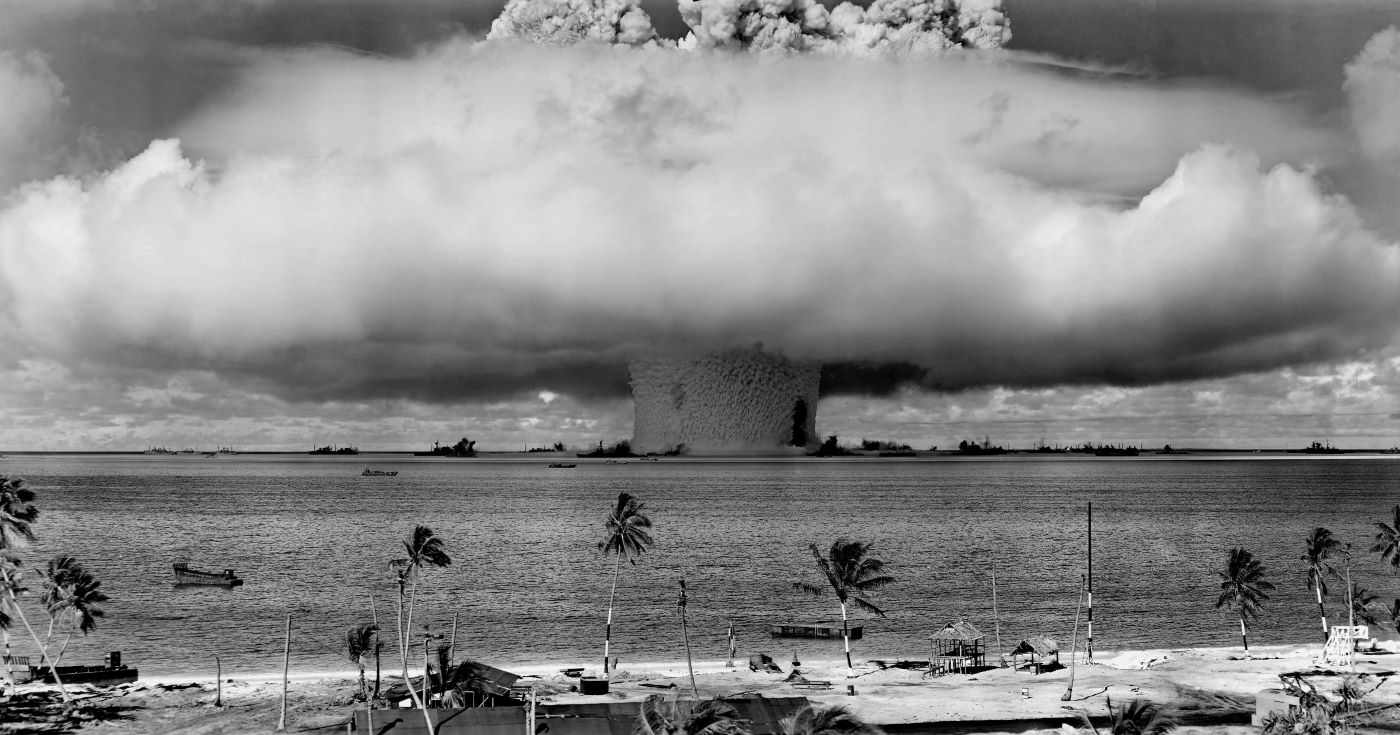
Three weeks later, on July 25, the second test, Baker, changed the world’s understanding of nuclear warfare. This bomb was suspended 90 feet under the water.
When Baker detonated, it didn't create a mushroom cloud in the traditional sense. It created a chimney. A massive, hollow column of water, two million tons of it, shot 6,000 feet into the air. The shockwave crushed the hulls of the submerged submarines instantly. The USS Arkansas, a 27,000-ton battleship, was lifted vertically out of the water like a toy before being slammed down into the mud.
But the true horror was the base surge. As the water column collapsed, it created a rolling tsunami of radioactive mist that expanded outward at 60 miles per hour. This mist was not just water; it was a slurry of coral, seabed, and fission products—plutonium, cesium, and strontium. It coated every ship in the lagoon. The fleet was not just physically damaged; it was painted with poison.
The Impossible Cleanup and the Scuttling
In the days following Baker, the Navy attempted to salvage the target fleet. Sailors were sent onto the decks with scrub brushes, lye, and firehoses to "decontaminate" the ships. It was a futile, suicidal task.
The radiation wasn't just surface dust; it had bonded chemically with the paint and the rust. The hulls were "Geiger sour." The needle on the detectors went off the scale everywhere. The Navy realized that the ships were effectively floating reactors. They could not be moved, they could not be scrapped, and they certainly couldn't be taken back to San Francisco.
The order was given to scuttle them. One by one, the great ships that had survived the blast were deliberately sunk by their own captors. The Saratoga, the Nagato, the Lamson—they were sent to the bottom of the lagoon, not by the bomb, but by the quarantine. The lagoon became an underwater tomb for the Atomic Age.
Operation Castle and the "Bravo" Disaster (1954)
If Crossroads was a display of power, Operation Castle in 1954 was a display of incompetence and apocalyptic force. By then, the US had graduated from fission bombs to fusion—thermonuclear hydrogen bombs.
On March 1, 1954, they detonated the "Shrimp" device, codenamed Castle Bravo. The scientists had calculated a yield of 6 megatons. They missed a key variable in the lithium isotope reaction. The bomb exploded with a force of 15 megatons—one thousand times more powerful than the Hiroshima bomb.
The fireball was four miles wide. It vaporized three islands of the Bikini atoll instantaneously, erasing them from the map. It gouged a crater in the reef that was a mile wide and 200 feet deep. The mushroom cloud rose to 130,000 feet, piercing the stratosphere. It was the largest nuclear detonation ever conducted by the United States.
Ash Like Snow: The Poisoning of Rongelap
The tragedy of Bravo was compounded by the wind. The meteorologists had predicted the fallout would drift over open ocean. Instead, the wind sheared east.
Within hours, a fine, white powder began to fall on the inhabited atolls of Rongelap and Utirik, a hundred miles away. It looked like snow. The children of Rongelap, having never seen snow, ran outside to play in it. They caught the flakes on their tongues. They rubbed it into their hair.
It was calcium carbonate from the pulverized coral reef, highly radioactive with fission byproducts. By nightfall, the entire population was vomiting. Their hair began to fall out in clumps. Their skin burned as if scalded by boiling water. The US military did not evacuate them for two days, leaving them to bake in the radiation. The "snow" of Rongelap remains one of the darkest stains on the American nuclear legacy.
The Lucky Dragon and the Global Alarm
The fallout cloud did not stop at the Marshalls. It drifted over a Japanese tuna fishing boat, the Daigo Fukuryū Maru (Lucky Dragon No. 5). The crew of 23 men were coated in the ash.
When they returned to port in Yaizu, Japan, they were all suffering from acute radiation syndrome. The radio operator, Aikichi Kuboyama, died months later, becoming the first victim of the hydrogen bomb. The panic was global. The catch of tuna was found to be radioactive, sparking a fear that the ocean itself was being poisoned. This incident shattered the secrecy surrounding the tests and galvanized the global anti-nuclear movement. It also birthed a cultural monster; the Japanese film Gojira (Godzilla), released that same year, was a direct metaphor for the Lucky Dragon incident and the horror of the awakening beast in the Pacific.
The Betrayal of 1968: The Failed Return
In 1968, President Lyndon B. Johnson declared that Bikini was safe for habitation. It was a political victory, but a scientific lie. The Bikinians, who had been starving and miserable on the rocky island of Kili, were overjoyed.
In the early 1970s, they began to return. They rebuilt their homes. They planted coconuts and breadfruit trees. For a brief window, it seemed that the exile was over. Children played in the lagoon, and elders fished on the reef. But the invisible enemy was still there, lurking in the soil.
The Cesium Coconut
The scientists had tested the background gamma radiation, which was low. But they had failed to account for the food chain. The soil of Bikini was saturated with Cesium-137.
Chemically, Cesium mimics potassium. The coconut trees, desperate for nutrients in the sandy soil, absorbed the Cesium through their roots and concentrated it in the coconuts—the staple of the Bikinian diet. The islanders were essentially eating dirty bombs every day. By 1978, body scans revealed that the residents had dangerously high levels of radiation. In a cruel replay of 1946, they were ordered to evacuate again. They watched their home disappear from the railing of a ship for the second time, traumatized and betrayed.
Nuclear Nomads: A People Without a Home
Today, the Bikinian people remain "nuclear nomads." Most live in exile on Kili Island, Majuro, or in Springdale, Arkansas, which has the largest concentration of Marshallese in the continental US.
They are sustained by a Trust Fund from the US government—compensation for the loss of their land. But money cannot replace a homeland. The elders who remember the lagoon are dying out, and the younger generation is growing up with a cultural hole in their identity. They are the landlords of a paradise they are forbidden to touch.
Bikini Today: The Radioactive Eden
Bikini Atoll today is a place of jarring contradictions. Because it has been devoid of human habitation for nearly 40 years, the nature has recovered with ferocious vitality. The coconut forests are dense and jungle-like. The beaches are littered with plastic from the ocean, but pristine of footprints.
A small "caretaker" crew lives on the main island, rotating in to maintain the infrastructure (a generator, a few buildings, a dock). They live a strange, monitored existence, importing all their food and water. The island feels paused in time. Rusted trucks from the 1970s resettlement effort sit in the jungle, swallowed by vines. It is a radioactive Eden, a sanctuary for sharks and birds that thrives solely because the apex predator—man—is afraid to stay.
Dark Tourism I: The Everest of Wreck Diving
For a very specific type of traveler, Bikini is the Holy Grail. It is widely considered the premier wreck diving destination on Earth, but it is not for the casual tourist. This is the realm of technical diving.
The wrecks lie deep—most between 160 and 180 feet. Visiting requires specialized training, mixed-gas equipment, and decompression procedures. It is dangerous, expensive, and physically demanding. But the reward is a time machine. Because the lagoon has been closed to commercial fishing and looting, the wrecks are time capsules, untouched since the moment they sank in 1946.
Dark Tourism II: The USS Saratoga
The crown jewel of the Ghost Fleet is the USS Saratoga (CV-3). She is bigger than the Titanic. She rests upright on the sand bottom at 170 feet. Descending through the blue water, the first thing that comes into view is the massive bridge, rising like a cathedral tower.
Divers can swim along the flight deck where Hellcat fighters once launched. The most haunting sight is the hangar deck. Inside, Helldiver dive bombers still sit with their wings folded, instruments intact, silt settling on the pilot’s seats. Bombs and torpedoes are still racked in the magazines. To drift through the Saratoga is to swim through a tomb of American industrial might, silenced by a force that rendered conventional warfare obsolete.
Dark Tourism III: The Flagship of the Enemy
A few hundred yards away lies the Nagato. This was the pride of the Imperial Japanese Navy. It was from the bridge of this ship that Admiral Yamamoto signaled "Tora! Tora! Tora!" to launch the attack on Pearl Harbor.
Today, she lies upside down. The hull is a massive, encrusted ceiling. But beneath the ship, the massive 16-inch guns—the weapons that once threatened empires—are still pointing menacingly into the sand. Seeing the Nagato here, resting in an American nuclear crater, is a profound lesson in the transience of power. The ship that started the Pacific War lies next to the ships that ended it, all equalized by the atom.
Logistics of the Impossible Trip
Getting to Bikini is an odyssey. There are no commercial flights to the atoll. Visitors must fly to Majuro or Kwajalein (a US military base), and then board a liveaboard dive vessel for a 24-to-30-hour open ocean crossing.
The seas can be rough. The cost is prohibitive—often upwards of $5,000 to $8,000 for a trip. Expeditions are sporadic; in some years, the atoll is completely closed due to lack of transport or breakdown of the island’s generator. It is one of the least visited UNESCO World Heritage sites on the planet.
The Invisible Threat: Radiation and Safety
The first question every visitor asks is: "Is it safe?" The answer is nuanced. The background radiation in the air and on the water is comparable to Denver, Colorado. The water in the lagoon acts as a shield; the wrecks themselves are not dangerously radioactive anymore (the isotopes have decayed or dispersed).
The danger is the dirt. Visitors are given strict instructions: Do not eat the coconuts. Do not eat the land crabs. The soil still contains pockets of Cesium-137. All food and water must be brought in from the ship. You can walk on the beach, you can swim in the water, but you cannot partake of the land. It is a "look but don't touch" relationship with the environment, enforced by the Geiger counter.
Conclusion: The Half-Life of Memory
Bikini Atoll is more than a diving destination; it is a scar on the skin of the world. The Bravo crater remains a permanent geographic feature, a blue eye staring up at space, marking the spot where humanity realized it had the power to unmake creation.
The Ghost Fleet in the lagoon serves as a sunken monument to that realization. As the steel hulls slowly rust away into the coral sand, the half-life of the isotopes continues its slow, invisible countdown. The Bikinians may never return to live as they once did. The "paradise" is lost, preserved only as a warning—a beautiful, poisonous jewel that reminds us that some genies, once released from the bottle, can never be put back in.
Sources & References
- UNESCO World Heritage Centre. "Bikini Atoll Nuclear Test Site." (Official designation and history). UNESCO Link.
- Niedenthal, Jack. (2001). For the Good of Mankind: A History of the People of Bikini and their Islands. (The definitive oral history by the Trust Liaison). Bikini Atoll Online.
- Atomic Heritage Foundation. "Operation Crossroads." (Historical overview of the 1946 tests). Atomic Heritage Link.
- Delgado, James P. (1996). Ghost Fleet: The Sunken Ships of Bikini Atoll. University of Hawaii Press. (Archaeological survey of the wrecks).
- U.S. Department of Energy. "Marshall Islands Program." (Radiological data and health reports). DOE Link.
- National Security Archive. "The Bravo Test." (Declassified documents regarding the 1954 disaster). GWU Archive Link.
- Lawrence Livermore National Laboratory. "Radioactivity at Bikini Atoll." (Scientific assessments of Cesium-137 levels). LLNL Link.
- Simon, Steven L., et al. (2010). "Radiation Doses and Cancer Risks in the Marshall Islands Associated with U.S. Nuclear Weapons Tests." Health Physics Journal. PubMed Link.
- Bulletin of the Atomic Scientists. "The Lucky Dragon incident." (Analysis of the Japanese fishing boat tragedy).
- Davis, Jeffrey. (1994). "Bombing Bikini Again (This Time With Money)." The New York Times. (Article on the trust fund and compensation).
- Groyer, Mathew. "Diving the Nuclear Ghost Fleet." Dive Magazine. (Expedition logs).
- The Guardian. (2015). "Bikini Atoll: A lost paradise where radiation levels are still higher than Chernobyl." Guardian Link.
- United States Navy. "Naval History and Heritage Command: Operation Crossroads." NHHC Link.
- Weisgall, Jonathan M. (1994). Operation Crossroads: The Atomic Tests at Bikini Atoll. Naval Institute Press.
- International Atomic Energy Agency (IAEA). "Radiological Conditions at Bikini Atoll: Prospects for Resettlement." IAEA Report.
- Johnston, Barbara Rose. "Nuclear Disaster: The Marshall Islands Experience and Lessons for a Post-Fukushima World." Global Asia.