
The Grave Robbery at Fort Sill: How Geronimo’s Skull Allegedly Reached the Tomb
In the spring of 1918, a group of Yale men in army uniform were stationed at Fort Sill, Oklahoma, training for the First World War. Several of them were members of Skull and Bones, and according to the legend that has clung to the society ever since, one night they took shovels to the Apache prisoner-of-war cemetery on the base, dug into the grave of Geronimo, and carried off his skull.
The claim is not pure folklore. In 2005, the Yale historian Marc Wortman found a letter in the society’s own archives, written in 1918 by a Bonesman named Winter Mead to a fellow member. Mead wrote that the skull of “the worthy Geronimo the Terrible,” exhumed from its grave at Fort Sill, was now safe inside “the T” — the Tomb — together with some of his bones and the bit and saddle horn buried with him. The man often named as part of the grave-robbing party was Prescott Bush, father of one future president and grandfather of another. Whether the skull is genuinely Geronimo’s is doubted even by some who accept that bones were taken; Mead himself was not at Fort Sill and may have been repeating a boast. But the letter is real, the grave was disturbed, and the society has never denied that something sits in the Tomb.
This is the dark logic of Skull and Bones, distilled. Everything about the society inverts the grand secret-society temples of London and Washington. There is no architecture built to awe a visitor, no guided tour, no museum, no plaque explaining the symbols. There is only a blank stone building that has kept its door shut for nearly two centuries, run by teenagers who will go on to run the country, and a rumored room of bones inside it. The Masonic orders advertise their mystery and then invite you in to be disappointed by the ordinariness. Skull and Bones offers the opposite proposition: total invisibility, total silence, and the suspicion — fed by the society’s own correspondence — that the men who inherited American power began their ascent by robbing a conquered enemy’s grave and locking the trophy away where no one could ask about it.
What Is Skull and Bones? The Yale Secret Society That Built a Crypt
Skull and Bones is the oldest and most famous of Yale University’s “senior societies,” a set of secretive clubs that select a handful of students for their final undergraduate year. It was founded in 1832 and has operated continuously since, building a membership network — “Bonesmen” — that reaches into the highest levels of American government, finance, law, and intelligence. The society is private and self-perpetuating, funded through an alumni trust, and formally separate from Yale itself, a distinction the university is always careful to stress whenever the society’s name surfaces in a scandal.
Fifteen Seniors a Year: How the Order Was Founded in 1832
William Huntington Russell, a Yale student from a wealthy merchant family, founded the society in 1832 with a classmate, reportedly after Russell returned from a period studying in Germany and brought back the trappings of a Germanic student order. From the start, Skull and Bones admitted exactly fifteen seniors each year, selected each spring in a ritual called “tap,” when existing members approach the chosen students and invite them into the order. That number has barely changed in nearly two centuries. The society’s symbol pairs a skull and crossed bones with the number 322, which members treat with reverence and outsiders have endlessly tried to decode — most commonly read as a reference to the death of the Greek orator Demosthenes in 322 BC, though the society has never explained it. The scale is the first thing that makes Skull and Bones extraordinary: a club that has only ever added fifteen people a year has nonetheless populated the commanding heights of American life.
The Tomb on High Street: A Windowless Building Nobody Outside Has Mapped
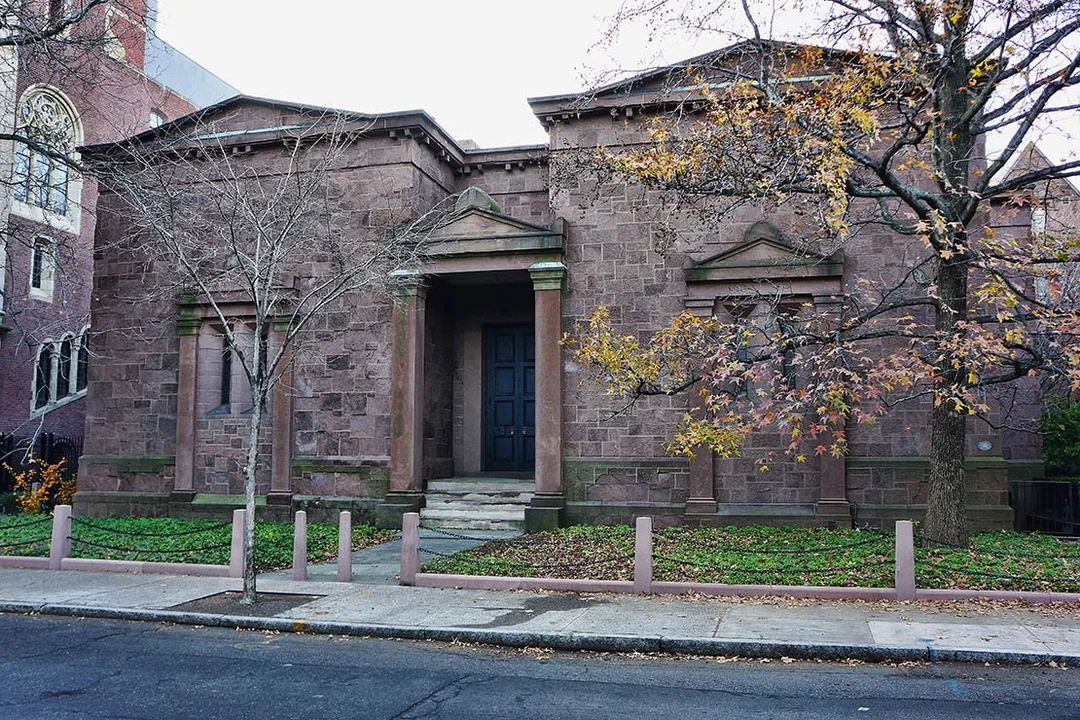
The society meets in a building it calls the Tomb, a brownstone structure on High Street in New Haven that went up in 1856 and was expanded over the following decades. It is one of the most deliberately uninviting buildings in America. The façade is heavy, dark, and almost entirely windowless, with great iron doors and blank stone walls that give nothing away, set among the Gothic architecture of the Yale campus like a mausoleum that wandered in from a cemetery. No journalist or outside researcher has ever been given an authorized tour of the full interior, and the floor plan of the inner rooms remains a matter of rumor and the accounts of the rare trespasser. Where the House of the Temple in Washington was designed to be entered and admired, the Tomb was designed to be looked at and never penetrated. Its secrecy is not theatrical. It is structural, built into the windowless walls.
Inside the Tomb: Rituals, Bones, and the Secrets of the Bonesmen
What happens inside the Tomb is known only through the accounts of members who broke their oath, occasional trespassers, and a handful of leaked documents — which means everything about the society’s interior life carries an asterisk. The society confirms nothing. But enough consistent reporting has accumulated over the decades to sketch a picture of an order obsessed with death, ritual, and the theater of initiation, and that picture has done more to fuel the conspiracy industry than any membership list.
What Allegedly Happens Inside: Coffins, Confessions, and the Number 322
The initiation rituals of Skull and Bones, as described in published exposés and the accounts of former members, are macabre by design. Initiates are reportedly required to lie in a coffin and recount their complete sexual history to the assembled members, a confession known within the society as “connubial bliss” — an exercise that both bonds the group and hands each member permanent leverage over every other. New members are said to be given society nicknames, with certain names passed down through the generations. The rooms are reported to be hung with skulls, bones, and Germanic death imagery, and the society’s calendar revolves around the number 322 and a private mythology centered on death and rebirth. Whether every detail is accurate is impossible to verify from outside, but the broad outline has been corroborated by enough independent sources that it is treated as substantially real by the journalists who have studied the order.
A Room Full of Relics: The Skulls, the Bones, and the “Tomb” Name
The society did not call its building the Tomb by accident. Skull and Bones is reported to keep a genuine collection of human skulls and bones among its furnishings, the macabre heart of a club whose very emblem is a death’s head. Over the years, members and trespassers have described display cases of bones, skulls used in ritual, and an assortment of dark trophies, and the society’s internal references — like Mead’s casual mention of Geronimo’s skull “inside the T” — treat such relics as ordinary fixtures. Some of the alleged skulls have acquired their own legends, supposedly belonging to historical figures whose graves were robbed to furnish them. The provenance of any of it is unprovable from outside the iron doors, but the society’s own founding aesthetic — a Germanic death cult imported by a homesick Yale student — makes the relic collection entirely in character. A club built around a skull and crossed bones, meeting in a building called the Tomb, has never pretended its tastes ran toward the wholesome.
The Geronimo Skull: A Grave Robbery That Wouldn’t Die
The single most persistent story about Skull and Bones is the one about Geronimo, and it endures because it sits at the intersection of documented fact and unprovable claim — the exact territory where legend thrives. A skull is alleged to sit in the Tomb. A real letter says it does. A real grave was disturbed. And the one party who could settle the matter has spent a century saying nothing.
The 1918 Letter and the Prescott Bush Legend
The documentary heart of the story is the Mead letter, written in 1918 and unearthed from the society’s records by historian Marc Wortman in 2005. In it, Winter Mead reports to a fellow Bonesman that Geronimo’s skull, dug up at Fort Sill by their club, is now secured inside the Tomb along with his other bones and his bit. The party of grave robbers is traditionally said to have included Prescott Bush, the Yale Bonesman who became a U.S. senator and founded a political dynasty — father of President George H. W. Bush and grandfather of President George W. Bush, both of them Bonesmen in their turn. The detail that the future presidential family may have begun its association with the order by helping loot an Apache grave is the kind of irony the story cannot shake, and the kind that historians caution may be more legend than fact, since the firsthand evidence places the boast in a letter by a man who was not there.
The 2009 Lawsuit and the Fight to Bring Geronimo Home
In February 2009, on the hundredth anniversary of Geronimo’s death, twenty of his descendants filed suit in federal court in Washington, seeking to recover his remains and rebury him near his birthplace in the Gila Wilderness of New Mexico. The lead plaintiff was Geronimo’s great-grandson Harlyn Geronimo; the lawyer was Ramsey Clark, a former U.S. attorney general. The suit named Skull and Bones, Yale University, and senior figures in the federal government, since Geronimo’s official grave sits on the military land of Fort Sill. In July 2010 a federal judge dismissed the case, ruling not on whether the skull was in the Tomb but on a technicality of sovereign immunity — the law the family invoked could not be applied to a grave disturbance that allegedly occurred decades before the statute existed. The remains, wherever they are, were never returned. The question of whether an Apache leader’s skull sits in a Yale clubhouse remains exactly where the society has always wanted every question about itself to remain: unanswered, behind a locked door. It is the same unfinished reckoning over stolen Native remains and desecrated graves that runs through sites like Wounded Knee, where the dispossession did not end with the killing.
Bonesmen in Power: Presidents, Spies, and the Conspiracy Engine
The reason anyone cares what teenagers do inside a New Haven crypt is the list of who those teenagers became. Skull and Bones has tapped fifteen seniors a year for nearly two centuries, and the alumni rolls read like an index of American power: President William Howard Taft, three generations of the Bush family, Senator and Secretary of State John Kerry, the publisher Henry Luce, and a remarkable concentration of the men who built the modern American intelligence apparatus, including several early figures of the CIA. For a club of its size, the over-representation at the summit of national life is statistically staggering, and it is the engine of every theory about the society.
The conspiracy reached its perfect expression in 2004, when the presidential election came down to two Bonesmen — the incumbent George W. Bush and the challenger John Kerry, both members of the same fifteen-man-a-year society, each so bound by his oath that when asked about it on national television, both essentially declined to say anything at all. To the conspiracy-minded, this was proof of a hidden hand: a single secret order fielding both candidates, so that whoever won, the Tomb won. The more grounded explanation is also the more durable one. Skull and Bones is an elite networking machine of extraordinary efficiency, a mechanism for binding a slice of each Yale generation into a lifelong web of mutual obligation, opening doors in government, finance, and intelligence that stay open for life. That is not a shadow government steering history from a crypt, the fantasy that attaches to it as readily as it attaches to Freemasons’ Hall in London. It is something more banal and more real — a self-replicating elite that has learned that the most effective power is the kind nobody is allowed to look at.
Visiting the Tomb Today: Standing Outside America’s Most Closed Door
The Tomb offers the most honest visitor experience in this entire atlas, because there is no experience to be had. You cannot go in. There are no tours, no open days, no museum, no gift shop, and no circumstance under which an ordinary member of the public will ever pass through the iron doors of the building on High Street. The society guards its privacy absolutely, and the most a visitor can do is stand on the public sidewalk in New Haven and look at the blank brownstone façade, a windowless wall that gives back nothing.
That blankness is the point, and it is worth standing in front of precisely because it refuses you. Every other site in this collection can be entered, photographed, walked through, and partially understood. The Tomb cannot. It is a dark place defined entirely by exclusion — a building whose entire meaning is that you are not allowed inside, run by an organization whose entire method is to make sure you never find out what it contains. The Yale campus around it is open and beautiful and full of students; the Tomb sits in the middle of it like a sealed vault, and the contrast is the whole story.
Standing on High Street, the visitor is left with the one question the society has spent nearly two centuries refusing to answer. Somewhere behind that windowless wall, if the society’s own letter is to be believed, sits a collection of human skulls, and one of them may be the head of an Apache leader stolen from his grave while his people were still imprisoned. The descendants who tried to bring him home were turned away by a technicality, and the door stayed shut. The Tomb keeps its secrets the way it always has — not by explaining them, but by making certain that the people with the right to ask can never get inside to do it.
Frequently Asked Questions About Skull and Bones
Is Geronimo’s skull really in the Skull and Bones Tomb?
The claim is supported by a real 1918 letter, written by Skull and Bones member Winter Mead, stating that Geronimo’s skull had been taken from Fort Sill and placed inside the Tomb. The grave at Fort Sill was genuinely disturbed around that time, and Prescott Bush is traditionally named among the Yale men involved. However, the authenticity is doubted even by some who accept that bones were taken, since Mead was not present and may have been repeating a boast. The society has never confirmed or denied possessing the remains.
What is Skull and Bones and how do you get in?
Skull and Bones is the oldest senior secret society at Yale University, founded in 1832. It selects exactly fifteen Yale seniors each year through a process called “tap,” in which existing members invite chosen students to join. Membership is for life, and members swear an oath of secrecy. The society is privately funded, formally separate from Yale, and has produced an extraordinary number of presidents, senators, judges, and intelligence officials.
What does 322 mean in Skull and Bones?
The number 322 appears alongside the skull and crossbones in the society’s emblem and is treated with great significance by members. The society has never publicly explained it. The most common interpretation is that it references the year 322 BC, when the Greek orator Demosthenes died, possibly marking the society as a successor to a Demosthenian tradition. Other theories abound, but without confirmation from the society, all remain speculation.
Why is Skull and Bones so controversial?
Skull and Bones attracts controversy because a tiny club that taps only fifteen members a year has placed an outsized number of them in the highest offices of American government, finance, and intelligence. Its absolute secrecy, macabre rituals, and rumored collection of human remains feed conspiracy theories about a hidden elite controlling national affairs. The 2004 presidential election, contested by two Bonesmen, intensified these suspicions. Most analysts describe it less as a shadow government than as an extraordinarily effective elite networking system.
Can you go inside the Skull and Bones Tomb?
The public cannot go inside the Tomb. The windowless brownstone building on High Street in New Haven offers no tours, open days, or public access of any kind, and no outside researcher has ever been given an authorized tour of its full interior. The society guards its privacy completely. Visitors can only view the building’s blank exterior from the public sidewalk.
Who are the most famous members of Skull and Bones?
Famous Bonesmen include President William Howard Taft, President George H. W. Bush, President George W. Bush, and Senator and Secretary of State John Kerry. The publisher Henry Luce, founder of Time magazine, was a member, as were numerous early figures in the American intelligence community and the founding of the CIA. The Bush family spans three generations of membership, beginning with Senator Prescott Bush.
Sources
Secrets of the Tomb: Skull and Bones, the Ivy League, and the Hidden Paths of Power — Alexandra Robbins (2002)
America’s Secret Establishment: An Introduction to the Order of Skull and Bones — Antony C. Sutton (1983)
The 1918 Mead Letter, Skull and Bones Archives — discovered and reported by Marc Wortman (2005)
Geronimo: His Own Story — Geronimo, as told to S. M. Barrett (1906)
Geronimo descendants v. Obama et al., U.S. District Court for the District of Columbia — court filings (2009-2010)
Cloak and Gown: Scholars in the Secret War, 1939-1961 — Robin W. Winks (1987)
Apache Prisoners of War at Fort Sill — National Park Service historical records
In the Footsteps of Geronimo — reporting in the Yale Daily News (2009-2010)



%2C%20Konjic%2C%20Bosnia.jpg)


