
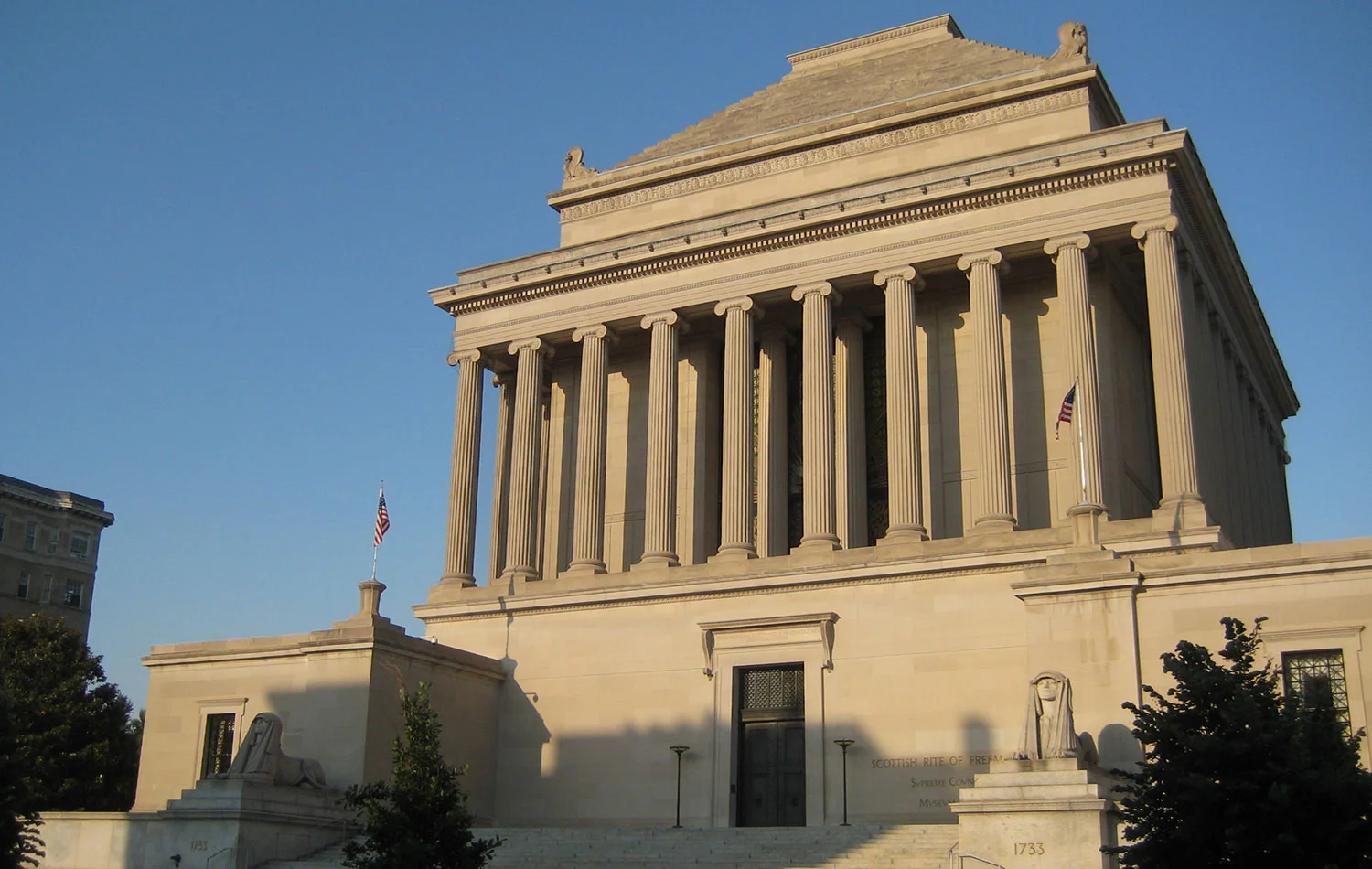
A Body in the Wall: The Arson Attack on Albert Pike’s Tomb
In February 2021, a man climbed into the House of the Temple, made his way to the wall where Albert Pike’s remains are interred, and tried to burn the body of a man who had been dead for 130 years. He failed to destroy it, but the attempt put a spotlight on a fact most Americans never knew: that there is a corpse in the wall of the Masonic headquarters on 16th Street, and that the corpse belongs to a Confederate general.
The attack was not random. It came in the long wake of the 2020 racial-justice protests, during which a separate statue of Pike a few blocks away had been pulled down and burned. To the people who targeted both the statue and the tomb, Pike was a slaveholding Confederate officer whose monuments had no place in the capital. To the Scottish Rite, he was the intellectual founder of their order, the man who turned a struggling fraternity into a philosophical system, and his body had rested inside their temple by their own deliberate choice since 1944.
The House of the Temple was built to be a tomb. That was the architect’s explicit model, and the building broadcasts it from the street: a windowless-looking stone monument, severe and permanent, modeled on the burial monument of an ancient king. The choice was not accidental and not merely aesthetic. An organization that wanted to project the authority of the ancient world onto an American fraternity barely a century old built itself the form of a Wonder, and then placed inside it the body of the man who had given it its scripture. The fire in 2021 was an attack on a contradiction the building has carried since the day it opened — a monument to permanence and ancient wisdom, guarding the remains of a man whose place in American memory had become impossible to settle.
What Is the Scottish Rite? The Branch of Freemasonry That Built a Temple in Washington
The Scottish Rite is one of the major branches of Freemasonry, an organization a man can join only after he has already become a Master Mason in a standard “Craft” lodge. Where the basic Craft Freemasonry practiced at places like Freemasons’ Hall in London consists of three degrees, the Scottish Rite layers on a further sequence of degrees, numbered up to the 33rd, each with its own elaborate ceremonial drama. Despite the name, it did not originate in Scotland; the system took its modern shape in the United States and France in the 18th and 19th centuries. The House of the Temple is the seat of its Southern Jurisdiction, the older and larger of the two American branches, governed by a body called the Supreme Council.
From Craft Lodge to the 33rd Degree: How the Scottish Rite Works
The Scottish Rite functions as a kind of graduate school of Freemasonry. A Master Mason who wants to go further can join and work through degrees four through thirty-two, which dramatize moral and philosophical lessons through staged ritual plays, some of them performed in theaters the order built for exactly that purpose. The 33rd degree is different — it is honorary, conferred on members for distinguished service rather than earned by progression, and it carries a mystique that has made “33rd-degree Mason” a staple of conspiracy literature. The reality is more prosaic: the men who hold it are typically long-serving volunteers and administrators of a fraternal charity, not initiates into a hidden circle of world power. The Southern Jurisdiction’s leadership sits at the House of the Temple, which is why the building functions as both a sanctuary and a head office.
Albert Pike: The Confederate General Who Wrote Freemasonry’s Bible
Albert Pike is the reason the building exists in the form it does. Born in Boston in 1809, Pike was a poet, lawyer, journalist, and frontier adventurer who drifted south and west, settling in Arkansas. He was a man of genuine intellect and enormous appetites — fluent in multiple languages, physically immense, and capable of the sustained scholarship that would reshape his adopted fraternity. When the Civil War came, Pike sided with the Confederacy and was commissioned a brigadier general, commanding Native American troops in the Indian Territory, a chapter of his life that ended in controversy and resignation amid accusations surrounding the conduct of his forces.
Pike’s lasting work came after the war, in Freemasonry. He rewrote and systematized the rituals of the Scottish Rite’s Southern Jurisdiction and, in 1871, published Morals and Dogma, a dense, sprawling volume of philosophy, comparative religion, and symbolism that became the order’s defining text for generations. It was given to new members for decades, admired more often than actually read, and quote-mined relentlessly by the order’s enemies. Pike turned the Scottish Rite from a struggling collection of degrees into a coherent philosophical system, and the order revered him for it. That reverence is why, when they built their great temple, they made a place in it for his body.
Building a Wonder of the Ancient World on 16th Street
The Scottish Rite did not want a building. It wanted a monument, and it hired the right man to get one. Grand Commander James D. Richardson, who drove the project in the early 1900s, instructed that the new temple be made “as magnificent as art and money can make it,” and explicitly preferred to be criticized for building something too fine and too costly than for putting up anything cheap. The result, completed in 1915, is one of the acknowledged masterpieces of American architecture and one of the most quietly imposing buildings in Washington.
John Russell Pope and the Tomb of Mausolus
The architect was John Russell Pope, who would later design the Jefferson Memorial and the National Archives — the man who, more than almost any other, gave official Washington its monumental classical face. For the House of the Temple, Pope reached back to the ancient world and chose, deliberately, a tomb. He modeled the building on the Mausoleum at Halicarnassus, the burial monument of the Persian-era ruler Mausolus that stood among the Seven Wonders of the Ancient World and gave the English language the very word “mausoleum.” Pope’s design rises as a stepped pyramid of stone above a colonnade of thirty-three columns — one for each degree of the Rite — each column thirty-three feet tall. The building is a coded object before a visitor ever steps inside: its dimensions speak the order’s numerology, and its form announces that this is a place built around death and remembrance.
The Temple Room, the Sphinxes, and the Architecture of Secrecy
Two sphinxes guard the entrance, carved by sculptor Alexander Weinman and named Wisdom and Power — Wisdom with eyes half-closed in contemplation, Power with eyes open and alert. Inside, the building opens into a sequence of grand ceremonial spaces culminating in the Temple Room, a soaring chamber lit from above where the Supreme Council conducts its highest rituals. The interior is a deliberate exercise in awe: vast, cool, dim, and heavy with symbolic ornament drawn from Egyptian, Greek, and Hebrew sources, the whole assembled to make a visitor feel small before something that presents itself as ancient and eternal. The effect is the same argument Pope’s exterior makes in stone — that the organization housed here is the inheritor of millennia of wisdom, even though the Scottish Rite in America was, at the building’s opening, scarcely more than a century old.
The Albert Pike Problem: A Confederate Entombed in the Capital
The single strangest fact about the House of the Temple is that its founding philosopher is buried inside it. Albert Pike died in 1891 and was originally interred elsewhere in Washington, but in 1944 the Scottish Rite moved his remains into the temple itself, sealing them in a wall of the building he had inspired. It is an unusual thing to do with a body, and it binds the order’s identity permanently to a man whose legacy has only grown more contested with time.
Why Pike Is Buried Inside His Own Headquarters
The reinterment was an act of veneration. To the Scottish Rite of the mid-twentieth century, Pike was simply the great man who had made the order what it was, and entombing him in the temple was the highest honor available — turning the headquarters into a shrine and a tomb in the most literal sense. A small memorial marks the spot, and for decades it drew little attention beyond the membership. The decision reflected an era in which Pike’s Confederate service was, for the men who honored him, a footnote to his Masonic achievement rather than the defining fact of his life. That balance has since inverted in the public eye, and the body in the wall has become the order’s most awkward inheritance.
The Statue, the KKK Myth, and the Reckoning
A few blocks from the temple, in Judiciary Square, stood a bronze statue of Pike erected in 1901 — for many years the only outdoor statue of a Confederate general in the nation’s capital. In June 2020, during the protests following the murder of George Floyd, demonstrators pulled it down and set it on fire. The statue’s defenders noted that it honored Pike as a Mason and scholar rather than a soldier; its opponents saw only a Confederate general memorialized in the capital of the country he had fought against. Pike’s reputation carries a further, fiercely disputed charge: the persistent claim that he was a senior figure in the early Ku Klux Klan. Historians have found no solid documentary evidence that Pike held any formal Klan office, and the claim is rejected by Masonic defenders and treated skeptically by many scholars, but it has circulated for over a century and attached itself permanently to his name. The truth is that Pike was a slaveholder and a Confederate officer whose actual record is damning enough without the Klan rumor, and that the order which entombed him has spent recent years navigating a memory it can neither fully defend nor easily disown. The same reckoning that toppled the carvings debated at Stone Mountain reached all the way into the wall of a Masonic temple.
Conspiracy, Dan Brown, and the Temple in the Popular Imagination
The House of the Temple occupies a permanent place in the architecture of American conspiracy theory, and it earned the role the same way Rosslyn Chapel did — by being strange, secretive-looking, and irresistible to anyone searching for hidden meaning. A temple modeled on a tomb, studded with the number 33, guarded by sphinxes, and run by men who hold a “33rd degree” is practically engineered to feed suspicion. Add the building’s location in the capital and its membership rolls full of prominent men, and the conspiracy writes itself: a secret order steering the republic from behind limestone walls.
Dan Brown made the building a centerpiece of his 2009 novel The Lost Symbol, setting the Scottish Rite and the House of the Temple at the heart of a Masonic mystery in Washington, much as he had used Rosslyn in The Da Vinci Code. The novel sent a new wave of curious readers toward 16th Street, looking for the secrets the book promised. What they found when they took the tour was an old, dim, beautiful building full of regalia and a research library, run by an organization that publishes its charitable giving and opens its doors four days a week. The reality of the Scottish Rite is a fraternal and philanthropic body that funds, among other things, programs for childhood language disorders. The myth is a shadow council of 33rd-degree masters. Both descriptions point at the same building, and the gap between them is exactly the space the conspiracy lives in — a gap that, as at Freemasons’ Hall in London, decades of open tours have done nothing to close.
Visiting the House of the Temple Today: Inside America’s Masonic Mausoleum
The House of the Temple sits at 1733 16th Street NW, a ten-to-fifteen-minute walk from the Dupont Circle and U Street Metro stations, and it has been open to the public for guided tours since the day it opened in 1915. Tours are free and run on weekdays, Monday through Thursday, led by guides who walk visitors through the ceremonial rooms, the Temple Room, and the extensive library, which holds one of the great collections of Masonic and Pike-related material in the country. Because the building is an active headquarters, hours can shift around the order’s business and the federal holiday schedule, so calling ahead is the difference between a tour and a locked door.
The experience is unlike any other building in Washington. There are no crowds, no ticket lines, often no more than a handful of visitors at a time, and the effect of moving through those vast cool stone rooms in near silence is closer to visiting a tomb than touring an attraction — which is precisely what the architecture intends. Somewhere in a wall on the main floor, behind a modest memorial, lie the remains of Albert Pike, and a visitor who knows the building’s history cannot quite forget it.
Standing in the Temple Room beneath Pope’s stone ceiling, the visitor confronts the building’s unresolved argument. The Scottish Rite built itself a Wonder of the Ancient World to claim a lineage stretching back to the dawn of wisdom, and then anchored that claim to the body of a single nineteenth-century man whose memory the country has since turned against. The tomb endures, magnificent and cold, exactly as designed. The man inside it is the one thing about the place that will not stay settled, and a fire only made the question burn brighter.
Frequently Asked Questions About the House of the Temple
Is someone really buried inside the House of the Temple?
Albert Pike, the 19th-century Confederate general and Masonic philosopher, is entombed in a wall on the main floor of the House of the Temple. He died in 1891 and was originally buried elsewhere in Washington, but the Scottish Rite moved his remains into the building in 1944 as an honor. A small memorial marks the location. In 2021, a man broke into the building and attempted to set fire to his remains.
Why was the House of the Temple built to look like a tomb?
The architect John Russell Pope deliberately modeled the House of the Temple on the Mausoleum at Halicarnassus, the ancient burial monument that was one of the Seven Wonders of the Ancient World and the origin of the word “mausoleum.” The Scottish Rite wanted a monument that projected ancient authority and permanence onto an organization that was, in America, only about a century old. The tomb form was a deliberate statement, reinforced by the building’s later use to entomb Albert Pike.
What is the difference between the Scottish Rite and regular Freemasonry?
A man must first become a Master Mason in a standard Craft lodge before he can join the Scottish Rite. Craft Freemasonry consists of three degrees, while the Scottish Rite adds a further sequence of degrees numbered up to the 33rd, each dramatized through ceremonial ritual. Despite the name, the Scottish Rite took its modern form largely in the United States and France rather than Scotland. The House of the Temple is the headquarters of its Southern Jurisdiction.
What does the number 33 mean at the House of the Temple?
The number 33 refers to the 33 degrees of the Scottish Rite, with the 33rd being the highest and an honorary rank conferred for distinguished service. The House of the Temple encodes this number in its architecture: its exterior colonnade has 33 columns, each standing 33 feet tall. While conspiracy theories treat “33rd-degree Mason” as a marker of hidden power, the degree is in practice an honor given to long-serving members of a fraternal charity.
Was Albert Pike a member of the Ku Klux Klan?
The claim that Albert Pike held a leadership role in the early Ku Klux Klan has circulated for over a century, but historians have found no solid documentary evidence that he held any formal position in the organization. Masonic defenders reject the claim, and many scholars treat it skeptically. What is not disputed is that Pike was a slaveholder and a Confederate brigadier general, facts that drove the 2020 toppling of his Washington statue regardless of the Klan question.
Can you visit the House of the Temple?
The House of the Temple is open to the public for free guided tours, Monday through Thursday, and has been since it opened in 1915. It is located at 1733 16th Street NW in Washington, roughly a 10 to 15 minute walk from the Dupont Circle and U Street Metro stations. Tours cover the ceremonial rooms, the Temple Room, and the building’s research library. Because it is an active headquarters, visitors are advised to call ahead, as hours can change around the order’s schedule.
Sources
Morals and Dogma of the Ancient and Accepted Scottish Rite of Freemasonry — Albert Pike (1871)
Albert Pike: The Man Beyond the Monument — Walter Lee Brown (1997)
The Architecture of John Russell Pope — Steven McLeod Bedford (1998)
A Bridge to Light: The Revised Standard Pike Ritual — Rex R. Hutchens (1988)
House of the Temple: A Pictorial Tour — The Supreme Council, 33°, Southern Jurisdiction
Freemasonry: A Very Short Introduction — Andreas Önnerfors (2017)
The Reconstruction of American Freemasonry — Heredom: Transactions of the Scottish Rite Research Society (various)
Pea Ridge: Civil War Campaign in the West — William L. Shea and Earl J. Hess (1992)
The Lost Symbol — Dan Brown (2009)




%2C%20Konjic%2C%20Bosnia.jpg)


