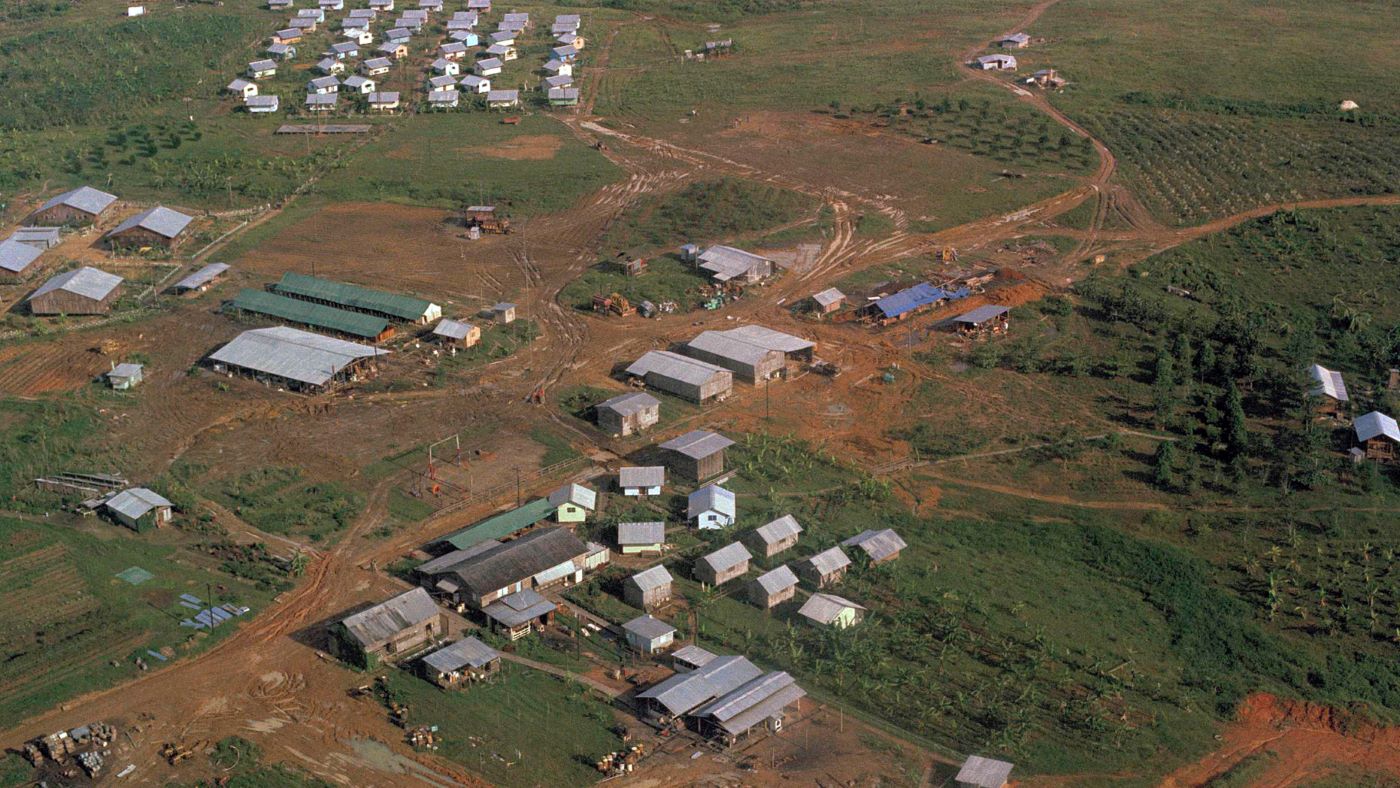
The Green Throat of the Jungle
The journey to the end of the world begins with red dust and the roar of a Land Rover engine struggling against the ruts of a primitive road. To reach the site of the Peoples Temple Agricultural Project today, one must travel deep into the Barima-Waini region of northwest Guyana, near the Venezuelan border. It is a place where the map blurs into an endless, suffocating canopy of green.
The drive from the rusted, sleepy airstrip at Port Kaituma takes nearly an hour, navigating a track that feels less like a road and more like a wound cut into the rainforest. The air here is not merely hot; it is a physical weight. The humidity sits at a constant, dripping near-100 percent, a wet blanket that clings to the skin and labors the breath. It is a landscape of aggressive vitality. Vines strangle trees, insects drone with a mechanical intensity, and the vegetation seems to grow visibly by the hour, eager to reclaim any space cleared by human hands.
This environment is crucial to understanding the tragedy. This is not a temperate forest or a manicured garden; it is a green throat that swallows sound and light. As the vehicle lurches to a halt at the coordinates 7°42′N 59°54′W, the engine cuts out, and the true nature of the isolation settles in. The silence is profound, broken only by the shriek of howler monkeys and the buzz of cicadas. Standing here, wiping sweat from your brow, you realize that the horror of Jonestown was not just ideological; it was geographical. There was nowhere to run. The jungle was the first set of bars in the prison.
Where the Pavilion Stood
Walking into the clearing where the settlement once stood is a disorienting experience. You expect ghosts; you expect ruins. Instead, you are met with aggressive overgrowth. The infamous central Pavilion—the open-air structure with the galvanized tin roof where the "White Nights" were held and where the final apocalypse took place—is gone. The jungle has digested it.
Standing in the knee-high grass, surrounded by scrub brush and ferns, requires a strenuous act of imagination to superimpose the historical footage over the reality of the terrain. This is the exact spot where over 900 people lay down to die, cheek to jowl, in a carpet of brightly colored polyester and convulsions.
If you listen closely to the atmosphere of this place, the silence becomes heavy. It is impossible to stand here without hearing the phantom echoes of the "Death Tape" (FBI designation Q 042). The chaotic noise of that recording—the crying of infants, the screaming of the macaws, the frantic organ music, and the slurred, hypnotic baritone of Jim Jones—stands in violent contrast to the stillness of the site today. The earth here feels thick, composting the memory of a trauma so large it seems the land itself is trying to forget it. There are no tour guides, no ticket booths, and often, no other living souls. Just the sun, the bugs, and the lingering sense that something terrible happened here, something that the soil has not yet finished metabolizing.
Exodus from the Concrete Jungle
To understand why the jungle floor is soaked in such tragedy, one must look back to the asphalt of California. The victims of Jonestown were not the brainwashed zombies often depicted in tabloid histories. They were idealists. They were civil rights activists, elderly pensioners, nurses, teachers, and young families. They were members of the Peoples Temple, a movement that, in its earlier years, was celebrated for its radical integration and charitable works in San Francisco and Los Angeles.
They came to Guyana fleeing the "concrete jungle" of American racism and the looming specter of nuclear war. In the mid-1970s, the Cold War was freezing the hearts of the anxious, and Jim Jones offered a way out. He promised a socialist Eden, a "Rainbow Family" where black and white could live in harmony, free from the oppression of the inner cities and the scrutiny of the press.
They sold their homes, signed over their Social Security checks, and packed their lives into crates, believing they were pioneers of a new society. They did not travel to South America to die; they went to live. They were refugees of the American Dream, seeking a Promised Land that was sold to them with the fervor of a revival preacher and the logistics of a military operation. They carried hope in their suitcases, unaware that their savior was slowly dissolving into paranoia and drug-induced madness.
A Kingdom in the Middle of Nowhere
Guyana was chosen for its obscurity. It was an English-speaking socialist cooperative republic that was happy to ignore the internal workings of the Peoples Temple in exchange for the development of its hinterlands. For Jones, it offered the ultimate strategic advantage: total isolation.
Upon arrival, the reality of the "Agricultural Project" struck the residents. It was not a paradise; it was a work camp. The soil was poor, acidic, and unsuited for the type of large-scale agriculture Jones had promised. But the physical hardships were secondary to the administrative control. The most chilling aspect of the migration was the collection of passports. Once a member stepped off the boat or plane, their documents were confiscated "for safekeeping."
Without a passport, in the middle of a dense jungle surrounded by miles of swamp and predator-filled wilderness, a person ceases to be a free agent. They become an inmate. The isolation was weaponized. Jones controlled all incoming and outgoing mail, censoring letters to ensure only glowing reports reached the US. He demonized the outside world, telling his followers that America had fallen into chaos, that African Americans were being herded into concentration camps, and that Jonestown was the last sanctuary on Earth.
The Architecture of a Prison Without Walls
The layout of Jonestown was designed for surveillance, not comfort. The settlement was a collection of simple wooden cottages with tin roofs, overcrowded and stiflingly hot, arranged around the central Pavilion. There were no prison walls, no barbed wire fences in the traditional sense. The jungle was the wall. The sensory deprivation of the rainforest meant that anyone who managed to slip away faced a green abyss.
To escape, one would have to navigate miles of dense bush without a compass, food, or water, risking jaguar attacks and venomous snakes, only to reach a river where they would likely be spotted by Temple security boats. The "guards"—armed members of the Temple's elite security force—patrolled the perimeter, but their job was made easy by the geography.
Inside the perimeter, life was a grueling routine of field labor from dawn until dusk, subsisting on a diet of rice and gravy. The architecture of control was total. There was no private space. Families were often separated, with children sleeping in communal dormitories to break the bonds of parental loyalty and transfer that affection solely to "Dad" (Jones). The physical structures were flimsy, but the psychological structures were made of iron.
The Voice on the Loudspeaker
If the jungle was the physical cage, Jim Jones’s voice was the psychological shackles. Survivors recount that the most inescapable feature of Jonestown was the Public Address system. Speakers were mounted on towers throughout the settlement, blasting Jones’s voice day and night.
He would speak for hours—sometimes six, sometimes twelve—rambling about news, reading skewed current events, issuing orders, or simply ranting about his own persecution. The residents were a captive audience. They woke up to his voice; they worked the fields to his voice; they went to sleep to his voice.
This constant auditory bombardment served a dual purpose: it exhausted the residents, preventing them from having the mental space to think critically, and it positioned Jones as the omnipresent narrator of their reality. Combined with severe sleep deprivation—residents were often kept up late into the night for mandatory meetings—the loudspeaker created a state of collective hypnosis. The mind, starved of rest and privacy, eventually stops fighting the incoming signal. Jones became the only truth they knew because he was the only voice they heard.
White Nights and Rehearsals for Death
As scrutiny from the US media and the organization "Concerned Relatives" intensified, Jones’s paranoia metastasized. The community began to undergo what Jones called "White Nights." These were terrifying, impromptu loyalty tests. The siren would sound in the middle of the night, rousing the exhausted residents from their beds. They would rush to the Pavilion, surrounded by armed guards.
Jones would tell them that the settlement was under attack—by the CIA, by the Guyanese army, by mercenaries. He would tell them that the only honorable way out was "revolutionary suicide." In these rehearsals, residents were given cups of liquid and told it was poison. They were ordered to drink it to prove their loyalty. After the weeping and the terror, after they had swallowed the liquid and prepared to die, Jones would reveal it was a test. "I was testing your loyalty," he would soothe them.
These mock suicides were a form of psychological conditioning known as desensitization. By forcing them to cross the threshold of death mentally, over and over again, Jones was eroding their survival instinct. He was drilling them for the final performance. When the real poison eventually came, the pathway had already been worn smooth in their minds.
The Congressman Arrives
The delicate bubble of terror burst in November 1978. Congressman Leo Ryan, a California Democrat known for his hands-on approach to investigation, announced he would visit Jonestown to investigate allegations of abuse. Jones tried to block the visit, but Ryan was persistent, accompanied by a delegation of journalists and frantic relatives.
When the delegation arrived on November 17, the Temple staged a masterclass in deception. A dinner was held in the Pavilion. The band played upbeat soul music; residents smiled and danced. To the casual observer, it looked like the racial harmony Jones had promised. But beneath the surface, the tension was vibrating. Jones looked erratic, sweating profusely, his eyes hidden behind dark sunglasses.
The cracks appeared almost immediately. While the music played, a few residents risked their lives to make contact with the visitors. They whispered desperate messages. They used their eyes to scream for help. The façade of the happy socialist commune was crumbling in real-time, held together only by the fear of the guards watching from the shadows.
A Note Trembling in the Hand
The turning point came the next morning. NBC reporter Don Harris was slipping through the camp when a resident stumbled into him and pressed a crumpled piece of paper into his hand. It was a note, scrawled with the names of people who wanted to leave. It read, simply and chillingly: "Help us get out of Jonestown."
This note was the death warrant for the settlement. It proved that Jonestown was not a paradise, but a prison. When Harris confronted Jones with the note, the "Father’s" demeanor shifted from benevolent leader to cornered animal. The realization that he had lost control—that the world would now know the truth—triggered the catastrophic cascade.
Ryan announced he would leave and take anyone who wished to go with him. A small group of defectors gathered their meager belongings, facing the jeers and screams of the loyalists. The tension was palpable; a knife attack on Ryan was narrowly thwarted in the camp. The delegation, along with the defectors, boarded the truck for the Port Kaituma airstrip, believing they had narrowly escaped a nightmare. They did not know the nightmare was following them.
Blood on the Tarmac
The distance between the settlement and the airstrip is about six miles. As the dump truck carrying the Congressman and the defectors arrived at the red-earth runway, two small planes were waiting. The boarding process was chaotic.
Suddenly, a tractor-trailer from the Temple pulled onto the airstrip. Armed men, members of Jones’s "Red Brigade" security squad, jumped out. There was no hesitation. They opened fire with shotguns and rifles.
The violence was brutal and efficient. Congressman Leo Ryan was gunned down—the first and only US Congressman to be assassinated in the line of duty. NBC reporter Don Harris, cameraman Bob Brown, photographer Greg Robinson, and defector Patricia Parks were also killed. Others fled into the surrounding jungle, wounded and terrified, hiding in the bush as the gunmen walked among the bodies, delivering coup de grâce shots.
Back at the settlement, Jones was informed via radio that the Congressman was dead. He knew the US military would descend on them within days. The time for rehearsals was over.
Gathering Under the Galvanized Roof
The final assembly at the Pavilion is preserved on the "Death Tape," a haunting 44-minute audio recording that captures the disintegration of the human spirit. Jones gathered his flock. The mood was not one of revolutionary fervor, but of confusion and dread.
Jones told them that the Congressman was dead, that the parachute troops were coming, and that they would "torture our babies." He spun a narrative where death was the only escape from the cruelty of the capitalist world. "It is not suicide," he proclaimed, "it is a revolutionary act."
There was resistance. A brave woman named Christine Miller stood up. Her voice, trembling but clear on the tape, argued for life. She suggested airlift to Russia, she suggested fighting. Jones shot down every option, and the crowd, whipped into a frenzy of fear and exhaustion, shouted her down. They were too tired to fight. They had been starved, overworked, and conditioned for this moment. The psychological siege was complete.
The Stolen Generation
It is imperative to dismantle the pop-culture phrase "drinking the Kool-Aid." It implies a foolish, blind compliance. What happened in Jonestown was not a mass suicide; it was a mass murder, specifically of the children.
The medical staff brought out a large metal tub filled with purple Flavor Aid, laced with potassium cyanide, Valium, and chloral hydrate. The order of operations was calculated for maximum control: the babies and children were to die first.
Nurses and parents used syringes to squirt the poison into the mouths of infants and toddlers. The intent was strategic. Jones knew that once the parents watched their children die—once they held the convulsing, foaming bodies of their offspring—their will to live would vanish. They would have nothing left to protect.
The tape captures the screams of the children and the wailing of the mothers. This was the moment the "utopia" revealed its true face. It was not a political statement; it was the slaughter of innocents. The adults who drank the poison afterwards did so in a state of traumatic shock, broken by the murder of their own families, surrounded by armed guards who threatened to shoot anyone who refused.
Nine Hundred and Nine
When the Guyanese Defense Force reached the site the following day, they encountered a silence so loud it felt violent. The scene was surreal. The ground was covered in a quilt of bright colors—the clothing of the victims. They lay face down, arms around each other, families clustered together in death as they had been in life.
The body count rose steadily as they cleared the layers of remains. First 400, then 700, and finally, 909 people. Jim Jones was found dead of a gunshot wound to the head—likely self-inflicted, spared the agonizing death by cyanide that he forced upon his followers.
The smell of decay in the tropical heat was immediate and overwhelming. The jungle, indifferent to human suffering, had already begun the process of reclamation. The sheer scale of the loss is hard to visualize: an entire town, wiped off the map in a single afternoon.
The Earth Remembers
Returning to the site today, the visitor is struck by how little remains. The jungle is a voracious eater. The wooden cottages have rotted away; the tin sheets have been scavenged or buried.
However, the earth remembers. If you walk through the bush with a local guide, you will find the rusted skeletal remains of the machinery. The carcass of a tractor, perhaps the very one used to transport the gunmen, sits engulfed by vines, its metal flaking away in orange scales. There are outlines of concrete foundations, the ghost footprint of the Pavilion.
These artifacts are not preserved in a museum; they are rotting in the open air. A truck engine block sits half-buried in the mud, a heavy, iron testament to the industrial ambition that once existed here. Nature is violently reclaiming the evidence, erasing the scar on the landscape. In a few more decades, there may be nothing left but the green wall.
The Gateway to Nowhere
At the entrance to the site stands a simple memorial. It is a white marker, erected to honor the victims. It feels incredibly lonely. Unlike the polished granite of Washington D.C. or the somber museums of Europe, this marker stands at the gateway to nowhere.
Standing before it, you are at the threshold of hell, yet the surroundings are paradoxically beautiful. The sun filters through the leaves; the air smells of wet earth and flowers. It is a jarring dissonance. This marker is the only physical acknowledgment that 918 people (including those at the airstrip and in Georgetown) perished here. It is a place of solitude, unvisited by the masses, stripped of commercialization. It is a raw wound in the geography.
Echoes in California
The tragedy of Jonestown feels incredibly distant, but its echoes are buried in American soil. Because of the political sensitivity and the sheer number of unclaimed bodies, many of the victims were not returned to their families. Instead, they were interred in a mass grave at Evergreen Cemetery in Oakland, California.
There is a profound geographic disconnect between the rotting jungle site and the manicured lawn in Oakland. The victims—predominantly African American, predominantly poor—were displaced in life and displaced in death. The mass grave in California is the final resting place for the "stolen generation" of Jonestown, a somber reminder that this was an American tragedy that just happened to take place on foreign soil.
Witnessing the Invisible
Visiting Jonestown falls under the umbrella of "Dark Tourism," but it differs significantly from visiting Alcatraz or Chernobyl. It is an ordeal to get there. There are no gift shops. There is no infrastructure.
This isolation raises an ethical question: Is this obscurity a form of peace, or a form of forgetting? By allowing the jungle to swallow the site, are we allowing the world to amnesia the lessons of the Peoples Temple? Standing in the overgrowth, one feels a sense of trespassing—not on private property, but on a crime scene that the universe has tried to close. Yet, the act of witnessing is important. To stand in the heat and the silence is to acknowledge the reality of the victims, to refuse to let them become just a punchline about a powdered drink.
The Rot at the Heart of Paradise
The story of Jonestown is the ultimate cautionary tale of Utopianism. It exposes the fragility of the human mind and the terrifying power of charisma. The people who died there wanted what we all want: a life of purpose, equality, and safety. They followed a man who promised them heaven, and he led them into the heart of darkness.
As you leave the site, bumping back down the red dirt road toward Port Kaituma, the jungle closes in the rearview mirror. The green wall seals shut. The tragedy of the Peoples Temple was not that they believed in too little, but that they believed too much. They believed that a perfect society could be built by human hands, and in that desperate search for perfection, they created a rotting wound in the silence of the Guyanese jungle.
FAQ
What exactly happened at Jonestown on November 18, 1978?
On this date, over 900 members of the Peoples Temple Agricultural Project died in a coerced mass murder-suicide event. Under the direction of their leader, Jim Jones, residents drank a cyanide-laced fruit punch. This tragedy occurred shortly after US Congressman Leo Ryan, who had visited the settlement to investigate abuse allegations, was ambushed and killed by Temple security at the nearby Port Kaituma airstrip. It remains one of the largest losses of American civilian life in a single deliberate act.
Is it possible to visit the Jonestown site today?
Yes, but it is logistically difficult and requires significant determination. The site is located in the remote Barima-Waini region of northwest Guyana, near the Venezuelan border. Visitors typically fly into the rusted airstrip at Port Kaituma and then take a one-hour drive on a primitive, rutted track deep into the rainforest. There are no official tour guides, ticket booths, or tourist infrastructure at the location.
What physical structures remain at the settlement?
Almost nothing remains of the original settlement. The famous central Pavilion, where the "White Nights" and the final massacre took place, has been completely reclaimed by the jungle. Visitors arriving at the coordinates (7°42′N 59°54′W) will encounter aggressive vegetation, scrub brush, and knee-high grass rather than ruins. The site is defined by its silence and the overwhelming density of the surrounding rainforest rather than physical artifacts.
Why did the Peoples Temple move to Guyana?
Jim Jones chose Guyana for its obscurity and the government's willingness to ignore the Temple's internal operations in exchange for developing the hinterlands. The location offered total strategic isolation, which Jones weaponized to control his followers. He marketed the project to his congregation as a "socialist Eden" free from American racism and the threat of nuclear war, though in reality, it functioned as a labor camp where passports were confiscated and communication with the outside world was censored.
What were the "White Nights"?
"White Nights" were terrifying, impromptu loyalty tests orchestrated by Jim Jones. He would wake the community in the middle of the night with sirens, claiming the settlement was under attack by the CIA or mercenaries. Residents were forced to drink liquid they were told was poison to prove their willingness to commit "revolutionary suicide." These rehearsals were designed to desensitize the members to the concept of death, effectively conditioning them for the actual massacre.
Is there a memorial at the site?
The article notes that there are no formal monuments or markers on the site itself. The area has been swallowed by the "green throat" of the jungle. The primary sensation described is a heavy, "thick" atmosphere where the land seems to be metabolizing the trauma. The lack of commercialization or memorialization raises ethical questions about whether the world is allowing the physical memory of the victims to be erased by the rainforest.
Sources & References
- FBI Records: The Vault - Jonestown: The official Federal Bureau of Investigation archive containing the recovered tapes (including Q 042) and documents from the investigation.
- The Jonestown Institute (San Diego State University): The most comprehensive digital archive of primary sources, including transcripts of all recovered tapes, autopsies, and photographs.
- Alternative Considerations of Jonestown & Peoples Temple: A repository of biographical profiles of the victims and survivors.
- NPR: "Father Cares: The Last of Jonestown": A seminal audio documentary utilizing the recovered tapes to reconstruct the final months.
- PBS American Experience: Jonestown: The Life and Death of Peoples Temple: A documentary providing visual context and survivor interviews.
- Rolling Stone: "Inside the Jonestown Massacre": Historical retrospective on the 40th anniversary.
- The Atlantic: "The Meaning of Jonestown": An analysis of the cultural impact and the misuse of the "Kool-Aid" phrase.
- BBC News: "Witness: The Jonestown Massacre": Survivor accounts and archival footage.
- Time Magazine: "Jonestown: The 1978 Massacre": Photographic archive of the aftermath.
- Evergreen Cemetery (Oakland) Memorial: Information regarding the mass grave of the Jonestown victims.
- Association for Diplomatic Studies and Training: "The Jonestown Massacre – A Diplomat’s Perspective."
- History.com: "Jonestown": General historical overview.