Vlad the Impaler’s Easter Revenge: How Poenari Castle Was Built by Prisoners
The boyars came up the mountain in the clothes they had worn to celebrate. It was Easter, sometime around 1457, and the leading noble families of Wallachia had gathered at the prince’s court in Târgoviște for the feast. They arrived in silk and brocade, in jewelry and fine boots, the costume of a ruling class that had outlived four princes in a single generation and assumed it would outlive a fifth. By the end of the day the older men among them were dead — impaled on stakes outside the city — and the rest were being driven north into the Carpathian foothills under guard.
Their destination was a ruined fortress on a cliff above the Argeș gorge. Their job was to rebuild it. For months the surviving boyars and their families hauled brick, hand-passed stone up the ridge, and fired lime in kilns at the base of the mountain, climbing the spur again and again under the eyes of Vlad III Dracula’s soldiers. They were not given new clothes. Contemporary accounts describe them working until the silk and finery they had worn to the Easter feast rotted and fell from their bodies, leaving them laboring half-naked on the rock.
Vlad the Impaler did not simply own Poenari Castle. He built it out of the people he was destroying, and that is the thing the Dracula tourism industry never tells you. The fortress is not a backdrop to his cruelty. It is his cruelty — political revenge converted directly into masonry, a working monument to the proposition that a Wallachian prince could turn his enemies into the walls of his own house. The historical Vlad needed no vampire mythology to be terrifying. He was a man who answered a generation of betrayals with an act of architecture, and the ruin on the Argeș is the receipt.
Where Is Poenari Castle? Wallachia and the Fortress on the Argeș River
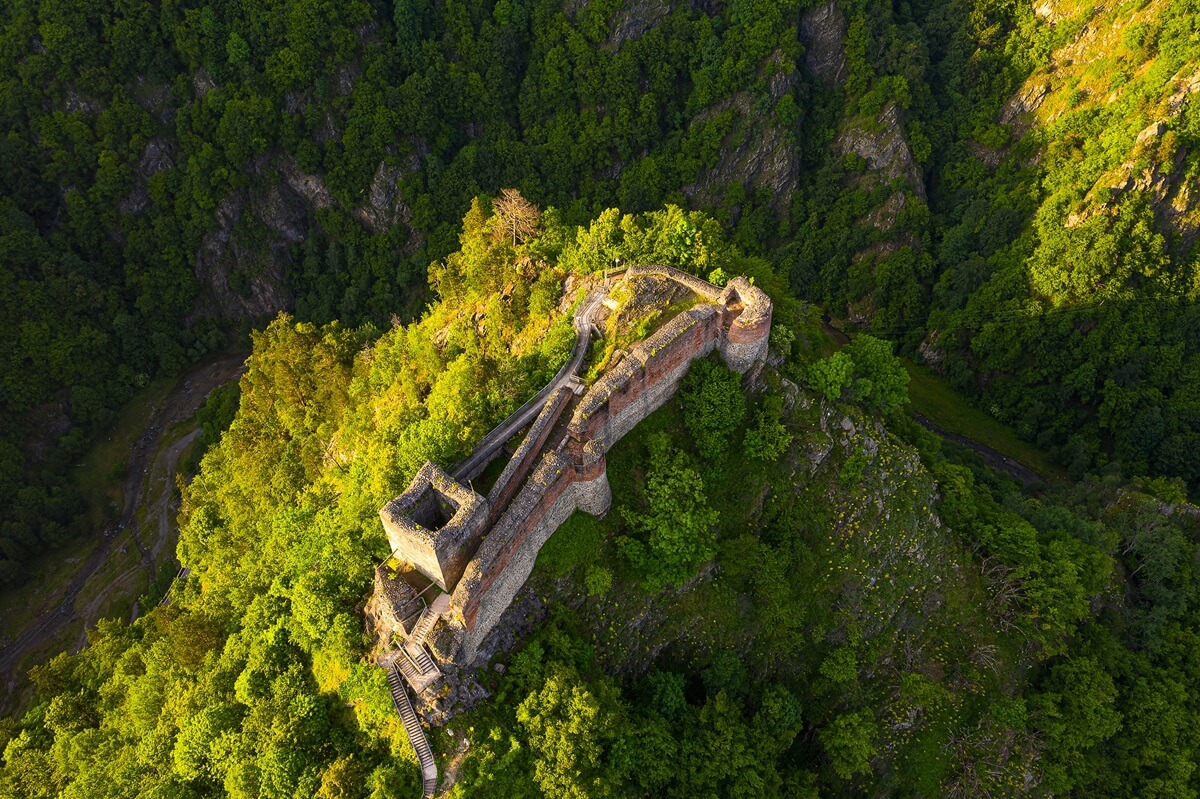
Poenari Castle stands in Romania’s Argeș County, perched on a rocky promontory of Mount Cetatea overlooking the Argeș River as it cuts down out of the southern Carpathians. The site guards the entrance to a steep mountain pass — the reason anyone built there at all. Today the modern Transfăgărășan highway runs past the base of the cliff, but in the medieval era this was the narrow seam between the Wallachian plain to the south and the high passes leading toward Transylvania.
The First Citadel: A 13th-Century Watchtower Guarding the Argeș Gorge
The first fortress on the ridge was built in the early 1200s by the rulers of Wallachia, a small wooden-and-stone watchtower meant to control the gorge and the road through it. By the time Vlad came to power it had fallen into disrepair, half-abandoned and structurally failing. That ruin is what he chose to resurrect — not for sentiment, but because the position was nearly perfect. The cliff did the defending. An attacker would have to come up a single exposed approach while the garrison rolled stones and rained arrows from above.
Vlad III Dracula: The Hostage Years That Forged a Tyrant
Vlad III was born around 1431 into a dynasty that ruled at the pleasure of stronger empires. His father, Vlad II Dracul, took his name from the Order of the Dragon, a chivalric brotherhood founded by the Holy Roman Emperor Sigismund and sworn to defend Christendom against the Ottomans — dracul meaning “the dragon” in old Romanian, later sliding toward “the devil.” The son inherited the name as Drăculea, son of the dragon, and a position perpetually for sale to whichever empire pressed hardest.
He also inherited his father’s habit of using sons as collateral. In 1442, to prove his loyalty to the sultan, Vlad II handed over his two younger boys — Vlad, around eleven, and Radu, still a small child — to the Ottoman court as hostages. The brothers were held for years at Edirne and elsewhere, kept comfortable but under the standing threat that any move by their father would cost them their lives. The two responded to captivity in opposite directions, and the split would define both their futures. Radu, charming and pliable, adapted to the court, converted, and became a favorite of the young prince who would soon be Mehmed II. Vlad did not adapt. Sources describe him as defiant, sullen, and frequently punished, and he came out of those years having absorbed the central lesson of Ottoman statecraft without any of its restraint: that fear, applied with absolute consistency, was the most reliable instrument of rule.
His family was annihilated while he sat in this gilded cage. In 1447 his father was hunted down and killed in the marshes near Bălteni, and his eldest brother Mircea was tortured, blinded with hot iron stakes, and buried alive by the boyars and rivals of Târgoviște. Vlad emerged from Ottoman custody into a Wallachia that had murdered his father and brother and would happily do the same to him. He fought his way to the throne in 1456 carrying that arithmetic. The boyars he would soon march up the mountain were, in his understanding, the same class of men who had put Mircea screaming into the ground.
How Vlad the Impaler Rebuilt Poenari Castle With Forced Labor
The rebuilding of Poenari was an act of accounting. Vlad came to power believing — with reason — that the Wallachian nobility was a permanent threat to any prince, a faction that made and unmade rulers to suit its own interests and had done so repeatedly during his lifetime. The Easter massacre and the forced reconstruction of the castle were his answer to the problem of the boyars, delivered in a single stroke.
The Târgoviște Massacre and the Brother Buried Alive
Vlad’s revenge had a specific target. After taking the throne, he reportedly investigated the death of his brother Mircea, ordering the grave opened — and found the skull turned face-down in the coffin, evidence that Mircea had been buried while still alive and had twisted in his grave trying to escape. The boyar class of Târgoviște had carried out that killing, or stood by while it happened.
The Easter feast was the trap. With the city’s leading families assembled in their best clothes, Vlad had the older men impaled on the spot and condemned the able-bodied to forced labor. The episode survives in multiple sources, including German and Russian pamphlets that circulated across Europe in the decades after his death and a Romanian oral tradition that recorded it as folk memory. The details vary, but the core is consistent: a prince who used a religious festival to decapitate the political class that had murdered his brother, then refused them even the dignity of a clean death.
Building a Cliff Fortress Until the Silk Rotted Off
The work itself was punishing in a way that needed no torturer. The boyars and their families fired bricks at the foot of the mountain and carried them up the spur to the building site, a vertical haul of hundreds of feet on bad footing. Vlad’s masons rebuilt the old citadel into a proper military fortress — a compact prismatic keep with thick walls and round and rectangular towers, sized to the narrow ridge it stood on rather than to any ambition of grandeur. There was no room on that rock for grandeur.
The labor went on long enough that the prisoners’ fine Easter garments wore through and disintegrated, leaving them to finish the fortress in rags or in nothing at all. By the time Poenari stood complete, it had been built twice over: once in stone, and once as a story that traveled across Wallachia and into the German printing presses — the story of what happened to men who crossed Vlad Drăculea.
The Reign of Terror Behind the Fortress: Vlad’s Forest of the Impaled
The castle made sense only against the background of how Vlad ruled everywhere else. His preferred punishment gave him his name: impalement, a slow death in which a sharpened, often deliberately rounded stake was driven through the body so that the victim might survive for hours or days. He used it on a scale that staggered even an era inured to public execution — on thieves and merchants, on Ottoman envoys, on Saxon traders from the Transylvanian towns, on his own subjects for offenses as minor as dishonesty. The German pamphlets that spread his legend put the body count in the tens of thousands, and while medieval numbers are never reliable, the consistency of the accounts across hostile and friendly sources alike tells its own story.
The Night Attack on Mehmed II’s Camp
The most audacious moment of the 1462 war came in the dark. On the night of June 16, Vlad led a small force directly into the sleeping Ottoman camp outside Târgoviște, aiming to assassinate Mehmed II himself in a lightning raid. The attack tore through the tents and killed thousands, but in the chaos Vlad’s men struck the wrong section of the camp and the sultan survived. The raid failed in its single objective and yet it terrified the invading army, who now understood that the prince would come for them in their beds.
A Forest of Stakes Outside the Capital
What broke the campaign’s nerve came in daylight. As Mehmed’s army advanced on Târgoviște, it came upon a field outside the city planted with the impaled bodies of some twenty thousand Ottoman and Bulgarian prisoners — a corridor of stakes left rotting in the sun, the corpses picked over by crows. The Greek chronicler Laonikos Chalkokondyles recorded that the sultan, the conqueror of Constantinople, looked on the spectacle and admitted he could not take the country from a man capable of such things. Mehmed turned the practical war over to Radu and withdrew. The fortress on the Argeș was the redoubt of a ruler who governed the open country through exactly this kind of theater, and the siege that followed was the moment the theater ran out.
The 1462 Ottoman Siege of Poenari and the Legend of Dracula’s Wife
The fortress earned its keep in 1462, the year the empire that had raised Vlad as a hostage came to destroy him. With the open field lost and his brother Radu installed as the sultan’s candidate for the throne, Vlad withdrew into the mountains toward the one place built to hold.
Mehmed II’s Campaign and a Fortress the Cannon Couldn’t Reach
Mehmed marched into Wallachia in 1462 with one of the largest armies of the era, fresh from taking Constantinople nine years earlier. Vlad could not meet that force in the open field. He fought a campaign of ambush and scorched earth, poisoning wells and burning his own villages to starve the advance, then withdrew toward Poenari as his support collapsed and Radu — raised alongside him in the Ottoman court — was put forward as the sultan’s preferred prince.
Poenari’s value was geographic. The same cliff that had made the boyars’ labor so brutal made the fortress nearly unassailable. Ottoman artillery, which had shattered the walls of Constantinople, could not be hauled up the gorge and aimed at a target a thousand feet overhead. The garrison was small, but the mountain fought on its side.
The Princess Who Leapt from the Tower into the Argeș
The most enduring story of Poenari belongs to a woman whose name history did not record. According to Romanian tradition, Vlad’s wife was inside the castle during the siege. When an archer fired a message into the keep — a warning, the story goes, from one of Vlad’s own men, that Radu’s forces were closing in and the fortress would fall — she chose her own ending. She climbed to the highest tower and threw herself into the Argeș River far below, declaring that she would rather have her body eaten by the fish of the river than be taken captive by the Turks.
The stretch of river beneath the cliff has carried the name Râul Doamnei — “the Lady’s River” — ever since. The leap appears in folk memory rather than in any contemporary chronicle, which is why it remains a legend and not a documented fact. It survived in the same oral tradition that recorded the Easter massacre, passed down by the villages below the castle. Whatever its literal truth, it marks Poenari as the place where the human cost of Vlad’s wars reached even into his own household.
Backward Horseshoes and the Peasants of Arefu
Vlad escaped. The tradition of the nearby village of Arefu holds that local peasants showed him a secret path over the mountains toward Transylvania, and that he had his horses shod with their shoes nailed on backward, so that the tracks in the snow pointed the wrong way and the pursuing Ottomans could not follow. He survived the siege, but not the war — Radu held the throne, and Vlad spent years imprisoned in Hungary before a brief, fatal return to power in 1476.
The Arefu story is the warmer counterpoint to the boyars’ fate, and it has a coda: the villagers claimed descent from the men who saved the prince, and for generations passed down the legends of Poenari as family history.
From Folk Memory to Bram Stoker: How Poenari Became Dracula’s Castle
The legends of Poenari survived four centuries because the people at the foot of the mountain kept telling them. The villages of Arefu and the Argeș valley carried the stories of the impaling prince, the building of the castle, and the lady who leapt — folk history, passed down through families who claimed to descend from the men who guided Vlad to safety. By the nineteenth century these tales were being collected by Romanian folklorists, and the historical Vlad III had hardened into a figure of national memory: cruel, yes, but also the prince who had defied the Ottomans and impaled their armies.
The Irish Author Who Never Came to Romania
The transmission to the wider world ran through a man who never saw the country. Bram Stoker, an Irish theater manager, spent years researching Eastern European folklore in the British Museum reading room for the novel that became Dracula in 1897. He took the name Dracula from Vlad’s patronymic, lifted fragments of Wallachian and Transylvanian history, and grafted them onto a vampire count of his own invention set in a fictional castle in the Borgo Pass. Stoker almost certainly never knew Poenari existed, and his Dracula has essentially nothing to do with the real prince beyond the borrowed name.
The irony compounded in the twentieth century, when Romania’s tourism industry needed a castle to sell to the readers of Stoker’s novel and the viewers of its film adaptations. The fortress Vlad actually built was a hard climb up a crumbling cliff. So the role went to Bran Castle, a photogenic and accessible fortress hundreds of kilometers away, on the thin pretext that Vlad may once have passed through it. The real Dracula’s castle was left to the bears and the landslides while the myth was sold somewhere else entirely.
Poenari Castle in Ruins: Landslides, Abandonment, and Decay
Poenari outlived its usefulness almost as fast as it was built. After Vlad’s death in 1476, Wallachia’s center of power stayed in the plains, and a small mountain keep guarding a single pass had little strategic value in the centuries that followed. The fortress was used intermittently and then simply abandoned, left to the weather on a ridge that was never going to be kind to it.
The mountain finished the job that neglect started. A major landslide in 1888 sent a section of the castle and the cliff it stood on tumbling into the river below, and a further collapse early in the twentieth century brought down more. What survives is a fragment — sections of wall, the remnants of the prismatic keep and its towers, enough to read the floor plan but not enough to mistake it for the fortress Vlad’s prisoners raised. The very feature that made Poenari defensible, its perch on unstable rock above a gorge, is the feature steadily pulling it apart. The Romanian state has stabilized and partially restored the ruin, but the cliff has the last word, as it always did.
Visiting Poenari Castle Today: 1,480 Steps to the Real Dracula’s Castle
Reaching Poenari requires earning it. From the parking area beside the Transfăgărășan highway, a single concrete staircase of roughly 1,480 steps switchbacks up the wooded slope to the ridge — a climb of fifteen to thirty minutes that leaves most visitors breathing hard by the top. Signs at the base warn about brown bears, which inhabit these forests in real numbers; the warnings are not decoration. The reward at the summit is a small, dramatic ruin clinging to the rock, with the Argeș valley falling away on all sides and the modern dam and reservoir visible downstream.
The site leans into its history without quite turning into a theme park. Mannequins arranged on stakes near the entrance recreate Vlad’s signature method of execution — a literal-minded touch that some find effective and others find ghoulish. There is no gift-shop machinery here, no costumed actors, no fang merchandise. The contrast with Bran Castle is the entire point: Bran is a handsome, accessible castle in Brașov County that has been marketed for decades as “Dracula’s Castle” despite Vlad having, at most, passed through it briefly and possibly never set foot inside. The tour buses go to Bran. The man himself was here, on a cliff that tried to kill its own builders.
Standing in the ruin, the distance between the historical Vlad and the literary Dracula collapses. The fiction gave the world a seductive aristocrat in a Transylvanian castle. The reality was a Wallachian prince who impaled tens of thousands of people, marched a city’s nobility up a mountain to die building his walls, and ruled from a fortress so hostile that his own wife’s legendary escape was to jump from it. Poenari rewards the climb not with horror-movie atmosphere but with something harder to shake: the recognition that the place is real, the cruelty was real, and the most frightening Dracula was never the one with the fangs.
Frequently Asked Questions About Poenari Castle
Is Poenari Castle the real Dracula’s castle?
Poenari is the fortress most directly tied to the historical Vlad III Dracula. He rebuilt it around 1457 and used it as a genuine military stronghold and residence, including during the 1462 Ottoman siege. This sets it apart from Bran Castle, which is marketed worldwide as “Dracula’s Castle” despite Vlad having, at most, only passed near or briefly through it. If any single site has a claim to the title, it is the ruin on the Argeș, not the tourist castle at Bran.
Did Vlad the Impaler really build Poenari Castle with forced labor?
According to multiple historical accounts, Vlad rebuilt the ruined citadel using the surviving boyar families of Târgoviște, whom he had captured during an Easter massacre. The sources describe them hauling brick and stone up the cliff until the fine clothes they had worn to the feast disintegrated on their bodies. The story appears in German and Russian pamphlets from the decades after Vlad’s death and in Romanian oral tradition. The details vary between versions, but the core account of forced noble labor is consistent.
What is the legend of Dracula’s wife at Poenari?
Romanian folklore holds that during the 1462 Ottoman siege, Vlad’s wife threw herself from the highest tower into the Argeș River rather than be captured. She is said to have declared she would rather be eaten by the river’s fish than fall into Ottoman hands. The river beneath the castle has been called Râul Doamnei — “the Lady’s River” — ever since. The leap survives in oral tradition rather than contemporary chronicle, so it remains a legend rather than a documented fact.
How many steps does it take to climb to Poenari Castle?
Reaching the castle requires climbing roughly 1,480 concrete steps from the parking area beside the Transfăgărășan highway. The ascent takes most visitors between fifteen and thirty minutes and gains significant elevation up a wooded slope. Signs at the base warn of brown bears, which genuinely inhabit the surrounding forests. The climb is the main reason Poenari sees a fraction of the visitors that Bran Castle receives.
Why is Bran Castle famous instead of Poenari?
Bran Castle became the commercial “Dracula’s Castle” largely because it is photogenic, accessible, and well preserved, making it ideal for tourism. Poenari, by contrast, is a crumbling ruin reached only by a long climb up an unstable cliff. When Romania’s tourism industry sought a castle to sell to readers of Bram Stoker’s novel, Bran fit the marketing need despite its weak historical connection to Vlad. The result is that the myth was sold at one castle while the real history sat decaying at another.
What happened to Poenari Castle?
Poenari lost its strategic value after Vlad’s death in 1476 and was gradually abandoned. A major landslide in 1888 sent part of the castle and the cliff it stood on into the river below, and further collapse in the early twentieth century brought down more of the structure. Today only fragments survive — sections of wall and the remnants of the keep and its towers. The Romanian state has since stabilized and partially restored the ruin.
Sources
Dracula: Prince of Many Faces — Radu R. Florescu and Raymond T. McNally (1989)
In Search of Dracula: The History of Dracula and Vampires — Raymond T. McNally and Radu Florescu (1994)
Vlad the Impaler: In Search of the Real Dracula — M. J. Trow (2003)
Vlad III Dracula: The Life and Times of the Historical Dracula — Kurt W. Treptow (2000)
The Histories — Laonikos Chalkokondyles (15th century; trans. Anthony Kaldellis, 2014)
Dracula: Sense and Nonsense — Elizabeth Miller (2000)
A Concise History of Romania — Keith Hitchins (2014)
The Ottoman Empire and Early Modern Europe — Daniel Goffman (2002)
Mehmed the Conqueror and His Time — Franz Babinger (1978)