The Curse of Samarkand’s Most Famous Tomb — Tamerlane and the Gur-e-Amir
On June 19, 1941, a team of Soviet scientists led by the anthropologist Mikhail Gerasimov pried open the jade sarcophagus of Tamerlane inside the Gur-e-Amir mausoleum in Samarkand. The excavation had been ordered by Stalin’s government as part of a campaign to study the remains of Central Asia’s historical figures. Local elders had pleaded with the team to stop. The outer tomb bore a carved inscription in Arabic: “When I rise from the dead, the world shall tremble.” According to persistent local accounts, a second inscription was found inside the casket: “Whosoever disturbs my tomb will unleash an invader more terrible than I.”
Gerasimov lifted the skull and began the reconstruction that would eventually produce the most reliable portrait of Tamerlane ever made. The skeleton confirmed what the chronicles had recorded: the right leg was shorter than the left, the right arm partially immobilized — injuries from battle that gave the conqueror his name, Timur-i-lang, “Timur the Lame,” which Europeans corrupted into Tamerlane. The man was tall for his era, broad-shouldered, with Mongoloid features and reddish hair that had not fully grayed at the time of his death at sixty-eight.
Three days after the tomb was opened, on June 22, 1941, Nazi Germany launched Operation Barbarossa — the largest military invasion in human history. 3.8 million Axis soldiers crossed the Soviet border. The coincidence was not lost on the people of Samarkand, or on the Soviet command. In November 1942, with the Battle of Stalingrad at its most desperate, Stalin reportedly ordered Tamerlane’s remains reburied with full Islamic rites. The reburial took place on November 20. The Soviet counteroffensive at Stalingrad began on November 19. Whether the timing was superstition, propaganda, or coincidence depends on who tells the story. In Samarkand, the question has never been considered open.
The tomb that Gerasimov opened belongs to a man who killed an estimated 17 million people — roughly 5 percent of the world’s population in the fourteenth century — and built one of the most beautiful cities on Earth with the proceeds. Samarkand is the monument to that paradox. Every turquoise dome, every tiled facade, every geometric arabesque was produced by artisans deported from the civilizations Tamerlane had destroyed — the tile-makers of Damascus, the stonemasons of Isfahan, the silk-weavers of Baghdad, the architects of Delhi. The city’s beauty was extracted from conquest. The question it poses is whether beauty built on that scale of violence can be separated from the violence itself.
Samarkand Before Tamerlane — Two Thousand Years on the Silk Road
The Stone City — From the Sogdians to Alexander the Great
Samarkand’s name comes from the ancient Sogdian words samar (stone) and kand (city). The settlement on the hill of Afrosiab, in the northern part of the modern city, dates to at least the 8th or 7th century BC. Under the Achaemenid Persian Empire, it was the capital of the Sogdian satrapy — a wealthy trading hub where Central Asian, Persian, Chinese, and Indian goods changed hands along the routes that would later be called the Silk Road.
In 329 BC, Alexander the Great conquered the city, which the Greeks called Marakanda. He used it as a base of operations for his Central Asian campaigns. A famous remark attributed to Alexander — “Everything I heard about Samarkand is true, except that it is more beautiful than I imagined” — is almost certainly apocryphal, but it captures the city’s reputation even in antiquity. Excavations at Afrosiab have uncovered 7th-century frescoes depicting foreign dignitaries — Chinese, Turkic, Indian — arriving at the Sogdian court, visual evidence of a cosmopolitan crossroads that predated the Islamic period by centuries.
Genghis Khan and the Destruction of Samarkand in 1220
The city passed through Seleucid, Kushan, Turkic, and Arab hands over the following fifteen centuries, absorbing each culture and retaining its position as a Central Asian trading center. By the early 13th century, Samarkand was one of the major cities of the Khwarazmian Empire, with a population estimated at several hundred thousand.
In 1220, Genghis Khan arrived. The Mongol army besieged and took the city. The destruction was comprehensive. The population was killed, enslaved, or scattered. The irrigation systems that sustained agriculture in the Zeravshan River valley were wrecked. The city that had been a crossroads for two millennia was reduced to a depopulated ruin. For 150 years after the Mongol conquest, Samarkand existed in a diminished state — still inhabited, still a waypoint on the Silk Road, but a shadow of what it had been.
The power vacuum left by the Mongol Empire’s fragmentation in Central Asia would be filled by a man who claimed Genghis Khan’s legacy as his own.
Tamerlane — The Conqueror Who Built Samarkand from the World’s Ruins
The Barlas Warlord Who Claimed Genghis Khan’s Legacy
Timur was born around 1336 near the city of Kesh (modern Shahrisabz), 80 kilometers south of Samarkand. He was a member of the Barlas tribe, a Turco-Mongol clan that had settled in Central Asia after the Mongol conquests. His pedigree was minor — he was not a descendant of Genghis Khan and could not claim the title of khan. To compensate, he married Saray Mulk Khanum, a Genghisid princess, and adopted the title Gurkani — “son-in-law” of the Genghisid line. It was a piece of political theater that allowed him to frame his conquests as a restoration of Mongol greatness rather than an upstart’s rebellion.
By 1370, Timur had consolidated control over Transoxiana and made Samarkand his capital. Over the next thirty-five years, he launched campaigns on a scale not seen since Genghis Khan. He destroyed the cities of the Golden Horde in 1395, sacked Delhi in 1398 (killing an estimated 100,000 prisoners before the battle even began), conquered Aleppo and Damascus in 1400–01, destroyed Baghdad in 1401, and defeated the Ottoman sultan Bayezid I at the Battle of Ankara in 1402 — a victory so decisive it plunged the Ottoman Empire into a decade of civil war. In February 1405, Timur set out to conquer China. He died en route, at Otrar in modern Kazakhstan, before crossing the border.
The cost of these campaigns was staggering. Historians estimate that Tamerlane’s wars killed approximately 17 million people — possibly 5 percent of the global population. He built towers of skulls outside the cities he conquered. In Isfahan alone, his troops killed an estimated 70,000 civilians after a revolt, stacking their heads in pyramids visible from miles away. The violence was not incidental to the empire-building. It was the method.
Architects in Chains — How Tamerlane Built Samarkand with Captive Labor
The same campaigns that produced the skull towers also produced Samarkand. Timur had a policy, applied consistently across thirty years of conquest: spare the artisans. When a city fell, its architects, tile-makers, calligraphers, weavers, glassblowers, and metalworkers were separated from the general population and deported to Samarkand under guard. From Damascus came the tile-makers whose techniques would define the city’s facades. From Isfahan came the stonemasons. From Baghdad came the silk-weavers. From Delhi came the architects and the elephants. Timur was personally involved in construction, often overseeing projects from horseback, issuing orders that frequently exceeded his workers’ technical abilities. When the Bibi-Khanym Mosque failed to meet his expectations, he had the entrance gateway demolished and rebuilt — a decision that may have contributed to the structural weaknesses that would cause the building to collapse within decades.
The Spanish ambassador Ruy González de Clavijo, who reached Samarkand on September 8, 1404, after traveling over 5,000 miles from Cádiz, left the most detailed Western eyewitness account of Timur’s capital. Clavijo found a city in a perpetual state of construction, surrounded by gardens, orchards, and markets stretching for miles outside the walls. His first audience with Timur took place in “a great orchard with a palace therein” — a paradise garden in the Persian tradition, filled with trained elephants, tent pavilions of jewel-encrusted silk, and banners fluttering in the wind. Clavijo recorded stores of “silks, satins, musk, rubies, diamonds, pearls, and rhubarb” carried from China. The Castilian ambassadors, dressed in their finest European clothes, were laughed at by the Samarkand court as provincial. Timur seated them above the Chinese emperor’s ambassador — a calculated insult to the Ming dynasty, whose tribute demands Timur had refused to pay.
Clavijo’s Samarkand was a cosmopolitan capital at the peak of its power, receiving embassies from Egypt, Turkey, China, and Spain simultaneously. It was also a city whose beauty had been assembled, literally, from the ruins of other civilizations.
The Monuments of Samarkand — Tamerlane’s Architecture of Power
The Bibi-Khanym Mosque and Samarkand’s Monumental Skyline
The Bibi-Khanym Mosque, built between 1399 and 1404, was Timur’s most ambitious architectural statement. Constructed after the sack of Delhi — using Indian architects and wealth plundered from the subcontinent — it was the largest mosque in Central Asia. The entrance portal rose to a height of 35 meters. The courtyard was vast enough to hold the entire Friday congregation of the city. Timur named it for his chief wife, Bibi-Khanym.
The mosque was also a monument to the gap between vision and engineering. Timur’s demands exceeded the structural capabilities of his builders. The dome cracked. The minarets leaned. Within decades of completion, the building began to collapse. Earthquakes accelerated the process across the following centuries. By the time the Russian Empire absorbed Samarkand in 1868, the mosque was a picturesque ruin. Soviet-era restoration in the twentieth century rebuilt much of the structure, and construction continues today. The building that stands on the site is, in significant part, a reconstruction — a replica erected on Tamerlane’s foundations.
Shah-i-Zinda — The Avenue of the Dead
The Shah-i-Zinda necropolis is Samarkand’s oldest sacred site and its most visually overwhelming. A narrow corridor of mausoleums climbs the slope of Afrosiab hill, each tomb more elaborately tiled than the last. The complex spans four centuries — the earliest structures date to the 11th century, but the finest mausoleums were built during the Timurid period, in the late 14th and early 15th centuries. The tilework here represents the highest achievement of Central Asian ceramic art: turquoise, cobalt blue, white, and gold glazes applied in geometric and floral patterns of extraordinary intricacy.
The name Shah-i-Zinda means “the Living King” and refers to the legend of Qusam ibn Abbas, a cousin of the Prophet Muhammad who is said to have brought Islam to Samarkand in the 7th century. According to the legend, Qusam was beheaded during a Zoroastrian attack but picked up his head, descended into a well, and continues to live underground. The pilgrimage site that grew around his supposed tomb predates Timur by centuries and gave the necropolis its sacred geography. Timur’s generals, wives, and relatives were buried along the corridor, their tombs competing in splendor.
The Gur-e-Amir — Tamerlane’s Tomb and the Blueprint for the Taj Mahal
The Gur-e-Amir — “Tomb of the King” in Persian — was built in 1404, initially as a mausoleum for Timur’s grandson and heir Muhammad Sultan, who had died during the Ottoman campaign. Timur himself died the following year. His body was embalmed, placed in an ebony coffin upholstered in silver brocade, and — contrary to his will to be buried in his native Kesh — transported to Samarkand by his grandson Khalil Sultan, who had seized the throne against Timur’s wishes.
The mausoleum is dominated by a fluted, ribbed dome covered in turquoise tiles — a double-shelled construction that became the signature of Timurid architecture. The interior is decorated with mosaic faience: each tile individually cut, colored, and fitted into place using an Iranian technique the Timurid builders had mastered through their captive artisans. The dark-green nephrite sarcophagus that marks Timur’s burial site was, according to tradition, taken from the Chinese emperor’s palace.
The Gur-e-Amir’s architectural influence is direct and documented. Timur’s descendants, the Mughals, established a dynasty on the Indian subcontinent and never forgot their ancestral capital. The line runs from the Gur-e-Amir to Humayun’s Tomb in Delhi (1570) to the Taj Mahal in Agra (1653). The double-shelled dome, the garden setting, the symmetry, the tile decoration — all are Timurid innovations that traveled from Samarkand to India with the conqueror’s bloodline. Emperor Jahangir, writing in the 1620s, inquired about the condition of his ancestor’s tomb and promised to pay for its upkeep. The Taj Mahal — widely considered the most beautiful building on Earth — is a direct descendant of the mausoleum Timur’s grandson built in Samarkand.
After Tamerlane — The Timurid Renaissance and Samarkand’s Long Decline
Ulugh Beg — The Astronomer King of Samarkand
Timur’s grandson Ulugh Beg (1394–1449) inherited neither his grandfather’s territorial ambitions nor his appetite for destruction. He inherited his intellect. Appointed governor of Samarkand at fifteen, Ulugh Beg transformed the city from a military capital into one of the great centers of medieval science.
Between 1417 and 1420, he built the first madrasa on the site that would become the Registan square — a theological school that doubled as a center for mathematics and astronomy. He invited scholars from across the Islamic world: Jamshid al-Kashi, Qadi Zada al-Rumi, and Ali Qushji among them. In 1428, he constructed an astronomical observatory on a hill outside Samarkand. Its main instrument was the Fakhri Sextant — a wall quadrant with a radius of 40 meters, sunk into the earth along a meridian arc. The measurements Ulugh Beg’s team produced — star catalogs, planetary tables, calculations of the length of the sidereal year accurate to within 25 seconds — were not surpassed in accuracy until the invention of the telescope two centuries later.
Ulugh Beg’s scientific ambitions did not protect him from the politics of succession. In 1449, his own son Abd al-Latif had him assassinated while traveling outside the city. Ulugh Beg was beheaded. His body was buried in the Gur-e-Amir alongside his grandfather. The observatory was abandoned and eventually buried; its foundations were rediscovered by Russian archaeologists in 1908.
The Registan — Three Madrasas and the Most Famous Square in Central Asia
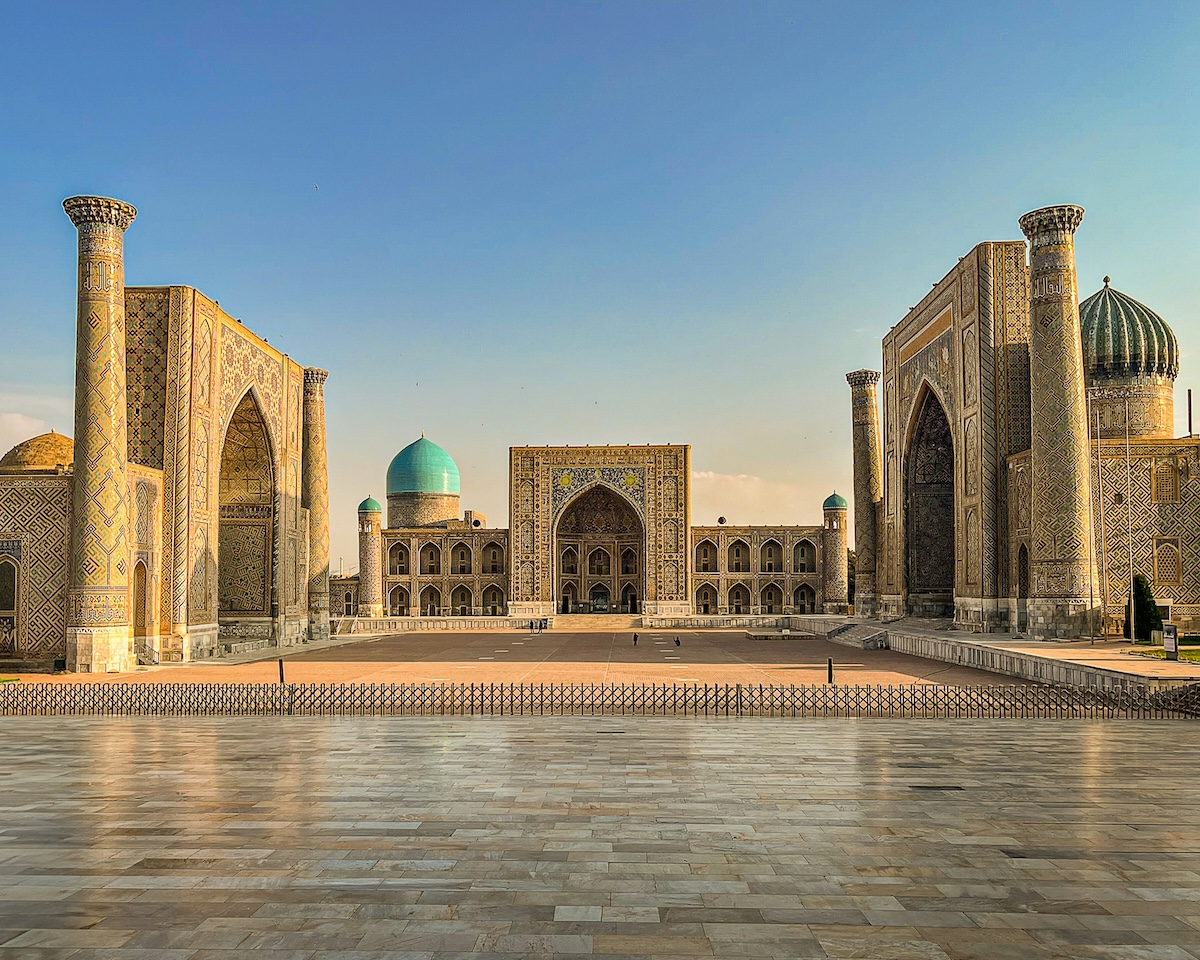
The Registan — from the Persian for “place of sand” — is the monumental square that has become the visual symbol of Samarkand. It comprises three madrasas facing each other across a public plaza:
The Ulugh Beg Madrasa (1417–1420), the oldest of the three, was the astronomer-king’s foundation. The Sher-Dor Madrasa (1619–1636), built two centuries later by the Shaybanid governor Yalangtush Bahadur, mirrors the Ulugh Beg Madrasa across the square and is distinguished by its portal mosaics depicting lions chasing deer beneath a rising sun — an image that, controversially, includes figurative representations unusual in Islamic architecture. The Tilya-Kori Madrasa (1646–1660) completes the ensemble on the north side, its interior mosque dome covered in gold leaf that gives the building its name (“covered in gold”).
The Registan was not built as a unified composition. It accreted over two centuries, each ruler adding to a public space that had existed since Ulugh Beg’s time. The effect, nonetheless, is one of overwhelming architectural coherence — three monumental facades of turquoise, cobalt, and gold tile framing a central plaza that was once the commercial and ceremonial heart of the city.
Samarkand’s Decline — From Imperial Capital to Provincial Town
Samarkand’s decline began almost immediately after Ulugh Beg’s murder. The Timurid dynasty fragmented. In the early 16th century, the Shaybanid Uzbek dynasty conquered Transoxiana and moved their capital to Bukhara. Samarkand lost its political centrality. The Silk Road trade routes that had sustained the city for two millennia shifted. Earthquakes damaged the monuments. The Bibi-Khanym collapsed. The observatory disappeared beneath the earth.
By the 18th century, Samarkand had suffered a severe economic decline. The population shrank. The great monuments stood empty, their tile facades crumbling. In 1740, the Persian conqueror Nader Shah attempted to carry away Tamerlane’s jade sarcophagus as a trophy; the stone broke in two during removal, which his advisers interpreted as an omen. He returned it.
The Russian Empire absorbed Samarkand in 1868. The new rulers built a European-style city to the west of the old Islamic center, creating the divided urban geography that persists today. Soviet restoration in the twentieth century rebuilt and stabilized the major monuments — the Registan, the Gur-e-Amir, the Bibi-Khanym — but the work was ideologically complicated. The Soviet state celebrated Timur’s architecture while suppressing the Islamic religious context in which it had been built. In 2001, UNESCO designated Samarkand a World Heritage Site under the title “Samarkand — Crossroads of Cultures.”
Samarkand Today — The Atlas Entry
Visiting Tamerlane’s Samarkand — What Remains and What Was Rebuilt
Modern Samarkand is divided in two. The old city — centered on the Registan, the Gur-e-Amir, and the Shah-i-Zinda — retains the layout of the medieval Islamic center, with narrow streets, bazaars, and private courtyard houses. The new city, built during the Russian and Soviet periods, extends to the west with broad avenues, administrative buildings, and Soviet-era apartment blocks.
The Registan is the obvious starting point. The three madrasas are open to visitors and function partly as museums, partly as artisan workshops. The Shah-i-Zinda necropolis — a steep climb through the corridor of mausoleums — contains the finest surviving Timurid tilework and is still an active pilgrimage site. The Gur-e-Amir is smaller and more intimate than the Registan, and the interior decoration is extraordinary. The Bibi-Khanym Mosque, largely reconstructed, is impressive in scale but lacks the patina of the less-restored sites. The Ulugh Beg Observatory, on a hill northeast of the center, preserves the excavated arc of the Fakhri Sextant in a small museum. The Afrosiab Museum, beside the archaeological mound of the ancient city, houses the pre-Islamic frescoes and provides context for Samarkand’s pre-Timurid history.
The tourism infrastructure has expanded dramatically under modern Uzbekistan. The city is accessible by high-speed rail from Tashkent (approximately two hours) and by direct flights. Hotels, restaurants, and guided tours are widely available. The best light for photography at the Registan falls in the early morning and late afternoon, when the turquoise tiles shift color with the angle of the sun.
The Conqueror’s Legacy — Samarkand Between Nationalism and the Tourist Trail
Tamerlane is the national hero of modern Uzbekistan. After independence in 1991, statues of Timur replaced Soviet monuments across the country. A bronze equestrian Timur stands in central Tashkent, on the spot once occupied by a statue of Karl Marx. In Samarkand, his image is everywhere — on banknotes, postage stamps, museum displays, and the rhetoric of state identity. The Uzbek government has framed Timur as a visionary builder, a patron of arts and science, and the father of the Timurid Renaissance.
The framing requires selective memory. The same man who built the Registan and funded Ulugh Beg’s observatory also killed an estimated 17 million people, built towers of severed heads, and depopulated entire regions of Persia, India, and the Middle East. The architects who created Samarkand’s beauty did not come voluntarily — they were war captives, deported under threat of death. The wealth that funded the construction was plundered from civilizations that Timur systematically destroyed.
Standing in the Registan at sunset, watching the tile facades catch fire in the late-afternoon light, the violence feels very far away. The beauty is immediate. The suffering that produced it requires knowledge, imagination, and the willingness to hold both truths at the same time — that this is one of the most magnificent public spaces ever built, and that it was built by captive hands with stolen wealth from burned cities. Samarkand does not resolve that contradiction. It embodies it. The city is 2,700 years old, and it has outlasted every empire that claimed it. Tamerlane’s domes are still standing. His skull towers are not. Whether that represents the triumph of beauty over violence, or its complicity, is a question each visitor answers for themselves.
Frequently Asked Questions About Samarkand
What is Samarkand famous for?
Samarkand is one of the oldest continuously inhabited cities in Central Asia, famous for its Timurid-era Islamic architecture. The conqueror Tamerlane made it the capital of his empire in 1370 and built it into the most magnificent city of the medieval Islamic world using architects and artisans forcibly deported from conquered civilizations. Its most iconic landmarks include the Registan square, the Gur-e-Amir mausoleum, the Bibi-Khanym Mosque, and the Shah-i-Zinda necropolis. UNESCO designated it a World Heritage Site in 2001.
Who was Tamerlane and what did he do?
Tamerlane (Timur) was a Turco-Mongol conqueror born around 1336 near Samarkand. He built an empire stretching from India to Turkey through thirty-five years of military campaigns that killed an estimated 17 million people. He sacked Delhi in 1398, destroyed Baghdad in 1401, and defeated the Ottoman sultan at Ankara in 1402. He made Samarkand his capital and transformed it into a center of art, architecture, and science by forcibly relocating the finest artisans from every city he conquered. He died in 1405 while marching to invade China. His descendants founded the Mughal dynasty in India.
What is the curse of Tamerlane’s tomb?
Tamerlane’s tomb in the Gur-e-Amir mausoleum bears an inscription reading “When I rise from the dead, the world shall tremble.” According to local tradition, a second inscription inside warned that anyone who disturbed the tomb would unleash an invader worse than Tamerlane. Soviet scientists opened the tomb on June 19, 1941. Three days later, Nazi Germany launched Operation Barbarossa. In November 1942, Tamerlane’s remains were reburied with full Islamic rites, reportedly on Stalin’s orders, shortly before the Soviet counteroffensive at Stalingrad.
What is the Registan in Samarkand?
The Registan is a monumental public square in the center of old Samarkand, framed by three madrasas (Islamic schools). The Ulugh Beg Madrasa was built between 1417 and 1420 by Tamerlane’s astronomer grandson. The Sher-Dor and Tilya-Kori Madrasas were added in the 17th century. The square is considered one of the finest examples of Islamic architecture in the world and is the most recognizable landmark in Uzbekistan.
How did Samarkand influence the Taj Mahal?
Tamerlane’s descendants, the Mughals, established a dynasty on the Indian subcontinent and maintained a direct connection to their ancestral capital. The Gur-e-Amir mausoleum in Samarkand — with its double-shelled dome, garden setting, and symmetrical design — served as the architectural prototype for Humayun’s Tomb in Delhi and ultimately the Taj Mahal in Agra. Emperor Jahangir, writing in the 1620s, inquired about the condition of Tamerlane’s tomb and promised to fund its maintenance.
How do I visit Samarkand?
Samarkand is accessible by high-speed rail from Tashkent (approximately two hours) and by direct flights. The major sites — the Registan, Gur-e-Amir, Shah-i-Zinda, Bibi-Khanym Mosque, and Ulugh Beg Observatory — are within walking distance of each other in the old city. Tourism infrastructure has expanded significantly in recent years, with hotels, restaurants, and guided tours widely available. The best light for the Registan falls in the early morning and late afternoon.
Sources
* Embajada a Tamorlán (Embassy to Tamerlane, 1403-1406) - Ruy González de Clavijo, ed. Francisco López Estrada (1943)
* The Rise and Rule of Tamerlane - Beatrice Forbes Manz, Cambridge University Press (1989)
* Tamerlane and the Symbolism of Sovereignty - Beatrice Forbes Manz, Iranian Studies Vol. 21, No. 1/2 (1988)
* The Timurid Architecture of Iran and Turan - Lisa Golombek and Donald Wilber, Princeton University Press (1988)
* Samarkand – Crossroads of Cultures - UNESCO World Heritage Site listing (2001)
* The Heavenly City of Samarkand - Roya Marefat, The Wilson Quarterly Vol. 16, No. 3 (1992)
* Tamerlane's Career and Its Uses - Beatrice Forbes Manz, Journal of World History Vol. 13, No. 1 (2002)
* Central Asia under Timur from 1370 to the early fifteenth century - K. Z. Ashrafyan, in History of Civilizations of Central Asia Vol. IV, UNESCO (1998)
* Ruy González de Clavijo’s Narrative of Courtly Life - David Roxburgh, Harvard University
* A Castilian in Samarkand, 1404 - Benjamin Breen, Origins: Current Events in Historical Perspective, Ohio State University (2012)
* The Gur-i Amir and the Building of Tamerlane’s Samarkand - Artifacts Travel (2024)
* Gur-e-Amir - Wikipedia, drawing on multiple primary and scholarly sources