The Valley of Silence
To enter the Valley of the Kings at dawn is to step onto the surface of another planet. Located on the west bank of the Nile, opposite the modern city of Luxor, the valley is a geological cauldron—a deep, jagged gash in the Theban hills where the sun beats down with merciless intensity. The contrast is violent: just a few miles away, the Nile floodplain is a riot of green palms and sugar cane. But here, in the Wadi el-Muluk, there is nothing but limestone, flint, and dust.
For five hundred years, during the New Kingdom (c. 1539–1075 BCE), this desolate canyon was the gateway to the afterlife for the rulers of Egypt. It was chosen for its silence and its secrecy. Unlike the arrogant pyramids of Giza, which stood as beacons for tomb robbers, the tombs here were subterranean, hidden deep within the rock, their entrances sealed and forgotten. For three millennia, the valley kept its secrets well, until the silence was broken by the scrape of a shovel in 1922.
The Pyramid of Nature
The location of the royal necropolis was not accidental. Looming over the valley is a natural, pyramid-shaped mountain known as Al-Qurn (The Horn). To the ancient Egyptians, this peak was a divine sign—a natural monument that required no labor to build. It allowed the pharaohs to be buried under a pyramid without the risk of constructing one.
Geologically, the valley is a maze of soft limestone and shale. This made it easy for ancient masons to carve elaborate corridors and chambers, but it also laid a trap. The rock is brittle and porous. When the rare but violent desert storms strike, flash floods scour the canyons, turning them into rivers of mud and debris. It was exactly such a flood that would seal the fate—and the salvation—of Tutankhamun.
The Heretic’s Shadow: Who Was Tutankhamun?
Before he was a treasure, Tutankhamun was a boy living in the shadow of a revolution. Born around 1341 BCE, he was the son of the "Heretic King" Akhenaten, who had upended centuries of religion by banning the old gods and worshipping only the Aten (the sun disk). When Akhenaten died, he left behind an empire in chaos.
Tutankhamun ascended the throne at age nine. His reign was short and guided by powerful advisors like Ay and Horemheb. His primary role was restoration: he reopened the temples of Amun, moved the capital back to Thebes, and tried to heal the spiritual wounds of his father’s reign. But he was physically frail. Modern DNA studies reveal he suffered from malaria and had a club foot, requiring a cane to walk. He died suddenly around age nineteen, likely from an infection following a broken leg. In the grand sweep of Egyptian history, he was a minor king—a footnote who barely had time to leave a mark before vanishing into the dark.
Buried by History
The obscurity of Tutankhamun was his greatest protection. Because he died young and unexpectedly, he was buried in a small, hastily finished tomb (KV62) rather than a grand royal sepulcher. Two centuries later, when workers were excavating the massive tomb of Ramesses VI (KV9) directly above, they dumped tons of limestone chips and rubble down the slope.
This debris completely buried the entrance to Tutankhamun’s tomb. Later, workmen built huts on top of this rubble, oblivious to the king sleeping beneath their feet. When the great waves of tomb robbing gutted the valley in the 20th Dynasty, thieves stripped the tombs of the great Ramesses and Seti, but they walked right over Tutankhamun. He was saved by the trash of history.
The Last Season: Carter’s Obsession
By the early 20th century, archaeologists believed the Valley of the Kings was tapped out. Theodore Davis, a wealthy American amateur, famously declared, "I fear the Valley of the Tombs is now exhausted." But Howard Carter, a stubborn and dour British artist-turned-archaeologist, disagreed. He was convinced one king remained.
Funded by the Earl of Carnarvon, an English aristocrat seeking relief from the damp British climate, Carter searched for five fruitless years. By 1922, Carnarvon had had enough. He gave Carter an ultimatum: one final season of funding. Carter returned to the valley with a desperate plan to clear the bedrock down to the last inch.
On November 4, 1922—just days after digging began—silence fell over the worksite. A water boy (often identified in local lore as Hussein Abdel Rassoul) or a workman struck a stone that didn't feel like the natural valley floor. They brushed away the sand and revealed a single step cut into the bedrock.
"Wonderful Things": The Breach
It took weeks to clear the staircase and wait for Lord Carnarvon to arrive from England. On November 26, Carter stood before a sealed doorway bearing the jackal seal of the necropolis guards. With trembling hands, he drove a chisel through the plaster.
The air that escaped was 3,300 years old. Carter inserted a candle and peered into the darkness. As his eyes adjusted, the gloom was replaced by the glint of gold. When Carnarvon asked anxiously, "Can you see anything?", Carter uttered the most famous words in the history of archaeology: "Yes, wonderful things."
Organized Chaos: The Antechamber
What Carter saw was not a neatly arranged museum display, but a high-status storage unit packed to the ceiling. The Antechamber was filled with a chaotic jumble of objects: three funeral beds shaped like strange beasts, dismantled golden chariots, alabaster vases, and chests of linen.
The tomb was small—just four rooms—but the density of the wealth was suffocating. Every inch of floor space was occupied. Unlike other tombs that had been swept clean by robbers, this one felt interrupted. A bowl of mortar had been left by the ancient masons; a fingerprint was still visible on a painted surface. It was a time capsule that collapsed the distance between 1323 BCE and 1922 AD in a single heartbeat.
The Gold Within Gold: The Burial Chamber
The greatest shock lay behind the sealed wall of the Burial Chamber. When Carter breached it in February 1923, he found his path blocked by a wall of gold. A massive gilded wooden shrine filled the room almost entirely, leaving only a few feet of clearance.
It was a Russian nesting doll of royalty. Inside the first shrine was a second, then a third, and a fourth. Inside the final shrine lay a quartzite sarcophagus. And inside that, three coffins nested within one another. The outer two were gilded wood, but the innermost coffin was a solid gold shell weighing 110 kilograms (242 lbs). It remains one of the largest single objects of gold ever created by human hands.
The Face of Eternity: The Death Mask
Covering the head and shoulders of the mummy was the Gold Mask, an object of such terrifying beauty that it has become the face of ancient Egypt. Beaten from two sheets of high-purity gold, it portrays the young king as a god—ageless, serene, and perfect.
The mask is inlaid with lapis lazuli (imitating the blue of the night sky), quartz, obsidian, and carnelian. On the back, a spell from the Book of the Dead is inscribed, designed to protect the king’s senses in the afterlife. "Thy right eye is the night bark... Thy eyebrows are the Ennead of the Gods." It is a masterpiece of portraiture that captures both the fragility of the boy and the divinity of the king.
Autopsy of a God: Science and the Body
Beneath the gold lay the mortal remains. Carter’s team, lacking modern ethics, treated the mummy roughly, pouring hot resins over it and using heated knives to pry the gold mask from the head, decapitating the king in the process.
Modern science has treated him more gently but revealed a sadder truth. CT scans and DNA analysis conducted in the 21st century show that Tutankhamun was not a murdered prince, but a sickly teenager. He suffered from Koehler disease (death of bone tissue) in his foot, a cleft palate, and severe malaria. The hole in the back of his skull, once thought to be evidence of assassination, was likely made during mummification. He died not from a blow to the head, but likely from a leg fracture that became gangrenous, compounded by his malaria.
The Cobra and the Canary: Birth of a Myth
The discovery of the tomb coincided with the dawn of global mass media, and the press was hungry for a sensation. The "Curse of the Pharaohs" provided it. The legend began with a cobra—the symbol of the pharaoh—allegedly eating Carter’s pet canary on the day the tomb was opened.
The hysteria peaked when Lord Carnarvon died in Cairo on April 5, 1923, less than five months after opening the tomb. He died of blood poisoning (sepsis) from an infected mosquito bite he had nicked while shaving. Newspapers reported that the lights in Cairo went out at the moment of his death and that his dog, Susie, howled and dropped dead back in England. The narrative was irresistible: the ancient king was striking back from the grave.
Deconstructing the Curse
In reality, the curse was a fabrication of the tabloids and a misunderstood translation of protective texts. There was no curse written over the door of the tomb. Statistically, the "curse" was a failure. Of the 58 people present when the sarcophagus was opened, only eight died within a dozen years. Howard Carter, the man most responsible for disturbing the king’s rest, lived another 17 years, dying of lymphoma at age 64.
However, the "curse" may have had a biological grain of truth. Ancient tombs can contain molds like Aspergillus niger, which can be harmful to those with weakened immune systems (like Carnarvon). But the idea of supernatural retribution was a modern invention, a way for the West to process its guilt and fascination with disturbing the dead.
The Great Migration: From Tahrir to Giza
For decades, Tutankhamun’s treasures were housed in the Egyptian Museum in Tahrir Square, displayed in old glass cases that gathered dust and fingerprints. Today, they are undergoing a historic migration.
The entire collection of 5,000 objects—from his chariots to his underwear—is being moved to the new Grand Egyptian Museum (GEM) in Giza. Here, in state-of-the-art conservation labs, the artifacts are being cleaned and studied. For the first time, the complete collection will be displayed together, telling the full story of the king’s life and death in a setting worthy of his wealth.
The Valley Today: Atmosphere and Access
Visiting the Valley of the Kings today is a pilgrimage into the heat. The modern visitor arrives at a sleek visitor center and takes an electric tram (the "Tuf-Tuf") up the valley floor. The silence Carter experienced is gone, replaced by the murmur of tour groups and the instructions of guides.
Yet, the atmosphere remains heavy. The valley walls tower above, shutting out the world. In the summer, temperatures can exceed 45°C (113°F), turning the canyon into a furnace. It serves as a reminder of the sheer physical endurance required by the ancient workmen who cut these tombs by hand in the dark.
Visiting KV62: The Tomb Experience
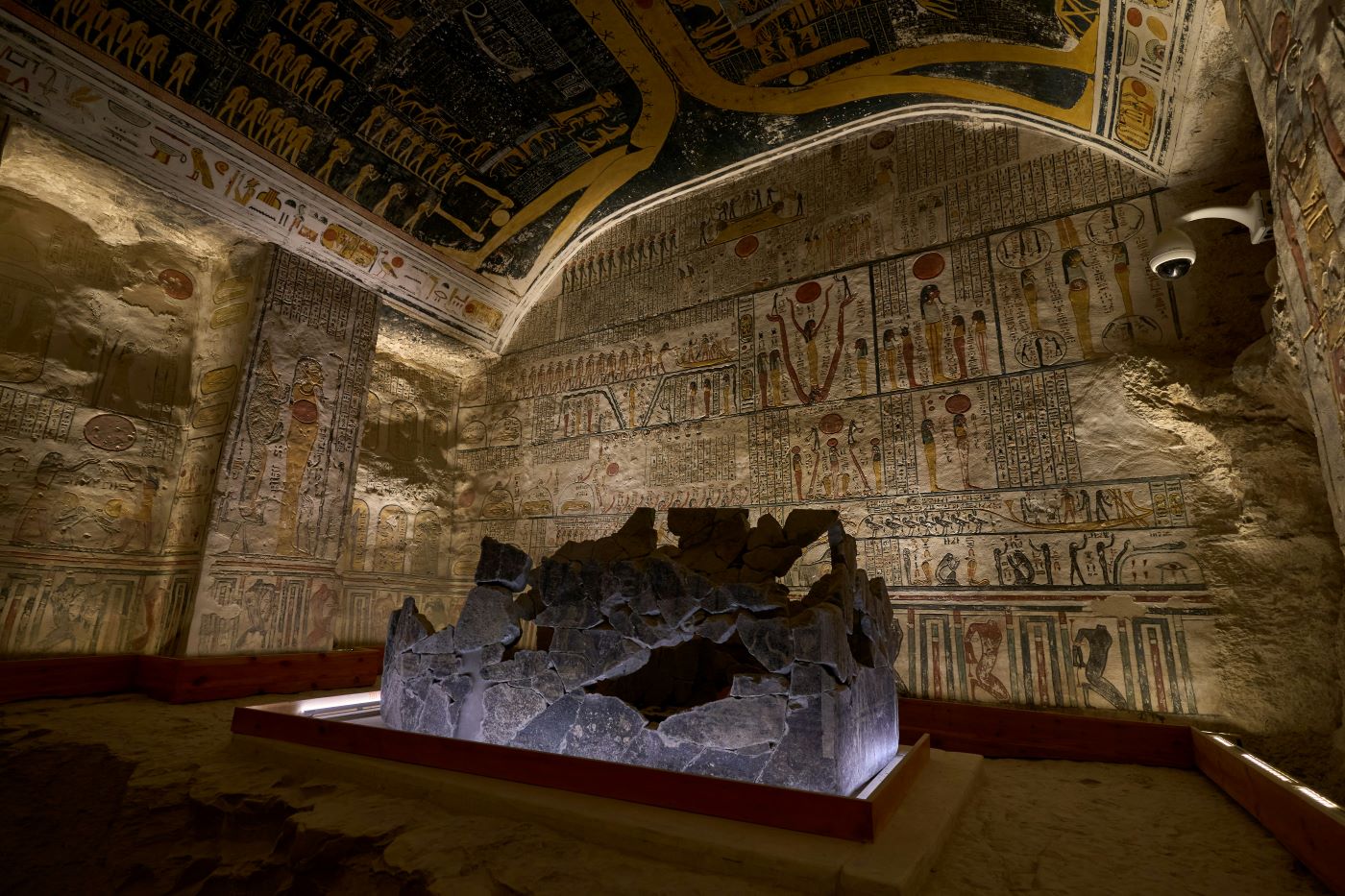
Entrance to Tutankhamun’s tomb (KV62) requires a separate, extra ticket, often costing significantly more than general entry. Visitors expecting a palace are often surprised. The tomb is tiny. The Antechamber and Annex are undecorated plaster. Only the Burial Chamber features painted walls, depicting the funeral procession and the king being welcomed by the gods.
The true power of visiting KV62 is not the architecture, but the resident. While the treasures have moved to Cairo, Tutankhamun himself remains. His mummy, blackened by resin and time, lies in a climate-controlled glass case in the Antechamber, his head and feet visible. He is the only pharaoh of the New Kingdom still resting in his own tomb, defying the looters and the museums alike.
Beyond the Boy King: Other Tombs to See
While Tutankhamun is the most famous, his tomb is architecturally underwhelming compared to his neighbors. To truly understand the Valley, one must visit the great tombs of the Ramesside kings.
- KV17 (Seti I): Often closed or requiring a premium ticket, this is the Sistine Chapel of ancient Egypt, with relief carvings of breathtaking quality.
- KV9 (Ramesses VI): The tomb that hid Tutankhamun. It features a stunning vaulted ceiling depicting the goddess Nut swallowing the sun, painted in vibrant astronomical colors.
- KV11 (Ramesses III): A massive, complex tomb known for its side chambers depicting harpers and armories.
In the Footsteps of Carter
For the complete historical experience, travelers should visit Howard Carter’s House, located near the entrance to the valley. Preserved as a museum, it contains his original desk, typewriter, and darkroom equipment. It offers a hauntingly personal glimpse into the lonely life of the man who spent years digging in the sand.
Nearby, the Replica Tomb (created by Factum Arte) offers an exact facsimile of KV62. It was built to divert tourist traffic and preserve the original tomb from humidity damage. It is a marvel of modern technology, indistinguishable from the real thing to the naked eye, raising questions about authenticity and preservation.
Ethical Exploration: Preservation and Respect
The greatest threat to the Valley of the Kings today is not thieves, but breath. The humidity generated by thousands of daily visitors causes the plaster walls to swell and crack. Fungi bloom on the ancient paint.
To visit respectfully means following the strict rules: do not touch the walls, do not use flash photography, and respect the silence. Photography is now generally allowed with mobile phones (no flash), but rules can change. It is crucial to remember that these are not just tourist sites; they are religious vessels designed for eternity.
Conclusion: The Victory of Memory
The ancient Egyptians believed that "to speak the name of the dead is to make him live again." By this standard, Tutankhamun is the most successful pharaoh in history. A boy king who died alone and in pain, whose name was erased from king lists by his successors, has achieved the immortality his great ancestors failed to secure.
He conquered the world not with armies, but with beauty. The discovery of his tomb reshaped our understanding of the ancient world, proving that the past is never truly lost—it is only waiting for the right person to look in the right place. As you stand in the dim light of KV62, looking at the blackened face of the boy king, the glitter of gold fades, leaving only the profound human connection across the abyss of time.
Sources & References
- The Griffith Institute (Oxford University). "Tutankhamun: Anatomy of an Excavation." (The complete digital archive of Carter’s records, photos, and diaries). Griffith Institute Link.
- Theban Mapping Project. "KV 62 (Tutankhamen)." (Detailed architectural plans and history of the tomb). Theban Mapping Project Link.
- Hawass, Zahi, et al. (2010). "Ancestry and Pathology in King Tutankhamun's Family." Journal of the American Medical Association (JAMA). (The key study on DNA, malaria, and health). JAMA Article.
- Reeves, Nicholas. (1990). The Complete Tutankhamun. Thames & Hudson. (The definitive academic reference on the tomb's contents).
- Factum Arte. "The Facsimile of the Tomb of Tutankhamun." (Details on the 3D scanning and replica project). Factum Arte Link.
- Ministry of Tourism and Antiquities (Egypt). "Grand Egyptian Museum." (Updates on the new museum and collection). Ministry Link.
- Carter, Howard. (1923). The Tomb of Tut.ankh.Amen. (Carter’s own three-volume account of the discovery).
- National Geographic. "King Tut: The Teen Whose Death Rocked Egypt." (Historical context and biography).
- Tyldesley, Joyce. (2012). Tutamen: The Search for an Egyptian King. Basic Books.
- Marchant, Jo. (2013). The Shadow King: The Bizarre Afterlife of King Tut’s Mummy. Da Capo Press.
- British Museum. "Tutankhamun: The treasures of the golden pharaoh." (Exhibition history and artifact details).
- Nature. "Malaria and weak bones may have killed Tutankhamun." (Report on the 2010 scientific findings). Nature Article.
- Supreme Council of Antiquities. "Valley of the Kings Visitor Information."
- Current World Archaeology. "KV62: 100 Years of Discovery."
- Smithsonian Magazine. "The curse of the pharaohs? No, just a fungus." (Scientific debunking of the curse).