Roman Chariot Racing: The Brutal Reality of the Ancient Games
The air inside the Circus Maximus in 100 AD was a toxic slurry of horse sweat, human excrement, and expensive Egyptian incense. There was no background noise in this valley; there was only the rhythmic, subsonic thrum of 150,000 pairs of sandals beating against stone tiers. When the white cloth, the mappa, hit the sand, the sound changed to a physical pressure—a roar that could be heard from the Janiculum Hill across the Tiber. This was not a sporting event in the modern sense. It was a high-speed religious rite where the physics of centrifugal force met the fragility of the human spine. The track was a 600-meter stretch of packed earth and sand, and at either end sat the metae—the turning posts that served as the primary killing zones of the Roman world.
Chariot Crashes and the Lethal Physics of the Naufragia
Chariot racing was an exercise in controlled suicide. A Roman racing chariot, or quadriga, was not a sturdy vehicle; it was a flimsy wooden basket balanced on a single axle, designed for nothing but raw speed. The driver did not hold the reins in his hands; he wrapped them around his waist, effectively tethering his body to four half-ton horses. When a chariot clipped the stone spina (the central barrier) at thirty-five miles per hour, the result was a naufragium—a shipwreck. The wooden frame would disintegrate into jagged splinters, and the driver would be dragged behind his own panicked team. His only hope was a small curved knife tucked into his belt, used to hack through the leather reins before his skull met the hooves of the following team. These shipwrecks were the primary draw for the Roman public, who viewed the mangled remains of drivers as a necessary sacrifice to the gods of speed.
The Crowd Capacity and Social Atmosphere of the Great Circus
The Circus was a pressure cooker of class and desperation. Unlike the Colosseum, which was strictly segregated by rank, the Circus Maximus was one of the few places where the Roman plebs sat in proximity to the elite. The heat generated by 150,000 bodies in the Roman summer created a microclimate of humidity and stench. Under the arches of the lower tiers, a sprawling underworld of cookshops, brothels, and betting dens operated in a perpetual twilight. The smell of roasting meat mingled with the stench of the open sewers that ran beneath the track. For a Roman citizen, the Circus was the only place where they possessed a collective voice. They used the pauses between races to scream demands at the Emperor—for lower grain prices, for the removal of a hated official, or for the blood of a specific prisoner. The sensory experience was one of total immersion in the power of the state and the volatility of the mob.
Famous Roman Charioteers: The Wealth of Gaius Appuleius Diocles
A charioteer was a slave who lived like a god and died like a dog. Most drivers began their careers in their early teens; few survived to see twenty-five. Their bodies were maps of trauma—reset collarbones, shattered kneecaps, and internal hemorrhaging that never truly healed. Yet, the financial stakes were astronomical. Gaius Appuleius Diocles, perhaps the most successful athlete to ever live, competed in 4,257 races and won 1,462 of them. By the time he retired at age forty-two, his total career earnings were estimated at 35,863,120 sesterces. In modern currency, this equates to roughly $15 billion, dwarfing the career earnings of any modern footballer or basketball star. This wealth was the price of blood. For every Diocles, there were thousands of unnamed boys whose bodies were shoveled out of the sand during the midday break, their names forgotten before the next heat began.
Panem et Circenses: How Emperors Used Entertainment for Social Control
The Circus Maximus did not exist for the sake of the sport; it existed for the sake of the Emperor. The Roman ruling class understood a fundamental truth of urban control: a fed and distracted population is a docile one. This philosophy, famously mocked by the satirist Juvenal as "bread and circuses," found its physical manifestation in the valley between the Palatine and Aventine hills. By providing free entertainment on a scale that defied human comprehension, the state bought the silence of a populace that had lost its political power. The Circus was the ultimate bribe, a massive architectural sedative designed to drown out the sounds of hunger and dissent with the thunder of hooves.
Architecture and Engineering of the Circus Maximus Valley
Roman greatness began with the management of filth. In the 6th century BC, the King Tarquinius Priscus first designated the valley for public games. He didn't build a stadium; he marked a territory. He ordered the construction of wooden bleachers that were notoriously unstable, frequently collapsing under the weight of the crowd. The engineering challenge was the water table. The valley was the natural drainage point for the surrounding hills. By encasing the stream that ran through the valley into a stone-vaulted tunnel—the Cloaca Maxima—the Romans mastered the terrain. This subterranean feat allowed the ground to support the immense weight of the masonry that would eventually form the permanent tiers of the Circus.
Augustus and Julius Caesar: Building the Imperial Stadium
Julius Caesar was the first to realize that the Circus needed to be a fortress of entertainment. In the 1st century BC, he expanded the seating and surrounded the track with a ten-foot-deep moat to protect the spectators from the elephants and bulls used in the morning hunts. After Caesar’s assassination at Curia Pompeia, Augustus completed the transformation. He added the pulvinar, a monumental imperial box that was physically connected to the palaces on the Palatine Hill. This allowed the Emperor to enter the stadium without ever walking among the common people. Augustus also brought the first obelisk to Rome from Heliopolis in Egypt, placing it on the spina as a symbol of Rome’s conquest of the sun itself. The obelisk, a 23-meter red granite needle, acted as a giant sundial, marking the passage of the races and the inevitable decline of the day.
The Imperial Box and the Hierarchies of Ancient Rome
Architecture in the Circus was a tool of psychological warfare. The Imperial Box was not just a seat; it was an altar. When the Emperor sat in the pulvinar, he was positioned higher than the people but lower than the gods whose statues were paraded through the track in the pompa circensis. This placement was intentional. It allowed the Emperor to observe the crowd as much as the race. While the Roman Forum served as the city's civic brain and the Via Appia as its logistical spine, the Circus Maximus was its emotional heart. The architecture dictated that 150,000 people had to look upward to see their ruler, framed by Corinthian columns and cloth-of-gold awnings. From this vantage point, the Emperor could grant or deny life with a flick of his wrist.
The Racing Factions: Politics, Gambling, and Civil Unrest
In Rome, you didn't just root for a team; you belonged to a faction. The four colors—the Blues (Veneti), Greens (Prasini), Reds (Russati), and Whites (Albati)—were more than sports franchises. They were massive corporate and political machines that owned the horses, the stables, and the souls of the fans. By the 2nd century AD, the Whites and Reds had largely been absorbed by the Blues and Greens, creating a binary sectarianism that mirrored the divisions of the empire itself. Membership in a faction was an identity that transcended family, geography, and even religion. If you were a Green, you hated the Blues with a theological intensity. This wasn't fan culture; it was an organized, state-sanctioned gang system that functioned as a shadow government.
The Blues and Greens: Sectoral Division in Roman Society
The factions were the true masters of the Circus. Each color represented a different season and an elemental force: Red for summer and fire, White for winter and air, Blue for autumn and water, and Green for spring and earth. However, the sociological reality was far more grounded. The Greens were traditionally the faction of the common people and the radical emperors (like Caligula and Nero), while the Blues often represented the aristocracy and the conservative establishment. These factions operated their own training schools, known as trigaria, and employed thousands of staff, from veterinarians and stable boys to "maddeners" whose job it was to agitate the horses before the start. The power of the factions was so great that they could negotiate directly with the Emperor for tax breaks or legal immunities for their members.
Sports Riots and the Underworld of Roman Gambling
The Circus Maximus was the largest gambling den in the ancient world. While gambling was technically illegal in Rome except during the festival of Saturnalia, the law was never enforced within the walls of the stadium. Huge sums of money changed hands on every race, leading to the financial ruin of entire families. This economic desperation, combined with the partisan hatred of the factions, made the Circus a frequent site of mass violence. Riots would erupt over a disputed finish or a perceived slight by the Emperor. In one instance in the later empire, a riot sparked in the stadium nearly burned down the city of Constantinople (the Nika Riots), proving that the passions stoked in the Circus could topple dynasties. The state allowed this because the factions provided a controlled way for the public to vent their aggression.
Curse Tablets and the Occult History of the Track
Below the surface of the track lay a layer of lead and spite. Because the stakes were so high, many fans and drivers turned to the supernatural to ensure victory. Archaeologists have discovered hundreds of defixiones—curse tablets—buried at the turning posts of the Circus. These were thin sheets of lead inscribed with terrifying invocations to underworld deities. A typical curse might read: "I invoke you, spirit of the dead, to take the horses of the Greens; trip them, bind them, so they cannot run, cannot turn, and cannot win." Often, these tablets were pierced with iron nails to "pin down" the victim's luck. The Romans believed the Circus was a thin place where the world of the living and the dead overlapped, fueled by the frequent deaths occurring on the sand.
The Midday Massacre: The Logistics of State-Sanctioned Slaughter
The sand of the Circus Maximus was specifically chosen for its ability to absorb liquid quickly. Between the morning's animal hunts and the afternoon's races, the stadium transitioned into a high-efficiency slaughterhouse. While the elite went to lunch, the "vulgar" stayed in their seats to watch the meridiani—the midday executions. This was the dark core of Roman social control: the demonstration that the state could not only take your life but could turn your final agony into a comedic interlude for the masses.
The Geography of the Killing Floor
Execution in the Circus was a sprawling, panoramic affair. Unlike the localized violence of the later Colosseum, the Circus required prisoners to be moved across a 600-meter stage. This necessitated a form of "mobile killing." Prisoners were often tied to low, wheeled platforms and dragged behind chariots at high speeds, or forced to run the length of the spina while being pursued by bestiarii (professional hunters). The sheer distance meant that a prisoner’s death could be prolonged for the entire length of the track, ensuring that every one of the 150,000 spectators had a front-row seat to the anatomical destruction of the human body.
Damnatio ad Bestias: The Theatricality of the Kill
The Romans didn't just want you dead; they wanted you erased. In the damnatio ad bestias, the execution was framed as a twisted piece of theater. To maximize the "entertainment" value, prisoners were often dressed in elaborate costumes to reenact myths. A common "play" involved the myth of Prometheus; a prisoner would be chained to a rock in the center of the track, and a starving eagle or leopard would be released to tear at his liver while he was still conscious.
This wasn't a punishment in the modern legal sense; it was a ritualized stripping of humanity. By the time the animals were finished, there was nothing left to bury. The remains were swept into the Cloaca Maxima sewers, physically and symbolically flushing the "enemies of Rome" out of the city’s memory.
The Christian Persecutions and the Tunica Molesta
The most horrific innovation of the Circus was the fire-death, most notably during the reign of Nero following the Great Fire of 64 AD. Because the Christians were cast as the "haters of humanity," their executions were designed to be uniquely agonizing.
They were often subjected to the tunica molesta—garments soaked in pitch, wax, and papyrus. Tied to stakes along the spina or at the turning posts, they were set ablaze as "living torches" to provide illumination for the evening events. The psychological impact on the crowd was total: the smell of burning human flesh mingled with the scent of the horses and the roasting meat from the nearby stalls. It served as a visceral reminder that the Emperor’s light was literally fueled by the destruction of those who defied him.
The Ritual of the Porta Libitinensis
The Circus had a specific architecture for the dead. At the curved end of the stadium sat the Porta Libitinensis, named after Libitina, the goddess of funerals. Every body—be it a shattered charioteer or a disemboweled prisoner—was hooked by the neck and dragged through this gate. Specialists known as confectores would check the bodies; if a prisoner was still breathing, their skull was crushed with a heavy mallet in a final act of state "mercy."
This gate was the exit point for the reality of Rome. Once the body passed through, the sand was raked, fresh incense was burned, and the crowd prepared for the next race, the blood of the "enemies" serving as the literal lubricant for the city's favorite sport.
The Great Fire of Rome: 64 AD and the Destruction of the Circus
The Circus Maximus was the tinderbox that destroyed Rome. On the night of July 18, 64 AD, a fire broke out in the shops lining the southeastern curve of the stadium. The wooden upper tiers and the oil-soaked warehouses nearby provided the perfect fuel. Driven by a strong wind, the flames climbed the Palatine Hill and swept across the city. The fire burned for six days, and then reignited for three more.
Nero was famously accused of playing his lyre while the city burned, but the reality was more structural: the Circus was a fire trap. The disaster led to a massive reconstruction of the stadium in stone and brick, but the memory of the screaming thousands trapped in the burning bleachers remained a permanent scar on the site’s history.
Visiting the Circus Maximus: The Modern Experience of the Ruins
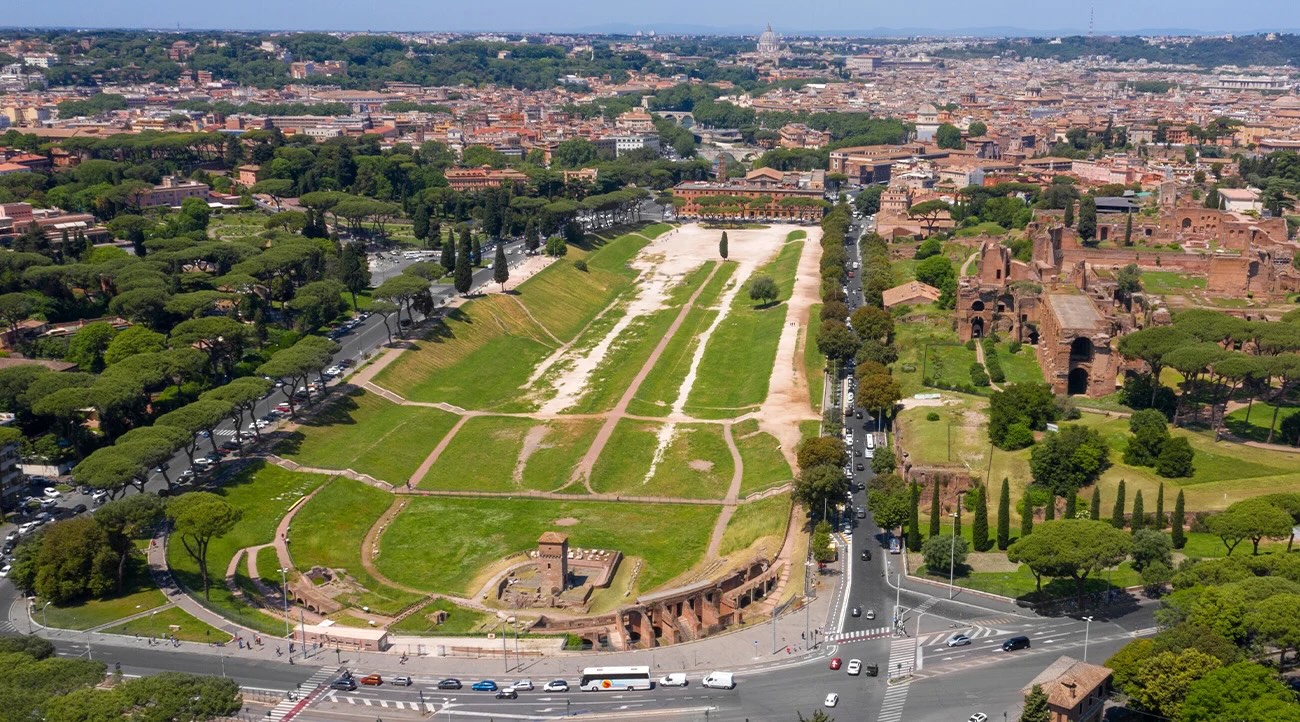
Visiting the Circus Maximus today is an exercise in archaeological imagination. Most tourists arrive at the site and are disappointed; they see a giant, dusty park where locals walk their dogs and tourists sit on the grass. There are no towering arches like the Colosseum, no forest of columns like the Forum. But this emptiness is the point. The Circus is a "negative monument"—it is the memory of a space. To truly understand it, you must stand at the northwestern end, near the site of the starting gates (carceres), and look down the 600-meter expanse toward the curved end. The sheer scale of the void tells you more about Roman ambition than a standing wall ever could.
Archaeology and Logistics: Navigating the Site Today
The best way to experience the site is to avoid the center. The track itself is now a flat, grassy plane, but the real history is in the edges. At the southeastern end, a ticketed archaeological area allows you to walk through the ancient corridors, see the remains of the shops (tabernae), and stand in the very rooms where the betting and prostitution took place. Look for the "water drains"—the stone channels that still mark where the Roman engineers fought back the swamp. If you visit in the late afternoon, the shadows of the Palatine Hill stretch across the valley, mimicking the vanished tiers of seating. It is in this play of light and shadow that the scale of the 150,000-seat ghost becomes tangible.
The Ethics of Tourism at a Site of Ancient Tragedy
There is a profound cognitive dissonance in the modern use of the Circus. Today, it hosts rock concerts by the Rolling Stones and Bruce Springsteen; it is where Italy celebrates its World Cup victories. People jog over the same soil where thousands of animals and humans were executed for "sport." There is no monument to the slaves who died here, no plaque for the Christians who were martyred on this sand. As a visitor, you must reconcile the beauty of the open space with the reality of its history as a site of state-sponsored cruelty. Is it a park, or is it a graveyard? The answer is both. To walk here is to participate in the final stage of the Roman cycle: the transformation of a monument into a memory, and a memory into a convenience.
Practical Travel Tips for the Entry
Do not go at midday in the summer. The valley acts as a heat trap, and there is almost no shade. The best time is at sunset, starting from the Circo Massimo Metro B station. Walk the perimeter of the track first to grasp the distance, then head to the Torretta della Moletta—the medieval tower at the curved end—which provides the best elevated view of the excavations. For a truly visceral perspective, climb the path up the Aventine Hill to the Rose Garden (Roseto Comunale). From there, you can look down into the "bowl" of the Circus and see the layout of the spina clearly. It is from this height that you realize you aren't just looking at a park; you are looking at the footprint of the largest machine for human distraction ever conceived.
FAQ
How did the Circus Maximus function as a political tool?
The Circus was the physical manifestation of "Bread and Circuses" (panem et circenses). By providing free, high-octane violence and grain doles, the Emperors effectively neutralized the political agency of the Roman mob. It was a pressure valve; the stadium allowed the citizenry to vent their frustrations at a horse race rather than at the grain warehouses or the Imperial Palace.
What were the actual survival rates for chariot drivers?
The career of a charioteer was statistically a death sentence. While superstars like Gaius Appuleius Diocles survived into retirement, the vast majority of drivers—mostly slaves in their teens—died within their first two years on the track. The combination of being tethered to the horses and the lack of protective gear meant that a single collision was usually fatal.
How did the engineering of the Circus handle the massive crowds?
The Circus utilized a sophisticated system of vomitoria—vaulted concrete passageways designed to funnel 150,000 people in and out of the stadium in minutes. This architectural innovation prevented the deadly crushes common in modern stadiums and ensured that the "mob" remained under the strict logistical control of the Praetorian Guard.
What was the role of the Circus in the persecution of Christians?
While the Colosseum is more famously associated with martyrdom, the Circus Maximus hosted far more executions due to its massive capacity. During the Great Fire of 64 AD, Nero used the Circus as a staging ground for the public torture and execution of Christians, turning the stadium into a site of religious trauma long before the first stone of the Colosseum was laid.
Why is so little of the original stone remaining today?
The Circus was the ultimate victim of its own success. Its massive travertine blocks and marble veneers were so high in quality that they were systematically looted for over a millennium. The stadium was dismantled to build the very churches and palaces that define Renaissance Rome, leaving only the "hollow" in the earth where the violence once occurred.
Sources and Citations
- The Circus Maximus: A History - Mark Cartwright (2013)
- Bread and Circuses: The Psychology of Roman Control - UNRV Roman History (2022)
- The Life and Earnings of Gaius Appuleius Diocles - Peter T. Struck (2010)
- Archaeological Records of the Vallis Murcia Excavations - Sovrintendenza Capitolina ai Beni Culturali (2024)
- The Great Fire of 64 AD: Structural Impacts on the Circus - National Geographic Society (2014)
- Curse Tablets (Defixiones) in the Roman Circus - The Metropolitan Museum of Art (2016)
- The Evolution of Roman Chariot Factions - Encyclopedia Britannica (2023)
- Rome: The Biography of a City - Christopher Hibbert (1985)