
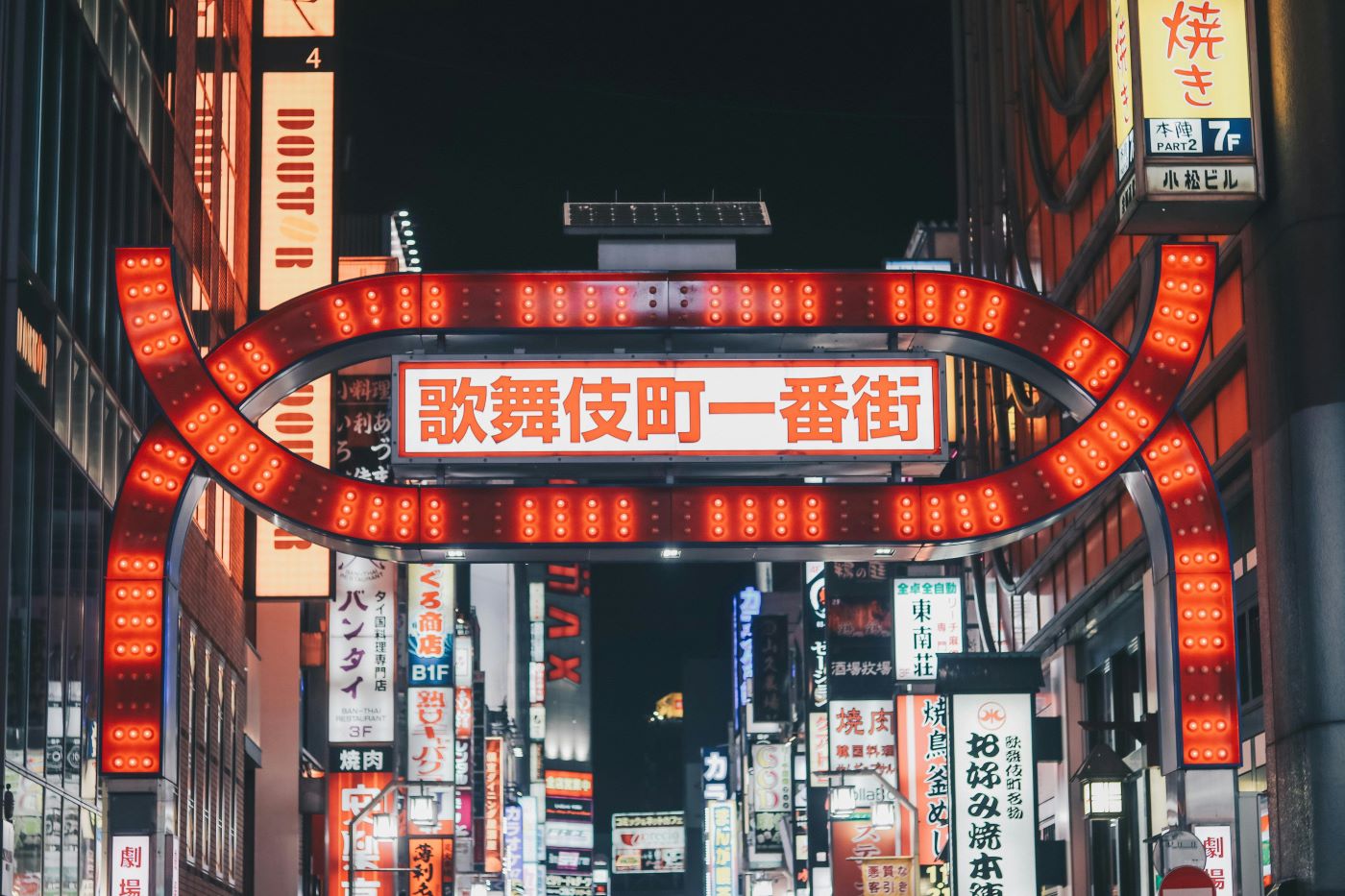
To enter Kabukichō is to step through a tear in the fabric of polite Japanese society. The transition is marked not by a wall, but by an archway: the iconic red neon gate of Kabukichō Ichibangai. Standing on Yasukuni-dori Avenue, looking into the maw of the beast, the first thing that hits you is the light. It is not the warm, inviting glow of a hearth, but a harsh, frantic strobe—a vertical canyon of LEDs, incandescent bulbs, and flashing screens that turn the night sky into a bruised purple haze.
This is Tokyo’s Kabukichō red light district, a roughly 600-square-meter patch of land in Shinjuku that boasts the highest concentration of bars, clubs, love hotels, and predatory desires on the planet. As you cross the threshold under the gate, the sensory assault induces a kind of "cyberpunk vertigo." The air vibrates with the deafening, mechanical roar of falling steel balls from the pachinko parlors, layered over the thumping bass of club speakers and the aggressive, rhythmic shouting of the street touts.
It is a place of dizzying contradiction. To your left, a group of college students laughs on their way to a karaoke box; to your right, a smartly dressed man with a predatory smile whispers promises of "cheap drinks" to a lone tourist, leading him toward a financial abyss. The rain, a frequent visitor to Tokyo, slicks the pavement, turning the ground into a mirror that doubles the neon intensity, creating the illusion that you are floating in a void of pure electricity.
This is the Sleepless Town. This is the playground of the Yakuza. And while the surface glitters with the promise of pleasure, the machinery beneath is greased by debt, vice, and organized crime.
The Name of Failure: Post-War Plans for a Kabuki Theater
To understand the Kabukicho history, one must look back to the ashes of 1945. Before the neon, before the host clubs, and before the Godzilla head, this area was known as Tsunohazu. Like much of Tokyo, it was flattened by Allied firebombing during World War II. The devastation was total; the area was a scorched wasteland of cinder and despair.
In the immediate post-war reconstruction period, a local neighborhood association leader named Kihei Suzuki had a grand, utopian vision. He sought to rebuild the area not just as a commercial district, but as a bastion of high culture. The centerpiece of this reconstruction plan was to be a magnificent Kabuki theater, a venue for traditional Japanese drama that would elevate the spirits of a defeated nation. In anticipation of this cultural renaissance, the district was officially renamed Kabukichō—literally "The Town of Kabuki"—in 1948.
It is one of history’s great ironies. Funding for the theater collapsed, and the building was never constructed. The high culture never arrived. Instead, the vacuum was filled by the exact opposite: movie theaters, dance halls, and eventually, the sex industry. The name remained, a ghostly artifact of a failed dream, attached to a district that would become world-renowned not for traditional art, but for the raw, commodified theater of the human flesh. The Post-war Tokyo reconstruction in this specific grid did not produce a sanctuary of the arts, but rather a sprawling, chaotic marketplace for the id.
From Black Markets to Blue Light: The Rise of the Yakuza in Tokyo
The failure of the Kabuki theater plan left a massive development void, and in the chaos of the post-war occupation, nature abhorred a vacuum. The roots of the Yakuza in Tokyo are deeply intertwined with the black markets (yami-ichi) that sprang up in Shinjuku to feed and clothe a starving population. The police force, dismantled and demoralized by the American occupation, was largely ineffective.
Into this lawless gap stepped the Yakuza. Initially, they operated under the guise of Tekiya (peddlers) and Bakuto (gamblers), groups that provided a brutal form of order. They allocated stalls, settled disputes, and protected vendors from common thieves—for a price. This protection racket was the embryonic stage of the modern Kabukichō ecosystem.
As Japan’s economy began to recover in the 1950s and 60s, the black markets evolved into permanent entertainment districts. The Yakuza evolved with them. They shifted from guarding market stalls to managing the burgeoning nightlife: the jazz kissaten, the strip theaters, and the early hostess bars.
By the time the lights of the economic miracle turned on, the organized crime syndicates had already poured the concrete foundations of the district. However, while Kabukicho provided the public face and high-volume cash flow, the strategic and ideological commands were often transmitted from the quiet, fortified hilltop estates of Nada Ward in Kobe. This relationship established a permanent link between the neon chaos of Tokyo and the administrative nerve center of the Yamaguchi-gumi, creating a national network where street-level vice was governed by suburban discipline.
The Golden Age of the Gokudō: The 1980s Bubble Era
If the post-war era was the birth of the district, the 1980s were its adolescence—wild, wealthy, and dangerously out of control. This was the era of the Japanese Asset Price Bubble, a time when Tokyo real estate was worth more than the entire state of California. In Kabukichō, cash didn't just flow; it flooded the gutters.
This was the Golden Age of the Yakuza. During the 80s, the syndicates operated with a level of openness that is shocking to modern sensibilities. High-ranking bosses maintained offices with their clan crests proudly displayed in gold leaf on the doors. Luxury sedans with tinted windows lined the streets, double-parked with impunity.
The economics of the Bubble fueled an explosion of excess. Corporate warriors, flush with expense accounts, flocked to Kabukichō to spend millions of yen in a single night. The Yakuza controlled the supply chain of this hedonism. They owned the buildings, they supplied the towels and the ice (oshibori and kori rackets), and they managed the human capital. It was a time of "gray zone" expansion, where the line between legitimate business and criminal enterprise blurred into irrelevance. The district became a symbol of Japan’s economic invincibility, but also of its moral rot—a place where anything could be bought, provided you could pay the "protection" tax.
The Ecosystem of the Night: Host and Hostess Clubs Explained
To the uninitiated tourist, the sheer variety of venues in Kabukichō is baffling. It is crucial to understand the hierarchy of the "Water Trade" (Mizu Shobai). The most visible establishments are the Kyabakura (cabaret clubs) and Host Clubs.
Host and hostess clubs explained: These are not brothels. They are venues for the sale of emotional labor and the illusion of romance. In a Kyabakura, men pay an hourly fee to drink with women who light their cigarettes, pour their whiskey, and laugh at their jokes. It is a psychological service, catering to the loneliness and ego of the modern salaryman.
Conversely, Host Clubs cater to women. Walk down the "Host Avenue" behind the Shinjuku Ward Office, and you will see towering billboards featuring men with gravity-defying anime hairstyles, airbrushed skin, and diamond jewelry. These are the hosts. Their job is to be the perfect boyfriend for a night. They charm, they flatter, and they pressure their female clients—often women working in the sex industry themselves—to buy exorbitantly priced "Champagne Towers."
The psychology here is predatory. The "Champagne Call"—where all the hosts gather to chant and cheer when a client buys an expensive bottle—is a dopamine hit designed to addict the customer to the feeling of being worshiped. It is a cycle of debt and desire that keeps the lights of Kabukichō burning.
Shadow Economics: Love Hotels and the Soapland Industry
Deeper in the labyrinth, past the host clubs, lies the "Pink" sector. The skyline of Kabukichō is dotted with the turreted, castle-like architecture of Love Hotels. In a city where living spaces are cramped and walls are paper-thin, these hotels provide a necessary privacy for couples. They are automated sanctuaries; you select a room from a backlit panel in the lobby, pay via a pneumatic tube or a machine, and often never see a human face.
However, the darker side of the district operates in the Soaplands. Due to Japan’s anti-prostitution laws, which narrowly define prostitution as "coital intercourse for pay," the sex industry thrives in loopholes. Soaplands are technically "bathhouses" where clients are washed by attendants. What happens in the privacy of the bath is, legally speaking, a "private relationship" between the bather and the attendant.
This legal gymnastics requires heavy regulation—and heavy protection. This is traditional Yakuza turf.
The recruitment for these venues remains one of the grim realities lurking behind the quirky 'Cool Japan' image of the district. This ruthless commodification of desire in Tokyo finds its only true rival in the neon labyrinth of Namba and Minami in Osaka. In both districts, the 'Water Trade' operates as a closed-loop system designed to extract every possible yen from the population, though Osaka’s south maintains a more jagged, industrial edge compared to the polished, predatory theater of Kabukicho.
Governor Ishihara’s Crackdown and the Anti-Yakuza Laws
The unchecked reign of the Yakuza began to crumble in the early 2000s. The catalyst was Shintaro Ishihara, the nationalist and hardline Governor of Tokyo. Ishihara launched a massive "Cleanup Operation" (known as the Kabukichō Renaissance) aimed at breaking the Yakuza's stranglehold on the district to make Tokyo safe for the 2020 Olympics bid.
This was not a subtle police action. It was a siege. The police instituted the "Bad Hand" ordinances, which aggressively targeted the businesses that paid protection money, rather than just the gangsters themselves. If a bar was caught paying off the Yakuza, their name was published, and they were fined, effectively cutting off the Yakuza’s revenue stream at the source.
Simultaneously, the city installed hundreds of high-resolution surveillance cameras throughout the district. The dark corners where deals were made were suddenly flooded with digital light. While the Shintaro Ishihara crackdown did not eliminate the Yakuza—they simply moved their offices into anonymous corporate towers and shifted to fraud—it fundamentally changed the street-level atmosphere. The open display of gang colors vanished, replaced by a tense, invisible cold war.
The Divergent Evolution: From Tokyo's Silence to Fukuoka's Fire
The success of the Ishihara crackdown in Kabukichō created a blueprint for social asphyxiation that was exported across the country, but it did not yield uniform results. In Tokyo, the syndicates chose a path of "quiet survival," trading their street-level presence for the anonymity of corporate shells. However, this domesticating pressure triggered a violent mutation on the southern island of Kyushu.
While the Tokyo underworld learned to hide, the Kudo-kai of Fukuoka reacted by radicalizing, escalating their tactics to include the use of hand grenades and rocket launchers against civilian and state targets. The sanitization of Kabukichō was only possible because the local gangs accepted their social death; in Fukuoka, the state discovered what happens when a cornered syndicate decides that if they are to be erased, they will take the peace of the city with them.
The Facade of Safety: The Godzilla Head and Shinjuku’s Rebranding
If Ishihara was the stick, the Godzilla Head was the carrot. In 2015, the massive Shinjuku Toho Building opened, capped with a life-sized head of Godzilla peering over the roof 52 meters above the street.
This landmark symbolizes the new, sanitized vision of Kabukichō. It is a tourist beacon, drawing families and movie-goers into the heart of the red-light district to visit the cinema complex and the themed hotel. The strategy is gentrification through tourism. The city planners hope that by flooding the streets with regular tourists and legitimate commerce, the vice industry will be diluted and pushed to the margins.
However, this has created a bizarre duality. You can now stand beneath the Godzilla head, eating popcorn with your family, while fifty feet away, a tout is aggressively coercing a drunk salaryman into a blackmail bar. The monster on the roof is a statue; the monsters in the alleys are real.
The Ghost of the Robot Restaurant: A Monument to Excess
No discussion of modern Kabukichō is complete without mentioning the Robot Restaurant. For a decade, this venue was the ultimate tourist trap—a fever dream of bikini-clad drummers, neon tanks, and battling robots. It was loud, garish, and entirely artificial, designed specifically for Westerners seeking the "wacky Japan" stereotype.
Its closure during the pandemic marked the end of an era. The Robot Restaurant was a monument to the district's attempt to commodify its own chaos. Its empty shell now stands as a ghost, a reminder of the district’s precarious reliance on tourism dollars and the fleeting nature of spectacle in a city that is constantly rewriting itself.
The Bottakuri Threat: Understanding Rip-off Bars in Kabukichō
For the modern traveler, the Yakuza are less of a threat than the Bottakuri (rip-off bars). This is the single most critical danger to understand when asking, "Is Kabukicho safe?"
The scam is mechanically simple and devastatingly effective. It begins with a tout—often a Nigerian or Japanese puller—standing on the street. They will approach you with excellent English: "Hey boss, you want to see titties? Cheap drink, 3,000 yen, all you can drink, no cover charge."
If you follow them, you are led to a nondescript bar on an upper floor. You are served a drink. When you ask for the check, the 3,000 yen bill is suddenly 300,000 yen ($2,000 USD). They will point to fine print on the menu you didn't read: ice charge, seat charge, weekend charge, staff drink charge.
If you refuse to pay, the mood shifts instantly. The friendly tout vanishes. Large men block the door. They threaten to call the police (who often consider this a civil dispute and won't intervene) or threaten physical violence. They will march you to a nearby ATM and force you to drain your account. This happens every single night in Kabukichō. The things to avoid in Kabukicho list begins and ends here: Never follow the touts.
Rules of Engagement: How to Stay Safe in Kabukichō
To navigate the Neon Labyrinth safely, you must adopt a set of strict "street smarts." The district is safe for those who know the rules, but it punishes the naive.
- The Golden Rule: Ignore the street touts (Kyakuhiki). Do not speak to them. Do not make eye contact. Do not say "no thank you," as this opens a negotiation. Treat them as invisible. A legitimate bar in Japan will never drag people in off the street.
- Know Your Venue: Only enter establishments you have researched beforehand or that are clearly visible from the street level with transparent pricing.
- The "X" Sign: If you are being harassed, cross your arms in an "X" shape in front of your chest. This is the universal Japanese sign for "no/stop" and is often more effective than verbal refusal.
- Stay on the Main Roads: The deeper you go into the narrow alleys behind the "Batting Center," the higher the concentration of Yakuza-run operations.
Golden Gai Bars: The Analog Survivor in a Digital World
Just a few blocks east of the main Kabukichō strip lies a temporal anomaly: Shinjuku Golden Gai. This area is the antithesis of the polished, LED-soaked main drag. It consists of six narrow, ramshackle alleys crammed with over 200 tiny bars, some large enough for only four or five customers.
Golden Gai bars are architectural survivors. They are what remains of the black market architecture of the 1950s. While developers have razed the surrounding blocks to build skyscrapers, Golden Gai has stubbornly refused to die. Here, the atmosphere is analog, claustrophobic, and intimate.
The contrast is jarring. In Kabukichō proper, you are anonymous, bathed in digital light. In Golden Gai, you are exposed, sitting knee-to-knee with strangers in a dimly lit wooden shack. It represents the "village" aspect of Tokyo life that the Yakuza-run clubs try to synthesize but fail to capture: genuine human connection.
Aural and Visual Assault: The Sensory Experience of the District
Writing about Kabukichō requires describing the sheer weight of the atmosphere. It is a place that attacks all five senses. The soundscape is a chaotic symphony: the electronic chirping of traffic signals, the irasshaimase! (welcome!) shouts from izakaya staff, the roar of the Yamanote line trains in the distance, and the thumping bass of hip-hop spilling out of elevator doors.
The smell is distinct—a mixture of charcoal smoke from yakitori grills, stale beer, heavy perfume, and the exhaust of thousands of taxis. But it is the visual reflection that lingers longest in the memory. After a rainstorm, the district transforms into a watercolor painting of electric light. The ground reflects the red and blue signage, creating a sensation that you are walking on light itself. It is this sensory overload that induces the "cyberpunk" feeling—the sense that you are living inside a machine that never sleeps.
Filming the Underworld: Tokyo Vice and Yakuza Pop Culture
For many Westerners, their mental image of this district comes from fiction. HBO’s Tokyo Vice and the Like a Dragon (formerly Yakuza) video game series have mythologized Kabukichō (renamed Kamurochō in the games) as a place of cinematic violence and honor.
Tokyo Vice filming locations are a popular search topic, but the reality is more complex. Because filming permits are notoriously difficult to get in Kabukichō due to Yakuza interference and strict police rules, much of Tokyo Vice was filmed in other parts of Tokyo or on soundstages. However, the feeling captured in the media—the smoke-filled rooms, the neon reflections, the tension—is authentic.
The video games, however, offer a startlingly accurate digital recreation of the district. You can virtually walk from the Don Quijote store to the batting cages, tracing the exact geography of the real city. This digital tourism has brought a new kind of visitor: the gamer looking for the spot where Kiryu Kazuma fought thugs, superimposing a fantasy of heroic Yakuza over the gritty reality of the actual criminal underworld.
Street Photography Ethics and the Danger of the Lens
Kabukichō is a photographer’s dream, but it is a dream with teeth. Street photography in Tokyo generally operates on respectful rules, but here, the rules are about survival.
There is an unwritten law: Do not photograph the faces of the workers. Pointing a DSLR camera at a group of touts, a bouncer outside a club, or a black luxury sedan is a quick way to find trouble. These people value their anonymity. The touts are often working illegally; the hosts have clients they need to protect; the Yakuza members do not want evidence of their presence.
If you are caught photographing the wrong person, you may be surrounded and forced to delete your SD card, or worse. The "cyberpunk aesthetic" is beautiful, but the people living in it are not props. They are participants in a high-stakes economy, and they view the camera lens as a weapon.
Conclusion: The Enduring Allure of the Dangerous City
As you walk back toward the station, leaving the roar of the district behind, the silence of the train platform feels heavy. Kabukichō is a place of paradox. It is the safest red-light district in the world, yet it is a place where you can be ruined financially in an hour. It is a tourist trap, yet it holds the deep, dark history of post-war Japan in its asphalt.
The "cleanup" efforts have sanitized the surface. The Godzilla head roars on the hour, and families eat crepes on the corner. But make no mistake: the shadows remain. The Yakuza haven't disappeared; they have just retreated into the corporate towers, trading tattoos for business cards.
Kabukichō remains the necessary shadow to the city’s blinding light. It is a testament to the fact that you cannot simply pave over human desire. As long as people seek escape, connection, or oblivion, the neon lights of the Sleepless Town will continue to burn, indifferent to the moths flying into the flame.
FAQ
Is Kabukicho safe for tourists to visit at night?
Yes, generally. While it is Tokyo's most infamous "red-light" district, physical violence against tourists is extremely rare. The primary danger is financial: "touting" scams where street promoters promise cheap drinks but lead victims to bars that charge exorbitant cover fees and entrap them. The golden rule for safety is to never follow a tout into a building, no matter what they promise.
Can you still see Yakuza members in the streets?
It is highly unlikely. Since the implementation of strict "Yakuza exclusion ordinances" in the early 2000s and 2010s, organized crime has been forced underground. Modern Yakuza rarely sport visible tattoos or missing fingers in public anymore to avoid police attention. They now operate behind the scenes, often through front companies running the hostess clubs and kyabakura (cabaret clubs).
What is the "Golden Gai" and how is it related?
Golden Gai is a tiny fragment of post-war Tokyo located on the edge of Kabukicho. It consists of six narrow alleys packed with over 200 miniature bars, some seating only four people. Historically, this area was a black market and prostitution zone controlled by gangs, but it resisted the high-rise redevelopment that consumed the rest of the district. Today, it is a safe, bohemiam drinking hub, though some bars still maintain a "regulars only" policy.
Are there areas tourists should avoid?
While the main streets are brightly lit and crowded, the "host club" zones and the darker back alleys near the Love Hotels can be uncomfortable for uninitiated tourists. Specifically, the area around the "Okubo Park" has recently seen an increase in street prostitution (locally called "tachi-nbo"), which has drawn increased police raids and is best avoided to stay out of trouble.
Is the "Robot Restaurant" still open?
No. The famous, garish tourist trap that came to symbolize the "wacky" side of Kabukicho permanently closed during the pandemic in 2020. The massive, neon-clad building remains, standing as a quiet, hulking relic of the pre-pandemic tourism boom, though new entertainment complexes like the Tokyu Kabukicho Tower are attempting to fill the void.
Sources & References
- The Japan Times: "Kabukichō: The dark side of Tokyo’s bright lights" – [Historical context on post-war black markets].
- Tokyo Metropolitan Police Department: "Safety Map and Crime Prevention in Shinjuku" – [Official safety data].
- Adelstein, Jake: Tokyo Vice: An American Reporter on the Police Beat in Japan. Pantheon, 2009. [Source for Yakuza structure and 2000s crackdown].
- Kaplan, David E. and Dubro, Alec: Yakuza: Japan's Criminal Underworld. University of California Press. [Historical reference on Yakuza evolution].
- The Tokyo Reporter: "Tokyo bar scams: How to spot a ‘bottakuri’" – [Details on the Bottakuri mechanics].
- Time Out Tokyo: "Guide to Golden Gai" – [Cultural contrast data].
- CNN Travel: "How Kabukicho cleaned up its act" – [Coverage of Governor Ishihara’s policies].
- SoraNews24: "The fall of the Robot Restaurant" – [Economic impact of tourism shifts].
- US Embassy in Japan: "Security Alert: Scams in Roppongi and Kabukicho" – [Official travel advisories].
- Shinjuku Ward Office: "Urban Planning and the Kabukicho Renaissance" – [Official city planning documents].
- Japan National Tourism Organization (JNTO): "Shinjuku Guide" – [General geographic references].
- Fowler, Edward: San'ya Blues: Laboring Life in Contemporary Tokyo. (Used for sociological context on the underclass in Tokyo).
- BBC News: "Japan's Yakuza: Inside the syndicate" – [Modern status of the gangs].


%2C%20Konjic%2C%20Bosnia.jpg)


