The Macabre Discovery of 1908
The silence of the Canadian North is not merely an absence of noise; it is a physical weight. In the winter of 1908, a patrol of the Royal North-West Mounted Police pushed through that heavy silence, deep into the uncharted wilderness of the Mackenzie Mountains. They were searching for two men who had effectively vanished from the face of the earth three years prior: Willie and Frank McLeod.
The McLeod brothers had ventured into the valley in 1905, driven by the feverish rumor of a creek where gold nuggets the size of grapes lay scattered in the silt. They were experienced bushmen, accustomed to the brutality of the subarctic, but they had failed to return. When the patrol finally located their campsite in a dense thicket of spruce, the scene they uncovered would birth a century of nightmares.
The bodies of Willie and Frank were found bound to trees. They had been dead for some time, preserved by the bitter cold and the scavenging animals. But the detail that turned a wilderness tragedy into a horror story was the mutilation: both men had been decapitated. Their heads were nowhere to be found.
There were no signs of a struggle that suggested a simple animal attack. There was only the cold ashes of their campfire, the looming canyon walls, and the bodies left as a grisly warning. Some reports from the era claimed a message was scratched into a nearby piece of wood: “They came for us.”
News of the discovery traveled down the river to the trading posts of Fort Simpson and beyond. The McLeods had found their gold, or so the story went, but the valley had exacted a terrible price. From that moment on, the South Nahanni River basin was no longer just a frontier; it was the "Headless Valley," a place where the map ended and the monsters began.
The Legend of the Lost McLeod Mine
To understand the darkness that clings to the Nahanni, one must understand the greed that drove men into its maw. Before their gruesome end, the McLeod brothers had reportedly made a secret trip back to civilization with a small vial of coarse gold. They spoke in hushed tones of a "mother lode" hidden somewhere within the flat-topped grandeur of the canyon lands.
This became known as the Lost McLeod Mine. It is the siren song that has lured dozens of men to their deaths in the decades since. Unlike the Klondike, where the gold rush was a public spectacle, the Nahanni was a private obsession. Prospectors believed the gold lay in a specific, high-altitude creek that fed into the main river, guarded by terrain so hostile it seemed designed to crush human intrusion.
The legend holds that the brothers had located a quartz vein of unprecedented purity. But the location of the mine died with them, or perhaps was taken by whoever—or whatever—removed their heads. The allure of the Lost McLeod Mine transformed the valley from a geographical curiosity into a graveyard for the optimistic. It established a narrative that still holds today: the Nahanni offers riches, but it demands blood in return.
Into the Nahanni National Park Reserve: A Wilderness Like No Other
Today, this landscape is protected as the Nahanni National Park Reserve, a UNESCO World Heritage site covering over 30,000 square kilometers of the Northwest Territories. It is a land of superlatives: canyons deeper than the Grand Canyon, waterfalls twice the height of Niagara, and limestone karst formations that look like the spine of a sleeping dragon.
To visit Nahanni Valley is to step back into a geologic era before humanity. The park is located in the Dehcho Region, a swath of boreal forest and jagged peaks that remains one of the most remote places in North America. There are no roads here. No trails mark the way except for those worn by game. The only access is by floatplane or by navigating the treacherous currents of the South Nahanni River.
The isolation is absolute. When the floatplane engine cuts out and the pilot departs, the silence rushes back in with terrifying speed. For the modern traveler, the beauty is undeniable, but it is a sharp, jagged beauty. The scale of the place makes you feel insignificant, a temporary intruder in a fortress built of stone and ice. It is easy to see why the early explorers felt they had crossed a threshold into a forbidden land.
The Vanished Naha Tribe: Ancient Shadows of the Boreal Forest
The dread associated with the Nahanni predates the arrival of white gold seekers. Long before the McLeods lost their heads, the local Dene people told stories of the Naha tribe.
According to the oral history of the Dene, the Naha were a fierce, mountain-dwelling people who lived in the high country of the river basin. They were known to descend from the canyons to raid the lowland settlements, striking with brutal efficiency before disappearing back into the mist. They were feared as "the giant people" or "the raiders."
Then, quite suddenly, the Naha vanished.
When the Dene elders and later European explorers ventured into the Naha’s territory, they found nothing. No bodies, no graves, no signs of battle. Their campfires were cold; their shelters were abandoned. It was as if the earth had simply swallowed an entire civilization. The disappearance of the Naha remains one of the great anthropological mysteries of the Canadian North.
This cultural vacuum contributes to the uncanny atmosphere of the park. When you camp on the riverbanks, you are sleeping in the ghost towns of a vanished people. The wind moving through the spruce trees sounds like whispering, and it is not difficult to imagine that the Naha are still watching from the ridges, waiting for the intruders to leave.
A Map of Horror: Why is it Called Headless Valley?
If you run your finger across a topographic map of the Nahanni National Park Reserve, you will find a nomenclature that reads like the index of a gothic horror novel. The early surveyors and prospectors did not name these features for their beauty; they named them for their dread.
The area where the McLeods were found is officially known as Deadman Valley. The creek that runs through it is Headless Creek. Looming above the river are the jagged peaks of the Funeral Range.
Further exploration reveals the Broken Skull River, Doom Canyon, and the Vampire Peaks. This is not a coincidence. These names serve as a psychological warning system. They were bestowed by men who were genuinely afraid of what they saw.
Why is it called Headless Valley? The name specifically refers to the lower canyons where the decapitations occurred, but it has come to encompass the entire mysterious aura of the region. This dark taxonomy sets the mood for any expedition. You are not hiking in "Pleasant Meadows"; you are traversing the "Valley of the Men Who Vanished." The landscape itself feels hostile, with towering limestone walls that block out the sun and trap the roar of the river, creating an echo chamber of isolation.
The Curse Continues: Martin Jorgensen and the Trail of Bodies
If the McLeods were the only victims, their deaths might have been dismissed as a freak occurrence—a conflict with a rival prospector or a moment of madness. But the list of the dead continued to grow, solidifying the legend of the "Nahanni Curse."
In 1917, a decade after the McLeod discovery, a Swiss prospector named Martin Jorgensen made his way into the valley. He, too, sent letters out claiming to have "struck it rich," locating the same gold source that the McLeods had died for.
Shortly after sending word of his success, Jorgensen’s cabin was found burned to the ground. Inside the ashes lay his skeleton. Like the brothers before him, his head was missing.
The pattern was undeniable. Over the next few decades, other bodies turned up. The "Yukon Fisher," a well-known outdoorsman, was found dead within the park boundaries. Some men vanished entirely, leaving only abandoned campsites and journals that trailed off into madness. In total, official RCMP records and local lore account for dozens of unexplained deaths and disappearances in the vicinity of the South Nahanni River between 1908 and 1969.
Each death reinforced the whisper: You can look for the gold, but you cannot leave with it.
The Four Canyons: Navigating the Whitewater of the South Nahanni River
Beyond the ghosts, the primary physical threat—and attraction—of the park is the river itself. A South Nahanni River rafting expedition usually begins far upstream, requiring travelers to navigate through four distinct, massive canyons, simply named First, Second, Third, and Fourth Canyon.
These are not gentle river bends. They are geological gashes in the earth. Fourth Canyon, the first one encountered by rafters traveling downstream, features painted limestone walls that rise nearly 1,000 meters (3,280 feet) straight out of the water. The scale causes a sense of vertigo; looking up, the sky is reduced to a thin ribbon of blue.
The current here is powerful and relentless. As you drift through Third Canyon, the walls tighten, known as "The Gate," where the river is squeezed between vertical pillars of rock. It is a place of profound claustrophobia. The water is opaque with glacial silt, hiding the obstacles beneath.
Navigating the Four Canyons is a journey into the earth’s crust. The geology changes from sandstone to limestone to shale, revealing millions of years of history. But the beauty is oppressive. There are few places to pull out, and once you enter a canyon, there is no turning back. You are committed to the flow of the river, carried deeper into the heart of the Headless Valley.
Virginia Falls (Nailicho): The Roar That Dwarfs Niagara
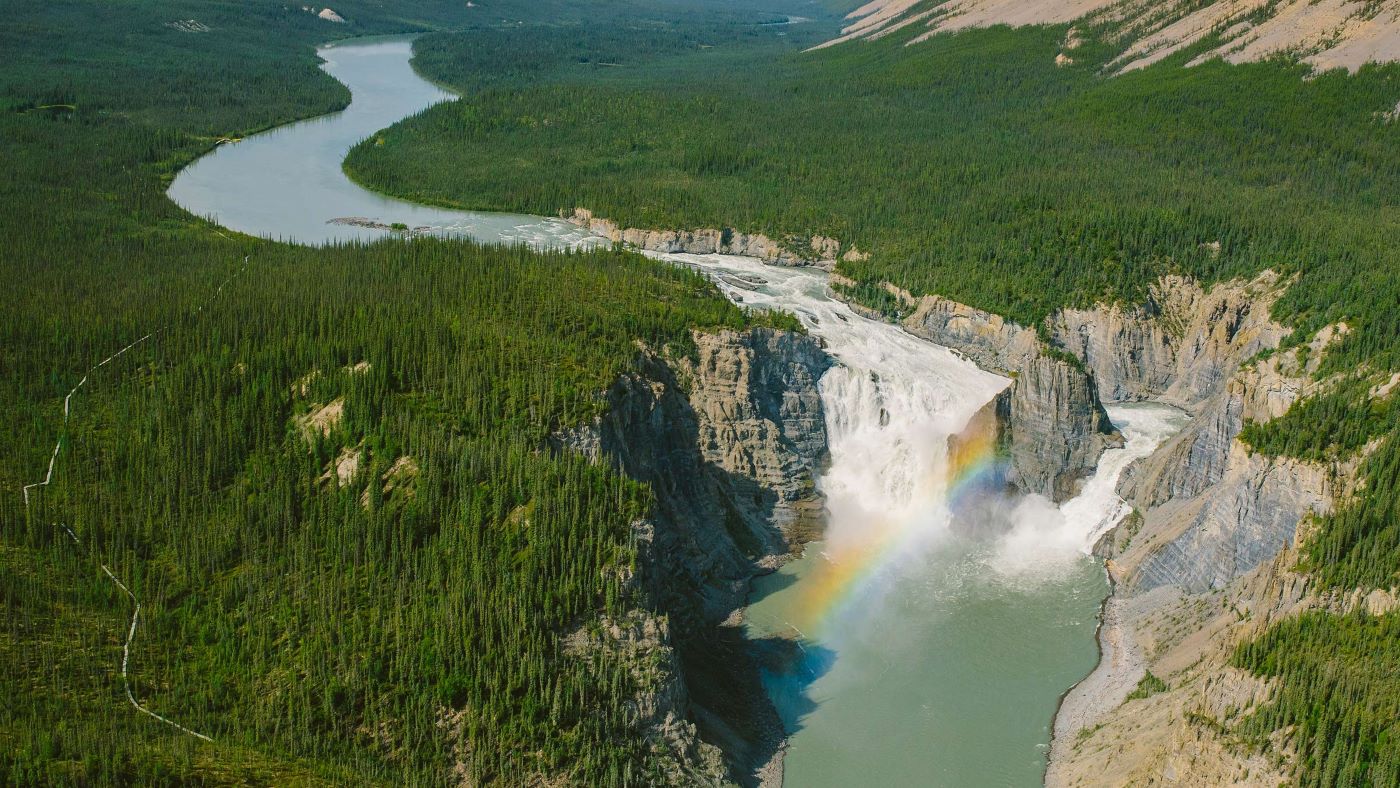
In the center of this wilderness lies the centerpiece of the park: Virginia Falls, known in the Dene language as Nailicho (the Big River Falling). It is a waterfall of monstrous proportions.
Dropping 96 meters (315 feet), Nailicho is twice the height of Niagara Falls. But unlike Niagara, which is surrounded by casinos and hotels, Virginia Falls is surrounded by nothing but primeval forest. The sensory experience is overwhelming. The ground shakes for miles around the drop. The mist rises in a perpetual cloud that nourishes a unique microclimate of orchids and rare mosses on the surrounding cliffs.
Dividing the curtain of water is a massive central spire known as Mason's Rock. The water does not just fall; it thunders. Below the falls, the river enters the "Sluice Box" rapids, a violent stretch of whitewater that churns with lethal force.
Standing at the edge of Nailicho, the stories of headless bodies and lost gold seem plausible. The raw energy of the water feels like a living thing, indifferent to human life. It is the beating heart of the park, a place of such violent majesty that it demands silence from anyone who witnesses it.
Rabbitkettle Hot Springs: Fragile Wonders in a Land of Stone
Not all the wonders of the Nahanni are violent. Upstream from the falls lies the Rabbitkettle Hot Springs, a geological anomaly that offers a stark contrast to the roaring river.
Here, warm water rich in calcium carbonate bubbles up from the earth, solidifying over thousands of years to create massive tufa mounds. The largest mound rises 30 meters high, a stark white terrace layered like a wedding cake amidst the green forest. These formations are incredibly fragile.
To protect them, Parks Canada strictly regulates access. Visitors must traverse the mounds barefoot to avoid crushing the delicate rims of the pools. Walking silently, barefoot on the warm stone, surrounded by the jagged peaks, feels like a ritual. It is one of the few places in the "Headless Valley" that feels peaceful, though it is a fragile peace. The tufa mounds are a reminder that the Nahanni is not just a place of death, but of delicate, slow creation.
The Cirque of the Unclimbables: Granite Spires for the Elite
For those who look up rather than down, the Nahanni offers the Cirque of the Unclimbables. Located in the ragged granite peaks of the Ragged Range, this cluster of spires is legendary in the mountaineering world.
The crown jewel is the Lotus Flower Tower, a sheer face of granite that rises 2,000 feet straight up. It is considered one of the fifty classic climbs of North America. The Cirque is a place of hostile beauty, where the weather can shift from sunshine to a blizzard in minutes.
The area known as the "Fairy Meadow" sits at the base of these towers, a lush green alpine bowl surrounded by teeth of grey stone. Climbers from around the world endure the complex logistics to reach this spot, drawn by the "unclimbable" nature of the rock. The names here continue the park’s dramatic theme—Mount Sir James MacBrien, the highest peak in the Mackenzie Mountains, looms nearby. In the Cirque, the danger is gravity and weather, a different kind of lethal than the mysteries of the lower valley, yet part of the same unforgiving landscape.
Guardians of Nah?a Dehé: The Dehcho First Nations Perspective
It is vital to strip away the "ghost story" lens and view this land through the eyes of its original stewards. To the Dehcho First Nations, this land is Nah?a Dehé. It is not a place of evil, but a place of immense spiritual power and resources.
The Dehcho have lived in balance with this land for millennia. Their oral histories regarding the Naha and the dangers of the mountains are not campfire spooks; they are survival guides passed down through generations. They teach respect.
Today, the park is co-managed by Parks Canada and the Dehcho First Nations. This partnership ensures that the cultural integrity of the land is preserved alongside the wilderness. When you visit, you are entering Dehcho territory. Their stewardship reminds us that the "Headless Valley" stories, while sensational, are a settler narrative imposed on a landscape that was already full of meaning. The "curse" may simply be the result of ignorance—strangers coming to a land they did not understand, seeking to take things (gold) that did not belong to them, and paying the price for their disrespect.
Predators of the North: Grizzlies, Wolves, and the Legend of the Waheela
While the headless ghosts grab the headlines, the biological reality of the Nahanni is far more dangerous. This is dense grizzly bear country. The bears here are not habituated to humans; they are wild, apex predators who view the river banks as their dining room.
Then there are the wolves. The Mackenzie Valley wolf is the largest subspecies of gray wolf in the world. They are massive, intelligent pack hunters. Their howling in the twilight adds a primal layer to the atmosphere of the valley.
Cryptozoologists have long linked the Nahanni to the legend of the Waheela—a mythical giant wolf or bear-dog hybrid said to crush the heads of its victims. Proponents of the theory suggest the Waheela is a relict population of the prehistoric Amphicyonid. While no scientific evidence exists for the Waheela, the legend likely stems from encounters with the very real, very large timber wolves of the region. Alone in the dark, a 175-pound wolf looks a lot like a monster. The decapitations of the McLeods were often blamed on these beasts by rationalists, though the clean nature of the severing leaves room for doubt.
The Ultimate Expedition: Planning a South Nahanni River Rafting Trip
For the brave soul wishing to visit Nahanni Valley, the journey is an expedition, not a vacation. The primary way to see the park is a multi-week river trip.
Most travelers join guided outfitters. These trips typically last 7 to 21 days. You will navigate Class I to Class IV whitewater. The isolation is total—there is no cell service, no roads, and no way out once you launch other than reaching the end or calling for a helicopter evacuation via satellite phone.
Preparation is key. The water is barely above freezing year-round. Hypothermia is a constant threat. You must bring everything you need and carry everything out, including human waste. It is a test of endurance. The days are long, the labor of setting up camp is heavy, and the psychological weight of the "Headless Valley" begins to settle in after a week of seeing no other humans.
Flightseeing the Nahanni: Accessing the Inaccessible by Floatplane
For those who cannot commit to three weeks on a raft, Nahanni flightseeing offers a glimpse into the abyss. Small charter airlines operate out of Fort Simpson (the "Gateway to the Nahanni") and the small community of Nahanni Butte.
Flying in a De Havilland Beaver or Twin Otter, you grasp the true scale of the terrain. The pilot will thread the needle between the canyon walls, flying below the rim. The highlight is the landing at Virginia Falls. The plane touches down on the river just above the brink, a maneuver that requires nerves of steel.
Stepping off the floatplane onto the rocky shore above the roar of the falls is a surreal experience. You are transported from civilization to the rawest nature in minutes. These day trips allow visitors to see the geography of the Lost McLeod Mine and the Deadman Valley from a safe distance, returning to a warm bed before the sun sets.
Logistics and Permits: The Cost of Entering the Unknown
Accessing the Nahanni is difficult and expensive. There are no roads into the park. You must drive to Fort Simpson (a long journey in itself) or fly in from Yellowknife.
How to get to Nahanni National Park? You essentially have to charter air transport. Whether you are rafting or flightseeing, you are paying for bush plane time, which is premium.
Furthermore, independent travelers require permits from Parks Canada. The park creates a quota system to prevent overcrowding and environmental degradation. You must register your trip, attend a mandatory orientation in Fort Simpson, and pay park fees. The "Leave No Trace" policy is strictly enforced to protect the Nah?a Dehé. The barriers to entry are high, which preserves the park’s aura of exclusivity and danger.
The Silence of the North
Why are we drawn to places like the Nahanni? Why does the story of the Headless Valley fascinate us more than a sunny beach?
Perhaps it is because the Nahanni represents one of the last true blank spots on the map of the modern psyche. In a world where every square inch is satellite-mapped and categorized, the Nahanni remains indifferent to us. It is a place where civilization has no authority.
The legends of the McLeods, the Naha, and the hidden gold serve as a reminder that the world is still wild, and that there are still places where humans are not the masters, but merely prey. To visit the Nahanni is to touch the void. It is a place of breathtaking beauty, yes, but it is a beauty that watches you back, waiting for you to make a mistake.
Sources & References
- Parks Canada - Nahanni National Park Reserve Official Site;
- Dehcho First Nations - Lands and Resources;
- UNESCO World Heritage List - Nahanni National Park;
- The Canadian Encyclopedia - The Legend of the Lost McLeod Mine;
- Northwest Territories Tourism - Nahanni National Park;
- Nahanni River Adventures (Reputable Outfitter Logs);
- NASA Earth Observatory - Nahanni National Park;
- RCMP Historical Graves Database (Contextual);
- Alpine Club of Canada - Cirque of the Unclimbables.