The Demon in the Dirt
The year was 1847. The place was the Ottoman province of Mosul, a dusty, forgotten corner of an empire in decline. Austen Henry Layard, a British adventurer with more ambition than funding, was tunneling blindly into the massive mound of earth known locally as Kuyunjik. For centuries, the local Bedouin and Ottoman officials had regarded these strange, artificial hills with suspicion. They were graveyards of ghosts, places where the wind whistled a little too loudly and the ground felt unnatural underfoot.
Layard was looking for distinct treasures to ship back to the British Museum, hoping to rival the French excavations at Khorsabad. But he found something that would terrify his workmen into dropping their shovels and fleeing in prayer. As the picks chipped away the compacted earth of two and a half millennia, a face emerged from the gloom. It was bearded, stoic, and terrifyingly human, yet it sat atop the body of a bull with the wings of an eagle.
It was a Lamassu—a colossal guardian spirit. To the local laborers, raised on the oral traditions of the Quran and the Bible, this was no mere statue. It was a djinn, a demon rising from the underworld. One chieftain reportedly rode his horse to Layard’s tent, shouting, "Hasten, O Bey, for they have found Nimrod himself!"
They had not found Nimrod, but they had found his spiritual successor. They had broken the seal on Nineveh. This discovery marked the first resurrection of the city. Layard had pulled back the shroud of dirt to reveal the capital of the Neo-Assyrian Empire, once the undisputed center of the world. But as the dirt settled, a grim historical irony began to take shape. Layard was celebrating the recovery of history in the 19th century, unaware that less than 200 years later, men with the same geographical heritage but a radically different ideology would descend upon these very stones to murder the city a second time.
The City of Blood: A Biblical Noir Profile
To understand the vertigo of Nineveh’s double death, one must first understand what it meant to be Assyrian. In the ancient Near East, Nineveh was not just a capital; it was a weapon made of mud-brick and stone. It was the heart of an empire that stretched from the Persian Gulf to the Mediterranean, maintained by a military machine of terrifying efficiency.
The Hebrew prophets did not write of Nineveh with admiration; they wrote with trembling. The Prophet Nahum called it the "City of Blood," full of lies and robbery. "The crack of the whip, and the noise of the rattling wheel, and of the prancing horses, and of the jumping chariots," Nahum wrote, painting a picture of a metropolis that thrived on kinetic violence.
This is the "Old Testament Grit" that defines the site. Unlike the philosophical academies of Athens or the legal forums of Rome, Nineveh was built on the aesthetics of domination. It was a city where the walls were plastered with the skins of flayed rebel kings, yet those same walls housed scholars who could calculate the movements of Jupiter with startling accuracy. This duality—supreme brutality and supreme sophistication—is the pulse of the city. It is a noir setting where the shadows are long, the kings are cruel, and the libraries are vast.
The Palace Without Rival: Hubris in Stone
At the center of this metropolis stood the "Palace Without Rival," the brainchild of King Sennacherib (ruled 705–681 BC). When Sennacherib moved the capital from Khorsabad to Nineveh, he did not intend to merely renovate; he intended to terraform.
The construction of the palace was a logistical nightmare that reshaped the geography of the Tigris River valley. The king’s annals boast of a building measuring roughly 500 meters long and 242 meters wide, sitting atop a raised terrace of mud brick that required the labor of thousands of prisoners of war to construct. The sensory experience of entering this palace was designed to overwhelm the visitor.
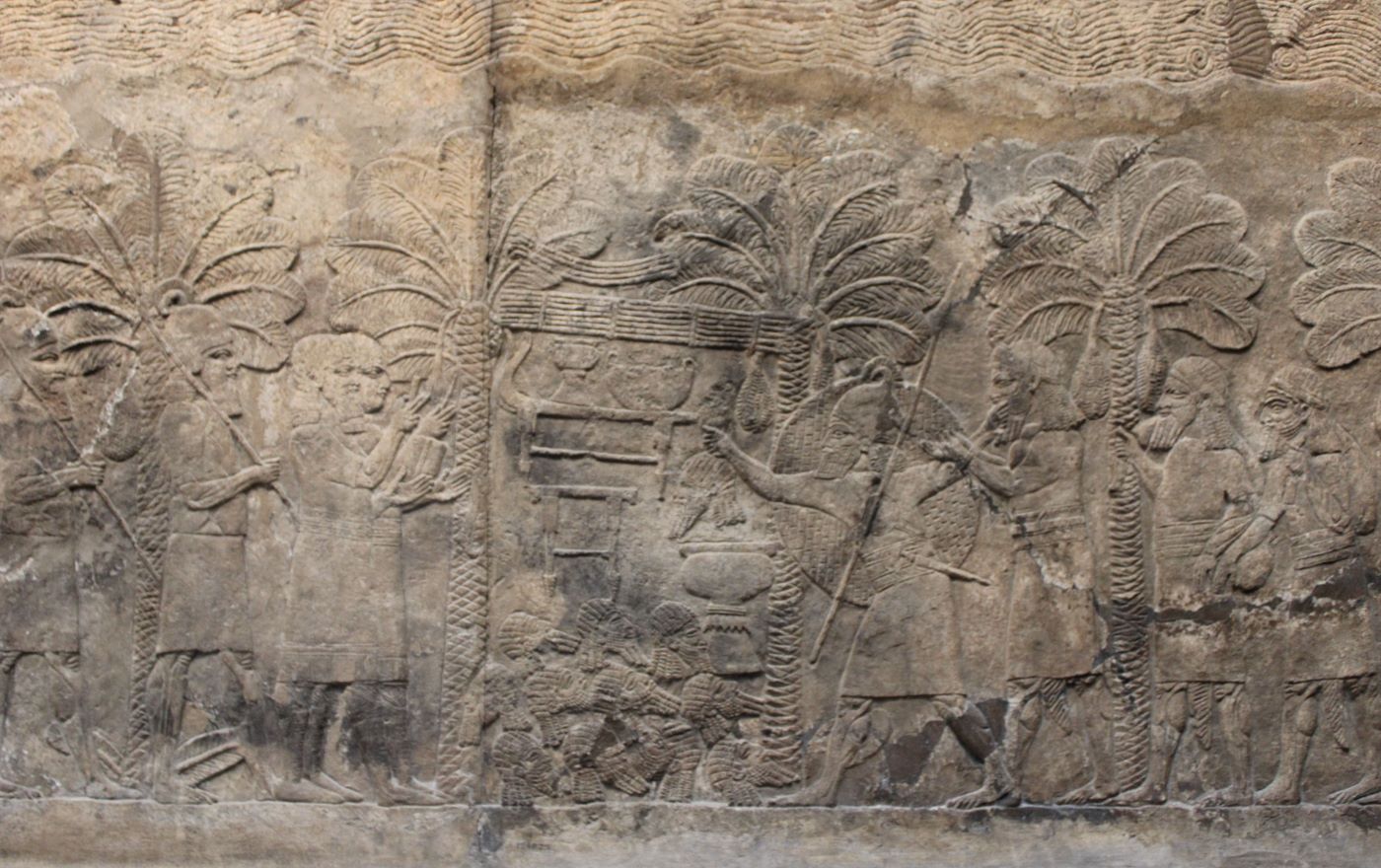
The air would have been thick with the scent of cedar. Sennacherib imported massive cedar beams from the forests of Lebanon, dragging them hundreds of miles across the desert to roof his halls. The gates were banded with copper and bronze, shining like fire in the Mesopotamian sun. But it was the walls that spoke the loudest. The palace contained nearly two miles of carved stone reliefs. These were not abstract decorations; they were political documentaries.
Walking down the corridors, a visiting diplomat would be forced to watch the Assyrian army in motion: sieges of Judean cities, the deportation of populations, and the ritual execution of enemies. The famous Lachish Reliefs, now in the British Museum, show Judean prisoners bowing before Sennacherib as their city burns behind them. It was propaganda carved in gypsum, designed to instill a singular message: Resistance is suicide.
The Propaganda of Terror: Art as Intimidation
The art of Nineveh challenges the modern viewer. It is exquisitely carved, showing a mastery of anatomy and spatial depth that would not be seen again until the Greek Classical period. Yet, the subject matter is the stuff of nightmares.
The "Lion Hunt" reliefs of Ashurbanipal are perhaps the most famous examples of Assyrian art. They depict the King slaughtering lions in an arena. The lions are rendered with heartbreaking realism—vomiting blood, dragging paralyzed legs, roaring in agony. For the Assyrians, this was not animal cruelty; it was cosmic symbolism. The lion represented chaos and the wild forces of nature. The King, by killing the lion, was imposing order upon the world.
This belief in the "imposition of order" is crucial to understanding the psychology of the city. The Assyrians believed they were mandated by the god Ashur to expand the borders of order. Thus, the flaying of a rebel king was not merely an act of sadism; it was a religious ritual to correct a chaotic element in the universe. This dangerous fusion of piety and violence would echo across the millennia, finding a strange and tragic parallel in the ideologies that would destroy the site in 2015.
The Lost Paradise: The Hanging Gardens of Nineveh?
One of history’s greatest unsolved mysteries may lie buried beneath the mounds of Nineveh. For centuries, the "Hanging Gardens of Babylon" have been listed as one of the Seven Wonders of the Ancient World. Yet, archaeologists digging in Babylon (modern-day Hillah) have found zero evidence of such a structure. The geography of Babylon, flat and near the water table, makes the hydraulic engineering required for gravity-fed gardens nearly impossible.
Dr. Stephanie Dalley of Oxford University proposed a groundbreaking theory: We have been looking in the wrong city. The Hanging Gardens were likely in Nineveh, built by Sennacherib, not Nebuchadnezzar.
The evidence is compelling. Sennacherib’s own reliefs depict lush gardens watered by aqueducts. He boasts of creating a "wonder for all peoples." More importantly, the engineering fingerprints are present. To water a terraced garden in the high mounds of Nineveh, one needs gravity. Sennacherib constructed a massive canal network stretching 50 miles into the Zagros Mountains. At Jerwan, the ruins of a massive stone aqueduct—predating Rome by centuries—still stand.
Dalley argues that Sennacherib utilized a bronze screw mechanism to raise water to the upper terraces—a technology identical to the "Archimedes Screw," appearing here 350 years before Archimedes was born. If this theory holds, Nineveh was not just a fortress of blood; it was a vertical paradise of exotic flora, a green mountain rising from the dust, fed by the mastery of Assyrian hydro-engineering.
The Scholar-King: Ashurbanipal’s Dual Soul
Sennacherib’s grandson, Ashurbanipal (ruled 668–627 BC), represents the peak of the Neo-Assyrian Empire and its most fascinating psychological case study. He was a man of profound contradictions. In his inscriptions, he boasts of his prowess in battle, describing how he "cut off the heads of his enemies like jagged stones." Yet, in the same breath, he brags about his literacy.
"I, Ashurbanipal, learned the wisdom of Nabu, the entire art of writing on clay tablets," he declared. Unlike most ancient kings who were illiterate and relied on scribes, Ashurbanipal could read Sumerian and Akkadian. He was a scholar-king, a man who collected heads and books with equal fervor. He dispatched agents across the known world not just to collect tribute, but to seize libraries. He wanted to possess every omen, every ritual, and every myth in existence.
The Cradle of Knowledge: The Library of Ashurbanipal
This hoarding of knowledge resulted in the Library of Ashurbanipal, the oldest surviving royal library in the world. Located within the North Palace, this collection contained over 30,000 clay tablets. It was here that Layard and his assistant Hormuzd Rassam found the tablets containing the Epic of Gilgamesh.
When George Smith, a curator at the British Museum, first deciphered the "Flood Tablet" (Tablet XI of the Epic) in 1872, he was so overcome with excitement that he began to undress in the office. He had found a pre-Biblical account of the Great Flood, proving that the narratives of the Old Testament were part of a much older Mesopotamian tradition.
The library contained medical texts detailing diagnoses for epilepsy, lexical lists translating Sumerian to Akkadian, and astronomical observations of Venus. It also housed the Enuma Elish, the Babylonian creation myth. It was the "Internet" of the Iron Age—a centralized repository of all human processing power.
The First Death: The Fall of Nineveh (612 BC)
The end of Nineveh was as violent as its life. By 612 BC, the empire had overextended itself. A coalition of vengeance-seeking Babylonians and Medes (from modern-day Iran) converged on the city.
The siege lasted three months. The archaeology confirms the Biblical account of the city’s demise. The prophet Nahum wrote, "The gates of the rivers are opened, and the palace is dissolved." Modern excavations suggest that the besiegers dammed the Khosr River, causing a flood that undermined the mud-brick walls of the city, creating a breach.
Once inside, the coalition unleashed a storm of fire. They did not just want to conquer Nineveh; they wanted to erase it. The palaces were torched. The intense heat caused the limestone reliefs to crack and fall. The cedar roofs collapsed, burying the floors in ash and debris. The greatest city on earth was turned into a smoking crater.
The Irony of Fire: How Destruction Preserved History
Here lies the supreme intellectual irony of Nineveh. The Medes and Babylonians intended to destroy Ashurbanipal’s legacy by setting fire to his library. But they failed to understand the medium they were destroying.
If the library had been written on papyrus (like the Library of Alexandria) or parchment, the history of Mesopotamia would have vanished in smoke in 612 BC. But the Assyrians wrote on wet clay.
When the palace burned, the library did not turn to ash; it turned to ceramic. The fire acted as a kiln, baking the tablets hard as stone. The collapse of the burning roof buried these now-indestructible tablets in a protective layer of debris. The act of destruction was, in fact, the ultimate act of preservation. The enemies of Assyria accidentally saved its literature for eternity.
The Long Interlude: A Mound in the Desert
For the next 2,500 years, Nineveh slept. The Greek historian Xenophon marched his army of mercenaries past the ruins in 401 BC. He saw the massive crumbling walls and called the place "Mespila," seemingly unaware he was standing in the shadow of Nineveh. The city had been erased so thoroughly that even the memory of its location was lost to the West, surviving only as a cautionary tale in the Bible.
It became a mound of dirt, grazing land for sheep, and eventually, the outskirts of the modern Iraqi city of Mosul. It waited for Layard to wake it up, and for the 21st century to try and kill it again.
The Second Death: ISIS and the Year Zero (2015)
The second death of Nineveh did not come with chariots and floods, but with pickup trucks and GoPros. In June 2014, the Islamic State of Iraq and Syria (ISIS/Daesh) seized control of Mosul. Their ideology was one of "Year Zero"—a fanatical belief that any history prior to their interpretation of Islam was jahiliyyah (ignorance) and shirk (idolatry) that must be purged.
In February 2015, the world watched in horror as ISIS released a video. The footage was slick, edited with the production values of a documentary, but the content was a snuff film for history.
The video showed militants entering the Mosul Museum and the Nergal Gate of Nineveh. The audio was not the roar of battle, but the high-pitched whine of angle grinders and the dull thud of sledgehammers. This was "Tragic Reportage" in real-time. The men in the video, dressed in grey tunics, toppled statues that had stood for 3,000 years. They took sledgehammers to the faces of kings.
The destruction was performative. It was designed to shock the West and signal the group's absolute rejection of the past. However, behind the camera, the hypocrisy was rampant. While they smashed the large statutes that were too heavy to move, they were quietly looting smaller artifacts—cylinder seals, pottery, coins—to sell on the black market to fund their war machine.
The Smashing of the Sentinel: The Lamassu
The most visceral image of this campaign was the destruction of the Lamassu at the Nergal Gate. This was the same gate Layard had excavated. This winged bull had survived the fire of the Medes in 612 BC. It had survived the elements for centuries.
In the video, a militant attacks the face of the bull with a pneumatic drill. The stone dust flies into the air, clouding the lens. There is a profound sense of "historical vertigo" in this scene: a 21st-century power tool, manufactured in a modern factory, being used to erase the craftsmanship of an artisan who died 2,700 years ago. The drill sheared off the face of the guardian, leaving a scar of raw, white limestone. It was a brutal reminder that stone is resilient against time, but fragile against ideology.
The Scars of Mosul: Post-Liberation Reality
Mosul was liberated in July 2017 after a grueling nine-month battle that left much of the modern city in ruins. When archaeologists finally returned to the site of Nineveh, the scale of the damage became clear.
The Nebi Yunus shrine (the Tomb of Jonah), which sits atop one of Nineveh's two main mounds, had been blown up by ISIS. However, in a strange twist of fate, the destruction revealed a secret. ISIS had dug tunnels deep into the mound beneath the destroyed shrine to loot artifacts.
These tunnels, grim and claustrophobic, inadvertently revealed the lost palace of King Esarhaddon, which had remained untouched by previous excavators. In their greed, the destroyers had acted as unintended archaeologists, exposing winged bulls and inscriptions that had never been seen before. The tunnels remain there today, shored up by wood, a literal underworld where the crimes of the present intersect with the glories of the past.
Urban Encroachment: The Living City vs. The Dead City
The threat to Nineveh did not end with the defeat of ISIS. The site faces a more mundane but equally destructive enemy: urban sprawl. Nineveh is not an isolated ruin in the desert; it is surrounded by the bustling metropolis of Mosul.
As the city rebuilds, the pressure for housing is immense. Modern concrete houses are creeping onto the archaeological mounds. Roads are being paved over ancient walls. The ancient city walls, which run for 12 kilometers, are now often used as backstops for garbage dumps or grazing land for livestock. The "City of Blood" is being slowly swallowed by the City of the Living.
The Ethics of Reconstruction: To Rebuild or Remember?
Now, the international community faces a difficult question: How do you fix a murdered city?
Organizations like the ALIPH Foundation and UNESCO’s "Revive the Spirit of Mosul" initiative are pouring millions into the region. But the debate over restoration is fierce. Should the smashed Lamassu be pieced back together using the original fragments, like a giant jigsaw puzzle? Or should they be replaced with pristine replicas created through 3D printing, such as the "Rakoto" project?
Some argue that the damage itself is now part of the history. Leaving the scars visible serves as a testament to the brutality of ISIS and the resilience of the culture they tried to erase. A pristine replica might erase the memory of the tragedy. The current consensus leans toward a hybrid approach—stabilizing what remains and using technology to fill the gaps, ensuring the scars remain visible but not fatal.
Digital Immortality: The Cyber-Library
While the stone is fragile, the knowledge is now secure. The British Museum’s "Ashurbanipal Library Project" has digitized the clay tablets. High-definition images and translations are available to anyone with an internet connection.
This is the final victory of Ashurbanipal. His library has transitioned from clay to silicon. It has migrated from the physical shelves of Nineveh, which can be burned or smashed, to the cloud, which is ethereal and ubiquitous. The "Internet of the Iron Age" has been uploaded to the Internet of the Digital Age.
Visiting Nineveh: Logistics and Reality
For the intrepid traveler, visiting Nineveh today is possible, but it requires navigation of a complex geopolitical landscape. Mosul is under the control of the Federal Government of Iraq, distinct from the semi-autonomous Kurdistan region nearby.
- Visas: A Federal Iraq visa is required (distinct from the Kurdish visa on arrival).
- Security: While safety has improved dramatically, the situation remains fluid. Checkpoints are frequent. Hiring a local fixer or guide is not just recommended; it is often necessary to navigate the military bureaucracy.
- The Experience: Do not expect a sanitized tourist park. There are no gift shops. You will be walking through a landscape that is part archaeological site, part crime scene. You will see the stub of the Nergal Gate, the wire mesh protecting the reliefs, and the sprawling mounds rising from the chaotic traffic of Mosul. It is a raw, unvarnished encounter with history.
Conclusion: The Resilience of Stone
Nineveh is a testament to the resilience of stone and the fragility of those who try to destroy it. Sennacherib built a palace to intimidate the world, believing his terror would last forever. He turned to dust; his palace fell. ISIS tried to erase the memory of that past, believing their caliphate would restart history. They were driven out; their flag fell.
The ruins of Nineveh remain. They are battered, broken, and scarred, but they are still there. The clay tablets of Ashurbanipal, baked by the fires of the first death, sit safely in museums, their stories deciphered and read by millions.
The destroyers always fail because they misunderstand the nature of history. You can smash a statue, you can burn a roof, and you can drill through the face of a stone bull. But once a story is told, it cannot be untold. Nineveh, the City of Blood, the City of Books, has died twice. And yet, it lives.
Sources & References
- The British Museum. "What was Ashurbanipal’s Library?" britishmuseum.org
- The British Museum. "I am Ashurbanipal: king of the world, king of Assyria" (Exhibition Video). youtube.com
- UNESCO. "Revive the Spirit of Mosul" unesco.org
- National Geographic. "On ISIS Destruction: Human History Is Permanent" youtube.com
- The Guardian. "ISIS fighters destroy ancient artefacts in Mosul museum" theguardian.com
- ALIPH Foundation. Projects: Mosul Cultural Heritage aliph-foundation.org
- World Monuments Fund. "Nineveh" wmf.org
- BBC News. "Return to Mosul" youtube.com
- Iraq Museum. "Recovery of the Nimrud and Nineveh Artifacts" theiraqmuseum.com
- Layard, Austen Henry. Nineveh and Its Remains. John Murray, 1849.
- Dalley, Stephanie. The Mystery of the Hanging Garden of Babylon: An Elusive World Wonder Traced. Oxford University Press, 2013.
- Reade, Julian. Assyrian Sculpture. British Museum Press.