The Horizon of Eternity
To stand on the Saqqara plateau at dawn is to witness the boundary between life and death carved into the earth. To the east, the Nile Valley is a ribbon of aggressive, verdant green—the land of the living, humid and teeming with the noise of the waking delta. To the west, the world ends. It terminates abruptly at a ridge of yellow limestone that rises sharply from the cultivation, giving way to an endless ocean of sand and wind.
This ridge is the Saqqara Necropolis. As the sun bleeds over the horizon, the silhouette of the Step Pyramid of Djoser emerges from the mist like a man-made mountain, its jagged tiers mimicking the primordial mound of creation. The silence here is heavy. Unlike the chaotic carnival atmosphere of the Giza Plateau, Saqqara feels ancient in a way that is almost oppressive. The wind whips across the open desert, carrying the grit of millennia. Underneath your feet, the ground is honeycombed with shafts, tunnels, and burial chambers—a subterranean city more vast and complex than the ruins visible on the surface. It is a landscape where millions of souls have been laid to rest over three thousand years, a sprawling archive of human mortality etched in stone.
The Geography of the West
In ancient Egyptian mythology, the "West" was synonymous with death. The sun died in the west every evening, descending into the underworld, and so the dead were buried on the western bank of the Nile to accompany the solar god, Ra, on his nocturnal journey. Saqqara is the ultimate manifestation of this sacred geography.
Geologically, it is a limestone promontory roughly 40 meters above the valley floor, offering a natural platform that stays dry above the annual floodwaters. This elevation was practical as well as symbolic; it ensured the preservation of the bodies buried within. The necropolis is immense, stretching over seven kilometers long and nearly two kilometers wide. It is not a single site but a continuous chain of cemeteries connecting Abusir in the north to Dahshur in the south. Walking its length, one traverses the entire timeline of Pharaonic civilization, from the archaic mudbrick tombs of the First Dynasty to the sprawling animal catacombs of the Ptolemies. It is the largest archaeological site in Egypt, and despite centuries of excavation, Egyptologists estimate that nearly 70% of it remains buried under the shifting sands.
Memphis: The City of the Living
To understand the silence of Saqqara, one must remember the noise of Memphis. Founded around 3100 BCE by King Menes, Memphis (originally Inbu-Hedj, "The White Walls") was the first capital of a unified Egypt. It was a bustling metropolis of mudbrick palaces, workshops, and markets, located in the valley just below the Saqqara plateau.
Saqqara was its shadow. For the citizens of Memphis, the necropolis was a constant visual presence on the western horizon—a reminder of where they would eventually reside. While the city of the living was built from ephemeral mudbrick, destined to dissolve back into the silt of the Nile, the city of the dead was built for eternity. Today, Memphis is largely gone—a few scattered statues in an open-air museum and mounds of earth under modern villages. But Saqqara remains. The stone endured where the mud did not, creating a historical paradox where we know the ancient Egyptians better by how they died than by how they lived.
The Stone Dream: Imhotep’s Revolution
In the 27th century BCE, during the Third Dynasty, a revolution occurred on the Saqqara plateau that would change the course of human architecture. Until this point, kings were buried in mastabas—flat-roofed, rectangular bench-like structures made of mudbrick. King Djoser, wishing to immortalize his reign, turned to his chancellor and high priest, Imhotep.
Imhotep envisioned something unprecedented: a tomb built entirely of stone, rising toward the heavens. He began with a traditional stone mastaba, but then he made a leap of genius. He enlarged the base and stacked five smaller mastabas on top of the first, creating a six-tiered staircase rising 62 meters into the sky.
This was the Step Pyramid. It was the first monumental stone structure in the history of the world. It required a complete reinvention of labor and engineering. Stone blocks had to be quarried, transported, and dressed with copper chisels. The result was a "resurrection machine," a literal stairway for the king’s soul to ascend and join the imperishable stars. Imhotep was so revered for this feat that he was later deified as a god of wisdom and medicine, the only non-royal Egyptian to achieve such status.
Inside the Step Pyramid Complex
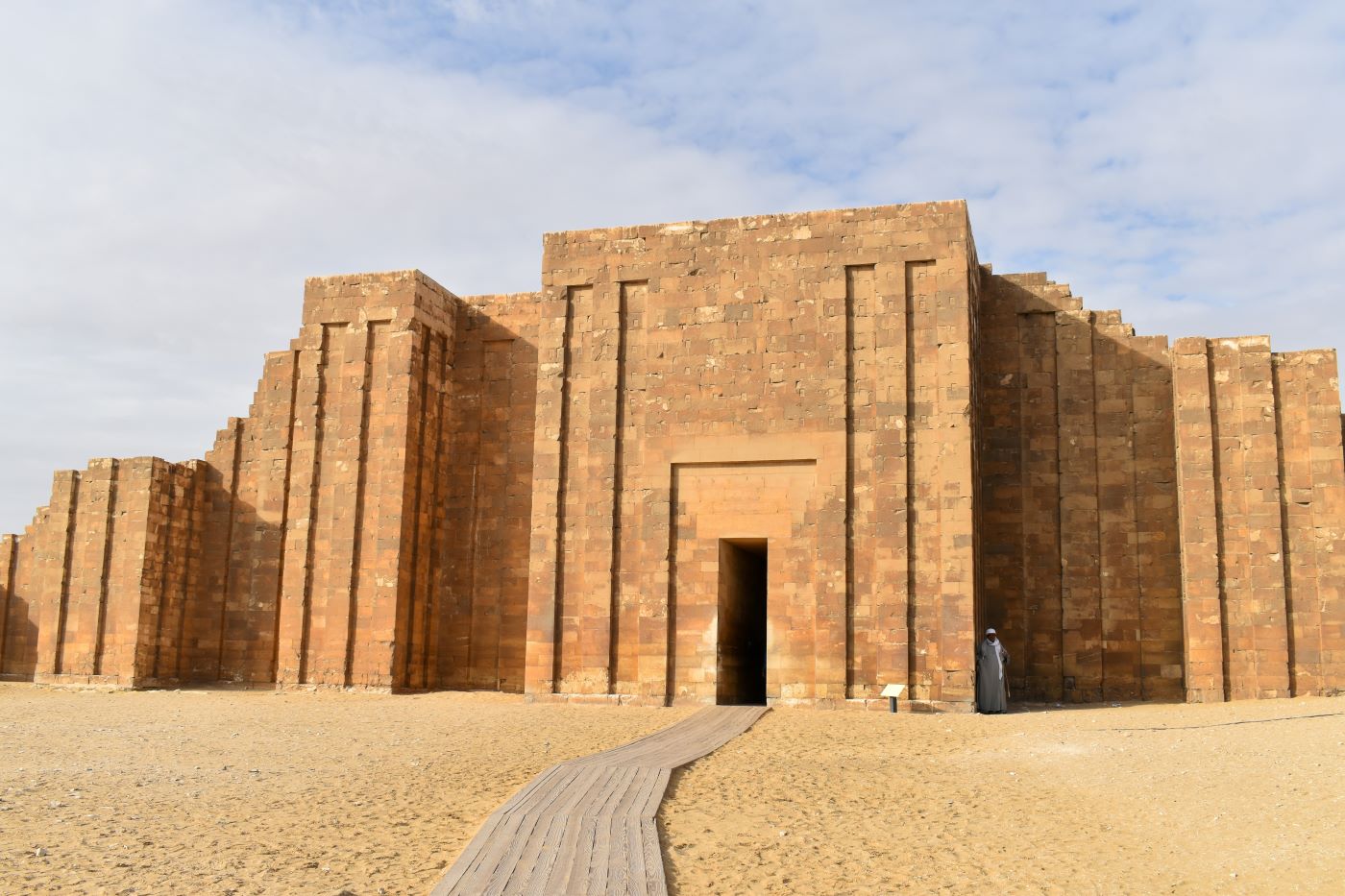
The Step Pyramid does not stand alone. It is the center of a vast rectangular complex enclosed by a limestone wall that originally stood 10 meters high, mimicking the "White Walls" of the palace in Memphis. Entering through the only functioning gateway, one passes into a colonnaded corridor—the first hypostyle hall in history. The columns here are engaged (attached to the walls), shaped to resemble bundles of papyrus stems, preserving in stone the organic forms of earlier wood and reed architecture.
Beyond the colonnade lies the Great South Court and the Heb-Sed court, lined with "dummy" chapels. These structures are facades; they have no interiors, filled only with rubble. They served a magical purpose, providing a backdrop for the King’s Heb-Sed festival (Jubilee) in the afterlife. Here, the spirit of the king would eternally perform the ritual race to prove his vitality and renew his right to rule. The complex was a stage set for a performance that would last forever, frozen in limestone.
The Labyrinth Beneath
While the pyramid reaches for the sky, the true marvel of Djoser’s tomb lies underground. Beneath the Step Pyramid is a veritable labyrinth—a network of 5.7 kilometers of shafts, tunnels, magazines, and galleries carved directly into the living bedrock. This substructure is far more complex than the interiors of the later Giza pyramids.
The central burial shaft is a terrifying drop, 28 meters deep and 7 meters wide, at the bottom of which lay a granite vault plugged with a 3.5-ton stone stopper. Surrounding this are galleries meant for the royal family and vast storage magazines for grave goods.
In the "Blue Faience Rooms," the walls were tiled with thousands of turquoise-glazed ceramic rectangles, arranged to mimic the reed-mat wall hangings of the king’s earthly palace. Even in the crushing dark of the underworld, the king wanted the familiar comforts of home. These chambers, recently stabilized and opened to the public, offer a glimpse into the sophisticated interior design of the 27th century BCE—a blue-green shimmering dreamscape buried in the dark.
The Speaking Stone: Unas and the Pyramid Texts
Fast forward to the end of the 5th Dynasty, and the priorities of the Old Kingdom changed. Just south of the Step Pyramid stands the Pyramid of Unas. From the outside, it looks like a pile of rubble, a collapsed hill of loose blocks. But this decay hides one of the most important discoveries in Egyptology.
When French archaeologist Gaston Maspero entered this pyramid in 1881, he found the walls of the burial chamber covered in columns of blue-pigmented hieroglyphs. These were the Pyramid Texts—the oldest religious texts in the world. Unlike the silent pyramids of Giza or Djoser, Unas’s tomb was a machine made of words.
The texts are a collection of spells, incantations, and hymns designed to protect the king’s remains, ward off snakes and scorpions, and help his soul ascend to the sky. "Unas has not died the death; Unas has become a spirit," one line proclaims. The discovery marked a shift in our understanding of Egyptian religion; it showed that by the late Old Kingdom, the power of stone was no longer enough—the king needed the magic of the written word to guarantee survival.
Mansions of Eternity: The Noble Tombs
Saqqara was not reserved for royalty. Surrounding the pyramids are streets of tombs belonging to the elite—the viziers, priests, and high officials who ran the country. These mastabas are architectural marvels in their own right, functioning as "mansions of eternity."
The tombs of Ty, Mereruka, and Kagemni are famous not for their size, but for their art. The walls are covered in exquisitely carved and painted reliefs depicting scenes of daily life. We see peasants force-feeding geese, butchers slaughtering oxen, boatmen jousting in the marshes, and scribes tallying taxes.
These images were not merely decorative. In the Egyptian belief system, representations could become real through magic. If the food offerings stopped, the scenes on the walls would come to life to sustain the deceased’s Ka (life force). Walking through the Mastaba of Mereruka (which has 33 rooms), one is struck by the vibrancy of life 4,300 years ago—a celebration of abundance in the face of death.
The Vault of the Giants: The Serapeum
To the northwest of Djoser’s complex lies the Serapeum, a site that feels fundamentally different from the rest of the necropolis. It is dark, industrial, and oppressive. Rediscovered by Auguste Mariette in 1850, this is the burial place of the Apis Bulls—living incarnations of the creator god Ptah.
Descending into the Serapeum is like entering a bomb shelter. A long, hot corridor carved from the bedrock runs for hundreds of meters. Lining this corridor are massive alcoves, each containing a gigantic granite sarcophagus. These coffers are staggering in scale—each weighs between 60 and 80 tons, with lids weighing up to 30 tons. They were quarried in Aswan (800km away) and maneuvered into these tight, subterranean spaces with a precision that still baffles engineers. The surfaces of the granite are polished to a mirror finish. The atmosphere here is heavy with the mystery of the "cult of the beast," a testament to the sheer fanaticism of Late Period religious devotion.
A Menagerie of Mummies
Saqqara was also the center of popular pilgrimage. In the Late Period (747–332 BCE), the site exploded with animal cults. Millions of pilgrims flocked here to buy mummified animals to offer to the gods as votive prayers.
Excavations have uncovered catacombs filled with literally millions of mummified creatures. There are galleries for ibises (sacred to Thoth), falcons (Horus), baboons, cats (Bastet), and even dogs (Anubis). The "Sacred Animal Necropolis" was a massive industry, complete with breeding farms, slaughterhouses, and mummification workshops. It reveals a side of ancient religion that was transactional and mass-produced, where buying a mummified hawk was the ancient equivalent of lighting a candle in a cathedral.
The Endless Dig: Excavation History
Saqqara has been the playground of archaeologists for two centuries. The early days were marked by the rough methods of adventurers like Auguste Mariette, who used dynamite to blast open the sealed entrance of the Serapeum. He camped in the desert for years, unearthing the Sphinx avenue that led to the galleries.
Later came the era of Jean-Philippe Lauer, the French architect who arrived in 1926 and spent the next 75 years—until his death in 2001—studying and restoring the Step Pyramid complex. He is the genius loci of Saqqara; almost every standing stone in Djoser’s complex was reassembled by his hands from the piles of rubble. Today, the work has shifted from reconstruction to high-tech scanning and careful stratigraphic excavation, but the sense of discovery remains constant.
The New Frontier: Recent Discoveries
Contrary to popular belief, the Age of Discovery in Egypt is not over; it is currently peaking in Saqqara. Since 2018, the site has yielded a relentless stream of "mega-discoveries." In the Bubasteion area, Egyptian missions have found hundreds of intact, sealed coffins from the Late Period, stacked to the ceiling in previously unknown shafts.
In 2018, the tomb of the priest Wahtye was discovered, untouched and filled with colorful statues. In 2020, archaeologists found a mummification workshop complete with cups of oil labeled with instructions for the embalming process. These finds are rewriting our understanding of the 26th Dynasty and the economics of death. Every time a shovel hits the sand in Saqqara, history is liable to change.
Saqqara Today: The Atmosphere
For the modern dark tourist, Saqqara offers a profoundly different experience than Giza. Giza is surrounded by the city of Cairo; the Pizza Hut overlooks the Sphinx. Saqqara, by contrast, retains its desert isolation.
The atmosphere is one of exposure. The sun beats down on the white limestone, reflecting a blinding glare. The wind is constant, whipping sand around the corners of the monuments. It feels desolate and abandoned. There are fewer aggressive touts here; the sheer size of the site dilutes the crowds. You can often find yourself entirely alone in a tomb or walking a stretch of desert wall, accompanied only by the silence and the distant view of the Bent Pyramid of Dahshur on the horizon. It is a place that demands contemplation.
What to See I: The Royals
A visit to Saqqara must begin with the Step Pyramid of Djoser. Thanks to recent restorations, visitors can now enter the pyramid. A new walkway takes you down the southern passage to view the massive central burial shaft from deep underground—a dizzying and claustrophobic perspective on Imhotep’s engineering.
Next is the Pyramid of Unas. While the entry is cramped, the burial chamber is essential viewing for the illuminated Pyramid Texts. The hieroglyphs glow in the artificial light, chanting their silent spells. Nearby, the Pyramid of Teti (6th Dynasty) appears as a pile of rubble, but the substructure is accessible and features texts and a basalt sarcophagus, often with fewer crowds than Unas.
What to See II: The Nobles and the Bulls
Do not skip the private tombs. The Mastaba of Mereruka, located near Teti’s pyramid, is a labyrinth of 33 chambers. The statue of Mereruka emerging from a false door is one of the most imposing figures in Egyptian art. The Tomb of Ti and the Tomb of Kagemni offer the finest relief carvings, detailed enough to identify species of fish and birds.
Finally, the Serapeum requires a separate ticket but is non-negotiable for the serious traveler. Walking the long, dim corridors past the megalithic sarcophagi creates a sense of dread and awe that no other site in Egypt can replicate. It is an architectural anomaly that feels almost alien in its precision.
Logistics of the Necropolis
Visiting Saqqara requires planning. It is located about 30 kilometers south of Cairo. There is no reliable public transport; you must hire a driver or take a taxi/Uber for the day. The driver should wait for you, as finding a return ride from the desert edge is difficult.
The site is enormous. Walking from the ticket gate to the Step Pyramid is manageable, but reaching the Serapeum or the southern tombs on foot in the summer heat is dangerous and exhausting. Bring water, a hat, and sturdy shoes—the ground is uneven sand and rock. Tickets are tiered: a general entry covers the plateau and the Imhotep Museum (currently renovating), while the interior of the Step Pyramid, the Serapeum, and the Noble Tombs often require extra tickets.
Treading on Bones: Ethical Tourism
Saqqara is an active cemetery. While the bodies have been removed from the open tombs, the ground is literally stuffed with human remains. It is imperative to treat the site with solemnity. Do not climb on the monuments or the rubble piles—ancient mudbrick is fragile and crumbles easily underfoot.
Inside the tombs, flash photography is strictly forbidden and often enforced by cameras or guards. The intense light damages the ancient pigments. Touching the walls is a crime against heritage; the oils from fingertips degrade the limestone. Tipping the local ghafirs (guards) who unlock the tombs is customary (and expected), as they are the low-paid custodians of this history. Their keys open the doors to the past; treat them with respect.
Conclusion: The Layered Cake of History
Saqqara is more than a tourist site; it is a chronometer of Egyptian civilization. It captures the initial spark of genius with Djoser, the artistic zenith of the Old Kingdom with the noble mastabas, the religious evolution of the Pyramid Texts, and the twilight cults of the animal mummies.
To visit Saqqara is to walk through the "layered cake" of history. It is a place where the ambition of the human spirit to conquer death is laid bare in stone. As the sun sets over the Western Desert, casting long shadows from the Step Pyramid, one realizes that Imhotep succeeded. The city of Memphis has dissolved into dust, its palaces forgotten. But the City of the Dead remains, standing defiant against the wind, a stone dream that refused to wake up.
Sources & References
- Ministry of Tourism and Antiquities (Egypt). "Saqqara Archaeological Site." (Official visitor information and news). Ministry Link.
- American Research Center in Egypt (ARCE). "Conservation of the Step Pyramid." (Details on restoration projects). ARCE Link.
- Lauer, Jean-Philippe. (1976). Saqqara: The Royal Cemetery of Memphis. Thames & Hudson. (The seminal text by the site’s primary architect).
- Lehner, Mark. (2008). The Complete Pyramids. Thames & Hudson. (The definitive guide to pyramid construction).
- UNESCO World Heritage Centre. "Memphis and its Necropolis – the Pyramid Fields from Giza to Dahshur." UNESCO Link.
- Ikram, Salima. (2005). Divine Creatures: Animal Mummies in Ancient Egypt. American University in Cairo Press. (Academic source on the animal necropolis).
- Dodson, Aidan. (2003). The Pyramids of Ancient Egypt. New Holland Publishers.
- Verner, Miroslav. (2001). The Pyramids: The Mystery, Culture, and Science of Egypt's Great Monuments. Grove Press.
- Current World Archaeology. "Saqqara: The Bubasteion Cache." (Report on 2020 discoveries). CWA Link.
- The Saqqara Geophysical Survey Project. (Scottish mission reports on subsurface mapping). Project Link.
- Kanawati, Naguib. (2003). Conspiracies in the Egyptian Palace: Unis to Pepy I. Routledge. (Context on the Old Kingdom collapse seen at Saqqara).
- Wilkinson, Richard H. (2000). The Complete Temples of Ancient Egypt. Thames & Hudson.
- Smithsonian Magazine. (2020). "Hundreds of Sarcophagi and Statues of Egyptian Gods Found in Saqqara." Smithsonian Article.
- Egyptian Exploration Society. "The Saqqara Epigraphic Survey." EES Link.
- Hawass, Zahi. (2002). Treasure of the Pyramids. White Star.