The Founding of Auroville: A City for Human Unity
The soil arrived from all over the world, carried by hand.
On February 28, 1968, on a hot, eroded plateau near the town of Puducherry on India's southeast coast, several thousand people gathered around a lotus-shaped urn of white marble. One by one, young people stepping forward on behalf of 124 nations and every state of India emptied handfuls of earth from their home countries into it — a fistful of ground from each corner of a divided planet, mixed together in a single vessel. Over the loudspeakers came the voice of a 90-year-old French woman known to everyone present simply as the Mother, reading out a four-point charter in several languages. The charter declared that the city taking shape on this ground would belong to no one in particular and to all of humanity at once.
There was no city. There was barely a tree. The plateau was a red laterite wasteland, stripped of forest and topsoil by generations of overgrazing, baking under the sun. What existed on February 28, 1968, was an idea and an urn full of dirt.
The idea was that a divided species could be repaired by building the right place. Nations, money, and religion had failed humanity; a city engineered from scratch — with no private property, no government in the ordinary sense, and a shared spiritual aspiration at its core — might succeed where they had not. This is a story about that experiment, and about what happens when a utopia designed to dissolve every form of division survives long enough to be torn apart by one.
The Vision Behind Auroville: The Mother and Sri Aurobindo
Who Was the Mother, Auroville's Founder
Mirra Alfassa was born in Paris in 1878 to a Sephardic Jewish family of Turkish and Egyptian origin. She trained as a painter and musician, moved in the city's artistic circles, and spent time in Algeria studying occultism before a series of inner visions sent her looking for a teacher she had seen only in dreams. She found him in 1914 in Pondicherry, then a French colonial enclave in India: the exiled Bengali revolutionary and yogi Sri Aurobindo, who had abandoned the independence struggle for a life of spiritual practice. Alfassa recognized him as the figure from her visions and never left.
Sri Aurobindo taught that human beings were an unfinished species, an intermediate step in evolution destined to be surpassed by a higher form of consciousness. Alfassa organized his followers into an ashram, took over its daily running, and after his death in 1950 became its undisputed leader. Auroville was her final and largest project — an attempt to test that philosophy not on individuals in a monastery but on an entire city. She died in 1973, five years after the urn ceremony, having never once set foot on the site she founded.
The Auroville Charter and the Dream of Human Unity
The charter Alfassa wrote for Auroville reads less like a municipal document than a religious manifesto. It states that the town belongs to humanity as a whole rather than to any owner, that it exists for unending education and constant progress, that it is a bridge between past and future, and that it is a site of research toward a living human unity. The name itself carries the intention: Auroville, the City of Dawn, a place built to face only the future.
The plan set a target population of 50,000 people drawn from every nation on Earth, living without money in the conventional sense, governed by no single authority. More than half a century on, the town has never held more than a fraction of that number. The gap between the 50,000 imagined and the 3,000 who actually came is not a footnote to the Auroville story. It is the fault line that everything else eventually broke along.
Building Auroville: The Galaxy City in the Red Desert
Roger Anger's Galaxy Plan and the Four Zones
The physical form of Auroville was designed by the French architect Roger Anger as a spiral galaxy pressed onto the earth. Roads and residential clusters were to sweep outward from the center in curving arms, organized into four zones — Industrial, Cultural, Residential, and International — and ringed by a protective Green Belt of forest and farmland. At the dead center sat the spiritual core, and everything else orbited it. The design was beautiful on paper and almost entirely unbuilt for decades, which is a large part of why the fight over it eventually turned violent.
How Auroville Reforested a Barren Plateau
The first Aurovilians arrived to find nothing.
They came in the late 1960s and 1970s — young Western idealists and Indian seekers alike — and lived in mud huts and thatched shelters on a plateau so eroded that the monsoon rains ran straight off it in red rivers, carrying what little soil remained down to the sea. Their first task was not to build a city. It was to make the land survive. They dug bunds and check dams to trap the rain, and they planted trees. Then they planted more. Over three decades the settlers put an estimated two to three million trees into the ground, transforming a dying wasteland into one of the largest man-made forests in South India, complete with organic farms that eventually grew a substantial share of the community's own food.
The work was physical and unglamorous in a way the charter's soaring language never hinted at. Settlers hauled water by hand to keep saplings alive through the dry months, lost whole plantings to drought and cyclone, and learned which hardy species could hold the soil long enough for the rest to follow. Cashew and casuarina went in first as pioneers, and slower native trees came behind them once there was shade and moisture to survive in.
The people who did this are still there, or their children are. They spent forty years watching seedlings become a canopy, and many of them came to see the forest not as a temporary stage before the city arrived but as Auroville's real achievement — the thing they had actually made. That conviction, grown one tree at a time, would later put ordinary residents in front of bulldozers.
The Matrimandir: The Golden Sphere at the Heart of Auroville
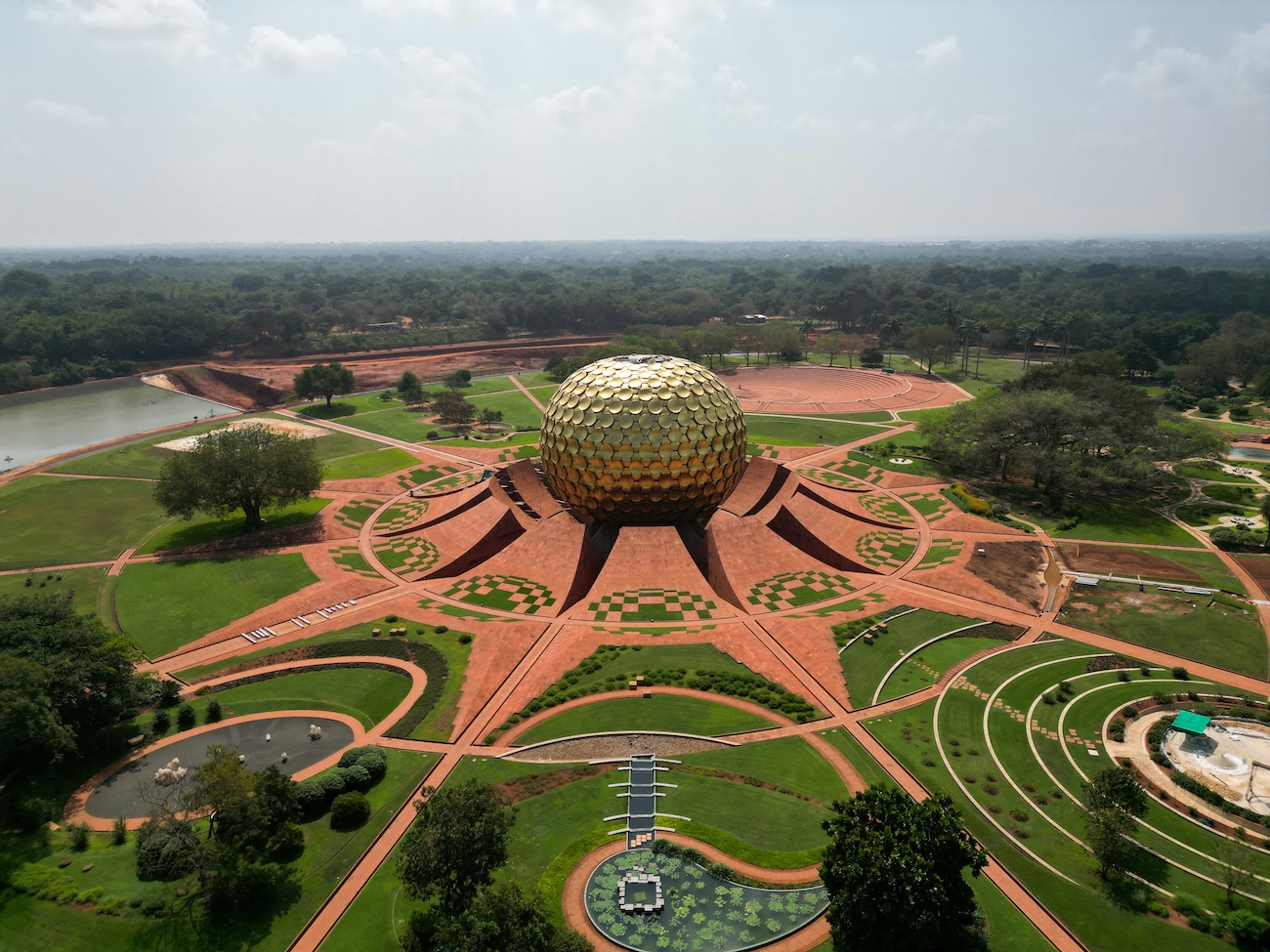
At the exact center of the galaxy sits the Matrimandir, a giant flattened sphere sheathed in gold discs, rising out of a landscaped bowl of twelve gardens. The Mother called it the soul of the city. Its foundation stone was laid on her birthday, February 21, 1971, and it was not finished until 2008 — thirty-seven years of construction, most of it slow, underfunded, and done by hand.
Inside is a chamber unlike anything else built in the twentieth century: a circular white marble room, silent, climate-controlled, entered without shoes or speech. At its center rests a perfectly polished crystal glass globe, one of the largest optical crystals ever made, onto which a computer-guided mirror on the roof directs a single unbroken beam of sunlight from dawn to dusk. There are no idols, no altar, no priest, and no prayer. People enter, sit, and concentrate in silence. The building was designed to hold no religion at all — a temple to the act of aspiration itself, at the center of a city built for a species that was supposed to be evolving into something better.
The Fight for Control of Auroville After the Mother's Death
The Mother died in 1973, and the experiment nearly died with her.
Control of Auroville's land and money had rested with the Sri Aurobindo Society, the organization that had raised the funds to buy the plateau. Within a few years of the Mother's death, the residents and the Society were at open war, with Aurovilians accusing the Society of financial misconduct and of trying to run the town as its private fief. The dispute grew so bitter that it reached the Indian courts and then Parliament. The Government of India stepped in with the Auroville (Emergency Provisions) Act of 1980 to take temporary control, and then made the arrangement permanent with the Auroville Foundation Act of 1988.
That Act built the machinery that governs Auroville today, and it built the machinery of the current crisis. It created a Foundation with three parts: a Governing Board appointed by the national government, a Residents' Assembly made up of the Aurovilians themselves, and an International Advisory Council. The law handed the residents real powers — over who could join the community, and over the town's own development plan — while placing a government-appointed board above them. For decades the balance held, because for decades the Governing Board mostly left Auroville alone. That ended in 2021.
Auroville in Crisis: The Bulldozers and the Master Plan
The 2021 Crown Road Demolitions
The bulldozers came at night in December 2021.
A new Governing Board and a new Secretary, the senior civil servant Jayanti Ravi, had taken charge with a mandate to finally build the city on paper — starting with the "Crown," a ring road at the core of Anger's galaxy plan that had never been constructed. Its route ran directly through a wooded youth community and a stretch of the forest the residents had spent fifty years growing. When the machines arrived to clear it, Aurovilians rushed out and stood in front of them in the dark, some of them the same people who had planted the trees now being knocked down. The clearing went ahead anyway. Images of residents weeping beside felled trees and blocking bulldozers ran in The Hindu, on NDTV, and across Indian media, and the case ricocheted between the National Green Tribunal and the Supreme Court, which ultimately allowed the development to proceed under conditions.
Forest Versus City: The Battle Over Auroville's Future
The demolitions detonated a conflict that had been latent in Auroville since its founding, and both sides of it are worth stating plainly, because both are real.
The Foundation's case rests on the law and the numbers. Auroville was chartered as a city of 50,000, and its master plan was formally gazetted by the Indian government in 2010. After more than fifty years, the town had built almost none of that city and attracted only around 3,000 people. From the government's chair, decades of consensus-based, non-hierarchical self-governance had produced a beautiful forest and near-total paralysis on the actual project — a settlement that had quietly redefined itself as an eco-village while the legally mandated city went unbuilt. The Governing Board holds statutory authority, the argument goes, and it is finally exercising it to realize the Mother's stated vision rather than the one the residents drifted into.
The residents' case rests on the founding spirit and the forest. In their account, the intervention since 2021 has been an authoritarian takeover that bulldozes trees, bypasses the participatory governance the 1988 Act guarantees, and treats a spiritual community as a construction site. The Foundation has taken over admissions and expulsions that the law assigns to the residents, dissolved elected community committees, and pushed through land exchanges that residents say erode the Green Belt. In December 2025 it leased most of the community's flagship organic farm, Annapurna, to a technical institute for a vehicle test track, over a petition signed by some 16,000 people. A month earlier, Auroville Today — the community's independent news magazine, running since 1988 — shut down after a new media policy took effect. Internal polls have shown the overwhelming majority of residents opposed to the administration's methods.
The courts have not handed either side a clean win. The Madras High Court, in rulings in 2022 and 2024, checked several of the Governing Board's unilateral moves — affirming that the Board could not simply dismiss the residents' own development council or seize the Residents' Assembly's statutory powers over admissions by administrative fiat. Other matters remain stayed or pending, and the Supreme Court's clearance for the master-plan roadwork stands. The result is a slow legal grind in which the residents win procedural battles while the physical development they oppose keeps advancing on the ground.
Underneath the legal fight is an older, harder question the community never resolved on its own: whether Auroville was ever meant to be a city at all, or whether the forest the settlers grew had quietly become the point. The government answered that question with bulldozers. The residents are answering it in court, where several cases remain unresolved.
The Legacy of Auroville's Experiment in Human Unity
Auroville did not fail, and it did not succeed. It did something stranger, which is that it half-worked and then kept going for fifty years in the gap.
Measured against its charter, the town is a disappointment: it drew 3,000 people instead of 50,000, and it never built the galaxy city. Measured against almost any other utopian community in modern history, it is an astonishing survivor. Most intentional spiritual settlements collapse within a few years under the weight of money, ego, or their founder's death. Rajneeshpuram, the Oregon commune built by the followers of another Indian guru around the same cultural moment, imploded inside four years amid immigration fraud and the largest bioterror attack in United States history. Auroville lost its founder in 1973 and is still here in the 2020s, with a functioning economy, a multinational population, and a forest that exists only because people chose to make one.
The experiment's most concrete legacy is ecological rather than spiritual. The transformation of a dead red plateau into millions of trees stands as one of the most successful large-scale reforestation efforts in India, whatever happens to the city plan on top of it. Its most uncomfortable legacy is the one still being written: a demonstration that a place built to escape the state cannot, in the end, escape the state that chartered it. The unfinished city is now caught between the government that wants to complete it and the residents who want to protect what they built instead of it — an argument about the future being fought, fittingly, in the City of Dawn.
Visiting Auroville: What to Know Before You Go
Auroville is open to visitors, but it is a living community in the middle of an internal crisis, not a monument, and it asks to be treated as one.
Most people begin at the Visitor Centre, a short distance from the town center, which houses exhibitions on the community's history, a café, and shops selling goods made in Auroville's workshops. From there, viewing the Matrimandir requires planning. The gardens and an outside viewing point are accessible to day visitors, but entry into the inner chamber for silent concentration must be booked in advance and is limited — it is reserved for those who come to sit in the room as intended, not to sightsee. Photography inside is forbidden, and silence is enforced. The surrounding forest, the guest houses, and many of the community's farms and enterprises can be visited by those who stay longer, and staying in an Auroville guest house is the only way to understand the place as anything other than a golden dome in a garden.
Visitors arriving now walk into a community under real strain. Some residents will talk openly about the demolitions and the fight with the Foundation; others are exhausted by it. The respectful posture is to remember that the people living here are in the middle of a genuine dispute over their homes, their forest, and the meaning of the thing they gave their lives to build. The plateau was bare earth in 1968. Everything standing on it now — the trees, the gold sphere, the argument itself — was made by people who believed a city could hold the whole of humanity. Whether they were right is still, more than half a century later, an open question, and standing at the center of it is the closest anyone can come to an answer.
Frequently Asked Questions
What is Auroville and why was it built?
Auroville is an experimental township in Tamil Nadu, South India, founded in 1968 as an attempt to build a city that would belong to no single nation or religion and would serve as a living laboratory for human unity. It was based on the philosophy of the Indian sage Sri Aurobindo, who taught that humanity was an unfinished species capable of evolving into a higher form of consciousness, and it was intended to house 50,000 people from around the world living without private property in the conventional sense. The town was planned in the shape of a spiral galaxy with a golden meditation temple at its exact center. More than half a century later it has drawn only around 3,000 residents and has never built the full city its founders envisioned.
Who founded Auroville?
Auroville was founded by Mirra Alfassa, a French-Indian spiritual figure known to her followers as "the Mother." Born in Paris in 1878 to a Sephardic Jewish family, she was a painter and musician who studied occultism before travelling to Pondicherry in 1914, where she met Sri Aurobindo and became his closest collaborator. After his death in 1950 she led his ashram, and in 1968 she inaugurated Auroville and wrote its founding charter. She died in 1973, five years after the town's founding, having never physically visited the site.
Can you visit Auroville and the Matrimandir?
Auroville is open to visitors, and most people begin at the Visitor Centre, which houses exhibitions, a café, and shops selling goods made in the community. The gardens and an outdoor viewing point for the Matrimandir, the golden meditation sphere at the town's center, are accessible to day visitors. Entry into the Matrimandir's inner chamber for silent concentration must be booked in advance and is limited to those who come to sit in the room as intended, with photography and speaking forbidden inside. Staying in one of Auroville's guest houses is the only way to experience the surrounding forest and community beyond a brief visit.
What is the Auroville conflict about?
Since 2021, Auroville has been the site of a bitter dispute between the community's residents and the Auroville Foundation, the government-appointed body that oversees the town. The Foundation has moved to finally build the city set out in the legally gazetted master plan, beginning with roads and infrastructure that require clearing parts of the forest and older communities, arguing that Auroville stalled for fifty years and must realize its chartered vision of a city for 50,000 people. Residents have opposed the demolitions as an authoritarian takeover that destroys the forest they spent decades growing and bypasses the participatory self-governance guaranteed by law. Several cases remain before the Indian courts, which have checked some of the Foundation's actions while allowing the core development to proceed.
How many people live in Auroville?
Auroville has a population of roughly 3,000 people drawn from more than fifty countries, with Indians making up close to half of the residents. This is a small fraction of the 50,000 the town was originally designed to hold. The gap between the intended and actual population is central to the current conflict, since the government body overseeing Auroville argues that the city was never built as planned, while many residents contend the community found its true purpose in ecology and self-governance rather than in reaching a population target.
Is Auroville a cult?
Auroville is generally not classified as a cult, though it grew out of a spiritual movement centered on Sri Aurobindo and the Mother. It has no living guru, no requirement of worship, and a diverse international population that includes people with a wide range of relationships to its founding philosophy. The Matrimandir at its center is used for silent concentration rather than religious ritual, and the community is governed under Indian law through an elected Residents' Assembly and a government-appointed board. Critics have raised concerns about the intensity of devotion to the Mother among some residents, but the town functions as a legally recognized township rather than a closed sect.
Sources
- [The Auroville Charter] - Mirra Alfassa (The Mother) (1968)
- [The Life Divine] - Sri Aurobindo (1940)
- [The Auroville Foundation Act, 1988] - Government of India (1988)
- [Auroville Universal Township Master Plan (Perspective: 2025)] - Auroville Foundation / Town Development Council (2010)
- [The Mother: The Story of Her Life] - Georges Van Vrekhem (2000)
- [Auroville in Crisis and the Way Forward] - The Auroville Global Fellowship (2025)
- [Auroville Residents Protest Uprooting of Trees for Contentious Crown Project] - The Hindu (2021)
- [Auroville Today (independent community magazine, archive)] - Auroville Today (1988–2025)
- [The Mother (Mirra Alfassa)] - World Religions and Spirituality Project, Virginia Commonwealth University (2018)
- [Saving Auroville: A Call for Immediate Intervention] - Fair Observer (2026)