The Night Nyiragongo Came Down the Mountain
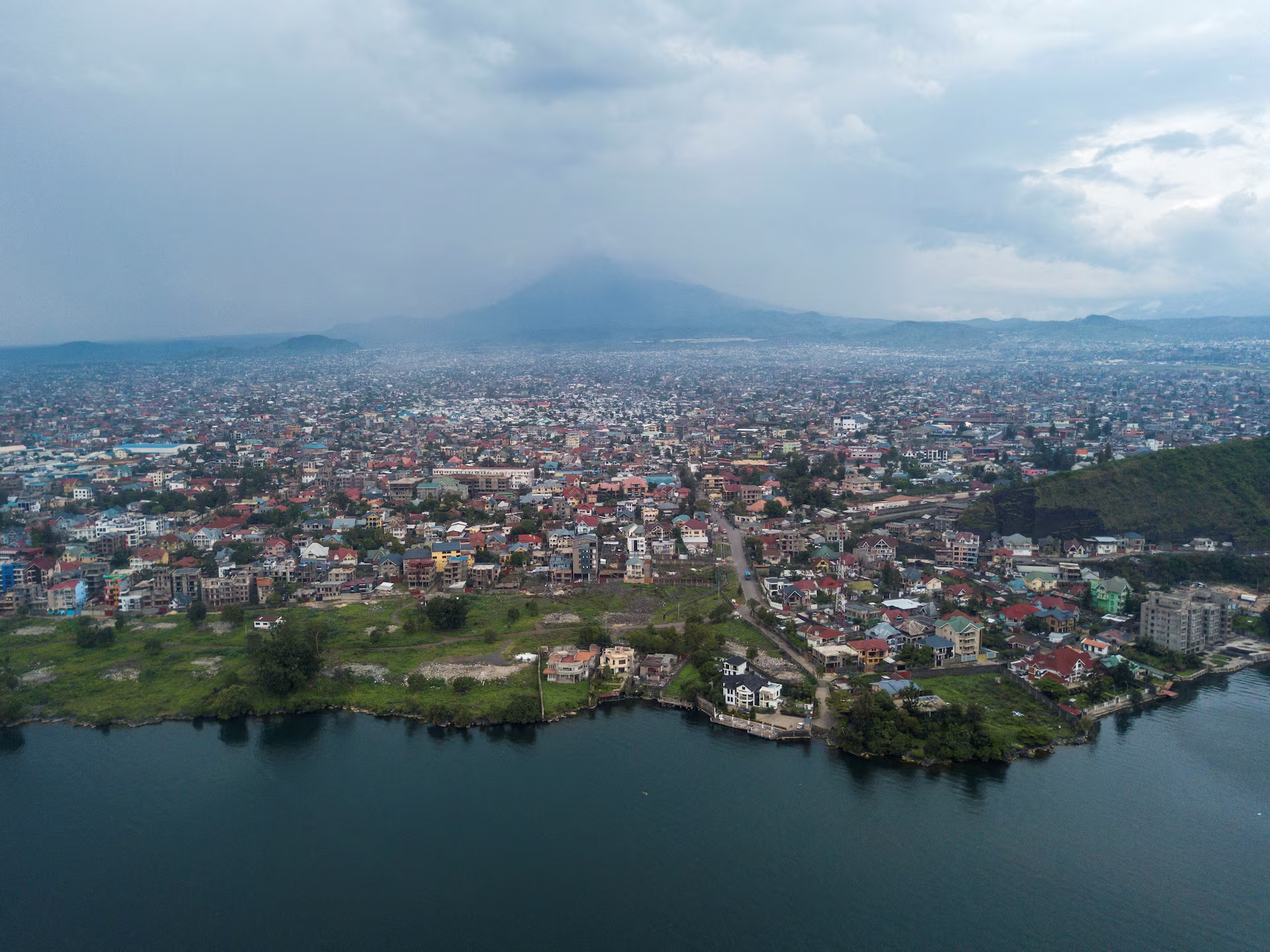
The glow appeared over the northern hills on the evening of 22 May 2021, and at first the people of Goma mistook it for something ordinary. A brush fire, maybe. The reflection of the setting sun. Within an hour the glow had a shape and the shape was moving — a bright seam of lava working down the flank of Nyiragongo toward the city of a million people spread along the lakeshore below.
There had been no warning. The observatory whose job it was to watch the mountain had gone dark months earlier, its funding cut, its sensors failing. So the alarm spread the way it always had in Goma, mouth to mouth in the dark. Families grabbed what they could carry and joined a river of tens of thousands walking out of the city under a red sky, some pushing toward the Rwandan border two kilometres east, some fleeing west into the hills, all of them moving away from the wall of rock that was now glowing at the edge of town. The lava reached the northern neighbourhoods and stopped just short of the airport runway. At least thirty-two people died that night. Half a million were told to leave.
Goma is the only city on Earth that lives permanently trapped between two ways to die. To the north stands Nyiragongo, which holds one of the planet's only persistent lava lakes and produces lava so fluid it can outrun a car. To the south lies Lake Kivu, a body of water saturated with dissolved carbon dioxide and methane that could, under the wrong conditions, rise up and asphyxiate every living thing along its banks. Between them, on ground made of old lava, sits a city that has also spent three decades as the front line of Central Africa's longest war.
The story of Goma is the story of a place that the earth and human beings have taken turns trying to erase, and that has refused, again and again, to be erased.
How a Lakeside Outpost Became the Gateway to Eastern Congo
Goma began as a colonial afterthought. Belgian administrators established a station on the lake in the early twentieth century, drawn by the cool highland climate and the fertile volcanic soil that made the region an agricultural prize. For decades it remained a small border town, its fortunes tied to the coffee and cattle of the surrounding hills and to its position at the northern tip of Lake Kivu, where the mountains of the Rift Valley squeeze the land into a natural corridor.
Goma's Strategic Position on the Rwanda Border and Lake Kivu
Geography made Goma matter far more than its size suggested. The city sits directly on the frontier with Rwanda — the twin town of Gisenyi begins where Goma ends, separated only by a border post and a fence. Lake Kivu blocks movement to the south, the volcanic massif walls off the north, and the result is a chokepoint. Anyone who wanted to move goods, weapons, or armies between the Great Lakes region and the vast interior of the Congo had to pass through Goma. That single fact would shape everything that came after. A town built for coffee became a town that controlled a gateway, and gateways in this part of the world are worth fighting for.
The Volcanic Ground Beneath the City
Goma is built on the evidence of its own destruction. Walk through the older districts and the ground underfoot is black, porous, sharp — solidified lava from eruptions that predate the city. Homes are constructed from blocks cut out of it. The airport was laid across it. The residents live, quite literally, on top of the record of the last time the mountain came down, which makes the mountain easy to forget until it moves again.
The 1994 Refugee Catastrophe and the Cholera That Killed Tens of Thousands
The first catastrophe of the modern era arrived not from the mountain but from across the border. In July 1994, as the genocide in Rwanda collapsed and the killers fled the advancing Rwandan Patriotic Front, more than a million Hutu refugees crossed into the Congo in the space of a few days. Most of them poured through Goma.
When a Million People Crossed the Border in Days
The scale broke every system built to absorb it. At the peak of the exodus, an estimated twelve thousand people crossed the border every hour. They kept coming for days — an entire population on the move, carrying children, mattresses, cooking pots, and the trauma of a genocide many of them had helped commit. Aid agencies that had planned for tens of thousands found themselves facing more than a million. The refugees spread out across the lava fields north and west of the city and built camps at Kibumba, Katale, and Mugunga that swelled overnight into some of the largest human settlements in Africa. There was no clean water. There were no latrines. There was only volcanic rock, and a lake, and more people arriving every minute.
The Cholera Epidemic in the Goma Refugee Camps
Cholera reached the camps within days, and it moved through the crowded, waterless settlements faster than anything the aid workers had ever seen. People began dying by the thousands. The disease killed so quickly that the sick would collapse on the road, and the dead accumulated faster than anyone could bury them.
Burial itself became impossible. The ground was solid lava, too hard to dig, and the workers who tried found they could not open graves in it. Bodies were wrapped in reed mats and laid in rows along the roadside to Gisenyi, sometimes stretching for kilometres, until bulldozers arrived to scrape shallow trenches into the rock and push the dead into them by the hundred. An estimated fifty thousand people died in the first month. It remains one of the fastest mass-mortality events of the late twentieth century, and it happened in full view of the world's television cameras, on a lava field beside a lake, in a place most viewers could not have found on a map.
The camps did not empty when the epidemic passed. The armed men who had orchestrated the genocide took control of them, ran them as a state in exile, and used them as a base to raid back into Rwanda. Goma had become the address of an unfinished war.
Goma at the Heart of the Congo Wars
The refugee camps lit the fuse. In 1996, Rwanda's new government, unwilling to tolerate a hostile army entrenched across its border, backed a Congolese rebel movement under Laurent-Désiré Kabila and sent it to destroy the camps. It succeeded, and then it kept going.
The First and Second Congo Wars and Goma's Role
Kabila's rebellion swept west out of the Goma region, crossed the entire width of the Congo in seven months, and toppled the dictator Mobutu Sese Seko in 1997. The victory did not bring peace. Within a year Kabila had turned on his Rwandan sponsors, and in 1998 the region exploded into the Second Congo War — a conflict so vast it pulled in nine African nations and earned the name "Africa's World War." An estimated five million people died before it formally ended in 2003, most of them from disease and starvation rather than bullets, which made it the deadliest conflict anywhere on the planet since 1945.
Goma spent those years as a rebel capital. The Rwanda-backed factions that controlled eastern Congo ran their administration from the city, and its border, its airport, and its lakefront became the infrastructure of an occupation. Even after the official peace, the war never truly left. It fragmented into a swarm of militias, and the city remained what it had become in 1994: a place where the shooting had paused but never stopped.
Conflict Minerals: Coltan, Gold, and the Global Supply Chain
The reason the war would not die lay in the ground around Goma. Eastern Congo holds some of the richest mineral deposits on Earth — gold, tin, tungsten, and above all coltan, the ore refined into the tantalum that sits inside nearly every mobile phone and laptop on the planet. When the coltan price spiked at the turn of the millennium, the mines of the Kivus became a source of almost unlimited money for whoever held them by force. Armed groups seized the mines, taxed the miners, and smuggled the ore across the border, and Goma became the hub through which the wealth flowed out and the weapons flowed in. The same logic had played out four centuries earlier and a continent away, at the silver mountain that financed an empire and consumed millions of lives: a resource so valuable that controlling it was worth any number of deaths. In Goma the resource was the future of consumer electronics, and the deaths were counted in the millions.
The Nyiragongo Eruptions of 2002 and 2021
While the war ground on, the mountain kept its own schedule. Nyiragongo is unlike almost any other volcano on Earth. Its lava is exceptionally low in silica, which makes it thin and runny, and a fluid lava does not build up and explode — it pours out and races downhill. In 1977 the crater's lava lake drained in under an hour and sent a flood of molten rock down the slopes at speeds that gave the people in its path no chance to run. The mountain had shown, once, exactly what it could do to the city below.
The 2002 Eruption That Split Goma in Half
On 17 January 2002, Nyiragongo did it again. Fissures opened on the southern flank and lava streamed straight toward Goma, entering the city in two broad rivers. One of them cut down the main commercial avenue and buried much of the business district under three metres of rock. The lava crossed the airport runway and split it in two. It reached the lakeshore. An estimated quarter of a million people fled across the border into Rwanda in a single night, joining a column of refugees so dense that the Gisenyi crossing became a crush of bodies. Roughly a hundred and fifty people died, many of them when a petrol station in the lava's path exploded as they tried to siphon fuel from it. When the flow finally cooled, tens of thousands of homes were gone and the centre of Goma was a field of steaming black rock. The city rebuilt on top of it, because there was nowhere else to go.
The 2021 Eruption and the Failure of the Warning System
The 2021 eruption was, in one sense, a smaller event than 2002 — the lava stopped at the edge of the city rather than running through its heart. In another sense it was a scandal. The Goma Volcano Observatory, the institution responsible for watching Nyiragongo, had lost much of its funding after questions were raised about the management of an international grant, and its ability to monitor the mountain had degraded badly. When the eruption came on the evening of 22 May, there was no functioning early warning. People learned the volcano was erupting by looking at the sky. At least thirty-two died, mostly in the chaos of the flight, and the eruption exposed a truth the city had lived with for years: the world's attention arrived only after the disaster, and the systems meant to protect a million people from the mountain above them were, when it mattered most, switched off.
The Lake That Could Kill a Million People
Lake Kivu is beautiful, and it is a slow-motion catastrophe waiting for a trigger. Deep beneath its calm surface, held down by the immense pressure of the water above, the lake stores staggering quantities of dissolved carbon dioxide and methane — gases fed in over centuries by the volcanic activity beneath the Rift. Under normal conditions the gas stays locked in the depths. Under abnormal conditions it does not.
The precedent is Lake Nyos in Cameroon, which in 1986 released a sudden cloud of carbon dioxide that rolled silently over the surrounding valleys and asphyxiated more than 1,700 people and their livestock in a single night, without a sound or a flame. Lake Kivu holds vastly more gas than Nyos did, and roughly two million people live along its shores. A large earthquake, a lava flow entering the water, or a disturbance of the lake's delicate layering could in theory trigger a similar release on an unimaginable scale. Engineers now tap the methane to generate electricity, a project that doubles as a slow attempt to defuse the lake. The people of Goma go about their lives beside water that is both their livelihood and a loaded weapon, which is its own kind of endurance — living next to a threat that, unlike the volcano or the militias, gives no warning at all and offers nowhere to run.
The Fall of Goma to M23
The war that never ended came back to the city in full force in January 2025. The March 23 Movement, known as M23, was the latest in the long line of Rwanda-backed rebel groups born from the unfinished business of 1994. It had briefly seized Goma once before, in 2012, holding the city for eleven days before international pressure forced it out. In 2025 it came to stay.
The January 2025 M23 Offensive and the Capture of the City
The offensive was fast. M23 columns, reinforced by thousands of Rwandan soldiers, closed on Goma through the second half of January and broke into the city on the morning of 27 January. The Congolese army collapsed. Between roughly nine hundred and two thousand people were killed in the days of fighting, according to competing UN and government estimates, and tens of thousands more fled. Within hours the rebels controlled the airport, the border posts, and the lakefront — the same infrastructure every occupier of Goma had seized for a century. The capture of the regional capital was the worst military defeat the Congolese state had suffered in a generation.
Life Under Rebel Administration
The occupation that followed was quieter than the assault, and in some ways more frightening. M23 installed a parallel administration and set about presenting itself as a government, keeping the streets orderly and its worst abuses less visible in Goma than in the villages beyond it, where the group cared less about its image. Human rights investigators documented summary executions in the city's neighbourhoods in the weeks after the takeover — in one incident, at least twenty-one civilians were killed and their bodies left in the streets as a warning. The order that residents observed on the surface was, many of them said, the discipline of fear.
The economy strangled. The Congolese government, hoping to squeeze the rebels, shut down every bank in Goma, and a year later they remained closed, their doors bolted and their ATMs dark. The rebels closed the airport, severing the city from the rest of the country. Residents were reduced to crossing the border into Rwanda simply to reach their own money, standing in line each day at the banks of Gisenyi to withdraw cash from accounts they could no longer access at home. A city that had survived genocide, war, and lava now found itself unable to buy bread with the money in its own name. As of early 2026, M23 still holds Goma, the peace talks in Doha and Washington have produced documents but no withdrawal, and the front lines to the west remain live.
Goma Today: A City That Refuses to Die
Goma in 2026 is a paradox its residents have long since stopped finding remarkable. The markets are busy. Motorbike taxis clog the streets. Vendors sell tomatoes and phone credit under signs for banks that no longer open. And all of it happens under armed patrols, on lava-black ground, between a volcano that is overdue and a lake that is waiting, in a city whose own airport is shut and whose currency has half-abandoned it.
Endurance in Goma is not the inspirational kind sold in slogans. It is the grinding, daily, unchosen kind — the pastor telling a congregation that this too will pass, the trader raising prices to survive another month, the family that rebuilt on the site of the last eruption because rebuilding was the only option available. The city has been compared to few places because few places carry this many threats at once. The closest analogues are elsewhere in Africa, in the vast informal settlements like Nairobi's Kibera, where a million people improvise survival on land nobody will guarantee them, and in the volcanic cities of the ancient world like the Roman town that Vesuvius erased in a single day. The difference is that Pompeii was buried once and became a memory. Goma keeps getting buried and keeps refusing to become one.
Visiting Goma: Access, Danger, and the Ethics of a City Under Occupation
Goma is, at the time of writing, a city under armed occupation, and it is not a destination. Every major government advises against all travel to North Kivu. The airport is closed to civilian flights. The only practical way in is overland through Rwanda's Gisenyi crossing, and even that puts a traveller inside territory controlled by an armed group operating outside any recognised authority, in a region where aid workers have been killed and where the front line can shift within a day.
For those who follow the region from a distance, the ethical weight of Goma is worth sitting with. This is not a ruin to be toured or a disaster safely locked in the past. It is a living city where more than a million people are enduring a crisis in real time — burying their dead, guarding their words, crossing a border to reach their own savings. The volcano will erupt again; the geology guarantees it. The lake will remain a threat that no one can fully neutralise. The war will end only when the economics that sustain it end, and there is little sign of that yet.
What Goma offers the outside observer is not a spectacle but a corrective. It is proof that a place can absorb more catastrophe than any model predicts, and that the people inside it will go on living regardless — not because they are heroic, but because living is what remains. The city on the lava between the volcano and the war does not ask for admiration. It asks, at most, to be seen clearly.
Frequently Asked Questions
Why is Goma so dangerous?
Goma faces an unusual combination of threats. It sits directly below Nyiragongo, one of the world's most active volcanoes, which has sent lava through the city twice this century. It lies on the shore of Lake Kivu, which contains enormous amounts of dissolved gas capable of a deadly release. And it has been the front line of eastern Congo's wars for three decades, most recently falling to the Rwanda-backed M23 rebel group in January 2025. Few cities on Earth carry this many simultaneous dangers.
What happened when Nyiragongo erupted in 2002?
On 17 January 2002, Nyiragongo sent two rivers of fast-moving lava straight into Goma. One buried much of the commercial centre under several metres of rock and cut the airport runway in two. Around a quarter of a million people fled across the border into Rwanda overnight, and roughly a hundred and fifty people died, many in an explosion at a petrol station in the lava's path. The city later rebuilt directly on top of the cooled lava.
Who controls Goma now?
As of early 2026, Goma is controlled by the March 23 Movement (M23), a Rwanda-backed armed group that seized the city on 27 January 2025. M23 has established a parallel administration, closed the airport, and governs the city outside the authority of the Congolese government in Kinshasa. Peace negotiations mediated by Qatar and the United States have taken place, but the rebels have not withdrawn.
What was the Goma cholera epidemic?
In July 1994, more than a million refugees fleeing the Rwandan genocide crossed into the Goma region within days. The overcrowded camps had no clean water or sanitation, and a cholera epidemic swept through them almost immediately. An estimated fifty thousand people died in the first month. Because the ground was solid volcanic rock and graves could not be dug, bodies were laid along the roads and later pushed into mass trenches by bulldozers.
Why is Lake Kivu considered dangerous?
Lake Kivu holds vast quantities of dissolved carbon dioxide and methane in its deep waters, fed by volcanic activity beneath the Rift Valley. A major disturbance — such as an earthquake or a lava flow entering the lake — could trigger a sudden release of gas, similar to the 1986 disaster at Lake Nyos in Cameroon that killed more than 1,700 people. Roughly two million people live along Lake Kivu's shores, and engineers now extract the methane partly to generate power and partly to reduce the risk.
Can tourists visit Goma?
Goma is not currently safe for travel. It is under the control of an armed group, its airport is closed to civilian flights, and governments advise against all travel to the North Kivu region. The only overland access is through Rwanda, and the security situation can change rapidly. Goma is a living city in the middle of an active crisis, not a stable destination.
Sources
- [Goma: Stones in the Making] — Karen Büscher, Journal of Eastern African Studies (2018)
- [The Great Lakes of Africa: Two Thousand Years of History] — Jean-Pierre Chrétien (2003)
- [Dancing in the Glory of Monsters: The Collapse of the Congo and the Great War of Africa] — Jason Stearns (2011)
- [The Nyiragongo 2002 Eruption: Lava Flows and Impact on Goma] — Journal of Volcanology and Geothermal Research (2003)
- [Emergency Response to the Nyiragongo Eruption of 2021] — Goma Volcano Observatory / Global Volcanism Program (2021)
- [Public Health Impact of the Rwandan Refugee Crisis: What Happened in Goma?] — Goma Epidemiology Group, The Lancet (1995)
- [Gas Emissions and Hazard Assessment of Lake Kivu] — Klaus Tietze et al., peer-reviewed limnology literature
- [The 1986 Lake Nyos Disaster and Limnic Eruptions] — United States Geological Survey
- [How the Curse of Coltan Fuels the Conflict in Eastern Congo] — Global Initiative Against Transnational Organized Crime (2025)
- [We Will Kill You If You Refuse: Abuses by M23 in Eastern DRC] — Human Rights Watch (2025)
- [Democratic Republic of the Congo: Situation Reports] — Global Centre for the Responsibility to Protect (2026)
- [Banks Shut, Futures Uncertain: One Year Under M23 in Goma] — Al Jazeera (2026)