A Woman on the Slag Heap: Life at the Top of the World
The pallaqueras work the discard piles. They are women, and women are forbidden inside the mines — the miners believe a woman underground brings bad luck and empties the vein — so they wait outside on the slopes of crushed rock the men have thrown away. A pallaquera squats on the slag at 5,100 meters, where the air holds barely half the oxygen of sea level, and breaks stones by hand for hours, hunting the flecks of gold the men missed. When she has enough, she grinds it on a stone tool called a quimbalete, rocking her body weight across the rock, then mixes the dust with mercury she handles with her bare fingers. Above her, the glacier glints. The same mercury vapor that rises off the gold shops in the town below is condensing on that ice right now, sinking into the meltwater she will drink tonight.
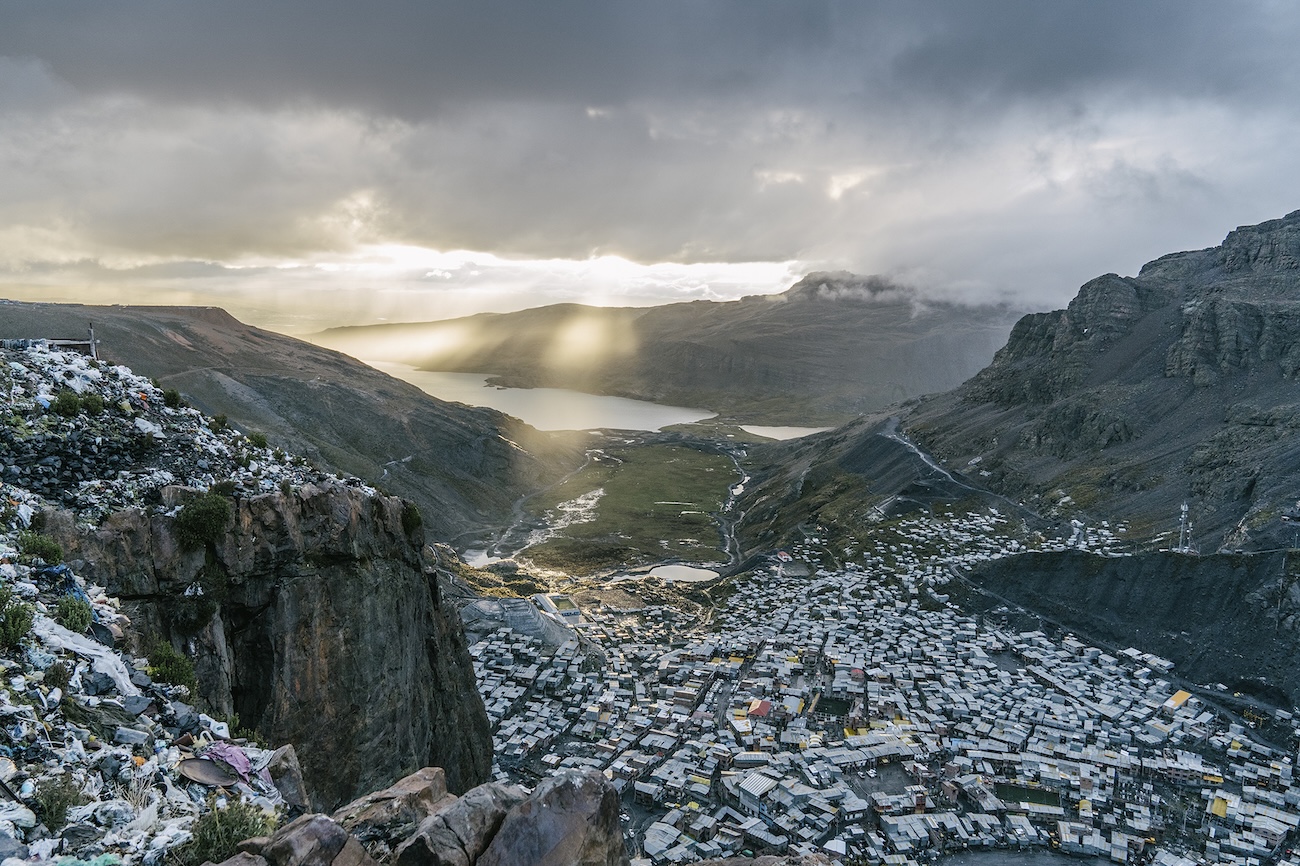
This is the highest city on Earth, and it should not exist. Nothing grows at 5,100 meters. There is no farmland, no clean water, no functioning sewage, and for most of its history no electricity. The temperature rarely climbs above freezing. The only reason a human being would endure chronic oxygen starvation in a town built on a garbage dump is the thing buried in the mountain behind it. La Rinconada is greed pushed to the literal ceiling of human habitation — a place that runs on hope as a substitute for wages, where the labor is a lottery, the water is poison, and the gold that justifies all of it ends up, eventually, in a wedding ring on someone's hand half a world away.
Where Is La Rinconada? The Geography of the World's Highest City
La Rinconada clings to the side of Mount Ananea in the Puno region of southeastern Peru, in the Ananea District, roughly 5,100 meters above sea level — high enough that geographers place it in the Janca, the highest of the Andean ecological zones, a band of rock and ice above where almost anything lives. The glacier above the town is named Auchita, but everyone calls it La Bella Durmiente. There is no soil to farm and no road that isn't a treacherous climb by truck. Unlike every traditional Andean town — built around farmland, a trade route, or a church — La Rinconada was built around mine entrances and nothing else. The successful miners don't even live here; they keep homes down in Juliaca, more than a kilometer lower, where there is running water and air a body can use. The town exists at an altitude that kills slowly, for a reason that has nothing to do with the place and everything to do with what is under it.
How Gold Built a City in the Clouds
Gold made La Rinconada, and gold prices built it into a city almost overnight.
From Prospector Camp to Boomtown: The Gold Rush of La Rinconada
The price of gold rose roughly 235 percent between 2001 and 2009, and the world's highest junkyard became its fastest-growing boomtown. What had been a seasonal prospectors' camp — men who climbed up, mined for a month, and left — swelled as the metal grew more valuable, until National Geographic estimated 30,000 people living on the mountain by 2009. Population figures for La Rinconada are a genuine fog: census takers recorded around 20,000 in the wider district in 2007 and only about 12,600 in 2017, while journalists and the miners' own associations routinely cite 50,000 to 70,000. The truth is that no one fully counts a place the state barely governs. What is certain is the shape of the migration: men arriving from the rural Peruvian highlands and from across the Bolivian border with nothing, drawn by stories of someone who struck a rich vein and walked off the mountain with a fortune.
The migrant who arrives finds a town with no plumbing and no garbage collection, where the responsible bury their trash outside the settlement and everyone else burns it or drops it in the street. The ground itself is laced with mercury. The newcomer comes anyway, because the alternative — the dull certainty of low wages and chronic poverty in the fields below — feels worse than the gamble. And the gamble is the entire economic logic of the place. It has a name.
The Cachorreo System: Working 30 Days for a Lottery Ticket
Cachorreo is the system that runs La Rinconada, and it is one of the most quietly brutal labor arrangements on Earth. A miner works for the concession holder for 30 days and receives no wage at all. On the final day — sometimes one day, sometimes two — he is allowed to enter the mine and keep whatever ore he can haul out on his own shoulders. If the ore he carries is rich, he eats for a month. If it is worthless rock, he has worked 30 days for nothing.
The cruelty is in the detail. A miner interviewed about the system pointed out the trick inside it: on the crucial day, the men are often sent to work areas where there is nothing to find. The one day that is supposed to be theirs is quietly rigged. The math elsewhere is just as stark — the manager of one larger operation said his mine produced more than five million dollars of gold a year, while his workers, on their monthly cachorreo, averaged around ten grams each, perhaps three thousand dollars across a whole year of labor.
And still they don't rebel. Juan Apaza, a gold-toothed miner up on the glacier, gave a reporter the line that explains the entire town: "It's a cruel lottery, but at least it gives us hope." That is the engine of La Rinconada. Not gold — hope, sold to desperate people as a wage. The slim monthly chance of winning big beats the certainty of poverty in the valley, so no one wants to change the system, not even the men it grinds down. It is cheaper for the contractor, who pays nothing for 29 days out of 30. It is a trap that the trapped help maintain, because the only thing worse than the lottery is admitting there is no prize.
The Mercury Curse: How Mining Poisons La Rinconada's Water and Air
The gold inside the mountain does not come out clean. It comes out bound to rock, and the way the miners free it is killing them, their children, and people who have never set foot on the mountain.
Gold, Mercury, and the Blowtorch: Inside the Amalgamation Process
Mercury is how a person with no machinery turns crushed rock into gold. The miner or pallaquera grinds the ore to sand, then mixes it with liquid mercury, which binds to the gold particles and forms a soft lump of amalgam — a process done in a tumbling drum or by rocking body weight across the stone quimbalete. The amalgam is then taken to a gold buyer, who hits it with a blowtorch. The mercury boils off into the air as vapor, and what remains in the bottom of the pan is gold.
This happens in the middle of town. The gold shops — by some counts more than 250 of them — sit in residential districts, and the blowtorch flames are so hot they burn invisible. The men holding the torches often wear no protection at all. The figure that should stop anyone cold comes from the UN's industrial development organization: in small-scale gold mining, two to five grams of mercury are released into the environment for every single gram of gold recovered. The whole town is breathing a heavy metal that attacks the nervous system, producing tremors, memory loss, muscle weakness, and, over years, paralysis.
The Poisoned Glacier: Mercury in the Drinking Water
Mercury vapor does not disappear. In the perpetually cold, thin air of 5,100 meters, the vapor rising off hundreds of gold shops condenses fast — onto rooftops, onto the streets, and onto the glacier above the town. La Rinconada draws its drinking water from two sources, and the contamination has reached both: glacier meltwater, which now carries the condensed mercury directly off the ice, and rainwater collected from roofs, which one long-term miner described bluntly: the rain in La Rinconada is acidic with mercury. The poison is delivered straight into the human food chain by the weather itself.
It does not stop at the town's edge. The contaminated water drains downhill into the Coata river, which flows to Lake Titicaca, carrying heavy metals into communities that never mined an ounce. A farmer in a village south of the mine described the timeline of his own ruin: the mine settled in around 2006, and by 2009 his animals were sick. He had once kept 80 alpacas and 56 sheep; he was left with ten of each. A 2018 national study found that 83.5 percent of residents in the affected region carried heavy metals in their bodies. The mountain is poisoning people forty kilometers downstream who will never see a flake of its gold.
Altitude, Disease, and the Bodies the Mountain Breaks
Altitude alone would make La Rinconada one of the hardest places on Earth to keep a body alive. At 5,100 meters the air holds about half the oxygen of sea level, and people who live here for years develop chronic mountain sickness — the blood thickening with excess red cells as it strains to carry enough oxygen. A peer-reviewed study of male miners living above 5,000 meters set out specifically to map the overlap of three afflictions stacked on top of one another here: chronic mountain sickness from the hypoxia, lung damage from inhaling crystalline silica dust in the tunnels, and neurological poisoning from the mercury. The miners of La Rinconada are fighting all three at once.
The town has one small clinic. The life expectancy of a miner is widely cited as 30 to 35 years — roughly half the Peruvian average — a figure that circulates in journalism more than in formal demography, but that no one who has documented the place treats as implausible. Silicosis, the lung disease that comes from breathing rock dust, is endemic. Men arrive young, strong, and hopeful, and the combination of thin air, dust, and mercury vapor does to them slowly what the cachorreo lottery does to their wages: takes almost everything and returns almost nothing.
The Lawless City: Crime, Trafficking, and the Absence of the State
La Rinconada is sometimes called la ciudad sin ley del Perú — the lawless city of Peru — and the name is earned. Where there is gold and almost no state, what fills the vacuum is violence.
La Ciudad Sin Ley: Why the State Never Arrived
The Peruvian state exists in La Rinconada on paper and almost nowhere else. The town falls administratively under the Ananea District, and the only company with a government license to mine here is Corporación Ananea — but dozens of informal and illegal operations run freely around it, and the national police keep only a small, badly understaffed outpost in a town of tens of thousands. The government has little appetite for scaling an icy, oxygen-starved mountain to impose order on a crowd of armed and desperate miners, and the mine operators have no interest in inviting in the regulation that would end their nearly free labor. The result is a de facto autonomy in which gold, alcohol, and weapons mix without supervision.
What governs in the state's absence is mob justice. Visitors entering the town pass effigies hung from poles — figures strung up as warnings to thieves, the local substitute for a courtroom. The crime is constant and the impunity total: men carrying gold are assaulted, killings happen over scraps of ore, and bodies turn up in waste fields and mine shafts. This is the same fundamental dynamic that produces the cartel-controlled zones and state-abandoned districts across Latin America — the predictable physics of a place where enormous value is extracted and no authority arrives to govern the extraction. The closest mirror, though, is not a modern one.
The Women of La Rinconada: Pallaqueras and the Trafficking Economy
Women occupy the bottom of La Rinconada's brutal hierarchy. Barred from the mines by superstition, they work the slag heaps as pallaqueras, scavenging the men's discards for the gold the system has already passed over twice. The work is the lowest-paid and the most exposed to mercury, handled with bare hands at the very end of the chain.
The darker economy that grew up around the all-male mining workforce is sexual exploitation, and it is documented rather than rumored. Reuters reported that in 2019 alone, Peruvian authorities rescued at least 68 victims of human trafficking from nightclubs in the area, and reporting on the region has repeatedly noted that many of the victims of sexual exploitation are minors. The same absence of the state that lets the killings go unpunished lets the trafficking run. In a town built entirely on the premise that desperate people will accept any gamble for a chance at gold, the women who never get to make even that bad bet are the ones who pay the most.
La Rinconada Today and the Atlas Entry
La Rinconada is not a ruin and not a relic. It is a living, growing, poisoned city, and the forces that built it are still pulling people up the mountain.
The Gold Supply Chain: From the Glacier to a Wedding Ring
The gold does not stay in the Andes. After it is freed from the rock with mercury, it moves through a chain of brokers who buy and sell it, and from there into the formal global market — some of it ending up with major refiners like Metalor Technologies, among the largest precious-metals suppliers in the world. Peru's attempt to fix this, a process called "formalization" that would force miners to pay taxes, hold permits, and manage their environmental damage, has largely failed: of more than 60,000 registered informal miners, only around 1,600 have completed it, while deadlines are extended again and again, allowing gold produced under exactly these conditions to keep flowing legally to market.
The uncomfortable arithmetic is that the supply chain works. Gold chipped out of the mountain by a miner on his cachorreo day, processed with mercury that will poison his children's water, can travel through enough hands that it arrives at a jewelry counter scrubbed of its origin. The metal humans have associated with permanence and purity for millennia comes, in part, from the place that is using it to kill itself. It is a Shangri-la in reverse: the pursuit of the immortal metal only hastens the miners' mortality.
The Slow Death of an Andean Mountain: Potosí's Mirror Across Four Centuries
La Rinconada has a mirror about 700 kilometers to the south, across the Bolivian border, and looking at it tells you that none of this is new. Potosí was the silver mountain that financed the Spanish Empire — a peak so rich it minted the coins that circled the globe, and so deadly that it is estimated to have consumed millions of lives over its centuries of operation. The Spanish fed those bodies into the mountain through the mita, a forced-labor draft that conscripted Andean men and sent them underground, many never to return.
The systems are four centuries apart and they are the same system. Potosí's mita was open compulsion — the state ordered men into the mountain. La Rinconada's cachorreo is dressed as its opposite: voluntary, even hopeful, a lottery the miners say they prefer. But strip away the language and the trade is identical. An Andean mountain holds a precious metal. The metal is worth more than the people who extract it. So the people are fed into the rock — by royal decree in 1600, by the cruel mathematics of hope in 2025 — and the metal flows out to the wider world while the bodies stay behind. Potosí is what La Rinconada will look like in the history books: a mountain that turned human lives into currency. The only thing that has changed in four hundred years is that the compulsion now calls itself a choice.
Visiting La Rinconada: What to Expect
La Rinconada can be reached, with difficulty, by truck up brutal mountain roads from Juliaca or Puno, and travelers do occasionally make the climb. It should be approached with more seriousness than almost anywhere else in this atlas, for two reasons. The first is physical: 5,100 meters is high enough to cause severe altitude sickness in the unacclimatized, the air is laced with mercury, the water is not safe, and the town has minimal medical care and a real, documented crime problem. This is not a site that can be visited casually or safely on a whim.
The second reason is ethical, and it matters more. La Rinconada is not an abandoned place where tragedy is finished and sealed behind glass. It is a community of tens of thousands of living people enduring conditions most visitors could not survive for a week — exploited by a labor system, poisoned by their own only industry, and largely abandoned by the state. To come here as a spectator of suffering is to treat human beings as scenery. If there is a reason to look at La Rinconada at all, it is to understand what the price of gold actually is, and to carry the knowledge that the metal in the case at the jeweler's may have come from a mountain where a woman is breaking rocks with her hands in the thin cold air, hoping, against the odds, for a single good day.
Frequently Asked Questions About La Rinconada
Where is La Rinconada and how high is it?
La Rinconada is a gold-mining town in the Puno region of southeastern Peru, on the slopes of Mount Ananea in the Andes, near the Bolivian border. It sits at roughly 5,100 meters (about 16,700 feet) above sea level, which makes it the highest permanent human settlement in the world. At that altitude the air holds about half the oxygen of sea level, and the town lies beneath a glacier that locals call La Bella Durmiente, the Sleeping Beauty.
What is the cachorreo system?
Cachorreo is the informal labor system that governs work in La Rinconada's gold mines. Under it, a miner works roughly 30 days for the mine's concession holder with no wage at all, and in exchange is allowed, on one final day, to enter the mine and keep whatever ore he can carry out on his own back. If that ore is rich he earns well; if it is worthless rock he has worked a month for nothing. Miners often describe it as a lottery, and one of its known abuses is that workers are frequently sent to barren areas on the very day they are supposed to mine for themselves.
Why is La Rinconada so polluted with mercury?
Miners in La Rinconada extract gold from crushed ore using mercury, which binds to the gold to form an amalgam. That amalgam is then heated with a blowtorch — usually in gold shops located right in residential areas — which vaporizes the mercury and releases it into the air. In the cold high-altitude climate the vapor condenses quickly onto rooftops, the streets, and the glacier above town, contaminating the meltwater and rainwater that residents drink. UN estimates suggest two to five grams of mercury are released for every gram of gold recovered in small-scale mining.
What is life expectancy like in La Rinconada?
Living conditions in La Rinconada are extreme, combining severe altitude, toxic mercury exposure, and lung disease from rock dust. The life expectancy of a miner is widely reported as 30 to 35 years, roughly half the Peruvian national average, though this figure appears more in journalism than in formal demographic study. What is well documented is the layering of chronic mountain sickness, silicosis, and mercury poisoning on the same population, and a 2018 study found that 83.5 percent of residents in the affected region carried heavy metals in their bodies.
Why is La Rinconada called the "lawless city"?
La Rinconada is sometimes called la ciudad sin ley del Perú, the lawless city of Peru, because the state has almost no real presence there. Only a small, understaffed police outpost serves a population of tens of thousands, and dozens of informal and illegal mines operate freely. The combination of gold, alcohol, and weapons produces frequent violence, with killings over gold and bodies left in waste fields and mine shafts. Mob justice fills the gap, and human trafficking is a documented problem — Peruvian authorities rescued at least 68 trafficking victims from the area in 2019 alone.
Can you visit La Rinconada?
It is possible to reach La Rinconada by truck along rough mountain roads from Juliaca or Puno, but it should not be treated as a casual destination. The altitude can cause life-threatening altitude sickness in unacclimatized visitors, the air and water are contaminated with mercury, medical facilities are minimal, and crime is a genuine risk. Beyond the physical dangers, La Rinconada is a living community of people enduring severe hardship, not an abandoned site, and any visit should be approached with seriousness and respect rather than as dark-tourism spectacle.
Sources
- [Gold Is a Toxic Lure in the World's Highest Settlement] - National Geographic (2022)
- [The Real Price of Gold] - Brook Larmer, National Geographic / Science and Environmental Health Network (2009)
- [Mining for Gold in the World's Highest Permanent Human Settlement] - Pulitzer Center / James Whitlow Delano (2019)
- [Peruvian Gold Comes with Mercury Health Risks] - Scientific American (2014)
- [Lung Function, Mercury Exposure and Chronic Mountain Sickness in Gold Miners at 5100m] - European Respiratory Society (2023)
- [Unique Mitochondrial and Heavy Metal Exposure Studies, La Rinconada region] - Peru National Institute of Health (2018)
- [Authorities Rescue Trafficking Victims in La Rinconada Mining Region] - Reuters (2019)
- [The Horrendous Saga of Gold Miners in Peru's Andes] - Capital Newspaper (2019)
- [Artisanal Gold Mining and Mercury Emissions Estimates] - United Nations Industrial Development Organization (UNIDO)