How the Colorado River Accidentally Created the Salton Sea in 1905
Two thousand men worked the trestles in the winter of 1906. They had been recruited from six local tribes, from Imperial Valley settlements and from labour crews across the Mexican border, and their job was to stand on temporary wooden bridges thrown across a torrent and push rock into it. Southern Pacific locomotives ran out onto the trestles and dumped rubble hauled from quarries more than a hundred miles away — the equivalent of some three thousand railcars of stone, gravel, timber and clay — into a gap that kept swallowing everything they fed it.
They were fighting the Colorado River, which had left its own delta and was pouring, in its entirety, into a dry basin in the California desert.
The final push took fifty-two days. In February 1907 the gap closed and the river turned back toward the Gulf of California, and the men on the trestle looked at what they had spent two years failing to prevent: a lake, roughly forty miles long, sitting in a sink two hundred feet below sea level, where no lake had been in living memory. They had not built it. They had been trying to stop it.
The Salton Sea is a hundred-year accumulation of accidents that everyone kept deciding to live with. A mistake made it. A second accident kept it alive, because for a century the farms of the Imperial and Coachella valleys drained their irrigation runoff into the basin, and that runoff was the only thing replacing what the desert evaporated. The lake is dying now because the second accident was finally corrected and the water was sold to San Diego.
The arithmetic at the end is the cruel part. A century of agricultural drainage means the sediment on the bottom of that lake holds selenium, arsenic and the residue of decades of pesticide and fertiliser use, and every acre of it that dries out becomes dust that the desert wind lifts into the towns on the shore. California cannot afford to restore the sea, and cannot afford to let it disappear. A place nobody meant to create has become a place nobody can afford to lose.
Lake Cahuilla and the Imperial Valley Canal That Broke
Lake Cahuilla: The Ancient Lake That Filled the Salton Sink for Centuries
The Colorado River has flooded this basin many times. Over thousands of years the river repeatedly built up its delta, blocked its own path to the sea, swung north into the Salton Sink and filled it — creating a body of water geologists call Lake Cahuilla, far larger than the sea that sits there now — before shifting course again and letting the desert take it back.
The Cahuilla people lived on those shorelines. Their stone fish traps are still there, built in low curved walls along the slopes of the Santa Rosa Mountains, hundreds of feet above the current waterline and miles from any water. People stood at those walls and caught fish in a lake that has been gone for centuries, in a basin that has now filled and emptied more times than any written record covers. The 1905 flood was not an aberration in the life of this landscape. The aberration was that this time someone was standing in the way with a canal.
The California Development Company and the 1905 Cut Into the Colorado River
The Imperial Valley was farmland conjured out of desert by an irrigation scheme. Engineer Charles Rockwood and investor George Chaffey built a canal system for the California Development Company that pulled water off the Colorado, looped south through Mexico to skirt the Algodones Dunes, and delivered it to a valley that had been bare sink floor. Settlers arrived in thousands. Alfalfa and melons came out of ground that had produced nothing.
Silt broke it. The Colorado carries an enormous sediment load, and the main canal clogged so badly that water stopped reaching the valley. Farms were dying and the company was facing bankruptcy, so in 1904 Rockwood ordered a shortcut: a new intake cut straight into the riverbank about four miles south of the existing headgate, on the Mexican side, without permission and — the detail that mattered — without any gate to control it.
The winter floods of 1905 came three times. Each one widened the cut, until the opening was more than half a mile across and the Colorado River had stopped going to the Gulf of California altogether and was running north into the sink. H. T. Cory, the engineer who eventually closed it, later described Rockwood's decision as a blunder serious enough to be practically criminal.
Farms went under. The town of Salton went under. The New Liverpool Salt Works, which had been harvesting salt from the dry floor of the sink, was submerged and never reopened. By 1906 the new lake stood at 195 feet below sea level and was still rising.
How the Southern Pacific Railroad Finally Closed the Breach in 1907
The Southern Pacific ended up fighting the river because the river was eating its railroad. The company's main line east of Indio had to be relocated three times as the water rose. E. H. Harriman, the railroad's president, took over the failing development company, put roughly three million dollars of Southern Pacific money into the effort, and went to President Theodore Roosevelt for federal help.
Engineer H. T. Cory ran the final operation. The method that finally worked was brute force applied faster than the river could respond: build a trestle across the breach, run trains onto it continuously, and dump rock into the current around the clock without pause, so that the stone accumulated faster than the water could scatter it. Three attempts failed. The fourth held.
The river went back to its channel in February 1907. The lake stayed.
Dummy Atomic Bombs: The Salton Sea Test Base and the Rehearsal for Hiroshima
The Navy commissioned a seaplane station on the southwest shore in October 1942, and its 4,000-foot airstrip had been graded earlier that year by Paramount Studios, which needed a runway to shoot a war film. Within two years the strangest tenants in the lake's history had moved in.
Between December 1944 and June 1945 a joint Army-Navy unit conducted aeroballistic testing at the Salton Sea on inert atomic weapon units — the casings and internal fusing systems of the first nuclear weapons, dropped without their nuclear components onto floating targets in the water while cameras on the shore tracked how they fell. The bombs that were dropped on Japan that August had to fall predictably and detonate at a set altitude, and this lake is where the falling was worked out. Crews released shapes over the water and instrument crews on the beach measured what they did on the way down, months before anything was dropped on Hiroshima.
The reason they chose this lake is the reason everything else about it is strange. The Salton Sea sits roughly two hundred feet below sea level, which meant the air above it was denser than air anywhere else available in the United States — the closest available match to conditions at low altitude over a target. An engineering mistake had produced the ideal atmosphere for perfecting the delivery of nuclear weapons.
The Atomic Energy Commission took the base over after the war and Sandia ran it as its primary ballistics range until 1961, conducting roughly 150 tests a year. Over 1,100 bomb and missile tests were carried out on this water in total. The rising lake eventually flooded the base, which is a fitting end for a facility that existed because the lake was there at all.
The Salton Riviera: California's Desert Resort Boom on an Accidental Lake
Salton City, Bombay Beach and the 1950s Desert Resort Development
Developers looked at the accident and saw waterfront. In the 1950s the shoreline was subdivided and sold as the Salton Riviera — Salton City, Bombay Beach, Salton Sea Beach, Desert Shores, North Shore — with graded streets, curbs, street signs and lot numbers laid out across bare desert on the promise that buyers were purchasing the next Palm Springs with a coastline attached.
Much of it was never built. Drive the grid at Salton City today and the streets are there, named and paved and running in orderly blocks past empty parcels, waiting for houses that were sold but never constructed. California has produced towns that emptied out after their reason for existing collapsed, and Bodie in the Sierra is the state's most famous. The Salton Riviera failed in a stranger way: much of it never filled up in the first place.
Yacht Clubs, Speedboats and the Sea That Drew Crowds to the Desert
The parts that did fill up were genuinely glamorous for about fifteen years. The North Shore Beach and Yacht Club opened in 1959 as a modernist building on a desert waterfront, with a marina, boat slips and a clientele that arrived from Los Angeles for the weekend. Speedboat racing was the sea's signature sport, because a lake below sea level in dense air with no tides and no swell is very fast water, and record attempts were run here.
Fish came with the boom. State wildlife officials stocked the sea with saltwater species through the 1950s, and corvina, sargo and croaker took hold well enough to support a genuine sport fishery. For roughly a decade the Salton Sea worked exactly as advertised — a warm inland sea with fish in it, four hours from the coast, in a desert.
Everything that made it work was temporary, and the people selling lots either did not understand that or did not say so.
Why the Salton Sea Started Dying: Salinity, Floods and Fish Kills
A Lake With No Outlet: How Agricultural Runoff Turned the Salton Sea Toxic
The Salton Sea is a terminal lake, which means water flows in and nothing flows out. Its inflow is agricultural drainage — the New River, the Alamo River and the Whitewater, carrying runoff off Imperial and Coachella valley farms, along with municipal and industrial waste from across the Mexican border. Its only outflow is evaporation, in a basin that regularly exceeds 110 degrees in summer.
Evaporation removes water and leaves behind everything the water was carrying. Salt concentrates. Fertiliser concentrates. Selenium concentrates. The result compounds year after year with nothing to flush it, and the sea is now substantially saltier than the Pacific Ocean and climbing.
The mechanism was understood early. The California Department of Fish and Game was warning about rising salinity while developers were still selling shoreline lots, and the sport fishery was stocked with species that everyone competent knew would eventually be unable to breed in the water they were being released into.
The 1976 and 1977 Storms That Drowned the Salton Sea Resorts
Tropical storms finished the resorts before the salt did. Hurricane Kathleen in 1976 and Hurricane Doreen in 1977 pushed the sea over its banks and into the shoreline communities within two years of each other, flooding streets, marinas and houses in towns built at the edge of a lake with no fixed level and no drain.
A body of water fed by irrigation runoff rises when there is more runoff and falls when there is less, and the resort towns had been platted on the assumption that a lakeshore stays where it is. Argentina lost a lakeside resort town to almost exactly this mechanism when saline water broke through and submerged Villa Epecuén, which stood underwater for a quarter of a century before the water withdrew again and left the ruins standing. Bombay Beach survived by building a dike, which is why the town now sits behind an earth wall with the drowned remains of its old waterfront on the wrong side of it.
Insurance and confidence went first. The visitors stopped, the businesses closed, and the shoreline entered a long decline that has not reversed since.
Beaches Made of Bone: The Tilapia Die-Offs and the Barnacle Shores
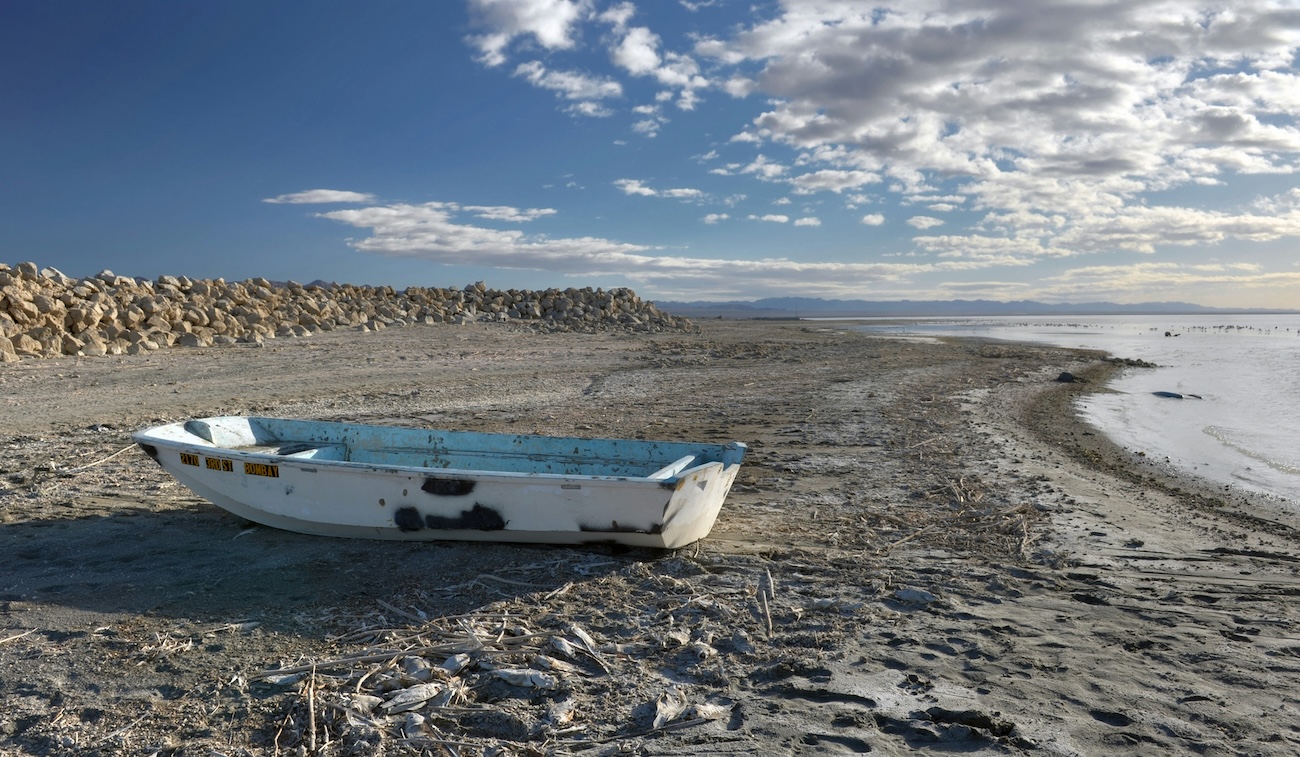
The white sand on the beaches at Bombay Beach is not sand. It is fish — crushed tilapia skeletons, vertebrae, gill plates and spines, mixed with the shells of barnacles that arrived on seaplane hulls in the 1940s and colonised the shoreline. The beach crunches underfoot. Whole fish lie at the tideline with their skin gone.
Tilapia die here in enormous numbers because summer heat strips oxygen out of shallow saline water, and when the oxygen crashes the fish suffocate in bulk and wash ashore by the million. The decomposition and the sulphur chemistry of the water produce hydrogen sulphide, and the smell that comes off the sea when conditions align has carried more than a hundred miles across the mountains into the Los Angeles basin, generating air quality complaints from people who have never seen the lake.
The corvina fishery is finished. Salinity passed what the stocked species could tolerate, and the sea that was sold as a fisherman's paradise now supports almost nothing.
The Bird Die-Offs and the Collapse of a Pacific Flyway Stopover
The 1992 Eared Grebe Die-Off and the Avian Botulism Outbreaks
California destroyed most of its wetlands, and the birds that used them ended up here. The Salton Sea became one of the most important stops on the Pacific Flyway almost by accident, hosting more than 400 species — birds moving between Alaska and South America, dropping into a lake that had existed for less than a century because most of the alternatives had been drained and paved.
Then the sea started killing them. In 1992 roughly 150,000 eared grebes died at the Salton Sea in a single event, and the cause was never conclusively established. Avian botulism outbreaks ran through the fish-eating birds in the mid-1990s, killing thousands of pelicans, including endangered brown pelicans. Crews worked the shoreline collecting carcasses by the truckload to slow the spread, because botulism moves through a die-off by way of the maggots in the dead birds and every body left on the beach makes the outbreak worse.
The sea is a trap in the ecological sense. It draws birds in with an abundance of fish and water, and the water is getting more toxic every year they keep coming back.
Sonny Bono, the Wildlife Refuge and Decades of Failed Restoration Plans
Sonny Bono made the Salton Sea his cause in Congress. The singer turned Palm Springs mayor turned congressman pushed for federal restoration money through the 1990s and died in a skiing accident in 1998 before anything was funded. The refuge at the southern end carries his name.
Thirty years of studies, task forces, authorising legislation and unfunded commitments followed. Every plan was technically sound and none was paid for, and the sea kept getting saltier while the reports accumulated.
The Shrinking Salton Sea: Toxic Dust and Imperial County's Asthma Crisis
The 2003 Water Transfer That Cut the Salton Sea's Lifeline
The sea's death sentence was a water deal. The 2003 Quantification Settlement Agreement moved a large volume of Colorado River water from the Imperial Irrigation District to urban San Diego County — a rational transfer from a policy standpoint, moving water from flood irrigation to cities in a basin running out of it.
The agricultural runoff that had been feeding the Salton Sea was the water being conserved. Mitigation flows were negotiated to soften the loss, and they ran until the end of 2017, at which point they stopped. The shoreline has been retreating ever since, and the retreat is accelerating.
Playa Dust, Children's Lungs and the Communities Around the Lake
The exposed lakebed is called playa, and it is the reason this is a public health story rather than a scenic one. Every acre that dries out becomes fine sediment holding a century of accumulated selenium, arsenic and agricultural chemistry, sitting loose on a desert floor in a region defined by wind. Tens of thousands of acres are now exposed.
Roughly 650,000 people live in the two counties bordering the sea, in what is among the poorest agricultural regions in California, and the health numbers are severe. Childhood asthma hospitalisation around the Salton Sea runs at about twice the state average. Close to one in four local children have been diagnosed with asthma. A long-running study following children who were starting elementary school when it began, and are now in high school, reported in 2026 that dust exposure around the sea is measurably affecting their lung growth.
What that finding changed was the standing of the claim. Residents and organisations like Comité Cívico del Valle had been reporting nosebleeds, headaches, bronchitis and asthma for years and had been treated as anecdote. The precise toxicity and composition of the playa dust is still being characterised — the California Air Resources Board has active research running on exactly that question, and it is honest to say the science is not finished — but the association between the drying lakebed and the lungs of the children living beside it is no longer in dispute.
Central Asia has already run this experiment at a larger scale. Soviet irrigation diversion drained the Aral Sea until the water withdrew from a bioweapons research island called Vozrozhdeniya, joining it to the mainland, and the exposed bed of that sea became a source of salt and chemical dust storms across the surrounding republics. The Salton Sea is the same physical process, in California, in slow motion, with a monitoring programme attached.
Lithium Valley: The Battery Metal Under the Salton Sea
Geothermal brine beneath the southern end of the sea holds one of the largest lithium deposits in the Western Hemisphere. The Salton Trough sits on an active fault system, and the superheated brine circulating below it has been used to generate geothermal power for decades. That same brine is dissolved lithium, and the technology to pull the metal out of it while the plants generate electricity has been the object of an extraction race.
Controlled Thermal Resources, Berkshire Hathaway Energy Renewables and EnergySource Minerals are all developing extraction facilities on the southern shore. Imperial County published a draft Lithium Valley development plan running to nearly 200 pages in February 2025. Commercial-scale production has been promised, and then rescheduled, more than once — the chemistry is difficult, the capital is enormous, and the timelines keep moving.
The proposition on the table is worth stating plainly. One of the poorest counties in California, with the state's worst childhood asthma numbers and an unemployment rate several times the state average, is sitting on a mineral the national energy transition cannot do without. Residents have heard a version of this before, in a place where the previous transformative development scheme produced a lake that is poisoning them.
Bombay Beach and the Salton Sea Today
Bombay Beach: America's Lowest Community and Its Second Life as an Art Colony
Bombay Beach sits about 220 feet below sea level, which makes it the lowest community in the United States. A few hundred people live there, in a grid of trailers and small houses behind the dike, and beyond the dike is the drowned section — collapsed structures, a submerged and re-emerged waterfront, and the bone beach.
Artists arrived in the last decade and the town acquired a second identity. Installations went up in the ruins, an annual arts event brought visitors, and derelict structures were converted into sculpture. The result is genuinely striking and sits on an uncomfortable foundation, because the raw material of the art is other people's collapse, and the people are still there. Residents' views on this range from welcoming to unimpressed, and both are reasonable.
The Salton Sea Conservancy and What Restoration Actually Means Now
California established a dedicated Salton Sea Conservancy in April 2026 — the state's first new conservancy in more than fifteen years — to run restoration, habitat management and air quality work at the sea. The Species Conservation Habitat Project, which builds shallow engineered wetlands on exposed lakebed to hold down dust and provide bird habitat, broke ground in October 2024.
The honest description of the goal matters here. No plan currently funded or proposed restores the Salton Sea. The working objective is a smaller, more saline lake with engineered wetlands around its margin, enough covered playa to keep the dust down, and enough habitat to hold some part of the bird population. Managed decline is the plan, and the state's difficulty is that the shoreline retreats faster than crews can cover what it leaves behind.
Visiting the Salton Sea: Access, Air Quality and the Ethics of a Dying Lake
The sea lies about an hour southeast of Palm Springs, with Highway 111 running down the eastern shore through North Shore, Bombay Beach and Niland, and Highway 86 down the western side past Salton City and Desert Shores. Everything is publicly accessible and the driving is easy. The Sonny Bono Salton Sea National Wildlife Refuge at the southern end is the best birding, and the mud pots near Niland — bubbling geothermal vents on the San Andreas Fault, which have been migrating slowly enough to threaten a rail line — are the strangest thing on the shore.
The smell is real and depends on wind and season. Air quality advisories are issued in the region and should be taken seriously by anyone with a respiratory condition. Walking the exposed playa raises dust that is under active study for its toxicity, and staying on established access points is the sensible position rather than a precaution.
Visitors should hold one thing in mind above the photography. Communities live on this shoreline, in a region where a quarter of the children have asthma, and the ruins that photograph so well are a functioning town's actual condition. The Salton Sea is not an abandoned place. It is an inhabited one, with the consequences still arriving.
Standing on the dike at Bombay Beach, what registers is the quiet. There is a wide flat sheet of water the colour of the sky, a rim of white shoreline that turns out to be bone, a smell like a struck match, and mountains behind it in every direction. The lake looks permanent. It looks like it has been there forever, and it has been there for slightly less than one human lifetime, and the reason it is disappearing is that someone finally fixed the mistake that made it.
The Salton Sea: Frequently Asked Questions
How was the Salton Sea created?
The Salton Sea was created by an engineering failure between 1905 and 1907. The California Development Company cut an unregulated intake into the Colorado River to keep its silted-up irrigation canal supplying the Imperial Valley, and winter floods in 1905 widened that cut until the entire river diverted north into the Salton Sink, a desert basin below sea level. The river ran into the basin for roughly two years while repeated attempts to close the breach failed. The Southern Pacific Railroad finally sealed it in February 1907 by running trains onto trestles and dumping rock continuously into the current. The lake left behind became the largest in California.
Why is the Salton Sea toxic?
The Salton Sea is a terminal lake, meaning water flows in but never flows out, so everything the water carries stays and concentrates as the sea evaporates. Its inflow for the past century has been agricultural drainage from Imperial and Coachella valley farms, plus municipal and industrial waste from across the Mexican border, which deposited selenium, arsenic, fertiliser and pesticide residue into the sediment. Salinity has risen well past that of the Pacific Ocean, killing off the sport fish that were introduced in the 1950s. As the lake shrinks, the contaminated sediment on the exposed bed dries out and becomes airborne dust.
Is the Salton Sea drying up?
The Salton Sea is shrinking and the rate has accelerated since 2018. The 2003 Quantification Settlement Agreement transferred Colorado River water from Imperial Valley agriculture to San Diego County, reducing the agricultural runoff that was the lake's only real source of replenishment. Mitigation water flows were negotiated to soften the transition and ended at the close of 2017. Tens of thousands of acres of lakebed have been exposed since, and no funded plan currently proposes restoring the sea to its former level.
Can you swim in the Salton Sea?
Swimming in the Salton Sea is legal and people do it, but conditions make it unappealing and carry real caution. The water is substantially saltier than the ocean, shallow, very warm in summer, and subject to oxygen crashes that cause mass fish die-offs. The sediment holds a century of agricultural chemistry including selenium and arsenic residue. Health advisories generally discourage contact with the water and sediment, and the shoreline in many places is covered in decomposing fish and crushed bone rather than sand.
Why does the Salton Sea smell bad?
The smell is hydrogen sulphide, produced when the lake's oxygen levels crash and bacteria in the oxygen-poor lower layers generate sulphur compounds. Summer heat strips oxygen out of the shallow saline water, killing fish in enormous numbers, and the decomposition adds to the effect. When wind conditions align, the rotten-egg odour has carried more than a hundred miles across the mountains into the Los Angeles basin, prompting air quality complaints from people nowhere near the lake.
What is Lithium Valley at the Salton Sea?
Lithium Valley is the name given to the geothermal field at the southern end of the Salton Sea, where superheated underground brine contains one of the largest lithium deposits in the Western Hemisphere. Geothermal plants have generated power from that brine for decades, and companies including Controlled Thermal Resources, Berkshire Hathaway Energy Renewables and EnergySource Minerals are developing technology to extract lithium from it during the power generation process. Imperial County published a draft Lithium Valley development plan in February 2025. Commercial-scale production targets have repeatedly moved as the extraction chemistry and financing prove difficult.
Sources
Salton Sea Management Program: Ten-Year Plan and Annual Reports — California Natural Resources Agency
Salton Sea History and Timeline — Salton Sea Authority
The Railroad in the Salton Sink — John R. Signor
Photograph Albums Documenting Diversion of the Colorado River and Creation of the Salton Sea, 1900–1911 — UCLA Library Special Collections
Salton Sea Test Base and the Origins of Sandia Field Testing — Sandia National Laboratories
Salton Sea Test Base Site Record — Center for Land Use Interpretation
Dust on the Horizon: Assessing Current and Projecting Future Health Risks from the Shrinking Salton Sea — California Air Resources Board, Contract 24RD001
Assessing Imperial Valley Respiratory Health and the Environment (AIRE) Study Findings — published 2026
The Deleterious Dust of the Salton Sea — Eos, American Geophysical Union (2025)
Quantification Settlement Agreement and Salton Sea Mitigation Water — Imperial Irrigation District (2003)
Sonny Bono Salton Sea National Wildlife Refuge: Avian Mortality Records — U.S. Fish and Wildlife Service
Report of the Blue Ribbon Commission on Lithium Extraction in California — California Energy Commission (2022)
Draft Lithium Valley Specific Plan — Imperial County (2025)