The Defiant Silence
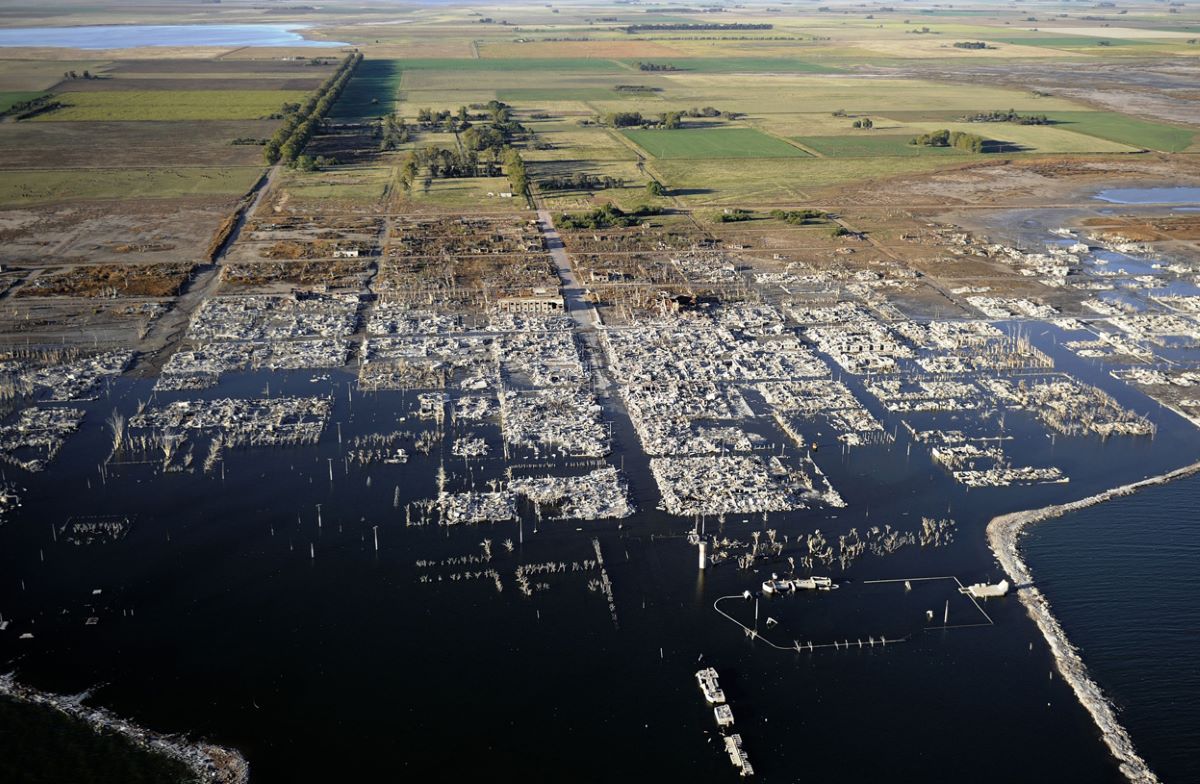
The silence here is not empty; it is defiant. It presses against your eardrums, a physical weight only occasionally punctured by the sharp, brittle sound of boots crushing crystallized salt. Walking down the Avenida de Mayo requires a recalibration of the senses. In any other city, this avenue would be a cacophony of traffic and commerce. Here, in the spectral remains of Villa Epecuén, it is a blindingly white tunnel of petrified destruction that simply would not stay buried.
To the uninitiated eye, the scene suggests a sudden, violent cataclysm—a bombing raid or a tectonic shear. But the violence here was fluid, and the aftermath is something far rarer than simple ruin. You are standing in a drowned world that has been regurgitated by the earth, mummified in brine, and left to bleach under the ruthless Patagonian sun. The "trees" lining the avenue are no longer flora; they are skeletal remains, stripped of bark and foliage, standing like bleached tibias driven into the earth. They do not sway in the wind; they rattle.
This is the "intellectual vertigo" of Epecuén. It is a place where the domestic and the apocalyptic collide. A rusted bedframe sits perfectly upright in a field of salt; a concrete staircase leads to a second floor that no longer exists; a street sign points towards a hotel that is now just a pile of saline rubble. It is the Argentine Atlantis, but unlike the myth, this city did not vanish into the abyss to be forgotten. It drowned, it waited, and it re-emerged. It is a ghost town in Argentina that serves as a terrifyingly beautiful monument to a city that refuses to die.
Geography of the Abyss: Lago Epecuén
To understand the ruin, one must understand the weapon: the water.
Lago Epecuén is not a normal lake. It is an endorheic basin—a terminal lake with no outlet to the ocean. Like the Dead Sea in the Middle East or the Great Salt Lake in the US, it loses water only through evaporation, leaving behind a hyper-saline concentrate. The salinity levels here are roughly ten times higher than the ocean.
Located in the far southwest of the Buenos Aires province, about 600 kilometers from the capital, the lake has historically gone through cycles of drought and abundance. However, the water here is heavy, oily, and buoyant. It supports the body effortlessly, a trait that originally birthed the town’s prosperity. But this same mineral density is what makes the ruins today look so alien. The water did not just destroy the town; it calcified it. When the lake receded, it left behind a crust of white crystals on every surface—brick, iron, wood, and plastic—unifying the debris into a single, monochromatic nightmare.
The Golden Age: An Aristocratic Playground
Long before it was a grail site for dark tourism, Villa Epecuén was the jewel of the pampas. From the 1920s through the 1970s, this was where the Argentine aristocracy came to heal. The mineral-rich waters were touted by physicians as a cure-all for rheumatism, skin diseases, and depression.
Imagine the arrival of the luxury trains from Buenos Aires in the 1950s. The platforms bustled with porters carrying leather trunks. The air smelled of sulfur and expensive perfume. The town boasted stats that rivaled major resorts:
- Over 280 businesses, including lodges and guesthouses.
- Grand hotels like the Hotel Royal and the Hotel Monte Real.
- Capacity to accommodate 5,000 to 7,000 tourists simultaneously.
It was a place of leisure and high society. Families strolled the promenade, eating alfajores and watching seaplanes land on the mirrored surface of the lake. There were castle-like structures, formidable stone embankments, and a sense of permanence. The residents believed they had tamed the hostile geography. They exported the mud and the water; they bottled the magic of Epecuén. It was a golden age of seemingly endless summer, where the laughter of children in the salt baths drowned out the geological ticking clock.
The Hubris of Construction
The tragedy of Epecuén is a classic narrative of engineering hubris. As the town grew, so did the demand for water consistency. The natural cycles of the lake—receding in drought, rising in rain—were bad for business. To stabilize the shoreline, the government and local authorities engaged in a series of hydraulic interventions. Canals were dug to bring fresh water in; embankments were raised to keep the salt water out.
The town expanded aggressively towards the water, building lower and lower, trusting the earthen walls to hold back a lake that had been fluctuating for millennia. It was a gamble against gravity and climate. By the late 1970s and early 1980s, a cycle of heavy rains began to pummel the province of Buenos Aires. The lake began to swell. The hydraulic systems designed to regulate the water were overwhelmed, and the political instability in Argentina at the time meant infrastructure maintenance was neglected. The beast was waking up, and the cage was rusting.
The Rising Tide: The 1985 Epecuén Flood
The end did not come with a scream, but with a seep. There was no tsunami, no crashing wave that wiped the town from the map in an instant. The 1985 Epecuén flood was a slow-motion horror.
On November 10, 1985, a massive volume of water broke through the earthen embankment protecting the town. At first, it was just water in the streets—ankle deep. Residents moved furniture to higher floors, assuming the government would fix the breach. But the water kept rising. One centimeter an hour. Then a foot a day.
It was an unstoppable, oozing invasion. The salt water saturated the foundations of the buildings. It wasn't just wet; it was corrosive. As the adobe and brick soaked up the brine, they lost their structural integrity and dissolved. Within weeks, the town was uninhabitable. Families packed what they could into trucks, fleeing their ancestral homes as the water lapped at their doorsteps.
- 1986: The town was under four meters of water.
- 1993: Villa Epecuén was submerged under ten meters of water.
The town did not die; it held its breath. For twenty-five years, the grand hotels, the playgrounds, the slaughterhouse, and the homes were preserved in a cold, dark, saline suspension.
The Drowning: Twenty-Five Years of Silence
During those two and a half decades, Epecuén existed only on maps and in memory. The Carhué thermal waters nearby continued to attract some visitors, but the old town was a lost city. Under the surface, the strange chemistry of the lake was at work.
Salt is a preservative. In a freshwater flood, biological matter rots. Wood decays, bodies decompose, and iron rusts into nothingness. In the hyper-saline waters of Epecuén, the process was different. The salt inhibited the bacteria that cause decay. Furniture was pickled. Trees were cured. The iron rusted, yes, but the oxidation was seized by crystallization. The town was being transformed into a hard, calcified reef. It was becoming a statue of itself.
The Emergence: A Mummified Resurrection
In 2009, the weather cycles shifted again. A prolonged drought struck the region, and the waters of Lago Epecuén began to recede. Slowly, the town re-emerged. But it was not the town that had vanished in 1985.
The receding water revealed a landscape that defied logic. It looked as though a layer of white ash had covered the entire world. This was the salt. As the water evaporated, the salt crystallized on every available surface, coating the red bricks in white, turning the grey concrete into sparkling quartz-like structures.
The Ruins of Epecuén today are a monochromatic study in texture. The streets are paved with a crunchy layer of sulfate. The buildings are roofless shells, their interiors exposed to the sky like dollhouses ripped open. You can walk into a dining room and see the fireplace, the rusted remains of a chandelier, and the distinct line on the wall marking the water level. It is a resurrection, but a ghastly one. The town has returned as a mummified corpse, perfectly preserved in its moment of death.
The Architectural Sentinel: Francisco Salamone’s Slaughterhouse
Among the ruins, one structure commands immediate, uneasy attention. Standing on slightly higher ground at the edge of the devastation is the Municipal Slaughterhouse (Matadero), designed by the legendary architect Francisco Salamone.
Salamone is a cult figure for urbex enthusiasts and architecture historians alike. Known for his futuristic, Art Deco, and sometimes Fascist-leaning monumentalism in the 1930s, he built municipal buildings across the pampas that looked like sets from the film Metropolis.
The Francisco Salamone slaughterhouse in Epecuén is a masterclass in functionalist menace. Its tower, a sharp, blade-like vertical thrust, dominates the flat horizon. The flooding did not topple it, though the water lapped at its upper reaches. Today, it stands as a grim sentinel over the wreckage. The concrete is stained and cracked, the grand letters "MATADERO" still visible, a testament to a time when state infrastructure was built with the grandeur of cathedrals. Seeing this imposing, modernist structure surrounded by the organic chaos of dead trees and crumbled brick creates a profound dissonance—the order of the state versus the chaos of the flood.
The Necropolis: A Cemetery Unsealed
Perhaps the most visceral encounter with the reality of Epecuén occurs at the cemetery. When the waters rose, they did not spare the dead. The cemetery was inundated, and the result was the stuff of gothic nightmares.
The force of the water and the erosion of the soil caused the vaults to crack open. Coffins were dislodged from their niches. During the height of the flood, locals recount the horror of seeing coffins floating in the lake.
Now that the waters have receded, the cemetery is a chaotic jumble of broken marble and exposed brick. Many of the tombs lie open, their contents long since claimed by the lake or relocated by families. Broken crosses lie half-buried in the salt. It is a necropolis unsealed, a stark reminder that in Epecuén, even the finality of death was interrupted by the intrusion of the water. The silence here is different—it is respectful, terrified, and absolute.
Domestic Ghosts: Inside the Shells of Homes
While the slaughterhouse and cemetery offer grandeur and horror, the true emotional weight of Epecuén lies in the domestic ruins. Wandering off the main avenue, you enter the privacy of people's lives.
You step over a threshold where a door once stood. The floor tiles, patterned in the style of the 1970s, are still there, scrubbed clean by the salt. You see a rusted tricycle fused to the ground. You see the metal skeleton of a mattress spring, the fabric long gone, looking like a torture device. In a bathroom, a toilet bowl sits filled to the brim with salt crystals, looking like a perverse art installation.
These tactile details induce a profound sadness. You realize that this wasn't just a "site"; it was a collection of sanctuaries. People cooked dinner here, argued here, made love here. The suddenness of their departure is recorded in the objects left behind. The salt has stripped the color, but it has preserved the shape of their lives.
The Sole Survivor: A Conversation with Pablo Novak
Amidst this desolation, there is a pulse. Pablo Novak, born in 1930, is the town’s only inhabitant. When everyone else fled to the neighboring town of Carhué or further afield, Novak eventually returned. He refused to abandon his home.
Living in a small, dusty house on the fringe of the ruins, Novak has become a living legend—the Guardian of the Ruins. With his weathered face, beret, and bicycle accompanied by his dogs, he is often found cycling through the debris.
"I saw this town born, and I saw it die."
He is not a ghost; he is a man of flesh and blood who has chosen to coexist with the ghosts. For Pablo Novak, the ruins are not scary; they are his memories made manifest. He reads the newspaper in the sun, boils water for mate, and welcomes the journalists and tourists who treat him like a sage of the apocalypse. His presence grounds the surreal experience; he reminds us that human resilience is just as stubborn as the salt.
The Dark Tourist's Grail: Why Epecuén Stands Alone
For the dedicated dark tourist, Villa Epecuén is not just another stop on the map; it is a holy grail. Unlike the irradiated exclusion zone of Pripyat, where the danger is invisible and the decay is biological, Epecuén offers a completely different sensory palette. It is the only place on earth where you can walk through a modern city that has been "pickled."
The appeal here lies in the texture of the apocalypse. In most abandoned locations, you are watching the slow rot of damp wood and the encroachment of green vines. Here, the process is reversed. The destruction is white, dry, and crystalline. It feels less like Earth and more like the surface of a dead moon.
This is aesthetic dissonance at its peak. The contrast between the brilliant blue sky, the blinding white salt, and the grey concrete creates a visual language that is almost impossible to find elsewhere. It satisfies the "ruin lust" (Ruinenlust) not through darkness and shadow, but through blinding light and exposure. There are no fences keeping you back, no Geiger counters ticking in your pocket. It is just you and the silent, heavy weight of a drowned world. It is the ultimate "limit experience"—a confrontation with a reality where our civilization has already lost.
A Photographer’s Mecca: Light, Salt, and Shadows
For visual artists, abandoned places in South America don't get more photogenic than this. Epecuén is a study in high contrast. The ground is white, the sky is often a piercing blue, and the ruins are shades of grey and rust.
Photographers flock here for the "golden hour." When the sun sets over Lago Epecuén, the light hits the salt crystals, and the entire town glitters as if covered in diamonds. The dead trees cast long, spindly shadows that look like calligraphy on the white earth. Music video directors and filmmakers have used the site as a stand-in for post-apocalyptic wastelands. The aesthetic is undeniable: it is Mad Max meets Salvador Dalí. The visual data is so overwhelming that it is almost impossible to take a bad photograph, yet capturing the feeling of the silence is the true challenge.
Logistics of the Visit: From Carhué to the Ruins
Reaching this remote wasteland requires intention. The gateway to the ruins is the town of Carhué, located about 7km away. Carhué itself is a functioning town that has pivoted its identity to support the "thermal tourism" and the historical curiosity of the flood.
- Access: Travelers usually arrive by bus or car from Buenos Aires (a 6 to 7-hour drive).
- Entry: From Carhué, a dirt road leads to the site. There is a small visitor center, the "Centro de Interpretación," located at the former train station, which offers context and history.
- Method: The site is open during daylight hours. While you can drive part of the way, the best way to experience the ruins is on foot. It allows you to hear the crunch, to smell the salt, and to navigate the smaller alleyways that cars cannot pass.
Safety and Hazards: Walking on Crystallized History
A word of warning to the urban explorer: Epecuén is not a theme park. It is an un-sanitized disaster zone.
- Structural Integrity: The standing walls are suspect. Rebar protrudes from the ground like rusted spears.
- The Salt: It is abrasive and can be sharp. Falling here means getting cut by crystals and infecting the wound with hyper-saline grit. Sturdy boots are non-negotiable.
- The Elements: In summer, the heat is amplified by the reflection off the white ground, creating a blinding oven. In winter, the wind off the lake cuts through layers of clothing. The environment is hostile, reminding you that you are a guest in a place that has evicted humanity once before.
The Resilience of Carhué: Life After the Flood
The story of Epecuén ends not with death, but with adaptation. The neighboring town of Carhué lived in fear that the water would take them too. When the waters stopped rising, Carhué had to reinvent itself. They lost their primary economic engine (the tourism of Villa Epecuén), so they built new thermal parks using the same lake water, but further inland.
They have embraced the ruins as a cultural asset. They host marathons through the salt flats; they support the documentary crews. The people of Carhué have demonstrated a profound resilience, turning the site of their greatest loss into a new engine for survival.
Conclusion: Memento Mori on a Civic Scale
Villa Epecuén is a Memento Mori on a civic scale. It is a whisper in the ear of every modern city: You, too, are temporary.
The concrete we pour, the steel we erect, and the embankments we build are fleeting attempts to impose order on a chaotic planet. Nature always reclaims its territory. Sometimes it takes millennia; in Epecuén, it took an afternoon.
Yet, as you leave the ruins and drive back towards the lights of Carhué, the feeling is not entirely one of despair. You have walked through the apocalypse and seen that life continues on the periphery. The story survives. The salt preserves. And in the figure of Pablo Novak, cycling against the wind, we see that while buildings may drown, the human spirit is remarkably buoyant. The town refused to die, and in doing so, it became immortal.
Sources & References
- The Atlantic: "The Ruins of Villa Epecuén" – [Photo Essay detailing the visual history].
- BBC News: "The town that spent 25 years underwater" – [Interview with Pablo Novak and historical account].
- NASA Earth Observatory: "Lago Epecuén, Argentina" – [Satellite imagery analysis of water levels].
- ArchDaily: "Francisco Salamone: The monumental architecture of the Pampas" – [Architectural analysis of the Slaughterhouse].
- Independent: "Argentina's ghost town: The ruins of Epecuén" – [Travel and logistics report].
- The Guardian: "Sole survivor of the drowned town" – [Profile on Pablo Novak].
- Weather.com: "The Climate Events behind the 1985 Flood" – [Meteorological data].
- Atlas Obscura: "Villa Epecuén" – [Guide to the specific ruins and oddities].
- Municipality of Adolfo Alsina (Carhué): Official tourism records and historical archives regarding the evacuation.
- National Geographic: "Haunting photos of a town that drowned" – [Visual storytelling of the site].