How a British Consul Demolished Dougga’s Ancient Mausoleum
The workmen arrived in 1842 with crowbars and orders to take the tower apart. Their target was the Libyco-Punic Mausoleum, a 21-meter limestone tomb that had stood on the southern slope of Dougga for roughly two thousand years — one of only a handful of intact monuments left from the kingdom of Numidia. The man who sent them was Sir Thomas Reade, the British consul in Tunis, and he did not want the tomb. He wanted one stone in it: a limestone frieze carved with a short text in two scripts, Punic on the left, Numidian on the right. To get the slab to London, his crew pried the monument apart from the top down, and the tower came down in pieces across the hillside.
Reade got his stone. The bilingual frieze went to the British Museum, where it remains today under inventory numbers 494 and 495. The slab turned out to be a key. In 1843 the French scholar Ferdinand de Saulcy used the two parallel texts to decipher the easternmost variant of the Libyco-Berber alphabet — the written language of the people who built the tomb. A diplomat had wrecked a royal monument to carry off a souvenir, and that souvenir unlocked a lost script.
The mausoleum standing at Dougga now is a reconstruction, rebuilt between 1908 and 1910 by the French archaeologist Louis Poinssot, who gathered the scattered blocks off the ground and fitted them back together as best he could. He never knew exactly where the inscription had sat or how the inner chambers were arranged.
This is the contradiction that runs through every stone at Dougga. The town is the best-preserved Roman small town in North Africa because the modern world mostly left it alone — and the moments the modern world did reach for it, it reached to take pieces away or to clear people out. Dougga survived Numidians, Carthaginians, Romans, Vandals, and Byzantines. The damage that defines its most famous monument was done by a nineteenth-century collector. The blow that finally emptied it of human life was struck in the name of saving it.
From Numidian Capital to Roman Town: The Origins of Thugga
People lived on this hill long before Rome existed. Bronze Age dolmen graves scattered across the northwestern edge of the site point to settlement here by at least 2000 BC. By the sixth century BC the place had a name written in the Libyco-Berber alphabet as TBGG, and it grew into one of the most important towns of the Numidian kingdom — likely an early capital under Massinissa, the Numidian king who outmaneuvered Carthage and Rome in turn during the second century BC. The town’s tangled, irregular streets, unusual for a Roman site, are the fingerprint of that older Numidian layout the Romans built over rather than erased.
Dougga sat 130 kilometers from Carthage, close enough to absorb Punic culture and gods, far enough inland to keep its own. When Rome destroyed Carthage and later annexed eastern Numidia under Julius Caesar in 46 BC, the town did not become Roman overnight. For generations it ran as two communities sharing one hill: a pagus of Roman settlers who answered to Carthage, and a civitas of Numidians governed by their own Punic-style magistrates, the suffetes. The fusion took centuries. The town was promoted to a municipium under the emperor Septimius Severus and finally to a full colonia, its two halves welded into one Roman city after more than two hundred years of living side by side.
The Libyco-Punic Mausoleum and the Lost Alphabet of Numidia
The Tomb of Ateban and the Bilingual Inscription That Cracked the Libyan Script
The mausoleum was built in the second century BC for a Numidian dignitary named Ateban, son of Iepmatath, son of Palu — a name recovered only because the inscription Reade stole spelled it out. The tower rose in three diminishing levels on a five-step base, decorated with false windows, pilasters, and a horseman and four-horse chariot near the top. It is one of just three surviving examples of royal Numidian funerary architecture, a style with no clear parallel in the Roman world and closer cousins in distant Anatolia.
The frieze on its podium carried the same text twice, once in Punic and once in the Numidian language. That doubling is the only reason anyone today can read the Libyco-Berber script at all. The carved stone gave de Saulcy a Rosetta-style bridge: known Punic on one side, unknown Numidian on the other, the same words in both. The alphabet he reconstructed from it is the ancestor of Tifinagh, the script still used by Amazigh communities across North Africa — a thread running from this hilltop tomb to living languages today. The same indigenous building instinct shows up elsewhere in Tunisia, in the Berber families who carved their homes down into the earth at Matmata.
How a Diplomatic Souvenir Hunt Tore the Monument Down
Western travelers had been sketching and measuring the mausoleum since the seventeenth century, treating it as a curiosity on the road between Carthage and the interior. Reade was the one with the means and the will to take it. He treated the inscription as a prize for the British Museum and the monument around it as an obstacle, and his workmen dismantled the structure to free the slab.
The result was a heap of carved limestone lying in the dirt for sixty-six years. Poinssot’s reconstruction restored the silhouette but not the certainty — the tomb you photograph at Dougga today is a careful guess assembled from rubble, missing the very text that gave it a name. The most valuable thing the monument ever held now sits in a glass case in London, fourteen hundred miles from the hill it was carved for.
Romanizing Dougga: The Capitol, the Forum, and the Temple of Saturn
The Capitol of Dougga and the Apotheosis of Antoninus Pius
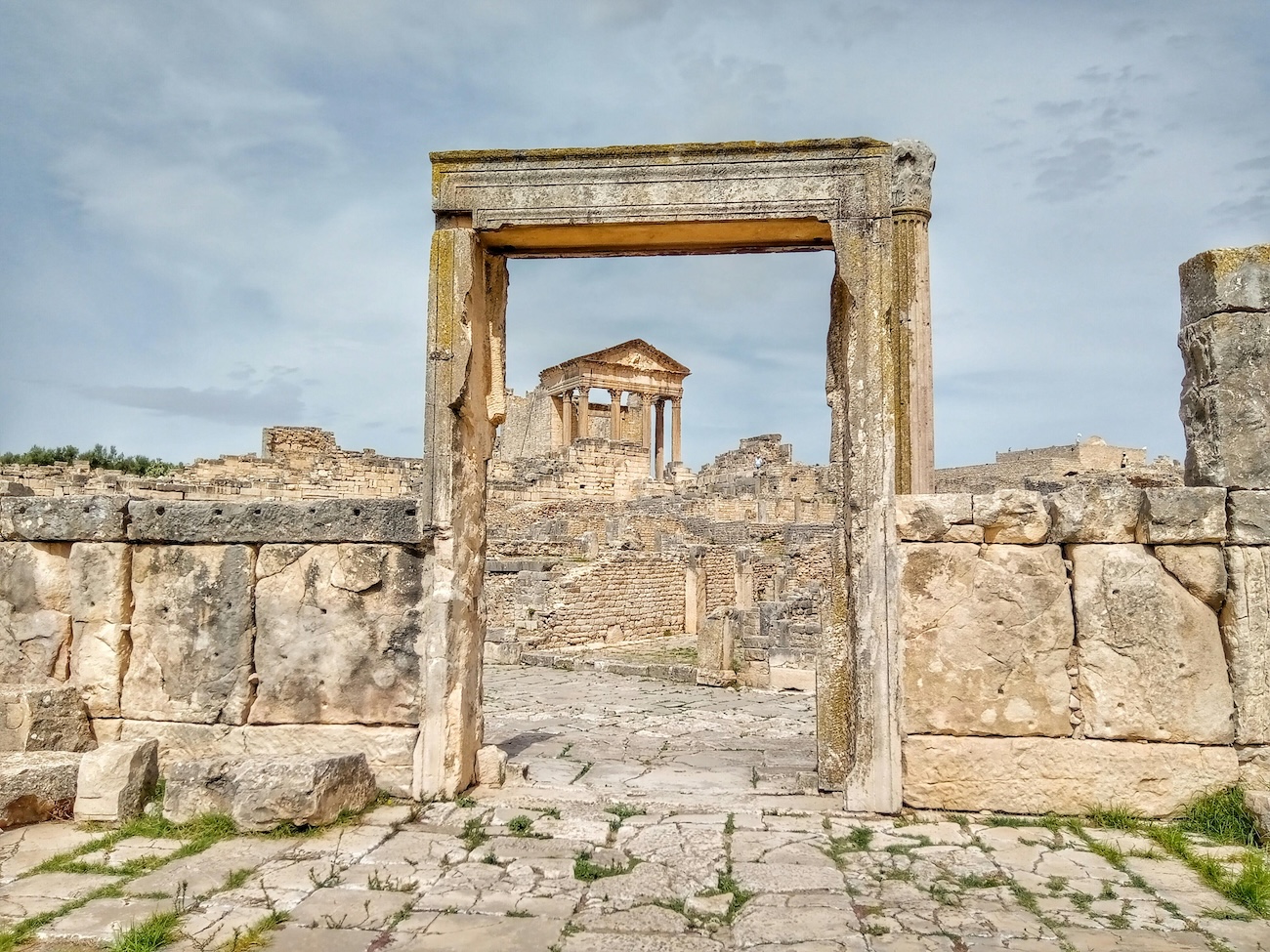
The Capitol is the building everyone photographs, and it owes its survival to an accident of war. Built in 166–167 AD by two members of a wealthy local family, the Marcii — Lucius Marcius Simplex and Lucius Marcius Simplex Regillianus — it was dedicated to Rome’s protective triad of Jupiter, Juno, and Minerva. Six Corinthian columns nearly ten meters tall still hold up its pediment. Inside once stood a colossal statue of Jupiter; in front of the temple, two great pillars are thought to have carried statues of the emperors Marcus Aurelius and his deified brother Lucius Verus, set so they faced the gods across the forum.
Look up at the pediment and the carving shows the emperor Antoninus Pius being lifted into the sky by an eagle — his apotheosis, the moment a dead emperor becomes a god. That image of a man turned divine has survived seventeen centuries in open air for a blunt reason: in the Byzantine period, soldiers wrapped the Capitol inside the wall of a hilltop fortress, and the stone box that imprisoned the temple is what shielded it from collapse and looting. The most Roman thing on the hill was saved by the people who came after Rome.
The Temple of Saturn and the Punic Gods That Refused to Die
The Temple of Saturn dominated the northern approach to Dougga, and the god it honored was a disguise. Saturn in Roman Africa was the old Punic deity Baal Hammon under a new name, worshipped on the exact ground where his earlier temple had stood. The Romans did not stamp out the local gods here — they renamed them and kept the altars warm. The same swap happened across town at the Temple of Juno Caelestis, an elegant crescent-colonnaded sanctuary built for a goddess who was really Tanit, the great mother of Carthage, fitted into a Roman costume.
This is what makes Dougga’s skyline strange when you count it: more than twenty temples for a town of perhaps five to ten thousand people. The density was not piety alone. Wealthy families paid for temples the way later generations endowed libraries — public monuments that advertised the donor’s fortune and bought him standing. Belief and vanity built the same walls. The town wore a Roman face over a Punic one over a Numidian one, and never fully shed any of them.
Daily Life in a Roman African Town: The Theatre, the Baths, and the Mosaics
The Theatre of Dougga and the Priest Who Paid for It
The theatre was a gift, and the donor made sure everyone knew it. Built in 168–169 AD by Publius Marcius Quadratus — a kinsman of the men who paid for the Capitol — it cut nineteen tiers of seating into the hillside, room for 3,500 spectators in a town that may have held fewer than twice that. Quadratus paid out of his own pocket and celebrated the opening with stage shows and athletic games, then had a long inscription carved across the stage building recording that he built it with curtains and decorations on becoming flamen for life, one of the highest priesthoods in the city. He bought the town a theatre and bought himself immortality on its wall, and the gamble half worked: his name still rides the frieze, and during the annual Dougga Festival, audiences again fill those nineteen tiers to watch classical drama on a stage eighteen centuries old.
The Ulysses Mosaic and the Twelve-Seat Latrine
The floors of Dougga’s private houses told stories in stone. The finest is a third-century mosaic of Ulysses lashed to the mast of his ship as he sails past the Sirens, his crew rowing with wax-stopped ears while bird-legged women crowd the rocks with their instruments. The piece once anchored the floor of a wealthy villa, a host’s way of showing both his taste and his Greek learning to dinner guests. It no longer lies in Dougga. Like most of the town’s best mosaics, it was lifted and carried to the Bardo Museum in Tunis, leaving the villa it decorated as bare rooms open to the sky.
Dougga also left behind the plumbing of ordinary life. One of the most-visited spots on the site is the communal latrine, a horseshoe of stone seats where a dozen residents once sat shoulder to shoulder over a running channel, conducting business and gossip at the same time. The town also had baths from around 300 AD, cisterns fed by a spring two hundred meters off, and two triumphal arches straddling its roads — one for Septimius Severus, raised in 205 AD, another for Alexander Severus a generation later. These are the bones of an ordinary prosperous life, the kind that leaves behind toilets and bathhouses rather than battlefields.
Decline, Byzantines, and the Fortress Built from the Forum
Dougga’s fall was undramatic, which is exactly why so much of it remains. The town slipped into decline through the fourth century as the Roman order frayed across North Africa. When the Byzantines retook the region in the sixth century, they did not build fresh — they tore stone from the existing monuments and threw up a fort around the forum, the same brutal recycling that locked the Capitol inside a defensive wall and, by accident, preserved it. The Islamic period that followed did not abandon the hill either; a mosque went up among the ruins, and people kept living there, generation after generation, in the shells of Roman houses.
Dougga faded rather than fell. Where Palmyra was blasted apart in a single ideological campaign, Dougga simply shrank — from a Roman colonia of thousands to a farming village of a few hundred, its temples turned into walls, its theatre into a quarry, its forum into a fort. The continuous habitation is the secret of its preservation. The columns stood because people lived among them and had no reason to knock them down.
The Village Inside the Ruins: How Dougga Became a Ghost City
A village still filled Dougga at the end of the nineteenth century — about sixty dwellings, some three hundred people, farming the same fertile valley the Numidians had farmed, drawing water from cisterns the Romans had cut, praying in a mosque built from imperial stone. Children grew up with the Capitol for a backyard. Families hung laundry between two-thousand-year-old columns. The town had never stopped being a town.
French archaeologists arrived after France established its protectorate over Tunisia in 1881, and they saw the residents not as the latest chapter of Dougga’s history but as an obstacle to it. Serious excavation began in 1901, concentrating first on the forum, and the diggers wanted the living villagers gone so the dead city could be cleaned and displayed. Removal became policy. It was finished by the independent Tunisian state in the 1960s, when the last inhabitants were permanently relocated to a plain, purpose-built settlement nearby called Dougga Jadida — New Dougga. The move was not agreed to. It was carried out through official pressure, threats, and the simple weight of a state deciding that ruins mattered more than residents.
The logic was preservation, and the preservation is real — without the clearance, modern concrete might have swallowed the site the way it swallowed much of Carthage. The cost was a community uprooted from a hill its ancestors had held for more than two and a half thousand years. The same arithmetic emptied the Anatolian hillsides of Kayaköy, where people were removed and a town left to stand as an open-air relic. Dougga is now a place you walk through, not a place anyone lives. The streets are swept and labeled. The houses are roofless rooms with explanatory signs. The town outlasted every empire that ever claimed it and lost its last inhabitants to an archaeology department.
Visiting Dougga Today
Dougga sits roughly 110 kilometers southwest of Tunis, perched at 571 meters on a hill above the Oued Khalled valley, near the modern town of Téboursouk. The drive takes about two hours through hills planted with olive groves and grain; trains run several times daily from Tunis to Gaafour, with a short taxi to finish the trip. The site is large — around seventy hectares of theatre, temples, baths, arches, villas, and tangled streets — and it receives only about fifty thousand visitors a year, leaving most of it quiet enough to hear the wind move through the columns.
The emptiness is the experience and the unease. Standing in the Capitol’s shadow or climbing the theatre’s tiers, the absence of crowds makes Dougga feel like the survivor it is, a complete Roman town with the volume turned down. The same emptiness has a harder edge once you know where the last villagers went, and that the silence on the hill was manufactured. Walk it knowing both things at once: that you are seeing one of the most intact ancient cities on earth, and that the price of that intactness was paid by families carried down to a drab new village within living memory. The stones were saved. The people were moved. Dougga keeps both truths under the same Tunisian sun.
Frequently Asked Questions About Dougga
Where is Dougga and how do you get there?
Dougga sits on a hilltop in northern Tunisia, about 110 kilometers southwest of Tunis near the town of Téboursouk, in the Béja Governorate. The most common route is a roughly two-hour drive from Tunis through olive groves and grain fields. Travelers without a car can take a train from Tunis to Gaafour and finish with a short taxi ride, or a bus to Jendouba followed by a longer taxi. The site is remote, which is part of why it survived so intact.
Why is Dougga so well preserved?
Dougga is the best-preserved Roman small town in North Africa because it was never violently destroyed and never overrun by modern construction. The town faded slowly over fifteen centuries rather than being sacked, and people kept living among the ruins, giving them no reason to demolish the standing structures. Its remote countryside location spared it the fate of Carthage, which was pillaged and rebuilt many times. The Capitol owes its survival to a Byzantine fortress that encased it in protective stone.
What is the Libyco-Punic Mausoleum at Dougga?
The Libyco-Punic Mausoleum is a 21-meter tomb built in the second century BC for a Numidian dignitary named Ateban, one of only three surviving examples of royal Numidian architecture. It once carried a bilingual inscription in Punic and Numidian, which allowed the French scholar Ferdinand de Saulcy to decipher the ancient Libyco-Berber alphabet in 1843. In 1842 the British consul Thomas Reade had the monument torn apart to remove the inscription for the British Museum, where it remains today. The tomb you see now is a reconstruction assembled from the scattered blocks between 1908 and 1910.
Is anyone still living at Dougga?
No one lives at Dougga today, but people did until the twentieth century. A village of around 300 residents occupied the ruins at the end of the 1800s, farming the valley and worshipping in a mosque built from Roman stone. French archaeologists wanted them removed to excavate and display the site, and the independent Tunisian state completed the relocation in the 1960s, moving the last inhabitants to a purpose-built village called Dougga Jadida. The move was carried out through official pressure rather than agreement.
Is Dougga worth visiting and what can you see there?
Dougga is widely considered one of the finest Roman archaeological sites in Africa and rewards a visit of several hours. The highlights include the towering Capitol dedicated to Jupiter, Juno, and Minerva, a 3,500-seat theatre still used during the annual Dougga Festival, the temples of Saturn and Juno Caelestis, public baths, two triumphal arches, and the reconstructed Libyco-Punic Mausoleum. With only about 50,000 visitors a year, the site is usually quiet, letting visitors walk its tangled ancient streets almost alone.
Sources
Dougga / Thugga (World Heritage List No. 794) — UNESCO World Heritage Centre (1997)
Les ruines de Dougga — Claude Poinssot, Institut National d’Archéologie et d’Arts (1958)
Dougga — Gabriel Camps, Encyclopédie berbère, tome XVI (1992)
Topographie religieuse de Thugga (Dougga) — Sophie Saint-Amans, Ausonius Éditions (2004)
L’architecture romaine du début du IIIe siècle av. J.-C. à la fin du Haut-Empire, tome 2 — Pierre Gros (2001)
Résurrection d’un monument : le mausolée libyco-punique de Dougga — HAL-SHS open archive (2022)
The Dougga Bilingual Inscription, Punic and Libyan (Collection Records 494–495) — The British Museum
Local Communities and Archaeological Sites: A Case Study at Dougga in Tunisia — The Ancient Near East Today, ASOR (2024)
Thugga — Mark Cartwright, World History Encyclopedia (2016)
Thugga — Encyclopaedia Britannica (Britannica Editors)
Inside Tunisia’s Bardo Museum: The World’s Largest Collection of Roman Mosaics — Smithsonian Magazine (2016)