The Mihrab in the Forest
The wall of the Great Mosque at Gedi was once studded with porcelain.
The niche that points the way to Mecca, the mihrab, set into the qibla wall of the 15th-century congregational mosque at the center of the city, was decorated with imported Chinese bowls pressed flat into wet coral plaster. The bowls came from a kiln in the Longquan district of Zhejiang province, on the southern coast of China, approximately 9,000 kilometers away. They were green-glazed celadon, the kind reserved at the Ming court for imperial banquets. They had arrived in East Africa as ballast and luxury cargo on dhows that had crossed the Indian Ocean on the monsoon winds, traded their way down the Swahili coast, and ended up embedded in a wall that the men who set them there believed would face Mecca for the rest of time.
In the spring of 1948, a British archaeologist named James Kirkman walked into the forest at Gedi for the first time. He later wrote that he could feel something watching him from behind the walls, neither hostile nor friendly, waiting for what it knew was going to happen. The bowls were still in the mihrab. The coral walls were still standing. The pillar tombs still stood in their orderly rows inside the inner wall. The forest had grown over the houses and the streets and the wells, and the city had been empty for approximately three hundred years.
This is the story of Gedi. It is the archaeological proof that medieval East Africa was not a periphery of the world. It was a hinge point in a global trading network that connected Beijing to Baghdad to the coast of Kenya, and the still-unsolved abandonment of the city in the 17th century is the story of how that network died. The forest swallowed Gedi so completely that no European recorded its existence until 1884, by which point the people who had built it were no longer entirely sure who had.
The Swahili Coast and the Indian Ocean Trading World
Gedi was one of more than a hundred medieval Swahili settlements along a 3,000-kilometer strip of African coastline that ran from Mogadishu in the north to Sofala in the south. The chain included Lamu and Pate and Malindi and Mombasa in present-day Kenya, Kilwa Kisiwani and Zanzibar and Kilwa Kivinje in present-day Tanzania, and a dozen island states in the Comoros and on the Mozambique coast. They were governed by sultans, populated by Swahili-speaking Muslims of mixed Bantu and Arab descent, and built almost entirely of coral stone and lime mortar. They traded with each other, with the Persian Gulf, with Gujarat in India, and with the southern Chinese ports. They had been doing this since at least the 9th century.
By the 14th century, the Swahili coast was the western terminus of one of the largest commercial systems in human history. The Indian Ocean trade moved ivory, gold, mangrove timber, ambergris, slaves, and dried fish out of Africa, and brought in Chinese porcelain, Indian cotton, Persian glass, Arabian dates, and Venetian beads. None of this required Europeans to function. None of it depended on the Atlantic. The system would not encounter a serious European disruption until the Portuguese arrived in 1498.
Why Gedi Was Built Three Kilometers Inland
The peculiarity of Gedi, the thing that distinguishes it from every other major Swahili city, is that it was not built on the coast.
It sits three kilometers inland, set back behind a screen of dense coastal forest, with no direct line of sight to the Indian Ocean and no harbor of its own. The Swahili convention was to build directly on the water. Mombasa and Malindi and Lamu and Kilwa all sat at the edge of natural anchorages, with the sea visible from every doorway. Gedi did not. To reach the coast from the city walls, a resident had to walk through several kilometers of forest to the small landing at Mida Creek, where ocean-going dhows could enter the mangrove estuary at high tide.
The reasons for the setback have never been fully explained, and the question is one of the active research problems for archaeologists working on the site. The leading hypotheses are defensive: that Gedi was built to be invisible from the sea, behind a forest screen that concealed its existence from passing fleets. The Portuguese, who controlled the coast from 1498 to the 1690s, do not appear to have known Gedi was there. The Chinese, whose treasure fleets under Admiral Zheng He visited Malindi in 1414 and 1417, left no record of it either. The city traded actively with both worlds, but it did not advertise itself. That decision, more than any other single fact about Gedi, kept its archaeology intact.
A City of Coral and Lime
The Gedi that James Kirkman began excavating in 1948 was a city of roughly 45 hectares enclosed by two concentric walls. The inner wall surrounded an elite quarter of stone houses, mosques, and tombs covering approximately 18 hectares. The outer wall, lower and less heavily built, enclosed agricultural land, wattle-and-daub houses for craftspeople and servants, and the city's secondary mosques. Beyond the outer wall, in mud and palm-thatch houses that have left no archaeological trace, lived the bulk of the population: an estimated 2,500 to 3,000 people at the city's peak in the 15th century.
The architecture was made almost entirely from materials within walking distance. The walls were built of coral rag, blocks of fossil coral quarried from the limestone reef inland and cemented with lime mortar made by burning more coral in kilns. The roofs were palm thatch, called makuti, supported on wooden beams from the surrounding forest. The floors were lime concrete polished to a hard white finish. The drainage systems, in the elite houses inside the inner wall, included flush toilets with private cesspits and individual washbasins set into the bedroom walls. By the standards of contemporary 15th-century Europe, the sanitation at Gedi was substantially in advance of anything in London.
The Pillar Tombs and the Great Mosque
The center of the inner wall was a complex of religious and funerary architecture that constituted the public face of the city. The Great Mosque, built in the middle of the 15th century and rebuilt approximately a century later, was the congregational mosque used for Friday prayers. Its rectangular hall was supported by three rows of coral pillars, with the middle row running down the center of the building and obscuring the view of the mihrab, a layout found nowhere outside East Africa. Its courtyard contained a deep well, a stone cistern, and a conduit for ritual ablution. There was no minaret. The call to prayer was given from the roof.
Adjacent to the mosque stood four large pillar tombs, the distinctive monumental form of the Swahili coast: a rectangular masonry tomb with a tall column rising from one end, often octagonal or hexagonal in cross-section, decorated with recessed panels and inset porcelain bowls. The pillars are unique to the East African coast. They do not appear in Arabia, in Persia, or anywhere else in the Islamic world. Their function is debated; the simplest reading is that they marked the graves of important sheikhs and merchants, with the height of the pillar signaling the social rank of the deceased.
One of the four pillar tombs, located inside the inner wall, carries an Arabic inscription incised in plaster that gives the year of construction in the Islamic calendar: 802 AH, corresponding to 1399 CE. The Dated Tomb, as Kirkman called it, is the only firmly dated monument at Gedi and has served ever since as the stratigraphic anchor for the entire site. Celadon and Islamic monochrome ceramics found above the level of the tomb were laid down in the 14th and 15th centuries. Yellow and black Islamic wares found below it date from earlier centuries, allowing the city's foundation to be pushed back to at least the 12th century.
The Palace of Gedi
Approximately a hundred meters northwest of the Great Mosque stands the structure that Kirkman called the Palace. It is the largest single residential building at Gedi, covering approximately a quarter-acre, and it is the only one in the city that combined elite domestic quarters with what may have been administrative and commercial functions.
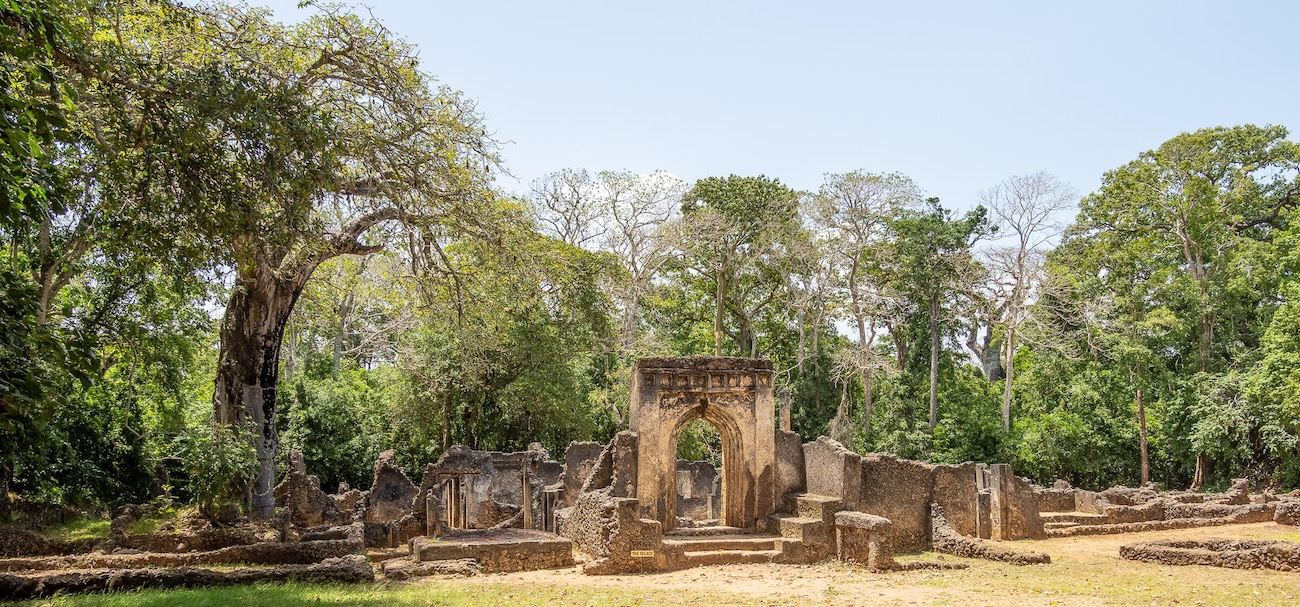
The Palace is a multi-courtyard complex enclosed within its own walled precinct. The main entrance, a pointed arch on a raised platform approached by a flight of steps, leads down into a sunken court. Beyond the court is a series of interconnected reception rooms, private quarters, storage rooms, and lavatories. A later annex, built in the late 15th century at the northern end of the complex, may have served as expanded women's quarters and includes four apartments each with its own private courtyard and lavatory, plus a fifth room that may have been a royal shop.
Whether the Palace housed a ruling family, a council of sheikhs, or some other governing institution remains uncertain. There is no contemporary written record from Gedi itself, and the city does not appear by name in the Kilwa Chronicle, the principal indigenous Swahili historical document. Whoever lived in the Palace, they did so in considerable comfort. Their bowls came from China, their beads came from Murano, their textiles came from Gujarat, and their drinking water came from a private well in the courtyard.
The Global Network That Ran Through Gedi
The Chinese Porcelain in the Coral Walls
The most striking single artifact category at Gedi is the Chinese porcelain. The collection on display at the small site museum includes pieces from every major Chinese export style of the medieval period: Longquan celadon from the late Yuan and early Ming dynasties, blue-and-white from the 15th and 16th centuries, monochrome whites, brown-glazed wares from Fujian. Some of the pieces were imported as complete vessels and used domestically; others were broken and set into walls and tomb pillars as decorative inlays. The mihrab of the Great Mosque, the pillar of one of the four large tombs, and the recessed panels of several elite houses all carried embedded porcelain bowls at the time of their original construction.
The route by which the porcelain reached Gedi can be reconstructed from contemporary records. Chinese kilns in Jiangxi and Zhejiang fired the bowls for export. They were carried overland to ports on the southern Chinese coast, principally Quanzhou and Guangzhou, where Arab and Persian merchant ships purchased them as deck cargo. They sailed across the South China Sea to Malacca, across the Bay of Bengal to Calicut on the Malabar Coast of India, across the Arabian Sea to Aden or Hormuz, and then southwest along the East African coast on the seasonal monsoon. The whole journey took approximately eighteen months and passed through perhaps a dozen separate intermediaries. The Ming dynasty's official voyages under Admiral Zheng He, which reached Malindi in 1414 and again in 1417, may have brought additional porcelain directly, but the bulk of the supply came through the existing commercial channels.
For perspective: when the Dated Tomb was inscribed at Gedi in 1399, Geoffrey Chaucer was still alive in England, the Hundred Years' War had thirty-four years left to run, and Columbus would not be born for another fifty-two years. The Swahili merchants of Gedi were already trading with China.
Venetian Glass, Indian Cotton, Persian Iron
The porcelain is the famous artifact category. It is not the only one. The Gedi museum's collection also includes Venetian glass beads in the distinctive cane-and-millefiori styles of the Murano workshops, cotton textile fragments traceable to the Gujarati weaving towns of western India, iron lamps and tools from Persian production centers in modern-day Iran, Spanish scissors of a 16th-century pattern, and cowrie shells from the Maldives that appear to have served as a secondary currency alongside silver coins. The total assemblage represents a city plugged simultaneously into Mediterranean, Middle Eastern, South Asian, East Asian, and Indian Ocean exchange networks. The convention for which Gedi is occasionally compared to medieval Venice, Chinguetti, or the trans-Saharan termini of Mali holds: a small, wealthy city whose entire economic existence was built on being a node in a long-distance trading system it did not control.
What Gedi Sent Out
The reciprocal question, the harder one, is what Gedi sent the other way. The archaeological evidence is sparser for outbound goods than for inbound ones, but the contemporary trade records of Arab and Persian merchants, supplemented by Portuguese reports from the 16th century, indicate four principal exports: ivory, gold, mangrove timber, and slaves.
Ivory came from elephant herds in the African interior, brought down to the coast by Bantu and Cushitic traders who exchanged it for porcelain and cloth. Gold arrived from the Mutapa kingdom in the Zimbabwean highlands, the same source that fed the contemporary stone city at Great Zimbabwe. Mangrove timber, harvested from the East African coastal swamps and prized in the timber-poor Persian Gulf, was the most consistent cash export. Slaves, captured in raids on the interior and sold through the Swahili coastal cities to buyers in Arabia, Persia, and India, are documented in Arabic sources from the 9th century onward. The East African slave trade was contemporaneous with, distinct from, and substantially older than the Atlantic system that would later operate through Elmina Castle. It did not stop when Gedi was abandoned. It continued through Zanzibar and Mombasa into the second half of the 19th century.
The Abandonment
The Gedi that Kirkman excavated had been empty for approximately three hundred years when he reached it. The dating of the abandonment is constrained by the absence of certain ceramic types in the final occupation layer. No Chinese porcelain later than the early 17th century has been found at the site. No Persian wares later than the same period. The site appears to have been continuously occupied through the 12th, 13th, 14th, 15th, and 16th centuries, with a brief interruption and partial rebuilding sometime in the late 15th century, and then a final emptying-out somewhere between approximately 1620 and 1650.
There are three principal theories for why this happened. None of them is fully satisfactory.
The Three Theories
The oldest and most widely repeated theory, advanced by Kirkman himself, is that Gedi was overrun by the Galla, a Cushitic-speaking pastoralist people from southern Somalia, also known by their own name as the Oromo. In the late 16th and early 17th centuries, Oromo war bands raided down the East African coast from their original territory in the Horn of Africa, sacking several Swahili coastal cities and destroying many of the smaller mainland towns. The dates of the raids approximately align with the abandonment of Gedi. The hypothesis fits the chronology. It does not, however, fit the archaeology of the final occupation layer, which shows no signs of violent destruction, no concentration of weapons, no scattered human remains, no fire damage of the kind that would be expected from a sacking. Gedi seems to have been emptied, not stormed.
The second theory is hydrological. The wells at Gedi, of which there are dozens, draw on a coastal aquifer that is sensitive to sea-level fluctuation and rainfall variation. Oral tradition collected by Mijikenda elders in the 20th century and recorded by Kenyan researchers describes a period when the city's wells turned salty and then dried up entirely, forcing a gradual evacuation. The hypothesis is consistent with the gradual, orderly pattern of abandonment visible in the archaeology. The difficulty is that the surrounding area continued to be inhabited at lower densities by the Mijikenda and other groups after Gedi was emptied, suggesting that the aquifer was not catastrophically damaged.
The third theory is commercial. The Portuguese arrived at Malindi, three kilometers down the coast from Gedi, in 1498. Within a generation they had restructured the entire trade economy of the Swahili coast in their own favor, fortifying Mombasa with Fort Jesus in 1593 and forcing the surviving Swahili sultanates into tributary relationships. Gedi, which had survived on its position as a node in a free-flowing commercial network, may simply have been priced out of the new system. There is no battle and no sacking in this version of events. There is only a city whose economic reason for existing had quietly stopped applying, and whose inhabitants drifted away to Mombasa, to Lamu, or to the smaller settlements where they could still make a living.
The most credible answer is probably some combination of all three. The Portuguese rerouted the trade; the wells gradually failed; the Oromo raids made the surrounding countryside unsafe for the remaining population. By the middle of the 17th century, the city was empty. The forest grew back over the streets.
The 1948 Rediscovery
James Kirkman and the Forgotten City
Gedi was reintroduced to European awareness in 1884 by Sir John Kirk, the British consul-general at Zanzibar, who visited the ruins and wrote a short descriptive note. The note attracted no follow-up. The site was placed on a list of African archaeological curiosities and forgotten again. In 1927, the British colonial government in Kenya declared Gedi a national monument, but no excavation followed.
The actual archaeological work began in 1948, when the colonial government appointed James Kirkman, a British archaeologist who had previously worked in Egypt and Palestine, as the warden of the new Gedi National Park. Kirkman spent the next twenty years excavating the site. He produced a series of monographs and field reports that established the basic chronology, identified the major buildings, and catalogued the artifact assemblage. The names by which most of the buildings at Gedi are now known, the Palace, the Dated Tomb, the House of the Cistern, the House of the Long Court, the House of the Scissors, were given by Kirkman, often based on a distinctive artifact or feature found inside the structure.
Kirkman recorded that he found Gedi unsettling. In one of his published accounts of the early excavations he wrote that from his first days at the site he had felt that something or somebody was looking out from behind the walls, neither hostile nor friendly, but waiting for what he knew was going to happen. The phrasing was characteristic of an archaeologist who took his subject seriously and tried to convey, in clipped colonial English, what he could not otherwise quantify. He eventually moved his living quarters from the site to a house in Malindi several kilometers away, citing in his diaries the sound of trees falling at night that left no traces by morning.
The Mijikenda and the Kaya Forests
The people who had known about Gedi the entire time were the Mijikenda, the nine related Bantu-speaking peoples of the Kenyan coastal hinterland whose territory had surrounded the ruins for centuries. The Mijikenda had not built the city, and they did not claim to have. Their oral traditions described it as the place of a vanished people whose spirits remained, and whose ground should not be disturbed.
The Mijikenda lived in fortified hilltop villages called kayas, set inside dense sacred groves of indigenous coastal forest. The kaya forests were under the management of councils of elders who restricted access, prohibited the felling of trees, and enforced traditional rules of conduct on visitors. The system had originated as a defense against the same Oromo raids that had probably contributed to the depopulation of Gedi. It had survived into the 20th century. By the time Kirkman arrived, the kaya tradition had effectively functioned for several centuries as an indigenous forest conservation regime, and the ruins of Gedi were inside the surviving belt of coastal forest the kaya rules had protected.
The relationship between Kirkman's excavation and the Mijikenda communities was difficult. The local elders, according to multiple accounts from the late 1940s and 1950s, were not pleased that the colonial government was disturbing what they regarded as a haunted and sacred site. Several Swahili and Mijikenda laborers on the dig reportedly fell ill or refused to continue working. Stories accumulated, then and since, about a curse on the excavation, about voices in the ruins at night, about people who had taken artifacts away from the site and then died unexpectedly. The stories may be true or may be embroidered. What is documented is that Gedi survived as an archaeological site primarily because the Mijikenda had preserved the forest around it, and the forest had preserved the city.
The Atlas Entry: Visiting Gedi
The Gedi Ruins lie approximately 16 kilometers south of Malindi and 110 kilometers north of Mombasa on the Kenyan coast, just inland from the small resort town of Watamu and within the boundary of the Arabuko-Sokoke Forest, the largest remaining fragment of East African coastal dryland forest. The site is operated by the National Museums of Kenya and is open daily from 7:00 a.m. to 6:00 p.m. Entry fees in 2026 are 100 Kenyan shillings for Kenyan citizens, 400 for East African Community residents, and 500 for non-residents.
The main 45-hectare archaeological zone is walkable in a couple of hours. The principal monuments, the Great Mosque, the Dated Tomb, the four large pillar tombs, and the Palace, are clustered in the northern half of the site and connected by maintained paths. A small museum at the entrance houses the artifact collection, including the Chinese porcelain, Venetian beads, and Spanish scissors that constitute the physical evidence of the city's commercial range. Local guides are available at the gate; their commentary is generally accurate and considerably enriches a visit. The trees themselves are part of the experience. Six-hundred-year-old baobabs grow out of what were once domestic courtyards. Black-and-white colobus monkeys move through the canopy. The Sokoke Scops owl, endemic to this specific forest, calls at dusk.
Watamu, the nearest town, is a small coastal tourism hub with hotels, restaurants, and the Watamu Marine National Park offshore. The combination of the Gedi Ruins, the Arabuko-Sokoke Forest reserve, and the marine park makes the area one of the most concentrated heritage and ecological destinations in Kenya, although the visitor numbers remain comparatively modest by Kenyan safari standards. The site has been on UNESCO's tentative list for World Heritage inscription since 2010 and has not yet advanced.
What this place asks of a visitor is not solemnity. It asks attention to a fact that the colonial archive deliberately suppressed: that medieval Africa was not waiting for Europe to arrive. The merchants of Gedi were buying Chinese porcelain a century before Columbus reached the Caribbean. Their city was abandoned for reasons that were probably as much about Portuguese commerce as about Oromo raids. The forest that grew over them was held in place for four hundred years by Mijikenda elders who declined to log it. The ruins are still there, three kilometers from the sea, in a coral-stone city that did not advertise itself and has not, even now, quite finished telling its story.
Frequently Asked Questions
Where exactly are the Gedi Ruins?
The Gedi Ruins, also spelled Gede, are located on the Kenyan coast approximately 16 kilometers south of Malindi, 110 kilometers north of Mombasa, and just inland from the resort town of Watamu in Kilifi County. The site sits three kilometers from the Indian Ocean inside the boundary of the Arabuko-Sokoke Forest. It is managed by the National Museums of Kenya and is open daily from 7:00 a.m. to 6:00 p.m.
Who built Gedi and when?
Gedi was built by Swahili-speaking Muslims of mixed Bantu and Arab descent, part of the broader Swahili coastal civilization that stretched from Mogadishu in Somalia to Sofala in Mozambique. The city was founded no later than the 12th century and reached its peak in the 15th century, when it had a population of approximately 2,500 to 3,000 people. The dated tomb inscription of 802 AH (1399 CE) provides the only firmly dated structure at the site and anchors the rest of the chronology.
Why was Gedi abandoned?
The abandonment of Gedi between approximately 1620 and 1650 is one of the unsolved questions of East African archaeology. Three theories compete: a raiding campaign by the Galla (Oromo) pastoralists from Somalia, who attacked coastal cities in the late 16th and early 17th centuries; a gradual failure of the city's wells, possibly due to saline intrusion from the coastal aquifer; and an economic collapse caused by the Portuguese restructuring of the Swahili coast trade after 1498. The archaeology of the final occupation layer shows no evidence of violent destruction, suggesting an orderly evacuation rather than a sack. Most contemporary scholars consider the abandonment to have resulted from a combination of all three factors.
What was found at the Gedi Ruins?
Excavations led by British archaeologist James Kirkman from 1948 to 1958 uncovered Ming Dynasty Chinese porcelain (both Longquan celadon and blue-and-white), Venetian glass beads, Indian cotton textile fragments, Persian iron lamps, Spanish scissors, Maldivian cowrie shells used as currency, gold and silver jewelry, coral-stone architecture including a great mosque and four large pillar tombs, a multi-courtyard palace, more than a dozen elite houses with flush toilets, and extensive evidence of pottery production, metalworking, and weaving. The combined assemblage demonstrates that Gedi was plugged into Mediterranean, Middle Eastern, South Asian, and East Asian trade networks simultaneously.
How was Gedi rediscovered?
Gedi was reintroduced to European awareness in 1884 by Sir John Kirk, the British consul-general at Zanzibar, who visited the ruins and wrote a short descriptive note. The site received no serious follow-up until 1927, when the British colonial government declared it a national monument. Actual archaeological excavation began in 1948 under James Kirkman, who spent twenty years at the site and produced the foundational monographs that established its chronology. The local Mijikenda communities, who lived in the surrounding kaya sacred forests, had known about the ruins continuously throughout this period but considered them haunted and refrained from disturbing the site.
Can you visit the Gedi Ruins today?
The Gedi Ruins are fully open to visitors and easily accessible from Watamu, Malindi, or Mombasa. A small site museum near the entrance displays excavated artifacts including Chinese porcelain and Venetian beads. The main archaeological area covers approximately 45 hectares and can be walked in two to three hours; local guides are available at the entrance gate. The ruins sit inside the Arabuko-Sokoke Forest reserve, and a visit combines well with the adjoining Watamu Marine National Park and the forest's own ecological attractions, including the endemic Sokoke Scops owl and resident populations of black-and-white colobus monkeys.
Sources
Gedi: Historical Monument — James S. Kirkman (1975)
The Palace — James S. Kirkman (1963)
Men and Monuments on the East African Coast — James S. Kirkman (1964)
The Early Islamic Architecture of the East African Coast — Peter S. Garlake (1966)
African Civilizations: Precolonial Cities and States in Tropical Africa — Graham Connah (1987)
The Swahili: Reconstructing the History and Language of an African Society, 800-1500 — Derek Nurse and Thomas Spear (1985)
The Swahili World — Stephanie Wynne-Jones and Adria LaViolette (eds.) (2018)
Gedi: A Swahili Town — Stephane Pradines, Annales islamologiques (2010)
The Mijikenda Kaya Forests of Kenya (UNESCO World Heritage Inscription) — UNESCO World Heritage Centre (2008)
The Indian Ocean in World History — Edward A. Alpers (2014)
Ming China and the Coastal Swahili World: The Zheng He Voyages — Tansen Sen, Journal of World History (2016)
Tentative List Submission: Gedi Historical Monument — National Museums of Kenya / UNESCO (2010)