The Crypt Beneath the Temple of Inscriptions
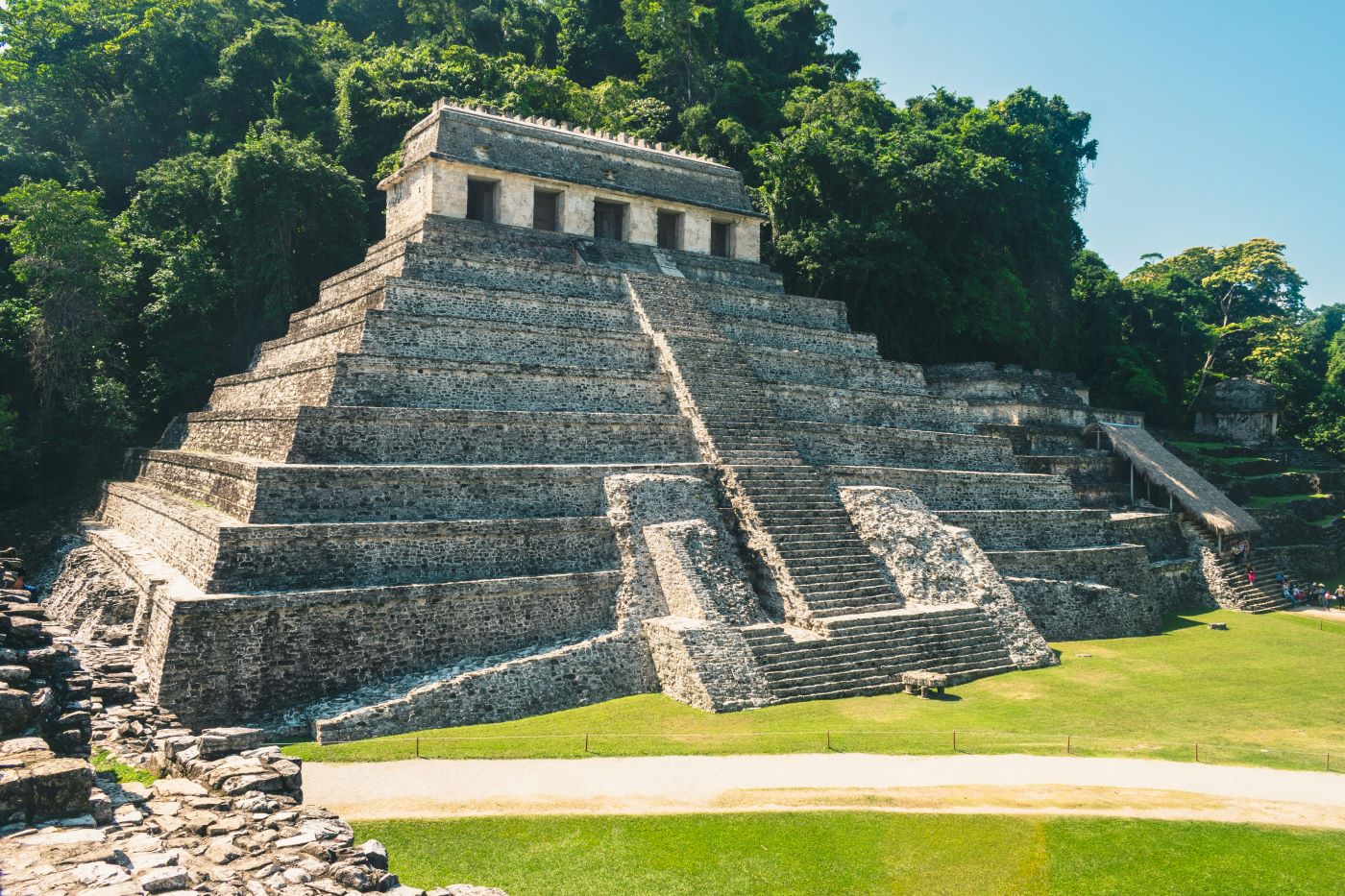
Alberto Ruz Lhuillier had been digging downward for four years. In 1949 he had noticed something the previous explorers of Palenque had walked past for two centuries: the floor of the Temple of Inscriptions, the steep pyramid crowning the site, had a slab with a double row of holes plugged with stone stoppers. The floor was meant to be lifted. Beneath it, when his workers cleared the first slab, was a stairway packed solid with rubble — tons of stone and clay deliberately rammed in to seal whatever lay below.
It took three field seasons to empty it. The stair descended in two flights, doubling back on itself, burrowing from the temple at the pyramid's summit down through its core to a point below ground level. In the choked passage Ruz's team found offerings, then a stone box holding the bones of five or six sacrificed youths — guardians for whatever waited beyond.
On June 15, 1952, Ruz reached a triangular slab set into the wall at the bottom of the stairs. He pried it aside and put his lamp through the gap.
The light fell on a vaulted chamber the size of a small chapel, its walls carved with stucco figures of long-dead lords. Filling almost the entire room was a single monolithic sarcophagus, sealed under a five-ton limestone lid carved edge to edge with imagery. Inside lay a tall man, his skeleton draped in jade — a collar, rings on every finger, a jade bead in each hand — and over the crushed bones of his face, a mosaic death mask of jade with eyes of shell and obsidian. No one had entered the room since masons bricked up the stairway in the 7th century.
This was the body of K'inich Janaab' Pakal, and his tomb rewrote the archaeology of an entire civilization. Until that morning, the consensus held that Mesoamerican pyramids were platforms for temples, never sepulchres for kings — the New World's answer to the cathedral, not the Egyptian tomb. Pakal demolished that idea from inside a chamber he had ordered built for exactly this purpose, decades before his death.
Pakal had spent his life turning a half-ruined city into a monument to his own permanence. The genius of it was total. He did not build to be remembered after he was gone. He built so that he would never be gone at all — encoding his face, his lineage, and his promised resurrection into stone designed to outlast the men who carved it. It worked far better than he could have planned. The dynasty he saved would last barely two centuries more. The tomb lasted thirteen.
The Maya World Before Palenque Rose
The Classic Maya did not build an empire. They built a constellation of rival kingdoms — dozens of city-states scattered across the lowlands of present-day Mexico, Guatemala, Belize, and Honduras, each ruled by a divine king, each locked in shifting wars and alliances with its neighbors. There was no capital, no emperor. There was Tikal, and Calakmul, and Copán, and Yax Mutal, and a hundred lesser courts, all competing for prestige, tribute, and captives.
Palenque sat at the far western edge of this world, where the limestone hills of Chiapas drop toward the Gulf coastal plain. The Maya called it Lakamha' — "Big Water" — for the streams that cut through it, and the kingdom itself B'aak, the Bone Kingdom. It was a frontier court, smaller than the great powers to the east, exposed and ambitious. That exposure nearly destroyed it before Pakal was born.
A Capital on the Edge of the Maya World
Palenque commands a natural shelf between jungle mountains and floodplain, threaded by the Otulum stream, which Maya engineers channeled through a vaulted stone aqueduct running beneath the plaza. The setting gave the city water, defensible high ground, and a stage: its temples were built against a green wall of forest that rises directly behind them, so that the white stucco buildings, once painted blood red, seemed to float at the edge of the world. The architecture here is unlike the heavy mass of Maya cities to the east — the builders of Palenque worked in thin walls, wide doorways, and delicate roof combs, and they covered nearly every surface in carved text. More of Maya history was written here than almost anywhere else, which is the only reason we know the names of the people who follow.
Pakal the Great and the Rebuilding of a Broken Dynasty
A Boy King After the Calakmul Catastrophe
Pakal inherited a humiliation. Twice within a generation, in 599 and again in 611, the armies of Calakmul — the Snake Kingdom, the most aggressive superpower of the Maya world — had marched the long distance west and sacked Palenque. The inscriptions record the catastrophe in the bitter shorthand of a defeated court: the gods themselves were "lost," the dynasty's patron deities humiliated, the sacred order broken. A king died. The royal line nearly collapsed.
Into this wreckage, in 615, a twelve-year-old boy took the throne. His full name was K'inich Janaab' Pakal — "Radiant Bird-Jewel Shield." His claim ran through his mother, Lady Sak K'uk', a problem in a culture that traced power through fathers, and one Pakal would spend his reign carving his way around. He would hold the throne for sixty-eight years, one of the longest documented reigns in the ancient Americas, dying around 683 at roughly eighty years old — an age confirmed, and then bitterly disputed, by the skeleton in the jade mask, whose bones some specialists read as belonging to a much younger man. The argument has never fully settled.
What is not disputed is what he did with those decades. A boy handed a broken kingdom rebuilt it into one of the most beautiful cities the Maya ever made.
Building Immortality in Stone
Pakal's answer to the Calakmul disaster was construction on a scale Palenque had never seen. He raised the Palace, a sprawling complex of courtyards, galleries, and subterranean passages built and rebuilt over generations, crowned by a four-story square tower unique in Maya architecture — possibly an observatory, possibly a watchtower facing the direction from which Calakmul's armies had once come. He commissioned the carved panels and stucco portraits that turned the city into a readable argument: that the dynasty was old, divinely sanctioned, and unbroken, no matter what the Snake Kingdom had done to it.
The masterwork was the Temple of Inscriptions, built over his own tomb during his lifetime. Its inner walls carry one of the longest hieroglyphic texts in the Maya world — a king-list reaching back into mythic time, binding Pakal to gods and ancestors stretching across thousands of years. He was not recording history. He was manufacturing it, welding his contested reign onto an unbreakable chain of legitimacy. Every glyph was propaganda set in limestone, and because the Maya wrote so much of it down here, Palenque later became the Rosetta Stone of Maya decipherment — the place where epigraphers in the 20th century finally cracked the script and discovered that these "anonymous" ruins had names, dates, and a dynastic drama as vivid as any in the Old World.
The Sarcophagus Lid and the "Astronaut" Myth
The five-ton lid over Pakal's body is the most famous carved stone in the Americas, and the most misunderstood. It shows the king at the instant of death, falling backward down the trunk of the world tree into the open jaws of the underworld, Xibalba, while above him the great ceiba tree rises crowned by a celestial bird — the moment of death and the promise of rebirth compressed into a single image. Smoke, bone, and the maize god's resurrection are woven through it. To a Maya viewer, it was a theology of return: the dead king becomes the rising sun.
In 1968 the Swiss writer Erich von Däniken looked at the same carving and announced, in Chariots of the Gods?, that it depicted an ancient astronaut at the controls of a rocket — Pakal's bent posture read as a pilot at his instruments, the world tree as an exhaust plume. The claim spread further than any genuine fact about Palenque ever has. It is nonsense. Every element on the lid appears, labeled and explained, elsewhere in Maya art and writing; nothing on it requires anything but a Maya king, a Maya tree, and a Maya idea of what happens after death. The carving's real meaning is stranger and more human than a spaceship: a man who built a mountain over himself so that he could be watched, eternally, in the act of becoming a god.
K'inich Kan Bahlam and the Temples of the Cross
Pakal's death did not end the building. His son K'inich Kan Bahlam II — "Radiant Snake-Jaguar" — took the throne in 684 already past sixty, and he had a dynastic problem of his own: he had to prove that the resurrection his father had promised in stone was real, that the line was divine and would continue. He answered with the most ambitious theological statement at the site.
The Three Temples and the Story They Tell
Kan Bahlam built the Group of the Cross — three temples set around a single plaza: the Temple of the Cross, the Temple of the Foliated Cross, and the Temple of the Sun. Each holds an inner sanctuary, and each sanctuary carries a carved tablet narrating the birth of Palenque's patron gods and tying that mythic birth directly to Kan Bahlam's own accession. The "crosses" are not Christian — they are the world tree again, the axis joining the underworld, the human world, and the sky. Read together, the three temples are a single argument carved across three buildings: the gods were born, the dynasty descends from them, and the new king is their living continuation.
This was the high-water mark. Under Pakal and his son, Palenque reached the peak of its art and power, a small western kingdom that had survived being sacked twice and turned its near-extinction into a golden age. The confidence in the stonework is almost audible. None of the men carving those tablets could have known how little time the city had left.
The Collapse: How Palenque Was Swallowed by the Jungle
Palenque died the way the entire Classic Maya world died — quietly, without invasion or catastrophe, in a slow unraveling no single cause fully explains. Across the 8th and 9th centuries, one great lowland city after another stopped raising monuments, stopped recording dates, and emptied out. Drought, overpopulation, exhausted soils, relentless warfare, and the collapse of belief in kings who could no longer deliver rain or victory — scholars argue the proportions, but the pattern is undeniable. The divine kings simply stopped, and the people walked away.
Palenque's last securely dated inscription falls late in the 8th century. After that, the record goes silent. There was no final battle to record, no dramatic end — only successors of diminishing power, then no successors at all. Squatters lived for a time in the decaying palaces of the god-kings, lighting cooking fires in throne rooms. Then they too left. The aqueduct silted up. The painted stucco peeled. Roots pried into the masonry, and the forest that had once been the city's backdrop closed over it completely. Within a few generations, the white city was a series of green hills, and the man in the jade mask lay sealed beneath one of them, watched by no one, exactly as he had arranged.
Rediscovery and the Atlas Entry
The forest kept Palenque hidden for the better part of a thousand years. Spanish colonists in Chiapas heard rumors of "stone houses" in the jungle, but the first formal expedition came only in 1787, when Antonio del Río hacked into the ruins on royal orders, battered through walls looking for treasure, and produced a report that — translated and published in London in 1822 — first showed Europe that a lost civilization lay in the Mexican rainforest. Others followed: the eccentric Jean-Frédéric Waldeck, who lived in a temple now bearing his name and "improved" his drawings with elephants and classical motifs that flattered European fantasies; and in 1840 the American traveler John Lloyd Stephens and the artist Frederick Catherwood, whose accurate, unsentimental account finally established that Palenque was built by Indigenous Americans and no one else — a claim that had to be argued against a century of racist disbelief.
The decisive figure remained Alberto Ruz Lhuillier, who not only opened Pakal's tomb but argued, against resistance, that the Maya wrote real history about real rulers. He was proven overwhelmingly right. The texts at Palenque became central to the breakthroughs that let scholars read Maya writing, recovering Pakal, Kan Bahlam, and Lady Sak K'uk' from anonymity. Ruz is buried near the city he gave his life to — within sight of the pyramid whose secret he carried up the stairs.
For its place among the great ruined cities of the Americas, Palenque belongs in the same conversation as Teotihuacan and Chichen Itza, each a Mesoamerican capital that reached extraordinary heights and then emptied — though only Palenque hid a named king inside its tallest pyramid. Its swallowing by the rainforest mirrors the fate of Ciudad Perdida, another jungle city that vanished from memory until the forest gave it back.
Palenque today is a Mexican national park and a UNESCO World Heritage Site, set in dense rainforest roughly eight kilometers from the modern town of the same name in Chiapas. The site is open daily; the climate is hot, humid, and frequently wet, and the stone steps are steep and slick. Visitors can climb among the Palace, the Group of the Cross, and the Temple of Inscriptions, though the tomb itself is now closed to the public to protect it — the jade mask and sarcophagus contents are held in the National Museum of Anthropology in Mexico City, with a replica crypt on display. Only a fraction of the city has been cleared; the green hills around the central plaza are still buildings, still unexcavated, still holding whatever the jungle has not yet given up.
Standing in the plaza at Palenque, the thing to hold onto is not the spectacle of the ruins but the intent behind them. A boy inherited a beaten kingdom and decided that neither it nor he would be forgotten. He was wrong about the kingdom. He was right about himself. Thirteen hundred years after masons sealed the stairway, a man with a lamp climbed down into the dark and looked at his face — and Pakal, who built a mountain to be remembered, is remembered still.
Frequently Asked Questions About Palenque
Who was buried inside the pyramid at Palenque?
The tomb inside the Temple of Inscriptions belongs to K'inich Janaab' Pakal, often called Pakal the Great, who ruled Palenque for sixty-eight years and died around 683 CE. His body was found in 1952 by the Mexican archaeologist Alberto Ruz Lhuillier, sealed in a five-ton sarcophagus and wearing a mosaic death mask of jade. It was the first royal burial ever discovered inside a Maya pyramid, overturning the long-held belief that such pyramids were only temples. His remains and burial goods are now held at the National Museum of Anthropology in Mexico City.
Is the Palenque sarcophagus lid really an ancient astronaut?
No. The carving on Pakal's sarcophagus lid shows the king at the moment of death, falling into the underworld along the trunk of the Maya world tree, with the promise of rebirth above him. The "ancient astronaut" idea was popularized by Erich von Däniken in 1968, who claimed it depicted a man piloting a rocket. Every element of the carving — the tree, the celestial bird, the underworld jaws — appears throughout Maya art and is fully explained by Maya religion, with no need for spacecraft.
Why was Palenque abandoned?
Palenque was abandoned as part of the broader Classic Maya collapse during the 8th and 9th centuries. Its last securely dated inscription falls late in the 8th century, after which the city stopped recording history. Scholars point to a combination of prolonged drought, overpopulation, soil exhaustion, constant warfare, and a loss of faith in divine kings who could no longer guarantee rain or victory. There was no single dramatic catastrophe — the population simply declined and dispersed, and the rainforest reclaimed the city.
Where is Palenque located and can you visit it?
Palenque is in the state of Chiapas in southern Mexico, set in dense rainforest about eight kilometers from the modern town of Palenque. It is a national park and a UNESCO World Heritage Site, open to visitors daily. The climate is hot, humid, and often rainy, and the stone steps are steep and slick. Visitors can explore the Palace, the Temple of Inscriptions, and the Group of the Cross, though Pakal's actual tomb chamber is now closed to the public to protect it.
What does the name Palenque mean?
"Palenque" is a Spanish word meaning "palisade" or "stockade," applied to the ruins by later Spanish colonists — it was not the city's original name. The ancient Maya called the settlement Lakamha', meaning "Big Water," for the streams running through it, and the kingdom itself was known as B'aak, the "Bone Kingdom." These original names were recovered only in the 20th century, once scholars learned to read the extensive hieroglyphic texts the city left behind.
Why is Palenque so important to Maya archaeology?
Palenque preserves some of the longest and most detailed hieroglyphic texts in the entire Maya world, including a king-list and dynastic histories carved into the Temple of Inscriptions and the Group of the Cross. These texts were central to the 20th-century breakthroughs that allowed scholars to finally read Maya writing, proving that the inscriptions recorded the real history of named rulers rather than abstract astronomy or myth alone. The discovery of Pakal's tomb in 1952 also fundamentally changed how archaeologists understood the purpose of Maya pyramids.
Sources
The Code of Kings: The Language of Seven Sacred Maya Temples and Tombs — Linda Schele & Peter Mathews (1998)
A Forest of Kings: The Untold Story of the Ancient Maya — Linda Schele & David Freidel (1990)
Chronicle of the Maya Kings and Queens — Simon Martin & Nikolai Grube (2000)
The Ancient Maya — Robert J. Sharer & Loa P. Traxler (2006)
El Templo de las Inscripciones, Palenque — Alberto Ruz Lhuillier (1973)
The Maya — Michael D. Coe & Stephen Houston (2015)
Breaking the Maya Code — Michael D. Coe (1992)
Incidents of Travel in Central America, Chiapas, and Yucatan — John Lloyd Stephens (1841)
Chariots of the Gods? Unsolved Mysteries of the Past — Erich von Däniken (1968)
The Memory of Bones: Body, Being, and Experience among the Classic Maya — Stephen Houston, David Stuart & Karl Taube (2006)
Palenque: Eternal City of the Maya — David Stuart & George Stuart (2008)