The Battle of Belchite: A History of the 1937 Siege
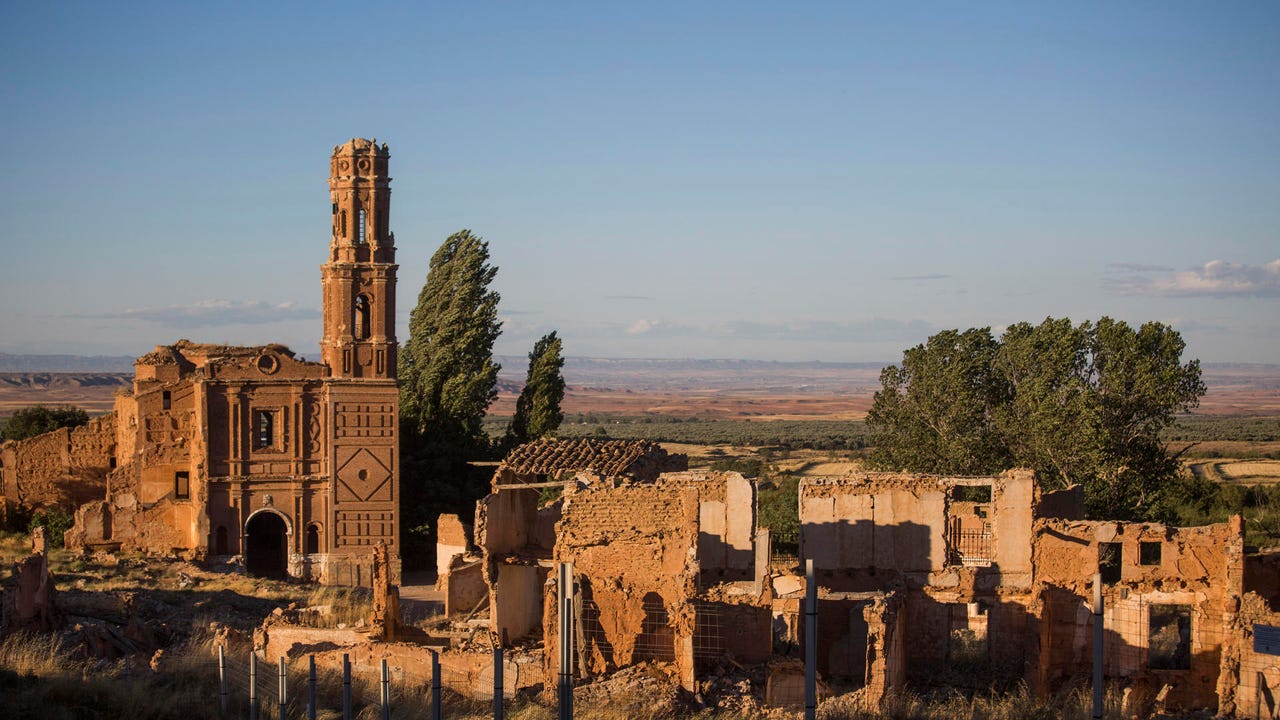
The ruins of Belchite do not represent a slow decline; they represent a sudden, violent cessation of existence. In August 1937, this town was a bustling hub of 3,800 people. By September, it was a skeletal graveyard. The air in the Aragon desert is notoriously dry, a "cierzo" wind that mummifies the landscape. When you stand in the center of the Pueblo Viejo, the silence is heavy, punctuated only by the whistle of wind through the pockmarked brickwork of the Calle Mayor. The smell is neutral—dust, sun-baked limestone, and dry sage—because the earth has long since finished reclaiming the biological remnants of the nearly 5,000 people who died within these few square kilometers.
Why the Battle of Belchite Became a Spanish Civil War Meat Grinder
The strategic obsession with Belchite was a mistake of ego and desperation. In the summer of 1937, the Republican Army of the East launched the Zaragoza Offensive to divert Nationalist troops from their crushing advance in the north. Belchite was supposed to be a 24-hour obstacle. Instead, it became a 13-day meat grinder. The Nationalist defenders, a mix of regular army and local "Requetés" (Carlist volunteers), realized that the Republican forces were executing prisoners of war. This turned the siege into a fight for biological survival. Every house was barricaded with heavy oak furniture; every wine cellar became a temporary hospital or a mass grave. The town was not taken by grand maneuvers, but by the slow, agonizing removal of one stone at a time, often at the cost of dozens of lives for a single street corner.
The Republican command, sensing the political importance of a victory on the Aragon front, refused to bypass the town even when the offensive stalled. This decision turned Belchite into a symbolic "Stalingrad of the South." The town became a magnet for fire, drawing in artillery from both sides until the very geography of the streets was altered by mounds of brick and human remains. By the fifth day, the paved roads were gone, replaced by a churned landscape of gray dust and jagged metal.
Republican vs. Nationalist Forces in the Aragon Offensive
The data of the conflict reveals a massive disparity in hardware that only highlights the brutality of the street fighting. The Republican side deployed 80,000 men, supported by 100 tanks—mostly Soviet T-26s with 45mm guns—and 90 aircraft, including the high-speed Polikarpov I-16 "Mosca" fighters. Inside the town, fewer than 3,000 Nationalists were trapped, many of them local civilians who had picked up rifles to defend their homes.
The logistics of the siege were nightmarish. The Republican forces cut the water pipes from the Aguasvivas River, forcing the defenders to survive on the liquid from canned goods and radiator water in 40°C heat. This dehydration led to a breakdown in sanity; records from the siege describe soldiers hallucinating under the relentless sun while the smell of three thousand unburied corpses in the streets created a pervasive, sickening miasma. The Republican troops were not immune; they had to sleep in the same dust that was saturated with the rot of their enemies. The battle wasn't just fought with bullets; it was fought against the biological limits of the human body.
Inside the Ruins of Pueblo Viejo de Belchite
To walk through Belchite today is to walk through a forensic reconstruction of urban demolition. The town was not razed by fire, as was the case with the systematic arson at Oradour-sur-Glane; it was dismantled by kinetic energy.
The Architecture of Destruction: San Martín de Tours Church
The San Martín de Tours church serves as the structural heart of the ruins. Its 15th-century Mudejar bell tower is the most iconic silhouette in the "Pueblo Viejo," but its beauty is secondary to its ballistic record. The tower was used by Nationalist snipers, who had a clear line of sight over the Republican approach. Consequently, it was targeted by Republican 75mm and 105mm artillery. The base of the tower is gouged by deep impact craters where the ancient brick has been pulverized into red dust.
Inside the nave, the collapse of the vaulted ceiling has left the interior exposed to the elements. You can still see the holes in the masonry where thick timber beams once supported a choir loft. The remaining plaster on the high walls is peppered with thousands of small-caliber indentations—the scars of a final, desperate stand inside the sanctuary. Civilians huddled in the side chapels while the central nave became a kill zone. The statues of saints were decapitated by shrapnel, and the floor, once polished stone, is now a mixture of bird droppings and shattered glass.
Street-to-Street Fighting and the Physics of Urban Warfare
The physics of the fighting in Belchite were dictated by the density of the town's medieval layout. The streets were narrow and winding, meaning tanks were often useless or became easy targets for dynamite. Republican "dinamiteros"—often miners from Asturias who had joined the militias—would blow holes through the walls of adjoining houses to bypass the snipers in the street.
This created a "tunneling" effect through the city. Combatants would move through a whole block without ever stepping outside, fighting from kitchen to bedroom to attic. When you look at the remains of the houses today, you are looking at raw cross-sections of 19th-century Spanish life. You see the blue-tinted plaster of a bedroom where a family once slept, a fragment of a spiral staircase leading to a non-existent second floor, and the blackened remains of a kitchen hearth. These homes were not just buildings; they were the primary fortification of the Nationalist defense, and they were destroyed from the inside out.
Franco’s Propaganda: The Creation of a Living Monument
After the war ended in 1939 with a Nationalist victory, Francisco Franco visited the ruins. His decision to preserve the site was not an act of historical preservation or respect for the dead; it was a calculated move in psychological warfare and domestic control.
Why Francisco Franco Refused to Rebuild Belchite
Franco issued a formal decree that Belchite was to remain exactly as it stood at the end of the siege. He wanted it to serve as a permanent, weaponized reminder of "Red Barbarism." By keeping the ruins visible, he could point to the pockmarked churches and collapsed homes as proof of the Republic's supposed hatred for Spanish tradition, religion, and the family unit.
This turned Belchite into a state-mandated propaganda set, a "frozen" version of the trauma that also saturated Montjuïc Castle and the Puente Nuevo of Ronda. While other cities were rebuilt under the "Devastated Regions" program, Belchite was left to rot. It was a physical narrative designed to justify forty years of dictatorship through a carefully curated lens of victimhood. The ruins weren't meant to be remembered; they were meant to be used as a warning.
The "New Belchite" and the Sociological Impact of the Ruins
The survivors were not allowed to reclaim their ancestral homes or salvage their belongings. Instead, they were moved into the "New Belchite," a sterile, planned village built immediately adjacent to the ruins by Republican prisoners of war. This was a final irony: the men who had fought to take the town were forced to build the replacement for the people they had displaced.
For eighty years, the residents of the new town have lived within 500 meters of their own ruins. This created a unique sociological trauma: the townspeople were forced to be spectators to their own tragedy. Every time they went to the bakery or the post office, they looked across the fence at the hollowed-out shells of the houses where they were born. Their former parlors and churches were turned into a nationalist shrine that they were forbidden from touching or mourning privately. This proximity ensured that the war never "ended" in Belchite; it simply moved across the road, leaving the Old Town to rot as a silent, unburied witness to a conflict that the state refused to let the people forget.
The Legacy of the Ruin
Belchite occupies a specific, dark niche in the atlas of human tragedy. It is the missing link between the deliberate massacre of civilians and the collateral damage of total war.
Sites of Mass Execution in the Spanish Civil War
While Belchite was a battlefield, it was also a site of mass execution. During the Republican occupation, priests, landowners, and anyone suspected of right-wing sympathies were rounded up and shot near the San Agustín convent. When the Nationalists retook the area in 1938, they responded with equal ferocity, purging anyone suspected of Republican ties.
This cycle of retribution mirrors the history of the Puente Nuevo of Ronda, where the 120-meter drop was used as a shortcut for execution without the need for a firing squad. In both locations, the architecture of the town—a bridge in Ronda, a convent in Belchite—was repurposed as a tool for political erasure. Belchite is simply the largest and most visual concentration of this fratricidal impulse in all of Spain.
War Ruins as Cinema: Belchite in Pan's Labyrinth and Hollywood
In the late 20th century, the meaning of Belchite began to shift from political monument to aesthetic backdrop. The absolute visual power of the ruins—the jagged brickwork, the skeletal towers, and the sense of an arrested apocalypse—attracted the global film industry.
Terry Gilliam used the site for The Adventures of Baron Munchausen, and Guillermo del Toro used the entrance to the Old Town for the opening sequence of Pan’s Labyrinth. This transition has commercialized the ruins, creating a deep tension between those who see the site as a sacred cemetery and those who see it as a dramatic location for hire. The "aesthetic of ruin" often masks the reality of the bodies still buried in the cellars. When you see a film set in a war zone, you are seeing a sanitized version; in Belchite, the set is real, and the blood that stained the stones was not corn syrup.
Visiting Belchite: Ghost Town Tours and Ethics
A visit to Belchite is not a casual stroll through a park; it is a clinical encounter with a disaster zone that remains politically charged and physically dangerous.
How to Visit Belchite: Logistics, Tickets, and Safety
The ruins are located in the province of Zaragoza, approximately a 45-minute drive from the city center. Access is strictly controlled via guided tours, which can be booked at the tourist office in the New Town. This is a functional necessity; the structures are in a state of terminal collapse. Every winter, the cycle of freezing and thawing further compromises the Mudejar brickwork.
Visitors are required to wear helmets in certain zones and must stay on the designated paths. The physical experience is one of intense exposure—the Aragon sun is a relentless force, and there is absolutely no shade within the Pueblo Viejo. You must carry your own water, a requirement that feels grimly appropriate given the history of the 1937 siege. The ground is a treacherous mix of loose gravel, shattered tile, and rusted metal; sturdy footwear is non-negotiable.
The Dark Tourism Ethics of the Spanish Civil War
The ethics of standing in Belchite are complex and require a high degree of sensitivity. Unlike Oradour-sur-Glane, where there is a clear, unified national narrative of mourning against a foreign occupier, Belchite remains a point of contention in Spain's "Memory Wars."
Some visitors come to mourn the Nationalist "Crusade," while others come to honor the Republican International Brigades. As a visitor, the challenge is to navigate this political friction without being consumed by it. The reality of the site is not political; it is biological and structural. It is the record of what happens when a society collapses so completely that it chooses to destroy its own house rather than live in it together. To visit is to bear witness to the ultimate failure of civil discourse, written in stone and bullet holes.
FAQ: Understanding the Ruins of Belchite
Why was Belchite left in ruins instead of being rebuilt?
Following the Nationalist victory in 1939, Francisco Franco issued a decree that the town should remain untouched as a "monument to the Crusade." It was a calculated move to create a permanent, physical piece of propaganda. By building "New Belchite" immediately adjacent to the destruction, the regime forced the survivors to live as perpetual witnesses to the "Red Barbarity" that allegedly destroyed their homes. This made Belchite the largest "living" war museum in Western Europe.
How many people died during the 1937 Battle of Belchite?
While casualty figures for the 13-day siege are often debated due to the chaos of the front, historians generally agree on a death toll of approximately 5,000 people. This includes Nationalist defenders, Republican attackers, and trapped civilians. When factoring in the wounded, the total casualty count exceeds 10,000. Many of the dead were never given formal burials; they were shoveled into communal pits or abandoned in the cellars of the homes that collapsed on top of them.
Can you visit Belchite without a tour guide?
No. Since 2013, the Pueblo Viejo (Old Town) has been fenced off for safety and preservation reasons. The structures are in a state of terminal collapse, and the risk of falling masonry is constant. Visitors must join a scheduled guided tour, which departs from the tourism office in the New Town. These tours are conducted in Spanish, though private English tours can sometimes be arranged in advance.
Is the site considered haunted?
While "The Dark Atlas" approaches history through a sociological lens, Belchite is a primary destination for paranormal investigators in Spain. They cite the violent nature of the deaths and the "trapped" energy of the ruins. However, the "haunting" of Belchite is best understood as the enduring psychic weight of the Spanish Civil War—a conflict that remains unresolved in the national consciousness. The "ghosts" are the unburied political tensions that the ruins continue to radiate.
What is the connection between Belchite and the International Brigades?
Belchite was a significant theater for foreign volunteers. The Abraham Lincoln Brigade (Americans) and the British Battalion were heavily involved in the house-to-house fighting. For many of these volunteers, the siege of Belchite was their first experience with the visceral reality of urban combat. Several American writers and journalists, including Ernest Hemingway and Martha Gellhorn, reported on the Aragon front, cementing Belchite’s dark reputation in the English-speaking world.
Sources & Citations
- The Spanish Civil War: A History - Hugh Thomas (2001)
- The Battle of Belchite: The Aragon Offensive - Records of the International Brigades (1937)
- Arrested Decay: The Propaganda of Ruins - Aragon Cultural Heritage Dept (2022)
- Franco's Monuments: The Architecture of Victory - S. Michonneau (2017)
- The Lincoln Brigade at Belchite - Abraham Lincoln Brigade Archives (ALBA)
- The Physics of Siege: Dehydration and Morale - Military History Quarterly
- Cinema of the Dead: Belchite in Pan’s Labyrinth - British Film Institute (BFI)
- Mass Graves of the Aragon Plain - Association for the Recovery of Historical Memory