The Monks Who Mortared Skulls into Their Own Bedroom Walls
Sometime in the late 16th century, three Franciscan monks walked into the dormitory where they had slept for years and began covering its walls with human remains.
The room was part of the cloister of the Convento de São Francisco, the first Franciscan house in Portugal, established in the 13th century on the southern edge of Évora. The dormitory had housed monks for generations — men who rose before dawn, prayed in the adjacent church, and returned to these stone walls each night. The three monks who undertook the chapel's construction — their names unrecorded, their identities absorbed into the anonymity they imposed on the dead — transformed the space where they had once laid their heads into a room where 5,000 skulls would stare back at anyone who entered.
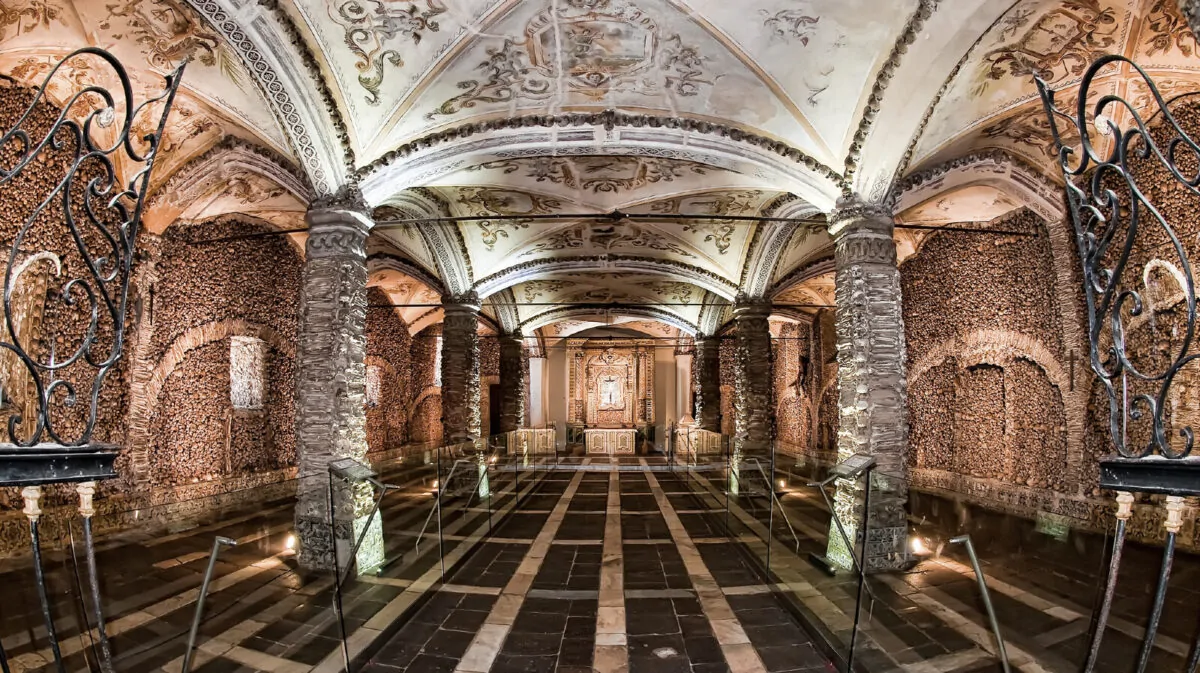
The logistics alone required years. The monks exhumed remains from as many as 43 cemeteries scattered across Évora and its surrounding monasteries. They sorted long bones — femurs, tibias, humeri — from smaller, irregular fragments and from skulls. The long bones were stacked horizontally, like logs in a woodpile or bricks in a kiln, to create the structural fabric of the walls. Skulls were reserved for decorative emphasis: set into cornices, arranged in jagged lines tracing the arches, and embedded at eye level along the eight pillars that divide the chapel's three naves. The mortar was coarse and grey, though a section near the entrance — deliberately left exposed for visitors — reveals that many bones are simply stacked without adhesive, held in place by geometry and the weight of the bones above them.
Above the doorway, they carved eight words into marble. Nós ossos que aqui estamos pelos vossos esperamos. The syntax is precise and deliberate. The bones are not described as resting. They are described as waiting. The inscription does not look backward into history; it looks forward, directly at the visitor, and claims their future.
Évora in the 16th century was not a quiet provincial town. It was the second city of Portugal — a favored residence of the royal court, the site of a Jesuit university founded in 1559, and the seat of one of Portugal's three Inquisition tribunals, which over the course of 200 years processed approximately 9,500 cases and staged public condemnations in the Praça do Giraldo that numbered in the tens of thousands. The city was saturated with theology, wealth, and death simultaneously. The 43 cemeteries that choked its outskirts were the physical residue of centuries of accumulated mortality in a city that had grown too fast and buried too deep. The Franciscans solved a sanitation crisis by turning it into a sermon. The dead who had been consuming valuable land became, in their hands, the building material for a chapel designed to cure the sin of forgetting that life ends.
Every society must eventually negotiate what to do with its dead when the dead outnumber the space available for them. What it chooses reveals everything about its relationship with mortality. The Franciscans of Évora chose to make death visible, permanent, and unavoidable. Four centuries later, the choice still works.
Évora's Golden Age and the Crisis of the Overflowing Dead
Royal Capital, Inquisition Seat, and the Richest City in the Alentejo
Évora's golden age began in the 15th century, when the Portuguese royal court began residing there for extended periods. King Manuel I built a palace in Gothic-Renaissance style. The Cadaval family, governors of the city, occupied a fortress whose towers still bracket the skyline. Convents, churches, and noble houses multiplied across a city whose Roman foundations — including a 1st-century temple still standing in the upper town — gave it a gravity that Lisbon, sprawling and chaotic by comparison, could not match.
The establishment of the Inquisition tribunal in 1536 added a darker dimension. Évora became one of only three permanent seats of the Portuguese Holy Office, alongside Lisbon and Coimbra. The tribunal's primary targets were conversos — Jews who had converted to Christianity under duress and were suspected of practicing their original faith in secret. The Praça do Giraldo, the central square where a Renaissance fountain still stands, became the stage for autos-da-fé — public sentencings that, over the course of two centuries, condemned an estimated 22,000 people. The Inquisition Palace, a stone's throw from the Roman temple, today functions as an arts and culture center. The bones in its neighboring chapel may include the remains of people whose families were shattered by the tribunal's judgments — though the anonymity of the exhumations makes certainty impossible.
The Jesuit university, founded in 1559 by Cardinal-King Henrique, attracted scholars from across Europe. The Flemish humanist Nicolas Cleynaerts, serving as a tutor at the Portuguese court, arrived in Évora in 1535 and recorded his impressions of a city where intellectual ambition and religious coercion existed side by side. Évora was simultaneously a place of extraordinary learning and extraordinary punishment — a city where the same generation that studied Aristotle also watched heretics burn.
43 Cemeteries and the Logistics of Medieval Burial
The cemetery crisis was the inevitable consequence of this concentrated urban life. By the 16th century, Évora's monasteries, convents, and parishes maintained at least 42 or 43 separate burial grounds within and around the city walls. Medieval burial practice in Portugal, as across Catholic Europe, treated graves as temporary. A body was interred, allowed to decompose over a period of years, and then exhumed to make room for the next occupant. The bones were moved to charnel houses — storage rooms, usually in church crypts, where the dead accumulated in anonymous piles.
The system worked when populations were stable. It collapsed when they were not. Évora's growth as a royal capital and ecclesiastical hub meant that deaths outpaced the capacity of the existing burial infrastructure. Land that might have been used for agriculture, housing, or commerce was locked up in cemetery plots. The Franciscan convent, which had maintained its own burial grounds since the 13th century, faced the problem at close range. The monks needed the land. They needed to clear the dead. The question was what to do with the remains once they were out of the ground.
How the Franciscans Built a Chapel from 5,000 Skeletons
The Igreja de São Francisco and the Origins of the Bone Chapel
The Church of St. Francis — the Igreja de São Francisco — was itself a monument to Évora's royal ambitions. Construction began around 1470 under the direction of master masons Martim Lourenço and Pero de Trilho, and the church was completed by approximately 1510 in a hybrid Gothic-Manueline style that reflected Portugal's maritime expansion. The soaring single nave, adorned with symbols of the Order of Christ and the emblems of King João II and King Manuel I, served as a royal chapel during the court's residences in Évora. The Franciscan convent attached to it was the first house of the order in Portugal, established in the 13th century and expanded over the following three hundred years.
The bone chapel was added later, in the space of the former monastic dormitory adjacent to the cloister. Dating is imprecise — some sources place the construction in the late 16th century, around 1580 to 1590; others, including a panel at the site itself, push it into the early 17th century. The design was reportedly inspired by San Bernardino alle Ossa in Milan, a 13th-century Milanese church whose ossuary had established the template for bone chapels across Catholic Europe. The Franciscans of Évora adapted the concept to their specific conditions: a compact room, three naves measuring 18.7 meters long and 11 meters wide, lit only by three small openings on the left wall.
Sorting the Dead — Long Bones, Skulls, and the Masonry of Calcium
The construction required a systematic process that modern archaeologists describe with clinical respect. The monks first exhumed the contents of the overflowing cemeteries — a task that would have taken months, involving the manual extraction of skeletal remains from soil that had been receiving bodies for centuries. The bones arrived at the dormitory in a disordered state: fragments of ribcages tangled with pelvic bones, skulls mixed with vertebrae, the remains of infants indistinguishable from those of the elderly.
The sorting was the critical step. Long bones — femurs, tibias, humeri — were separated and grouped by type. These provided the structural mass of the walls, stacked in horizontal rows to create a surface texture resembling rough masonry. Skulls were set aside for prominent positions: embedded in the pillars at regular intervals, arranged in bands along the wall at approximately head height, and placed in clusters at the junctions of arches. The effect was deliberate — the skulls face outward, their empty orbits meeting the gaze of anyone standing in the room. Smaller bones — vertebrae, phalanges, sacral bones — were used as filler, packed into the spaces between the larger elements.
The artistry becomes intricate in the details. Rosettes and floral patterns were constructed from the rounded heads of humerus bones, creating decorative motifs that echo the Baroque plasterwork of the church next door — except that the medium is calcium phosphate rather than lime. The geometric repetition imposes a terrifying rationality on decay. Row after row, indistinguishable from one another, the skulls erase individuality as thoroughly as any mass grave — but with an intentionality that mass graves lack.
The Inscription, the Poem, and the Theology of Memento Mori
"Nós Ossos Que Aqui Estamos Pelos Vossos Esperamos"
The inscription above the doorway is not a greeting. It is a theological argument compressed into eight words. The Franciscan order, founded by St. Francis of Assisi in the early 13th century, built its identity on poverty, humility, and a direct confrontation with the material conditions of human existence. Death was not an abstraction for the Franciscans — it was the door through which every soul must pass to reach judgment, and complacency about that passage was, in their theology, among the gravest of sins.
The Counter-Reformation supplied the institutional context. The Council of Trent (1545–1563) had reasserted the Catholic Church's role as the sole mediator of salvation, and the religious orders — Jesuits, Dominicans, Franciscans — competed to demonstrate their commitment to spiritual discipline. The Jesuits built universities and deployed intellectual rigor. The Franciscans built a room where the evidence of mortality was inescapable, where a visitor could not look at any surface — wall, pillar, ceiling arch — without seeing the material proof that every body eventually becomes raw material. The chapel functioned as a spiritual gymnasium, a space designed to shock the comfortable into contemplation.
The same Inquisitorial apparatus that prosecuted conversos in the Praça do Giraldo and filled the dungeons of institutions like Castel Sant'Angelo and the torture chambers documented at Campo de' Fiori operated in Évora simultaneously with the chapel's construction. The Franciscans' memento mori was gentler than the Inquisitors' methods — no rack, no strappado, no fire — but it shared the same foundational conviction: that the living needed to be reminded, forcefully, of truths they preferred to ignore.
Fr. António da Ascenção Teles and the Poem on the Pillar
The chapel continued to generate devotional material long after its construction. Displayed in an old wooden frame on one of the bone-covered pillars is a poem attributed to Fr. António da Ascenção Teles, who served as parish priest of São Pedro — the parish within which the Church of St. Francis stands — from 1845 to 1848. The poem opens: Aonde vais, caminhante, acelerado? — Where are you going in such a hurry, traveler?
The fourteen lines function as a sonnet of reproach. The traveler is told to stop, to consider that everyone who has ever lived has ended in this same state, and that the more one pauses here, the further one advances. The final couplet inverts the logic of movement itself — standing still in the presence of death becomes a form of progress. The poem is a 19th-century addition to a 16th-century room, proving that the chapel's capacity to provoke new responses remained active across three centuries. Fr. António was not the builder. He was the chapel's latest convert, compelled to add his own voice to the walls.
The Desiccated Bodies and the Legend of the Mother's Curse
Two Mummies in Glass — Natural Preservation in Alentejo Soil
The walls of clean bone create a patterned, almost abstract background — a geometry that the mind can process as decorative, if not comfortable. The two desiccated bodies shatter that distance. An adult and a child, originally suspended from chains on the chapel wall, now displayed in glass cases near the altar, these figures retain their dried skin, cartilage, and fragments of burial shrouds. They are natural mummies, likely preserved by the dry, hot conditions of the Alentejo soil or the calcium-rich limestone environment of their original graves.
The adult hangs with a grim weight. The child's small frame triggers the instinctive recoil that the clean skulls, for all their number, do not quite achieve. These bodies occupy the space between the skeletal abstraction of the walls and the fleshed reality of the living. They represent the phase of decomposition that the chapel's other occupants have passed through and that every visitor will eventually enter — the corruption of soft tissue, the slow retreat of identity from the body. The monks who chose to display them understood their power. The bones are a concept. The bodies are a fact.
The Mother's Curse — Local Legend vs. Historical Reality
Local folklore has attached a specific narrative to the two figures. The most persistent version claims they were a father and son who tormented the wife and mother of the family. On her deathbed, the woman cursed them: "May the earth of your graves not destroy you!" The earth obeyed, preserving their bodies while consuming everyone else's, and the monks — recognizing the curse — hung them in the chapel as evidence of divine judgment.
The story is almost certainly apocryphal. Historians consider the bodies to be ordinary exhumations that happened to be unusually well-preserved — a product of soil chemistry, not supernatural intervention. The monks, recognizing an opportunity to enhance the chapel's didactic force, displayed them as explicit examples of what the clean bones could no longer show: the corruption of flesh, the intermediate state between life and skeleton. The legend's persistence, however, is itself significant. The chapel generates its own mythology. A room built to confront visitors with the unadorned reality of death has, over four centuries, accumulated exactly the kind of stories that dress reality up in narrative — curses, divine punishment, the uncanny. The bones wait. The stories grow.
The Bone Chapels of Europe — From Milan to Sedlec to Évora
The Capela dos Ossos belongs to a European tradition of ossuaries that stretches from the late medieval period through the Baroque era — spaces where the accumulated dead were not merely stored but arranged, displayed, and incorporated into architectural form. The tradition emerged from the same logistical crisis that faced Évora: cemeteries filling faster than bodies could decompose, requiring exhumation and rehousing on a scale that simple charnel houses could not accommodate.
San Bernardino alle Ossa in Milan, the chapel that reportedly inspired the Évora design, established the template in the 13th century. The Sedlec Ossuary in the Czech Republic pushed the concept further — a woodcarver named František Rint was hired in 1870 to organize 40,000 skeletons accumulated from Black Death and Hussite War casualties, and he responded by building chandeliers, garlands, and a full heraldic coat of arms from human remains, signing his name on the wall in bone. The Paris Catacombs addressed a similar crisis on an industrial scale in the 18th century, relocating roughly six million Parisians into abandoned quarries beneath the city, arranged in neat walls of anonymous uniformity.
Évora occupies a distinct position among these sites. Sedlec is theatrical — Rint's ambition turned the bones into art objects. Paris is monumental — the sheer volume overwhelms individual response. Évora is intimate and liturgical. The chapel is small enough that a visitor can see every wall simultaneously. Mass has been said in this room. The bones are not a spectacle viewed from a distance; they are the architecture that surrounds the act of prayer. The dead are not displayed for the living to observe — they are the room itself, and the living are inside them.
The Ceiling Frescoes, the Church, and the Architecture of Contrast
Death Below, Resurrection Above — The 1810 Ceiling Paintings
The vaulted ceiling offers the theological counterweight the walls demand. Painted in 1810, the frescoes depict biblical scenes, symbols of the Passion of Christ, and allegorical imagery connecting death to resurrection. One phrase appears among the painted motifs: Morre o dia, nasce o dia — The day dies, the day is born.
The ceiling prevents the chapel from collapsing into nihilism. The Franciscan theology that produced the ossuary was not a cult of death for its own sake — it was a theology of transition, in which death was the necessary passage to eternal life. The walls represent the mortal half of the equation: calcium, phosphate, the material residue of biological existence. The ceiling represents the spiritual half: light, paint, the promise that the soul survives what the body cannot. A visitor who looks only at the walls sees horror. A visitor who looks up sees the argument the monks were actually making — that the bones below are not the end of the story.
Gothic Gold and Manueline Stone — The Church That Frames the Chapel
The Igreja de São Francisco amplifies the contrast by design. The main church — accessible through the same entrance complex, included in the same admission ticket — is a masterpiece of late Gothic architecture: a soaring single nave, golden Baroque altarpieces, nautical symbols from the Age of Discovery carved into the keystones. The light inside is generous, the space expansive, the atmosphere one of elevation and triumph.
The adjacent bone chapel is the inverse. Compact, dim, heavy with the smell of old lime and dust. The Franciscans placed them side by side deliberately, creating a binary that visitors experience physically by walking from one space into the other. The golden church represents the glory of creation. The bone chapel represents the humility of the created. The gold is unbearable without the bone to ground it; the bone is unbearable without the gold to promise something beyond it. Each room requires the other. Together, they form the Franciscan argument in architecture: that divine beauty and human decay are not opposites but complements, two faces of the same theological truth.
Visiting the Capela dos Ossos — Hours, Tickets, and What to Expect in Évora
Practical Information for Visitors
The Capela dos Ossos is located within the Church of St. Francis complex on the Praça 1º de Maio in Évora, approximately 130 kilometers east of Lisbon. Évora is reachable by train (roughly 90 minutes from Lisbon's Oriente station) or by car via the A6 motorway. The chapel entrance is to the right of the main church facade, through a separate ticketed door.
Admission costs approximately €7 for adults, with concessions available for youth (12–25) and seniors (over 65). The ticket includes access to the bone chapel, the Religious Art Museum housed in the former monastery dormitory above, and a collection of nativity scenes amassed by a private collector over 35 years. The chapel is open daily, typically from 9:00 to 18:30 in summer and 9:00 to 17:00 in winter. Photography is permitted without flash.
The chapel itself is compact — a visit of 15 to 30 minutes is typical, though the surrounding complex rewards more time. The best hours are early morning (at opening, before the tour groups arrive from Lisbon) or late afternoon, when the light entering through the three small windows shifts across the bone surfaces. Peak season (July and August) brings significant crowds into a small space; spring and autumn offer a quieter experience.
Évora is a UNESCO World Heritage city whose major sites cluster within a five-minute walk of each other: the 1st-century Roman Temple, the 13th-century Cathedral (the largest in Portugal), and the former Inquisition Palace — now the Fórum Eugénio de Almeida arts center — are all immediately accessible from the Church of St. Francis.
Standing Where the Bones Speak
The chapel's atmosphere resists description because it operates on the body before it reaches the mind. The air is noticeably cooler than the Alentejo heat outside. The smell — cold lime, mineral dust, the faint metallic edge of extreme age — is specific and constant. Sound behaves differently in a room lined with irregular bone surfaces; voices drop instinctively, and the silence between them feels heavier than in a conventional church.
The emotional register shifts depending on which surface holds attention. The walls, with their geometric repetition, can be processed almost abstractly — a pattern, a texture, an architectural choice. The skulls embedded in the pillars at eye level resist that abstraction. They are specific — particular cranial shapes, particular dental configurations, the marks of particular lives lived in a particular city. The desiccated bodies near the altar resist it entirely. Standing in front of them, the distance between observer and observed narrows to nothing.
The Sedlec Ossuary offers the closest companion experience — another bone chapel built from the residue of cemetery overcrowding, another room where anonymous medieval dead were arranged by craftsmen into forms that blur the line between veneration and spectacle. The parallel between Évora's Inquisition context and the religious violence documented at Campo de' Fiori — where Giordano Bruno was burned in 1600, the same decade the capela was likely being completed — adds a layer that the chapel itself does not announce but that the history of the city supplies.
The inscription over the door remains the final word. It was written for every visitor who has ever entered, and it has not yet been wrong. The bones wait. The living pass through. The chapel endures because its argument is unanswerable.
Frequently Asked Questions About the Capela dos Ossos
Are the bones in the Capela dos Ossos real?
Every bone in the chapel is genuine. The remains of approximately 5,000 individuals — exhumed from as many as 43 medieval cemeteries in and around Évora — were used to construct the walls, pillars, and ceiling arches. The bones are held in place by a combination of coarse cement mortar and, in many sections, simple stacking without adhesive. A section near the entrance has been left exposed to show the original wall recesses and the method of bone placement.
Who built the Capela dos Ossos and when?
The chapel was built by three Franciscan monks whose names were not recorded. Construction is dated to the late 16th century, though some sources place it in the early 17th century. The space was formerly the dormitory of the Franciscan convent attached to the Church of St. Francis, which was itself constructed between 1470 and 1510. The chapel's design was reportedly influenced by San Bernardino alle Ossa, a 13th-century ossuary church in Milan.
What does the inscription above the door mean?
The inscription reads "Nós ossos que aqui estamos pelos vossos esperamos" — translated as "We bones that are here wait for yours." It is a direct address from the dead to the living, rooted in the Franciscan tradition of memento mori (remember that you must die). The inscription was designed as a theological provocation, intended to shock visitors into contemplating the certainty of their own death and the importance of spiritual preparation.
What are the hanging bodies in the chapel?
Two desiccated corpses — an adult and a child — are displayed in glass cases near the altar. They were originally suspended from the wall on chains. The bodies are natural mummies, preserved by the dry climate and limestone-rich soil of the Alentejo region. Local legend attributes their preservation to a mother's deathbed curse, but historians consider them ordinary exhumations that the monks chose to display as instructional examples of bodily decomposition.
How long does a visit take and what else is there to see?
The chapel itself can be viewed in 15 to 30 minutes. The admission ticket also includes the Religious Art Museum on the upper floor and a nativity scene collection. The adjacent Church of St. Francis — a Gothic-Manueline masterpiece with golden Baroque altarpieces — is free to enter separately and adds another 15 to 20 minutes. Évora's other major sites — the Roman Temple, the Cathedral, the University, and the former Inquisition Palace — are all within a five-minute walk.
Sources
- Capela dos Ossos - Wikipedia / Wikimedia Commons (historical and architectural details)
- Historic Centre of Évora - UNESCO World Heritage Centre (1986 inscription)
- The Macabre Capela dos Ossos: Why Was It Decorated with the Dead? - Ancient Origins (2017)
- Capela dos Ossos (Chapel of Bones), Evora: A Visitor's Guide - MyPortugalHoliday.com (visitor logistics, construction details)
- Portugal's Chapel of Bones in Évora - Atlas Obscura (historical context)
- Portuguese Inquisition - Wikipedia (Évora tribunal statistics and operations)
- Évora — A Royal City - Slow Nomads (Inquisition Palace, Praça do Giraldo history)
- Capela dos Ossos, Evora - Dark-Tourism.com (2025 visitor account, current site conditions)
- Historic Centre of Évora: Criterion iv - UNESCO World Heritage Centre (urban history, royal residence period)
- The Danse Macabre in Medieval Art - The Metropolitan Museum of Art (European ossuary tradition)
- The Franciscan Order and History - Encyclopedia Britannica (order history, spiritual principles)