The Nivelle Offensive: The Morning the War Was Supposed to End
The dawn of April 16, 1917, did not bring the sun. It brought a biting wind that cut through the wool greatcoats of the French infantry, followed by a sleet that turned the shell-pocked earth into a freezing slurry. This was the day the war was supposed to end.
General Robert Nivelle, the charismatic and overly confident commander-in-chief, had promised a breakthrough within 48 hours. “We have the formula,” he had declared to the government and his troops. The plan was simple, violent, and allegedly unstoppable: a massive rolling barrage followed by a surge of blue-coated poilus who would punch through the German lines on the ridge, rupture the front, and chase the enemy back to the border. The mood in the trenches, despite the weather, was one of desperate optimism. Soldiers had written letters home predicting their return by summer. They sharpened bayonets and checked rifles, believing they were part of the final hammer blow.
As the whistles blew at 6:00 AM, sending thousands of men over the parapets and into the grey morning light, the reality became immediately, horrifically clear. The artillery had failed to cut the German wire. The creeping barrage moved too fast, leaving the infantry exposed. And the Germans, entrenched on the high ground of the Chemin des Dames, were waiting. Machine-gun fire erupted from concrete pillboxes that had survived the bombardment, scything down the advancing waves of French infantry in the driving snow. It was not the beginning of a victory parade; it was the opening act of a national tragedy that would break the French Army.
The Chemin des Dames is a story about what happens when a commanding general falls in love with his own certainty. Nivelle’s offensive was not undone by bad luck or German superiority alone — it was undone by a military culture that allowed one man’s ego to override every warning, every intelligence report, and every lesson the Western Front had already taught in three years of industrial slaughter. The ridge became the place where the French soldier’s willingness to die for his country finally reached its limit — and where the army, for the first time, said no.
Why the Chemin des Dames Was the Deadliest Ridge on the Western Front
The Ladies’ Path: How a Royal Road Became a Killing Ground
The Chemin des Dames translates literally to “The Ladies’ Path.” The ridge, running east to west between the Aisne and Ailette river valleys, obtained its name in the 18th century. It was improved and smoothed into a navigable road for Adélaïde and Victoire, the daughters of King Louis XV. The princesses used this route to travel between Paris and the Château de la Bove, home of their lady-in-waiting. For decades, it was a scenic promenade offering commanding views of the rolling countryside — a symbol of the Ancien Régime’s disconnection from the toil of the peasantry below.
Two centuries later, that same commanding view made the ridge the most valuable strategic real estate in the sector. The geography that once offered scenic vistas now offered perfect lines of sight for German artillery observers. The road built for princesses became a corridor of death where hundreds of thousands of men would be pulverized for the sake of a few hundred meters of limestone.
General Robert Nivelle and the “Formula” That Failed
The catastrophe cannot be separated from the man who engineered it. Nivelle was an artilleryman by trade, a hero of Verdun who had risen rapidly through the ranks on the strength of his poise, his flawless English (his mother was British), and his persuasive rhetoric. In a war defined by stalemate, Nivelle offered a seductive alternative: a lightning-fast offensive that relied on violence of action rather than attrition.
His confidence bordered on delusion. He was a man in love with his own “formula,” dismissing the cautious objections of his subordinates and the terrified warnings of intelligence officers. He viewed the battlefield as a mathematical problem to be solved with artillery calculations, ignoring the human variables of mud, morale, and machine guns.
Crucially, Nivelle ignored the shifting reality of the German defense. While he planned his grand rupture, the German army had shortened their lines and withdrawn to the formidable Hindenburg Line (Siegfried Stellung). They had adopted a defense-in-depth strategy, leaving the front lines lightly manned while concentrating their reserves in the rear, out of range of the initial French bombardment. Nivelle was planning to strike a hammer blow against a sponge. His arrogance was so absolute that even when it became clear the element of surprise was lost, he refused to alter the plan.
How the Germans Turned the Ridge into a Fortress
The Intelligence Failure That Doomed the French Assault
The tragedy was compounded by a colossal failure of operational security. The Germans knew the French were coming. Weeks before the attack, German trench raids had captured French non-commissioned officers carrying detailed plans of the offensive — a breach of protocol that proved fatal. The German High Command knew the date, the time, and the objectives.
The Hindenburg Line and the Underground Defenses of the Chemin des Dames
While the French shivered in their assembly trenches, the Germans sat secure in the Hindenburg Line, a marvel of military engineering. The limestone ridge is honeycombed with natural quarries and caves. The Germans had spent years connecting and fortifying these subterranean spaces. They built concrete machine-gun nests with overlapping fields of fire that covered every approach slope. They registered their artillery on the choke points where French troops would bunch up.
The defenses were not just trenches; they were a complex web of strongpoints designed to survive the heaviest shelling. When the French artillery barrage lifted, German machine gunners simply emerged from their deep dugouts, hauled their Maxim guns onto the firing steps, and waited for the silhouettes of the French infantry to appear in the snow. It was a killing zone prepared with industrial efficiency, and the French High Command, blinded by hubris, walked their army right into it.
April 16, 1917: The First Day of the Nivelle Offensive
40,000 Casualties and the Collapse of the Rolling Barrage
The attack began at 6:00 AM. By 7:00 AM, the dream of a breakthrough was dead. As the French infantry climbed the muddy, slippery slopes of the ridge, they were met with a storm of steel. The terrain was a nightmare; the bombardment had churned the ground into a cratered moonscape, making movement agonizingly slow. The rolling barrage, which was supposed to shield the advance, moved forward at a pre-set pace of 100 meters every three minutes. The infantry, bogged down in mud and wire, could not keep up.
The barrage moved away, leaving the infantry exposed. German machine guns opened up from the flanks and from the heights of the Plateau de Californie. Entire battalions were decimated in minutes. The “Zone Rouge” became a carpet of blue uniforms. Survivors huddled in shell holes, pinned down by sniper fire, watching their comrades die in the freezing slush.
The medical evacuation chains collapsed immediately. Stretcher-bearers were cut down trying to reach the wounded. Men screamed for help that would never come. By the end of the first day, the offensive had inflicted over 40,000 casualties on the French Army. The breakthrough was a myth. The offensive that was supposed to end the war had only succeeded in creating a new, more terrible form of stalemate — and sowing the seeds of the rebellion to come. The same logic of frontal assault against entrenched positions had already produced the catastrophe of the Somme eight months earlier. The French High Command had watched the British lose 57,000 men in a single day and learned nothing.
The First French Tank Attack: The Schneider CA1 Disaster at Berry-au-Bac
While the infantry was being massacred on the ridge, another tragedy was unfolding to the east, near Berry-au-Bac. This sector saw the first mass deployment of French heavy armor — the Schneider CA1 tanks. Nivelle had placed great hope in this “special artillery” to crush the wire and silence the machine guns.
It was a disaster. The Schneider CA1 was a primitive, box-like machine, poorly ventilated and thinly armored. On April 16, 132 of these steel beasts rumbled toward the German lines. They were slow, top-heavy, and prone to mechanical breakdown. Worse, their fuel tanks were located in the front of the vehicle, making them incredibly vulnerable to enemy fire.
German artillery crews, firing over open sights, treated the tanks as target practice. One by one, the Schneiders were hit. When a shell struck the front armor, the fuel tanks often ruptured, spraying burning gasoline over the crew inside. Men burned to death trapped inside their hulls, while those who bailed out were picked off by machine-gun fire. Of the 132 tanks that started the attack, 57 were destroyed and many more broke down. The debut of French armor, like the infantry assault, was a bloody failure marked by courage but doomed by poor design and tactical ineptitude.
The Senegalese Tirailleurs: Colonial Troops Sacrificed in the Snow
Among the most tragic victims of the offensive were the colonial troops, specifically the Senegalese Tirailleurs of the Force Noire. These men, recruited from French West Africa, were renowned for their bravery and were often used as shock troops to spearhead assaults. Under the command of General Charles Mangin — known as “The Butcher” for his aggressive tactics — they were thrown into the fiercest fighting on the steepest slopes.
The weather was their first enemy. Many of these soldiers had never seen snow, let alone fought in it. The freezing rain and sub-zero temperatures caused frostbite before the battle even began, numbing hands so badly that some men could not operate their rifles.
When the attack launched, the Tirailleurs faced the full fury of the German defenses. Their brightly colored fezzes and distinct uniforms made them high-priority targets for German snipers. They charged with terrifying courage, only to be mowed down in droves. Stories from the battle describe colonial troops dying of hypothermia in shell holes, their bodies huddled together for warmth. The Senegalese were sacrificed cynically, their high casualty rates later becoming a point of bitter contention and a permanent stain on the legacy of Mangin. The exploitation of colonial soldiers at the Chemin des Dames echoed France’s broader pattern of imperial extraction — the same logic that built La Cabaña Fortress and the colonial plantations ran the calculus that determined whose bodies were expendable.
The Caverne du Dragon: The Underground War Beneath the Ridge
How German Troops Survived the Bombardment in Limestone Caves
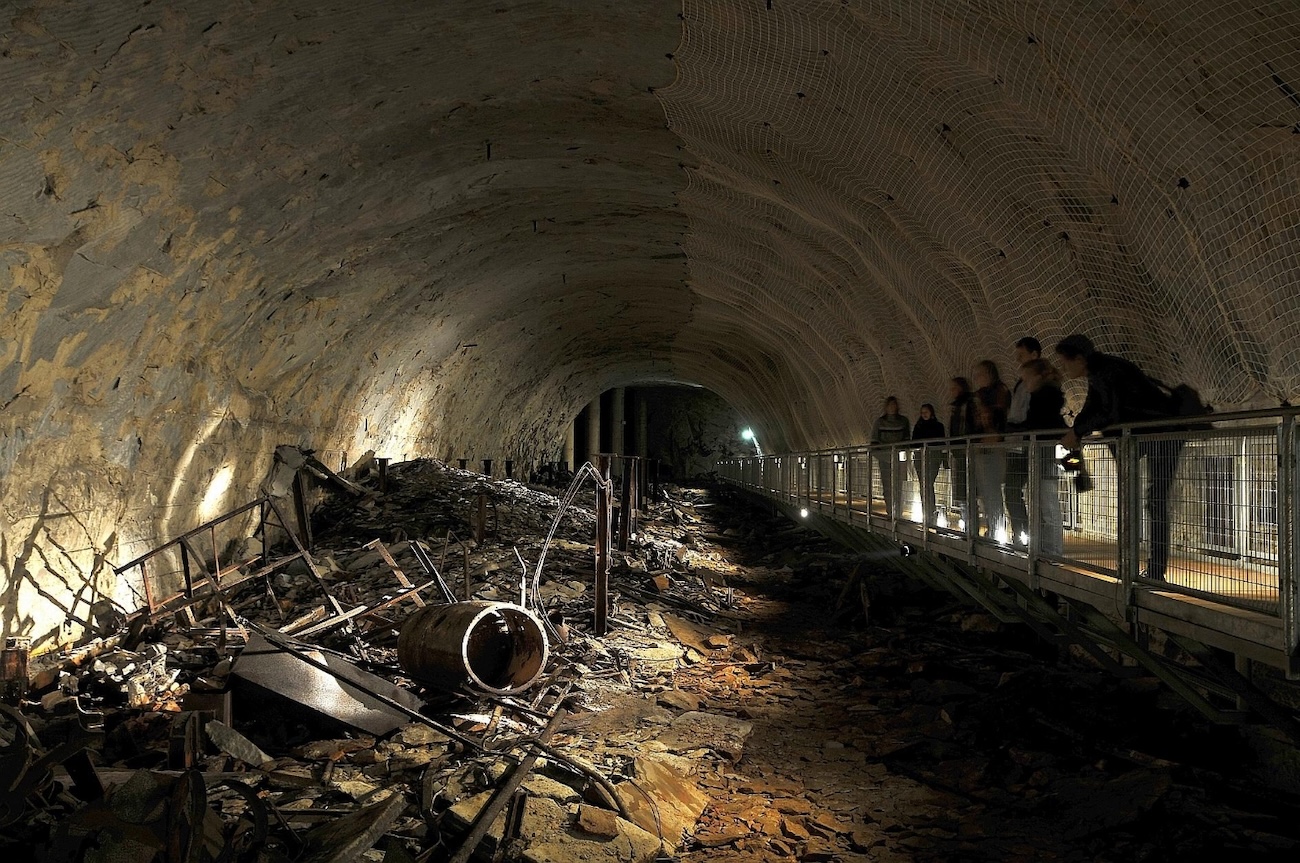
To understand why the German lines held so firmly, one must look beneath the surface. The Chemin des Dames is not solid rock but a limestone ridge filled with ancient quarries known as creutes. The most infamous of these is the Caverne du Dragon (Dragon’s Cave).
While French troops died in the freezing mud above, German soldiers lived in relative comfort below. The Germans had connected the existing quarries to create a vast, subterranean fortress. This underground facility had electric lights, ventilation systems, a hospital, a chapel, and sleeping quarters for hundreds of men. It was immune to even the heaviest French artillery shells.
French and German Soldiers Fighting in the Same Cave System
The fighting here took on a surreal, nightmarish quality. When the French did manage to capture an entrance, the battle moved underground. Men fought with grenades, flamethrowers, and knives in pitch-black tunnels. The air was thick with the smell of cordite, unwashed bodies, and rotting flesh. At one point, French and German troops occupied different parts of the same cave system, separated only by hastily built barricades, listening to each other breathe in the darkness. The Caverne du Dragon represents the industrialization of survival — a hidden city of war that allowed the defenders to outlast the storm above. The same vertical warfare — men fighting in tunnels while the surface burned — defined the Ypres Salient, where British miners and German engineers fought beneath the Messines Ridge in the same months.
The French Army Mutinies of 1917: When the Soldiers Said No
The Psychology of Failure and the Breaking of Trust
By late April, the magnitude of the disaster was impossible to hide. The “48-hour breakthrough” had turned into a weeks-long meat grinder. The hospitals were overwhelmed. Wounded men arrived at the rear stations caked in mud and blood, telling stories of incompetence and slaughter.
French Army morale began to disintegrate. It wasn’t just the high casualties; it was the betrayal. The soldiers had believed Nivelle’s promise. They had agreed to one last, great effort to end the war. Now, they saw that their lives were being thrown away for nothing. The trust between the poilu and his officers — the sacred bond that holds an army together — snapped.
Rumors flew through the ranks: of German spies in the high command, of generals drinking champagne while men died in the wire, of women at home striking for peace. The psychological collapse soldiers experienced was not cowardice; it was a rational reaction to an irrational situation. They were willing to die for France, but they were no longer willing to die for a mistake.
How 54 Divisions Refused to Attack — and the Army Nearly Collapsed
In May 1917, the unimaginable happened: the French Army went on strike. It began sporadically — a battalion refusing to move up to the line, a regiment shouting down its officers. Soon, it spread like wildfire across the front.
It is crucial to understand the nature of this rebellion. The soldiers did not desert to the enemy. They did not abandon the trenches. They simply refused to attack. They would hold the line, they said, to protect their homes and families, but they would not participate in any more suicidal offensives. “We will defend the trenches,” they shouted, “but we will not go over the top!”
Officers were ignored or beaten. Red flags were raised over camps. Councils of soldiers were formed, echoing the Russian Revolution that had begun just months earlier. The “collective indiscipline” involved tens of thousands of troops across nearly half of the French divisions. The High Command was terrified. If the Germans realized the French Army had effectively ceased to function as an offensive force, they could have marched on Paris. It was the most dangerous moment of the war for France.
The Chanson de Craonne: The Banned Song of the French Mutinies
The spirit of the mutinies was captured in a song — a mournful, angry ballad that became the anthem of the doomed. The Chanson de Craonne (Song of Craonne) was set to a popular tune but carried new, subversive lyrics.
It spoke of the misery of the trenches, the exploitation of the poor by the rich, and the certainty of death. The chorus is a haunting farewell: “Adieu la vie, adieu l’amour, / Adieu toutes les femmes. / C’est bien fini, c’est pour toujours, / De cette guerre infâme.” (Goodbye life, goodbye love, / Goodbye to all the women. / It is all over, it is forever, / Of this infamous war.)
The song explicitly attacked the gros — the “big shots” — who profited from the war while the poor died. Officers were ordered to arrest anyone singing it. The government offered a reward for identifying the author, but the author remained anonymous — the voice of the suffering collective. The Chanson de Craonne remains the most powerful artistic expression of the mutinies, a melody heavy with the sorrow of a generation sacrificed on the Ladies’ Path.
How Pétain Restored the French Army After the Mutinies
General Philippe Pétain replaced Nivelle and understood the soldier’s psyche better than any other commander. He knew that the army could not be bullied back into submission; it had to be healed.
Pétain adopted a dual strategy of repression and pragmatism. To restore discipline, he convened courts-martial. Thousands of soldiers were tried, and hundreds were sentenced to death, though only about 49 were actually executed. These executions were intended to be symbolic examples to “encourage the others.”
Pétain also addressed the root causes of the anger. He halted all major offensives, famously stating, “I am waiting for the Americans and the tanks.” He improved the food, ensured regular leave rotations, and ordered better rest camps behind the lines. He visited the troops personally, listening to their grievances. Slowly, sullenly, the army returned to its duty. Pétain saved the French Army, but the trust was never fully restored. The military justice dispensed in 1917 left a scar that would ache for decades — and Pétain’s own reputation would take a far darker turn in 1940, when the hero of the Chemin des Dames became the collaborationist leader of Vichy France.
The Destroyed Villages of the Chemin des Dames and the Zone Rouge
The violence of the artillery bombardment along the ridge was so intense that it erased geography. Villages that had stood for centuries were pulverized into dust. Old Craonne, Ailles, Beaulne-et-Chivy — these names were wiped from the map.
After the war, the French government deemed certain areas too dangerous and too damaged for habitation. The soil was churned with unexploded ordnance, human remains, and chemical residues from gas shells. This was the Zone Rouge (Red Zone).
Some villages were rebuilt nearby. Others were declared mort pour la France (died for France) and never reconstructed. Today, the sites of these destroyed villages are marked only by signs and the unnatural undulations of the ground — mounds that cover the rubble of homes and churches. Walking through the Arboretum of the old Craonne is a ghostly experience; the forest has returned, but beneath the roots lie the cellars and hearths of a vanished community, forever silenced by the guns of 1917. The erasure of these villages mirrors what happened at Oradour-sur-Glane a generation later — a French community frozen in the moment of its destruction, preserved as evidence of what war does to the places where ordinary people lived.
Visiting the Chemin des Dames Battlefields Today
The Caverne du Dragon Museum: What to Expect Underground
For the modern traveler, the descent into the Caverne du Dragon is the most visceral way to connect with the history of the ridge. Now a world-class museum, the site offers a glimpse into the troglodyte existence of the soldiers.
As you step down from the bright sunlight into the limestone quarry, the temperature drops instantly to a damp 12°C (54°F). The silence is heavy. The museum has preserved the space with minimal intrusion. You can still see the soot marks from cooking fires on the ceiling, the rusty remains of weapons, and, most poignantly, the graffiti carved into the soft stone. Names, dates, and prayers left by German and French soldiers alike cover the walls — messages from men who knew they might never see the sun again. The guided tours are essential for understanding the complex layout of the galleries. Plan about 90 minutes.
The Plateau de Californie and the Basque Memorial
Just above the village of Craonne lies the Plateau de Californie, one of the bloodiest sectors of the ridge. Today, it is a place of jarring beauty. An arboretum was planted here to cover the devastated landscape, but the trees cannot hide the shape of the ground. The earth is a chaotic sea of grass-covered mounds and depressions — thousands of shell craters that have softened with time but never disappeared. As you walk the trails, you are walking on the roof of the underworld, over the bones of the unrecovered dead.
A modern observation deck provides a stunning view over the Ailette valley. From here, you can see the steep slopes the French infantry had to climb under fire. Standing sentinel on the ridge nearby is the Monument des Basques, a memorial dedicated to the 36th Infantry Division, largely composed of soldiers from the Basque region of southwest France. The monument is a monolithic stone figure in traditional Basque dress, looking out over the battlefield. It is often shrouded in the mist that clings to the heights. Unlike the grandiose monuments of Verdun, this statue feels personal, almost protective.
The Cerny-en-Laonnois Necropolis: French and German Dead Side by Side
The sheer cost of the Nivelle Offensive is measured in the cemeteries that dot the landscape. The National Necropolis at Cerny-en-Laonnois is the heart of this constellation of death. The French and German cemeteries lie side by side, a powerful symbol of enemies united in death. The French cemetery contains over 5,000 individual graves and ossuaries holding the remains of thousands more unknown soldiers. The rows of white crosses — and stele for Muslim and Jewish soldiers — stretch out in perfect geometric alignment. Just across the road, the German war graves are marked by somber grey crosses.
How to Get to the Chemin des Dames from Paris, Reims, or Laon
The Chemin des Dames is located in the department of Aisne, roughly halfway between Paris and the Belgian border. The easiest access is by car from the cities of Laon or Reims, both about a 30–40 minute drive from the ridge. There is no direct train service to the memorial sites, so a vehicle is essential. Plan for a full day: start at the Caverne du Dragon (allow 2 hours), then drive the length of the Chemin des Dames along the D18CD road, stopping at the Plateau de Californie, the Basque Memorial, and the Cerny-en-Laonnois cemetery. Spring and autumn offer the best weather. The Somme battlefields are roughly two hours north, and Verdun approximately three hours east — a three-site circuit covers the defining battles of the French experience in the First World War.
The ridge remains silent now, but if you listen closely to the wind in the trees of the Plateau de Californie, you can almost hear the faint, ghostly strains of the Song of Craonne, bidding farewell to a world that was lost in the mud of 1917.
FAQ
What happened at the Chemin des Dames in 1917?
On April 16, 1917, the French Army launched the Nivelle Offensive, a massive assault intended to break through the German lines along the Chemin des Dames ridge in the Aisne department of northern France. General Robert Nivelle had promised a decisive breakthrough within 48 hours. The attack failed catastrophically on its first day, producing over 40,000 French casualties as infantry advanced into entrenched German machine-gun positions and fortified cave systems. The offensive continued for weeks with no meaningful gains, eventually producing an estimated 187,000 French casualties. The disaster triggered mutinies across nearly half of the French Army’s divisions, the largest military rebellion in modern French history.
What caused the French Army mutinies of 1917?
The mutinies were a direct consequence of the failed Nivelle Offensive. French soldiers had been promised that the Chemin des Dames attack would end the war. When it produced only mass casualties and no breakthrough, trust between the troops and the high command collapsed. The soldiers did not desert or surrender to the enemy — they refused to participate in further offensive operations while continuing to hold their defensive positions. The rebellion spread to tens of thousands of troops across 54 divisions between May and June 1917. General Philippe Pétain replaced Nivelle, restored discipline through a combination of limited executions and genuine improvements to soldiers’ conditions, and halted major offensives for the remainder of the year.
What is the Caverne du Dragon and can you visit it?
The Caverne du Dragon (Dragon’s Cave) is a large limestone quarry beneath the Chemin des Dames ridge that was used as an underground fortress during the First World War. German troops fortified the cave system with electric lighting, ventilation, a hospital, and sleeping quarters for hundreds of soldiers. At various points during the fighting, French and German troops occupied different sections of the same cave, separated by barricades. Today the site operates as a museum, accessible by guided tour only. Tours run approximately 90 minutes and are available in French, with English tours by advance booking. The site is located along the D18CD road between Laon and Reims.
What is the Chanson de Craonne?
The Chanson de Craonne is a French anti-war song that became the anthem of the 1917 mutinies. Set to a pre-existing popular melody, it carried subversive lyrics attacking the generals and war profiteers while expressing the despair of soldiers who knew they were being sent to die for nothing. The French military authorities banned the song and offered a reward for identifying its anonymous author, who was never found. The song remained officially suppressed until 1974. It is named after the village of Craonne on the Chemin des Dames ridge, which was completely destroyed during the fighting and never rebuilt.
How do you get to the Chemin des Dames battlefields?
The Chemin des Dames ridge is located in the Aisne department of northern France, approximately 150 kilometers northeast of Paris. The nearest cities with rail connections are Laon (30 minutes by car) and Reims (40 minutes). There is no public transport to the battlefield sites, so a car is essential. The main memorial road is the D18CD, which runs the length of the ridge. Key stops include the Caverne du Dragon museum, the Plateau de Californie observation point, the Monument des Basques, and the French-German military cemetery at Cerny-en-Laonnois. A full visit requires a day.
Why is the Chemin des Dames called “The Ladies’ Path”?
The ridge was named in the 18th century after Adélaïde and Victoire, the daughters of King Louis XV. The road along the crest was improved as a scenic route for the princesses to travel between Paris and the Château de la Bove. The contrast between the delicate, aristocratic name and the industrial slaughter that occurred there two centuries later remains one of the most haunting ironies of the First World War.
Sources
- The Nivelle Offensive and the Battle of the Aisne 1917 — Andrew Uffindell, Pen & Sword Military (2015)
- Mutinies 1917: The French Army in Crisis — Leonard V. Smith, Indiana University Press (1994)
- Pétain’s Soldiers: The French Mutinies of 1917 — Leonard V. Smith, in The French Republic: History, Values, Debates (2011)
- The Price of Glory: Verdun 1916 — Alistair Horne, Penguin (1993)
- La Chanson de Craonne: De la chanson palimpseste à la chanson-monument — Guy Marival, in Historial de la Grande Guerre archives (2017)
- Les Tirailleurs Sénégalais: The Ambiguous Heritage of France’s Colonial Soldiers — Joe Lunn, Greenwood Press (1999)
- The Nivelle Offensive — International Encyclopedia of the First World War, 1914-1918-online.net (2014)
- Caverne du Dragon: Guide du Musée du Chemin des Dames — Département de l’Aisne (2019)
- Chemins de Mémoire: Le Chemin des Dames — French Ministry of the Armed Forces (cheminsdememoire.gouv.fr)
- Mémoire des Hommes: Database of Soldiers Died for France — French Ministry of Defence (memoiredeshommes.sga.defense.gouv.fr)
- The First World War — John Keegan, Vintage (2000)
- Volksbund Deutsche Kriegsgräberfürsorge: German War Graves at Cerny-en-Laonnois — Volksbund Records (volksbund.de)